oil temperature GMC SIERRA 1995 Owners Manual
[x] Cancel search | Manufacturer: GMC, Model Year: 1995, Model line: SIERRA, Model: GMC SIERRA 1995Pages: 488, PDF Size: 26.01 MB
Page 14 of 488
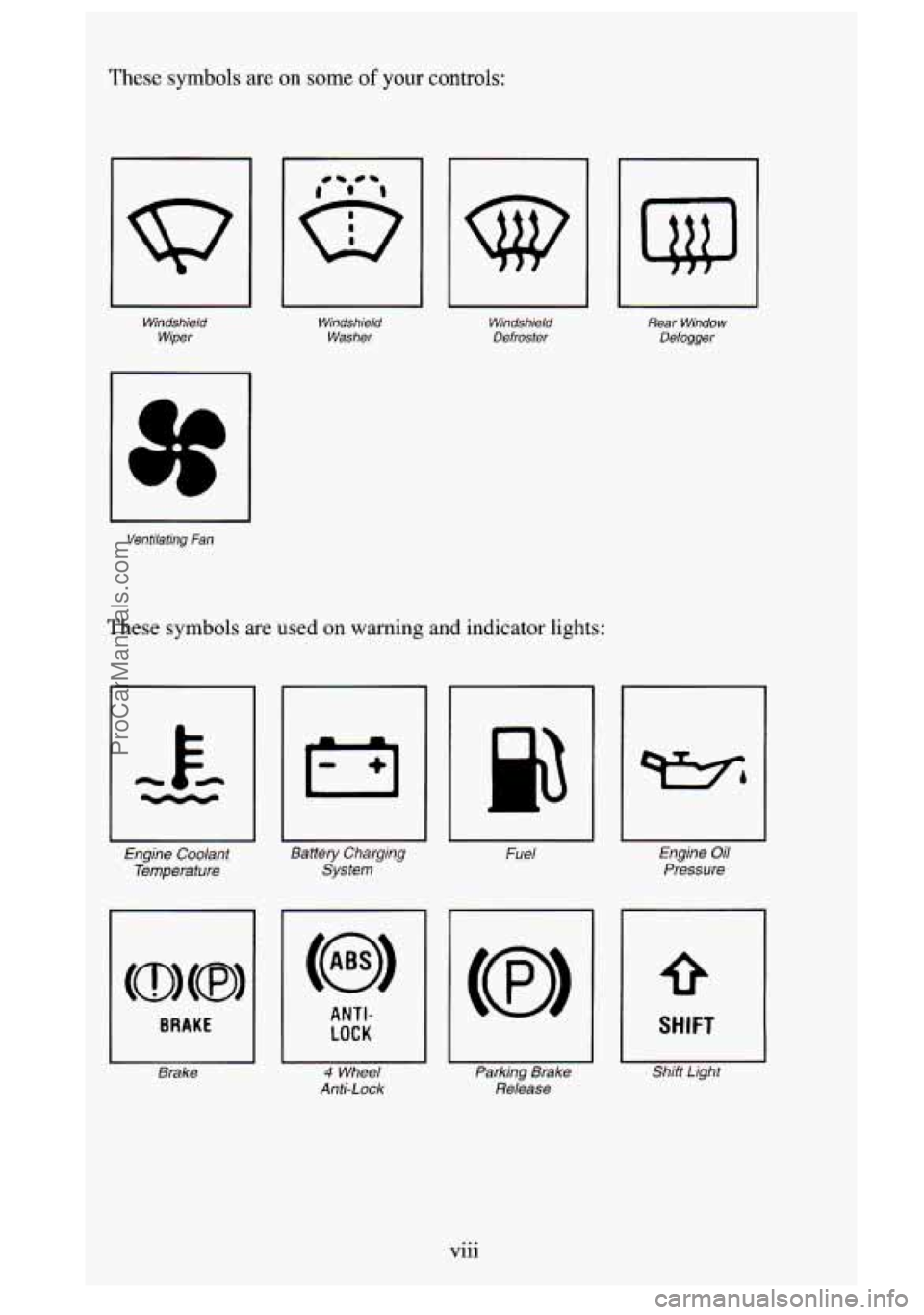
These symbols are on some of your controls:
uu
Windshield Wiper Windshield
Washer
I I
Windshield Defroster
Ventilating Fan
These symbols are used on warning and indicator lights:
Engine Coolant
Temperature
~~
Battery Charging
System
BRAKE
Brake
ANTI-
LOCK
4 Wheel
Anti-Lock
I 1
Rear Window
Defogger
Fuel
Parking Brake
Release
Engine Oil
Pressure
SHIFT
Shift Lighf
Vlll . ..
ProCarManuals.com
Page 78 of 488
NOTICE:
If you’re not in an idling vehicle and the engine overheats, you
wouldn’t be there to see the coolant temperature gage. This
could damage your vehicle. Don’t let your engine run when
you’re not in your vehicle.
Cold Weather Starting (Diesel Engine)
The following tips will help you get good starting in cold weather.
Use
SAE IOW-30 oil when the outside temperature drops below freezing.
When the outside temperature drops below
0°F (-1 floc), use your engine
coolant heater.
If you park your vehicle in a garage, you shouldn’t need to use the coolant
heater until the garage temperature goes below
0°F (-I SOC), no matter how
cold
it is outside.
To use the engine coolant heater, first turn off the engine. Then open the
hood, unwrap the electrical cord and plug it in. It uses normal house voltage
(I 10 volts), but:
A CAUTION:
Plugging the cord into an ungrounded outlet could cause an
electrical shock. Also, the wrong kind of extension cord could
overheat and cause
a fire. You could be seriously injured. Plug
the cord into a properly grounded three-prong 110-volt outlet.
If the cord won’t reach, use a heavy-duty three-prong extension
cord rated for
at least 15 amps.
NOTICE:
After you’ve used the coolant heater, be sure to store the cord in
the manner it was, to help keep it away from moving engine
parts.
If you don’t, it could be torn and damaged.
2-16
ProCarManuals.com
Page 139 of 488
NOTICE:
If you keep driving your vehicle with this light on, after a while
the emission controls
won’t work as well, your fuel economy
won’t
be as good, and your engine may not run as smoothly.
This could lead
to costly repairs not covered by your warranty.
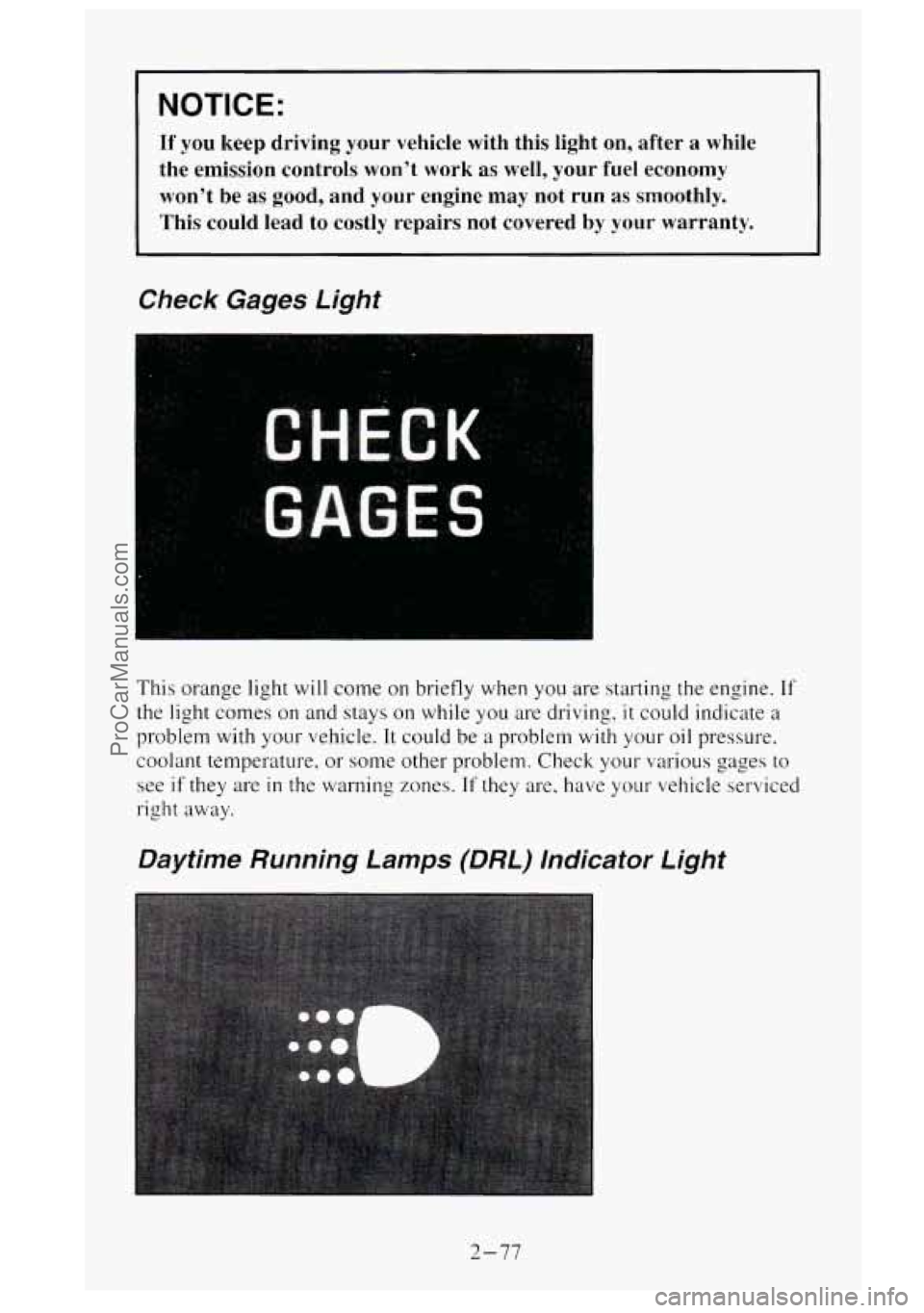
Check Gages Light
This orange light will come on briefly when you are starting the engine. If
the light comes on and stays on while you are driving, it could indicate a
problem with your vehicle.
It could be a problem with your oil pressure.
coolant temperature, or some other problem. Check your various gages
to
see if they are in the warning zones. If they are, have your vehicle serviced
right away.
Daytime Running Lamps (DRL) Indicator Light
2-77
ProCarManuals.com
Page 143 of 488
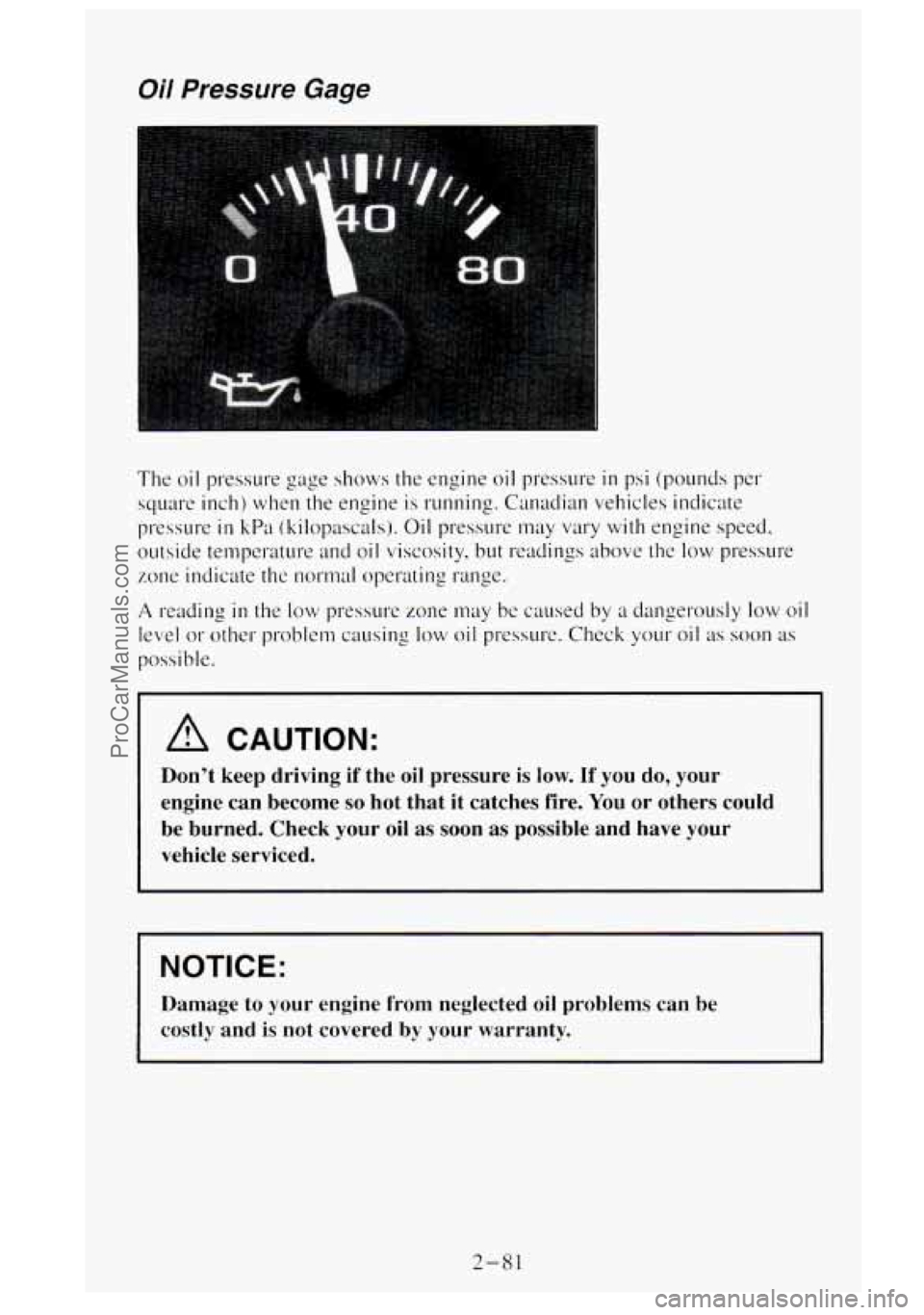
Oil Pressure Gage
The oil pressure gage shows the engine oil pressure in psi (pounds per
square inch) when the engine is running. Canadian vehicles indicate
pressure
in kPa (kilopascals). Oil pressure may vary with engine speed,
outside temperature and oil viscosity, but readings above the
low pressure
zone indicate the norn~al opcrating ranse.
A reading in the low pressure zone may bc caused by a dangemusly low oil
level or other problem causing low oil pressure. Check your oil as soon as
possible.
A CAUTION:
Don’t keep driving if the oil pressure is low. If you do, your
engine can become
so hot that it catches fire. You or others could
be burned. Check your oil
as soon as possible and have your
vehicle serviced.
NOTICE:
Damage to your engine from neglected oil problems can be
costly and is not covered by your warranty.
2-81
ProCarManuals.com
Page 222 of 488
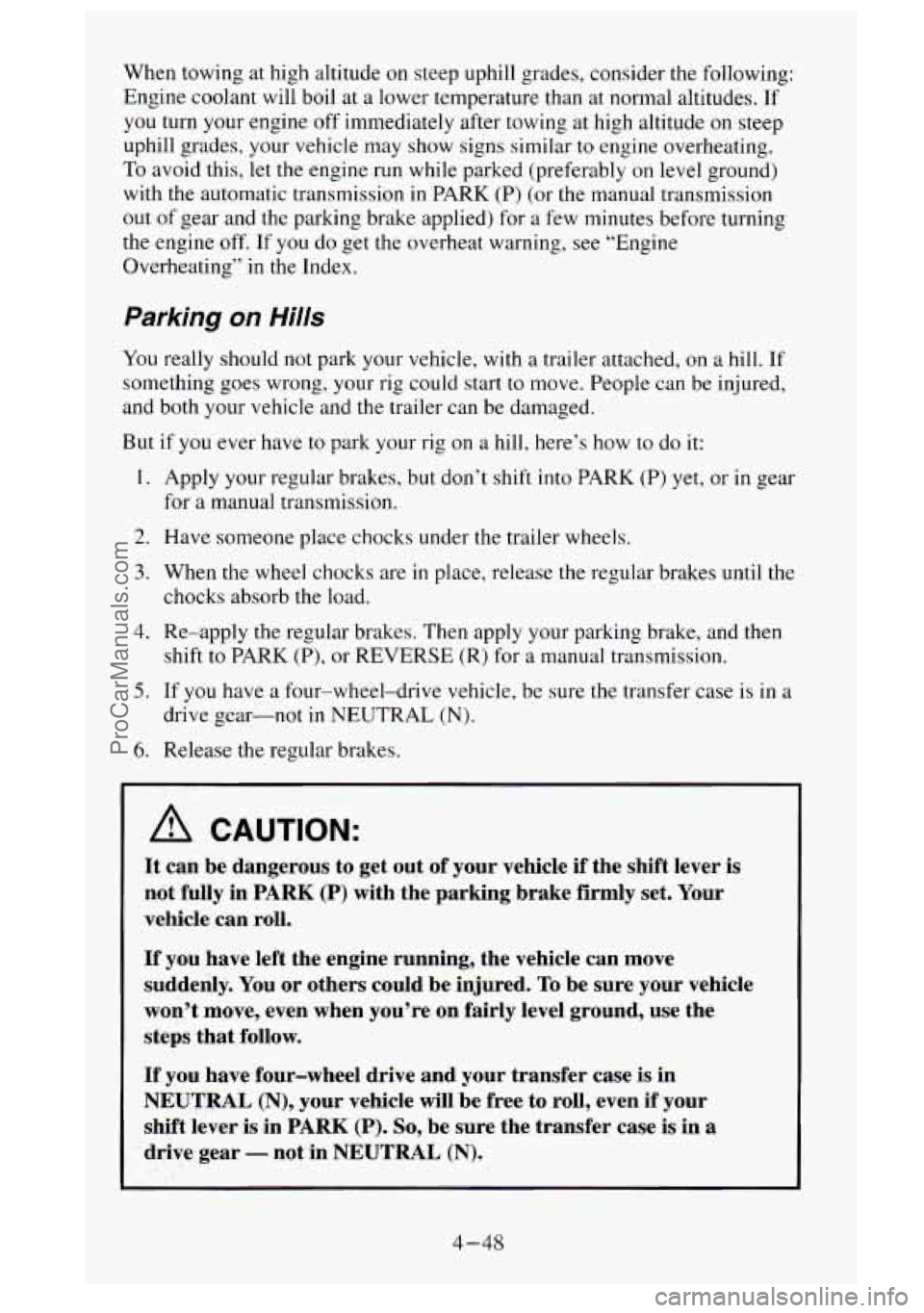
When towing at high altitude on steep uphill grades, consider the following:
Engine coolant will boil at a lower temperature than at normal altitudes. If
you turn your engine off immediately after towing at high altitude on steep
uphill grades, your vehicle
may show signs similar to engine overheating.
To avoid this, let the engine run while parked (preferably on level ground)
with the automatic transmission
in PARK (Pj (or the manual transmission
out
of gear and the parking brake applied) for a few minutes before turning
the engine off.
If you do get the overheat warning, see “Engine
Overheating”
in the Index.
Parking on Hills
You really should not park your vehicle, with a trailer attached, on a hill. If
something goes wrong, your rig could start to move. People can be injured,
and both your vehicle and the trailer can be damaged.
But
if you ever have to park your rig on a hill, here’s how to do it:
1.
2.
3.
4.
5.
6.
Apply your regular brakes, but don’t shift into PARK (P) yet, or in gear
for a manual transmission.
Have someone place chocks under the trailer wheels.
When the wheel chocks are
in place, release the regular brakes until the
chocks absorb the load.
Re-apply the regular brakes. Then apply your parking brake, and then
shift
to PARK (P), or REVERSE (Rj for a manual transmission.
If you have
a four-wheel-drive vehicle, be sure the transfer case is in a
drive gear-not in NEUTRAL
(N).
Release the regular brakes.
A CAUTION:
It can be dangerous to get out of your vehicle if the shift lever is
not fully in
PARK (P) with the parking brake firmly set. Your
vehicle can rofl.
If you have Ieft the engine running, the vehicle can move
suddenly. You or others could be injured.
To be sure your vehicle
won’t move, even when you’re on fairly level ground, use the
steps that follow.
If you have four-wheel drive and your transfer case is in
NEUTRAL (N), your vehicle will be free to roll, even if your
shift lever is in
PARK (P). So, be sure the transfer case is in a
drive gear
- not in NEUTRAL (N).
4-48
ProCarManuals.com
Page 270 of 488
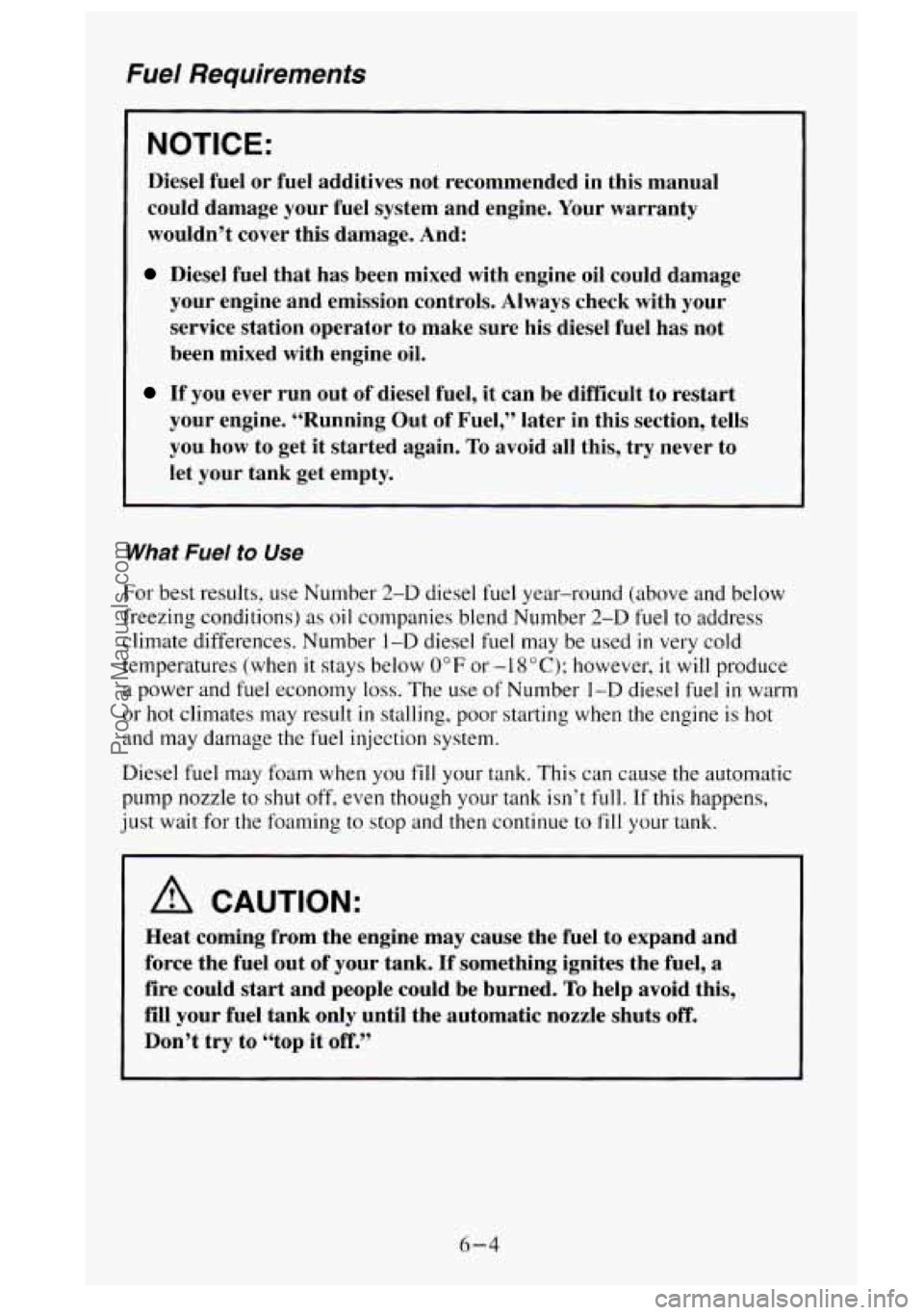
Fuel Requirements
NOTICE:
Diesel fuel or fuel additives not recommended in this manual
could damage your fuel system and engine. Your warranty
wouldn’t cover this damage. And:
Diesel fuel that has been mixed with engine oil could damage
your engine and emission controls. Always check with your
service station operator to make sure his diesel fuel has not \
been mixed with engine oil.
If you ever run out of diesel fuel, it can be difficult to restart
your engine. “Running Out of Fuel,” later in this section, tells
you how to get it started again.
To avoid all this, try never to
let your tank get empty.
What Fuel to Use
For best results, use Number 2-D diesel fuel year-round (above and below
freezing conditionsj as oil companies blend Number
2-D fuel to address
climate differences. Number
1-D diesel fuel may be used in very cold
temperatures (when
it stays below 0°F or -18°C); however, it will produce
a power and fuel economy loss. The use of Number I-D diesel fuel in warm
or hot climates may result in stalling, poor starting when the engine is hot
and
may damage the fuel injection system.
Diesel fuel may foam when you
fill your tank. This can cause the automatic
pump nozzle to shut off, even though your tank isn’t
full. If this happens,
just wait for the foaming to stop and then continue to
fill your tank.
A CAUTION:
Heat coming from the engine may cause the fuel to expand and \
force the fuel out of your tank.
If something ignites the fuel, a
fire could start and people could be burned. To help avoid this,
fill your fuel tank only until the automatic nozzle shuts
off.
Don’t try to “top it off.”
6-4
ProCarManuals.com
Page 271 of 488
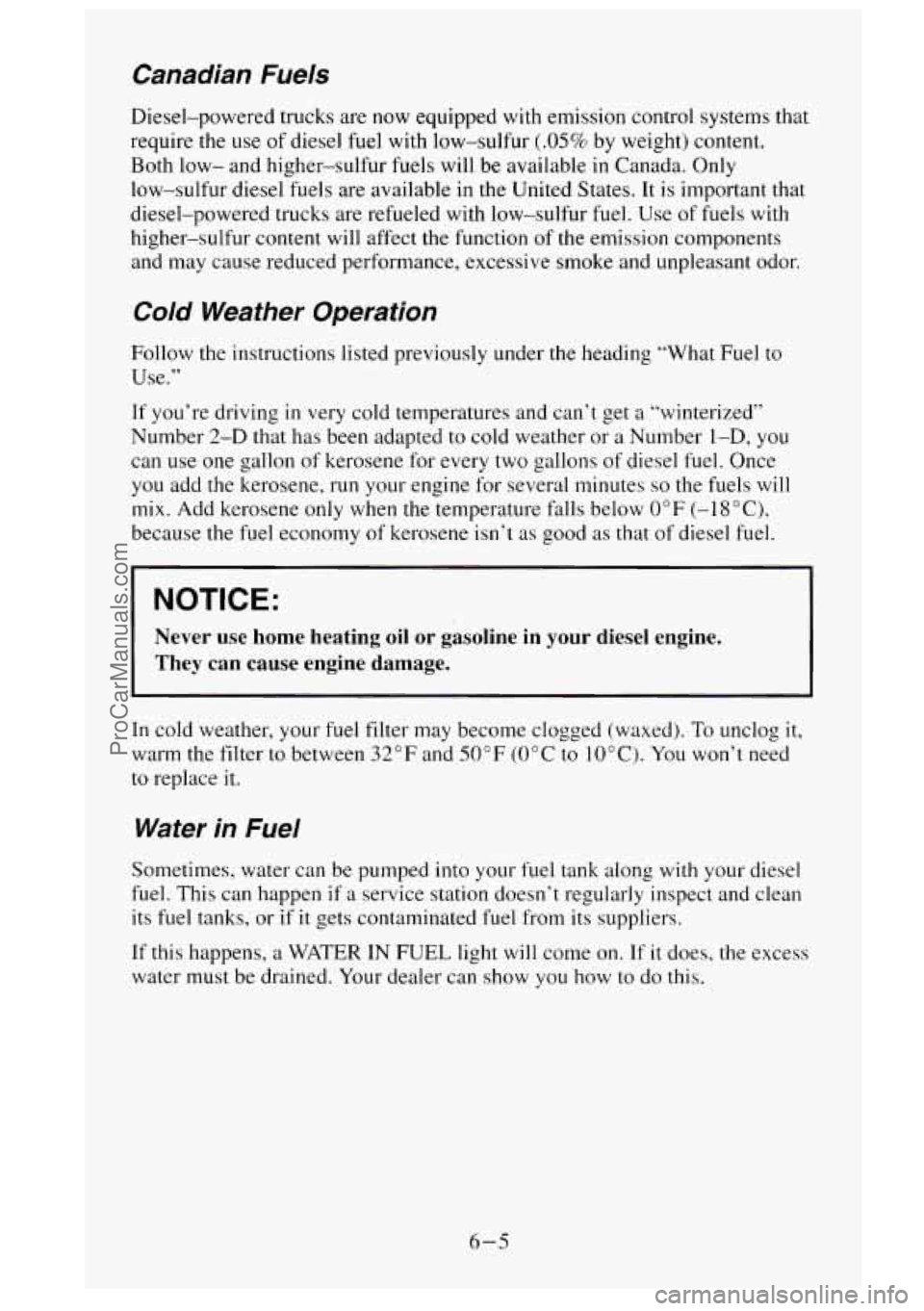
Canadian Fuels
Diesel-powered trucks are now equipped with emission control systems that
require the use of diesel fuel with low-sulfur
(.05% by weight) content.
Both low- and higher-sulfur fuels will be available
in Canada. Only
low-sulfur diesel fuels are available
in the United States. It is important that
diesel-powered trucks are refueled with low-sulfur fuel. Use of fuels with
higher-sulfur content will affect
the function of the emission components
and may cause reduced performance, excessive smoke and unpleasant odor.
Cold Weather Operation
Follow the instructions listed previously under the heading “What Fuel to
Use.”
If you’re driving
in very toold temperatures and can’t get a “winterized”
Number
2-D that has been adapted to cold weather or a Number 1-D, you
can
use one gallon of kerosene for every two gallons of diesel fuel. Once
you add the kerosene, run your engine for several minutes
so the fuels will
mix. Add kerosene only when the temperature falls below 0°F (-1 S”C),
because the fuel economy of kerosene isn’t as good as that of diesel fuel.
NOTICE:
Never use home heating oil or gasoline in your diesel engine. \
They can cause engine damage.
In cold weather, your fuel filter may become clogged (waxed). To unclog it,
warm the filter to between
32°F and 50°F (OOC to 10°C). You won’t need
to replace
it.
Water in Fuel
Sometimes, water can be pumped into your fuel tank along with your diesel
fuel. This can happen
if a service station doesn’t regularly inspect and clean
its fuel tanks, or
if it gets contaminated fuel from its suppliers.
If this happens, a WATER
IN FUEL light will come on. If it does, the excess
water must be drained. Your dealer can show
you how to do this.
6-5
ProCarManuals.com
Page 284 of 488
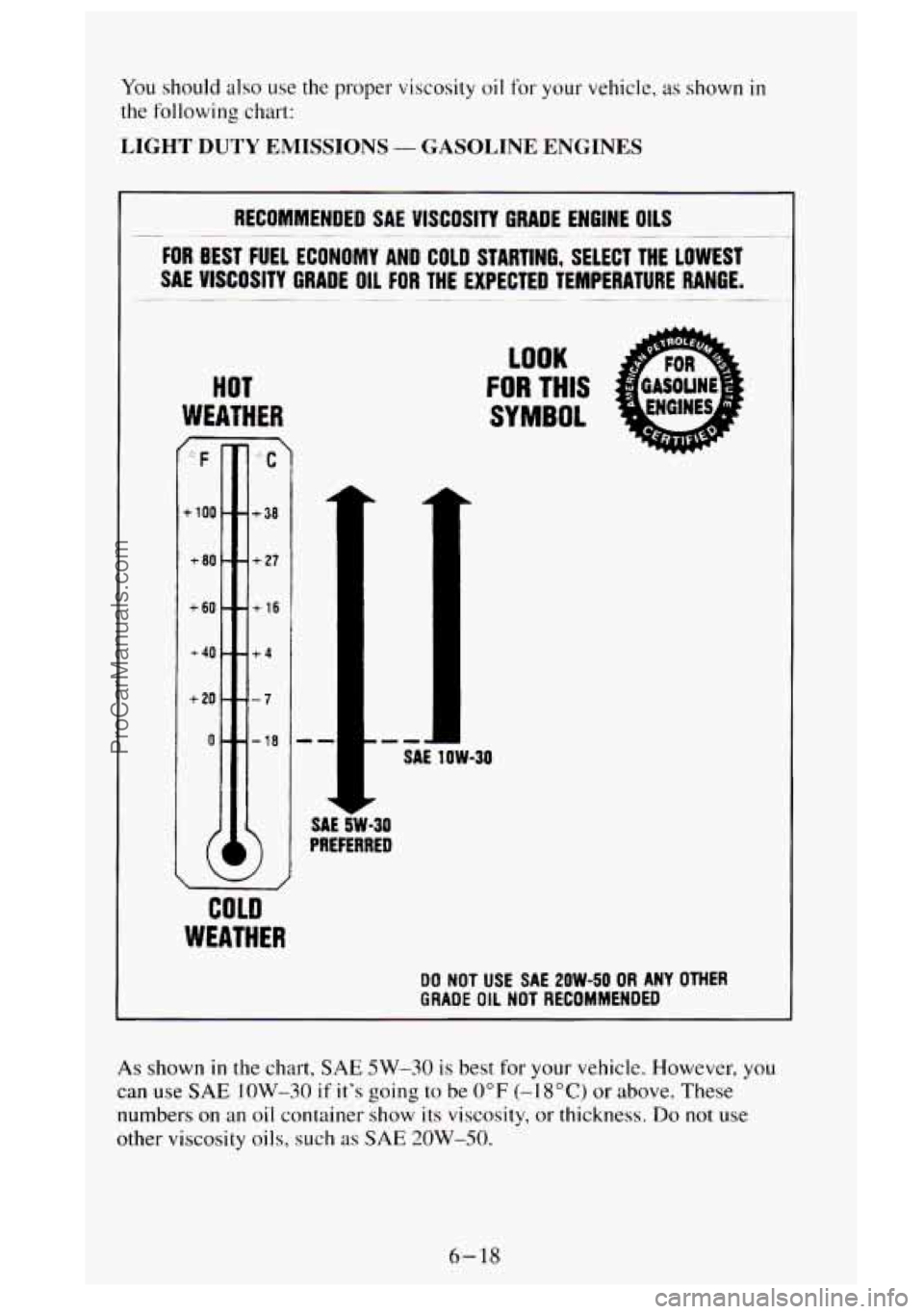
You should also use the proper viscosity oil for your vehicle, as shown in
the following chart:
LIGHT DUTY EMISSIONS - GASOLINE ENGINES
FOR BEST FUEL ECONOMY AND COLD STARTING, SELECT THE LOWEST
SAE VISCOSITY GRADE 011 FOR THE EXPECTED TEMPERATURE RANGE.
HOT
WEATHER
WEATHER
n
c
.
SAE IOW-30
L
LOOK
FOR THIS
SYMBOL
r31.
ip
L c,
SAE SW-30
PREFERRED
DO NOT USE SAE 2OW-50 OR ANY OTHER
GRADE OIL NOT RECOMMENDED
As shown in the chart, SAE 5W-30 is best for your vehicle. However, you
can use SAE IOW-30 if it’s going to be 0°F (-I 8°C) or above. These
numbers on
an oil container show its viscosity, or thickness. Do not use
other viscosity oils, such as
SAE 2OW-SO.
6-18
ProCarManuals.com
Page 285 of 488
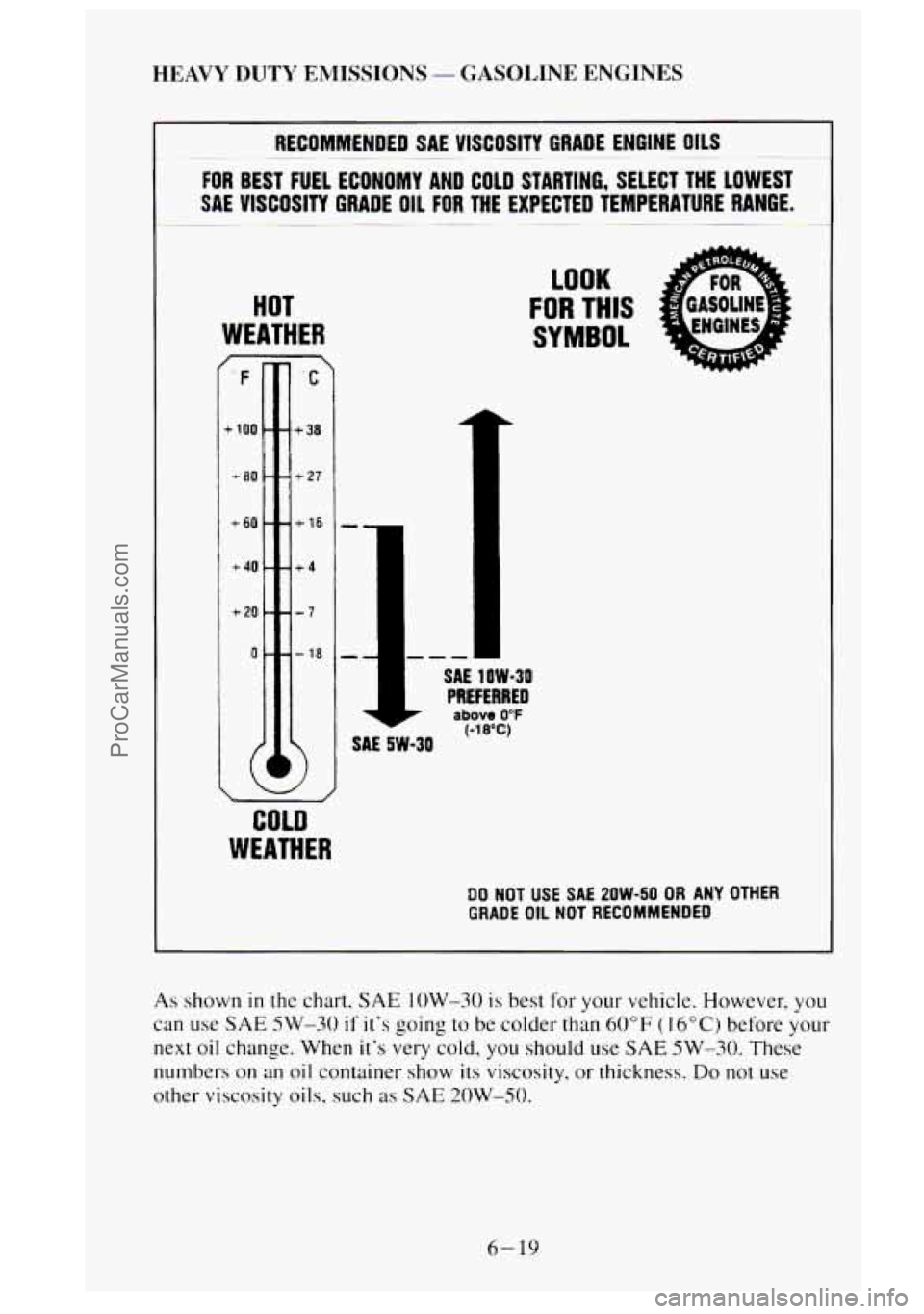
HEAVY DUTY EMISSIONS - GASOLINE ENGINES
RECOMMENDED SAE VISCOSITY GRADE ENGINE OILS ~ ~ ~~~
FOR BEST FUEL ECONOMY AND COLD STARTING, SELECT
THE LOWEST
SAE
VISCOSITY GRADE OIL FOR THE EXPECTED TEMPERATURE RANGE.
HOT
WEATHER
SA€ 5W-30
LOOK
FOR THIS
SYMBOL
SAE 10W-30
PREFERRED
above 0°F (‘1 8°C)
COLD
WEATHER
00 NOT USE SA€ 2OW-50 OR ANY OTHER
GRADE OIL NOT RECOMMENDED
As shown in the chart, SAE 10W-30 is best for your vehicle. However, you
can use SAE SW-30 if it’s going to be colder than 60°F (16°C) before your
next oil change. When it‘s very cold, you should use SAE 5W-30. These
numbers on
an oil container show its viscosity, or thickness. Do not use
other viscosity
oils, such as SAE 2OW-50.
6- 19
ProCarManuals.com
Page 286 of 488

NOTICE:
Use only engine oil with the American Petroleum Institute
Certified For Gasoline Engines “Starburst” symbol. Failure \
to
use the proper oil can result in engine damage not covered
by
your warranty.
GM Goodwrench@ oil (in Canada, GM Engine Oil) meets all the
requirements for your vehicle.
Engine Oil Additives
Don’t add anything to your oil. Your GM dealer is ready to advise if you
think something should be added.
When to Change Engine Oil
See if any one of these is true for you:
Most trips are less than 5 to 10 miles (8 to 16 km). This is particularly
important when outside temperatures are below freezing.
Most trips include extensive idling (such as frequent driving in stop and
go traffic).
Most trips are through dusty areas.
You operate your vehicle in dusty areas or off-road frequently.
You frequently tow a trailer.
If any one
of these is true for your vehicle, then you need to change your oil
and filter every
3,000 miles (5 000 km) or 3 months - whichever comes
first.
Light Duty Emissions:
If none of them is true, change the oil and filter every 7,500 miles (12 500
km) or 12 months - whichever comes first.
Heavy Duty Emissions:
If none of them is true, change the oil and filter every 6,000 miles (10 000
km) or 12 months - whichever comes first.
6-20
ProCarManuals.com