recommended oil GMC SIERRA 1995 Owners Manual
[x] Cancel search | Manufacturer: GMC, Model Year: 1995, Model line: SIERRA, Model: GMC SIERRA 1995Pages: 488, PDF Size: 26.01 MB
Page 81 of 488
NOTICE:
After you’ve used the coolant heater, be sure to store the cord as
it was before to keep
it away from moving engine parts. If you
don’t,
it could be damaged.
How long should you keep the coolant heater plugged in? The answer
depends on the weather, the kind of oil you have. and some other things.
Inste.ad of trying
to list everything here, we ask that you contact your GM
dealer in the area where you‘ll be parking your vehicle. The dealer can give
you the best advice for that particular area.
Automatic Transmission
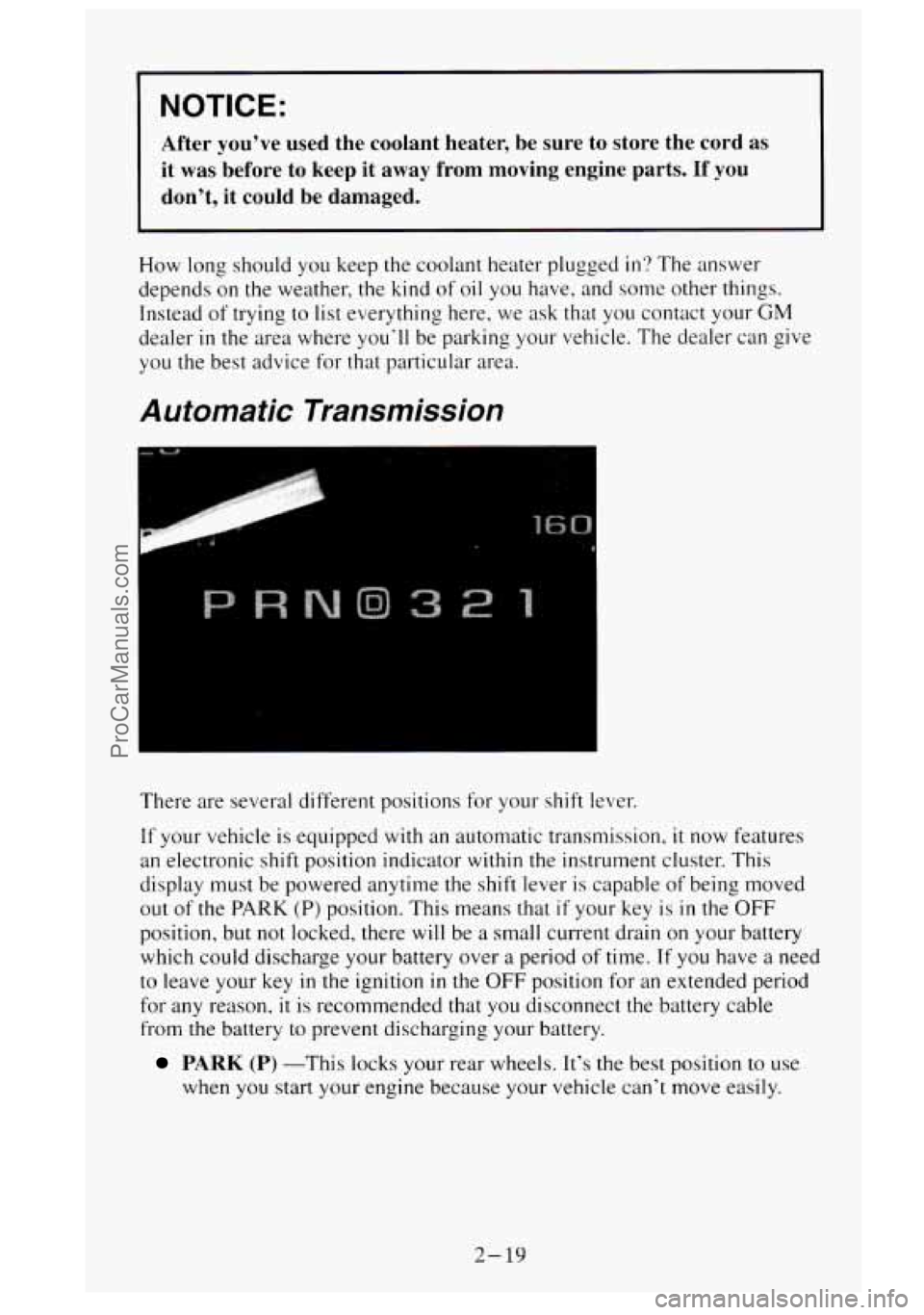
There are several different positions for your shift lever.
If your vehicle is equipped with an automatic transmission, it now features
an electronic shift position indicator
within the instrument cluster. This
display must be powered anytime the shift lever is capable
of being moved
out of the
PARK (P) position. This means that if your key is in the OFF
position, but not locked, there will be a small current drain on your battery
which could discharge your battery over
a period of time. If you have a need
to leave your key
in the ignition in the OFF position for an extended period
for any reason,
it is recommended that you disconnect the battery cable
from the battery to prevent discharging your battery.
PARK (P) -This locks your rear wheels. It’s the best position to use
when you start your engine because your vehicle can’t move easily.
2- 19
ProCarManuals.com
Page 202 of 488
When you want to leave the freeway, move to the proper lane well in
advance. If
you miss your exit do not, under any circumstances, stop and
back up. Drive on
to the next exit.
The exit ramp can be curved, sometimes quite sharply.
The
exit speed is usually posted.
Reduce your speed according to your speedometer, not to your sense
of
motion. After driving for any distance at higher speeds, you may tend to
think you are going slower than you actually are.
Before Leaving on a Long Trip
Make sure you’re ready. Try to be well rested. If you must start when you’re
not fresh
- such as after a day’s work - don’t plan to make too many
miles that first part
of the journey. Wear comfortable clothing and shoes you
can easily drive
in.
Is your vehicle ready for a long trip‘? If you keep it serviced and maintained,
it’s ready to go.
If it needs service, have it done before starting out. Of
course, you’ll find experienced and able service experts
in GM dealers all
across North America. They’ll be ready and willing to help if you need it.
Here are some things you can check before a trip:
0
0
0
0
0
a
0
Windshield Washer Fluid: Is the reservoir full? Are all windows clean
inside and outside?
Wiper Blades: Are they in good shape?
FueZ, Engine Oil, Other Fluids: Have you checked all levels?
Lamps: Are they all working? Are the lenses clean?
Tires: They are vitally important to a safe, trouble-free trip. Is the tread
good enough for long-distance driving? Are
the tires all inflated to the
recommended pressure?
Weather Forecasts: What’s the weather outlook along your route?
Should
you delay your trip a short time to avoid a major storm system?
Maps: Do you have up-to-date maps?
Highway Hypnosis
Is there actually such a condition as “highway hypnosis”? Or is it just plain
falling asleep at the wheel? Call it highway hypnosis, lack of awareness, or
whatever.
There
is something about an easy stretch of road with the same scenery,
along with the
hum of the tires on the road, the drone of the engine, and the
rush
of the wind against the vehicle that can make you sleepy. Don’t let it
happen
to you! If it does, your vehicle can leave the road in less than a
second, and you could crash and be injured.
4-28
ProCarManuals.com
Page 270 of 488
Fuel Requirements
NOTICE:
Diesel fuel or fuel additives not recommended in this manual
could damage your fuel system and engine. Your warranty
wouldn’t cover this damage. And:
Diesel fuel that has been mixed with engine oil could damage
your engine and emission controls. Always check with your
service station operator to make sure his diesel fuel has not \
been mixed with engine oil.
If you ever run out of diesel fuel, it can be difficult to restart
your engine. “Running Out of Fuel,” later in this section, tells
you how to get it started again.
To avoid all this, try never to
let your tank get empty.
What Fuel to Use
For best results, use Number 2-D diesel fuel year-round (above and below
freezing conditionsj as oil companies blend Number
2-D fuel to address
climate differences. Number
1-D diesel fuel may be used in very cold
temperatures (when
it stays below 0°F or -18°C); however, it will produce
a power and fuel economy loss. The use of Number I-D diesel fuel in warm
or hot climates may result in stalling, poor starting when the engine is hot
and
may damage the fuel injection system.
Diesel fuel may foam when you
fill your tank. This can cause the automatic
pump nozzle to shut off, even though your tank isn’t
full. If this happens,
just wait for the foaming to stop and then continue to
fill your tank.
A CAUTION:
Heat coming from the engine may cause the fuel to expand and \
force the fuel out of your tank.
If something ignites the fuel, a
fire could start and people could be burned. To help avoid this,
fill your fuel tank only until the automatic nozzle shuts
off.
Don’t try to “top it off.”
6-4
ProCarManuals.com
Page 284 of 488
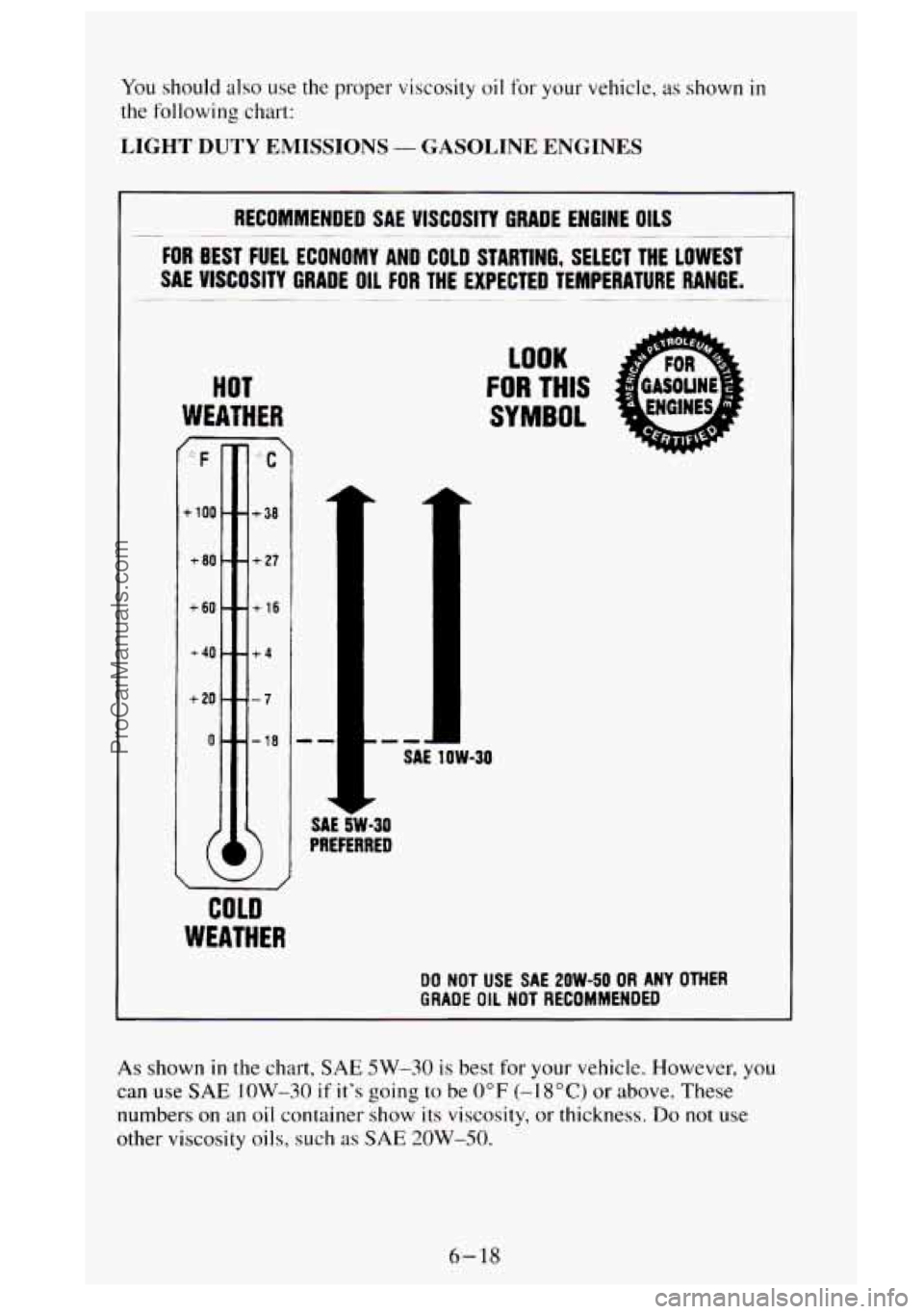
You should also use the proper viscosity oil for your vehicle, as shown in
the following chart:
LIGHT DUTY EMISSIONS - GASOLINE ENGINES
FOR BEST FUEL ECONOMY AND COLD STARTING, SELECT THE LOWEST
SAE VISCOSITY GRADE 011 FOR THE EXPECTED TEMPERATURE RANGE.
HOT
WEATHER
WEATHER
n
c
.
SAE IOW-30
L
LOOK
FOR THIS
SYMBOL
r31.
ip
L c,
SAE SW-30
PREFERRED
DO NOT USE SAE 2OW-50 OR ANY OTHER
GRADE OIL NOT RECOMMENDED
As shown in the chart, SAE 5W-30 is best for your vehicle. However, you
can use SAE IOW-30 if it’s going to be 0°F (-I 8°C) or above. These
numbers on
an oil container show its viscosity, or thickness. Do not use
other viscosity oils, such as
SAE 2OW-SO.
6-18
ProCarManuals.com
Page 285 of 488
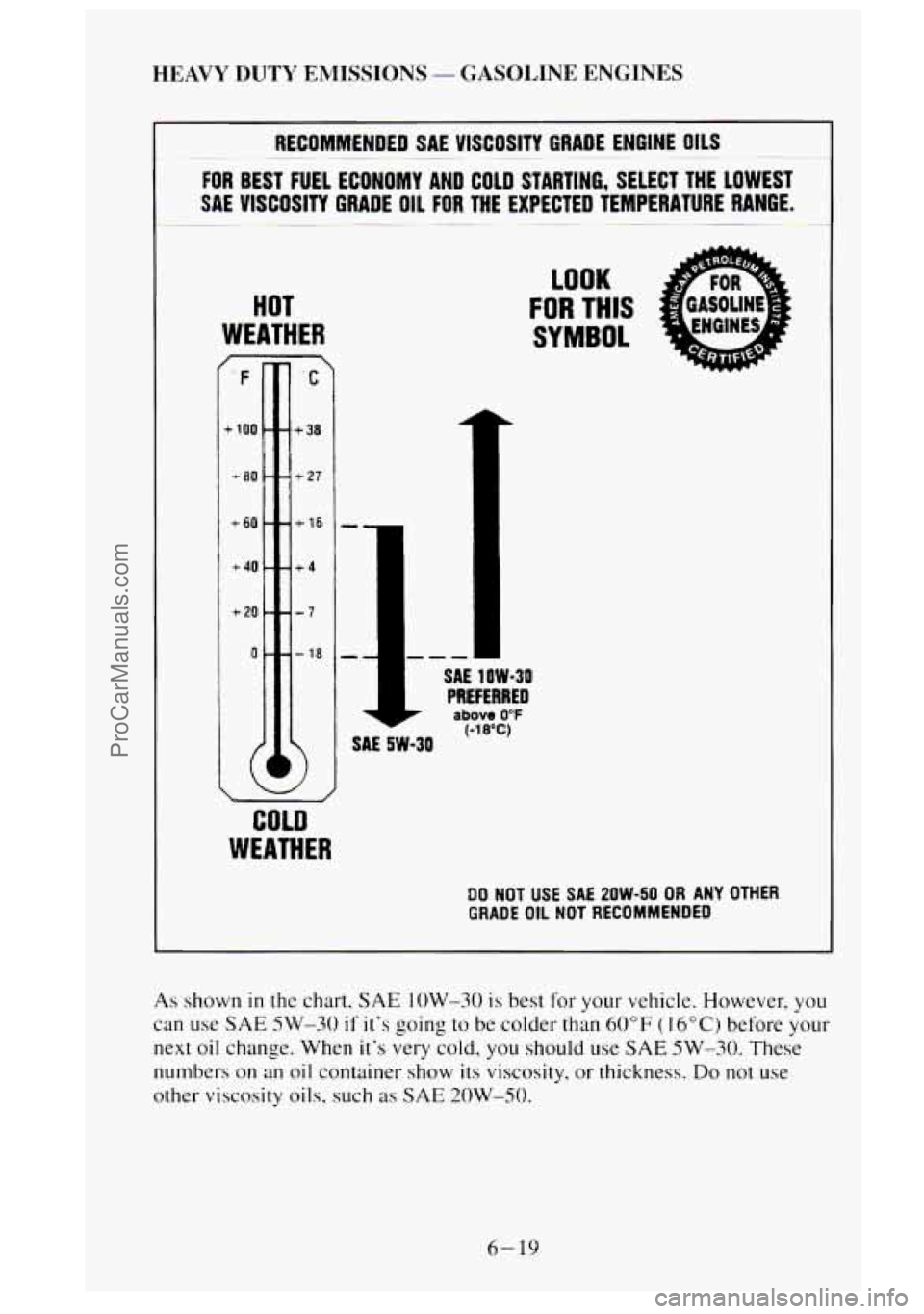
HEAVY DUTY EMISSIONS - GASOLINE ENGINES
RECOMMENDED SAE VISCOSITY GRADE ENGINE OILS ~ ~ ~~~
FOR BEST FUEL ECONOMY AND COLD STARTING, SELECT
THE LOWEST
SAE
VISCOSITY GRADE OIL FOR THE EXPECTED TEMPERATURE RANGE.
HOT
WEATHER
SA€ 5W-30
LOOK
FOR THIS
SYMBOL
SAE 10W-30
PREFERRED
above 0°F (‘1 8°C)
COLD
WEATHER
00 NOT USE SA€ 2OW-50 OR ANY OTHER
GRADE OIL NOT RECOMMENDED
As shown in the chart, SAE 10W-30 is best for your vehicle. However, you
can use SAE SW-30 if it’s going to be colder than 60°F (16°C) before your
next oil change. When it‘s very cold, you should use SAE 5W-30. These
numbers on
an oil container show its viscosity, or thickness. Do not use
other viscosity
oils, such as SAE 2OW-50.
6- 19
ProCarManuals.com
Page 290 of 488
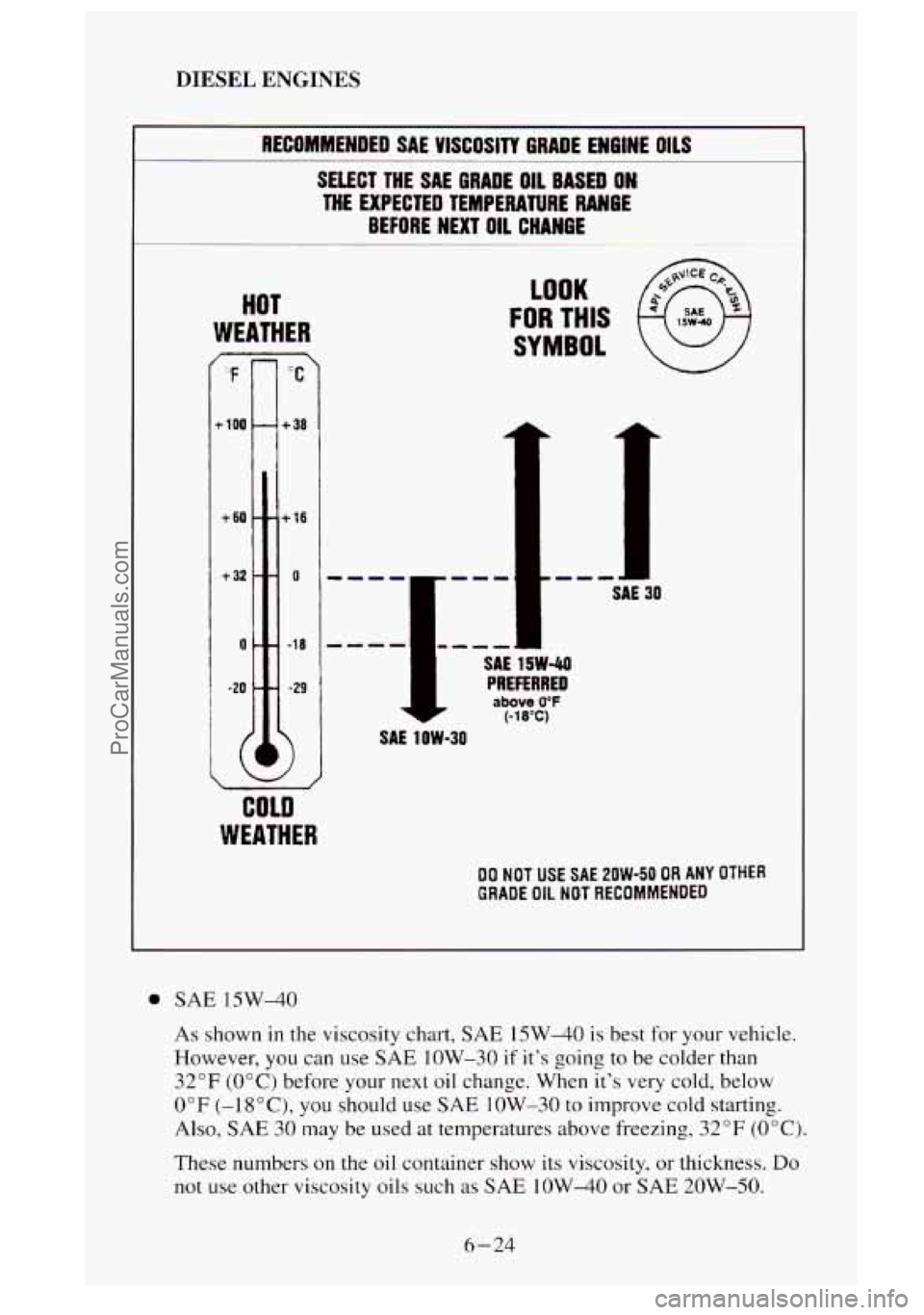
DIESEL ENGINES
RECOMMENDED SAE VISCOSITY GRADE ENGINE OILS
SELECT THE SAE GRADE OIL BASE0 ON
THE EXPECTED TEMPERATURE RANGE
BEFORE NEXT OIL CHANGE
HOT
WEATHER r
:' F
I- 100
+ 60
+ 32
0
-20
- -
-
- -+16
-3 0
- - -16
- - -29
1 +
/c3'
FOR LOOK THIS @
SYMBOL
SAE 1OW-30
- SAE J 30
SAE 15W4
PREFERRED
above 0°F (-1 8°C)
WEATHER
00 NOT USE SAE 2OW-50 OR ANY OTHER
GRADE OIL NOT RECOMMENDED
a SAE 15W-40
As shown in the viscosity chart, SAE 15W-40 is best for your vehicle.
However, you can use
SAE IOW-30 if it's going to be colder than
32°F (0°C) before your next oil change. When it's very cold, below
0°F (-18"C), you should use SAE low-30 to improve cold starting.
Also, SAE 30 may be used at temperatures above freezing, 32°F (0°C).
These numbers on the
oil container show its viscosity, or thickness. Do
not use other viscosity oils such as SAE 10W-40 or SAE 20W-50.
6-24
ProCarManuals.com
Page 296 of 488
How to Add Fluid
Refer to the Maintenance Schedule to determine what kind of transmission
fluid
to use. See “Recommended Fluids and Lubricants” in the Index.
Add fluid only after checking the transmission fluid
HOT. (A COLD check
is used
only as a reference.) If the fluid level is low, add only enough of the
proper fluid to bring the level up
to the HOT area for a hot check. It doesn’t
take much fluid, generally less than a
int. Don ’t overfill. We recommend
you use only fluid labeled DEXRON
-111, because fluid with that label is
made especially for your automatic transmission. Damage caused by fluid
other than DEXRON@-I11 is not covered by your
new vehicle warranty.
8
0 After adding fluid, recheck the fluid level as described under “How to
Check.”
0 When the correct fluid level is obtained, push the dipstick back in all
the way; then flip the handle down
to lock the dipstick in place.
Manual Transmission Fluid
When to Check
A good time to have it checked is when the engine oil is changed. However,
the fluid
in your manual transmission doesn’t require changing.
How to Check
Because this operation can be a little difficult, you may choose to have this.
done at your
GM dealer Service Department.
If you do it yourself, be sure to follow all the instructions here, or you could
get a false reading.
NOTICE:
Too much or too little fluid can damage your transmission. Too
much can mean that some of the fluid could come out and fall on
hot engine parts or exhaust system parts, starting a fire.
Be sure
to get an accurate reading if you check your transmission fluid.
Check the fluid level only when your engine is off, the vehicle is parked on
a level place and the transmission is cool enough for you to rest your fingers
on the transmission case.
6-30
ProCarManuals.com
Page 301 of 488
If the differential is at operating temperature (warm), add enough lubricant
to raise the level to the bottom
of the filler plug hole.
If the differential is cold, add enough lubricant to raise the level to
1/2 inch
( 12 mm) below the filler plug hole.
What to Use
Refer to the Maintenance Schedule to determine what kind of lubricant to
use. See “Recommended Fluids and Lubricants” in the Index.
Engine Coolant
The following explains your cooling system and how to add coolant when it
is low. If you have a problem with engine overheating, see “Engine
Overheating”
in the Index.
The proper coolant for your vehicle will:
Give freezing protection down to -34°F (-37°C).
0 Give boiling protection up to 262°F (128°C).
Protect against rust and corrosion.
Help keep the proper engine temperature.
Let the warning gages work as they should.
What to Use
Use a mixture of one-half cleun water (preferably distilled) and one-half
antifreeze that meets “GM Specification 6038-M,” which won’t damage
aluminum parts.
You can also use a recycled coolant conforming to “GM
Specification 6038-M.” Use GM Coolant Supplement (Sealer) with a
complete coolant flush and refill. If you use this mixture. you don’t need to
add anything else.
A CAUTION:
Adding only plain water to your cooling system can be
dangerous. Plain water, or some other liquid like alcohol, can
boil before the proper coolant mix will. Your vehicle’s coolant
warning system
is set for the proper coolant mix. With plain
water or the wrong mix, your engine could get too hot but
you
wouldn’t get the overheat warning. Your engine could catch fire
and you or others could be burned. Use
a 50/50 mix of clean
water and
a proper antifreeze.
6-35
ProCarManuals.com
Page 312 of 488
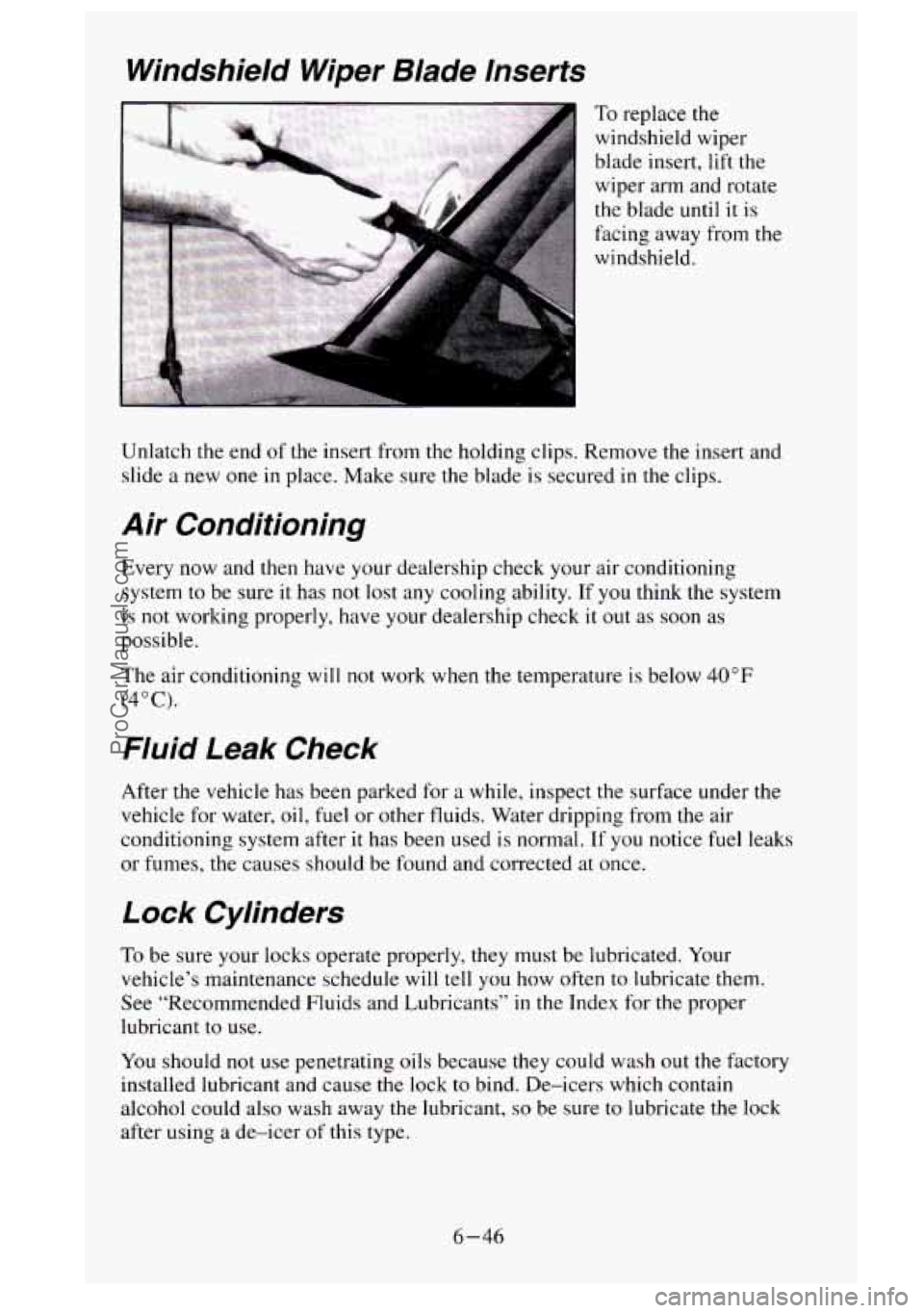
Windshield Wiper Blade Inserts
To replace the
windshield wiper
blade insert, lift
the
wiper arm and rotate
the blade until
it is
facing away from the
windshield.
Unlatch the end
of the insert from the holding clips. Remove the insert and
slide
a new one in place. Make sure the blade is secured in the clips.
Air Conditioning
Every now and then have your dealership check your air conditioning
system to be sure it
has not lost any cooling ability. If you think the system
is not working properly, have your dealership check it out as soon as
possi bleb
The air conditioning will
not work when the temperature is below 40°F
(4°C).
Fluid Leak Check
After the vehicle has been parked for a while, inspect the surface under the
vehicle for water, oil, fuel
or other fluids. Water dripping from the air
conditioning system after it has been used is normal.
If you notice fuel leaks
or fumes, the causes should be found and corrected at once.
Lock Cylinders
To be sure your locks operate properly, they must be lubricated. Your
vehicle’s maintenance schedule will tell you how often to lubricate them.
See “Recommended Fluids and Lubricants” in the Index for
the proper
lubricant to use.
You should
not use penetrating oils because they could wash out the factory
installed lubricant and cause
the lock to bind. De-icers which contain
alcohol could also
wash away the lubricant, so be sure to lubricate the lock
after using
a de-icer of this type.
6-46
ProCarManuals.com
Page 339 of 488
Protecting Exterior Bright Metal Parts
Bright metal parts should be cleaned regularly to keep their luster. Washing
with water is all that is usually needed. However, you may use
GM Chrome
Polish on chrome or stainless steel trim, if necessary.
Use special care with aluminum trim.
To avoid damaging protective trim,
never use auto or chrome polish, steam or caustic soap to clean aluminum.
A coating of wax, rubbed to high polish, is recommended for all bright
metal parts.
Aluminum Wheels (If So Equipped)
Your aluminum wheels have a protective coating similar to the painted
surface of your vehicle. Don’t use strong soaps, chemicals, chrome polish,
abrasive cleaners or abrasive cleaning brushes
on them because you could
damage this coating. After rinsing thoroughly, a wax may be applied.
I NOTICE:
If you have aluminum wheels, don’t use an automatic car wash
that has hard silicon carbide cleaning brushes. These brushes can take the protective coating
off your aluminum wheels.
Tires
To clean your tires, use a stiff brush with a tire cleaner.
When applying a tire dressing always take care to wipe off any overspray or
splash from painted surfaces. Petroleum-based products may damage the
paint finish.
Sheet Metal Damage
If your vehicle is damaged and requires sheet metal repair or replacement,
make sure the body repair shop applies anti-corrosion material to the parts
repaired or replaced to restore corrosion protection.
Foreign Material
Calcium chloride and other salts, ice melting agents, road oil and tar, tree
sap, bird droppings, chemicals from industrial chimneys, and other foreign \
matter can damage your vehicle’s finish if they remain on painted surfaces.
Use cleaners that are marked safe for painted surfaces to remove foreign
matter.
6.- 73
ProCarManuals.com