warning light GMC SIERRA 1995 Owners Manual
[x] Cancel search | Manufacturer: GMC, Model Year: 1995, Model line: SIERRA, Model: GMC SIERRA 1995Pages: 488, PDF Size: 26.01 MB
Page 13 of 488
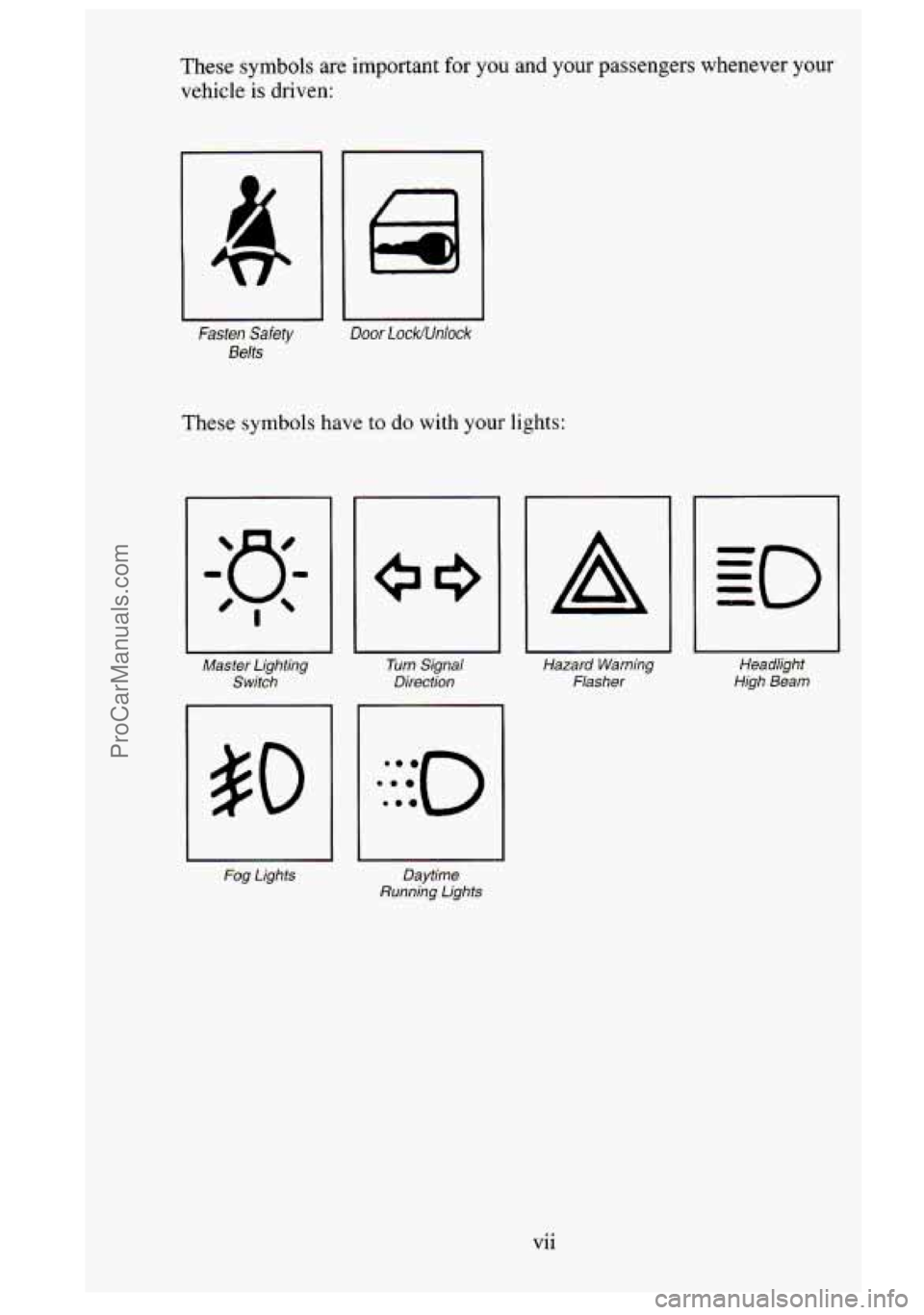
These symbols are important for you and your passengers whenever your
vehicle is driven:
~~ ~
Fasten Safety Door Lock/Unlock
Belts
These symbols have to do with your lights:
Master Lighting
Switch Turn
Signal
Direction
Fog Lights Daytime
Running Lights
A
I
Hazard Warning
Flasher Headlight
High Beam
vii
ProCarManuals.com
Page 14 of 488
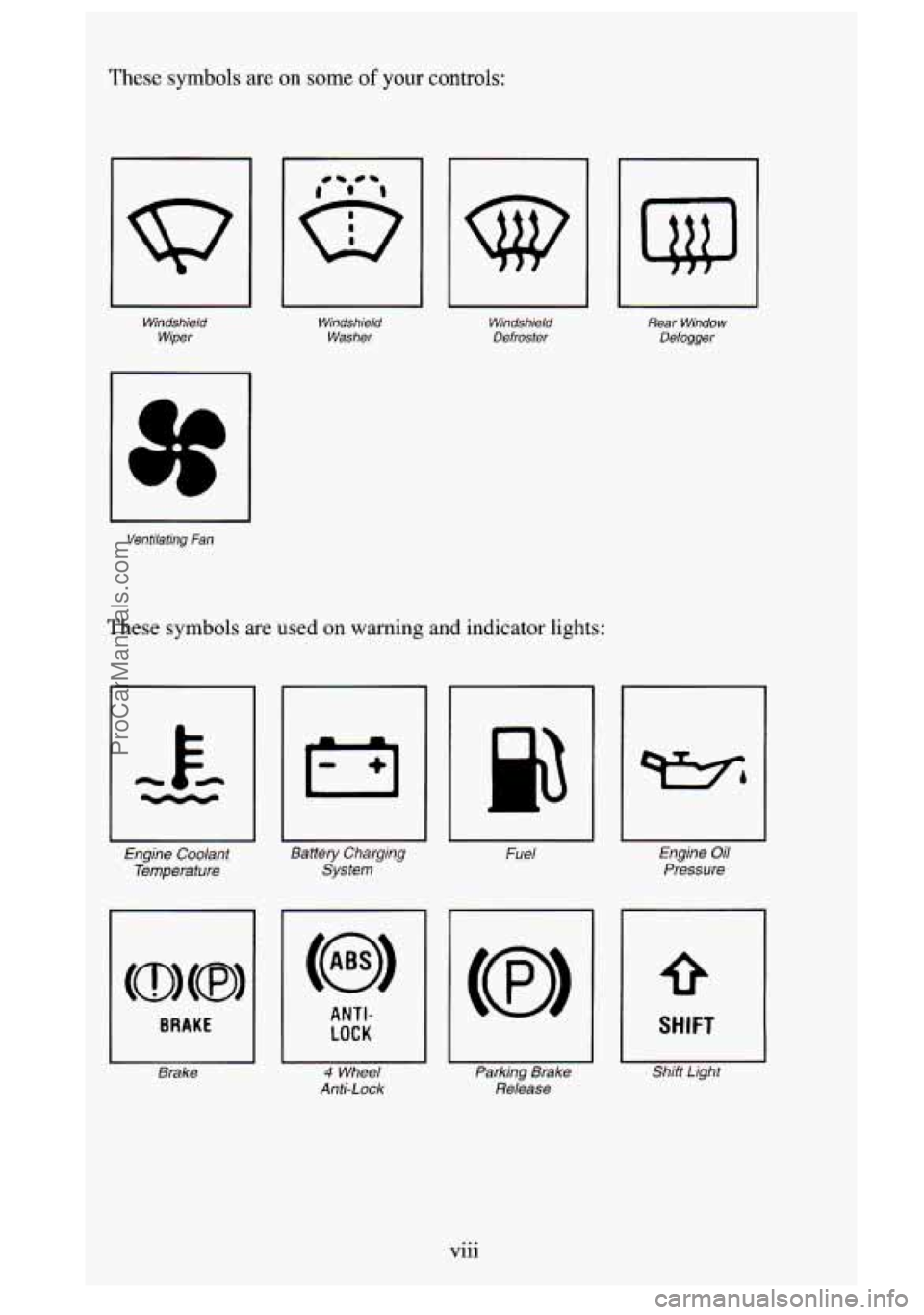
These symbols are on some of your controls:
uu
Windshield Wiper Windshield
Washer
I I
Windshield Defroster
Ventilating Fan
These symbols are used on warning and indicator lights:
Engine Coolant
Temperature
~~
Battery Charging
System
BRAKE
Brake
ANTI-
LOCK
4 Wheel
Anti-Lock
I 1
Rear Window
Defogger
Fuel
Parking Brake
Release
Engine Oil
Pressure
SHIFT
Shift Lighf
Vlll . ..
ProCarManuals.com
Page 89 of 488
Locking Rear Axle
If you have this feature. your rear axle can give you additional traction on
snow, mud, ice, sand or gravel. It works like a standard axle most
of the
time. but when one
of the rear wheels has no traction and the other does, the
locking feature will allow the wheel with traction to move the vehicle.
Parking Brake
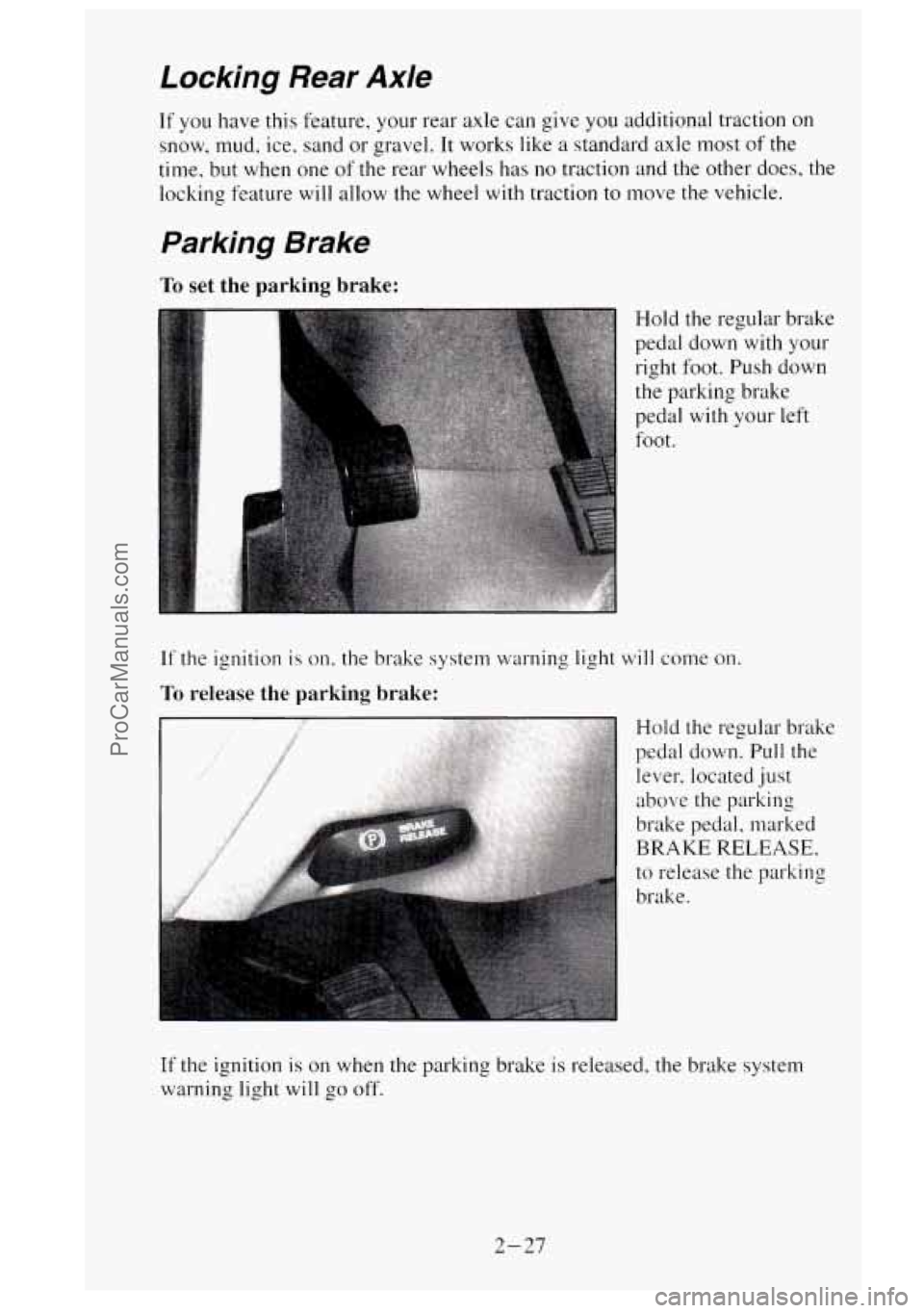
To set the parking brake:
Hold the regular brake
pedal down with your
right foot. Push down
the parking brake
pedal with your left
foot.
If the ignition is on. the brake system warning light will come on.
To release the parking brake:
Hold the regular brake
pedal down. Pull the
lever. located just
above the parking
brake pedal, marked
BRAKE RELEASE,
to release the parking
brake.
If the ignition is on when the parking brake is released, the brake system
warning light will go off.
2-27
ProCarManuals.com
Page 132 of 488
.
1 NOTICE:
Do not operate the engine with the tachometer in the red area\
,
your engine")
Tachometer
. :i
Your tachometer
displays the engine
speed
in revolutions
per minute (rpm).
1 NOTICE:
Do not operate the engine with the tachometer in the red area\
,
your engine
or other parts could be damaged.
Damage to your engine or vehicle caused
by operating the
engine
in the red area isn’t covered by your vehicle warranty.
Warning Lights and Indicators
This part describes the warning lights and gages that may be on your
vehicle. The pictures will help you locate them.
Warning lights and gages can signal that something is wrong before
it
becomes serious enough to cause an expensive repair or replacement.
Paying attention to your warning lights and gages could also save you or
others from injury.
Warning lights come on when there may be or is a problem
with one of your
vehicle’s functions.
As you will see in the details on the next few pages,
some warning lights come on briefly when you start the engine just
to let
you know they’re working. If you are familiar
with this section, you should
not be alarmed when
this happens.
Gages can indicate when there may be or is a problem with one of your
vehicle’s functions. Often gages and warning lights work together to let you
know when there’s
a problem with your vehicle.
When one
of the warning lights comes on and stays on when you are
driving, or when one
of the gages shows there may be a problem, check the
section that tells you what
to do about it. Please follow this manual‘s advice.
Waiting to
do repairs can be costly - and even dangerous. So please get to
know your warning lights and gages. They’re a big help.
2-70
ProCarManuals.com
Page 134 of 488
You will see this light flash for a few seconds when you turn your ignition
to
RUN or START. Then the light should go out. This means the system is
ready.
If the air bag readiness light doesn’t come on when you start your vehicle,
or stays on, or comes on when you are driving, your air bag system may not
work properly. Have your vehicle serviced right away.
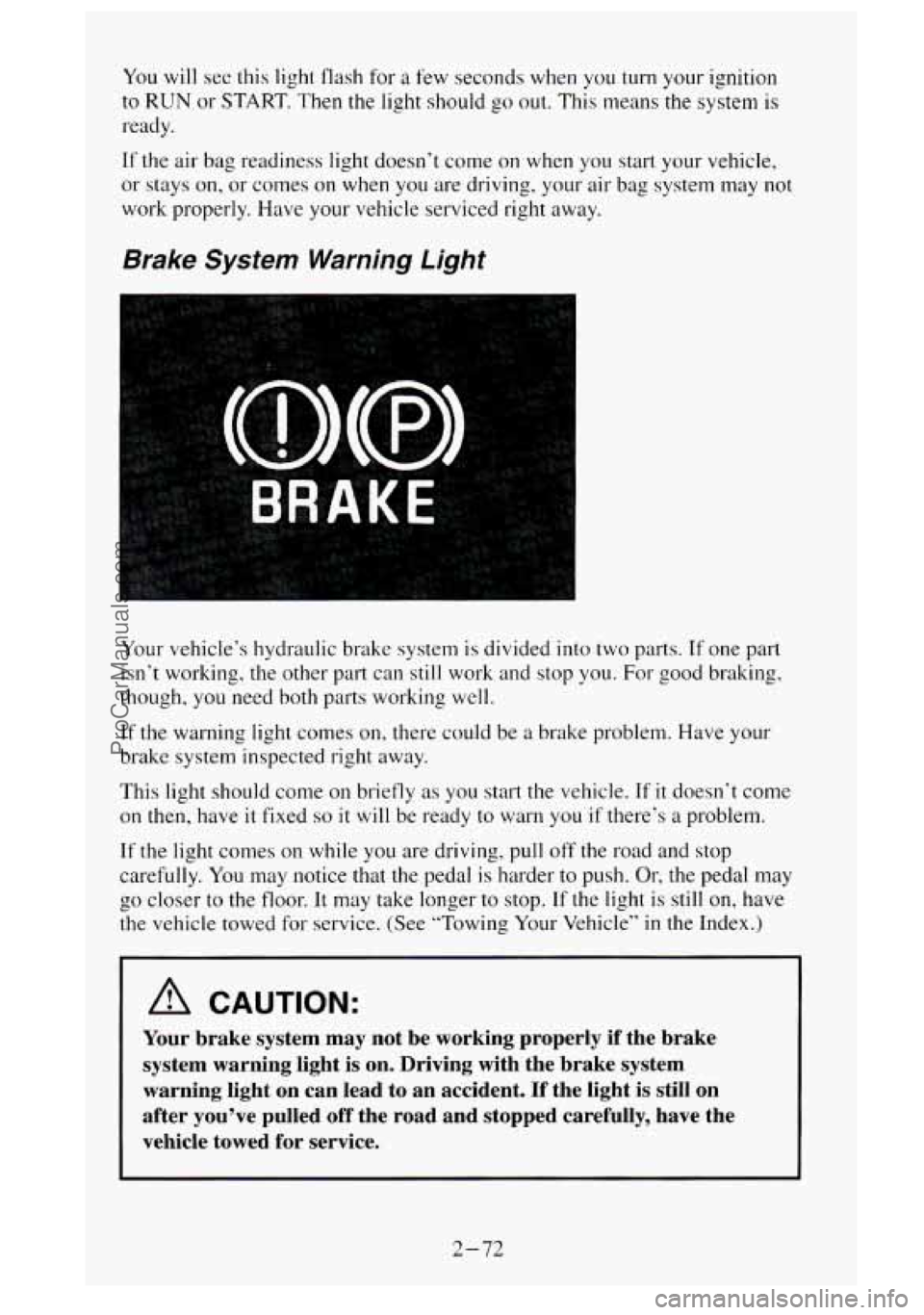
Brake System Warning Light
Your vehicle‘s hydraulic brake system is divided into two parts. If one part
isn’t working, the other part can still work and stop you.
For good braking,
though, you need both parts working well.
If the warning light comes on, there could be a brake problem. Have your
brake system inspected right away.
This light should come
on briefly as you start the vehicle. If it doesn‘t come
on
then, have it fixed so it will be ready to warn you if there’s a problem.
If the light comes on while you are driving, pull off the road and stop
carefully. You may notice that the pedal is harder to push.
Or, the pedal may
the vehicle towed for service. (See “Towing
Your Vehicle’’ in the Index.)
b 00 closer to the floor. It may take longer to stop. If the light is still on, have
A CAUTION:
Your brake system may not be working properly if the brake
system warning light is on. Driving with the brake system
warning light on can lead to an accident. If the light is st\
ill on
after you’ve pulled off the road and stopped carefully, have\
the
vehicle towed for service.
2-72
ProCarManuals.com
Page 135 of 488
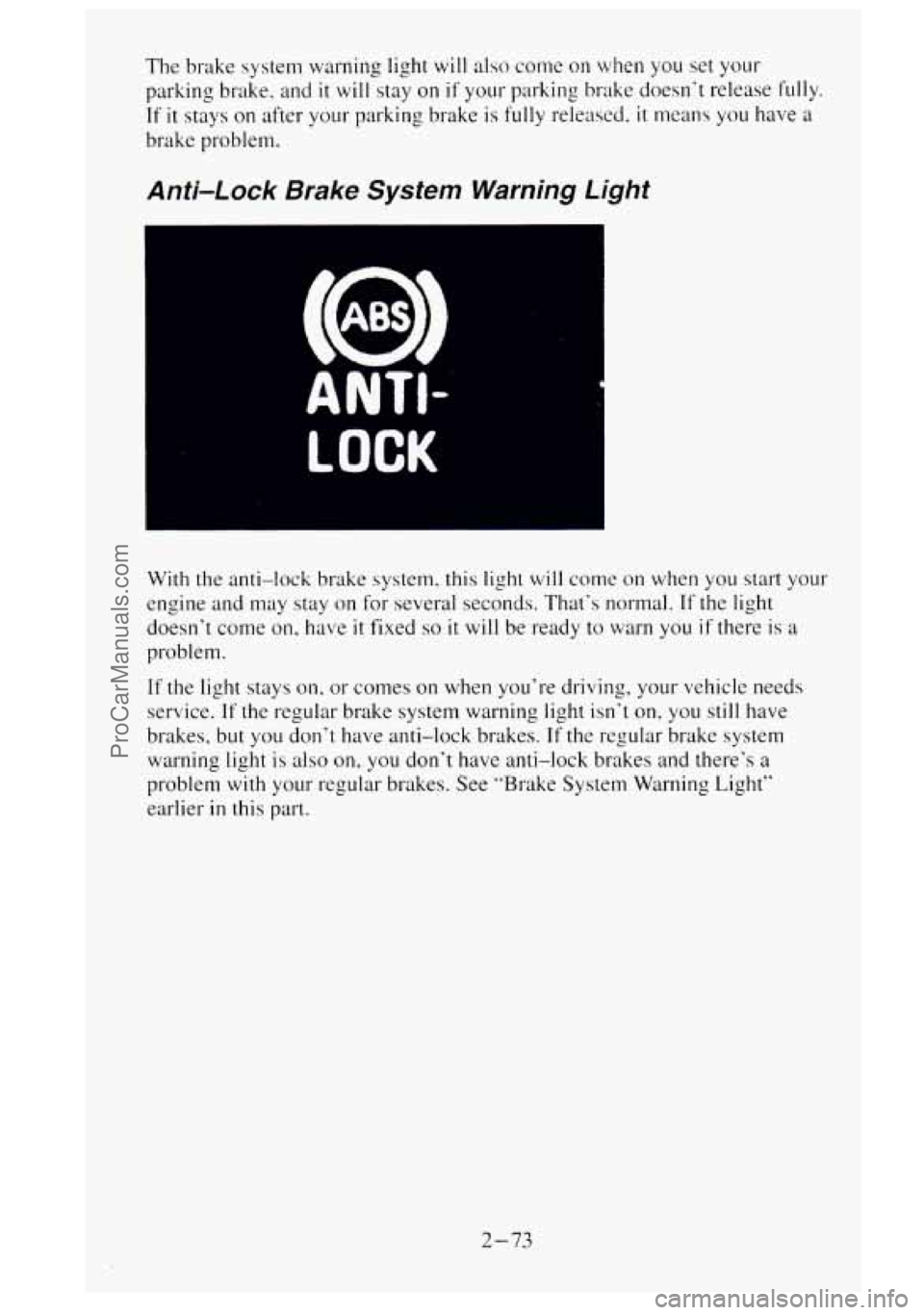
The brake system warning light will also come on when you set your
parking brake, and
it will stay on if your parking brake doesn’t release fully.
If it stays on after your parking brake is fully released, it means you have a
brake problem.
Anti-Lock Brake System Warning Light
ANTI-
LOCK
With the anti-lock brake system, this light will come on when you start your
engine and may stay on for several seconds. That‘s normal.
If the light
doesn’t come on, have
it fixed so it will be ready to warn you if there is a
problem.
If the light stays on. or comes on when you’re driving, your vehicle needs
service.
If the regular brake system warning light isn‘t on, you still have
brakes, but you don‘t have anti-lock brakes.
If the regular brake system
warning light is
also on, you don’t have anti-lock brakes and there’s a
problem with your regular brakes. See “Brake System Warning Light”
earlier
in this part.
2-73
ProCarManuals.com
Page 137 of 488
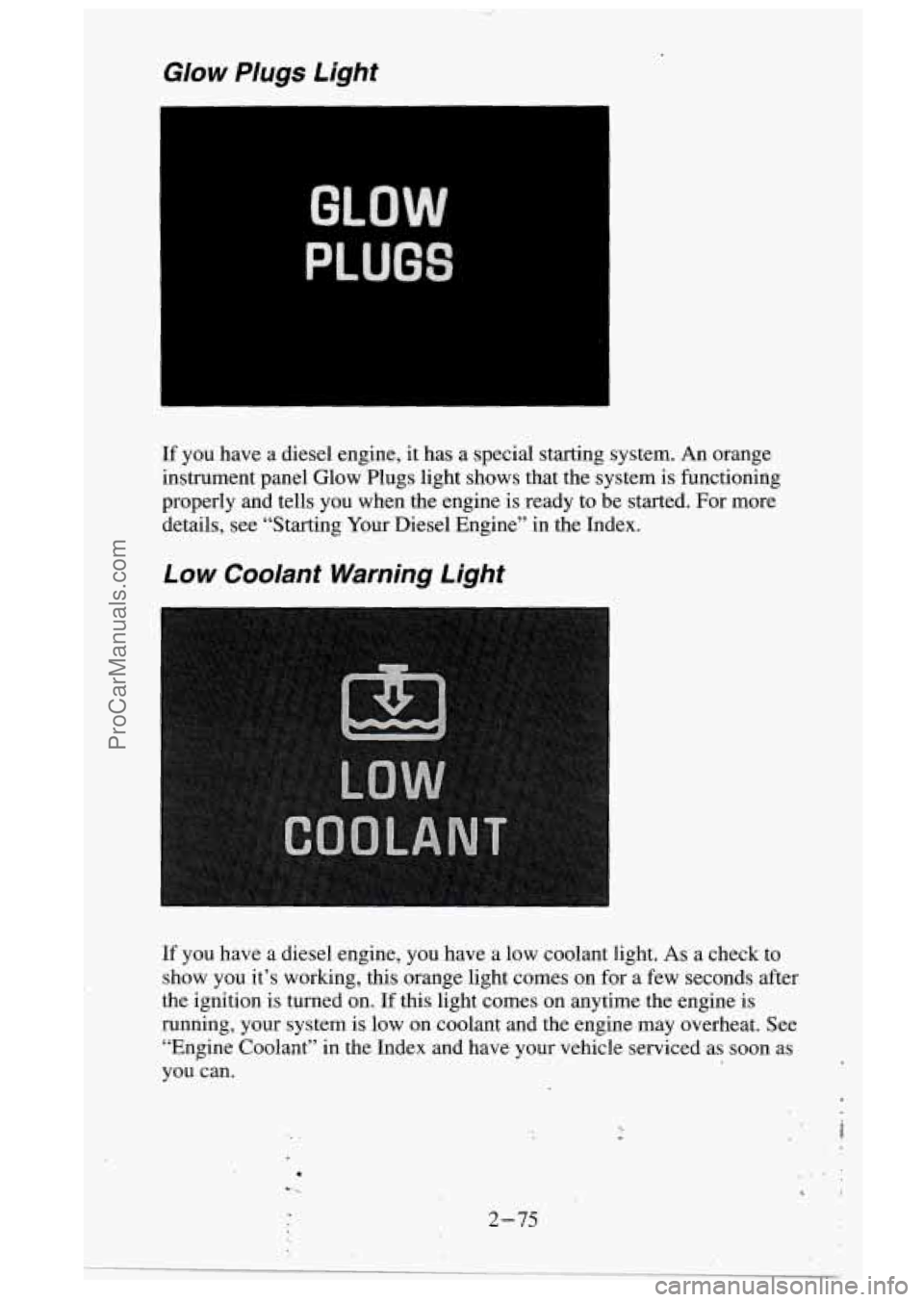
Glow Plugs Light
GLO
PLUGS
If you have a diesel engine, it has a special starting system. An orange
instrument panel Glow Plugs light shows that the system is functioning
properly and tells you when the engine is ready to be started. For more
details, see “Starting
Your Diesel Engine’’ in the Index.
Low Coolant Warning Light
41 h,
2-75
t
ProCarManuals.com
Page 138 of 488
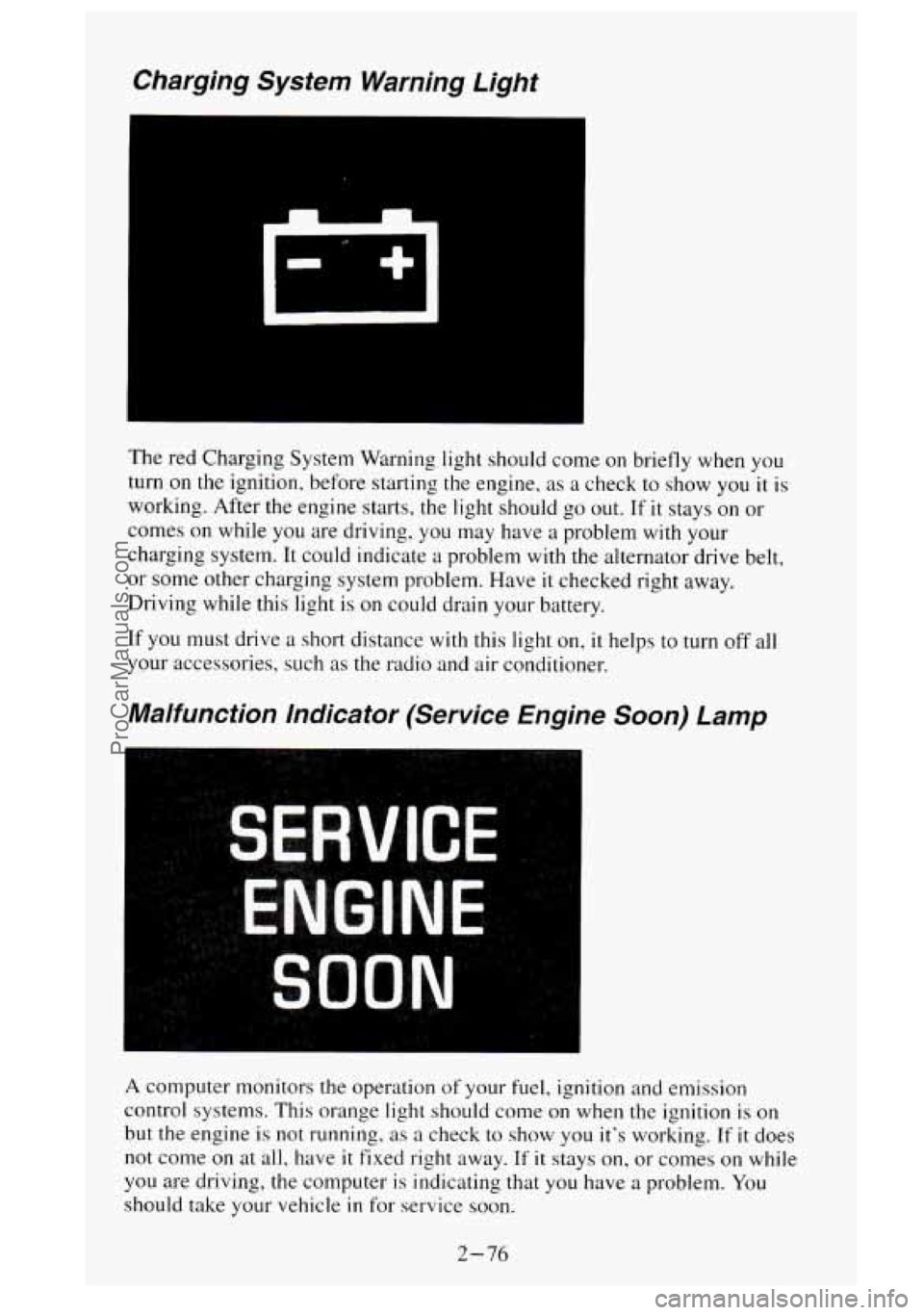
Charging System Warning Light
The red Charging System Warning light should come on briefly when you
turn on
the ignition, before starting the engine, as a check to show you it is
working. After the engine starts, the light should
go out. If it stays on or
comes on while you are driving, you may have a problem
with your
charging system. It could indicate a problem with the alternator drive belt,
or
some other charging system problem. Have it checked right away.
Driving while this light
is on could drain your battery.
If you must drive a short distance
with this light on, it helps to turn off all
your accessories, such
as the radio and air conditioner.
Malfunction Indicator (Service Engine Soon) Lamp
I
A computer monitors the operation of your fuel, ignition and emission
control systems. This orange light should come on when
the ignition is on
but the engine is not running. as a check
to show you it’s working. If it does
not come on at all, have
it fixed right away. If it stays on, or comes on while
you are driving, the computer is indicating that you have
a problem. You
should take your vehicle
in for service soon.
2-76
ProCarManuals.com
Page 139 of 488
NOTICE:
If you keep driving your vehicle with this light on, after a while
the emission controls
won’t work as well, your fuel economy
won’t
be as good, and your engine may not run as smoothly.
This could lead
to costly repairs not covered by your warranty.
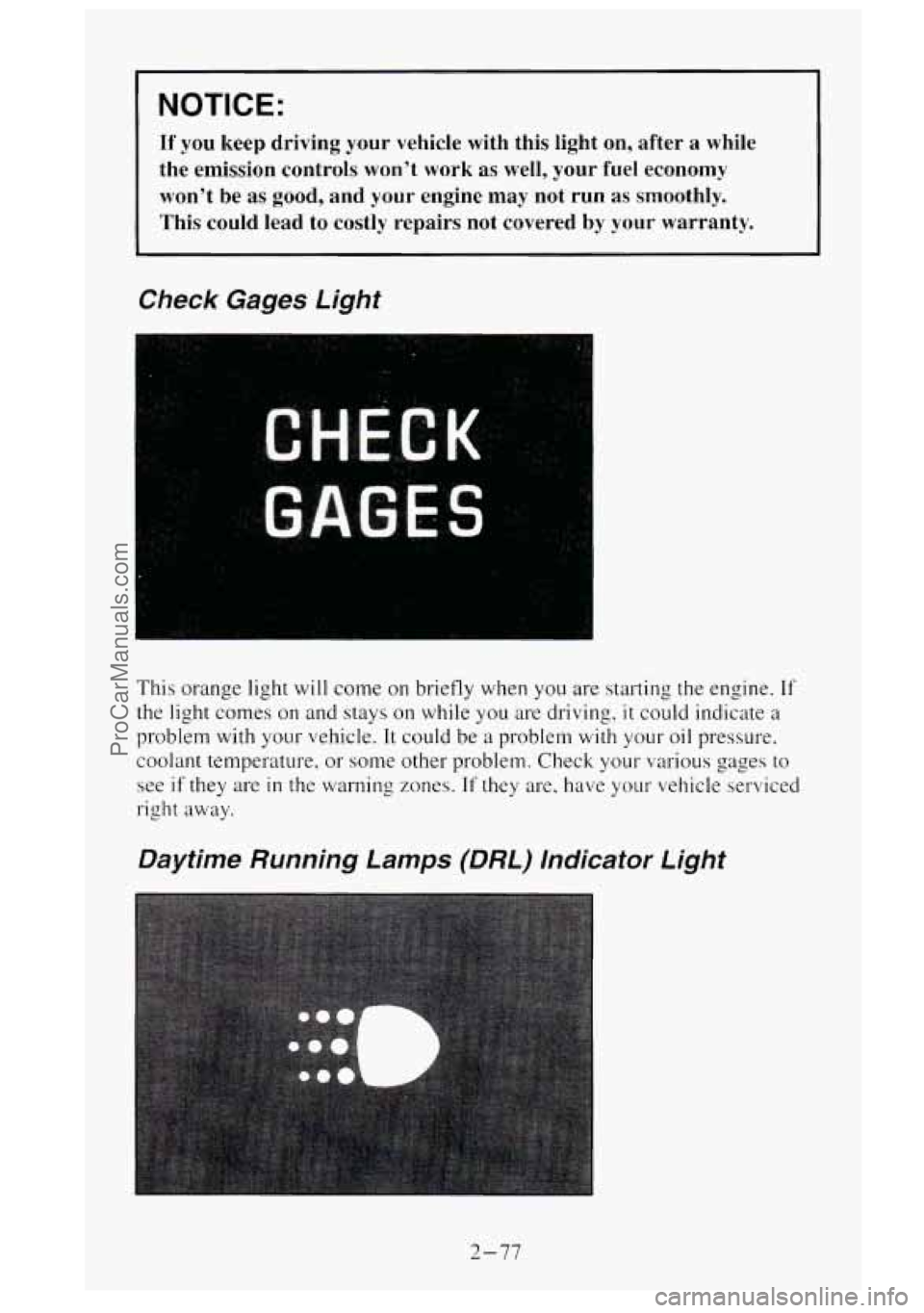
Check Gages Light
This orange light will come on briefly when you are starting the engine. If
the light comes on and stays on while you are driving, it could indicate a
problem with your vehicle.
It could be a problem with your oil pressure.
coolant temperature, or some other problem. Check your various gages
to
see if they are in the warning zones. If they are, have your vehicle serviced
right away.
Daytime Running Lamps (DRL) Indicator Light
2-77
ProCarManuals.com
Page 185 of 488
Try not to pass more than one vehicle at a time on two-lane roads.
Reconsider before passing the next vehicle.
0 Don’t overtake a slowly moving vehicle too rapidly. Even though the
brake lights are
not flashing, it may be slowing down or starting to turn.
If you’re being passed, make it easy for the following driver to get
ahead
of you. Perhaps you can ease a little to the right.
Loss of Control
Let’s review what driving experts say about what happens when the three
control systems (brakes, steering and acceleration) don’t have enough
friction where the tires meet the road
to do what the driver has asked.
In any emergency, don’t give up. Keep trying
to steer and constantly seek an
escape route or area of less danger.
Skidding
In a skid, a driver can lose control of the vehicle. Defensive drivers avoid
most skids by taking reasonable care suited
to existing conditions, and by
not “overdriving” those conditions. But skids are always possible.
The three types of skids correspond to your vehicle’s three control systems.
In the braking skid your wheels aren’t rolling. In the steering or cornering
skid, too much speed or steering in
a curve causes tires to slip and lose
cornering force. And
in the acceleration skid too much throttle causes the
driving wheels to spin.
A cornering skid and an acceleration skid are best handled by easing your
foot off the accelerator pedal.
If your vehicle starts to slide, ease your foot
off the accelerator pedal and
quickly steer the way you want the vehicle
to go. If you start steering
quickly enough, your vehicle may straighten out. Always be ready for
a
second skid if it occurs.
Of course, traction is reduced when water, snow, ice, gravel, or other
material is on
the road. For safety, you’ll want to slow down and adjust your
driving to these conditions. It is important to slow down on slippery
surfaces because stopping distance will be longer and vehicle control more
limited.
While driving on a surface
with reduced traction, try your best to avoid
sudden steering, acceleration. or braking (including engine braking
by
shifting to a lower gear). Any sudden changes could cause the tires to slide.
You may not realize the surface is slippery until your vehicle
is skidding.
Learn
to recognize warning clues - such as enough water, ice or packed
snow
on the road to make a “mirrored surface” - and slow down when you
have any doubt.
Remember:
Any anti-lock brake system (ABS) helps avoid only the braking
skid.
4-13
ProCarManuals.com