wiring GMC SIERRA 1995 Owners Manual
[x] Cancel search | Manufacturer: GMC, Model Year: 1995, Model line: SIERRA, Model: GMC SIERRA 1995Pages: 488, PDF Size: 26.01 MB
Page 110 of 488
To Erase Speed Memory
When you turn off' the Cruise Control or the ignition. your Cruise Control
set speed memory
is erased.
Headlamps and Vehicle Lighting
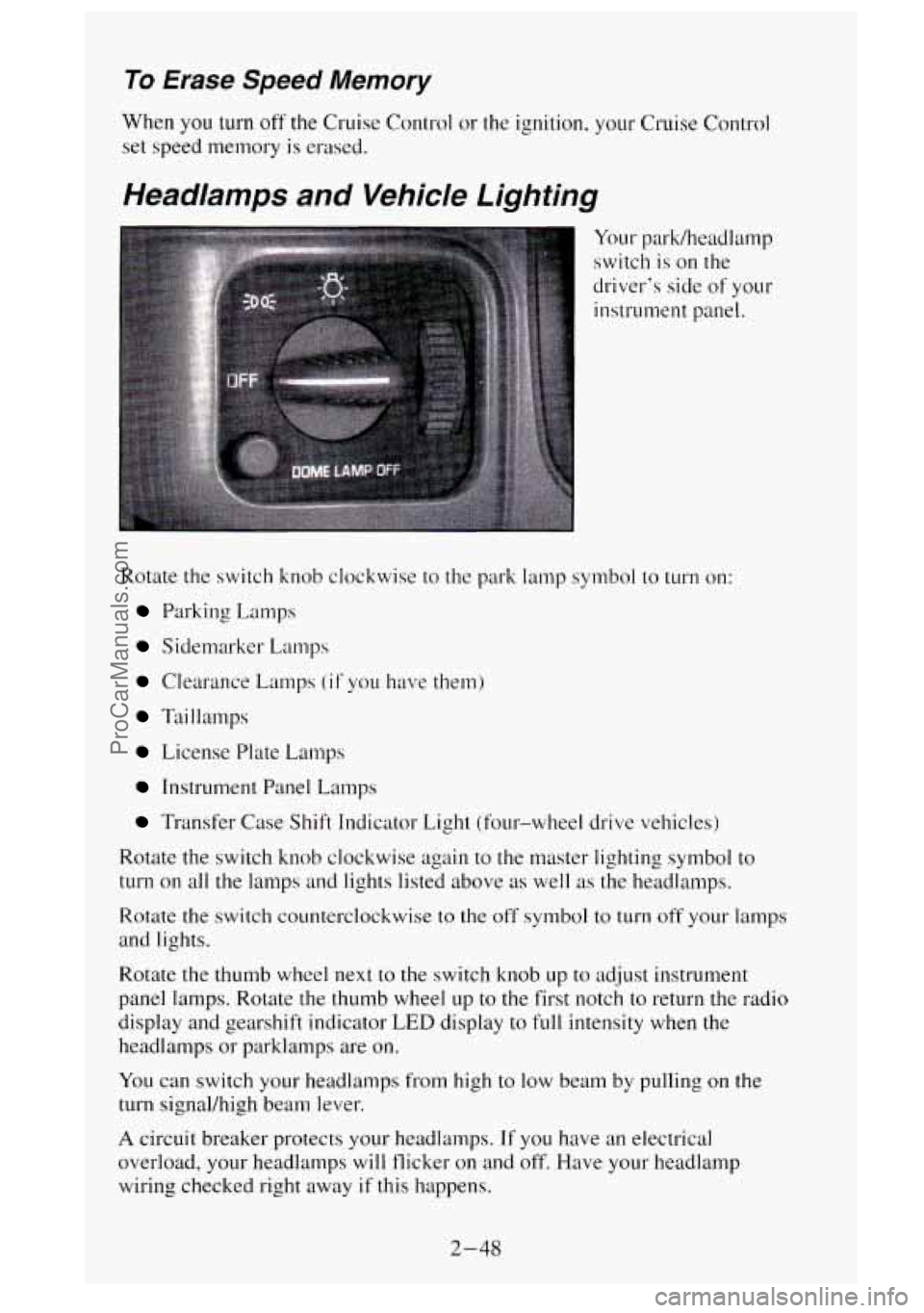
Your park/headlamp
switch is on the
driver's side of your
instrument panel.
Rotate the switch knob clockwise to the park lamp symbol to
turn on:
Parking Lamps
Sidemarker Lamps
Clearance Lamps (if you have them)
Taillamps
License Plate L.amps
Instrument Panel Lamps
Transfer Case Shift Indicator Light (four-wheel drive vehicles)
Rotate the switch knob clockwise again to the master lighting symbol to
turn on all the lamps and lights listed above as well as the headlamps.
Rotate the switch counterclockwise to the off symbol to turn off your lamps
and lights.
Rotate the thumb wheel next to the switch knob up
to adjust instrument
panel lamps. Rotate
the thumb wheel up to the first notch to return the radio
display and gearshift indicator
LED display to full intensity when the
headlamps or parklamps are
on.
You can switch your headlamps from high to low beam by pulling on the
turn signal/high beam lever.
A circuit breaker protects your headlamps. If you have an electrical
overload, your headlamps will flicker on and off. Have your headlamp
wiring checked right away if this happens.
2-48
ProCarManuals.com
Page 145 of 488
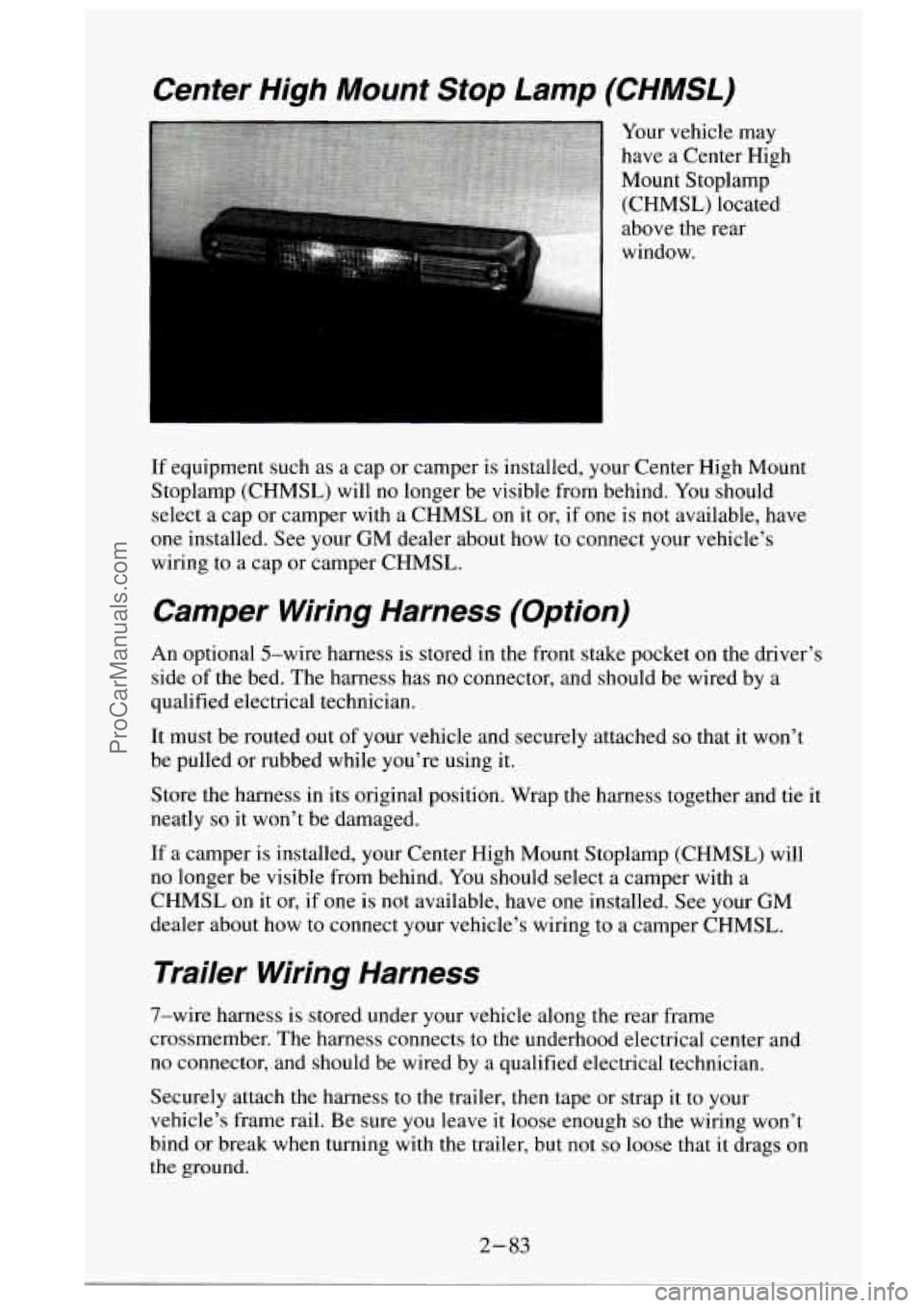
Center High Mount Stop Lamp (CHMSL)
I window.
If equipment such as a cap or camper is installed, your Center High Mount
Stoplamp (CHMSL) will no longer be visible from behind. You should
select a cap or camper with a CHMSL on it or, if one is not available, have
one installed. See your GM dealer about how to connect your vehicle’s
wiring to a cap or camper CHMSL.
Camper Wiring Harness (Option)
An optional 5-wire harness is stored in the front stake pocket on the driver’s
side of the bed. The harness has
no connector, and should be wired by a
qualified electrical technician.
It must be routed out of your vehicle and securely attached so that it won’t
be pulled or rubbed while you’re using it.
Store the harness
in its original position. Wrap the harness together and tie it
neatly so it won’t be damaged.
If a camper is installed, your Center High Mount Stoplamp (CHMSL) will
no longer be visible from behind. You should select a camper with a
CHMSL on
it or, if one is not available, have one installed. See your GM
dealer about how to connect your vehicle’s wiring to a camper CHMSL.
Trailer Wiring Harness
7-wire harness is stored under your vehicle along the rear frame
crossmember. The harness connects to the underhood electrical center and
no connector, and should be wired by a qualified electrical technician.
Securely attach the harness to the trailer, then tape or strap it to your
vehicle’s frame rail. Be sure
you leave it loose enough so the wiring won’t
bind or break when turning with the trailer, but
not so loose that it drags on
the ground.
2-83
ProCarManuals.com
Page 146 of 488
Store the harness in its original position. Wrap the harness together and tie it
neatly so it won’t be damaged.
If you do tow a trailer, your Center High Mount Stoplamp (CHMSL) may
not be properly visible from behind.
You should select a trailer with a
CHMSL on
it or, if one is not available, have one installed. See your GM
dealer about how
to connect your vehicle’s wiring to a trailer CHMSL.
Step-Bumper Pad
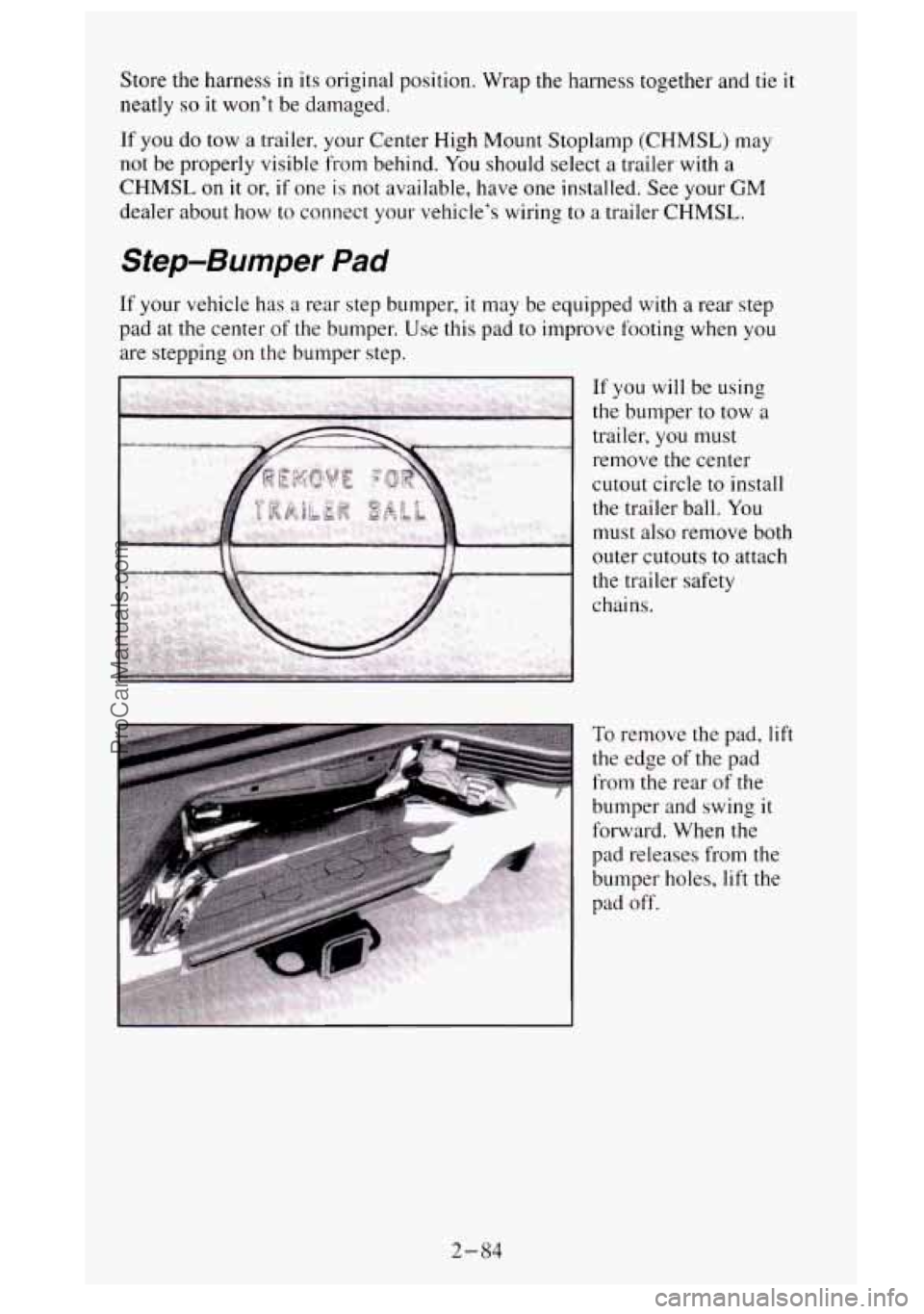
If your vehicle has a rear step bumper, it may be equipped with a rear step
pad at the center
of the bumper. Use this pad to improve footing when you
are stepping on the bumper step.
remove the center
cutout circle to install
the trailer ball.
You
must also remove both
outer cutouts
to attach
the trailer safety
chains.
To remove the pad, lift
the edge of the pad
from the rear
of the
bumper and swing it
forward. When the
pad releases from the
bumper holes,
lift the
pad
off.
2-84
ProCarManuals.com
Page 221 of 488

Making Turns
I NOTICE:
Making very sharp turns while trailering could cause the traile\
r to come in contact with the vehicle. Your vehicle could be
damaged. Avoid making very sharp turns while trailering.
When you’re turning with a trailer, make wider turns than normal. Do this
so your trailer won’t strike soft shoulders, curbs, road signs, trees, or other
objects. Avoid jerky or sudden maneuvers. Signal well in advance.
Turn Signals When Towing a Trailer
When you tow a trailer, your vehicle has to have extra wiring (included in
the optional trailering package). The green arrows
on your instrument panel
will flash whenever
you signal a turn or lane change. Properly hooked up,
the trailer lamps will also flash, telling other drivers you’re about to turn,
change lanes or stop.
When towing a trailer, the green arrows on your instrument panel will flash
for
turns even if the bulbs on the trailer are burned out. Thus, you may think
drivers behind
you are seeing your signal when they are not. It’s important
to check occasionally to be sure the trailer bulbs are still working.
Driving On Grades
Reduce speed and shift to a lower gear before you start down a long or steep
downgrade. If
you don’t shift down, you might have to use your brakes so
much that they would get hot and no longer work well.
On
a long uphill grade, shift down and reduce your speed to around 45 mph
(70 kmh) to reduce the possibility of engine and transmission overheating.
If you have an automatic transmission
you should use DRIVE (3) (or, as
you need to, a lower gear) when towing a trailer. Operating your vehicle in
DRIVE (3) when towing a trailer will minimize heat build-up and extend
the life
of your transmission.
If you have a manual transmission and
you are towing a trailer, it’s better
not to use FIFTH (5) gear. Just drive in FOURTH (4) gear (or, as you need
to, a lower gear).
4-47
ProCarManuals.com
Page 223 of 488
When You Are Ready to Leave After Parking on a Hill
1. Apply your regular brakes and hold the pedal down while you:
Start your engine:
Shift into a gear; and
Release the parking brake.
2. Let up on the brake pedal.
3. Drive slowly until the trailer is clear of the chocks.
4. Stop and have someone pick up and store the chocks.
Maintenance When Trailer Towing
Your vehicle will need service more often when you’re pulling a trailer. See
the Maintenance Schedule
for more on this. Things that are especially
important
in trailer operation are automatic transmission fluid (don’t
overfill), engine oil, axle lubricant, belt, cooling system, and brake
adjustment. Each of these is covered
in this manual, and the Index will help
you find them quickly. If you’re trailering, it’s
a good idea to review these
sections before you start your trip.
Check periodically to see that all hitch
nuts and bolts are tight.
Trailer Lighting Systems Wiring
See “Trailer Wiring Harness” in the Index.
4-49
ProCarManuals.com
Page 345 of 488
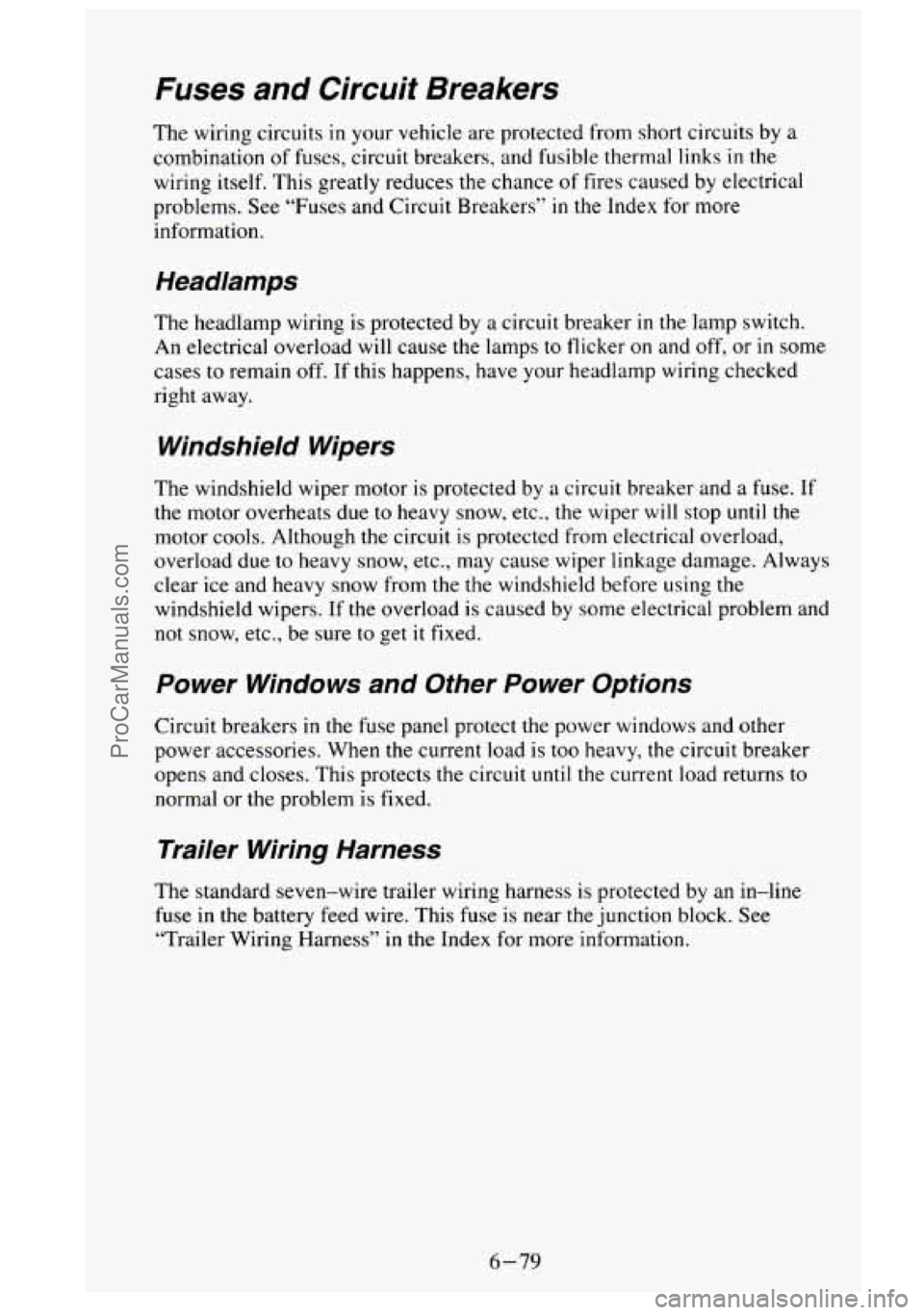
Fuses and Circuit Breakers
The wiring circuits in your vehicle are protected from short circuits by a
combination of fuses, circuit breakers, and fusible thermal links
in the
wiring itself. This greatly reduces
the chance of fires caused by electrical
problems. See “Fuses and Circuit Breakers’’
in the Index for more
information.
Headlamps
The headlamp wiring is protected by a circuit breaker in the lamp switch.
An electrical overload will cause
the lamps to flicker on and off, or in some
cases to remain
off. If this happens, have your headlamp wiring checked
right away.
Windshield Wipers
The windshield wiper motor is protected by a clrculc DreaKer ana a ruse. 11
the motor overheats due to heavy snow, etc., the wiper will stop until the
motor cools. Although the circuit is protected from electrical overload,
overload due to heavy snow, etc., may cause wiper linkage damage. Always
clear ice and heavy snow from the the windshield before using the
windshield wipers. If the overload
is caused by some electrical problem and
not snow, etc., be sure
to get it fixed.
Power Windows and Other Power Options
Circuit breakers in the fuse panel protect the power windows and other
power accessories. When the current load is too heavy, the circuit breaker
opens and closes. This protects the circuit
until the current load returns to
normal or the problem is fixed.
Trailer Wiring Harness
The standard seven-wire trailer wiring harness is protected by an in-line
fuse in the battery feed wire. This fuse is near the junction block. See
“Trailer Wiring Harness” in the Index for more information.
6-79
ProCarManuals.com
Page 482 of 488
Towing ATrailer
.................................................... 442
DrivingonGrades
.......................................... 4-47
Driving with
a Trailer ....................................... 4-46
ParkingonHills
............................................ 4-48
Passing
................................................... 4-46
Safety Chains
.............................................. 445
Hitches
..................................................... 4-45
TowingYourVehicle .............................................. 5-7
Trailer
Brakes
...................................................... 4-45
Recommendations ............................................. 4-42
Towing (See “Towing”)
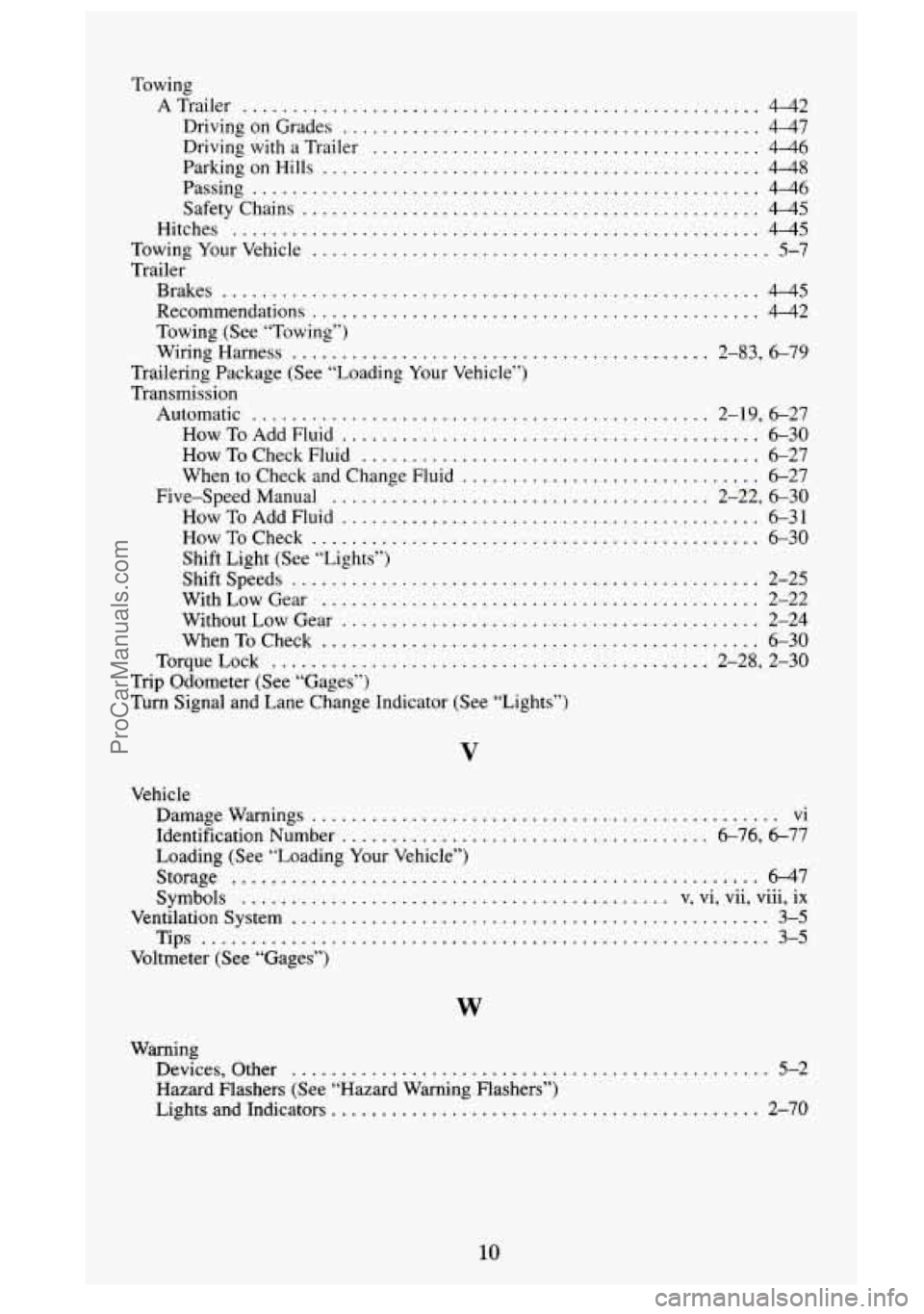
Wiring Harness
.......................................... 2-83. 6-79
Trailering Package (See “Loading Your Vehicle”)
Transmission
Automatic
.............................................. 2-19. 6-27
How To Add Fluid
.......................................... 6-30
How
To Check Fluid ........................................ 6-27
When to Check and Change Fluid
.............................. 6-27
Five-SpeedManual
...................................... 2-22: 6-30
How
To Add Fluid .......................................... 6-31
HowToCheck
............................................. 6-30
Shift Light (See “Lights”)
Shiftspeeds
............................................... 2-25
With Low
Gear ............................................ 2-22
WithoutLowGear
.......................................... 2-24
WhenToCheck
............................................ 6-30
TorqueLock
............................................ 2-28, 2-30
Trip Odometer (See “Gages”)
Turn Signal and Lane Change Indicator (See “Lights”)
V
Vehicle
Damage Warnings
............................................... vi
Identification Number ..................................... 6-76. 6-77
Loading (See “Loading Your Vehicle”)
Storage
..................................................... 6-47
Symbols
........................................... v. vi. v11. ~111. ix
Ventilation System
................................................ 3-5
Tips ......................................................... 3-5
Voltmeter (See “Gages”)
.....
Warning
Devices. Other
................................................ 5-2
Hazard Flashers (See “Hazard Warning Flashers”)
Lights and Indicators
........................................... 2-70
10
ProCarManuals.com