change time GMC SIERRA 1996 User Guide
[x] Cancel search | Manufacturer: GMC, Model Year: 1996, Model line: SIERRA, Model: GMC SIERRA 1996Pages: 404, PDF Size: 21.57 MB
Page 201 of 404
NOTICE:
Pulling a trailer improperly can damage your
vehicle and result in costly repairs not covered by
your warranty.
To pull a trailer correctly, follow
the advice in this part, and see your
GM dealer
for-important information about towing a trailer
with your vehicle.
Every vehicle is ready for some trailer towing. If yours
was built with trailering options, as many are, it’s ready
for heavier trailers. But trailering is different than just
driving your vehicle by itself. Trailering means changes
in handling, durability and fuel economy. Successful,
safe trailering takes correct equipment, and it has to be
used properly.
That’s the reason for this part. In it are many
time-tested, important trailering tips and safety rules.
Many of these
are important for your safety and that of
your passengers.
So please read this section carefully
before you pull
a trailer.
If You Do Decide To Pull A Trailer
If you do, here are some important points:
0
0
0
0
There are many different laws, including speed limit
restrictions, having to do with trailering. Make sure-
your rig will be lega1,not only where you live but
also where you’ll be driving. A good source for this
information can be state or provincial police.
Consider using a sway control if your trailer will
weigh
4,000 lbs. (1 800 kg) or less. You should
always use a sway control if your trailer will weigh
more than
4,000 lbs. (1 800 kg). You can ask a hitch
dealer about sway controls.
Don’t tow a trailer at all‘during the first
500 miles
(800 km) your new vehicle is driven. Your engine,
axle or other parts could be damaged.
Then; during the first
500 miles (800 km) that you
tow a trailer, don’t drive over
50 mph (80 ktn/h) and
don’t make starts at full throttle. This helps your
engine and other parts of your vehicle wear in at the
heavier loads.
4-47
ProCarManuals.com
Page 243 of 404
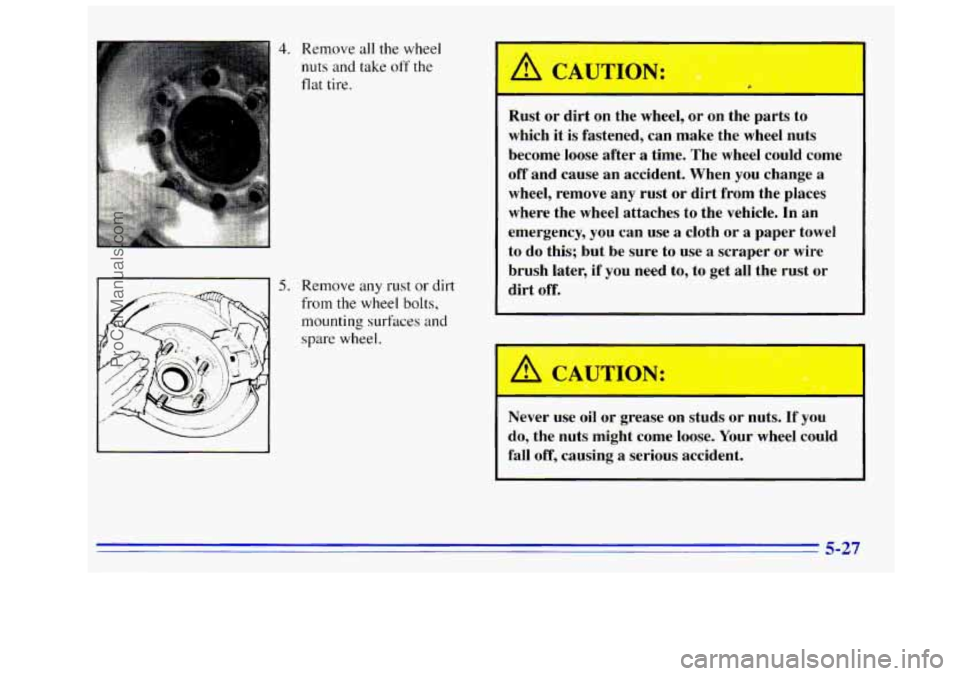
4. Remove all the wheel
nuts and take off the
flat tire.
5. Remove any rust or dirt
from the wheel bolts,
mounting surfaces and
spare wheel. Rust or dirt on the
wheel, or on the parts to
which
it is fastened, can make the wheel nuts
become loose after
a time. The wheel could come
off and cause an accident. When you change
a
wheel, remove any rust or dirt from the places
where the wheel attaches
to the vehicle. In an
emergency, you can use a cloth or a paper towel
to do this; but be sure to use
a scraper or wire
brush
later, if you need to, to get all the rust or
dirt off.
I A CAUTIO^:
Never use oil or grease on studs or nuts. If you
do, the nuts might come loose. Your wheel could
fall
off, causing a serious accident.
5-27
ProCarManuals.com
Page 269 of 404
Automatic Transmission Fluid
When to Check a1 C’ -ge
A good time to check your auromarlc transmission fluid
level
is when the engine oil is changed.
Change both the fluid and filter every
50,000 miles
(83 000 km) if the vehicle’s GVWR is over 8,600 or
if the vehicle is mainly driven under one or more of
these conditions:
In heavy city traffic where the outside temperature
regularly reaches
90°F (32°C) or higher.
0 In hilly or mountainous terrain.
0 When doing frequent trailer towing.
Uses such as found in taxi, police or delivery service.
If your vehicle’s GVWR is not over 8,600 and you do
not use your vehicle under any of these conditions, the
fluid and filter
do not require changing.
See “Scheduled Maintenance Services’’
in the Index.
How to Check
Because this operation can be a little difficult, you
may choose to have this done at your GM dealership
Service Department. If
you do it yourself,
be sure to follow all the instructions
here, or
you could get a false reading on the dipstick.
NOTICE:
Too much or too little fluid can damage your
transmission.
Too much can mean that some of
i the fluid could come out and fall on hot engine
~ parts or exhaust system parts, starting a fire. Be
sure to get an accurate reading if you check your
transmission fluid.
Wait at least 30 minutes before checking the
transmission fluid level
if you have been driving:
When outside temperatures are above 90°F (32°C).
0 At high speed for quite a while.
In heavy traffic -- especially in hot weather.
While pulling a trailer.
To get the right reading, the fluid should be at normal
operating temperature, which
is 180°F to 200°F (82°C
to 93°C).
6-19
ProCarManuals.com
Page 272 of 404
Manual Transmission Fluid
When to Check
A good time to have it checked is when the engine
oil
is changed. However, the fluid in your manual
transmission doesn’t require changing.
How to Check
Because this operation can be a little difficult, you
may choose to have this done at your GM dealership
Service Department.
If you do it yourself, be sure to follow all the
instructions here, or you could get
a false reading.
NOTICE:
Too much or too little fluid can damage your
transmission.
Too much can mean that some of
the fluid could come out and fall on hot engine
parts or exhaust system parts, starting a fire.
Be
sure to get an accurate reading if you check your
transmission fluid.
II
Check the fluid level only when your engine is off, the
vehicle
is parked on a level place and the transmission
is cool enough for you to rest your fingers on the
transmission case.
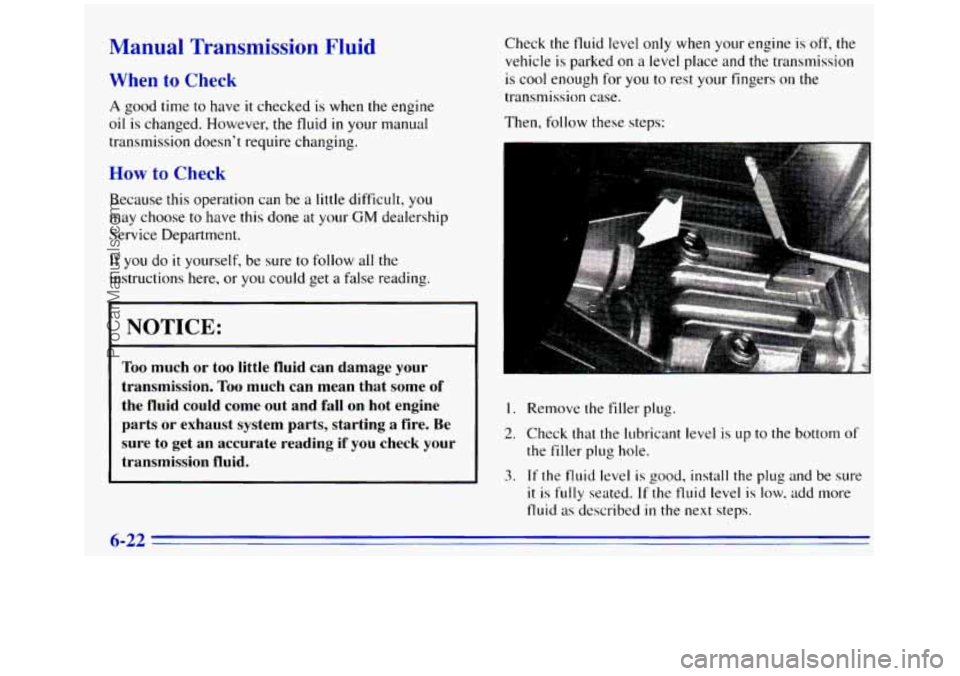
Then, follow these steps:
1. Remove the filler plug.
2. Check that the lubricant level is up to the bottom of
the filler plug hole.
3. If the fluid level is good, install the plug and be sure
it is fully seated. If the fluid level is low, add more
fluid as described in the next steps.
6-22
ProCarManuals.com
Page 274 of 404
Rear Axle
When to Chc d Change Lubricant
Refer to the Maintenance Schedule to determine how
often to check the lubricant and when to change
it. See
“Scheduled Maintenance Services”
in the Index.
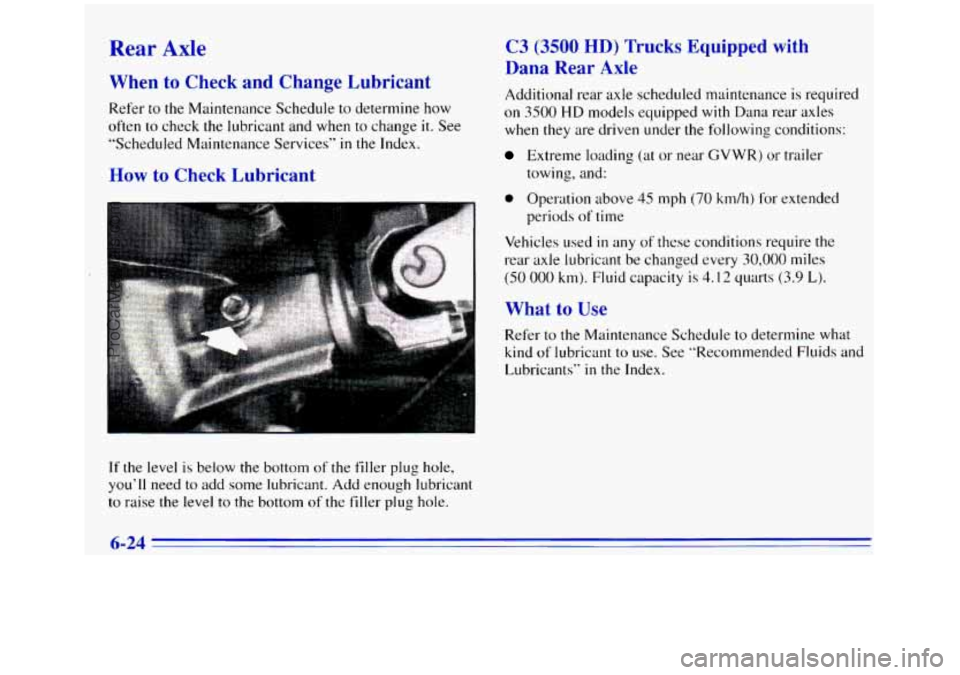
How to Check Lubricant
If the level is below the bottom of the filler plug hole,
you’ll need to add some lubricant. Add enough lubricant
to raise the level to the bottom
of the filler plug hole.
C3 (3500 HD) Trucks Equipped with
Dana Rear
Axle
Additional rear axle scheduled maintenance is required
on 3500 HD models equipped with Dana rear axles
when they are driven under the following conditions:
Extreme loading (at or near GVWR) or trailer
towing, and:
0 Operation above 45 mph (70 km/h) for extended
periods
of time
Vehicles used
in any of these conditions require the
rear axle lubricant be changed every 30,000 miles
(SO 000 km). Fluid capacity is 4.12 quarts (3.9 L).
What to Use
Refer to the Maintenance Schedule to determine what
kind
of lubricant to use. See “Recommended Fluids and
Lubricants”
in the Index.
6-24
ProCarManuals.com
Page 286 of 404
NOTICE: .
Continuing to drive with worn-out brake pads
could result in costly brake repair.
Some driving conditions or climates may cause a brake
squeal when the brakes are first applied or lightly
applied. This does not mean something is wrong with
your brakes.
Free movement
of brake calipers and properly torqued
wheel nuts
are necessary to help prevent brake
pulsation. When tires
are rotated, inspect.brake calipers
for movement, brake pads for wear, and evenly torque
wheel nuts in the proper sequence
to GM specifications.
If you have rear drum brakes, they don’t have wear
indicators, but
if you ever hear a rear brake rubbing
noise, have the rear brake linings inspected.
Also, the
rear brake drums should be remoQed and inspected each
time the tires are removed for rotation or changing.
When you have the front brakes replaced, have the rear
brakes inspected,
too. I
Brake linings should always be replaced as complete
axle sets.
Brake Pedal Travel
See your dealer if the brake pedal does not return to
normal height, or if there is a rapid increase in pedal
travel. This could be a sign of brake trouble.
Brake Adjustment
Every time you make a brake stop, your disc brakes
adjust for wear.
If your brake pedal goes down farther than normal, your
rear drum brakes may need adjustment. Adjust them by
backing up and firmly applying the brakes a few times.
Replacing Brake System Parts
The braking system on a modern vehicle is complex. Its
many parts have to be
of top quality and work well
together if the vehicle is to have really good braking.
Vehicles we design and test have top-quality
GM brake
parts
in them, as your vehicle does when it is new. When
you replace parts of your braking system -- for example,
when- your brhke linings wear do.wn and you have
to
haye new ones put in -- be sure you get new genuine
GM replacement parts. If you don’t, your brakes may
no longer work properly. For example,
if someone
puts in brake linings that are wrong for your vehicle,
the balance between your front and rear brakes can
change
-- for the worse. The braking performance
you’ve come to expect can change
in many other ways
if someone puts in the wrong replacement brake parts.
I
I
6-36
ProCarManuals.com
Page 302 of 404
When It’s Time for New Tires
Rust or dirt on
a wheel, or on the parts to which
it
is fastened, can make- wheel nuts become loose
.after
a time. The wheel could come off and cause
an accident. When you change
a wheel, remove
any rust or dirt from places where the wheel
attaches to the vehicle. In an emergency, you can
use a cloth or a paper towel to do this; but be
sure to use
a scraper or wire brush later, if you
need to, to get all the rust or dirt
off. (See
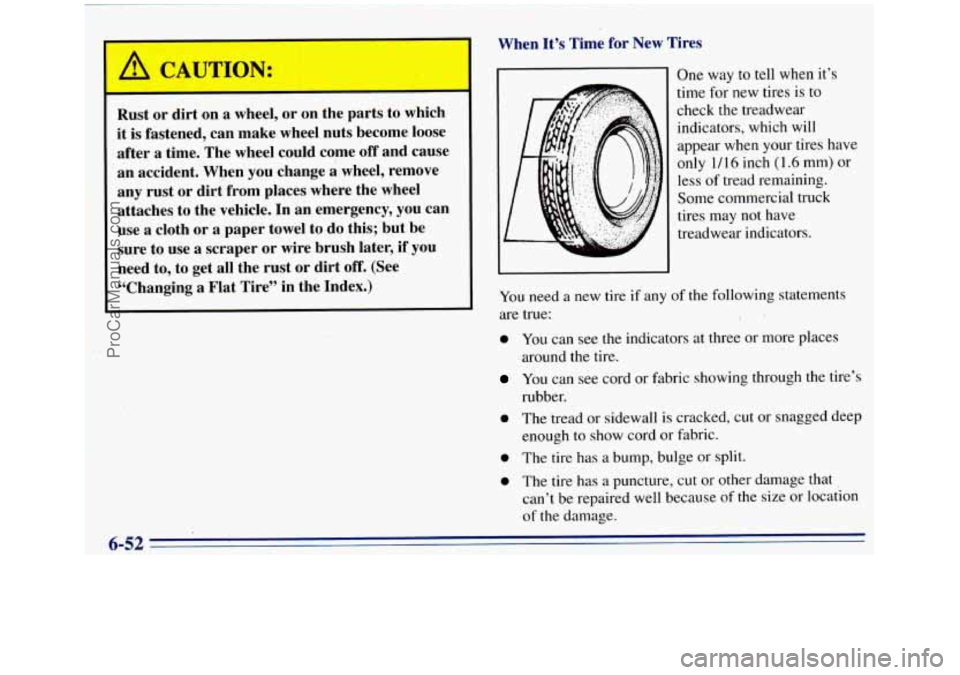
“Changing a Flat Tire” in the Index.) One
way to tell when it’s
time for new tires is
to
check the treadwear
indicators, which will
appear when your tires have
only
1/16 inch (1.6 mm) or
less
of tread remaining.
Some commercial truck
tires may not have
treadwear indicators.
Its
You need a new tire if any of the following statemen
are true:
0 You’can see the indicators at three or more places
around the tire.
You can see cord or fabric showing through the tire’s
rubber.
0 The tread or sidewall is cracked, cut or snagged deep
enough to show cord or fabric.
0 The tire has a bump, bulge or split.
0 The tire has a puncture, cut or other damage that ,
can’t be repaired well because of the size or location
of the damage.
ProCarManuals.com
Page 325 of 404
Wheels and Tires
Model Torque
C 1500, K 1500, C/K 2500, C/K 3500 (Single Rear Wheels) ............................ 140 Ib-ft (190 N-m)
C3500 (Dual
Rear Wheels) ...................................................... 140 Ib-ft (190 N-m)
Tire Pressure ........................... See the Certificationflire label on the rear edge of the driver's door
or the incomplete vehicle document in the cab.
C-3500HD
.................................................................. 175Ib-ft(240N-m)
Normal Maintenance Replacement Parts
Replacement part numbers listed in this section
are based on the latest information available at the time of printing,
and are subject to change.
If a part listed in this manual is not the same as the part used in your vehicle when it was
built, or
if you have any questions, please contact your GM truck dealer.
These specifications are
for information only. If you have any questions. see the service manual for the chassis or
refer
to the body manufacturer's publications.
VIN Code w M
Oil Filter PF52
PF1218T
Air
Cleaner Filter A 1300C A 1300C
PCV Valve CV746C CV796C
Spark Plugs 4 1-932 4 1-932
Fuel Filter GF626
GF626
Wiper Blades 22 154886 221 54886
Type Trico Trico
Length
18 inches (45.0 cm) 18 inches (45.0 cm)
?Use a PF52 oil filter if your vehicle has four-wheel drive.
R
PF1218T
A 130OC
CV796C
4 1-932
GF626
22 154886
Trico
18 inches (45.0 cm)
J
PF1218
A
1300C
cv774c
41 -932
GF626
22 154886
Trico
18 inches (45.0 cm)
6-75
ProCarManuals.com
Page 332 of 404
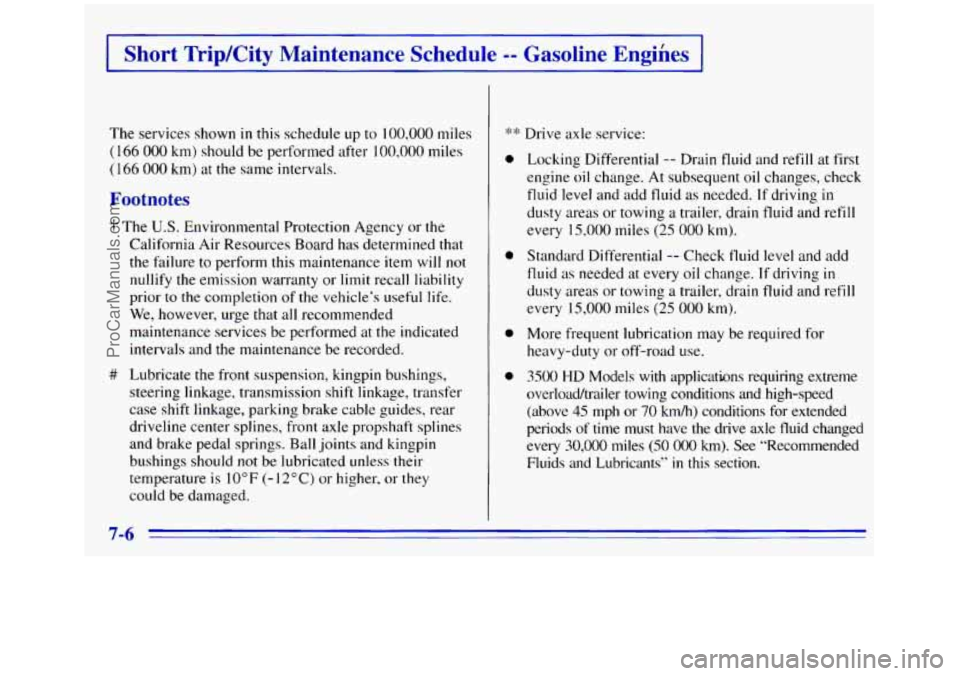
Short TripKity Maintenance Schedule -- Gasoline Engines
The services shown in this schedule up to 100,000 miles
(1 66 000 km) should be performed after 100,000 miles
(166 000 km) at the same intervals.
Footnotes
T The U.S. Environmental Protection Agency or the
California Air Resources Board has determined that
the failure to perform this maintenance item will
not
nullify the emission warranty or limit recall liability
prior
to the completion of the vehicle‘s useful life.
We, however, urge that all recommended
maintenance services be performed at the indicated
intervals and the maintenance be recorded.
# Lubricate the front suspension, kingpin bushings,
steering linkage, transmission shift linkage, transfer
case shift linkage, parking brake cable guides, rear
driveline center splines, front axle propshaft splines
and brake pedal springs. Ball joints and kingpin
bushings should not be lubricated unless their
temperature is 10°F
(- 12°C) or higher, or they
could be damaged.
:f: :1:
0
0
0
e
Drive axle service:
Locking Differential
-- Drain fluid and refill at first
engine
oil change. At subsequent oil changes, check
fluid level and add fluid as needed. If driving in
dusty areas or towing a trailer, drain fluid and refill
every 15,000 miles
(25 000 km).
Standard Differential -- Check fluid level and add
fluid
as needed at every oil change. If driving in
dusty areas or towing a trailer, drain fluid and refill
every
I5,OOO miles (25 000 km).
More frequent lubrication may be required for
heavy-duty or off-road
use.
3500 HD Models with applications requiring extreme
overload/trailer towing conditions and high-speed
(above
45 mph or 70 kmh) conditions for extended
periods
of time must have the drive axle fluid changed
evey
30,000 miles (50 000 km). See “Recommended
Fluids and Lubricants’’
in this section.
7-6
ProCarManuals.com
Page 355 of 404
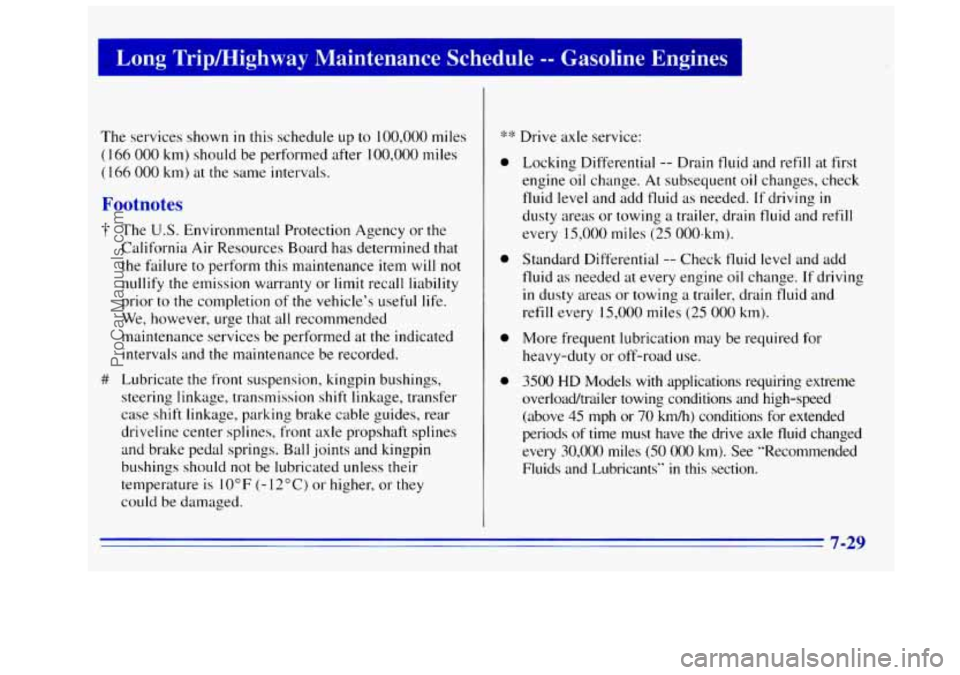
Long Tripmighway Maintenance Schedule -- Gasoline Engines I
The services shown in this schedule up to 100,000 miles
(1 66 000 km) should be performed after 100,000 miles
(166 000 km) at the same intervals.
Footnotes
j- The U.S. Environmental Protection Agency or the
California Air Resources Board has determined that
the failure
to perform this maintenance item will not
nullify the emission warranty or limit recall liability
prior
to the completion of the vehicle’s useful life.
We, however, urge that all recommended
maintenance services be performed at
the indicated
intervals and the maintenance be recorded.
# Lubricate the front suspension, kingpin bushings,
steering linkage, transmission shift linkage, transfer
case shift linkage, parking brake cable guides, rear
driveline center splines, front axle propshaft splines
and brake pedal springs. Ball joints and kingpin
bushings should not be lubricated unless their
temperature is
10°F (- 12°C) or higher, or they
could be damaged.
‘k‘k Drive axle service:
a
e
e
a
Locking Differential -- Drain fluid and refill at first
engine
oil change. At subsequent oil changes, check
fluid level and add fluid as needed.
If driving in
dusty areas or towing a trailer, drain fluid and refill
every 15,000 miles
(25 000.km).
Standard Differential
-- Check fluid level and add
fluid
as needed at every engine oil change. If driving
in dusty areas or towing a trailer, drain fluid and
refill every
15,000 miles (25 000 km).
More frequent lubrication may be required for
heavy-duty or off-road use.
3500 HD Models with applications requiring extreme
overloadtrailer towing conditions and high-speed
(above
45 mph or 70 kmh) conditions for extended
periods
of time must have the drive axle fluid changed
every
30,000 miles (50 000 km). See ”Recommended
Fluids and Lubricants”
in this section.
I
ProCarManuals.com