coolant GMC SIERRA 1996 User Guide
[x] Cancel search | Manufacturer: GMC, Model Year: 1996, Model line: SIERRA, Model: GMC SIERRA 1996Pages: 404, PDF Size: 21.57 MB
Page 230 of 404
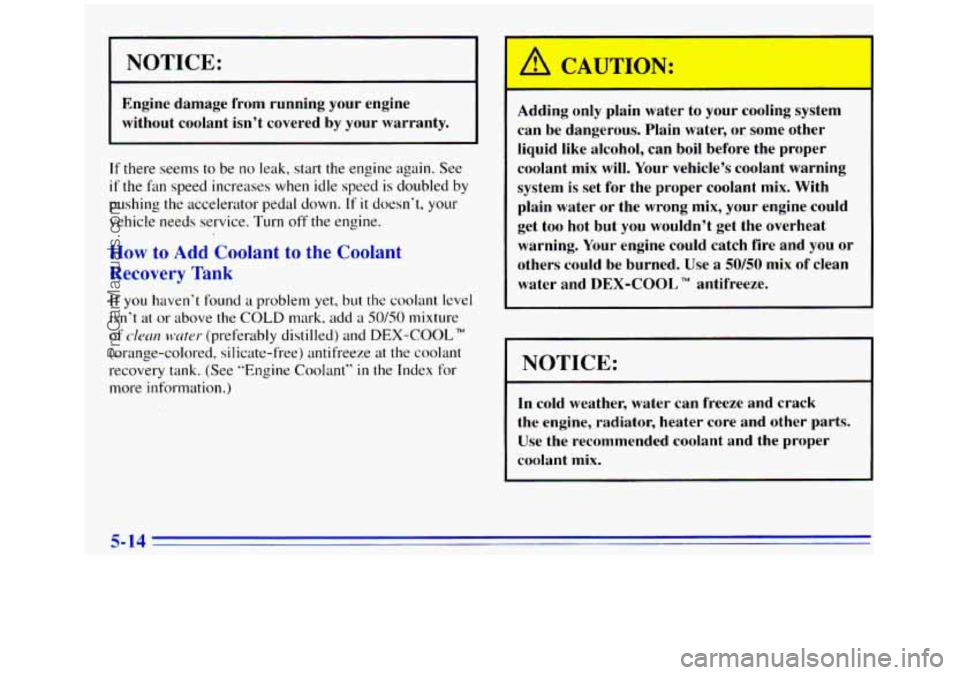
NOTICE:
I
I
I
Engine damage from running your engine without coolant isn’t covered by your warranty.
If there seems to be no leak, start the engine again. See
if the fan speed increases when idle speed is doubled by
pushing the accelerator pedal down.
If it doesn’t, your
vehicle needs service. Turn
off the engine.
How to Add Coolant to the Coolant
Recovery Tank
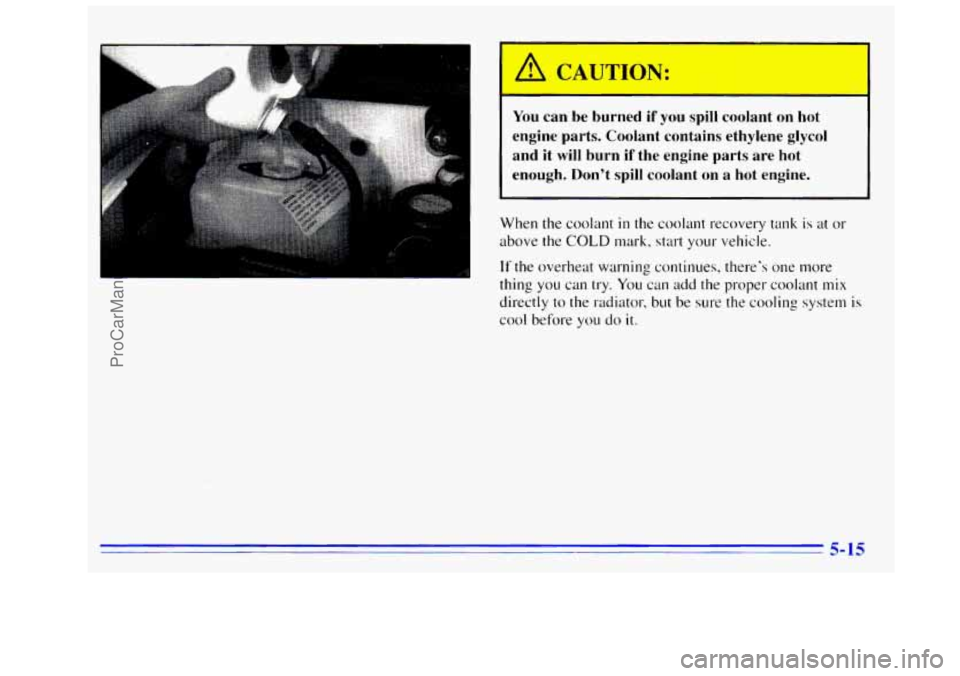
If you haven’t found a problem yet, but the coolant level
isn’t at or above the
COLD mark, add a SO/SO mixture
of ciecu? wter (preferably distilled) and DEX-COOL”
(orange-colored, silicate-free) antifreeze at the coolant
recovery tank.
(See (‘Engine Coolant” in the Index for
more information.)
I A CAUTION:
Adding only plain water to your cooling system
can be dangerous. Plain water, or some other
liquid like
alcohol, can boil before the proper
coolant mix
will. Your vehicle’s coolant warning
system
is set for the proper coolant mix. With
plain water or the wrong mix, your engine could
get too hot but you wouldn’t get the overheat
warning. Your engine could catch fire and you or
others
could be burned. Use a 50/50 mix of clean
water and
DEX-COOL TM antifreeze.
I NOTICE:
In cold weather, water can freeze and crack
the engine, radiator, heater core and other parts.
Use the recommended coolant and the proper
coolant mix.
5- 14
ProCarManuals.com
Page 231 of 404
You can be burned if’ you spill coolant on hot
engine parts. Coolant contains ethylene glycol
and it will burn if the engine parts are hot
enough. Don’t
spill coolant on a hat engine.
When the coolant in the coolant recovery tank is at or
above
the COLD mark, start your vehicle.
If the overheat warning continues. there’s one more
thing you can try. You can add the proper coolant mix
directly to the radiator, but be sure the cooling system is
cool before you do it.
ProCarManuals.com
Page 233 of 404
How to Add Coolant to the Radiator
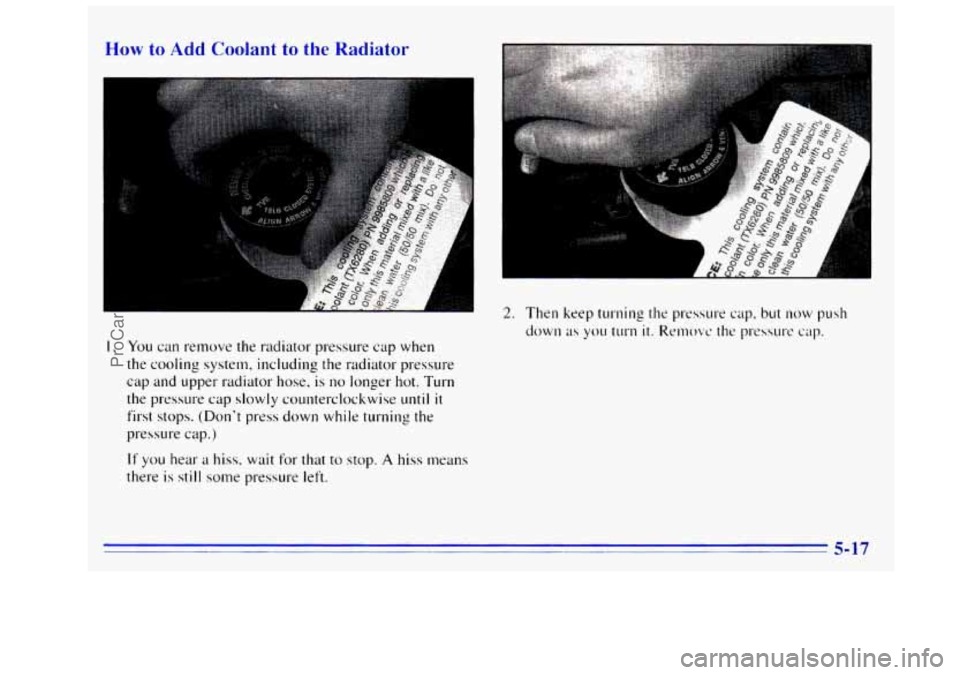
I. You can remove the radiator pressure cap when
the cooling system, including the radiator pressure
cap and upper radiator hose,
is no longer hot. Turn
the pressure cap slowly counterclockwise
until it
first stops. (Don't press down while turning the
pressure cap.
j
If you hear a hiss, wait for that to stop. A hiss means
there is
still some pressure left.
5-17
ProCarManuals.com
Page 234 of 404
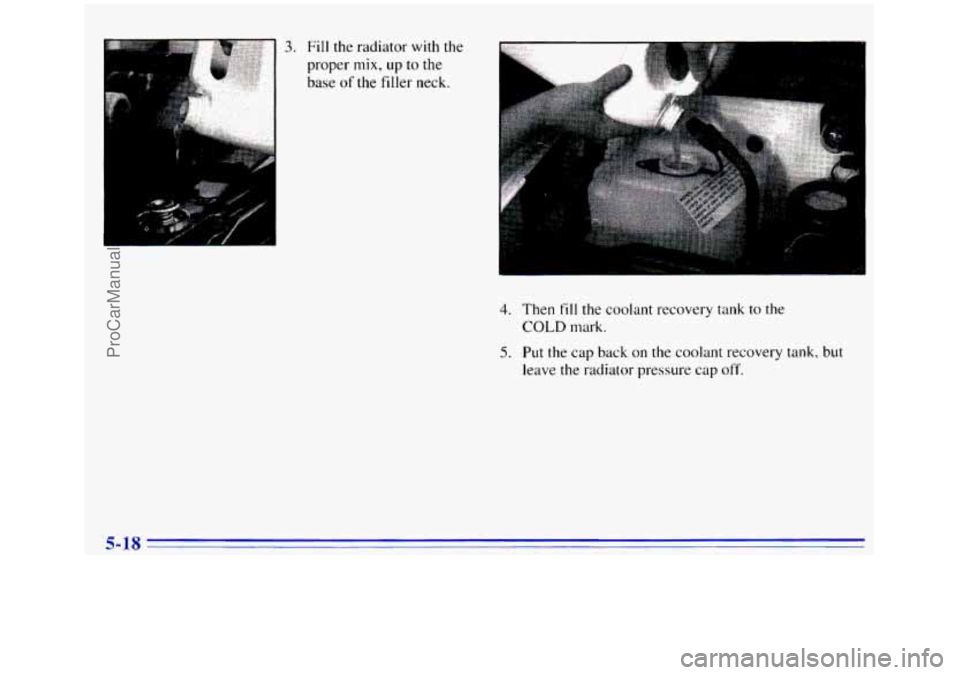
3. Fill the radiator with the
proper mix, up to the
base of the filler neck. I
4. Then fill the coolant recovery tank to the
COLD mark.
5. Put the cap back on the coolant recovery tank, but
leave the radiator
pressure cap off.
5-18
ProCarManuals.com
Page 235 of 404
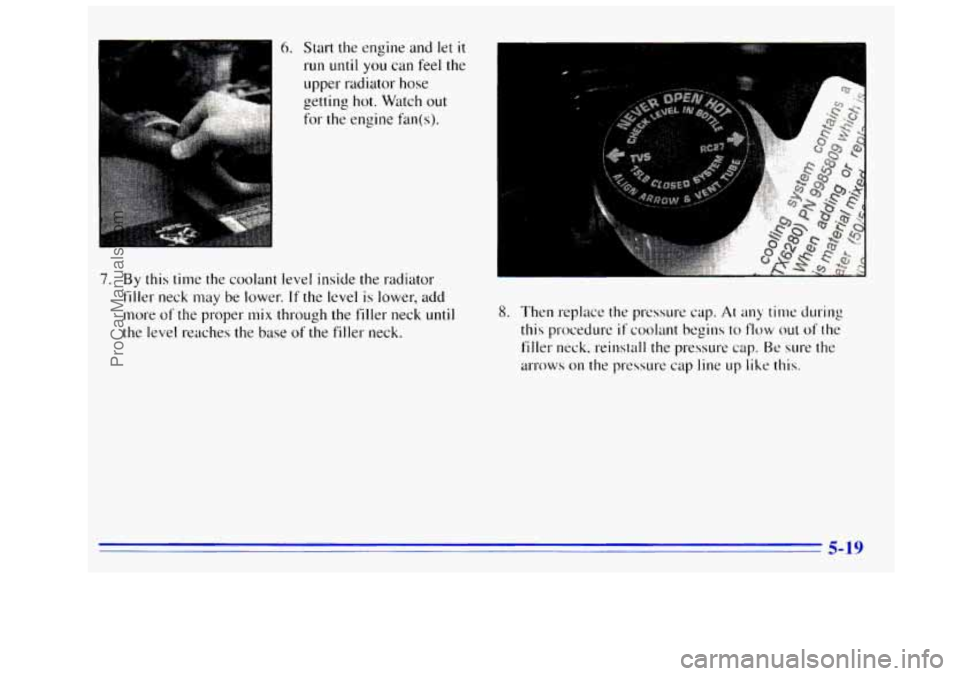
6. Start the engine and let it
run until you can feel the
upper radiator hose
getting
hot. Watch out
for the engine fan(s).
7. By this time the coolant level inside the radiator
filler neck may be lower.
If the level is lower, add
more of the proper mix through the filler neck until
the level reaches the base of the filler neck.
I
8. Then replace the pressure cap. At any time during
this procedure if coolant begins to flow out of the
filler neck. reinstall the pressure
cap. Be sure the
arrows
on the pressure cap line up like this.
5-19
ProCarManuals.com
Page 256 of 404
Be careful not to spill gasoline. Clean gasoline from
painted surfxes as soon
as possible. See “Cleaning the
Outside
of Your Vehicle” in the Index.
When you put the cap back
on, turn it to the right until
you hear at least three clicks. Make sure you fully install
the cap. The diagnostic system can determine if the fuel
cap has been
left off or improperly installed. This would
allow
fuel to evaporate into the atmosphere. See
“Malfunction Indicator Lamp” in the Index.
I NOTICE:
If you need a new cap, be sure to get the right
type. Your dealer can get one for you. If you get
the wrong type, it may not fit or have proper
venting, and your fuel tank and emissions system
might be damaged.
Checking Things Under the Hood
h
I ! CAUTION:
If your vehicle has air conditioning, the auxiliary
engine fan under the hood can start up and
hjure you even when the engine
is not running.
Keep hands, clothing and tools away from any
underhood electric fan.
Things that burn can get on hot engine parts and
start a fire. These include liquids like gasoline or
diesel fuel, oil, coolant, brake fluid, windshield
washer and other fluids, and plastic or rubber.
You
or others could be burned. Be careful not to drop
or spill things that will burn onto a hot engine.
6-6
ProCarManuals.com
Page 259 of 404
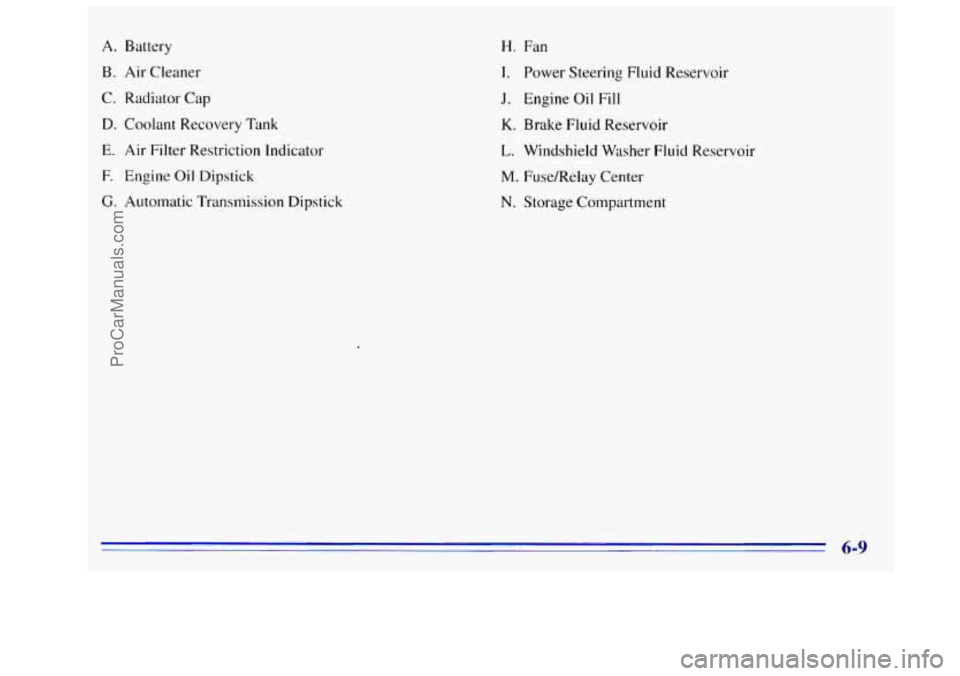
A. Battery
B. Air Cleaner
C. Radiator Cap
D. Coolant Recovery Tmk
E. Air Filter Restriction Indicator
E Engine Oil Dipstick
G. Automatic Transmission Dipstick
H. Fan
I. Power Steering Fluid Reservoir
J. Engine Oil Fill
K. Brake Fluid Reservoir
L. Windshield Washer Fluid Reservoir
M. FuseIRelay Center
N. Storage Compartment
ProCarManuals.com
Page 260 of 404
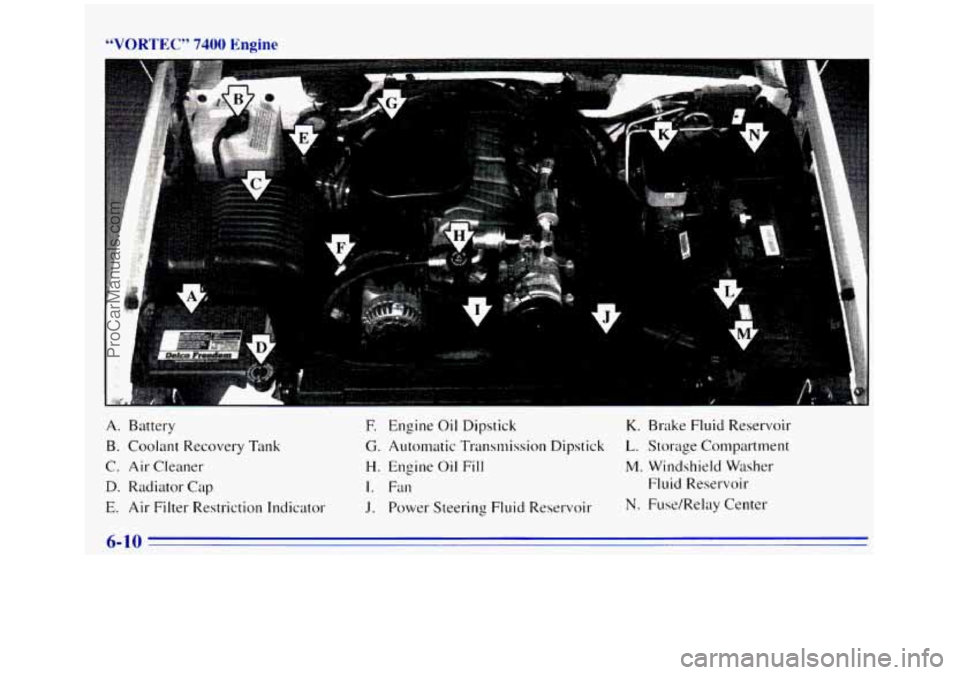
“VORTEC” 7400 Engine
I
A. Battery
B. Coolant Recovery Tank
C. Air Cleaner
D. Radiator Cap
E. Air Filter Restriction Indicator
E Engine Oil Dipstick K. Brake Fluid Reservoir
G. Automatic Transmission Dipstick L. Storage Compartment
H. Engine Oil Fill M. Windshield Washer
I. Fan Fluid
Reservoir
J. Power Steering Fluid Reservoir Ne Fuse/RelaY Center
ProCarManuals.com
Page 266 of 404
What to Do with Used Oil
Did you know that used engine oil contains certain
elements that
may be unhealthy for your skin and could
even cause cancer? Don’t let used
oil stay on your skin
for very long. Clean your skin and nails with soap and
water, or
a good hand cleaner. Wash or properly throw
away clothing or rags containing used engine oil. (See
the manufacturer’s warnings about the use and disposal
of oil products.)
Used
oil can be a real threat to the environment. If you
change your own
oil, be sure to drain all free-flowing oil
from the filter before disposal. Don’t ever dispose
of oil
by putting it in the trash, pouring it on the ground, into
sewers,
or into streams or bodies of water. Instead,
recycle
it by taking it to a place that collects used oil. If
you have a problem properly disposing of your used oil,
ask your dealer, a service station or a local recycling
center for
help.
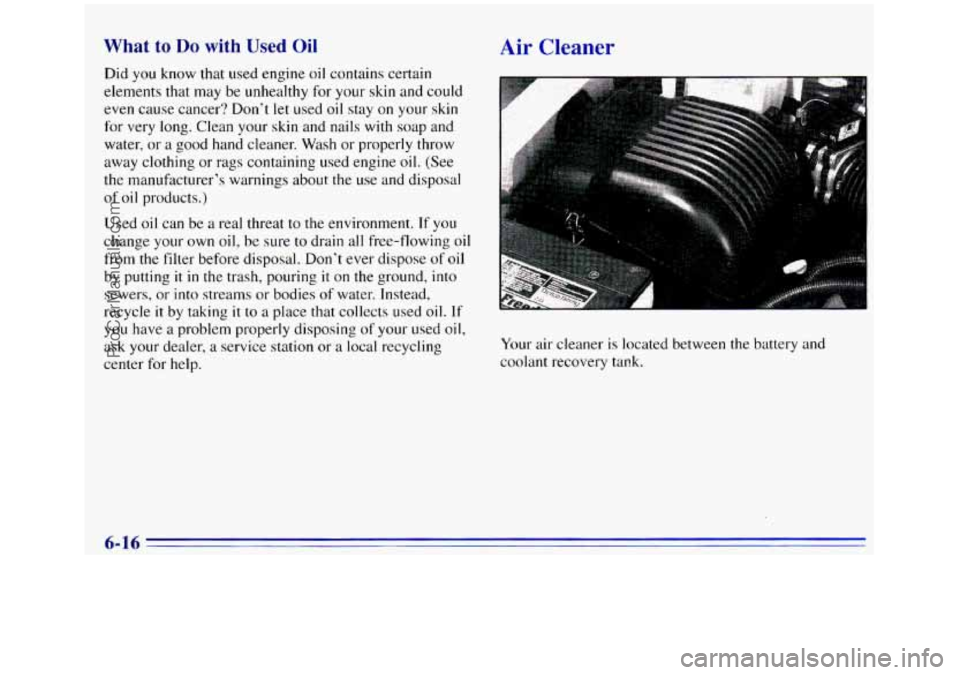
Air Cleaner
Your air cleaner is located between the battery and
coolant recovery tank.
ProCarManuals.com
Page 276 of 404
Front Axle
When to Check and Change Lubricant
Refer to the Maintenance Schedule to determine how
often
to check the lubricant and when to change it. See
"Scheduled Maintenance Services"
in the Index.
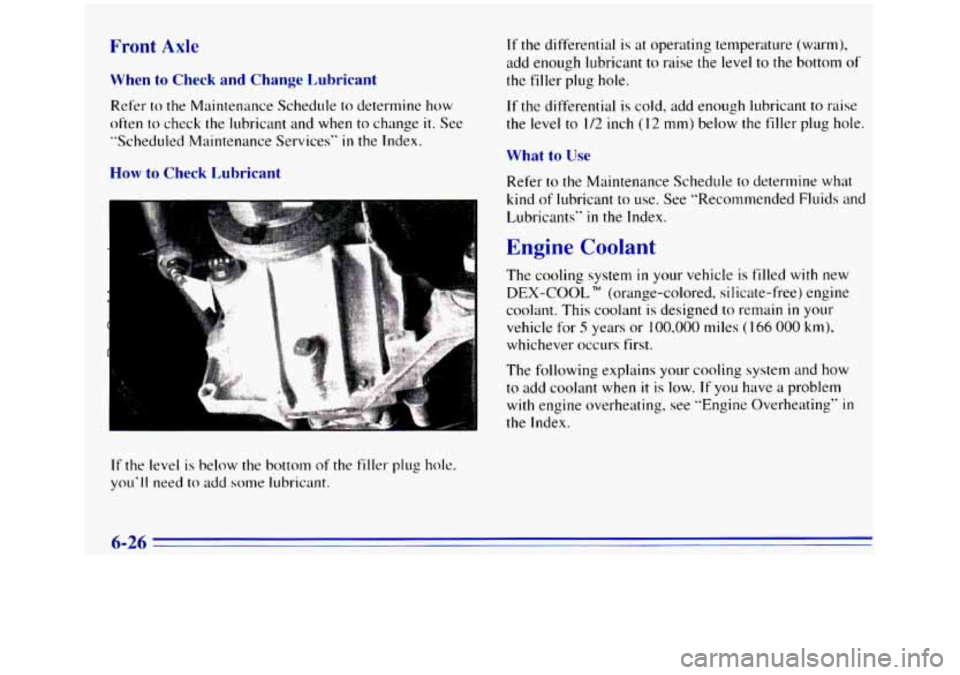
How to Check Lubricant
If the level is below the bottom of the filler plug hole.
you'll
need to add some lubricant.
If the differential is at operating temperature (warm),
add enough lubricant
to raise the level to the bottom of
the filler plug hole.
If the differential is cold, add enough lubricant to raise
the level
to 1/2 inch (1 2 mm) below the filler plug hole.
What to Use
Refer to the Maintenance Schedule to determine what
kind
of lubricant to use. See "Recommended Fluids and
Lubricants"
in the Index.
Engine Coolant
The cooling system in your vehicle is filled with new
DEX-COOL
TM (orange-colored, silicate-free) engine
coolant. This coolant is designed
to remain in your
vehicle for
5 years or 100,000 miles (1 66 000 km),
whichever occurs first.
The following explains
your cooling system and how
to add coolant when it is low. If you have a problem
with engine overheating, see "Engine Overheating"
in
the Index.
6-26
ProCarManuals.com