fuel GMC SIERRA 1996 User Guide
[x] Cancel search | Manufacturer: GMC, Model Year: 1996, Model line: SIERRA, Model: GMC SIERRA 1996Pages: 404, PDF Size: 21.57 MB
Page 130 of 404
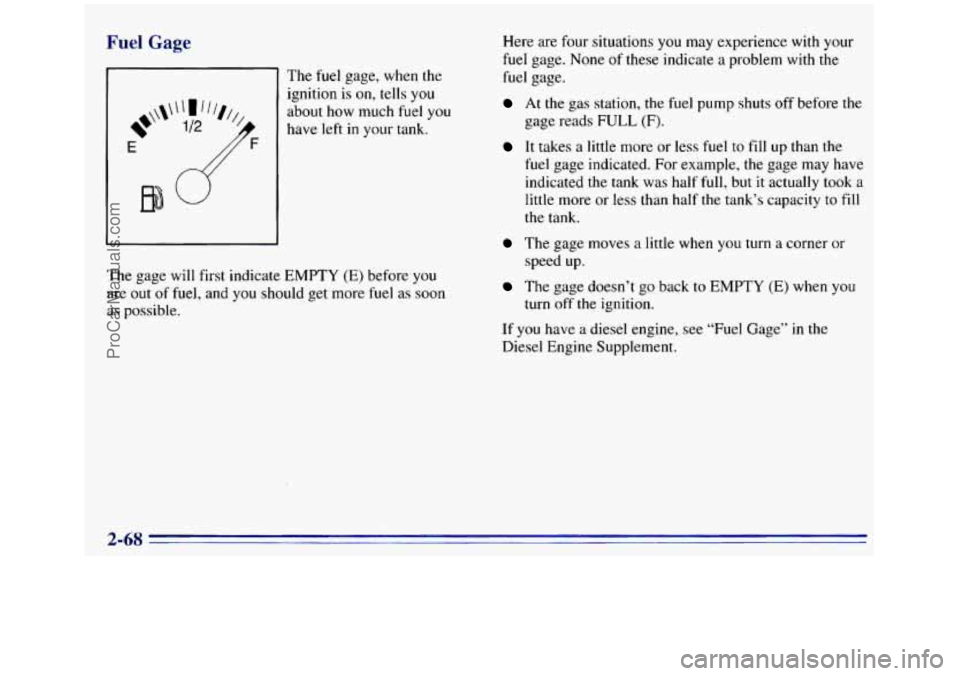
Fuel Gage
81 The fuel gage, when the
ignition is on, tells you
about how much fuel you
have left
in your tank.
E
The gage will first indicate EMPTY (E) before you
are
out of fuel, and you should get more fuel as soon
as possible. Here
are four situations
you may experience with your
fuel gage. None of these indicate a problem with the
fuel gage.
At the gas station, the fuel pump shuts off before the
gage reads
FULL (F).
It takes a little more or less fuel to fill up than the
fuel gage indicated.
For example, the gage may have
indicated the tank was half full, but
it actually took a
little more or less than half the tank’s capacity to fill
the tank.
The gage moves a little when you turn a corner or
speed up.
The gage doesn’t go back to EMPTY (E) when you
turn off the ignition.
If you have a diesel engine, see “Fuel Gage”
in the
Diesel Engine Supplement.
2-68
ProCarManuals.com
Page 133 of 404
Temperature Knob
The middle knob on the control panel lets you select the
relative temperature
of the air flowing into the passenger
area of your vehicle. This knob will allow you to adjust
the relative air temperature independently
of the
function knob setting. Move the knob clockwise
toward
the red area for warmer air. Move the knob
counterclockwise toward the blue area for cooler air.
The right knob on the control panel allows you to
choose the direction of air delivery. The control knob
can be placed
in any position between two mode settings
to blend the flow of air.
/J VENT: This setting directs air through the
instrument panel outlets.
+H VENT/HEAT Use this setting to divide airflow
between the floor outlets and instrument panel outlets.
+’ HEATER: This setting directs air through the
heater floor outlets.
+e
+.
0
Qe
+’ DEFOG: This setting directs air to the heater
outlets and toward
the windshield.
DEFROST This setting directs air toward the
windshield.
Air Conditioning
On hot days, open the windows long enough to let hot
air inside escape. This reduces the time it takes for your
vehicle
to cool down. Then keep your windows closed
for
the air conditioner to work it’s best.
The recirculation button, between the fan and
temperature knobs, allows the air inside your vehicle to
be recirculated. This setting helps
to maximize your air
conditioner’s performance and your vehicle’s fuel
economy. This setting also
cools the air the fastest and
can be used
to keep unwanted odors and/or dust from
entering the vehicle. When using the air conditioner,
turn off recirculation after the vehicle reaches a
comfortable interior temperature. When the right knob
on the control panel is between HEATER and
DEFROST, the recirculation feature will
not function.
ProCarManuals.com
Page 134 of 404
The A/C button, between the temperature and mode
knobs, allows
the air coming into your vehicle to be
cooled. This setting
is useful for normal cooling on hot
days. When
you use A/C with the recirculation button
pushed
in, turn off recirculation as soon as the vehicle
reaches a comfortable interior temperature.
With the
A/C on, move the temperature knob to MAX
for maximum cooling.
This setting also puts the system
in the recirculation mode and helps
to maximize your air
conditioner’s performance and your vehicle’s fuel
economy. This setting also cools the air the fastest. After
the vehicle’s interior reaches a comfortable temperature,
move the temperature knob clockwise to place the air
conditioning system
in the normal mode.
Heating
The heater works best if you keep your windows closed
while using
it. On cold days, use the HEATER or
VENT/HEAT setting with the temperature knob in the
red area.
If you use the engine coolant heater before starting your
engine (in cold weather (20°F (-8°C) or lower), your
heating system
will produce warmer air faster, to heat
the passenger compartment
in cold weather. The
use
of an engine coolant heater also reduces the
time
it takes for the engine to reach normal operating
temperature, and shortens the time
it takes the heater to
reach full output. For more information, see “Engine
Coolant Heater”
in the Index.
Ventilation System
For mild outside temperature when little heating or
cooling
is needed, use VENT to direct outside air
through
your vehicle. Air will flow through the
instrument panel outlets.
Your vehicle’s ventilation systeril supplies outside air
to the inside of your vehicle when it is moving. With
the side windows closed, air will flow into the front
air inlet grilles, through the vehicle, and out the air
exhaust valves.
Outside air will
also enter the vehicle when the heater or
the air conditioning fan is running, unless you have
the
recirculation button pushed in. For more information on
the recirculation button, see “Air Conditioning” earlier
in this section.
3-4
ProCarManuals.com
Page 168 of 404
Before You Go Off-Roading
There are some things to do before you go out. For
example,
be sure to have all necessary maintenance and
service work done. Check
to make sure all underbody
shields (if
so equipped) are properly attached. Be sure
you read all the information about your four-wheel-drive
vehicle in
this manual. Is there enough fuel? Is the spare
tire fully inflated? Are
the fluid levels up where they
should be? What are the local laws that apply
to
off-roading where you’ll be driving? If you don’t know,
you should check with law enforcement people in the
area. Will you be on someone’s private land? If so, be
sure to get the necessary permission.
Loading Your Vehicle for Off-Road Driving
There are some important things to remember about
how
to load your vehicle.
The heaviest things should be on the load floor and
forward
of your rear axle. Put heavier items as far
forward
as you can.
Be sure the load is secured properly, so driving on
the off-road terrain doesn’t toss things around.
4 CAUTION: ‘ ’
0
0
e
Cargo on the load floor piled higher than
the seatbacks can be thrown forward
during a sudden stop.
You or your
passengers could be injured. Keep cargo
below the top of the seatbacks.
Unsecured cargo
on the load floor can
be tossed about when driving over rough
terrain.
You or your passengers can
be struck by flying objects. Secure the
cargo properly. Heavy
loads on the roof raise the vehicle’s
center of gravity, making it more likely to
roll over.
You can be seriously or fatally
injured if the vehicle rolls over. Put heavy
loads inside the cargo area, not on the roof.
Keep cargo in the cargo
area as far forward
and low as possible.
You’ll find other important information
in this manual.
See “Vehicle Loading,” “Luggage Carrier” and “Tires”
in the Index.
4-14
ProCarManuals.com
Page 182 of 404
Dr g at I
Remove any brush or debris that has collected on the
underbody, chassis or under the hood. These
accumulations can be a fire hazard.
After operation
in mud or sand, have the brake linings
cleaned
and checked. These substances can cause
glazing and uneven braking. Check the body structure,
steering, suspension, wheels, tires and exhaust system
for damage. Also, check the fuel lines and cooling
system for any leakage.
Your vehicle
will require more frequent service due to
off-road use. Refer
to the Maintenance Schedule for
additional information.
Night driving
is more dangerous than day driving.
One reason
is that some drivers are likely to be
impaired
-- by alcohol or drugs, with night vision
problems, or by fatigue.
4-28
ProCarManuals.com
Page 195 of 404
I /1 CAJTION:
Snow can trap exhaust gases under your vehicle.
This can cause deadly
CO (carbon monoxide) gas
to get inside. CO could overcome you and kill
you. You can’t see it or smell it,
so you might not
know it is
in your vehicle. Clear away snow from
around the base
of your vehicle, especially any
that is blocking your exhaust pipe. And check
around again from time to time to be sure snow doesn’t collect there.
Open a window just a little on the side of the
vehicle that’s away from the wind. This will help
keep
CO out.
Run your engine only as long as you must. This saves
fuel. When you run the engine, make it go a little faster
than just idle. That is, push the accelerator slightly. This
uses less fuel for the heat that you get and it keeps the
battery (or batteries) charged.
You will need a
well-charged battery (or batteries) to restart the vehicle,
and possibly for signaling later
on with your headlamps.
Let the heater run for awhile.
If
you have a diesel engine, you may have to run it at a
higher speed to get enough heat. Then, shut the engine
off and close the window almost all the way to preserve
the heat. Start the engine again and repeat this
only
when you feel really uncomfortable from the cold. But
do it as little
as possible. Preserve the fuel as long as you
can. To help keep warm, you can get out of the vehicle
and do some fairly vigorous exercises every half hour or
so until help comes.
4-41
~.
ProCarManuals.com
Page 196 of 404
Loading Your Vehicle
n ", ,. , I --- SEE OWNER'S MANUAL FOR ADDITIONAL INFORMATION I U
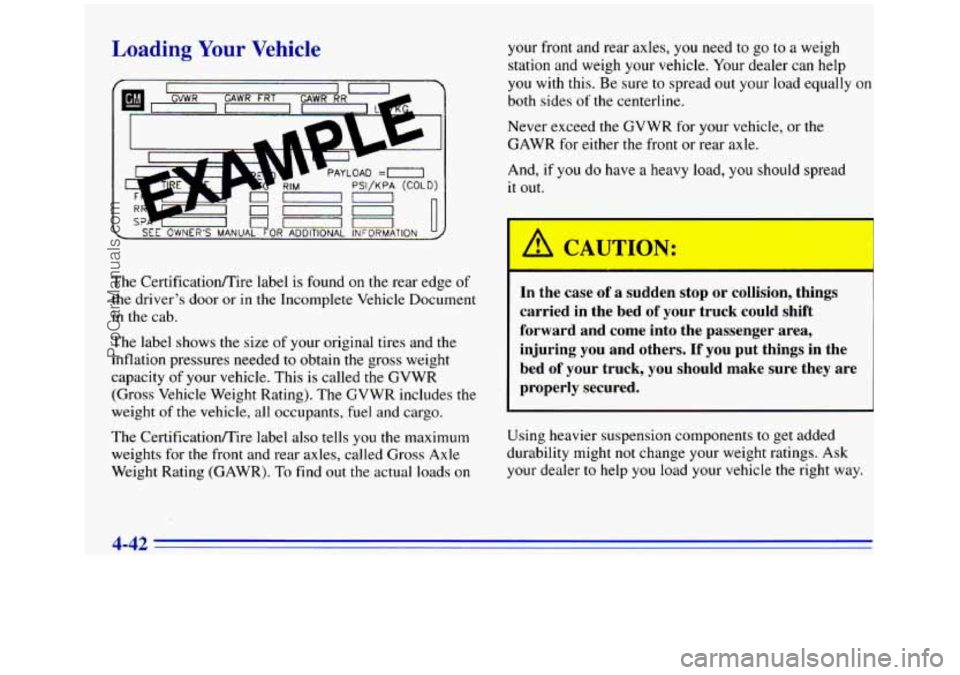
The Certificatiomire label is found on the rear edge of
the driver's door or in the Incomplete Vehicle Document
in the cab.
The label shows the size of your original tires and the
inflation pressures needed to obtain the gross weight
capacity
of your vehicle. This is called the GVWR
(Gross Vehicle Weight Rating).
The GVWR includes the
weight of the vehicle, all occupants, fuel and cargo.
The Certificationmire label also tells
you the maximum
weights for the front and rear axles, called Gross
Axle
Weight Rating (GAWR). To find out the actual loads on your
front and rear axles,
you need to go to a weigh
station and weigh your vehicle. Your dealer can help
you with this. Be sure to spread out your load equally on
both sides of the centerline.
Never exceed the GVWR for your vehicle, or the
GAWR for either the front or rear axle.
And,
if you do have a heavy load, you should spread
it
out.
I
In the case of a sudden stop or collision, things
carried in the bed
of your truck could shift
forward and come into the passenger area,
injuring you and others.
If you put things in the
bed
of your truck, you should make sure they are
properly secured.
Using heavier suspension components to get added
durability might not change your weight ratings. Ask
your dealer to help you load your vehicle the right way.
4-42
ProCarManuals.com
Page 201 of 404
NOTICE:
Pulling a trailer improperly can damage your
vehicle and result in costly repairs not covered by
your warranty.
To pull a trailer correctly, follow
the advice in this part, and see your
GM dealer
for-important information about towing a trailer
with your vehicle.
Every vehicle is ready for some trailer towing. If yours
was built with trailering options, as many are, it’s ready
for heavier trailers. But trailering is different than just
driving your vehicle by itself. Trailering means changes
in handling, durability and fuel economy. Successful,
safe trailering takes correct equipment, and it has to be
used properly.
That’s the reason for this part. In it are many
time-tested, important trailering tips and safety rules.
Many of these
are important for your safety and that of
your passengers.
So please read this section carefully
before you pull
a trailer.
If You Do Decide To Pull A Trailer
If you do, here are some important points:
0
0
0
0
There are many different laws, including speed limit
restrictions, having to do with trailering. Make sure-
your rig will be lega1,not only where you live but
also where you’ll be driving. A good source for this
information can be state or provincial police.
Consider using a sway control if your trailer will
weigh
4,000 lbs. (1 800 kg) or less. You should
always use a sway control if your trailer will weigh
more than
4,000 lbs. (1 800 kg). You can ask a hitch
dealer about sway controls.
Don’t tow a trailer at all‘during the first
500 miles
(800 km) your new vehicle is driven. Your engine,
axle or other parts could be damaged.
Then; during the first
500 miles (800 km) that you
tow a trailer, don’t drive over
50 mph (80 ktn/h) and
don’t make starts at full throttle. This helps your
engine and other parts of your vehicle wear in at the
heavier loads.
4-47
ProCarManuals.com
Page 236 of 404
Engine Fan Noise
Your vehicle has a clutched engine cooling fan. When the
clutch
is engaged, the fan spins fdster to provide more air
to cool the engine.
In most every day driving conditions,
the fan
is spinning slower and the clutch is not fully
engaged. This improves fuel economy and reduces fan
noise. Under heavy vehicle loading, trailer towing andor
high outside temperatures, the
fm speed increases as the
clutch more fully engages.
So you may hear an increase
in fan noise. This is normal and should not be mistaken
as the transmission slipping or making extra shifts.
It is
merely the cooling system functioning properly. The fan
will slow down when additional cooling is not required
and the clutch partially disengages.
You may also hear this
fm noise when you start
the engine.
It will go away as the fan clutch
partially disengages.
If a Tire Goes Flat
It’s unusual for a tire to “blow out” while you’re driving,
especially
if you maintain your tires properly. If air goes
out
of a tire, it’s much more likely to leak out slowly.
But if you should ever have a “blowout,” here are a few
tips about what
to expect and what to do:
If a front tire fails, the flat tire will create a. drag that
pulls the vehicle toward that side. Fake your foot off the
accelerator pedal and grip the steering wheel firmly.
Steer to maintain
lane position, and then gently brake to
a stop well out of the traffic lane.
A rear blowout, particularly on a curve, acts much like
a skid and
ITMY require the same correction you’d use in
a skid. In any rear blowout, remove your foot from the
accelerator pedal. Get the vehicle under control by
steering the way you want the vehicle to
go. It may be
very bumpy and
noisy, but you can still steer. Gently
brake to a stop
-- well off the road if possible.
If a tire goes tlat, the next part shows how to use your
jacking equipment to change
a flat tire safely.
5-20
ProCarManuals.com
Page 251 of 404
Section 6 Service and Appearance Care
I
I
Here you will find information about the care of your
vehicle. This section begins
with service and fuel
information, and then it shows how to check important
fluid and lubricant levels. There is also technical
information about your vehicle, and
a part devoted to
its appearance care.
Service
Your GM dealer knows your vehicle best and wants you
to be happy with
it. We hope you’ll go to your dealer for
all your service needs. You‘ll get genuine GM parts and
GM-trained and supported service people. We
hope you’ll want
to keep your GM vehicle all GM.
Genuine GM parts have one of these marks:
Delco
Doing Your Own Service Work
If you want to do some of your own service work. you’ll
want to get the proper service manual.
It tells you much
more about how
to service your vehicle than this rnanual
can.
To order the proper service manual, see “Service
and Owner Publications”
in the Index.
6’
ProCarManuals.com