instrument panel GMC SIERRA 1996 User Guide
[x] Cancel search | Manufacturer: GMC, Model Year: 1996, Model line: SIERRA, Model: GMC SIERRA 1996Pages: 404, PDF Size: 21.57 MB
Page 114 of 404
Ashtrays and Cigarette Lighter
Front Ashtray
The front ashtray is located at the bottom of the instrument
panel. Pull
on the notch in the ashtray door to open it.
NOTICE:
If you store paper or other things that burn in
your ashtrays, they could be set on fire by
cigarettes
or other smoking materials. That could
cause
a fire and possibly damage your vehicle. Do
not store papers and other things that burn in
your ashtrays.
To remove the front ashtray, press the retainer spring
and pivot
the ashtray toward you. To replace the ashtray.
place
the bottom part of the ashtray on the pivot bar at
the bottom
of its mounting on the instrument panel.
Then rotate the ashtray
back to its original position.
Rear Ashtray
To use a rear ashtray, if you have them, pull at the top of
the ashtray door to flip the door open.
To remove a rear ashtray. press down on the inside tabs
and open the door fully.
NOTICE:
If you store paper or other things that burn in
your ashtrays, they could be
set on fire by
cigarettes or other smoking materials. That could
cause a fire and possibly damage your vehicle.
Do
not store papers and other things that burn in
your ashtrays.
To use the cigarette lighter, push it in all the way, and let
go. When it’s ready, it will pop back by itself.
NOTICE:
Holding a cigarette lighter in with your hand
while it is heating can make it overload,
damaging the lighter and the heating element.
Just
push the lighter all the way in and let go.
When it’s done, it
will pop back by itself.
2-52
ProCarManuals.com
Page 116 of 404
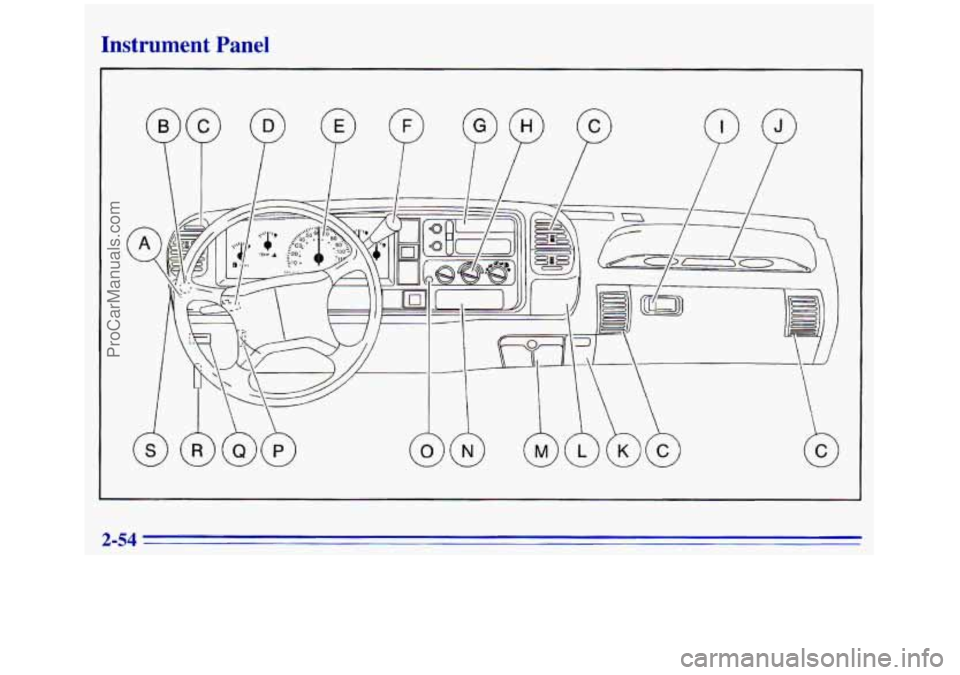
Instrument Panel
Q I
I P P P
2-54
ProCarManuals.com
Page 118 of 404
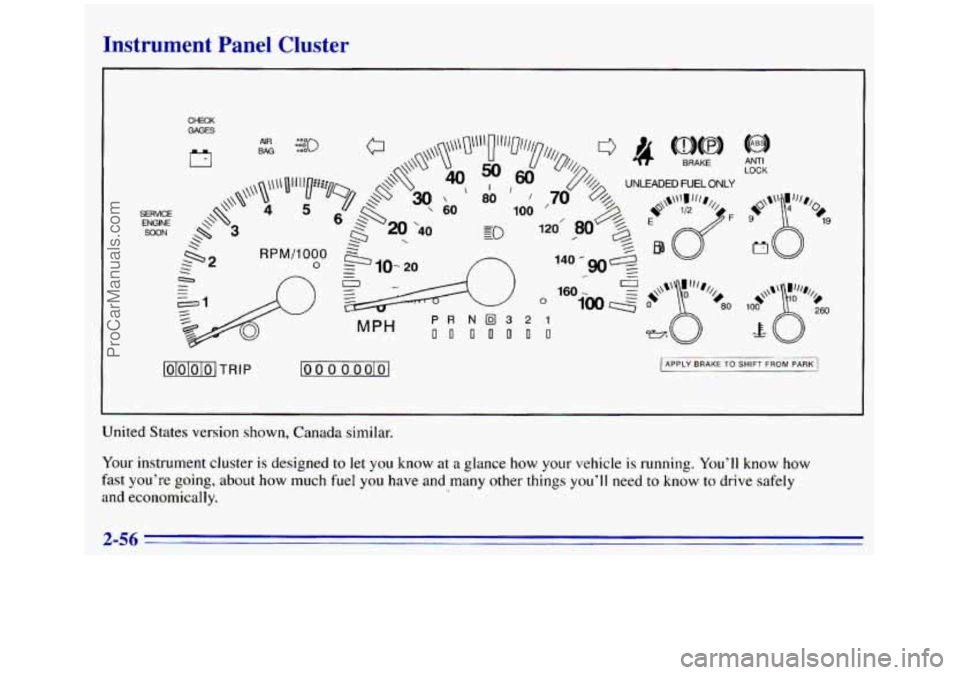
Instrument Panel Cluster
CHECK GAGES
SERVICE ENGINE SOON ANTI
LOCK
TRIP loo 0 0 oolol 1 APPLY TO SHIFT FROM PARK
United
States version shown, Canada similar.
Your instrument cluster is designed to let you know at a glance how your vehicle is running. You'll know how
fast you're going, about how much fuel you have and many other things you'll need to
know to drive safely
and economically.
2-56
ProCarManuals.com
Page 121 of 404
Air Bag Readiness Light
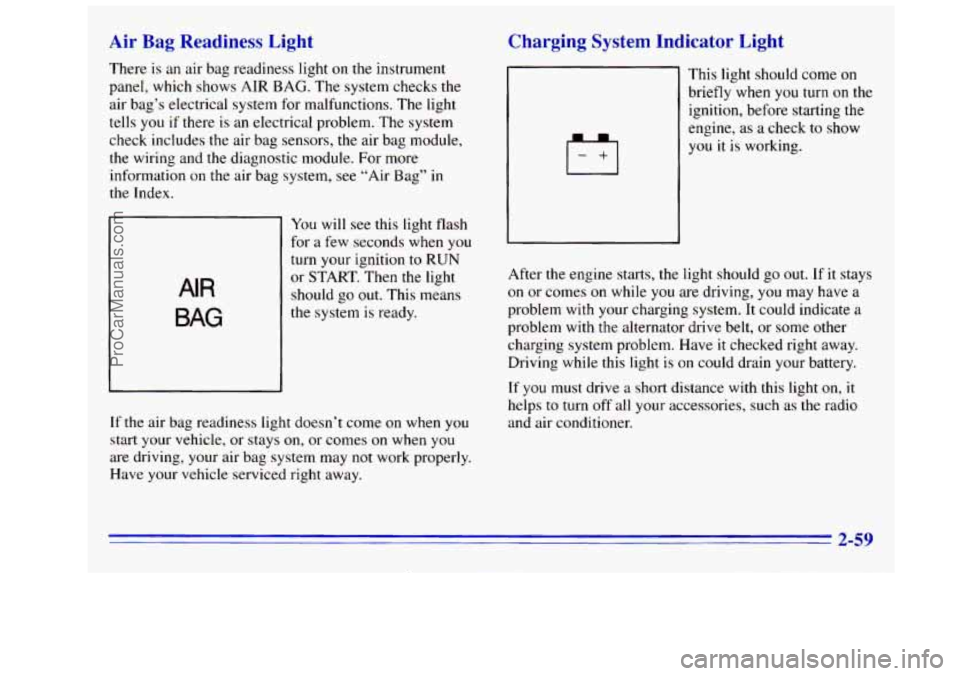
There is an air bag readiness light on the instrument
panel, which shows AIR BAG. The system checks the
air bag’s electrical system for malfunctions. The light
tells
you if there is an electrical problem. The system
check includes the air bag sensors, the air bag module,
the wiring and the diagnostic module. For more
information
on the air bag system, see “Air Bag” in
the Index.
AIR
BAG
You will see this light flash
for a few seconds when you
turn your ignition
to RUN
or START. Then the light
should go out. This means
the system is ready.
Charging System Indicator Light
If the air bag readiness light doesn’t come on when you
start your vehicle, or stays on, or comes on when you
are driving, your air bag system may not work properly.
Have your vehicle serviced right away. This
light should come
on
briefly when you turn on the
ignition, before starting the
engine, as
a check to show
you it is working.
After the engine starts,
the light should go out. If it stays
on or comes on while
you are driving, you may have a
problem with your charging system. It could indicate a
problem with the alternator drive belt,
or some other
charging system problem. Have
it checked right away.
Driving while this light is on could drain your battery.
If
you must drive a short distance with this light on, it
helps to turn off all your accessories, such
as the radio
and air conditioner.
2-59
ProCarManuals.com
Page 132 of 404
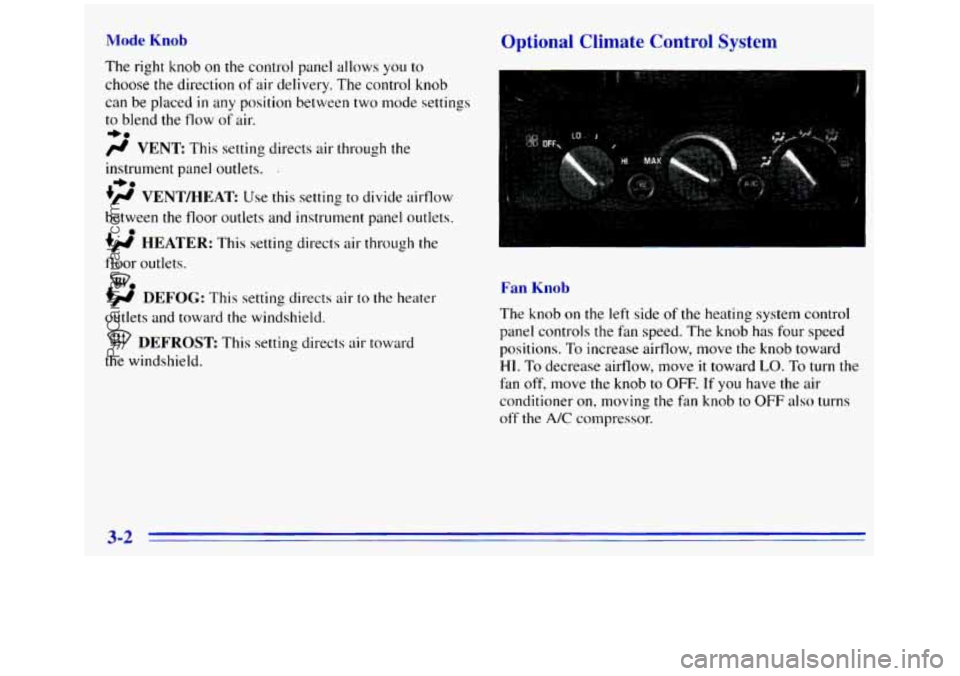
Mode Knob Optional Climate Control System
The right knob on the control panel allows you to
choose
the direction of air delivery. The control knob
can be placed in any position between two mode settings
to blend the
flow of air.
+e
/J VENT: This setting directs air through the
instrument panel outlets.
+’ VENT/HEAT Use this setting to divide airflow
between
the floor outlets and instrument panel outlets.
+iJ HEATB; This setting directs air through the
floor outlets.
6fl DEFOG: This setting directs air to the heater
outlets and toward the windshield.
9 DEFROST: This setting directs air toward
the windshield.
+*
e
(ii3, Fan Knob
The knob on the left side of the heating system control
panel controls the fan speed. The knob has four speed
positions. To increase airflow, move the knob toward
HI. To decrease airflow, move it toward LO. To turn the
fan off, move the knob to
OFF. If you have the air
conditioner on. moving
the fan knob to OFF also turns
off the A/C compressor.
3-2
ProCarManuals.com
Page 133 of 404
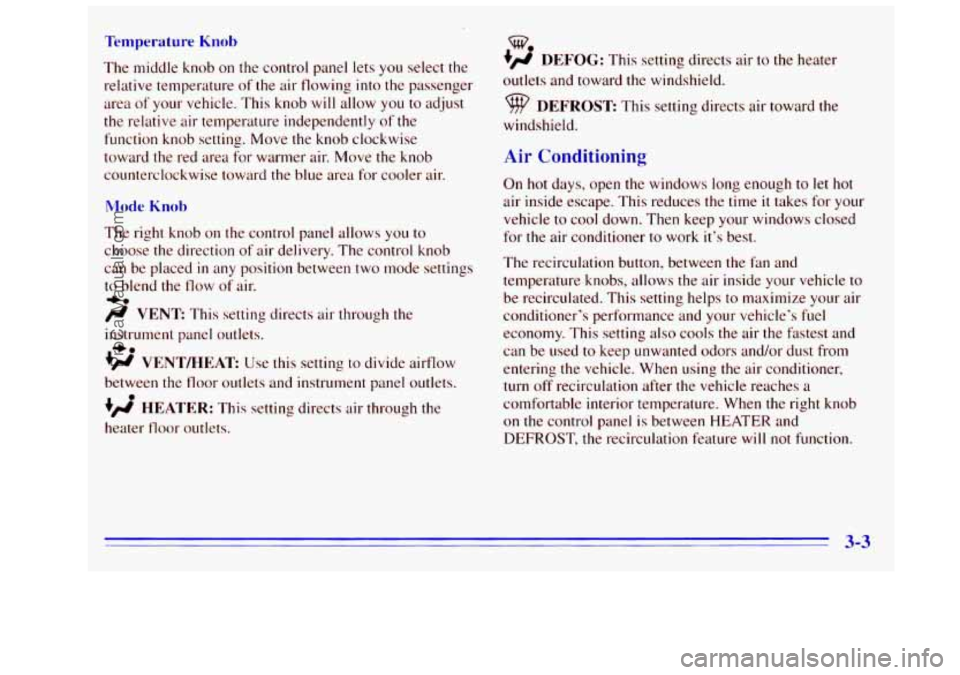
Temperature Knob
The middle knob on the control panel lets you select the
relative temperature
of the air flowing into the passenger
area of your vehicle. This knob will allow you to adjust
the relative air temperature independently
of the
function knob setting. Move the knob clockwise
toward
the red area for warmer air. Move the knob
counterclockwise toward the blue area for cooler air.
The right knob on the control panel allows you to
choose the direction of air delivery. The control knob
can be placed
in any position between two mode settings
to blend the flow of air.
/J VENT: This setting directs air through the
instrument panel outlets.
+H VENT/HEAT Use this setting to divide airflow
between the floor outlets and instrument panel outlets.
+’ HEATER: This setting directs air through the
heater floor outlets.
+e
+.
0
Qe
+’ DEFOG: This setting directs air to the heater
outlets and toward
the windshield.
DEFROST This setting directs air toward the
windshield.
Air Conditioning
On hot days, open the windows long enough to let hot
air inside escape. This reduces the time it takes for your
vehicle
to cool down. Then keep your windows closed
for
the air conditioner to work it’s best.
The recirculation button, between the fan and
temperature knobs, allows the air inside your vehicle to
be recirculated. This setting helps
to maximize your air
conditioner’s performance and your vehicle’s fuel
economy. This setting also
cools the air the fastest and
can be used
to keep unwanted odors and/or dust from
entering the vehicle. When using the air conditioner,
turn off recirculation after the vehicle reaches a
comfortable interior temperature. When the right knob
on the control panel is between HEATER and
DEFROST, the recirculation feature will
not function.
ProCarManuals.com
Page 134 of 404
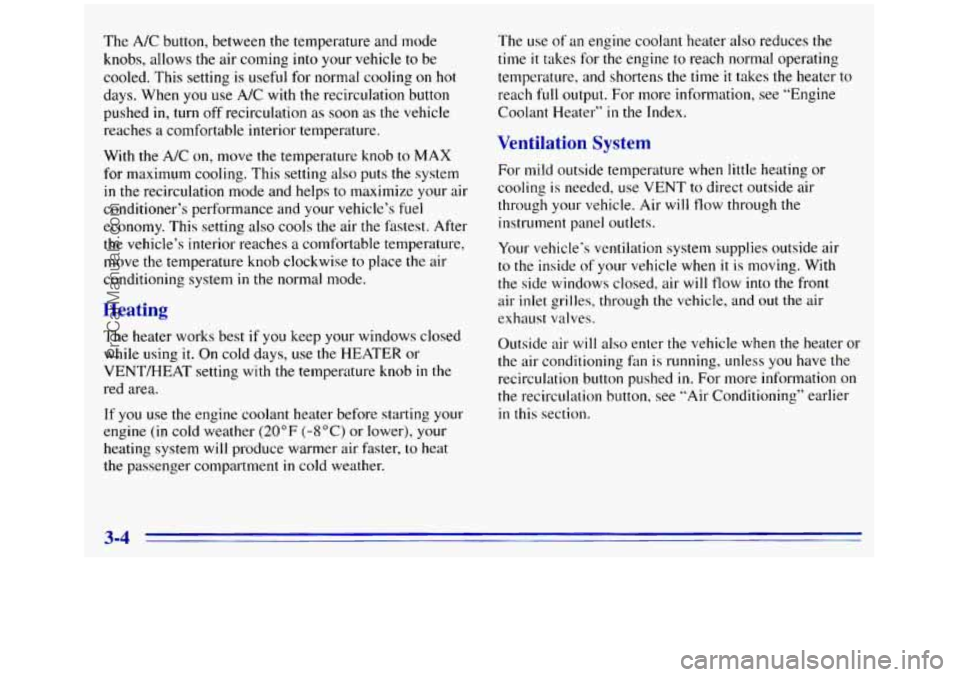
The A/C button, between the temperature and mode
knobs, allows
the air coming into your vehicle to be
cooled. This setting
is useful for normal cooling on hot
days. When
you use A/C with the recirculation button
pushed
in, turn off recirculation as soon as the vehicle
reaches a comfortable interior temperature.
With the
A/C on, move the temperature knob to MAX
for maximum cooling.
This setting also puts the system
in the recirculation mode and helps
to maximize your air
conditioner’s performance and your vehicle’s fuel
economy. This setting also cools the air the fastest. After
the vehicle’s interior reaches a comfortable temperature,
move the temperature knob clockwise to place the air
conditioning system
in the normal mode.
Heating
The heater works best if you keep your windows closed
while using
it. On cold days, use the HEATER or
VENT/HEAT setting with the temperature knob in the
red area.
If you use the engine coolant heater before starting your
engine (in cold weather (20°F (-8°C) or lower), your
heating system
will produce warmer air faster, to heat
the passenger compartment
in cold weather. The
use
of an engine coolant heater also reduces the
time
it takes for the engine to reach normal operating
temperature, and shortens the time
it takes the heater to
reach full output. For more information, see “Engine
Coolant Heater”
in the Index.
Ventilation System
For mild outside temperature when little heating or
cooling
is needed, use VENT to direct outside air
through
your vehicle. Air will flow through the
instrument panel outlets.
Your vehicle’s ventilation systeril supplies outside air
to the inside of your vehicle when it is moving. With
the side windows closed, air will flow into the front
air inlet grilles, through the vehicle, and out the air
exhaust valves.
Outside air will
also enter the vehicle when the heater or
the air conditioning fan is running, unless you have
the
recirculation button pushed in. For more information on
the recirculation button, see “Air Conditioning” earlier
in this section.
3-4
ProCarManuals.com
Page 135 of 404
Ventilation Tips
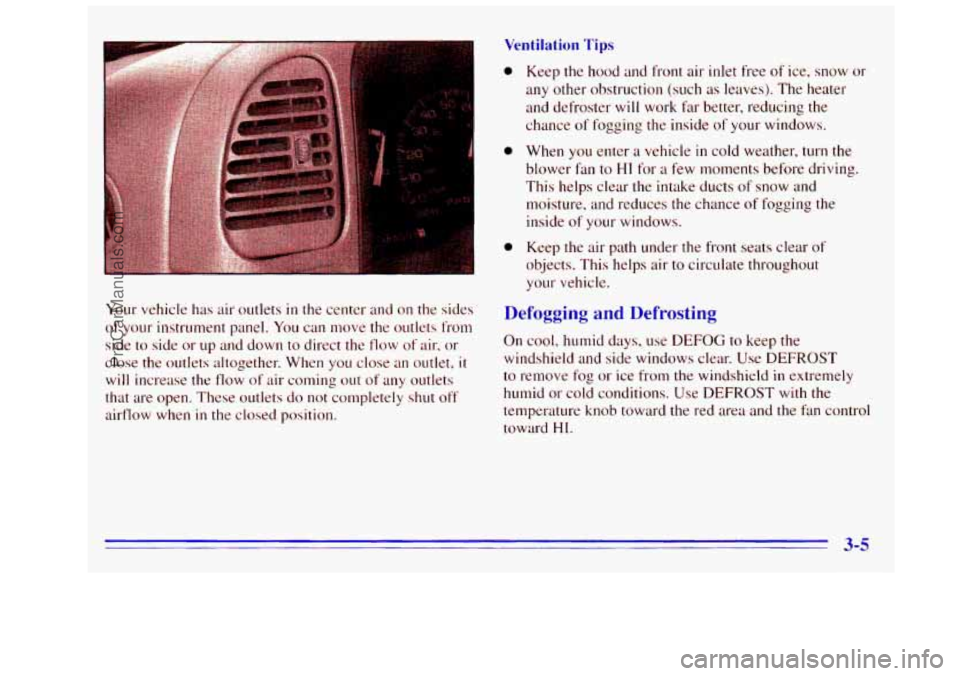
Your vehicle has air outlets in the center and on the sides
of your instrument panel. You can move the outlets from
side to side or up and down to direct the
flow of air, or
close the outlets altogether. When
you close an outlet, it
will increase the flow of air coming out of any outlets
that are open. These outlets do not completely
shut off
airflow when
in the closed position.
0
0
0
Keep the hood and front air inlet free of ice, snow or
any other obstruction (such
as leaves). The heater
and defroster
will work far better, reducing the
chance of fogging the inside
of your windows.
When you enter
a vehicle in cold weather, turn the
blower fan to HI for a few moments before driving.
This helps clear the intake ducts
of snow and
moisture, and reduces the chance
of fogging the
inside
of your windows.
Keep the air path under the front seats clear
of
objects. This helps air to circulate throughout
your vehicle.
Defogging and Defrosting
On cool, humid days, use DEFOG to keep the
windshield and side windows clear.
Use DEFROST
to remove fog or ice from the windshield in extremely
humid or cold conditions. Use DEFROST
with the
temperature knob toward
the red area and the fan control
toward
HI.
ProCarManuals.com
Page 211 of 404
Turn Signals When Towing a Trailer
The green arrows on your instrument panel will flash
whenever
you signal a turn or lane change. Properly
hooked up, the trailer lamps will also flash, telling other
drivers you’re about to turn, change lanes or stop.
When towing a trailer, the green arrows
on your
instrument panel will flash for turns even
if the bulbs on
the trailer are burned out. Thus, you may
think drivers
behind
you are seeing your signal when they are not. It’s
important to check occasionally to be sure the trailer
bulbs are
still working.
Driving On Grades
Reduce speed and shift to a lower gear be~m you start
down
a long or steep downgrade. If you don’t shift
down,
you might have to use your brakes so much that
they would get hot and
no longer work well.
On a long uphill grade,
shift down and reduce your
speed
to around 45 mph (70 km/h) to reduce the
possibility
of engine and transmission overheating.
If you have an automatic transmission, you should use
THIRD
(3) (or, as you need to, a lower gear) when
towing a trailer. Operating your vehicle in THIRD
(3)
when towing a trailer will minimize heat build-up and
extend
the life of your transmission
If
you have a manual transmission and you are towing a
trailer,
it’s better not to use FIFTH (5) gear. Just drive in
FOURTH (4) gear (or, as you need to, a lower gear).
When towing at high altitude on steep uphill grades,
consider the following: Engine coolant will boil at a
lower temperature than at normal altitudes. If
you turn
your engine off‘ immediately after towing at high altitude
on steep uphill grades, your vehicle may show signs
similar
to engine overheating. To avoid this, let the
engine
run while parked (preferably on level ground)
with the automatic transmission
in PARK (P) (or the
manual transmission out
of gear and the parking brake
applied) for a few minutes before turning
the engine off.
If you do get the overheat warning, see “Engine
Overheating’’
in the Index.
ProCarManuals.com
Page 226 of 404
Engine Overheating
(Gasoline Engine)
You will find a coolant temperature gage on your
vehicle’s instrument panel.
If your vehicle has a
diesel engine, see “Engine Overheating” in the Diesel
Engine Supplement.
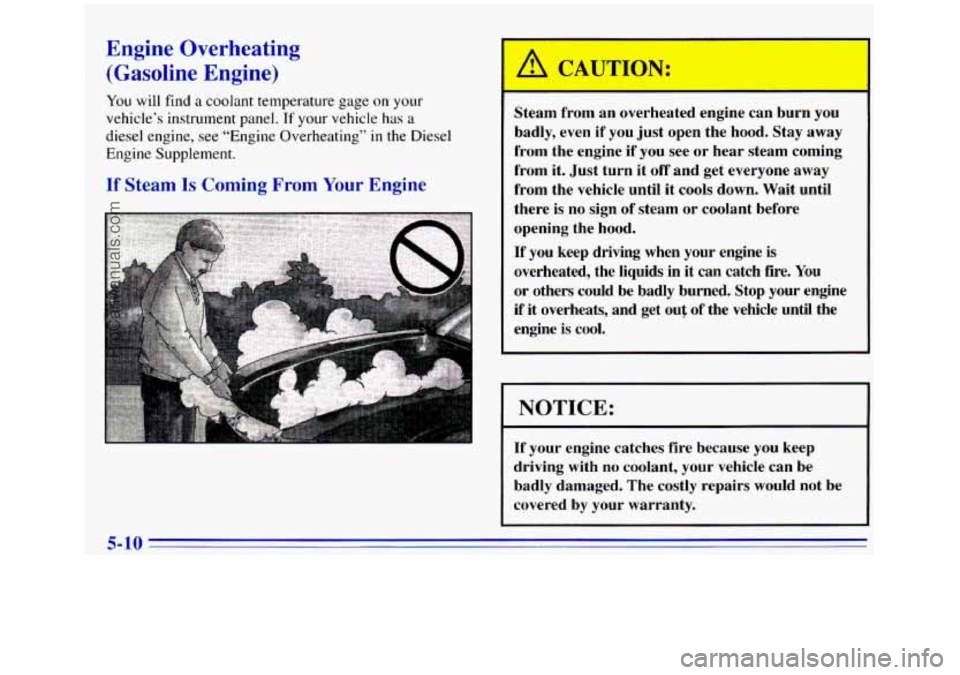
If Steam Is Coming From Your Engine
A CAUTION:
Steam from an overheated engine can burn you
badly, even if you just open the hood. Stay away
from the engine if you see
or hear steam coming
from it. Just turn it
off and get everyone away
from the vehicle until it cools down. Wait until
there is no sign
of steam or coolant before
opening the hood.
If you keep driving when your engine is
overheated, the liquids in it can catch
fire. You
or others could be badly burned. Stop your engine
if it overheats, and get out of the vehicle until the
engine is cool.
NOTICE:
If your engine catches fire because you keep
driving with no coolant, your vehicle can be
badly damaged. The costly repairs would not be
covered by your warranty.
5-10
ProCarManuals.com