trailer GMC SIERRA 1996 Owner's Manual
[x] Cancel search | Manufacturer: GMC, Model Year: 1996, Model line: SIERRA, Model: GMC SIERRA 1996Pages: 404, PDF Size: 21.57 MB
Page 213 of 404
When You Are Ready to Leave After
Parking on a Hill
1. Apply your regular brakes and hold the pedal down
while
you:
0 Start your engine;
Shift into a gear; and
0 Release the parking brake.
2. Let up on the brake pedal.
3. Drive slowly until the trailer is clear of the chocks.
4. Stop and have someone pick up and store the chocks.
Maintenance When Trailer Towing
Your vehicle will need service more often when you’re
pulling
a trailer. See the Maintenance Schedule for more
on this. Things
that are especially important in trailer
operation are automatic transmission fluid (don’t
overfill), engine oil, axle lubricant, belt, cooling system
and brake adjustment. Each of these is covered
in this
manual, and the Index will help you find them quickly.
If you’re trailering, it’s a good idea
to review these
sections before you start your trip.
Check periodically
to see that all hitch nuts and bolts
are tight.
Trailer Wiring Harness
A seven-wire harness is stored under the rear end of
your vehicle. between the frame rails. An electrical
connector
will need to be installed at the trailer end of
the harness, by a qualified electrical technician. For
additional trailer wiring and towing information please
consult your
GM dealer. Securely attach the harness to
the trailer, then tape or strap it to your vehicle’s frame
rail.
Be sure you leave it loose enough so the wiring
won’t bind or break when turning with the trailer, but
not so loose that it drags on the ground. Store the
harness in its original position. Wrap the harness
together and tie
it neatly so it won’t be damaged. If you
tow a trailer, your Center High-Mounted Stoplamp
(CHMSL) may not be properly visible from behind.
You should select a trailer with
a CHMSL on it or, if
one is not available, have one installed. See your GM
dealer about how to connect your vehicle’s wiring to
a trailer CHMSL.
4-59
ProCarManuals.com
Page 216 of 404
Using a Transfer Case Mounted Power
Take-Off (Automatic Transmission)
1.
2.
3.
4.
5.
6.
Set the parking brake.
Shift the transfer case into NEUTRAL
(N).
Shift the transmission into NEUTRAL (N).
Engage the PTO.
If you are going to drive the vehicle, shift the
transfer case
into the range yo11 want. Then apply the
regular brakes and release the parking brake.
Shift the transmission to
THIRD (3) to start the PTO.
Release the regular brakes to drive the vehicle.
Step-Bumper Pad
If your vehicle has a rear step bumper, it may
be equipped with
a rear step pad at the center of
the bumper.
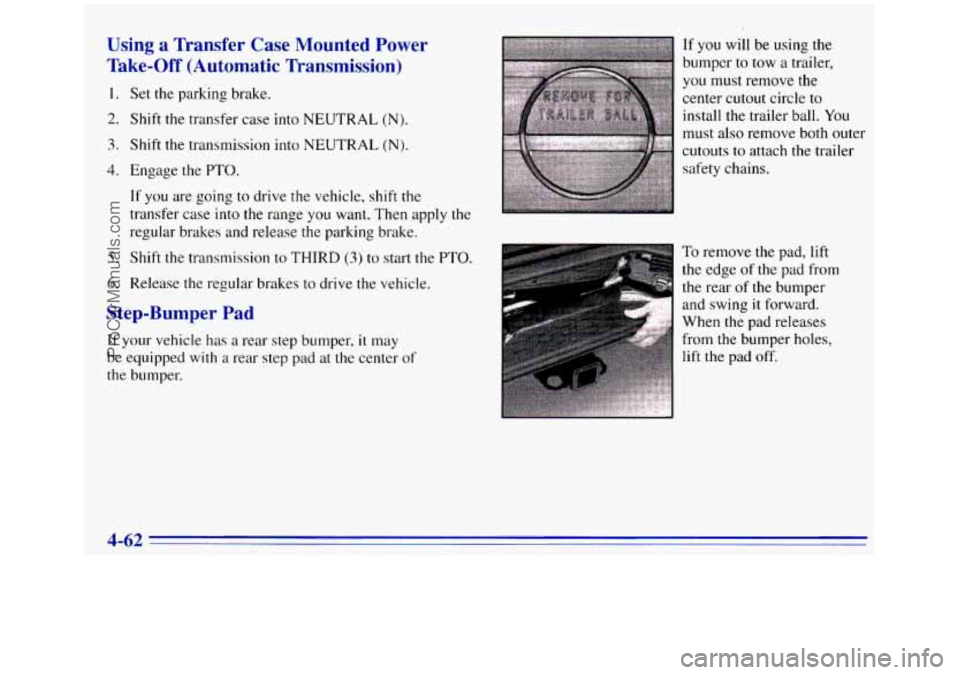
If you will be using the
bumper to
tow a trailer,
you must remove the
center cutout circle
to
install the trailer ball. You
must also remove both outer
cutouts to attach the trailer
safety chains.
To remove the pad, lift
the edge of
the pad from
the rear
of the bumper
and swing
it forward.
When
the pad releases
from
the bumper holes,
lift the pad off.
4-62
ProCarManuals.com
Page 227 of 404
If No Steam Is Coming From Your Engine
If you get the overheat warning but see or hear no
steam, the problem may
not be too serious. Sometimes
the engine can get
a little too hot when you:
Climb a long hill on a hot day.
0 Stop after high-speed driving.
Idle for long periods in traffic.
Tow a trailer. See “Driving on Grades” in the Index.
If you get the overheat warning with no sign of steam,
try
this for a minute or so:
I. If you have an air conditioner, turn it off.
2. Turn on your heater to full hot at the highest fan
speed and open the window
as necessary.
3. If you’re in a traffic jam, shift to NEUTRAL (N);
otherwise, shift to the highest gear while
driving
-- AUTOMATIC OVERDRIVE (0)
or THIRD (3) for automatic transmissions.
If you no longer have the overheat warning, you can drive.
Just to be safe, drive slower
for about 10 minutes. If the
warning doesn’t come back
on, you can drive normally.
If the warning continues, pull over, stop, and park your
vehicle right away.
If there’s still
no sign of steam, push the accelerator
until the engine speed is about twice as fast as normal
idle speed. Bring the engine speed back
to normal idle
speed after two or three minutes. Now see
if the warning
stops.
But then, if you still have the warning, turn of
the engine nrzd get everyone nut of the vehicle until it
cools down.
You
may decide not to lift the hood but to get service
help right away.
5-11
ProCarManuals.com
Page 236 of 404
Engine Fan Noise
Your vehicle has a clutched engine cooling fan. When the
clutch
is engaged, the fan spins fdster to provide more air
to cool the engine.
In most every day driving conditions,
the fan
is spinning slower and the clutch is not fully
engaged. This improves fuel economy and reduces fan
noise. Under heavy vehicle loading, trailer towing andor
high outside temperatures, the
fm speed increases as the
clutch more fully engages.
So you may hear an increase
in fan noise. This is normal and should not be mistaken
as the transmission slipping or making extra shifts.
It is
merely the cooling system functioning properly. The fan
will slow down when additional cooling is not required
and the clutch partially disengages.
You may also hear this
fm noise when you start
the engine.
It will go away as the fan clutch
partially disengages.
If a Tire Goes Flat
It’s unusual for a tire to “blow out” while you’re driving,
especially
if you maintain your tires properly. If air goes
out
of a tire, it’s much more likely to leak out slowly.
But if you should ever have a “blowout,” here are a few
tips about what
to expect and what to do:
If a front tire fails, the flat tire will create a. drag that
pulls the vehicle toward that side. Fake your foot off the
accelerator pedal and grip the steering wheel firmly.
Steer to maintain
lane position, and then gently brake to
a stop well out of the traffic lane.
A rear blowout, particularly on a curve, acts much like
a skid and
ITMY require the same correction you’d use in
a skid. In any rear blowout, remove your foot from the
accelerator pedal. Get the vehicle under control by
steering the way you want the vehicle to
go. It may be
very bumpy and
noisy, but you can still steer. Gently
brake to a stop
-- well off the road if possible.
If a tire goes tlat, the next part shows how to use your
jacking equipment to change
a flat tire safely.
5-20
ProCarManuals.com
Page 265 of 404
As shown in the chart, SAE 5W-30 is best for your
vehicle. However,
you can use SAE low-30 if it’s going
to be
0°F (-1 8°C) or above. These numbers on an oil
container show its viscosity, or thickness. Do not use
other viscosity oils, such as
SAE 20W-50.
I NOTICE:
Use only engine oil with the American Petroleum
Institute Certified For Gasoline Engines
“Starburst” symbol. Failure to use the
recommended oil can result in engine damage not
covered
by your warranty.
GM Goodwrench@ oil meets all the requirements for
your vehicle.
Engine Oil Additives
Don’t add anything to your oil. Your GM dealer is ready
to advise if you think something should be added.
When to Change Engine Oil
See if any one of these is true for you:
a
a
a
a
a
Most trips are less than 5 to 10 miles (8 to I6 km).
This is particularly important when outside
temperatures are below freezing.
Most trips include extensive idling (such as frequent
driving
in stop-and-go traffic).
You operate your vehicle in dusty areas or
off-road frequently.
You frequently
tow a trailer.
The vehicle is used for delivery service, police, taxi
or other commercial application.
Driving under these conditions causes engine oil to
break down sooner.
If any one of these is true for your
vehicle, then you need
to change your oil and filter
every
3,000 miles (5 000 km) or 3 months -- whichever
occurs first.
If none of them is true, change the oil and filter every
7,500 miles ( 12 500 km) or I2 months -- whichever
occurs first. Driving a vehicle
with a fully warmed
engine under highway conditions causes engine
oil to
break down slower.
6-15
ProCarManuals.com
Page 269 of 404
Automatic Transmission Fluid
When to Check a1 C’ -ge
A good time to check your auromarlc transmission fluid
level
is when the engine oil is changed.
Change both the fluid and filter every
50,000 miles
(83 000 km) if the vehicle’s GVWR is over 8,600 or
if the vehicle is mainly driven under one or more of
these conditions:
In heavy city traffic where the outside temperature
regularly reaches
90°F (32°C) or higher.
0 In hilly or mountainous terrain.
0 When doing frequent trailer towing.
Uses such as found in taxi, police or delivery service.
If your vehicle’s GVWR is not over 8,600 and you do
not use your vehicle under any of these conditions, the
fluid and filter
do not require changing.
See “Scheduled Maintenance Services’’
in the Index.
How to Check
Because this operation can be a little difficult, you
may choose to have this done at your GM dealership
Service Department. If
you do it yourself,
be sure to follow all the instructions
here, or
you could get a false reading on the dipstick.
NOTICE:
Too much or too little fluid can damage your
transmission.
Too much can mean that some of
i the fluid could come out and fall on hot engine
~ parts or exhaust system parts, starting a fire. Be
sure to get an accurate reading if you check your
transmission fluid.
Wait at least 30 minutes before checking the
transmission fluid level
if you have been driving:
When outside temperatures are above 90°F (32°C).
0 At high speed for quite a while.
In heavy traffic -- especially in hot weather.
While pulling a trailer.
To get the right reading, the fluid should be at normal
operating temperature, which
is 180°F to 200°F (82°C
to 93°C).
6-19
ProCarManuals.com
Page 274 of 404
Rear Axle
When to Chc d Change Lubricant
Refer to the Maintenance Schedule to determine how
often to check the lubricant and when to change
it. See
“Scheduled Maintenance Services”
in the Index.
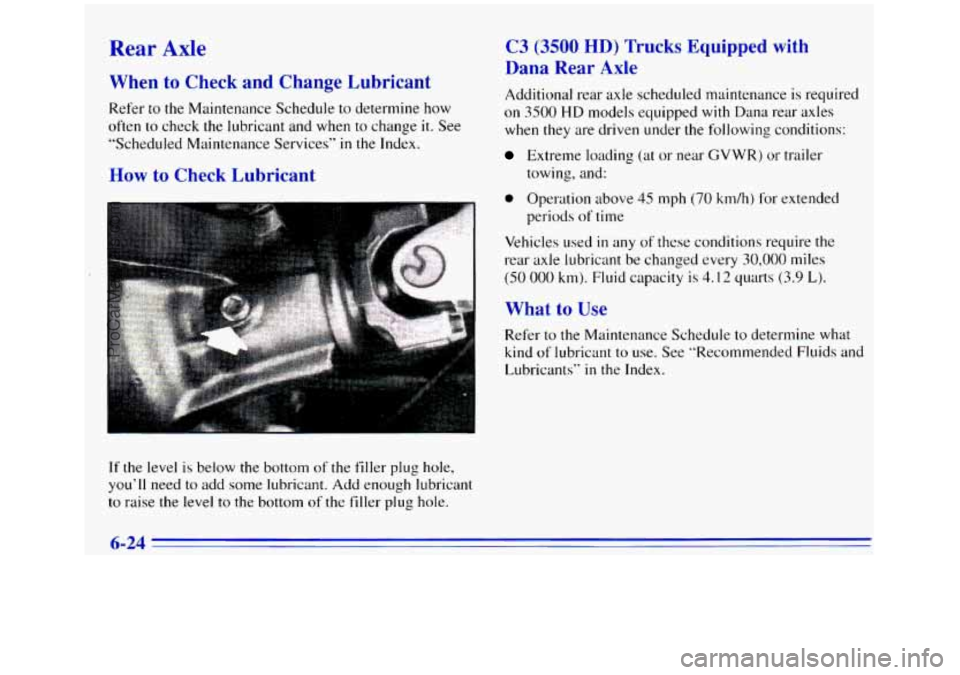
How to Check Lubricant
If the level is below the bottom of the filler plug hole,
you’ll need to add some lubricant. Add enough lubricant
to raise the level to the bottom
of the filler plug hole.
C3 (3500 HD) Trucks Equipped with
Dana Rear
Axle
Additional rear axle scheduled maintenance is required
on 3500 HD models equipped with Dana rear axles
when they are driven under the following conditions:
Extreme loading (at or near GVWR) or trailer
towing, and:
0 Operation above 45 mph (70 km/h) for extended
periods
of time
Vehicles used
in any of these conditions require the
rear axle lubricant be changed every 30,000 miles
(SO 000 km). Fluid capacity is 4.12 quarts (3.9 L).
What to Use
Refer to the Maintenance Schedule to determine what
kind
of lubricant to use. See “Recommended Fluids and
Lubricants”
in the Index.
6-24
ProCarManuals.com
Page 330 of 404
Maintenance Schedule
I Short Trip/City Definition -- Gasoline Engines . I ~
Follow the Short Trip/City Maintenance Schedule if any
one of these conditions is true for your vehicle:
Most trips are less than 5 to 10 miles (8 to 16 km).
This is particularly important when outside
temperatures are below freezing.
driving in stop-and-go traffic).
off-road frequently.
0 Most trips include extensive idling (such as frequent
0 You operate your vehicle in dusty areas or
You frequently tow a trailer.
If the vehicle is used for delivery service, police, taxi
One of the reasons you should follow this schedule if you
operate your vehicle under any of these conditions is that
these conditions cause engine oil to break down soonez
or other commercial application.
I Short Trip/City Intervals -- Gasoline Engines I
Every 3,000 Miles (5 000 km): Engine Oil and Filter
Change
(or 3 months, whichever occurs first). Chassis
Lubrication (or
3 months, whichever occurs first). Drive
Axle Service (or
3 months, whichever occurs first).
At 6,000 Miles (10 000 km) -- Then Every
12,000 Miles (20
000 km): 'Tire Rotation.
Every 15,000 Miles (25 000 km): Shields and
Underhood Insulation Inspection
(GVWR above
8,500 lbs. only). Thermostatically Controlled Engine
Cooling Fan Check (or every
12 months, whichever
occurs first). Front Wheel Bearing Repack
(2WD only)
(or at each brake relining, whichever occurs first).
Every 30,000 Miles (50 000 km): Fuel Filter Replacement.
Every 50,000 Miles (83 000 km): Automatic
Transmission Service (vehicles over
8600 GVWR or
driven under severe conditions only).
Evwy 60,000 Miles (100 000 km): Engine Accessory
Drive Belt Inspection. Fuel Tank, Cap and Lines
Inspection. Exhaust Gas Recirculation System
Inspection. Evaporative Control System Inspection.
Every 100,000 Miles (166 000 km): Cooling System
Service (or every
60 months, whichever occurs first).
Spark Plug Wire Inspection. Spark Plug Replacement.
Positive Crankcase Ventilation
(PCV) Valve Inspection.
These intervals only summarize maintenance services.
Be sure to follow the complete maintenance schedule
on
the following pages.
7-4
ProCarManuals.com
Page 332 of 404
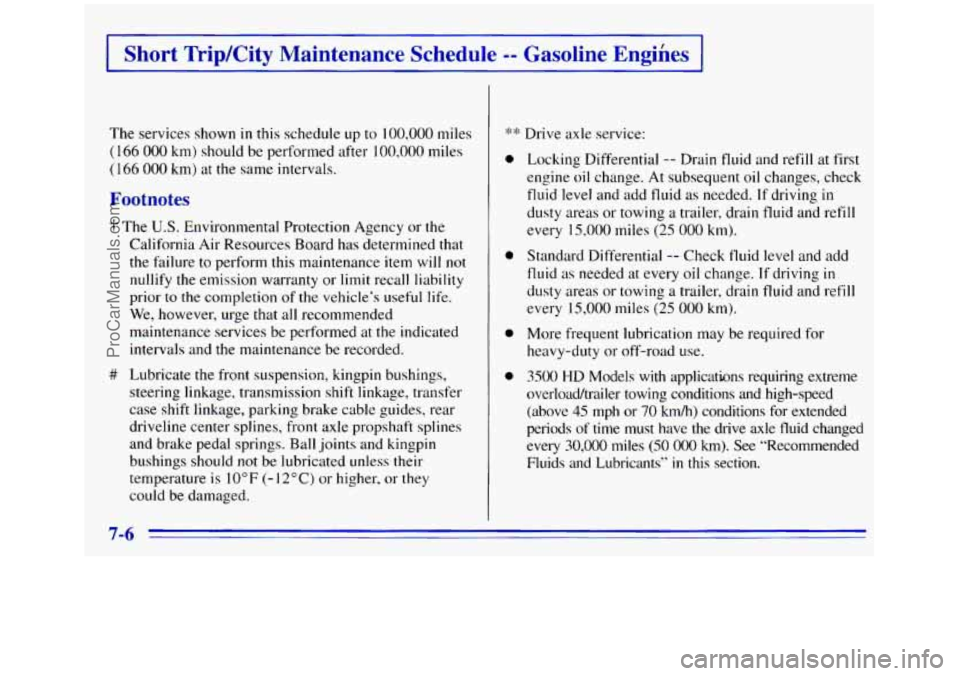
Short TripKity Maintenance Schedule -- Gasoline Engines
The services shown in this schedule up to 100,000 miles
(1 66 000 km) should be performed after 100,000 miles
(166 000 km) at the same intervals.
Footnotes
T The U.S. Environmental Protection Agency or the
California Air Resources Board has determined that
the failure to perform this maintenance item will
not
nullify the emission warranty or limit recall liability
prior
to the completion of the vehicle‘s useful life.
We, however, urge that all recommended
maintenance services be performed at the indicated
intervals and the maintenance be recorded.
# Lubricate the front suspension, kingpin bushings,
steering linkage, transmission shift linkage, transfer
case shift linkage, parking brake cable guides, rear
driveline center splines, front axle propshaft splines
and brake pedal springs. Ball joints and kingpin
bushings should not be lubricated unless their
temperature is 10°F
(- 12°C) or higher, or they
could be damaged.
:f: :1:
0
0
0
e
Drive axle service:
Locking Differential
-- Drain fluid and refill at first
engine
oil change. At subsequent oil changes, check
fluid level and add fluid as needed. If driving in
dusty areas or towing a trailer, drain fluid and refill
every 15,000 miles
(25 000 km).
Standard Differential -- Check fluid level and add
fluid
as needed at every oil change. If driving in
dusty areas or towing a trailer, drain fluid and refill
every
I5,OOO miles (25 000 km).
More frequent lubrication may be required for
heavy-duty or off-road
use.
3500 HD Models with applications requiring extreme
overload/trailer towing conditions and high-speed
(above
45 mph or 70 kmh) conditions for extended
periods
of time must have the drive axle fluid changed
evey
30,000 miles (50 000 km). See “Recommended
Fluids and Lubricants’’
in this section.
7-6
ProCarManuals.com
Page 342 of 404
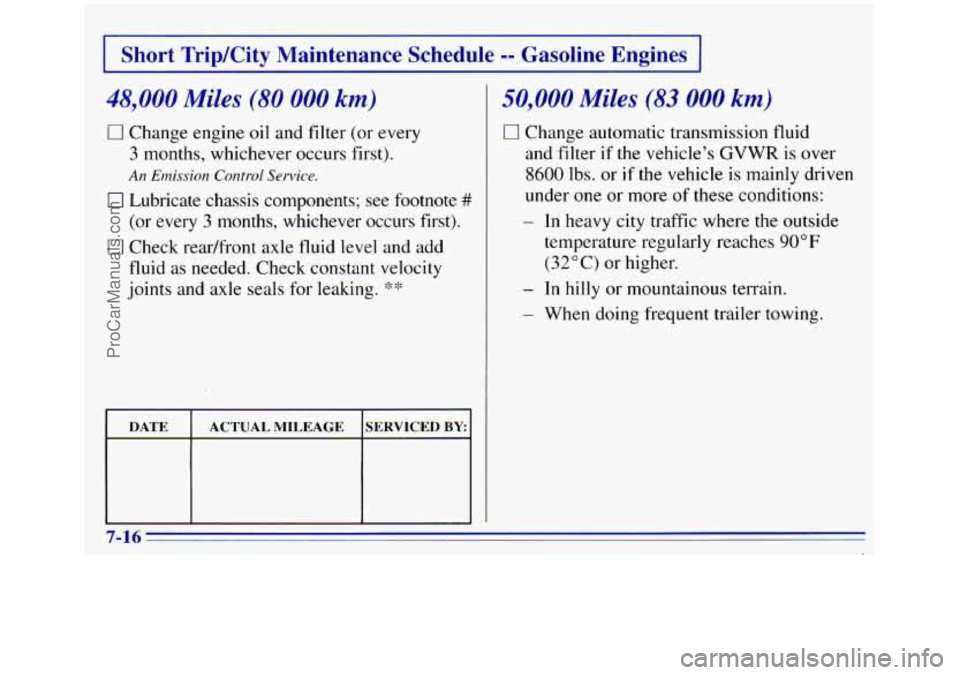
I Short TripKity Maintenance Schedule -- Gasoline Engines I
48,000 Miles (80 000 km)
0 Change engine oil and filter (or every
3 months, whichever occurs first).
An Emission Control Service.
0 Lubricate chassis components; see footnote #
(or every 3 months, whichever occurs first).
0 Check readfront axle fluid level and add
fluid as needed. Check constant velocity
joints and axle seals for leaking. w
DATE SERVICED BY ACTUAL MILEAGE
50,000 Miles (83 000 k
0 Change automatic transmission fluid
and filter
if the vehicle’s GVWR is over
8600 lbs. or if the vehicle is mainly driven
under one or more of these conditions:
- In heavy city traffic where the outside
temperature regularly reaches
90°F
(32°C) or higher.
- In hilly or mountainous terrain.
- When doing frequent trailer towing.
7-16
ProCarManuals.com