air condition GMC SIERRA 1997 User Guide
[x] Cancel search | Manufacturer: GMC, Model Year: 1997, Model line: SIERRA, Model: GMC SIERRA 1997Pages: 436, PDF Size: 23.38 MB
Page 244 of 436
2. Get the vehicles close enough so the jumper cables
can reach, but be
sure the vehicles aren’t touching
each other. If they are, it could cause a ground connection you don’t want. You wouldn’t be able to
start your vehicle, and the bad grounding could
damage the electrical systems.
To avoid the possibility of the vehicles rolling, set the
parking brake
fmly on both vehicles involved in the
jump stat procedure. Put an automatic transmission in
PARK (P) or a manual transmission in NEUTRAL (N).
If you have a four-wheel-drive vehicle, be sure the
transfer case is not
in NEUTRAL (N).
3. Turn off the ignition on both vehicles. Unplug
unnecessary accessories plugged into the cigarette
lighter or accessory power outlets. Turn
off all lamps
that aren’t needed as well
as radios. This will avoid
sparks and help save both batteries.
In addition, it
could save your radio!
I NOTICE:
If you leave your radio on, it could be badly
damaged. The repairs wouldn’t be covered by
your warranty.
4. Open the hoods and locate the batteries. Find the
positive
(+) and negative (-) terminals on each battery.
If your vehicle has air conditioning, the auxiliary
electric fan under the hood can start
up even
when the engine is not running and can injure
you. Keep hands, clothing and tools away
from
any underhood electric fan.
5-4
ProCarManuals.com
Page 253 of 436
If you get the overheat warning with no sign of steam,
try this for a minute or
so:
1. If you have an air conditioner, turn it off.
2. Turn on your heater to full hot at the highest fan
speed and open the window
as necessary.
3. If you’re in a traffic jam, shift to NEUTRAL (N);
otherwise, shift to the highest gear while
driving
-- AUTOMATIC OVERDRIVE (@)
for automatic transmissions.
If you no longer have
the overheat warning, you can
drive. Just
to be safe, drive slower for about 10 minutes.
If the warning doesn’t come back
on, you can
drive normally.
If the warning continues, pull over, stop, and park your
vehicle right away.
If there’s still no sign of steam, push the accelerator until
the engine speed is about twice as fast as normal idle
speed. Bring the engine speed back to normal idle speed
after two or three minutes. Now see if the warning stops.
But then, if
you still have the warning, turn oflthe
engine and get everyone out
of the vehicle until it
cools down.
Cooling System -- Gasoline Engines
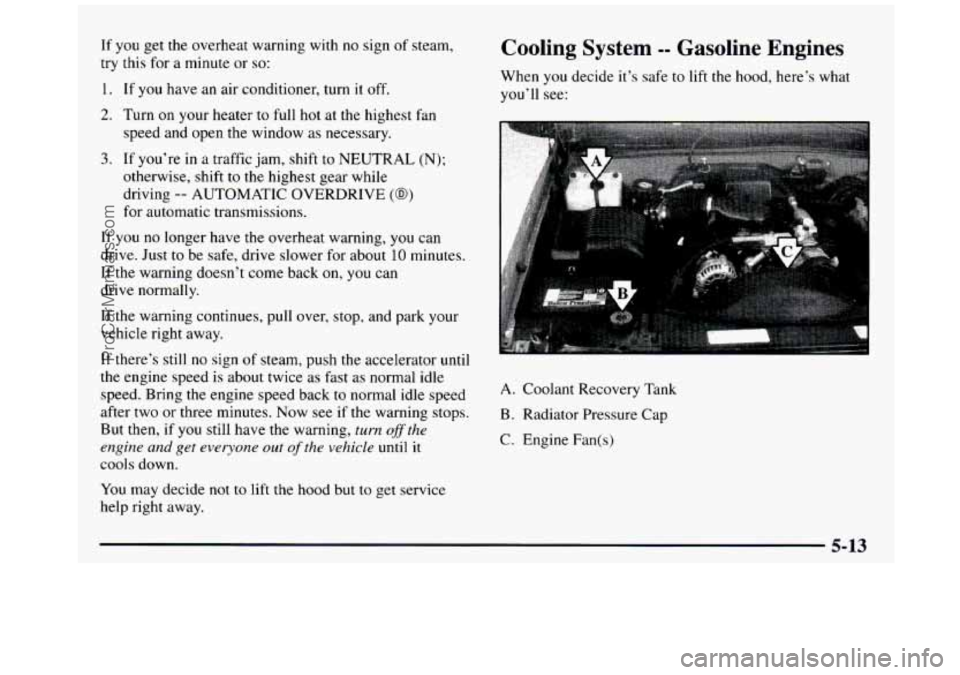
When you decide it’s safe to lift the hood, here’s what
you’ll see:
A. Coolant Recovery Tank
B. Radiator Pressure Cap
C. Engine Fan(s)
You may decide
not to lift the hood but to get service
help right away.
ProCarManuals.com
Page 254 of 436
I A CAUTION:
If your vehicle has air conditioning, the auxiliary
electric fan under the hood can start
up even
when the engine is not running and can injure
you. Keep hands, clothing and tools away from
any underhood electric fan.
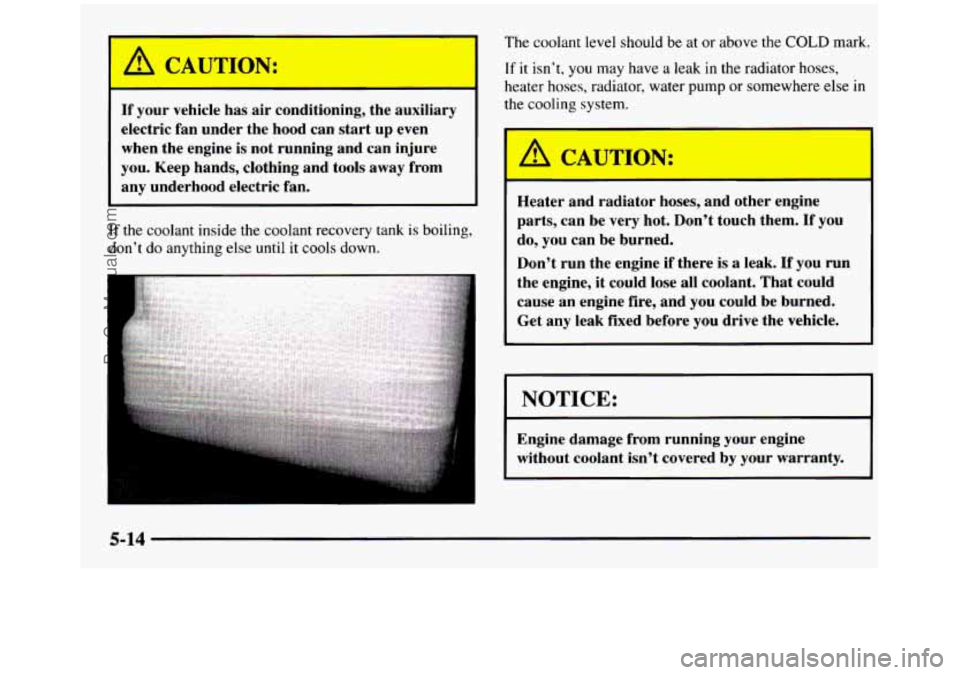
If the coolant inside the coolant recovery tank is boiling,
don’t do anything else until it
cools down. The
coolant level should be at or above
the COLD mark.
If it isn’t, you may have a leak in the radiator hoses,
heater hoses, radiator, water pump or somewhere else
in
the cooling system.
I
Heater and radiator hoses, and other engine
parts, can be very hot. Don’t touch them.
If you
do, you can be burned.
Don’t run the engine if there is
a leak. If you run
the engine, it could lose all coolant. That could
cause an engine fire, and you could be burned.
Get any leak fixed before you drive the vehicle.
I NOTICE:
Engine damage from running your engine
without coolant isn’t covered
by your warranty.
5-14
ProCarManuals.com
Page 261 of 436
Engine Fan Noise
Your vehicle has a clutched engine cooling fan. When
the clutch is engaged, the fan spi.ns faster to provide
more air
to cool the engine. In most everyday driving
conditions, the fan is spinning slower and the clutch is
not fully engaged. This improves
fuel economy and
reduces fan noise. Under heavy vehicle loading, trailer towing and/or high outside temperatures, the fan speed
increases as the clutch more fully engages.
So you may
hear an increase in fan noise. This
is normal and should
not be mistaken as the transmission slipping or making
extra shifts. It is merely the cooling system functioning
properly. The fan will slow down when additional
cooling is not required and the clutch disengages.
You may also hear this
fan noise when you start the engine.
It will
go away as the fan clutch partially disengages.
If a Tire Goes Flat
It’s unusual for a tire to “blow out” while you’re driving,
especially
if you maintain your tires properly. If air goes
out
of a tire, it’s much more likely to leak out slowly.
But if you should ever have
a “blowout,” here are a
few tips about what to expect and what to do:
If a front tire fails, the flat tire will create a drag that
pulls the vehicle toward that side. Take your foot off the
accelerator pedal and grip the steering wheel firmly.
Steer to maintain lane position, and then gently brake to
a stop well out of the traffic lane.
A rear blowout, particularly on a curve, acts much like a
skid and may require the same correction you’d use in
a skid. In any rear blowout, remove your foot from
the accelerator pedal. Get the vehicle under control by
steering the way you want the vehicle to go. It may be
very bumpy and noisy, but
you can still steer. Gently
brake
to a stop -- well off the road if possible.
If a tire goes flat, the next part shows how to
use your
jacking equipment
to change a flat tire safely.
ProCarManuals.com
Page 277 of 436
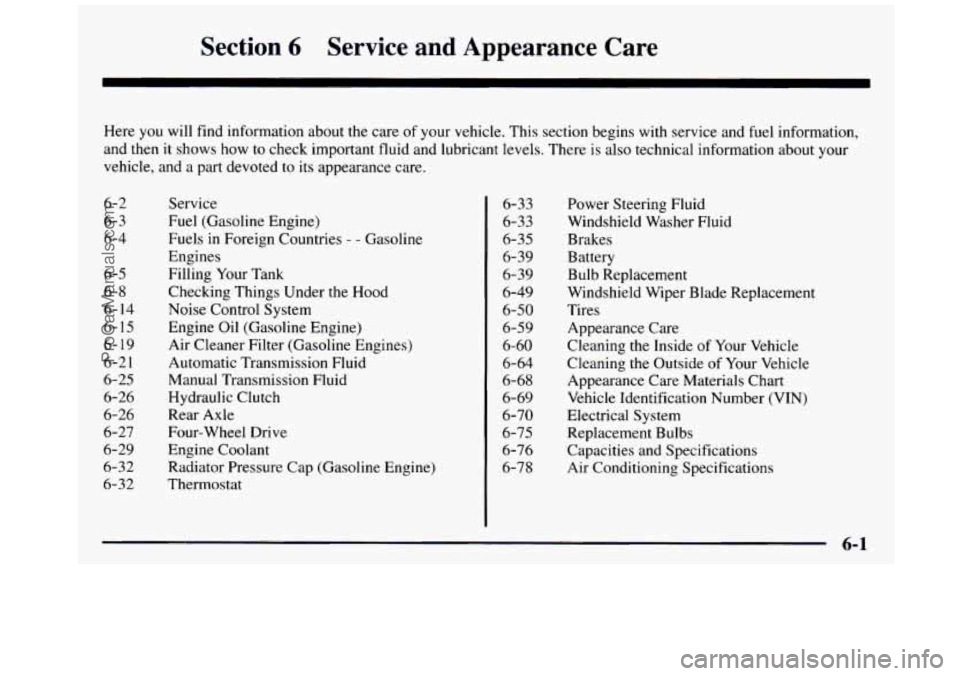
Section 6 Service and Appearance Care
Here you will find information about the care of your vehicle. This section begins with service and fuel information,
and then it shows how
to check important fluid and lubricant levels. There is also technical information about your
vehicle, and a part devoted to its appearance care.
6-2
6-
3
6-4
6-5
6-8
6- 14
6- 15
6- 19
6-2 1
6-25
6-26
6-26 6-27
6-29
6-32
6-32 Service
Fuel (Gasoline Engine)
Fuels
in Foreign Countries - - Gasoline
Engines
Filling Your Tank
Checking Things Under the Hood
Noise Control System
Engine Oil (Gasoline Engine)
Air Cleaner Filter (Gasoline Engines)
Automatic Transmission Fluid
Manual Transmission Fluid
Hydraulic Clutch
Rear Axle
Four-wheel Drive
Engine Coolant Radiator Pressure Cap (Gasoline Engine)
Thermostat 6-33
6-33 6-35
6-39
6-39
6-49 6-50
6-59
6-60
6-64
6-68
6-69
6-70 6-75
6-76
6-78 Power Steering Fluid
Windshield Washer Fluid
Brakes
Battery
Bulb Replacement
Windshield Wiper Blade
R
Tires
Appearance Care .eplacement
Cleaning the Inside
of Your Vehicle
Cleaning
the Outside of Your Vehicle
Appearance Care Materials
Chart
Vehicle Identification Number (VIN)
Electrical System Replacement Bulbs
Capacities and Specifications
Air Conditioning Specifications
ProCarManuals.com
Page 279 of 436
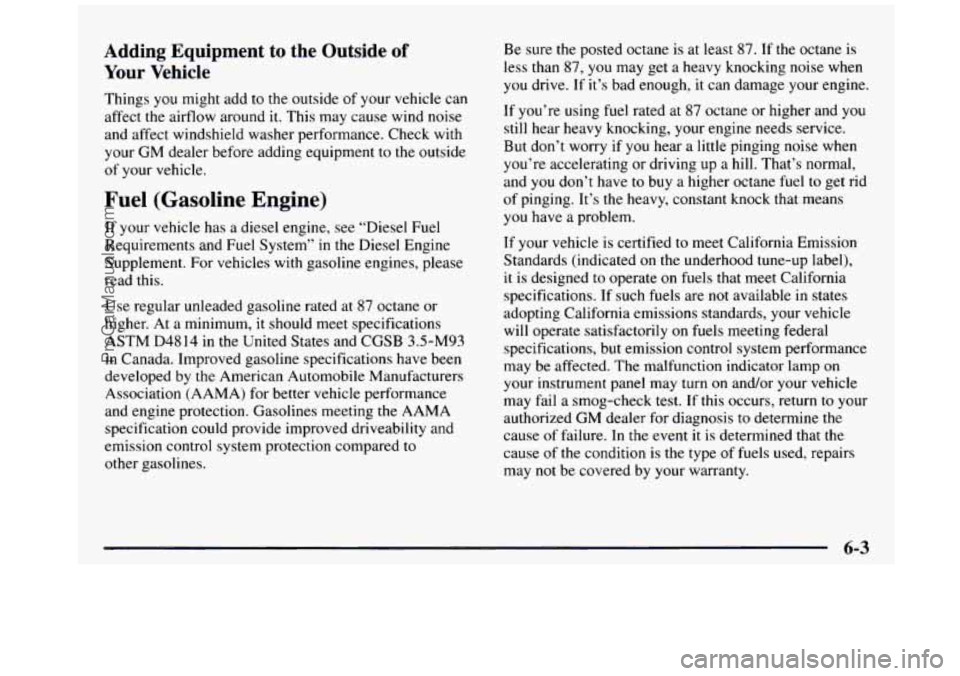
Adding Equipment to the Outside of
Your Vehicle
Things you might add to the outside of your vehicle can
affect the airflow around it. This may cause wind noise
and affect windshield washer performance. Check with
your GM dealer before adding equipment to
the outside
of your vehicle.
Fuel (Gasoline Engine)
If your vehicle has a diesel engine, see “Diesel Fuel
Requirements and Fuel System”
in the Diesel Engine
Supplement. For vehicles with gasoline engines, please
read this.
Use regular unleaded gasoline rated at
87 octane or
higher. At a minimum, it should meet specifications
ASTM D4814 in the United States and CGSB
3.5-M93
in Canada. Improved gasoline specifications have been
developed by
the American Automobile Manufacturers
Association (AAMA) for better vehicle performance
and engine protection. Gasolines meeting
the AAMA
specification could provide improved driveability and
emission control system protection compared to
other gasolines. Be sure
the posted octane is at least 87. If
the octane is
less than
87, you may get a heavy knocking noise when
you drive. If it’s bad enough, it can damage your engine.
If you’re using fuel rated at
87 octane or higher and you
still hear heavy knocking, your engine needs service.
But don’t worry if you hear a little pinging noise when
you’re accelerating or driving up a
hill. That’s normal,
and
you don’t have to buy a higher octane fuel to get rid
of pinging. It’s the heavy, constant knock that means
you have a problem.
If your vehicle is certified to meet California Emission
Standards (indicated
on the underhood tune-up label),
it is designed to operate
on fuels that meet California
specifications. If such fuels are
not available in states
adopting California emissions standards, your vehicle
will operate satisfactorily
on fuels meeting federal
specifications, but emission control system performance
may be affected. The malfunction indicator lamp
on
your instrument panel may turn on andor your vehicle
may fail a smog-check test. If this occurs, return
to your
authorized GM dealer for diagnosis
to determine the
cause of failure. In the event it is determined that the
cause of
the condition is the type of fuels used, repairs
may not be covered by your warranty.
ProCarManuals.com
Page 284 of 436
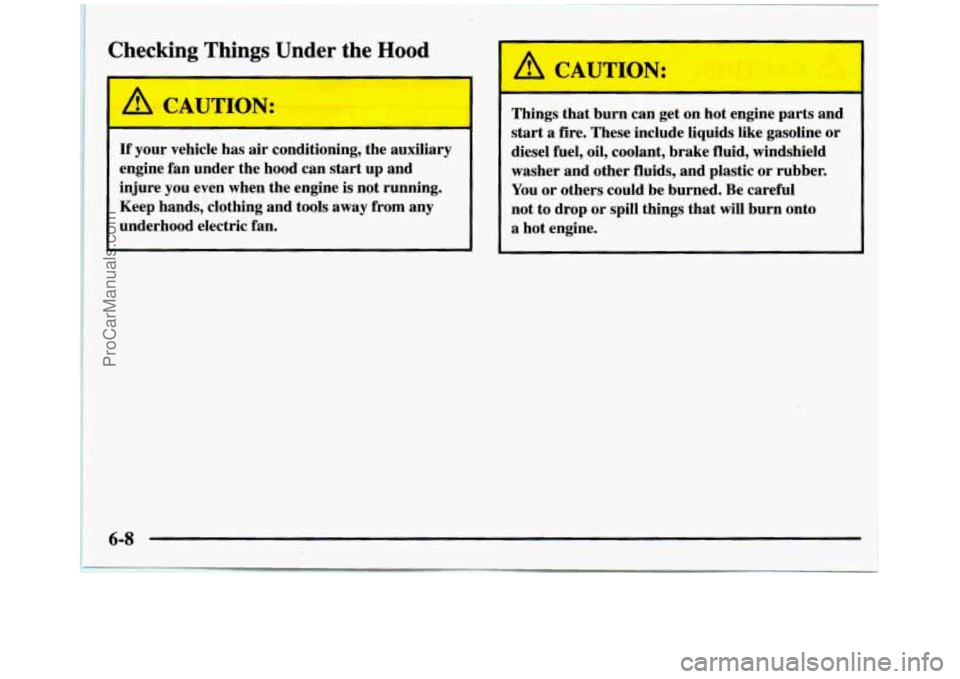
Checking Things Under the Hood
I A CAUTION:
If your vehicle has air conditioning, the auxiliary
engine fan under the hood can
start up and
injure you even when the engine
is not running.
Keep hands, clothing and tools away from any
underhood electric
fan.
t -4
Things that burn can get on hot engine parts and
start a fire. These include liquids like gasoline or
diesel fuel, oil, coolant, brake fluid, windshield
washer and other fluids, and plastic or rubber. You or others could be burned. Be careful
not to drop or spill things that will burn onto
a hot engine.
ProCarManuals.com
Page 297 of 436
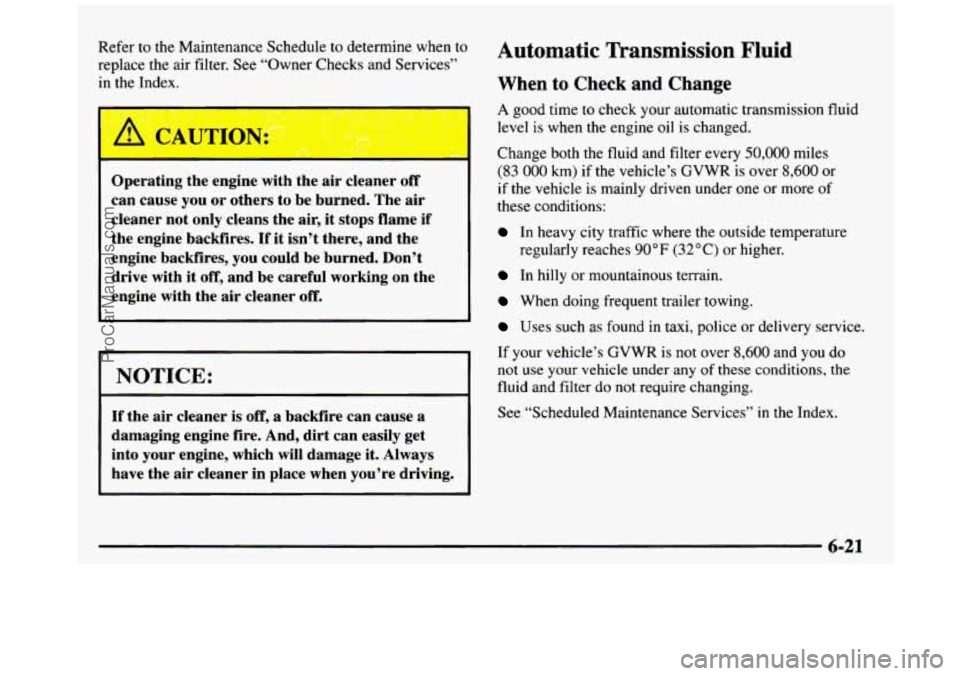
Refer to the Maintenance Schedule to determine when to
replace the air filter. See “Owner Checks and Services”
in
the Index.
Operating the engine with the
air cleaner off
can cause you OF others to be burned. The air
cleaner not only cleans the air,
it stops flame if
the engine backfires.
If it isn’t there, and the
engine backfires, you could be burned. Don’t
drive with it
off, and be careful working on the
engine with the air cleaner
off.
I NOTICE:
If the air cleaner is off, a backfire can cause a
damaging engine fire. And, dirt can easily get
into your engine, which will damage it. Always
have the air cleaner in place when you’re driving.
Automatic Transmission Fluid
When to Check and Change
A good time to check your automatic transmission fluid
level is
when the engine oil is changed.
Change both the fluid and filter every
50,000 miles
(83
000 km) if the vehicle’s CVWR is over 8,600 or
if the vehicle is mainly driven under one or more
of
these conditions:
In heavy city traffic where the outside temperature
regularly reaches
90°F (32°C) or higher.
In hilly or mountainous terrain.
When doing frequent trailer towing.
Uses such as found in taxi, police or delivery service.
If your vehicle’s GVWR is not over
8,600 and you do
not use your vehicle under any
of these conditions, the
fluid and filter do
not require changing.
See “Scheduled Maintenance Services’’
in the Index.
ProCarManuals.com
Page 331 of 436
Dual Tire Operation Buying New Tires
To find
out what kind and size of tires you need, look
at the CertificationEire label. When the vehicle is new, or whenever a wheel, wheel bolt
or wheel
nut is replaced, check the wheel nut torque after
100,
1,OOO and 6,000 miles (160, 1 600 and 10 OOO km)
of driving. For proper torque, see “Wheel Nut Torque” in
the Index.
The outer tire on a dual wheel setup generally wears faster
than
the inner tire. Your tires will wear more evenly and
last longer if you rotate the tires periodically.
If you’re
going to be doing a lot of driving on high-crown roads,
you can reduce tire wear by adding 5 psi (35 kPa) to the
tire pressure in the outer tires.
Be sure to return to the
recommended pressures when no longer driving under
those conditions. See “Changing a Flat Tire”
in the
Index for more information.
If you operate your vehicle with a tire that is badly
underinflated, the
tire can overheat. An overheated
tire
can lose air suddenly or catch fire. You or others
could be injured. Be sure all tires (including the
spare,
if any) are properly inflated.
The tires installed on your vehicle when it was new had
a Tire Performance Criteria Specification
(TPC Spec)
number on each
tire’s sidewall. When you get new tires,
get ones with that same TPC Spec number. That way
your vehicle will continue to have tires that are designed
to give proper endurance, handling, speed rating,
traction, ride and other things during normal service
on your vehicle.
If your tires have an all-season tread
design, the TPC number will be followed by an
“MS”
(for mud and snow).
If you ever replace your tires with those not having a
TPC Spec number, make sure they are the same size,
load range, speed rating and construction type (bias,
bias-belted or radial) as your original tires.
ProCarManuals.com
Page 333 of 436
Temperature -- A, B, C
The temperature grades are A (the highest), B, and C,
representing the tire's resistance to the generation of
heat and its ability to dissipate heat when tested under
controlled conditions on a specified indoor laboratory
test wheel. Sustained high temperature can cause the
material of the tire to degenerate and reduce tire life, and
excessive temperature can lead to sudden tire failure.
The grade
C corresponds to a level of performance
which all passenger car tires must meet under the
Federal Motor Vehicle Safety Standard
No. 109. Grades
B and A represent higher levels of performance on the
laboratory test wheel than the minimum required by law.
Warning: The temperature grade for this tire
is
established for a tire that is properly inflated and not
overloaded. Excessive speed, underinflation,
or
excessive loading, either separately or in combination,
can cause heat buildup and possible tire failure.
Wheel Alignment and Tire Balance
The wheels on your vehicle were aligned and balanced
carefully at the factory to give you the longest tire life
and best overall performance. Scheduled
wheel alignment and wheel balancing are not
needed. However, if
you notice unusual tire wear or
your vehicle pulling one way or the other, the alignment
may need to be reset. If you notice your vehicle
vibrating
when driving on a smooth road, your wheels
may need to be rebalanced.
Wheel Replacement
Replace any wheel that is bent, cracked, or badly rusted
or corroded. If wheel nuts keep coming loose, the wheel,
wheel bolts and wheel nuts should be replaced. If the
wheel leaks air, replace
it (except some aluminum
wheels, which can sometimes be repaired). See your
GM dealer if any of these conditions exist.
Your dealer will know the kind of wheel
you need.
Each new wheel should have the same load-carrying
capacity, diameter, width, offset and be mounted
the
same way as the one it replaces.
If you need to replace any of your wheels, wheel bolts
or wheel nuts, replace them only
with new GM original
equipment parts. This way, you
will be sure to have the
right wheel, wheel bolts
and wheel nuts for your vehicle.
ProCarManuals.com