flat tire GMC SIERRA 1997 Owner's Manual
[x] Cancel search | Manufacturer: GMC, Model Year: 1997, Model line: SIERRA, Model: GMC SIERRA 1997Pages: 436, PDF Size: 23.38 MB
Page 329 of 436
111
V
n
111
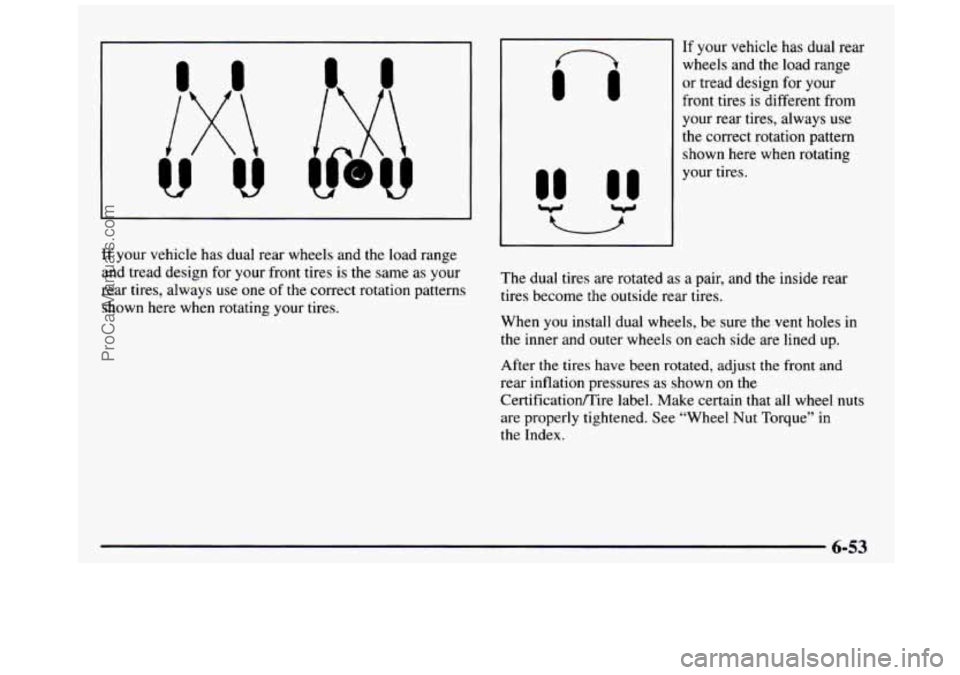
If your vehicle has dual rear
wheels and the load range
or tread design for your
front tires is different from
your rear tires, always use
the correct rotation pattern
shown here
when rotating
your tires.
If your vehicle has dual rear wheels and the load range
and tread design for your front tires is the same as your
rear tires, always use one of the correct rotation patterns
shown here when rotating your tires. The dual tires are rotated as
a pair, and the inside rear
tires become the outside rear tires.
When you install dual wheels, be sure the vent holes
in
the inner and outer wheels on each side are lined up.
After the tires have been rotated,
adjust the front and
rear inflation pressures as shown on the
Certificatiomire label. Make certain that all wheel nuts
are properly tightened. See “Wheel Nut Torque” in
the Index.
ProCarManuals.com
Page 330 of 436
When It’s Time for New Tires
Rust or dirt
on a wheel, or on the parts to which
it is fastened, can make wheel nuts become loose
after a time. The wheel could come
off and cause
an accident. When you change a wheel, remove
any rust
or dirt from places where the wheel
attaches to the vehicle. In an emergency, you can
use a cloth or
a paper towel to do this; but be
sure to use
a scraper or wire brush later, if you
need to,
to get all the rust or dirt off. (See
“Changing
a Flat Tire” in the Index.)
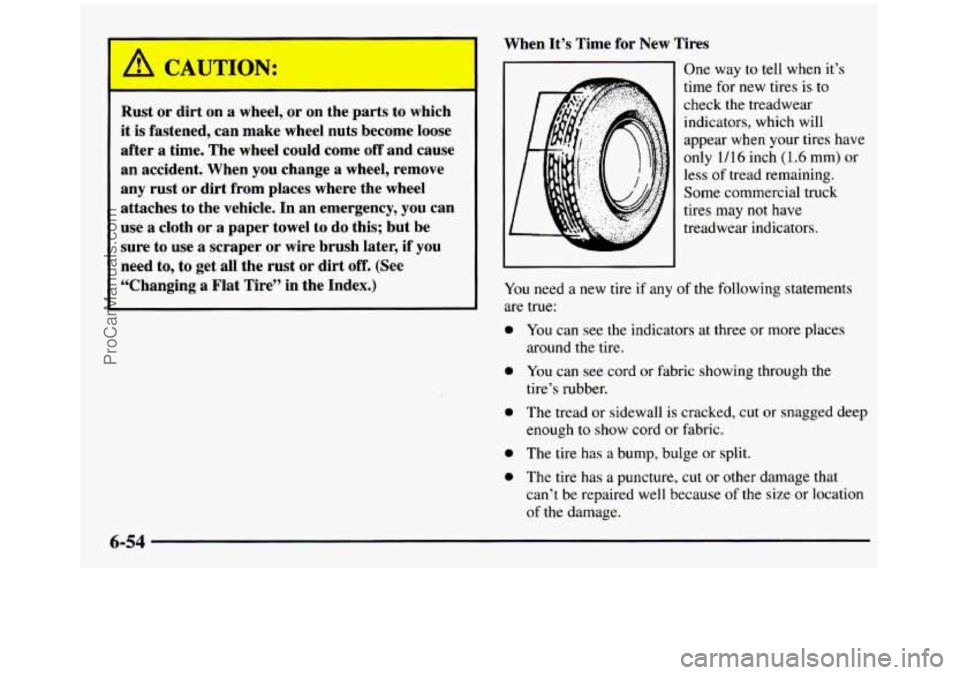
One way to tell when it’s
time for new tires is to
check the treadwear
indicators, which will
appear when your tires have
only 1/16 inch
(1.6 mm) or
less of tread remaining.
Some commercial truck
tires may not have
treadwear indicators.
You need a new tire if any of the following statements
are true:
0 You can see the indicators at three or more places
around the tire.
0 You can see cord or fabric showing through the
0 The tread or sidewall is cracked, cut or snagged deep
tire’s rubber.
enough
to show cord
or fabric.
0 The tire has a bump, bulge or split.
0 The tire has a puncture, cut or other damage that
can’t be repaired well because
of the size or location
of the damage.
6-54
ProCarManuals.com
Page 331 of 436
Dual Tire Operation Buying New Tires
To find
out what kind and size of tires you need, look
at the CertificationEire label. When the vehicle is new, or whenever a wheel, wheel bolt
or wheel
nut is replaced, check the wheel nut torque after
100,
1,OOO and 6,000 miles (160, 1 600 and 10 OOO km)
of driving. For proper torque, see “Wheel Nut Torque” in
the Index.
The outer tire on a dual wheel setup generally wears faster
than
the inner tire. Your tires will wear more evenly and
last longer if you rotate the tires periodically.
If you’re
going to be doing a lot of driving on high-crown roads,
you can reduce tire wear by adding 5 psi (35 kPa) to the
tire pressure in the outer tires.
Be sure to return to the
recommended pressures when no longer driving under
those conditions. See “Changing a Flat Tire”
in the
Index for more information.
If you operate your vehicle with a tire that is badly
underinflated, the
tire can overheat. An overheated
tire
can lose air suddenly or catch fire. You or others
could be injured. Be sure all tires (including the
spare,
if any) are properly inflated.
The tires installed on your vehicle when it was new had
a Tire Performance Criteria Specification
(TPC Spec)
number on each
tire’s sidewall. When you get new tires,
get ones with that same TPC Spec number. That way
your vehicle will continue to have tires that are designed
to give proper endurance, handling, speed rating,
traction, ride and other things during normal service
on your vehicle.
If your tires have an all-season tread
design, the TPC number will be followed by an
“MS”
(for mud and snow).
If you ever replace your tires with those not having a
TPC Spec number, make sure they are the same size,
load range, speed rating and construction type (bias,
bias-belted or radial) as your original tires.
ProCarManuals.com
Page 333 of 436
Temperature -- A, B, C
The temperature grades are A (the highest), B, and C,
representing the tire's resistance to the generation of
heat and its ability to dissipate heat when tested under
controlled conditions on a specified indoor laboratory
test wheel. Sustained high temperature can cause the
material of the tire to degenerate and reduce tire life, and
excessive temperature can lead to sudden tire failure.
The grade
C corresponds to a level of performance
which all passenger car tires must meet under the
Federal Motor Vehicle Safety Standard
No. 109. Grades
B and A represent higher levels of performance on the
laboratory test wheel than the minimum required by law.
Warning: The temperature grade for this tire
is
established for a tire that is properly inflated and not
overloaded. Excessive speed, underinflation,
or
excessive loading, either separately or in combination,
can cause heat buildup and possible tire failure.
Wheel Alignment and Tire Balance
The wheels on your vehicle were aligned and balanced
carefully at the factory to give you the longest tire life
and best overall performance. Scheduled
wheel alignment and wheel balancing are not
needed. However, if
you notice unusual tire wear or
your vehicle pulling one way or the other, the alignment
may need to be reset. If you notice your vehicle
vibrating
when driving on a smooth road, your wheels
may need to be rebalanced.
Wheel Replacement
Replace any wheel that is bent, cracked, or badly rusted
or corroded. If wheel nuts keep coming loose, the wheel,
wheel bolts and wheel nuts should be replaced. If the
wheel leaks air, replace
it (except some aluminum
wheels, which can sometimes be repaired). See your
GM dealer if any of these conditions exist.
Your dealer will know the kind of wheel
you need.
Each new wheel should have the same load-carrying
capacity, diameter, width, offset and be mounted
the
same way as the one it replaces.
If you need to replace any of your wheels, wheel bolts
or wheel nuts, replace them only
with new GM original
equipment parts. This way, you
will be sure to have the
right wheel, wheel bolts
and wheel nuts for your vehicle.
ProCarManuals.com
Page 334 of 436
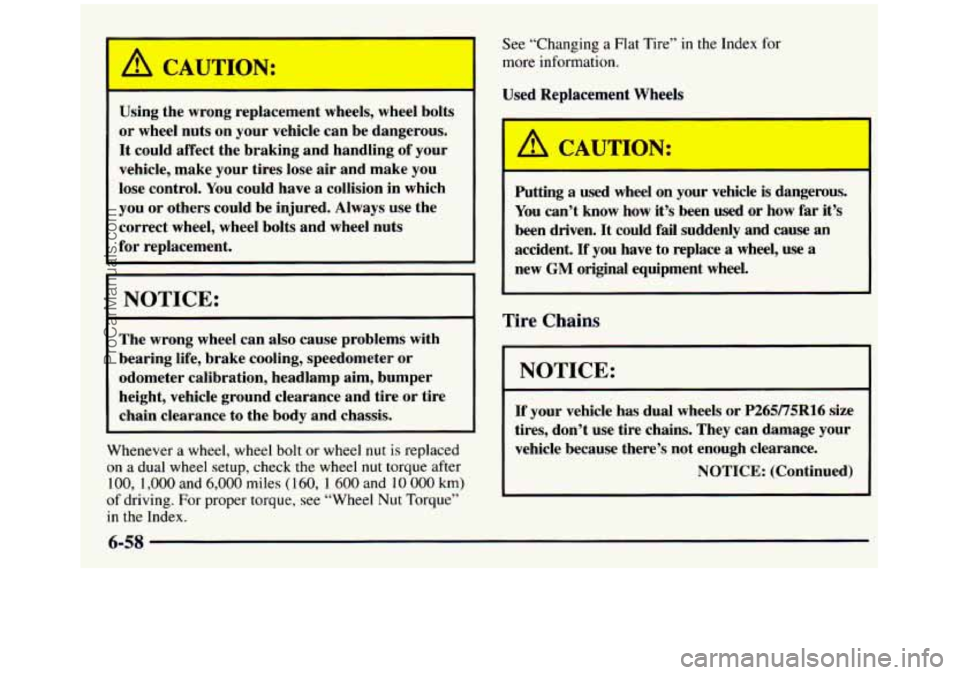
I a CAUTION:
Using the wrong replacement wheels, wheel bolts
or wheel nuts on your vehicle can be dangerous.
It could affect the braking and handling of your
vehicle, make your tires lose air and make you
lose control.
You could have a collision in which
you or others could be injured. Always use the
correct wheel, wheel bolts and wheel nuts
for replacement.
I NOTICE:
The wrong wheel can also cause problems with
bearing life, brake cooling, speedometer or
odometer calibration, headlamp aim, bumper
height, vehicle ground clearance and tire or tire
chain clearance
to the body and chassis.
Whenever a wheel, wheel bolt or wheel
nut is replaced
on a dual wheel setup, check the wheel
nut torque after
100, 1,000 and 6,000 miles ( 160, 1 600 and 10 000 km)
of driving. For proper torque, see “Wheel Nut Torque’’
in the Index. See
“Changing a
Flat Tire” in the Index for
more information.
Used Replacement Wheels
~
Putting a used wheel on your vehicle is dangerous.
You can’t know how it’s been used or how far it’s
been driven. It could fail suddenly and
cause an
new
GM original equipment wheel.
~ accident. If you have to replace a wheel, use a
Tire Chains
I NOTICE:
If your vehicle has dual wheels or P26975R16 size
tires, don’t use tire chains. They can damage
your
vehicle because there’s not enough clearance.
NOTICE: (Continued)
6-58
ProCarManuals.com
Page 356 of 436
Introduction
IMPORTANT:
KEEP ENGINE OIL
AT THE PROPER
LEVEL AND CHANGE AS
RECOMMENDED
I
Your Vehicle and the Environment
Proper vehicle maintenance not only helps to keep your
vehicle
in good working condition, but also helps the
environment. All recommended maintenance procedures
are important. Improper vehicle maintenance can
even
affect the quality of the air we breathe. Improper fluid
levels or the wrong tire inflation can increase the level
of emissions from your vehicle. To help protect our
environment, and to keep your vehicle in good
condition, please maintain your vehicle properly.
Have you purchased the GM Protection Plan? The Plan
supplements
your new vehicle warranties. See your
Warranty and Owner Assistance booklet, or your
GM dealer for details.
7-2
ProCarManuals.com
Page 399 of 436
Part B: Owner Checks and Services
Listed below are owner checks and services which
should be performed at the intervals specified
to help
ensure the safety, dependability and emission control
performance
of your vehicle.
Be sure any necessary repairs are completed at once.
Whenever any fluids or lubricants are added
to your
vehicle, make sure they are the proper ones,
as shown
in Part
D.
At the First 100, 1,000 and 6,000 Miles
(160,1600 and 10 000 km)
For vehicles with dual wheels, check dual wheel nut
torque. For proper torque, see “Wheel Nut Torque” in
the Index.
At Each Fuel Fill
It is important for you or ~1 service station attendant to
per$orm these underhood
checks ut eachjbtelfiE1.
Engine Oil Level Check Engine Coolant Level Check
Check the
engine coolant level and add the proper
coolant mix if necessary. See “Engine Coolant’’ in the
Index for further details.
Windshield Washer Fluid Level Check
Check the windshield washer fluid level in the
windshield washer tank and add
the proper fluid if
necessary. See “Windshield Washer Fluid”
in the Index
for further details.
At Least Once a Month
Tire Inflation Check
Make sure tires are inflated to the correct pressures. See
“Tires”
in the Index for further details.
Cassette Deck Service
Clean cassette deck. Cleaning should be done every
50 hours of tape play. See “Audio Systems” in the Index
for further details.
Check
the engine oil level and add the proper oil if
necessary. See “Engine Oil” in the Index for
further details.
7-45
ProCarManuals.com
Page 423 of 436
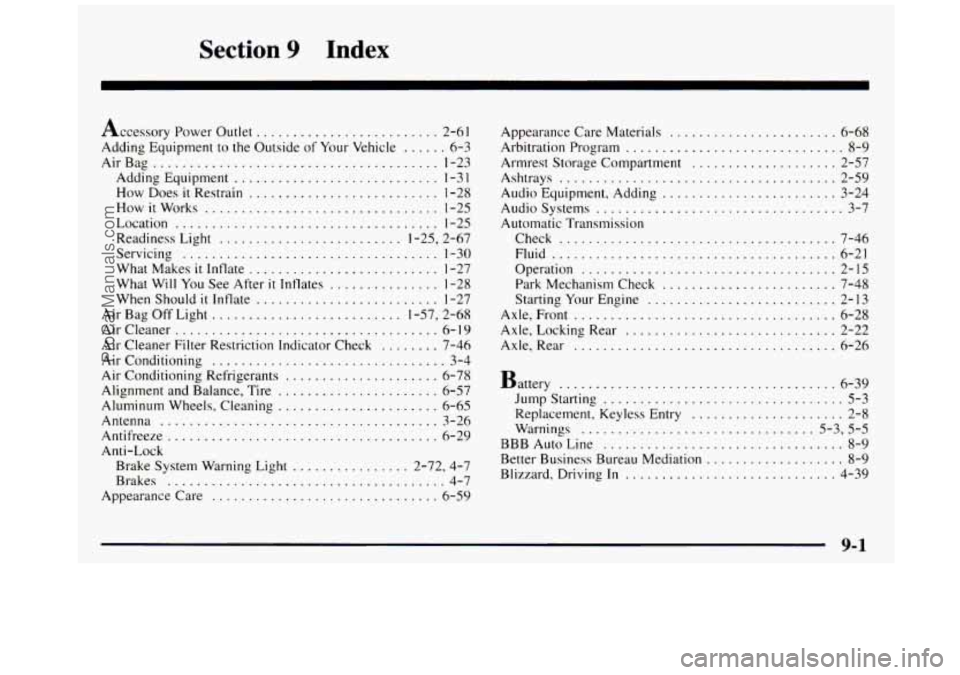
Section 9 Index
Accessory Power Outlet ......................... 2-6 I
Adding Equipment to the Outside of Your Vehicle ...... 6-3
AirBag ....................................... 1-23
Adding Equipment ............................ 1-3 1
How Does it Restrain .......................... 1-28
How
it Works ................................ 1-25
Location
.................................... 1-25
Readiness Light
......................... 1-25. 2-67
Servicing
................................... 1-30
What Makes it Inflate .......................... 1-27
What Will You See After
it Inflates ............... 1-28
When Should
it Inflate ......................... 1-27
Air Bag Off Light
.......................... 1-57, 2-68
Aircleaner
.................................... 6-10
Air Cleaner Filter Restriction Indicator Check ........ 7-46
Air Conditioning
................................ 3-4
Air Conditioning Refrigerants ..................... 6-78
Alignment and Balance. Tire
...................... 6-57
Aluminum Wheels. Cleaning
...................... 6-65
Antenna
...................................... 3-26
Antifreeze
..................................... 6-29
Anti-Lock Brake System Warning Light
................ 2-72. 4.7
Brakes
...................................... 4-7
Appearance Care
............................... 6-59 Appearance Care
Materials
....................... 6-68
Arbitration Program .............................. 8-9
Armrest Storage Compartment
.................... 2-57
Ashtrays
...................................... 2-59
Audio Equipment. Adding
........................ 3-24
Audio Systems
.................................. 3-7
Automatic Transmission
Check
...................................... 7-46
Fluid
....................................... 6-21
Operation
................................... 2-15
Park Mechanism Check
........................ 7-48
Starting Your Engine
.......................... 2-13
Axle.
Front .................................... 6-28
Axle. Locking Rear
............................. 2-22
Axle. Rear
.................................... 6-26
Battery ...................................... 6-39
Jump Starting ................................. 5-3
Replacement. Keyless Entry
..................... 2-8
Warnings
................................ 5.3. 5.5
BBB Auto Line ................................. 8-9
Better Business Bureau Mediation ................... 8-9
Blizzard. Driving In ............................. 4-39
9-1
ProCarManuals.com
Page 424 of 436
Brake Adjustment
.................................. 6-38
Fluid
....................................... 6-35
Parking
..................................... 2-27
PedalTravel
................................. 6-38
Master Cylinder
.............................. 6-35
Replacing System Parts
........................ 6-38
System Warning Light
......................... 2-71
Trailer
...................................... 4-54
Transmission Shift Interlock Check ............... 7-47
Brakes, Anti-Lock
............................... 4-7
Braking
........................................ 4-6
Braking in Emergencies ........................... 4-9
Break-In, New Vehicle
.......................... 2- 10
Bulb Replacement
.............................. 6-39
Wear
....................................... 6-37
BTSICheck
................................... 7-47
Canadian Roadside Assistance
.................... 8-7
Capacities and Specifications
...................... 6-76
Care
of Your Cassette Tape Player .................. 3-25
Cassette Deck Service
........................... 7-45
Cassette Tape Player
........................ 3.9. 3.12
Cassette Tape Player Care
........................ 3-25
Cassette/Compact Disc Storage
.................... 2-57
Center Overhead Console
........................ 2-52
Center Passenger Position
........................ 1-32
Certificationire Label
.......................... 4-41
CarbonMonoxide
......................... 2.32. 4.40
Cargo Lamp 2-47
...................................
.............................. Certification Label 4-4 1 Chains. Safety
................................. 4-54
Changing a Flat Tire
............................. 5-22
Charging System Light
.......................... 2-69
Check Gages Light
.............................. 2-77
Checking Your Restraint Systems
.................. 1-65
Chemical Paint Spotting
.......................... 6-67
Child Restraints
................................ 1-43
Securing in a Rear Outside Seat Position
...... 1-48. 1-50
Securing in the Center Seat Position
.............. 1-52
Securing in the Right Front Seat Position
..... 1-54. 1-57
Where to Put ........................... 1-45. 1-46
Chrome Wheels. Cleaning
......................... 6-65
Cigarette Lighter
............................... 2-59
Circuit Breakers and Fuses
....................... 6-71
Aluminum Wheels
............................ 6-65
Exterior LampsLenses
........................ 6-64
Glass
....................................... 6-63
Inside of Your Vehicle ......................... 6-60
Outside
of Your Vehicle ........................ 6-64
Special Problems
............................. 6-61
Vinyl
....................................... 6-62
Windshield and Wiper Blades
................... 6-63
................................... Chains. Tire 6-58
TopStrap
................................... 1-47
Cleaner. Air
................................... 6-19
Cleaning
Fabric
...................................... 6-60
Instrumentpanel
............................. 6-63
Leather
..................................... 6-62
Stains
...................................... 6-61
Tires
....................................... 6-66
Wheels
..................................... 6-65
9-2
ProCarManuals.com
Page 426 of 436
Electrical System ............................... 6-70
Engine
.................................. 6-10. 6-12
Electrochromic
Daymight Rearview Mirror
.......... 2-48
Coolant
..................................... 6-29
Coolant Heater
............................... 2- 14
Coolant Level Check
.......................... 7-45
Coolant Temperature Gage
..................... 2-72
Cooling System Capacity
....................... 6-78
Exhaust
..................................... 2-32
FuseBlocks
............................ 6-71, 6-73
Identification
................................ 6-69
OilLevelCheck
.............................. 7-45
Overheating
................................. 5-11
Running While Parked
......................... 2-32
Specifications
................................ 6-76
StartingYour
................................ 2-13
Underhood Fuse/Relay Center
................... 6-73
Engineoil
.................................... 6-15
Adding
..................................... 6-15
Additives
................................... 6-18
Checking
................................... 6-15
Used
....................................... 6-18
Whentochange
.............................. 6-18
Exhaust. Engine
................................ 2-32
Pressure Gage
................................ 2-75
Fabric Cleaning
............................... 6-60
Fan Control. Climate Control System ............ 3.2. 3.3
Fender Marker Lamp
Bulb Replacement ............. 6-44
FillingYourTank
................................ 6-5
Filter. Air ..................................... 6-19
Finish Care
.................................... 6-64
Finish Damage
................................. 6-66
Flashers. Hazard Warning
......................... 5-2
Flat Tire. Changing
............................. 5-22
Fluid Capacities
................................ 6-78
Fluids and Lubricants
............................ 7-51
Fog Lamps
.................................... 2-45
Foreign Countries. Fuel
........................... 6-4
Four-wheel Drive
......................... 2-22. 6-27
French LanguageManual
11
Front Axle .................................... 6-28
Front Axle Locking Feature
....................... 2-23
FrontTowing
.................................. 5-10
Front Turn Signal Lamp Bulb Replacement ..... 6-42. 6-43
Fuel
.......................................... 6-3
Filling Your Tank
.............................. 6-5
Gage ....................................... 2-78
In Foreign Countries ........................... 6-4
Tank Capacity
............................... 6-78
Fuses and Circuit Breakers
....................... 6-71
FusibleLinks
.................................. 6-71
.. ...........................
bages Engine Coolant Temperature
.................... 2-72
Engine Oil Pressure
........................... 2-75 "
Fuel ....................................... 2-78
Speedometer
................................. 2-65
Tachometer
.................................. 2-65
Voltmeter
................................... 2-70
9-4
ProCarManuals.com