fuel GMC SIERRA 1997 Owner's Manual
[x] Cancel search | Manufacturer: GMC, Model Year: 1997, Model line: SIERRA, Model: GMC SIERRA 1997Pages: 436, PDF Size: 23.38 MB
Page 279 of 436
Adding Equipment to the Outside of
Your Vehicle
Things you might add to the outside of your vehicle can
affect the airflow around it. This may cause wind noise
and affect windshield washer performance. Check with
your GM dealer before adding equipment to
the outside
of your vehicle.
Fuel (Gasoline Engine)
If your vehicle has a diesel engine, see “Diesel Fuel
Requirements and Fuel System”
in the Diesel Engine
Supplement. For vehicles with gasoline engines, please
read this.
Use regular unleaded gasoline rated at
87 octane or
higher. At a minimum, it should meet specifications
ASTM D4814 in the United States and CGSB
3.5-M93
in Canada. Improved gasoline specifications have been
developed by
the American Automobile Manufacturers
Association (AAMA) for better vehicle performance
and engine protection. Gasolines meeting
the AAMA
specification could provide improved driveability and
emission control system protection compared to
other gasolines. Be sure
the posted octane is at least 87. If
the octane is
less than
87, you may get a heavy knocking noise when
you drive. If it’s bad enough, it can damage your engine.
If you’re using fuel rated at
87 octane or higher and you
still hear heavy knocking, your engine needs service.
But don’t worry if you hear a little pinging noise when
you’re accelerating or driving up a
hill. That’s normal,
and
you don’t have to buy a higher octane fuel to get rid
of pinging. It’s the heavy, constant knock that means
you have a problem.
If your vehicle is certified to meet California Emission
Standards (indicated
on the underhood tune-up label),
it is designed to operate
on fuels that meet California
specifications. If such fuels are
not available in states
adopting California emissions standards, your vehicle
will operate satisfactorily
on fuels meeting federal
specifications, but emission control system performance
may be affected. The malfunction indicator lamp
on
your instrument panel may turn on andor your vehicle
may fail a smog-check test. If this occurs, return
to your
authorized GM dealer for diagnosis
to determine the
cause of failure. In the event it is determined that the
cause of
the condition is the type of fuels used, repairs
may not be covered by your warranty.
ProCarManuals.com
Page 280 of 436
Some gasolines that are not reformulated for low
emissions contain
an octane-enhancing additive called
methylcyclopentadlenyl manganese tricarbonyl
(MMT);
ask your service station operator whether or not his fuel
contains
"T. General Motors does not recommend the
use of such gasolines.
If fuels containing MMT are used,
spark plug life may
be reduced and your emission control
system performance may
be affected. The malfunction
indicator lamp on your instrument panel may
turn on. If this
occurs, return to your authorized GM dealer for service.
To provide cleaner air, all gasolines in the United States
are now required to contain additives that
will help prevent
deposits from forming
in your engine and fuel system,
allowing your emission control system to function
properly. Therefore, you should not have to add anything
to the fuel. In addition, gasolines containing oxygenates,
such
as ethers and ethanol, and reformulated gasolines
may
be available in your area to help clean the air. General
Motors recommends that you use these gasolines
if they
comply
with the specifications described earlier.
NOTICE:
Your vehicle was not designed for fuel that
contains methanol. Don't use it. It can corrode
NOTICE: (Continued)
I NOTICE: (Continued) I
metal parts in your fuel system and also damage
plastic and rubber parts. That damage wouldn't
be covered under your warranty.
Fuels in Foreign Countries -- Gasoline
Engines
If you plan on driving in another country outside the
United States or Canada, the proper fuel may be hard
to find. Never use leaded gasoline or
any other fuel not
recommended
in the previous text on fuel. Costly repairs
caused
by use of improper fuel wouldn't be covered by
your warranty.
To check on fuel availability, ask an auto club, or
contact
a major oil company that does business in the
country where you'll be driving.
You can also write us
at the following address for
advice. Just tell
us where you're going and give your
Vehicle Identification Number (VIN).
General Motors International Product Center 1908 Colonel Sam Drive
Oshawa, Ontario
L 1 H 8P7
6-4
ProCarManuals.com
Page 281 of 436
Filling Your Tank
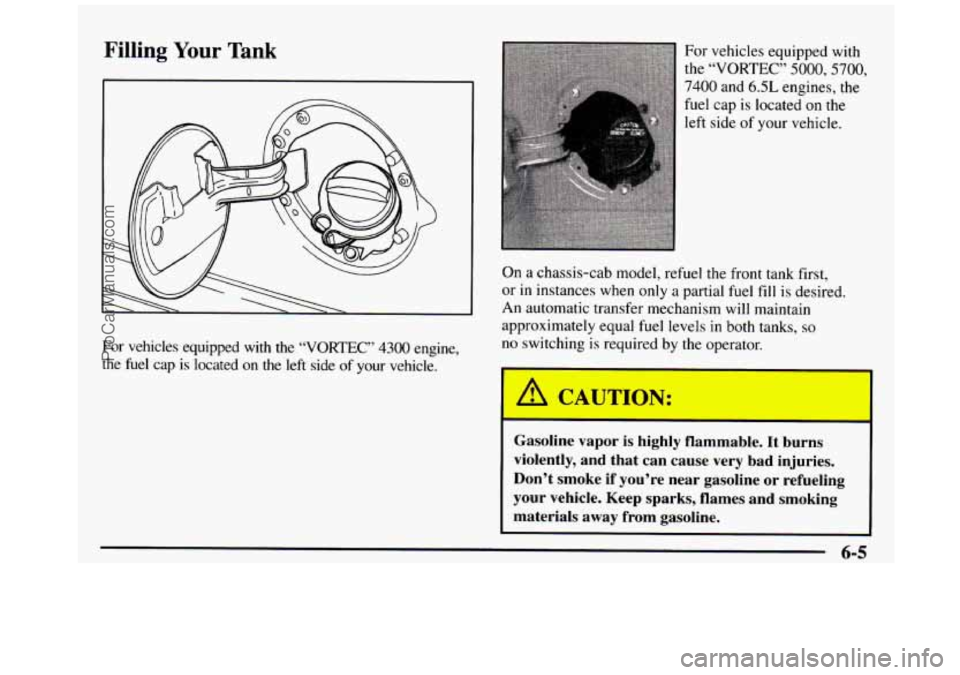
For vehicles equipped with the “VORTEC” 4300 engine,
the
fuel cap is located on the left side of your vehicle. For vehicles equipped with
the “VORTEC” 5000,5700,
7400 and 6.5L engines, the
fuel cap
is located on the
left side
of your vehicle.
On a chassis-cab model, refuel the front tank first,
or in instances when
only a partial fuel fill is desired.
An automatic transfer mechanism will maintain
approximately equal fuel levels in both tanks,
so
no switching is required by the operator.
.- i
‘P ’ION:
Gasoline vapor is highly flammable. It burns
violently, and that can cause very bad injuries.
Don’t smoke if you’re near gasoline or refueling
your vehicle.
Keep sparks, flames and smoking
materials away from gasoline.
6-5
ProCarManuals.com
Page 282 of 436
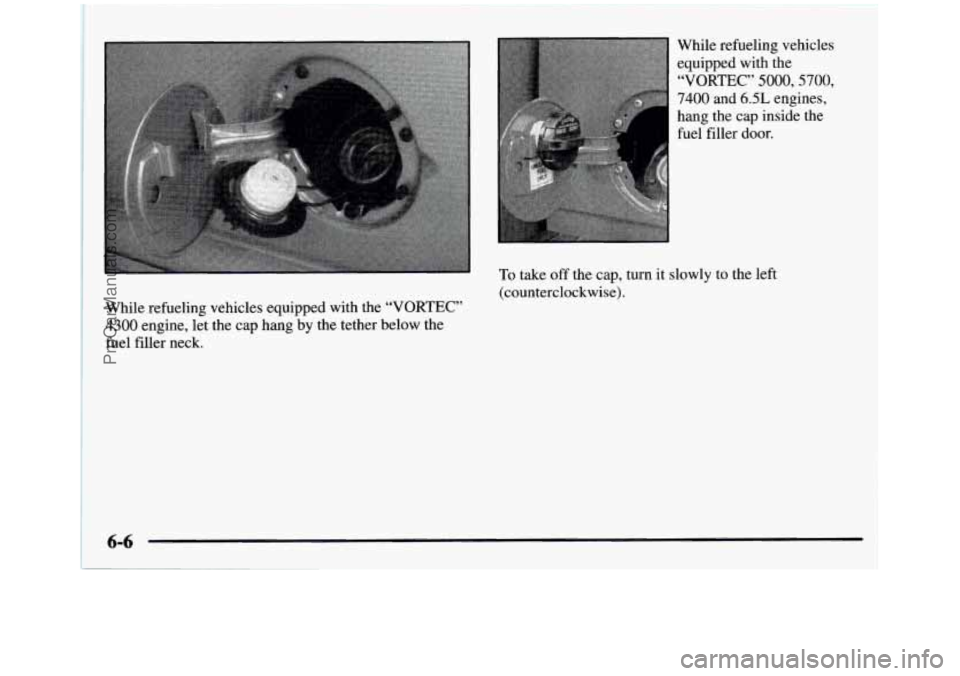
7400 and 6.5L engines,
hang the cap inside the fuel filler door.
To take off the cap, turn it slowly to the left
(counterclockwise).
While refueling vehicles equipped with the
“VORTEC”
4300 engine, let the cap hang by the tether below the
fuel filler neck.
6-6
ProCarManuals.com
Page 283 of 436
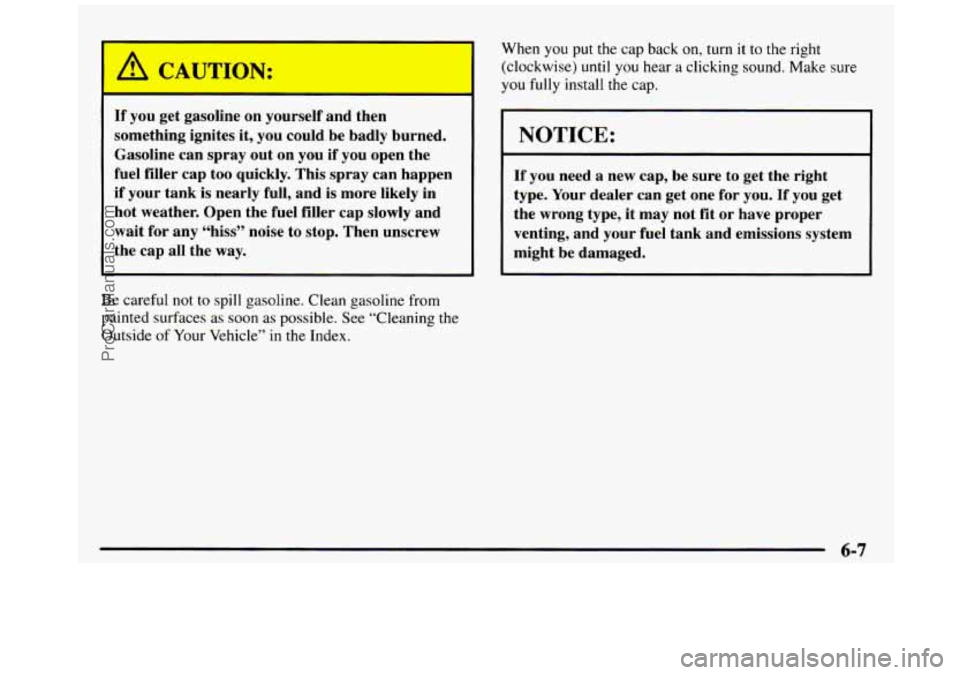
/1 CAUTION:
If you get gasoline on yourself and then
something ignites it, you could be badly burned. Gasoline can spray out on you if you open the
fuel filler cap too quickly. This spray can happen
if your tank is nearly full, and
is more likely in
hot weather. Open the fuel filler cap slowly and
wait for
any “hiss” noise to stop. Then unscrew
the cap all the
way.
When you put the cap back on, turn it to the right
(clockwise)
until you hear a clicking sound. Make sure
you fully install the cap.
NOTICE:
If you need a new cap, be sure to get the right
type.
Your dealer can get one for you. If you get
the wrong type, it may not
fit or have proper
venting, and your fuel tank and emissions system
might be damaged.
Be careful not
to spill gasoline. Clean gasoline from
painted surfaces as soon as possible. See “Cleaning the
Outside of Your Vehicle” in the Index.
6-7
ProCarManuals.com
Page 284 of 436
Checking Things Under the Hood
I A CAUTION:
If your vehicle has air conditioning, the auxiliary
engine fan under the hood can
start up and
injure you even when the engine
is not running.
Keep hands, clothing and tools away from any
underhood electric
fan.
t -4
Things that burn can get on hot engine parts and
start a fire. These include liquids like gasoline or
diesel fuel, oil, coolant, brake fluid, windshield
washer and other fluids, and plastic or rubber. You or others could be burned. Be careful
not to drop or spill things that will burn onto
a hot engine.
ProCarManuals.com
Page 291 of 436
Engine Oil (Gasoline Engine)
If your vehicle has a diesel engine, see “Engine Oil (Diesel Engine)” in the Diesel Engine Supplement.
It’s a good idea to check your engine oil every time you
get fuel. In order to get an accurate reading, the oil must
be warm and the vehicle must be on level ground.
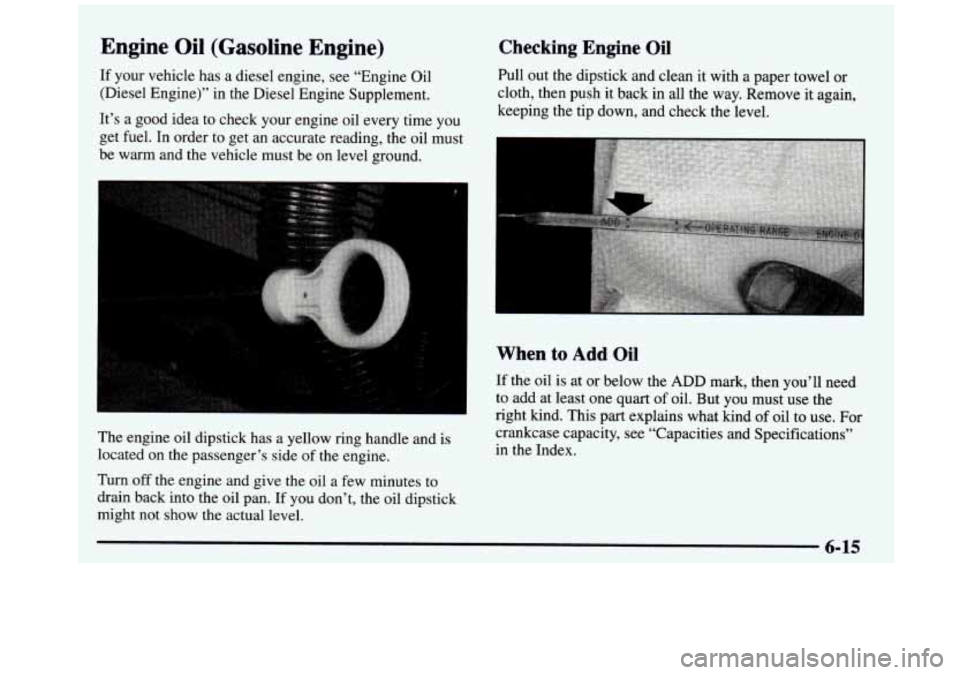
The engine oil dipstick has
a yellow ring handle and is
located on the passenger’s side
of the engine.
Turn
off the engine and give the oil a few minutes to
drain back into the oil pan.
If you don’t, the oil dipstick
might not show the actual level.
Checking Engine Oil
Pull out the dipstick and clean it with a paper towel or
cloth, then push it back in all the way. Remove it again,
keeping the tip down, and check the level.
When to Add Oil
If the oil is at or below the ADD mark, then you’ll need
to add at least one
quart of oil. But you must use the
right kind. This part explains what kind of oil to use.
For
crankcase capacity, see “Capacities and Specifications”
in the Index.
6-15
ProCarManuals.com
Page 293 of 436
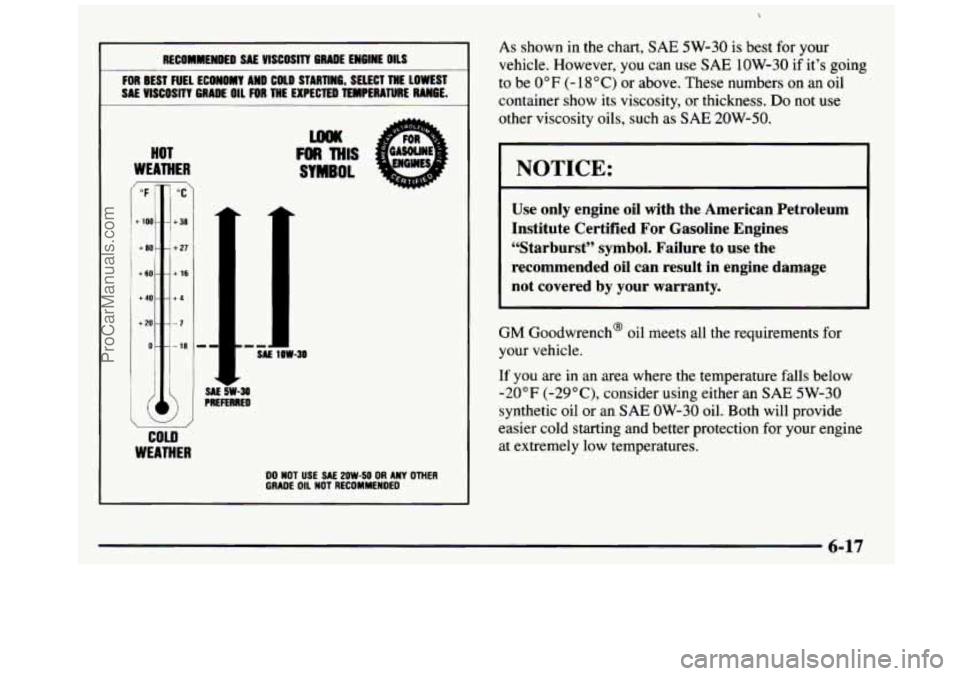
RECOMMENDED SAE YlSCOSlTT GRADE ENGINE OILS I
FOR BEST FUEL ECONOMY AND COLD STARTING, SELECT THE LOWEST
SAL VISCOSITY GRADE OIL
FOR THE EXPECTED TEMPERATURE RANGE. I
HOT
WEATHER
COLD
WEATHER
SAE 5w-30 PREFERRED
LWK
Fm THIS
SYMBOL
DO NOT USE SAE 2ow-50 OR ANY OTHER GRADE OIL NOT RECOMMENDED
As shown in the chart, SAE 5W-30 is best for your
vehicle. However, you can use
SAE 1OW-30 if it’s going
to be
0°F (- 18°C) or above. These numbers on an oil
container
show its viscosity, or thickness. Do not use
other viscosity oils, such
as SAE 20W-50.
NOTICE:
Use only engine oil with the American Petroleum
Institute Certified For Gasoline Engines
“Starburst” symbol. Failure to use the
recommended oil can result in engine damage
not covered by your warranty.
GM Goodwrench@ oil meets all the requirements for
your vehicle.
If you are in an area where the temperature falls below
-20°F (-29”C), consider using either an SAE 5W-30
synthetic oil or an SAE OW-30 oil. Both will provide
easier cold starting and better protection for your engine
at extremely low temperatures.
6-17
ProCarManuals.com
Page 327 of 436
Inflation -- Tire Pressure
The Certificationmire label, which is on the rear edge of
the driver’s door, or on the incomplete vehicle document
in the cab, shows the correct inflation pressures for your
tires when they’re cold. “Cold” means your vehicle has
been sitting for at least three hours or driven no more
than
1 mile (1.6 km).
You can operate some vehicles at reduced inflation
pressures only when you’ll be carrying reduced loads.
On those vehicles, the minimum cold inflation pressures
for
a typical reduced load are printed on the Improved
Ride Tire Pressure label located on the driver’s door.
Weigh the vehicle to find the load on each tire and see
the label for the minimum cold inflation pressures for
that load.
NOTICE:
Don’t let anyone tell you that underinflation or
overinflation is all right.
It’s not. If your tires
don’t have enough air (underinflation), you can
get the following:
Too much flexing
Too much heat
0 Tire overloading
Bad wear
Bad handling
Bad fuel economy.
If your tires have too much air (overinflation),
you can get the following:
Unusual wear
Bad handling
Rough ride
Needless damage from road hazards.
6-51
-
ProCarManuals.com
Page 343 of 436
Underbody Maintenance
Chemicals used for ice and snow removal and dust
control can collect on the underbody. If these are not
removed, accelerated corrosion (rust) can occur on
the underbody parts such as fuel lines, frame, floor
pan and exhaust system
even though they have
corrosion protection.
At least every spring, flush these materials from the
underbody with plain water. Clean any areas where mud
and other debris can collect. Dirt packed in closed areas
of the frame should be loosened before being flushed.
Your dealer
or an underbody car washing system can
do this for you.
Chemical Paint Spotting
Some weather and atmospheric conditiow &n cr&ite a
chemical fallout. Airborne pollutants can fall upon and
attack painted surfaces on your vehicle. This damage
can take
two forms: blotchy, ringlet-shaped
discolorations, and small irregular dark spots etched
into the paint surface.
Although no defect in the paint job causes this,
GM will
repair, at no charge
to the owner, the surfaces of new
vehicles damaged by this fallout condition within
12 months or 12,000 miles
(20 000 km) of purchase,
whichever occurs first.
This applies only to materials manufactured and sold by
General Motors. Bodies, body conversions or equipment
not made or sold by General Motors are not covered.
ProCarManuals.com