light GMC SIERRA 1997 Owners Manual
[x] Cancel search | Manufacturer: GMC, Model Year: 1997, Model line: SIERRA, Model: GMC SIERRA 1997Pages: 436, PDF Size: 23.38 MB
Page 7 of 436
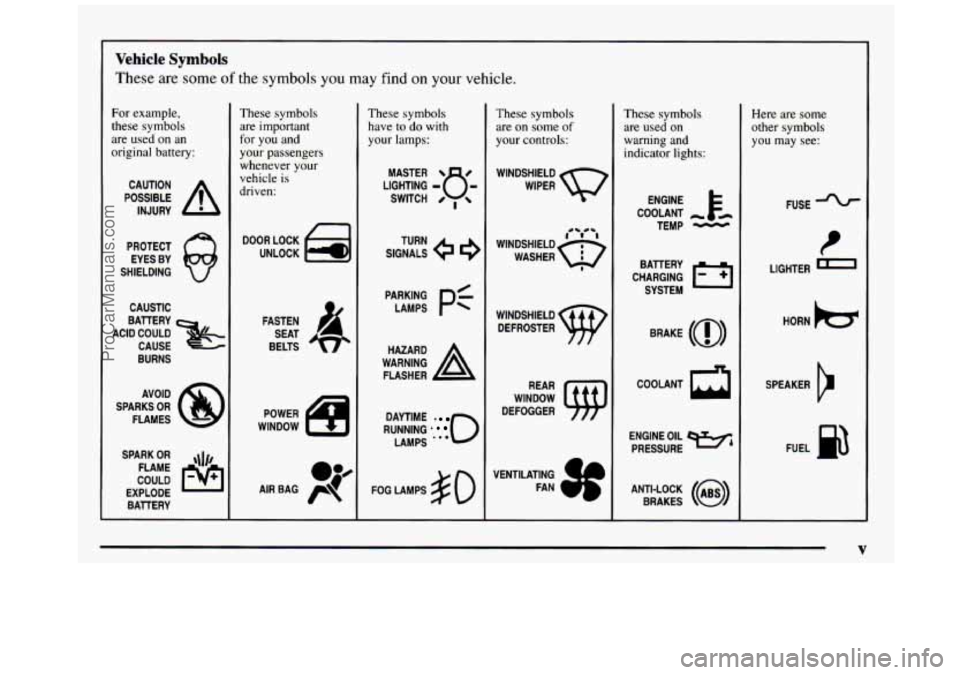
Vehicle Symbols
These are some of the symbols you may find on your vehicle.
For example,
these symbols
are used on an
original battery:
POSSIBLE A
CAUTION
INJURY
PROTECT EYES BY
SHIELDING
Q
CAUSTIC
ACID COULD BAllERY
CAUSE
BURNS
SPARK
OR qJ/,
COULD FLAME
EXPLODE BAllERY
These symbols
are important
for you and
your passengers
whenever your
vehicle is
driven:
DOOR LOCK
UNLOCK
FASTEN SEAT
BELTS
POWER
WINDOW
These symbols have to
do with
your lamps:
SIGNALS e
TURN
WARNING
A
HAZARD
FLASHER
RUNNING
* 0
DAYTIME -
LAMPS **'
FOG LAMPS $0
These symbols
are on
some of
your controls:
WINDSHIELD
WIPER
WINDSHIELD DEFROSTER
WINDOW
DEFOGGER
VENTILATING FAN
c
These symbols
are used on
warning and
indicator lights:
COOLANT -
TEMP -
CHARGING I-1
BAllERY
SYSTEM
BRAKE
(a)
COOLANT a
ENGINE OIL e,
PRESSURE
ANTI-LOCK
(@)
BRAKES
Here are some
other symbols you may see:
FUSE
LIGHTER
e
HORN )cr
SPEAKER
b
FUEL la
V
ProCarManuals.com
Page 18 of 436
It is extremely dangerous to ride in a cargo area,
inside
or outside of a vehicle. In a collision,
people riding in these areas are more likely
to be
seriously injured or killed.
Do not allow people to
ride in any area of your vehicle that is not
equipped with seats and safety belts. Be sure
everyone in your vehicle is in
a seat and using a
safety belt properly. Your
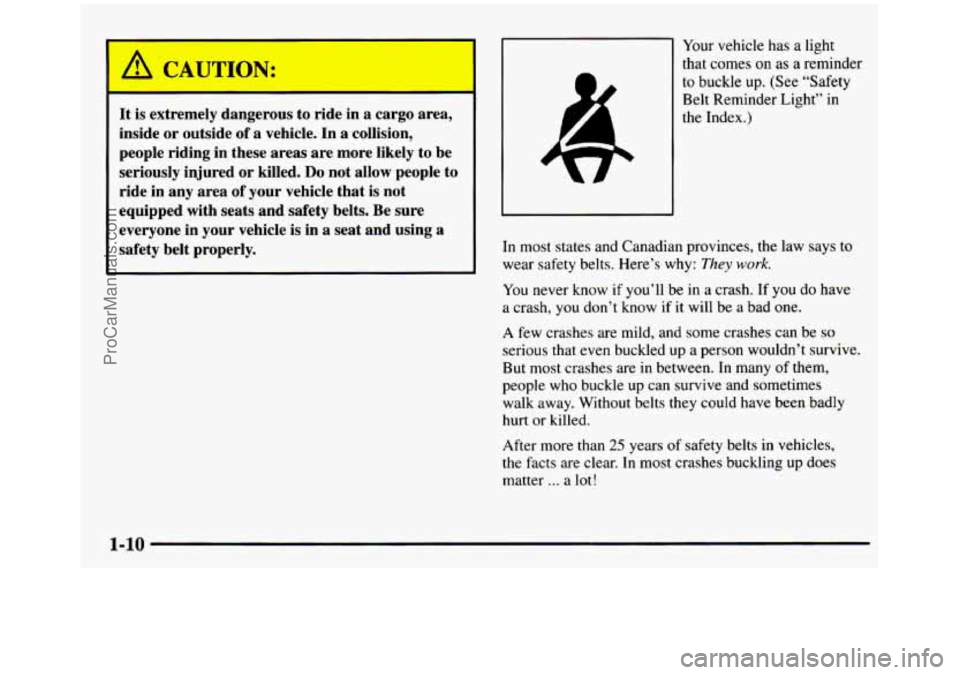
vehicle has a light
that comes on
as a reminder
to buckle up. (See “Safety
Belt Reminder Light” in
the Index.)
In most states and Canadian provinces, the law says to
wear safety belts. Here’s why:
They work.
You never know if you’ll be in a crash. If you do have
a crash,
you don’t know if it will be a bad one.
A few crashes are mild, and some crashes can be so
serious that even buckled up a person wouldn’t survive.
But most crashes are in between. In many
of them,
people who buckle up can survive and sometimes
walk away. Without belts they could have been badly
hurt or killed.
After more than
25 years of safety belts in vehicles,
the facts are clear. In most crashes buckling up does
matter
... a lot!
ProCarManuals.com
Page 33 of 436
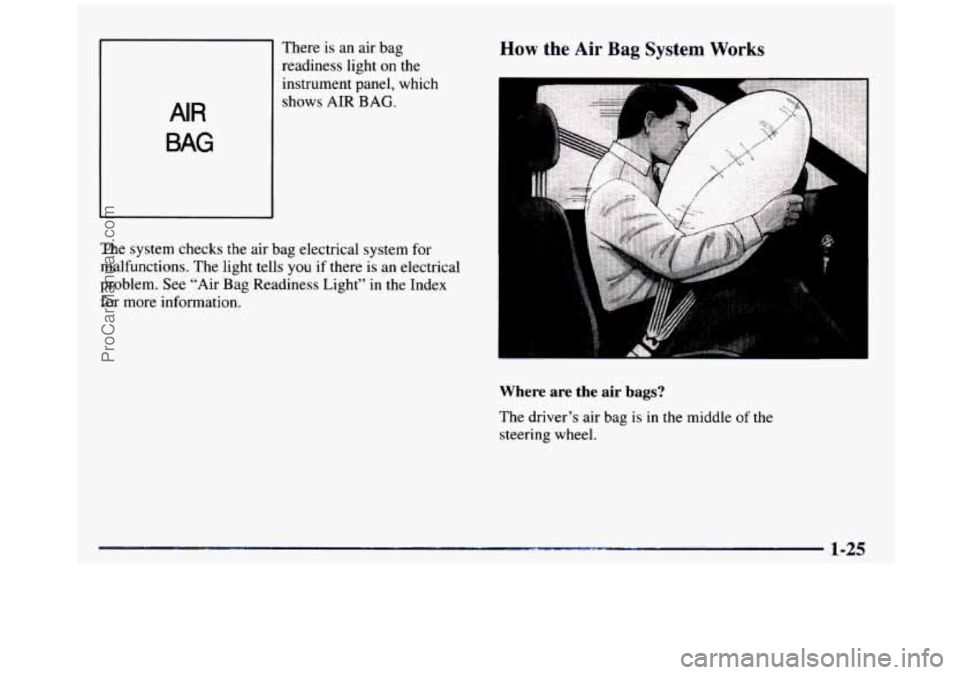
There is an air bag
readiness light on the
AIR
BAG
instrument panel, which
shows AIR
BAG.
The system checks the air bag electrical system for
malfunctions. The light tells you if there is an electrical
problem. See “Air Bag Readiness Light”
in the Index
for more information.
How the Air Bag System Works
Where are the air bags?
The driver’s air bag is in the middle of the
steering wheel.
ProCarManuals.com
Page 66 of 436
I
CAUTION: (Continu
Be sure to turn
off the air bag before using a
rear-facing child restraint in the right front
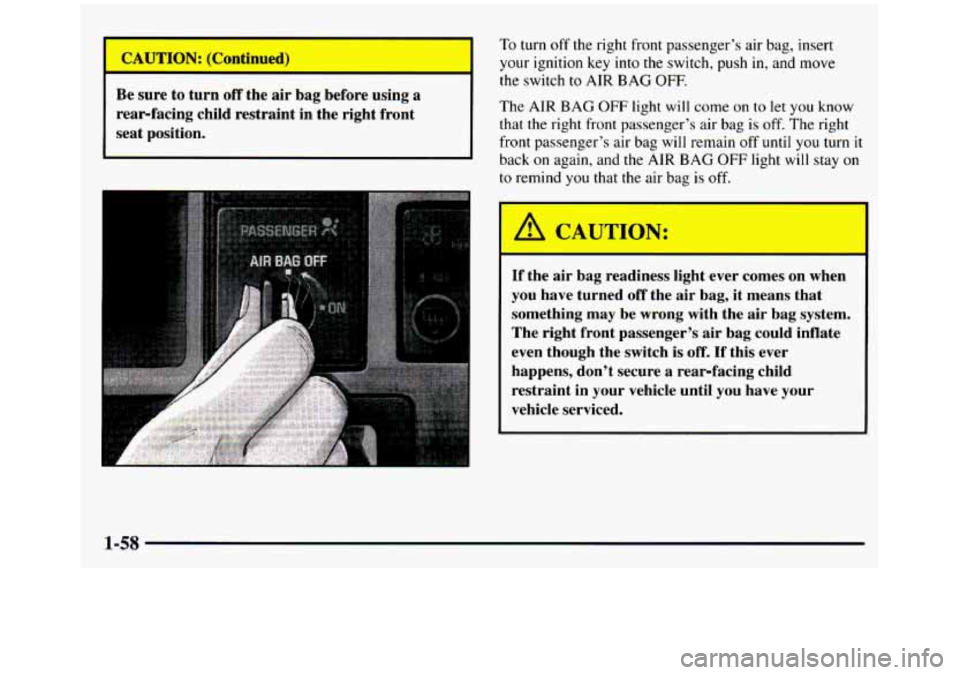
seat position. To turn
off the right
front passenger’s air bag, insert
your ignition key
into the switch, push in, and move
the switch to AIR BAG OFF.
The AIR BAG OFF light will come on to let you know
that the right front passenger’s air bag is off. The right
front passenger’s air bag will remain
off until you turn it
back on again, and
the AIR BAG OFF light will stay on
to remind you that the air bag is off.
A CAUTdN:
If the air bag readiness light ever comes on when
you have turned
off the air bag, it means that
something may be wrong with the air bag system.
The right front passenger’s air bag could inflate
even though the switch
is off. If this ever
happens, don’t secure
a rear-facing child
restraint in your vehicle until you have your
vehicle serviced.
I
1-58
ProCarManuals.com
Page 73 of 436
Safety Belt Extender
If the vehicle’s safety belt will fasten around you, you
should use it.
But if a safety belt isn’t long enough
to fasten, your
dealer will order
you an extender. It’s free. When you go
in
to order it, take the heaviest coat you will wear, so the
extender will be long enough for
you. The extender will
be just for you, and just for the seat in your vehicle that
you choose. Don’t let someone else use it, and use it
only for the seat it is made to fit. To wear it, just attach it
to
the regular safety belt.
Checking Your Restraint Systems
Now and then, make sure the safety belt reminder light
and all your belts, buckles, latch plates, retractors and
anchorages are working properly. Look for any other
loose or damaged safety belt system parts. If
you see
anything that might keep
a safety belt system from
doing its job, have it repaired.
Torn or frayed safety belts may
not protect you in a
crash. They can rip apart under impact forces. If a belt is
torn or frayed, get a new one right away.
Also
look for any opened or broken air bag covers, and
have them repaired or replaced. (The air bag system
does
not need regular maintenance.)
Replacing Restraint System Parts
After a Crash
If you’ve had a crash, do you need new belts?
After a very minor collision, nothing may be necessary.
But if the belts were stretched, as they would be
if worn
during a more severe crash, then
you need new belts.
If belts
are cut or damaged, replace them. Collision
damage also may mean
you will need to have safety belt
or seat parts repaired or replaced. New parts and repairs
may be necessary
even if the belt wasn’t being used at
the time of the collision.
If an air bag inflates, you’ll need to replace air bag
system parts. See the part on the air bag system earlier in
this section.
ProCarManuals.com
Page 75 of 436
Section 2 Features and Controls
-
Here you can learn about the many standard and optional features on your vehicle, and information on starting,
shifting and braking. Also explained
are the instrument panel and the warning systems that tell you if everything is
working properly
-- and what to do if you have a problem.
2- 1
2-3
2-4
2-5
2-7 2-9
2- 10
2-11
2- 13
2- 14
2- 15
2- 19
2-22
2-22
2-27
2-28
2-30
Keys
Tailgate
Third Door
Door Locks
Keyless Entry System
Theft
New Vehicle “Break-In” Ignition Positions
Starting Your Gasoline Engine
Engine Coolant Heater
Automatic Transmission Operation
Manual Transmission Operation
Locking Rear Axle
Four-wheel Drive
Parking Brake
Shifting Into PARK
(P) (Automatic
Transmission Models Only)
Shifting Out
of PARK (P)
(Automatic Transmission) 2-3
1
2-3 1
2-32
2-32
2-33
2-36
2-36
2-43 2-48
2-52
2-59
2-6
1
2-62
2-64 2-66 Parking
Your Vehicle (Manual
Transmission Models Only)
Parking Over Things That Burn
Engine Exhaust
Running Your Engine While You’re Parked
(Automatic Transmission)
Windows
Tilt Wheel
Turn SignalAUultifunction Lever
Lamps
Mirrors Storage Compartments
Ashtrays and Cigarette Lighter
Sun Visors
Instrument Panel
Instrument Panel Cluster
Warning Lights, Gages and Indicators
ProCarManuals.com
Page 78 of 436
4 I
I
I
I
I
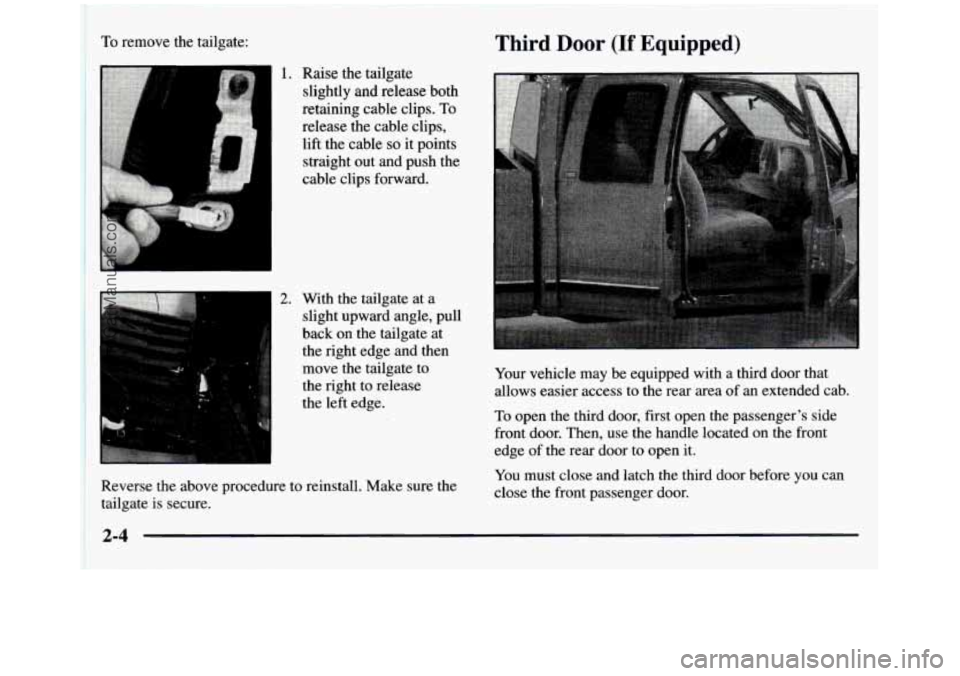
To remove the tailgate:
Raise the tailgate
slightly and release both
retaining cable clips.
To
release the cable clips,
lift the cable
so it points
straight out and push the
cable clips forward.
With the tailgate at a
slight upward angle, pull
back on the tailgate at
the right edge and then move the tailgate to
the right to release
the left edge.
Third Door (If Equipped)
Reverse the above procedure to reinstall. Make sure the
tailgate is secure. Your
vehicle may be equipped with a third door that
allows easier access to the rear area of an extended cab.
To open the third door, first open the passenger's side
front door. Then, use the handle located on the front
edge of the rear door to open it. You must close and latch the third door before you can
close the front passenger door.
2-4
ProCarManuals.com
Page 84 of 436
~ ~~~~~ ~~~~~~~~~~~~
~ ~~ -~ ~
Key in the Ignition
If you leave your vehicle with the keys inside, it’s an
easy target for
joy riders or professional thieves -- so
don’t do it.
When you park your vehicle and open the driver’s door, you’ll hear a tone reminding you to remove your key
from the ignition and take it with you. Always do this.
Your steering wheel will be locked, and
so will your
ignition.
If you have an automatic transmission, taking
your key out also locks your transmission. And
remember to lock the doors.
Parking at Night
Park in a lighted spot, close all windows and lock your
vehicle. Remember
to keep your valuables out of sight.
Put them in a storage area, or take them with you.
Parking Lots
If you park in a lot where someone will be watching
your vehicle, it’s best to lock it
up and take your keys.
But what
if you have to leave your ignition key? What if
you have to leave something valuable in your vehicle?
Put your valuables in a storage area, like your
glove box.
Lock all the doors except the driver’s.
New Vehicle “Break-In”
NOTICE:
Your modern vehicle doesn’t need an elaborate
“break-in.” But it will perform better in the long
run
if you follow these guidelines:
Keep your speed at 55 mph (88 km/h) or
less for the first
500 miles (805 km).
Don’t drive at any one speed -- fast or
slow
-- for the first 500 miles (805 km).
Don’t make full-throttle starts.
200 miles (322 km) or so. During this time
your new brake linings aren’t yet broken
in. Hard stops with new linings can mean
premature wear and earlier replacement.
Follow this breaking-in guideline every
time you get new brake linings.
0 Don’t tow a trailer during break-in. See
“Towing a Trailer’’ in the Index for
more information.
a Avoid making hard stops for the first
2-10
ProCarManuals.com
Page 96 of 436
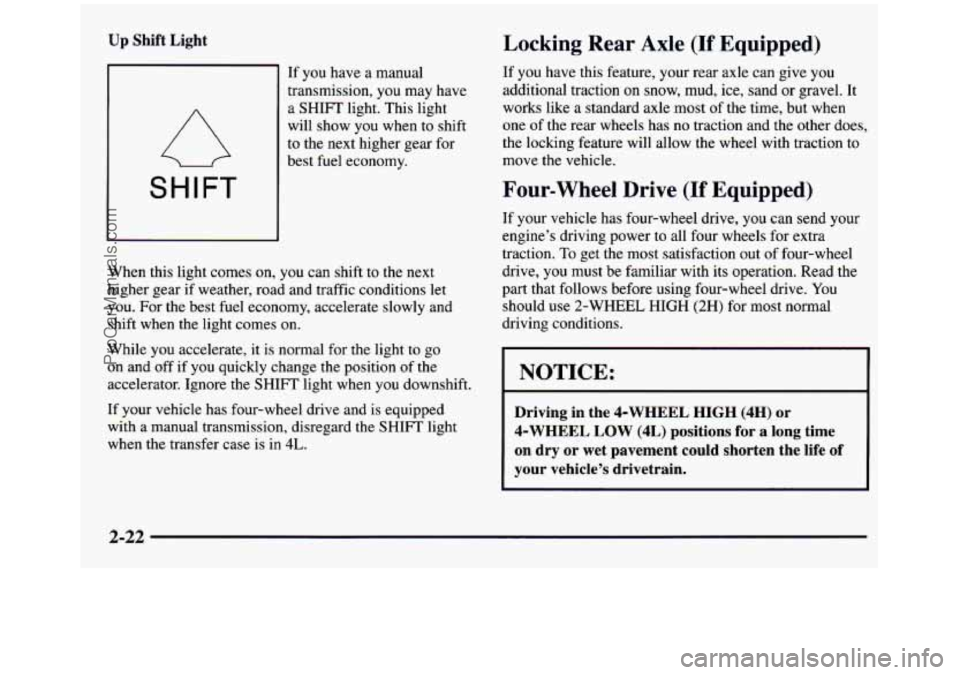
Up Shift Light
SHIFT
If you have a manual
transmission,
you may have
a SHIFT light. This light
will show
you when to shift
to the next higher gear for
best fuel economy.
When this light comes on, you can shift to the next
higher gear
if weather, road and traffic conditions let
you. For the best fuel economy, accelerate slowly and shift when the light comes
on.
While you accelerate, it is normal for the light to go
on and off if you quickly change the position of the
accelerator. Ignore the
SHIFT light when you downshift.
If your vehicle has four-wheel drive and is equipped
with a manual transmission, disregard the
SHIFT light
when the transfer case is in
4L.
Locking Rear Axle (If Equipped)
If you have this feature, your rear axle can give you
additional traction on snow, mud, ice, sand
or gravel. It
works like a standard axle most
of the time, but when
one of the rear wheels has no traction and the other
does,
the locking feature will allow the wheel with traction to
move the vehicle.
Four-wheel Drive (If Equipped)
If your vehicle has four-wheel drive, you can send your
engine’s driving power to all four wheels for extra
traction.
To get the most satisfaction out of four-wheel
drive, you must be familiar with its operation. Read the
part that follows before using four-wheel drive. You
should use 2-WHEEL
HIGH (2H) for most normal
driving conditions.
I NOTICE: I
Driving in the 4-WHEEL HIGH (4H) or
4-WHEEL LOW (4L) positions for a long time
on dry or wet pavement could shorten the life of
your vehicle’s drivetrain.
2-22
ProCarManuals.com
Page 97 of 436
Front Axle Locking Feature
The front axle locks and unlocks automatically when you shift the transfer case. Some delay for the axle to lock or
unlock is normal. If the outside temperature is very hot, or
the vehicle has
been used under hard driving conditions,
there may be a slight delay for the axle to unlock.
Manual Transfer Case (If Equipped)
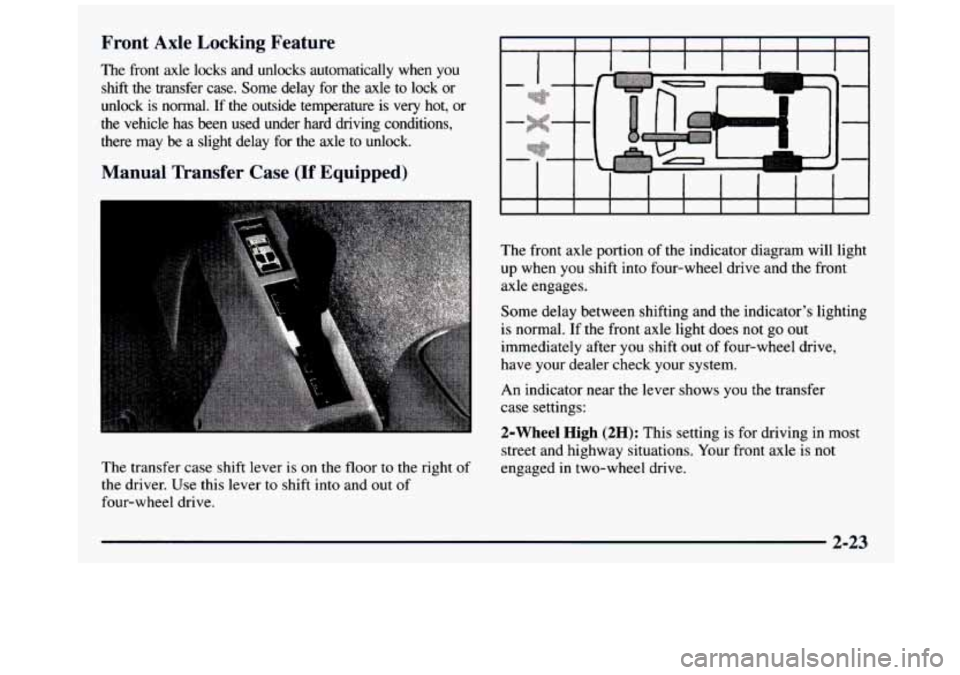
The transfer case shift lever is on the floor to the right of
the driver. Use this lever to shift into and out of
four-wheel drive. The front
axle portion of the indicator diagram will light
up when
you shift into four-wheel drive and the front
axle engages.
Some delay between shifting and the indicator’s lighting
is normal. If
the front axle light does not go out
immediately after you shift out of four-wheel drive,
have your dealer check your system.
An indicator near the lever shows you the transfer
case settings:
2-Wheel High (2H): This setting is for driving in most
street and highway situations. Your front axle is not
engaged in two-wheel drive.
2-23
ProCarManuals.com