radiator cap GMC SIERRA 1997 Owners Manual
[x] Cancel search | Manufacturer: GMC, Model Year: 1997, Model line: SIERRA, Model: GMC SIERRA 1997Pages: 436, PDF Size: 23.38 MB
Page 253 of 436
If you get the overheat warning with no sign of steam,
try this for a minute or
so:
1. If you have an air conditioner, turn it off.
2. Turn on your heater to full hot at the highest fan
speed and open the window
as necessary.
3. If you’re in a traffic jam, shift to NEUTRAL (N);
otherwise, shift to the highest gear while
driving
-- AUTOMATIC OVERDRIVE (@)
for automatic transmissions.
If you no longer have
the overheat warning, you can
drive. Just
to be safe, drive slower for about 10 minutes.
If the warning doesn’t come back
on, you can
drive normally.
If the warning continues, pull over, stop, and park your
vehicle right away.
If there’s still no sign of steam, push the accelerator until
the engine speed is about twice as fast as normal idle
speed. Bring the engine speed back to normal idle speed
after two or three minutes. Now see if the warning stops.
But then, if
you still have the warning, turn oflthe
engine and get everyone out
of the vehicle until it
cools down.
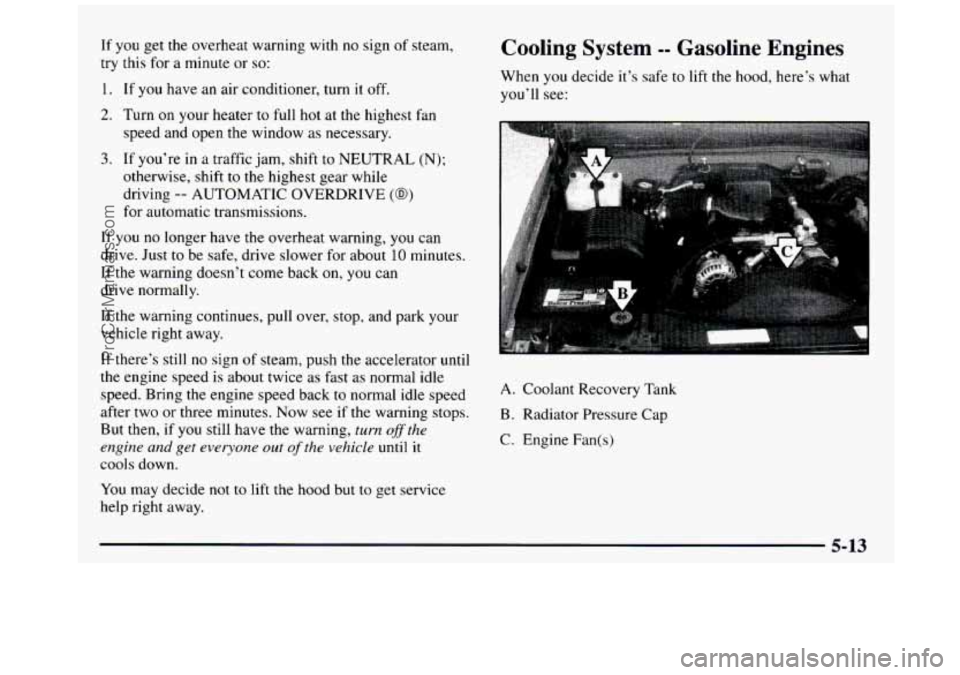
Cooling System -- Gasoline Engines
When you decide it’s safe to lift the hood, here’s what
you’ll see:
A. Coolant Recovery Tank
B. Radiator Pressure Cap
C. Engine Fan(s)
You may decide
not to lift the hood but to get service
help right away.
ProCarManuals.com
Page 257 of 436
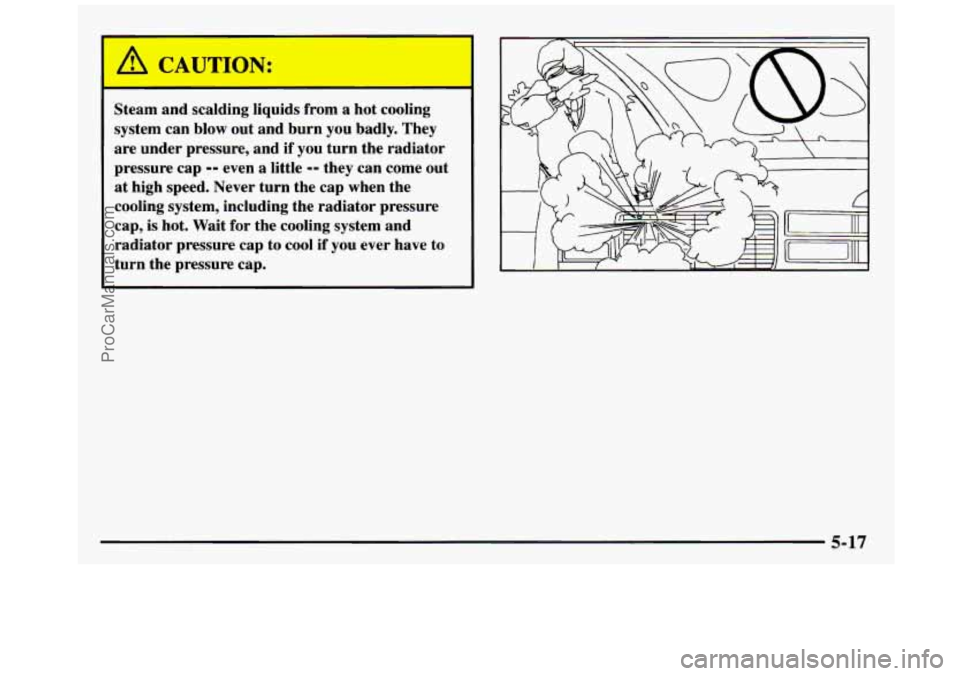
A CAUTION:
Steam and scalding liquids from a hot cooling
system can blow
out and burn you badly. They
are under pressure, and
if you turn the radiator
pressure cap
-- even a little -- they can come out
at high speed. Never turn the cap when the
cooling system, including the radiator pressure
cap, is hot. Wait for the cooling system and
radiator pressure cap to cool if you ever have to
turn the pressure cap.
I
5-17
ProCarManuals.com
Page 258 of 436
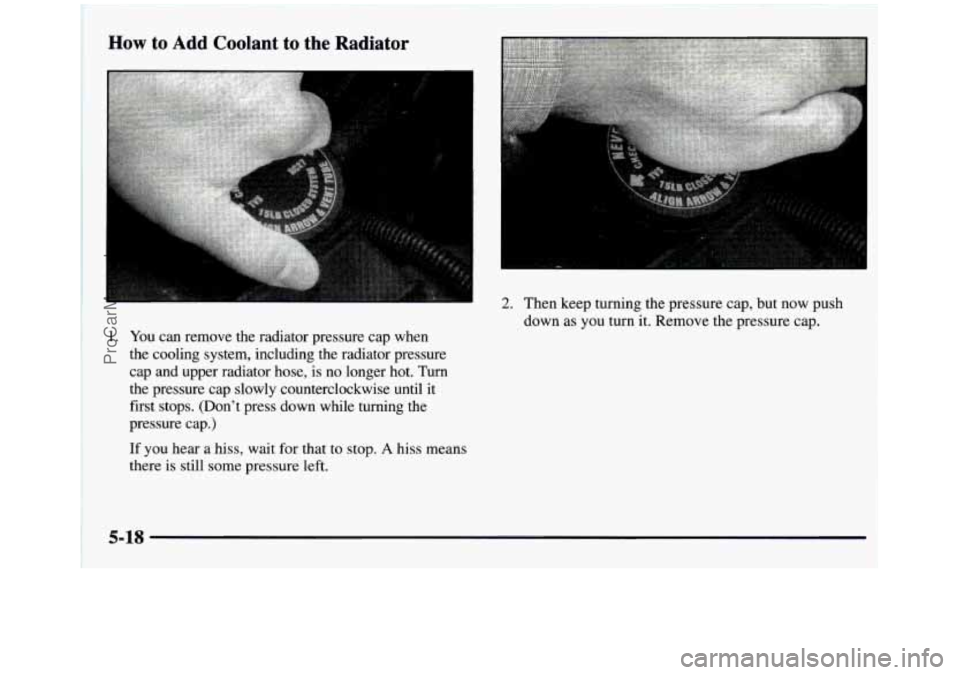
How to Add Coolant to the Radiator
1. You can remove the radiator pressure cap when
the cooling system, including the radiator pressure
cap and upper radiator hose, is no longer hot.
Turn
the pressure cap slowly counterclockwise until it
first stops. (Don’t press down while turning the
pressure cap.)
2. Then keep turning the pressure cap, but now push
down as
you turn it. Remove the pressure cap.
If you hear a hiss, wait for that to stop.
A hiss means
there is still some pressure left.
ProCarManuals.com
Page 259 of 436
..
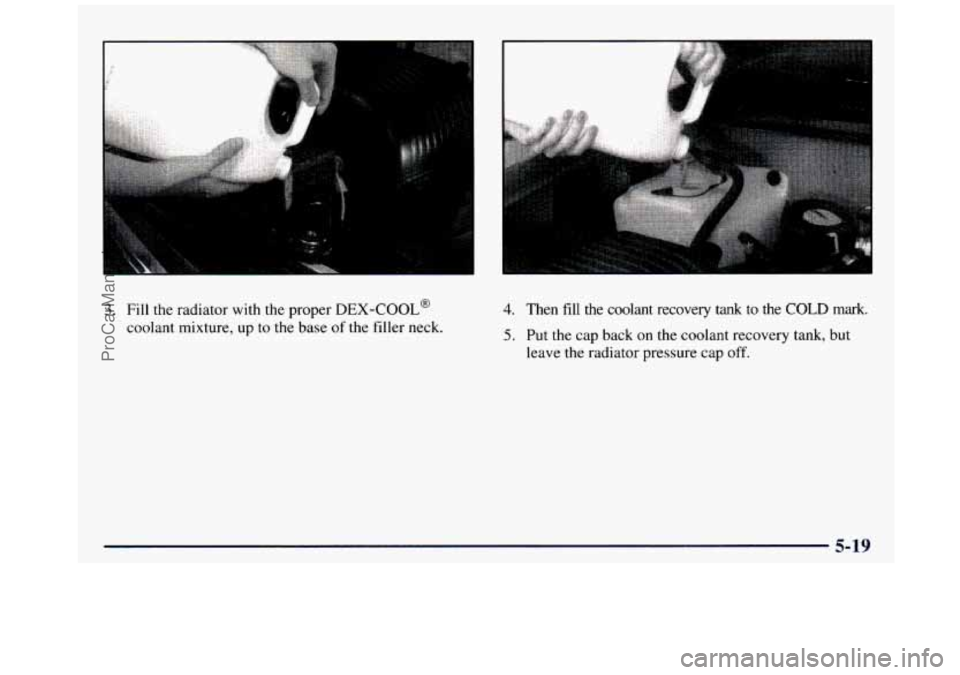
3. Fill the radiator with the proper DEX-COOL@
coolant mixture, up to the base of the filler neck.
4. Then fill the coolant recovery tank to the COLD mark.
5. Put the cap back on the coolant recovery tank, but
leave
the radiator pressure cap off.
ProCarManuals.com
Page 260 of 436
i 'I
I
I
I
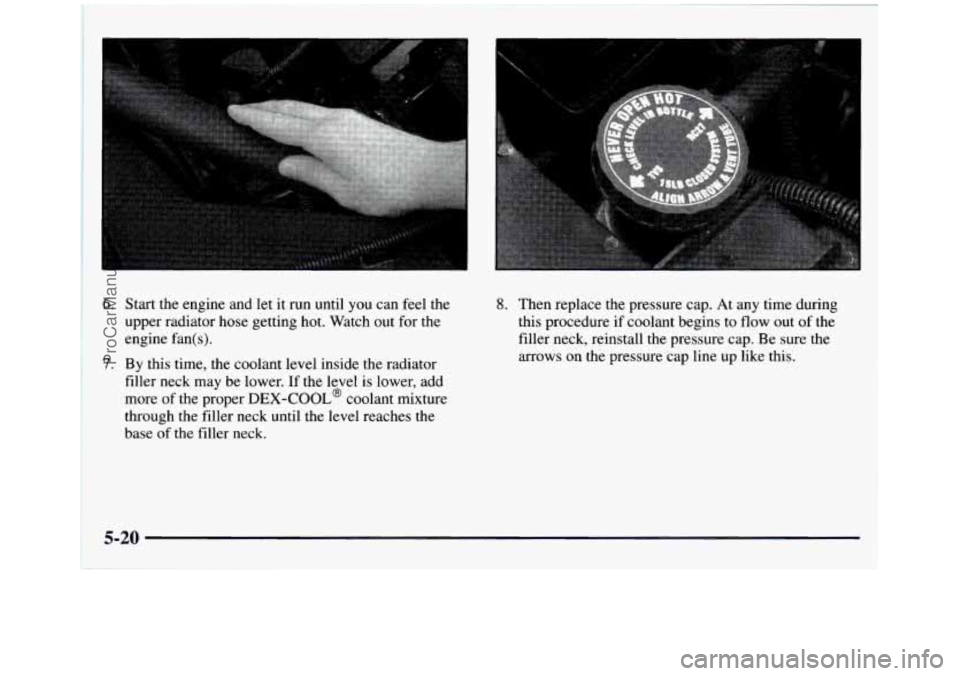
6. Start the engine and let it run until you can feel the 1
' upper radiator hose getting hot. Watch out for the
engine fan(s).
I 7. By this time, the coolant level inside the radiator
filler neck may be lower. If the level is lower, add
more
of the proper DEX-COOL@ coolant mixture
through the filler neck until the level reaches the
base
of the filler neck.
f:
8. Then replace the pressure cap. At any time during
this procedure if coolant begins to
flow out of the
filler neck, reinstall the pressure cap. Be sure the
arrows on the pressure cap line up like this.
5-20
ProCarManuals.com
Page 277 of 436
Section 6 Service and Appearance Care
Here you will find information about the care of your vehicle. This section begins with service and fuel information,
and then it shows how
to check important fluid and lubricant levels. There is also technical information about your
vehicle, and a part devoted to its appearance care.
6-2
6-
3
6-4
6-5
6-8
6- 14
6- 15
6- 19
6-2 1
6-25
6-26
6-26 6-27
6-29
6-32
6-32 Service
Fuel (Gasoline Engine)
Fuels
in Foreign Countries - - Gasoline
Engines
Filling Your Tank
Checking Things Under the Hood
Noise Control System
Engine Oil (Gasoline Engine)
Air Cleaner Filter (Gasoline Engines)
Automatic Transmission Fluid
Manual Transmission Fluid
Hydraulic Clutch
Rear Axle
Four-wheel Drive
Engine Coolant Radiator Pressure Cap (Gasoline Engine)
Thermostat 6-33
6-33 6-35
6-39
6-39
6-49 6-50
6-59
6-60
6-64
6-68
6-69
6-70 6-75
6-76
6-78 Power Steering Fluid
Windshield Washer Fluid
Brakes
Battery
Bulb Replacement
Windshield Wiper Blade
R
Tires
Appearance Care .eplacement
Cleaning the Inside
of Your Vehicle
Cleaning
the Outside of Your Vehicle
Appearance Care Materials
Chart
Vehicle Identification Number (VIN)
Electrical System Replacement Bulbs
Capacities and Specifications
Air Conditioning Specifications
ProCarManuals.com
Page 287 of 436
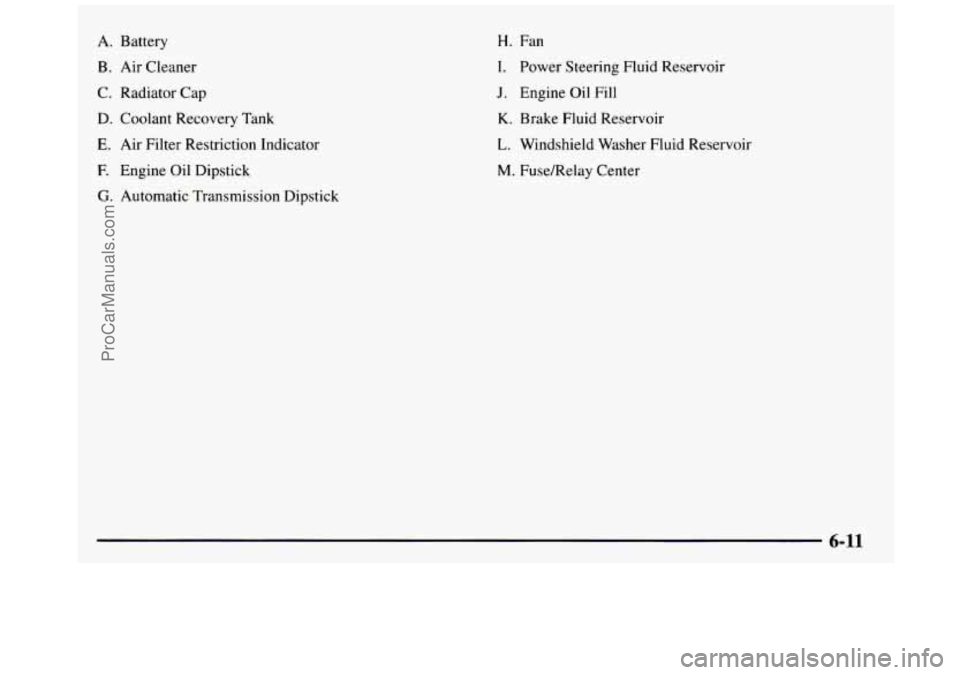
A. Battery
B. Air Cleaner
C. Radiator Cap
D. Coolant Recovery Tank
E. Air Filter Restriction Indicator
F. Engine Oil Dipstick
G. Automatic Transmission Dipstick
H. Fan
I. Power Steering Fluid Reservoir
J. Engine Oil Fill
K. Brake Fluid Reservoir
L. Windshield Washer Fluid Reservoir
M. Fuse/Relay Center
6-11
ProCarManuals.com
Page 289 of 436
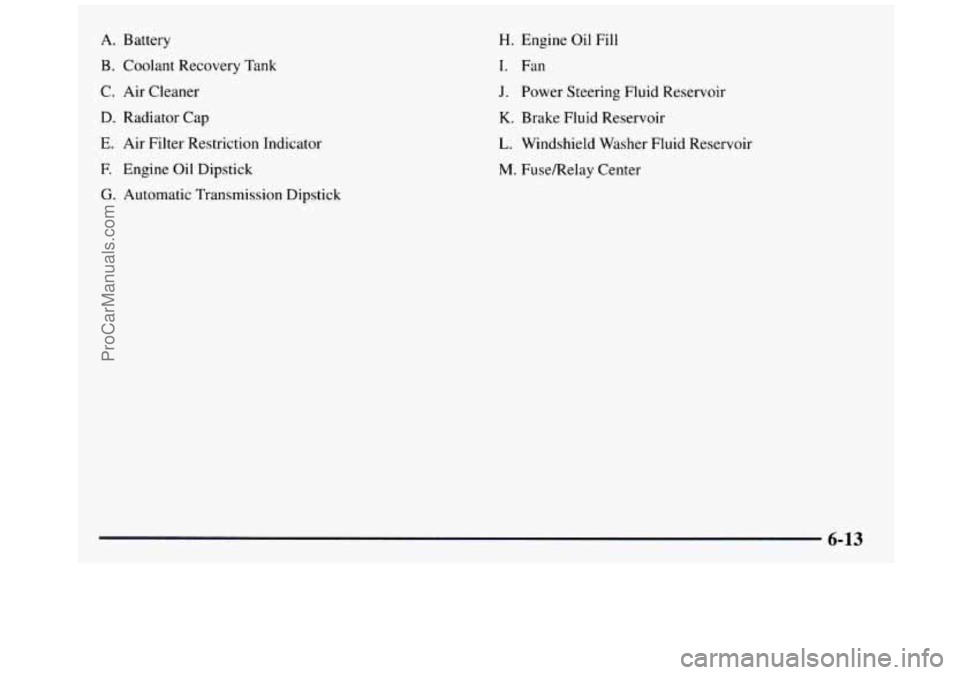
A. Battery
B. Coolant Recovery Tank
C. Air Cleaner
D. Radiator Cap
E. Air Filter Restriction Indicator
E Engine Oil Dipstick
G. Automatic Transmission Dipstick
H. Engine Oil Fill
I. Fan
J. Power Steering Fluid Reservoir
K. Brake Fluid Reservoir
L. Windshield Washer Fluid Reservoir
M. FuseRelay Center
6-13
ProCarManuals.com
Page 307 of 436
Checking Coolant
If your vehicle has a diesel engine, see “Checking
Coolant”
in the Diesel Engine Supplement. Adding Coolant
If you need more
coolant, add the proper DEX-COOL@
coolant mixture
at the coolant recovery tank.
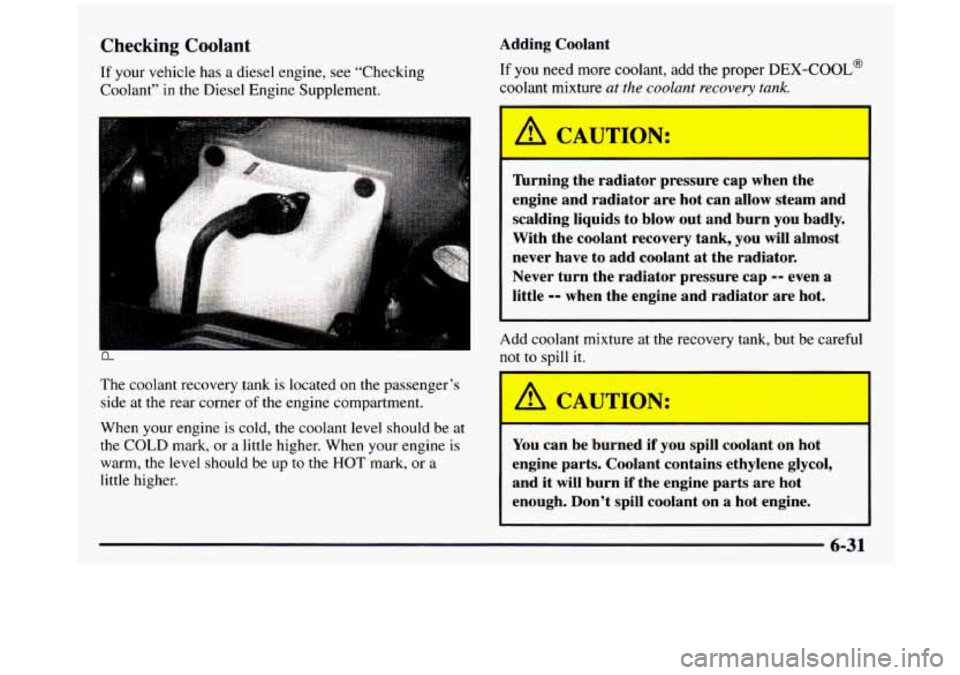
The coolant recovery tank is located on the passenger’s
side at the rear corner
of the engine compartment.
When your engine is cold,
the coolant level should be at
the
COLD mark, or a little higher. When your engine is
warm, the level should be up to the HOT mark, or a
little higher.
A CAUTION:
Turning the radiator pressure cap when the
engine and radiator are hot can allow steam and
scalding liquids to blow out and burn you badly.
With the coolant recovery tank, you will almost
never have to add coolant at the radiator.
Never turn the radiator pressure cap
-- even a
little -- when the engine and radiator are hot.
Add coolant mixture at the recovery tank, but be careful
not to spill
it.
You can be burned if you spill coolant on hot
engine parts. Coolant contains ethylene glycol,
and it will burn if the engine parts are hot
enough. Don’t spill coolant on a hot engine.
6-31
~ .
ProCarManuals.com
Page 308 of 436
Radiator Pressure Cap
(Gasoline Engine)
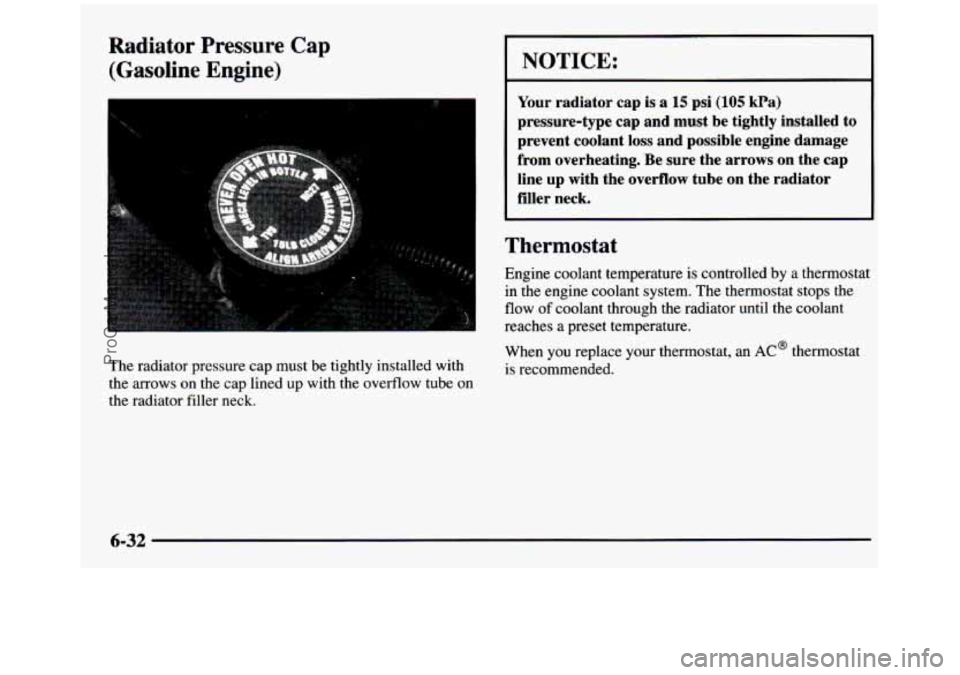
The radiator pressure cap must be tightly installed with
the arrows
on the cap lined up with the overflow tube on
the radiator filler neck.
NOTICE:
Your radiator cap is a 15 psi (105 kPa)
pressure-type cap and must be tightly installed to
prevent coolant loss and possible engine damage
from overheating. Be sure the arrows on the cap line up with the overflow tube on the radiator
filler neck.
Thermostat
Engine coolant temperature is controlled by a thermostat
in the engine coolant system. The thermostat stops the
flow
of coolant through the radiator until the coolant
reaches a preset temperature.
When you replace your thermostat, an
AC@ thermostat
is recommended.
6-32
ProCarManuals.com