brake light GMC SIERRA 1998 User Guide
[x] Cancel search | Manufacturer: GMC, Model Year: 1998, Model line: SIERRA, Model: GMC SIERRA 1998Pages: 452, PDF Size: 23.65 MB
Page 152 of 452
If the warning light comes on, there co11ld be a brake
problem. Have your brake system inspected right away.
This light should come on
(a) (@)
briefly when you turn the
ignition key
to RUN. If it
doesn‘t come on then, have
it
fixed so it will be ready to
warn you if there’s a problem. BRAKE
If the light comes on while you are driving, pull off the
road and
stop carefully. You may notice that the pedal is
harder
to push. Or, the pedal may go closer to the floor.
It may take longer to stop.
If the light is still on, have the
vehicle towed
for service. (See “Towing Your Vehicle”
in the Index.)
Your brake system may not be working properly
if the brake system warning light is
on. Driving
with the brake system warning light on can lead
to an accident.
If the light is still on after you’ve
pulled off the road and stopped carefully, have
the vehicle towed for service.
Anti-Lock Brake System Warning Light
With the anti-lock brake
system,
this light will
come on when you start
ANTI -
LOCK
your engine and may stay
on for several seconds.
That’s normal.
2-68
ProCarManuals.com
Page 153 of 452
If the light stays on, or comes on when you’re driving,
your vehicle needs service.
If the regular brake system
warning light isn’t on, you still have brakes, but you
don’t have anti-lock brakes.
If the regular brake system
warning light is also on, you don’t have anti-lock brakes
and there‘s a problem
with your regular brakes. See
“Brake System Warning Light” earlier
in this section.
The anti-lock brake system warning light should come
on briefly when you turn the ignition key to RUN. If the
light doesn‘t come on then. have it fixed
so it will be
ready to warn you
if there is a problem.
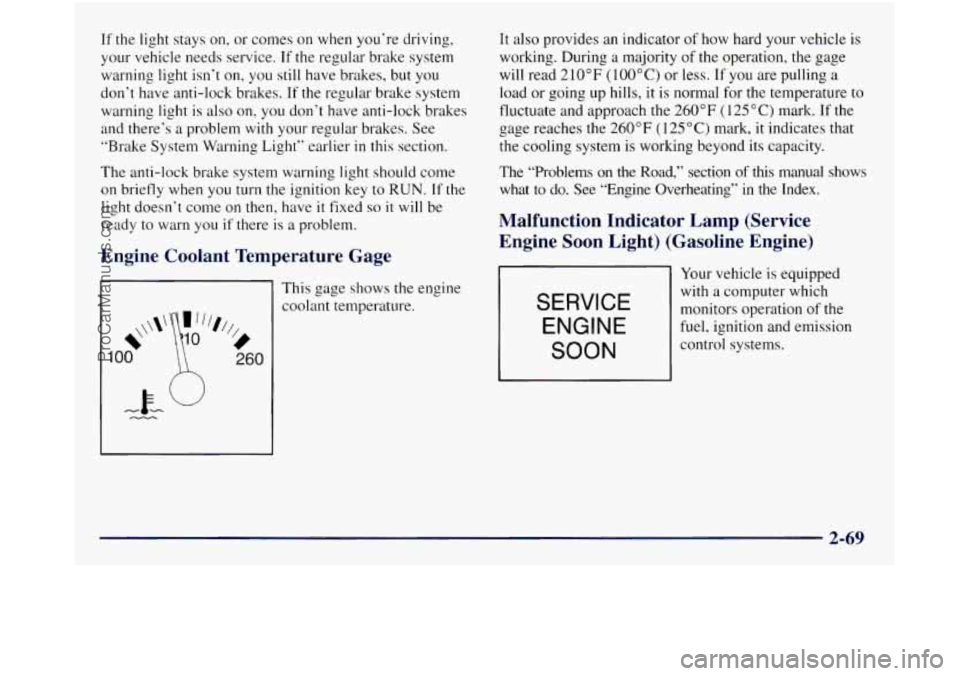
Engine Coolant Temperature Gage
1
This gage shows the engine
coolant temperature.
It also provides an indicator of how hard your vehicle is
working. During a majority of the operation, the gage
will read
210°F (100°C) or less. If you are pulling a
load or going up hills, it is normal for the temperature to
fluctuate and approach the
260°F (1 25 “C) mark. If the
gage reaches the
260°F (125°C) mark, it indicates that
the cooling system is working beyond its capacity.
The “Problems on
the Road,” section of this manual shows
what
to do. See “Engine Overheating” in the Index.
Malfunction Indicator Lamp (Service
Engine
Soon Light) (Gasoline Engine)
SERVICE
ENGINE
SOON
Your vehicle is equipped
with a computer which
monitors operation
of the
fuel, ignition and emission
control systems.
2-69
ProCarManuals.com
Page 195 of 452
If your engine ever stops while you’re driving, brake
normally but don’t pump your brakes.
If you do, the
pedal may get harder to push down. If your engine
stops, you will still have some power brake assist. But
you will use it when you brake. Once the power assist is
used up, it may take longer to stop and the brake pedal
will be harder to push.
Anti-Lock Brakes (ABS)
Your vehicle has anti-lock brakes (ABS). ABS is an
advanced electronic braking system that will help
prevent a braking skid.
When you start your engine and begin
to drive away,
your anti-lock brake system will check itself. You may
hear
a momentary motor or clicking noise while this
test is going on. This is normal.
(@!
ANTI -
If there’s a problem with
the anti-lock brake system,
this warning light will stay
on. See “Anti-Lock Brake
System Warning Light”
in
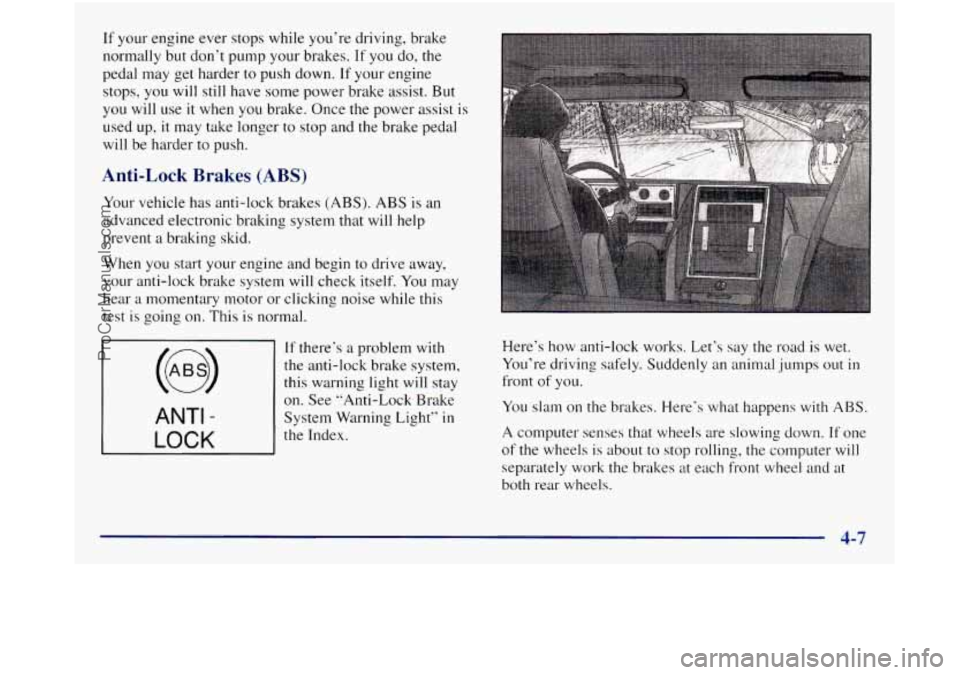
I LOCK I the Index. Here’s how
anti-lock works. Let’s say the road
is wet.
You’re driving safely. Suddenly an animal jumps out
in
front of you.
You slam
on the brakes. Here’s what happens with ABS.
A computer senses that wheels are slowing down. If one
of the wheels is about to stop rolling, the computer will
separately work the brakes at each front wheel and at
both rear wheels.
4-7
ProCarManuals.com
Page 210 of 452
Driving Downhill
When off-roading takes you downhill, you’ll want to
consider
a number of things:
How steep is the downhill? Will I be able to maintain
vehicle control?
What’s the surface like? Smooth‘? Rough‘? Slippery?
Hard-packed dirt? Gravel?
Are there hidden surfxe obstacles’? Ruts? Logs?
Boulders?
What’s at the bottom of the hill‘? Is there a hidden
creek bank or even
a river bottom with large rocks‘?
If you decide you can go down a hill safely, then try to
keep your vehicle headed straight down, and use a low
gear. This way, engine drag can help your brakes and
they won’t have to do all the work. Descend slowly,
keeping your vehicle under control at all times.
Heavy braking when going down a hill can cause
your brakes to overheat and fade. This could cause
loss of control and a serious accident. Apply the
brakes lightly when descending a hill and use a
low
gear to keep vehicle speed under control.
Are there some things
I should not do when
driving down a hill?
A: Yes! These are important because if you
0
0
ignore them you could lose control and have a
serious accident.
When driving downhill, avoid turns that take you
across the incline of the
hill. A hill that’s not too
steep to drive down may be too steep to drive across.
You could
roll over if you don’t drive straight down.
Never
go downhill with the transmission in
NEUTRAL (N), or with the clutch pedal depressed
in a manual shift. This is called “free-wheeling.”
Your brakes
will have to do all the work and could
overheat
and fade.
4-22
ProCarManuals.com
Page 214 of 452
__ ~~~~~ ~ ~~ ~ ~ ~ . _~_
Driving in Water
Light rain causes no special off-road driving problems.
But heavy rain can mean flash flooding, and flood
waters demand extreme caution.
Find out how deep the water is before
you drive through
it. If it’s deep enough to cover your wheel hubs, axles or
exhaust pipe, don’t try it
-- you probably won’t get
through. Also, water that deep can damage your axle
and other vehicle parts.
If the water isn’t too deep, then drive through it slowly. \
At
fast speeds, water splashes on your ignition system and
your vehicle can stall. Stalling can also occur
if you get
your tailpipe under water. And, as long as your tailpipe is
under water, you’ll never
be able to start your engine.
When you
go through water, remember that when your
brakes get wet,
it may take you longer to stop.
.
Driving through rushing water can be dangerous.
Deep water can sweep your vehicle downstream
and you and your passengers could drown. If it’s
only shallow water, it can still wash away the
ground from under your tires, and you could lose
traction and roll the vehicle over. Don’t drive
through rushing water.
See “Driving Through Water’’ in the Index for more
information on driving through water.
After Off-Road Driving
Remove any brush or debris that has collected on the
underbody, chassis or under the hood. These
accumulations can be a fire hazard.
After operation in mud or sand, have the brake linings
cleaned and checked. These substances can cause
glazing and uneven braking. Check the body structure,
4-26
ProCarManuals.com
Page 218 of 452
J L
Wet brakes can cause accidents. They won’t work
as well in a quick stop and may cause pulling to
one side. You could lose control
of the vehicle.
After driving through
a large puddle of water or
a car wash, apply your brake pedal lightly until
your brakes work normally.
Hydroplaning
Hydroplaning is dangerous. So much water can build up
under your tires that they can actually ride
on the water.
This can happen if the road
is wet enough and you’re
going
fast enough. When your vehicle is hydroplaning,
it has little or no contact with the road.
Hydroplaning doesn’t happen often. But it can if your
tires do not have much tread or if the pressure in
one or
more
is low. It can happen if a lot of water is standing on
the road. If you can see reflections from trees, telephone
poles or other vehicles, and raindrops “dimple” the
water’s surface, there could be hydroplaning. Hydroplaning usually happens at higher
speeds, There
just
isn’t a hard and fast rule about hydroplaning. The
best advice
is to slow down when it is raining.
Driving Through Deep Standing Water
c
NOTICE:
If you drive too quickly through deep puddles or
standing water, water can come in through your
engine’s air intake and badly damage your
engine. Never drive through water that is slightly
lower than the underbody
of your vehicle. If you
can’t avoid deep puddles or standing water, drive
through them very slowly.
Some Other Rainy Weather Tips
0 Besides slowing down, allow some extra following
distance. And be especially careful when you pass
another vehicle. Allow yourself more clear room
ahead, and be prepared to have your view restricted
by road spray.
0 Have good tires with proper tread depth. (See
“Tires”
in the Index.)
4-30
ProCarManuals.com
Page 248 of 452
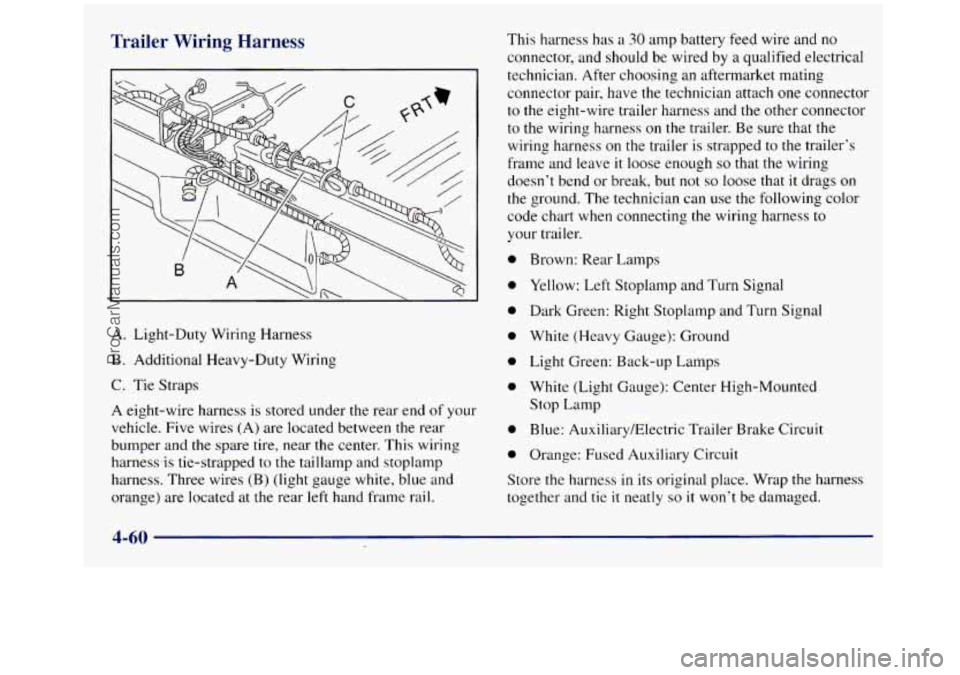
Trailer Wiring Harness
A. Light-Duty Wiring Harness
B. Additional Heavy-Duty Wiring
C. Tie Straps
A eight-wire harness is stored under the rear end of your
vehicle. Five wires (A) are located between the rear
bumper and the spare tire, near the center. This wiring
harnewis tie-strapped to the taillamp and stoplamp
harness. Three wires (B) (light gauge white, blue and
orange) are located at
the rear left hand frame rail. This
harness has a
30 amp battery feed wire and no
connector, and should be wired
by a qualified electrical
technician. After choosing an aftermarket mating
connector pair, have the technician attach one connector
to the eight-wire trailer harness and the other connector
to the wiring harness on the trailer. Be sure that the
wiring harness on the trailer is strapped to the trailer’s
frame and leave
it loose enough so that the wiring
doesn’t bend or break, but not
so loose that it drags on
the ground. The technician can use the following color
code chart when connecting the wiring harness to
your trailer.
0 Brown: Rear Lamps
0 Yellow: Left Stoplamp and Turn Signal
0 Dark Green: Right Stoplamp and Turn Signal
0 White (Heavy Gauge): Ground
0 Light Green: Back-up Lamps
0 White (Light Gauge): Center High-Mounted
Stop Lamp
0 Blue: Auxiliary/Electric Trailer Brake Circuit
0 Orange: Fused Auxiliary Circuit
Store the harness
in its original place. Wrap the harness
together and tie
it neatly so it won’t be damaged.
4-60
ProCarManuals.com
Page 256 of 452
2. Get the vehicles close enough so the jumper cables
can reach, but be sure the vehicles aren’t touching
each other. If they are, it could cause a ground
connection
you don’t want. You wouldn’t be able
to start your vehicle, and the bad grounding could
damage the electrical systems.
To avoid the possibility
of the vehicles rolling, set
the parking brake firmly on both vehicles involved
in the jump start procedure. Put an automatic
transmission in
PARK (P) or a manual transmission
in NEUTRAL (N).
If you have a four-wheel-drive
vehicle, be sure the transfer case is not in
NEUTRAL
(N).
3. Turn off the ignition on both vehicles. Unplug
unnecessary accessories plugged into the cigarette
lighter or accessory power outlets. Turn
off all lamps
that aren’t needed as well as radios. This will avoid
sparks and help save both batteries. In addition, it
could save your radio!
I NOTICE:
If you leave your radio on, it could be badly
damaged. The repairs wouldn’t be covered by
your warranty.
4. Open the hoods and locate the batteries. Find the
positive
(+) and negative (-) terminals on each battery.
If your vehicle has air conditioning, the auxiliary
electric fan under the hood can start up even
when the engine is not running and can injure
you. Keep hands, clothing and tools
away from
any underhood electric fan.
5-4
t
ProCarManuals.com
Page 328 of 452
Some driving conditions or climates may cause a brake
squeal when the brakes are first applied or lightly
applied. This does
not mean something is wrong with
your brakes.
Properly torqued wheel
nuts are necessary to help
prevent brake pulsation. When tires are rotated, inspect
brake pads for wear and evenly torque wheel nuts
in the
proper sequence to
GM specifications.
If you have rear drum brakes, they don‘t have wear
indicators, but if you ever hear a rear brake rubbing
noise, have the rear brake linings inspected immediately. Also, the rear brake drums should be removed and
inspected each time the tires are removed for rotation
or
changing. When you have the front brake pads replaced,
have the rear brakes inspected, too.
Brake linings should always be replaced as complete
axle sets.
See “Brake System Inspection”
in Section 7 of this manual
under
Part C “Periodic Maintenance Inspections.”
Brake Pedal Travel
See your dealer if the brake pedal does not return to
normal height, or
if there is a rapid increase in pedal
travel. This could be a sign of brake trouble.
Brake Adjustment
Every time you make a brake stop, your disc brakes
adjust for wear.
If your brake pedal goes down farther than normal, your
rear drum brakes may need adjustment. Adjust them by
backing
up and firmly applying the brakes a few times.
Replacing Brake System Parts
The braking system on a modern vehicle is complex. Its
many parts have to be
of top quality and work well
together if the vehicle is to have really good braking.
Your vehicle was designed and tested
with top-quality
GM brake parts. When you replace parts of your braking
system
-- for example, when your brake linings wear
down and you have
to have new ones put in -- be sure
you get new approved
GM replacement parts. If you
don’t,
your brakes may no longer work properly. For
example,
if someone puts in brake linings that are wrong
for your vehicle, the balance between your front and
rear brakes can change
-- for the worse. The braking
performance you’ve come
to expect can change in many
other ways
if someone puts in the wrong replacement
brake parts.
6-38
ProCarManuals.com
Page 364 of 452
Fuse/Circuit Breaker Usage
20
21
22
23
24
A
B
PRNDL, Automatic Transmission,
Speedometer, Check Gages
Warning Light
Security/Steering
Not Used
Not Used
Front Axle,
4WD Indicator Lamp,
TP2 Relay (Gasoline Engine)
Power Door Lock, Six-Way Power Seat, Keyless Entry Module
Power Windows
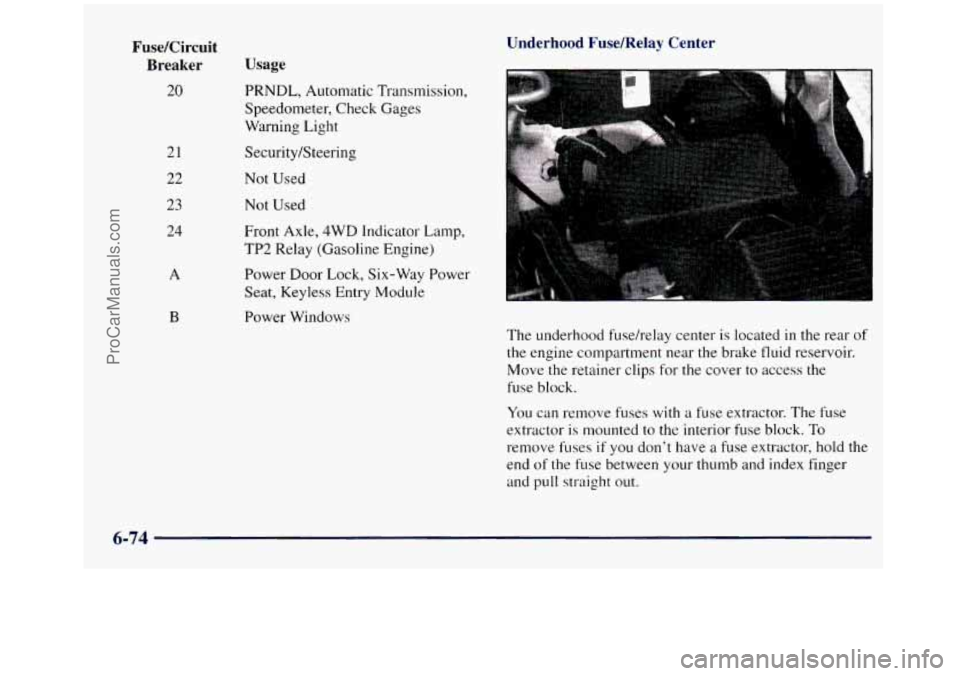
Underhood Fuse/Relay Center
The underhood fusehelay center is located in the rear of
the engine compartment near the brake fluid reservoir.
Move the retainer clips
for the cover to access the
fuse block.
You can remove fuses with a fuse extractor. The fuse
extractor
is mounted to the interior fuse block. TO
remove fuses
if you don’t have a fuse extractor, hold the
end of the fuse between your thumb and index finger
and pull straight out.
6-74
ProCarManuals.com