check engine GMC SIERRA 1998 User Guide
[x] Cancel search | Manufacturer: GMC, Model Year: 1998, Model line: SIERRA, Model: GMC SIERRA 1998Pages: 452, PDF Size: 23.65 MB
Page 184 of 452
Tips About Your Audio System
Hearing damage from loud noise is almost undetectable
until
it is too late. Your hearing can adapt to higher
volumes of sound. Sound that seems normal can be loud
and harmful
to your hearing. Take precautions by
adjusting the volume control on your radio to a safe
sound level before your hearing adapts to
it.
To help avoid hearing loss or damage:
Adjust the volume control to the lowest setting.
0 Increase volume slowly until you hear comfortably
and clearly.
NOTICE: F
Before you add any sound equipment to your
vehicle -- like a tape player, CB radio, mobile
telephone or two-way radio
-- be sure you can
add what you want.
If you can, it’s very
important to do it properly. Added sound equipment may interfere with the operation
of
your vehicle’s engine, Delco Electronics radio or
other systems, and even damage them. Your
vehicle’s systems may interfere with the
operation of sound equipment that has been
added improperly.
So, before adding sound equipment, check with
your dealer and be sure to check Federal rules
covering mobile radio and telephone units.
ProCarManuals.com
Page 195 of 452
If your engine ever stops while you’re driving, brake
normally but don’t pump your brakes.
If you do, the
pedal may get harder to push down. If your engine
stops, you will still have some power brake assist. But
you will use it when you brake. Once the power assist is
used up, it may take longer to stop and the brake pedal
will be harder to push.
Anti-Lock Brakes (ABS)
Your vehicle has anti-lock brakes (ABS). ABS is an
advanced electronic braking system that will help
prevent a braking skid.
When you start your engine and begin
to drive away,
your anti-lock brake system will check itself. You may
hear
a momentary motor or clicking noise while this
test is going on. This is normal.
(@!
ANTI -
If there’s a problem with
the anti-lock brake system,
this warning light will stay
on. See “Anti-Lock Brake
System Warning Light”
in
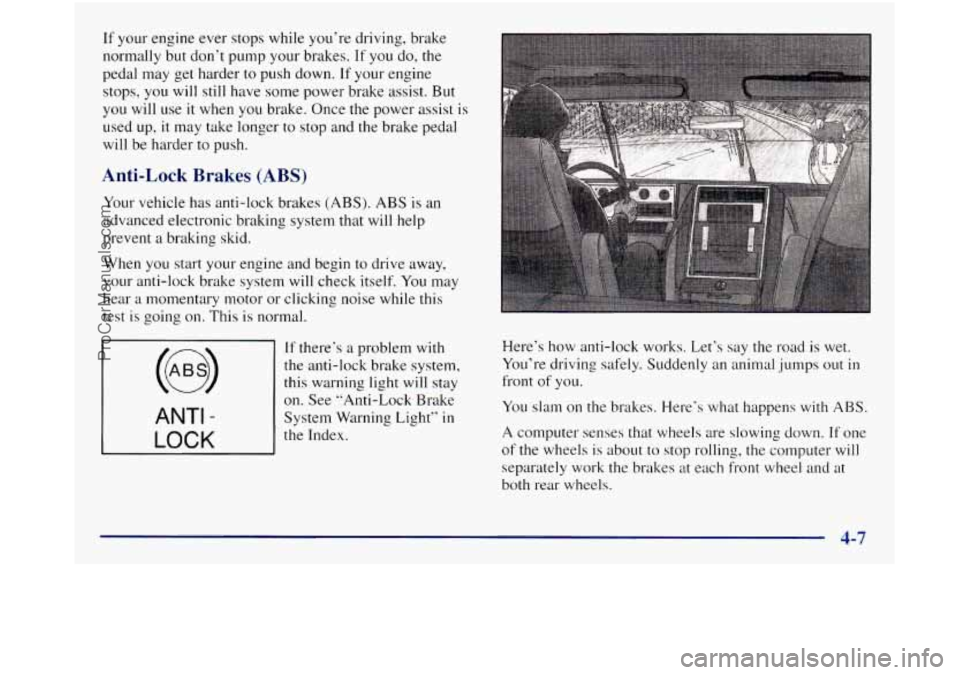
I LOCK I the Index. Here’s how
anti-lock works. Let’s say the road
is wet.
You’re driving safely. Suddenly an animal jumps out
in
front of you.
You slam
on the brakes. Here’s what happens with ABS.
A computer senses that wheels are slowing down. If one
of the wheels is about to stop rolling, the computer will
separately work the brakes at each front wheel and at
both rear wheels.
4-7
ProCarManuals.com
Page 214 of 452
__ ~~~~~ ~ ~~ ~ ~ ~ . _~_
Driving in Water
Light rain causes no special off-road driving problems.
But heavy rain can mean flash flooding, and flood
waters demand extreme caution.
Find out how deep the water is before
you drive through
it. If it’s deep enough to cover your wheel hubs, axles or
exhaust pipe, don’t try it
-- you probably won’t get
through. Also, water that deep can damage your axle
and other vehicle parts.
If the water isn’t too deep, then drive through it slowly. \
At
fast speeds, water splashes on your ignition system and
your vehicle can stall. Stalling can also occur
if you get
your tailpipe under water. And, as long as your tailpipe is
under water, you’ll never
be able to start your engine.
When you
go through water, remember that when your
brakes get wet,
it may take you longer to stop.
.
Driving through rushing water can be dangerous.
Deep water can sweep your vehicle downstream
and you and your passengers could drown. If it’s
only shallow water, it can still wash away the
ground from under your tires, and you could lose
traction and roll the vehicle over. Don’t drive
through rushing water.
See “Driving Through Water’’ in the Index for more
information on driving through water.
After Off-Road Driving
Remove any brush or debris that has collected on the
underbody, chassis or under the hood. These
accumulations can be a fire hazard.
After operation in mud or sand, have the brake linings
cleaned and checked. These substances can cause
glazing and uneven braking. Check the body structure,
4-26
ProCarManuals.com
Page 221 of 452
The exit speed is usually posted.
Reduce your speed according
to your speedometer, not
to your sense of motion. After driving for any distance
at higher speeds,
you may tend to think you are going
slower than you actually are.
Before Leaving on a Long Trip
Make sure you’re ready. Try to oe wed rested. If you
must start when you’re not fresh
-- such as after a day’s
work
-- don’t plan to make too many miles that first part
of the journey. Wear comfortable clothing and shoes you
can easily drive in.
Is your vehicle ready for a long trip? If you keep it
serviced and maintained, it’s ready to
go. If it needs
service, have
it done before starting out. Of course,
you’ll find experienced and able service experts in
GM
dealerships all across North America. They’ll be ready
and willing
to help if you need it.
Here are some things you can check before a trip:
0 Windshield Washer Fluid: Is the reservoir full? Are
all windows clean inside and outside?
Wiper Blades: Are they in good shape?
0
0
0
0
0
Fuel, Engine Oil, Other Fluids: Have you checked
all levels?
Lamps: Are they all working? Are the lenses clean?
Tires: They are vitally important to a safe,
trouble-free trip.
Is the tread good enough for
long-distance driving? Are the tires all inflated to the
recommended pressure?
Weather Forecasts: What’s the weather outlook
along your route? Should you delay your trip
a short
time
to avoid a major storm system?
Maps: Do you have up-to-date maps?
Highway Hypnosis
Is there actually such a condition as “highway hypnosis”?
Or is
it just plain falling asleep at the wheel? Call it
highway hypnosis, lack of awareness, or whatever.
There
is something about an easy stretch of road with the
same scenery, along with the hum of the tires on the road,
the drone of
the engine, and the rush of the wind against
the vehicle that can make you sleepy. Don’t let it happen to you! If it does, your vehicle can leave
the road in less
than n second, and you could crash and be injured.
4-33
ProCarManuals.com
Page 223 of 452
0
0
Keep your vehicle in good shape. Check all fluid
levels and also the brakes, tires, cooling system and
transmission. These parts can work hard on
mountain roads.
Know how to go down hills. The most important
thing to know
is this: let your engine do some of the
slowing down. Shift to
a lower gear when you go
down a steep or long hill.
I A CAJTION: I
If you don’t shift down, your brakes could get so
hot that they wouldn’t work well. You would then
have poor braking or even none going down
a hill.
You could crash. Shift down to let your engine
assist your brakes on a steep downhill slope. Coasung
aownhill in NEUTRAL
(N) or with the
ignition
off is dangerous. Your brakes will have
to do all the work
of slowing down. They could
get
so hot that they wouldn’t work well. You
would then have poor braking or even none going
down
a hill. You could crash. Always have your
engine running and your vehicle in gear when
you go downhill.
0
0
Know how ro g6 uphill. You may want to shift down
to a lower gear.
The lower gears help cool your engine
and transmission, and you can climb the hill better.
Stay in your own lane when driving on two-lane
roads in hills or mountains. Don’t swing wide or cut
across the center
of the road. Drive at speeds that let
you stay in your own lane.
0
0 As you go over the top of a hill, be alert. There could be
something in your lane, like a stalled car
or an accident.
You may see highway signs
on mountains that warn of
special problems. Examples are long grades, passing or
no-passing zones, a falling rocks area or winding
roads. Be alert
to these and take appropriate action.
4-35
ProCarManuals.com
Page 228 of 452
Snow can trap exhaust gases under your vehicle.
This can cause deadly CO (carbon monoxide) gas
to get inside.
CO could overcome you and kill
you.
You can’t see it or smell it, so you might not
know it is
in your vehicle. Clear away snow from
around the base
of your vehicle, especially any
that is blocking your exhaust pipe. And check
around again from time to time to be sure snow
doesn’t collect there.
Open
a window just a little on the side of the
vehicle
that’s away from the wind. This will help
keep
CO out.
Run your engine only as long as you must. This saves
fuel. When you run
the engine, make it go a little faster
than just idle. That is, push the accelerator slightly. This
uses less fuel for the heat that you get and it keeps
the
battery (or batteries) charged. You will need a
well-charged battery
(or batteries) to restart the vehicle,
and possibly for signaling later on with your headlamps.
Let the heater run for a while.
If you have a diesel engine, you may have to run it at a
higher speed to get enough heat. Then, shut the engine
off and close the window almost all the way to preserve
the heat. Start the engine again and repeat this only
when you feel really uncomfortable from the cold. But
do it
as little as possible. Preserve the fuel as long as you
can.
To help keep warm, you can get out of the vehicle
and do some fairly vigorous exercises every half hour or
so until help comes.
4-40
ProCarManuals.com
Page 247 of 452
5. If you have a four-wheel-drive vehicle,
be sure the transfer case is in
a drive gear and not
in
NEUTRAL (N).
6. Release the regular brakes.
-
/r CAUTIOIA:
It can be dangerous to get out of your vehicle if
the shift lever is not fully in
PARK (P) with the
parking brake firmly set. Your vehicle can roll.
If you have left the engine running, the vehicle
can move suddenly. You or others could be
injured.
To be sure your vehicle won’t move, even
when you’re on fairly level ground, use the steps
that follow.
If you have four-wheel drive and your transfer
case is in
NEUTRAL (N), your vehicle will be free
to
roll, even if your shift lever is in PARK (P). So,
be sure the transfer case is in a drive gear -- not
in
NEUTRAL (N).
When You Are Ready to Leave After
Parking
on a Hill
1. Apply your regular brakes and hold the pedal down
while you:
Start your engine;
Shift into a gear; and
Release the parking brake.
2. Let up on the brake pedal.
3. Drive slowly
until the trailer is clear of the chocks.
4. Stop and have someone pick up and store the chocks.
Maintenance When Trailer Towing
Your vehicle will need service more often when you’re
pulling
a trailer. See the Maintenance Schedule for more
on this. Things that are especially important
in trailer
operation are automatic transmission fluid (don’t
overfill), engine
oil, axle lubricant, belt, cooling system
and brake adjustment. Each of these is covered in this
manual, and the Index will help you find them quickly.
If you’re trailering, it’s a good idea to review these
sections before
you start your trip.
Check periodically
to see that all hitch nuts and bolts
are tight.
ProCarManuals.com
Page 257 of 452
I
Using a match near a battery can cause battery
gas to explode. People have been hurt doing this,
and some have been blinded. Use a flashlight
if
you need more light.
Be sure the batteries have enough water. You
don’t need to add water to the ACDelco
Freedom@ battery (or batteries) installed in
every new
GM vehicle. But if a battery has filler
caps, be sure the right amount of fluid is there.
If
it is low, add water to take care of that first. If
you don’t, explosive gas could be present.
Battery fluid contains acid that can burn you.
Don’t get it on you.
If you accidentally get it in
your eyes or on your skin, flush the place with
water and get medical help immediately.
5. Check that the jumper cables don’t have loose or
missing insulation.
If they do, you could get a shock.
The vehicles could be damaged too.
Before you connect the cables, here are some
basic things
you should know. Positive (+) will
go to positive
(+) and negative (-) will go to a
metal engine part. Don’t connect positive
(+) to
negative
(-) or you’ll get a short that would
damage the battery and maybe other parts
too.
On vehicles equipped with dual batteries, make any
battery connections
to the primary battery located on
the passenger’s side of the vehicle.
Fans or other moving engine parts can injure you
badly. Keep your hands
away from moving parts
once the engine is running.
5-5
ProCarManuals.com
Page 291 of 452
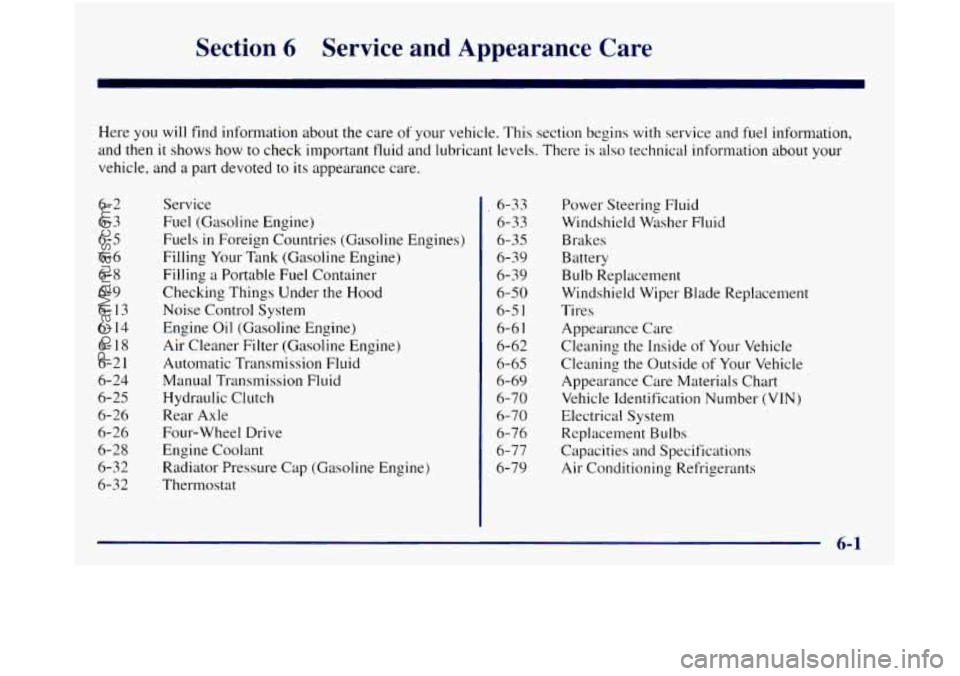
Section 6 Service and Appearance Care
Here you will find information about the care of your vehicle. This section begins with service and fuel information,
and then it shows how to check important fluid and lubricant levels. There is also technical information about your
vehicle, and
a part devoted to its appearance care.
6-2
6-3
6-5
6-6
6- 8
6-9
6- 13
6- 14
6-18
6-2
I
6-24
6- 25
6-26
6-26
6-28 6-32
6-32 Service
Fuel (Gasoline Engine)
Fuels
in Foreign Countries (Gasoline Engines)
Filling Your Tank (Gasoline Engine)
Filling a Portable Fuel Container
Checking Things Under the Hood
Noise Control System
Engine Oil (Gasoline Engine)
Air Cleaner Filter (Gasoline Engine)
Automatic Transmission Fluid
Manual Transmission Fluid
Hydraulic Clutch
Rear Axle
Four-wheel Drive
Engine Coolant Radiator Pressure Cap (Gasoline Engine)
Thermostat
, 6-33
6-3 3
6-35
6-39
6-39
6-50
6-5
1
6-6 1
6-62
6-65 6-69
6-70
6-70
' 6-76
6-77 6-79 Power
Steering Fluid
Windshield Washer Fluid
Brakes
Battery
Bulb Replacement
Windshield Wiper Blade Replacement
Tires
Appearance Care
Cleaning the Inside
of Your Vehicle
Cleaning the Outside of Your Vehicle
Appearance Care Materials Chart
Vehicle Identification Number (VIN)
Electrical System Replacement
Bulbs
Capacities and Specifications
Air Conditioning Refrigerants
6-1
ProCarManuals.com
Page 293 of 452
-
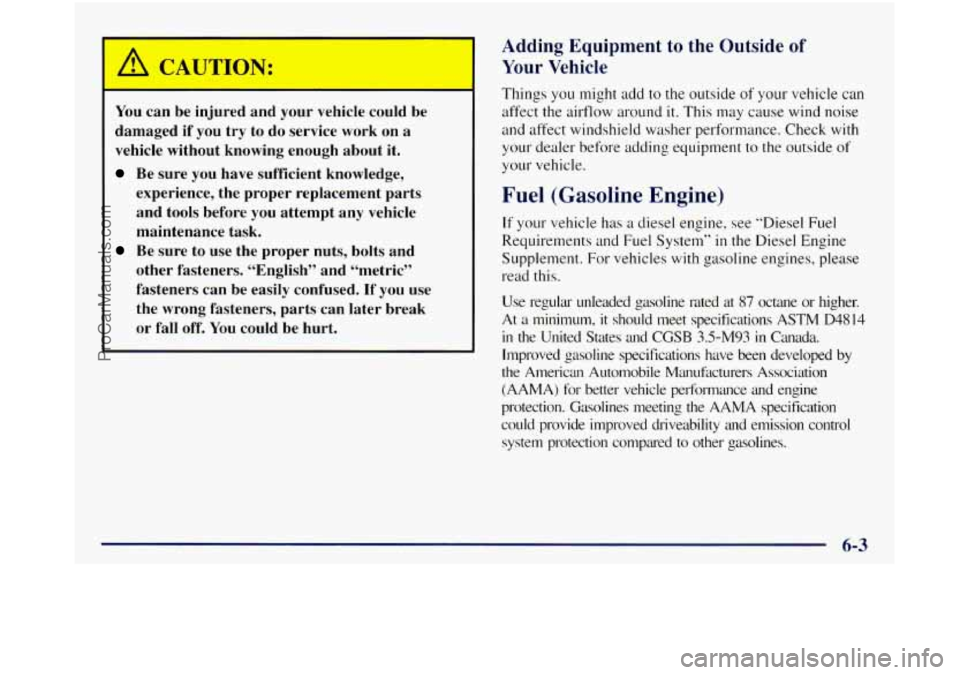
/! CAUTION:
You can be injured and your vehicle could be
damaged
if you try to do service work on a
vehicle without knowing enough about it.
Be sure you have sufficient knowledge,
experience, the proper replacement parts and tools before you attempt
any vehicle
maintenance task.
Be sure to use the proper nuts, bolts and
other fasteners. “English” and “metric”
fasteners can be easily confused. If you use
the wrong fasteners, parts can later break
or fall off.
You could be hurt.
Adding Equipment to the Outside of
Your Vehicle
Things you might add to the outside of your vehicle can
affect the airflow around
it. This may cause wind noise
and affect windshield washer performance. Check
with
your dealer before adding equipment to the outside of
your vehicle.
Fuel (Gasoline Engine)
If your vehicle has a diesel engine, see “Diesel Fuel
Requirements and Fuel System”
in the Diesel Engine
Supplement. For vehicles with gasoline engines, please.
read this.
Use regular unleaded gasoline rated at
87 octane or higher.
At
a minimum, it should meet specifications ASTM D48 14
in the United States and CGSB 3.5-M93 in Canada.
Improved gasoline specifications have been developed
by
the American Automobile Manufxturers Association
(AAMA) for better vehicle performance and engine
protection. Gasolines meeting the
AAMA specification
could provide improved chiveability and emission control
system protection compared to other gasolines.
6-3
ProCarManuals.com