engine overheat GMC SIERRA 1998 User Guide
[x] Cancel search | Manufacturer: GMC, Model Year: 1998, Model line: SIERRA, Model: GMC SIERRA 1998Pages: 452, PDF Size: 23.65 MB
Page 269 of 452
If there seems to be no leak, start the engine again. See if
the engine cooling
fan speed increases when idle speed is
doubled
by pushing the accelerator pedal down. If it
doesn't, your vehicle needs service. Turn off the engine.
How to Add Coolant to the Coolant
Recovery Tank -- Gasoline Engines
If you haven't found a problem yet, but the coolant level
isn't at or above the COLD mark, add
a 50/50 mixture
of C'IC~LIII r.tuter- (preferably distilled) and DEX-COOL@
engine coolant at the coolant recovery tank. (See
"Engine Coolant"
in the Index for more information.)
I A CAUTION: I
I CAUTION: (Continued)
Adding only plain water to your cooling system
can be dangerous. Plain water, or some other
liquid like alcohol, can boil before the proper
coolant mix will. Your vehicle's coolant warning
system
is set for the proper coolant mix.
CAUTION: (Continued) With plain water or the wrong mix,
your engine
could get
too hot but you wouldn't get the
overheat warning. Your engine could catch
fire
and you or others could be burned. Use a 50/50
mix of clean water and DEX-COOL%oolant.
I NOTICE:
In cold weather, water can freeze and crack the
engine, radiator, heater core and other parts. Use the recommended coolant and the proper
coolant mixture.
5-17
ProCarManuals.com
Page 270 of 452
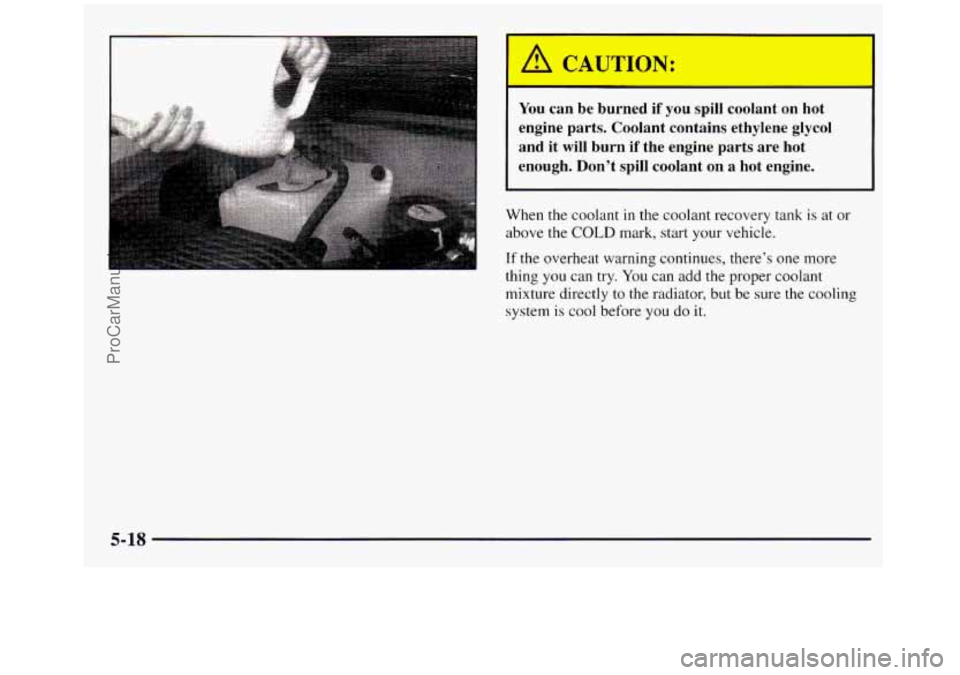
You can be burned if you spill coolant on hot
engine parts. Coolant contains ethylene glycol
and it
will burn if the engine parts are hot
enough. Don’t spill coolant on a hot engine.
When the coolant in the coolant recovery tank is at or
above the
COLD mark, start your vehicle.
If the overheat warning continues, there’s one more
thing
you can try. You can add the proper coolant
mixture directly to
the radiator, but be sure the cooling
system is cool before you do it.
5-18
ProCarManuals.com
Page 288 of 452
J
E
I
F
C
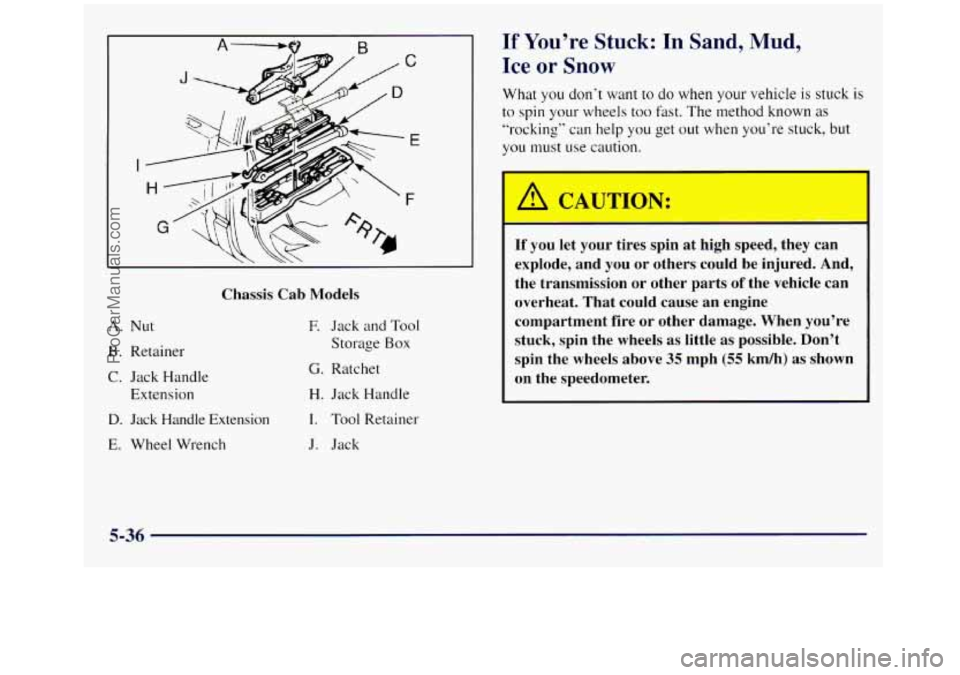
Chassis Cab Models
A. Nut
B. Retainer
C. Jack Handle Extension
D. Jack Handle Extension
E. Wheel Wrench
E Jack and Tool
Storage Box
G. Ratchet
H. Jack Handle
I. Tool Retainer
J. Jack
If You’re Stuck: In Sand, Mud,
Ice or Snow
What you don’t want to do when your vehicle is stuck is
to spin your wheels too fast. The method known as
“rocking” can help
you get out when you’re stuck, but
you must use caution.
A CAUTION:
If you let your tires spin at high speed, they can
explode, and you or others could be injured. And,
the transmission or other parts
of the vehicle can
overheat. That could cause an engine
compartment fire or other damage. When you’re
stuck, spin the wheels as little as possible. Don’t
spin the wheels above
35 mph (55 km/h) as shown
on the speedometer.
5-36
ProCarManuals.com
Page 318 of 452
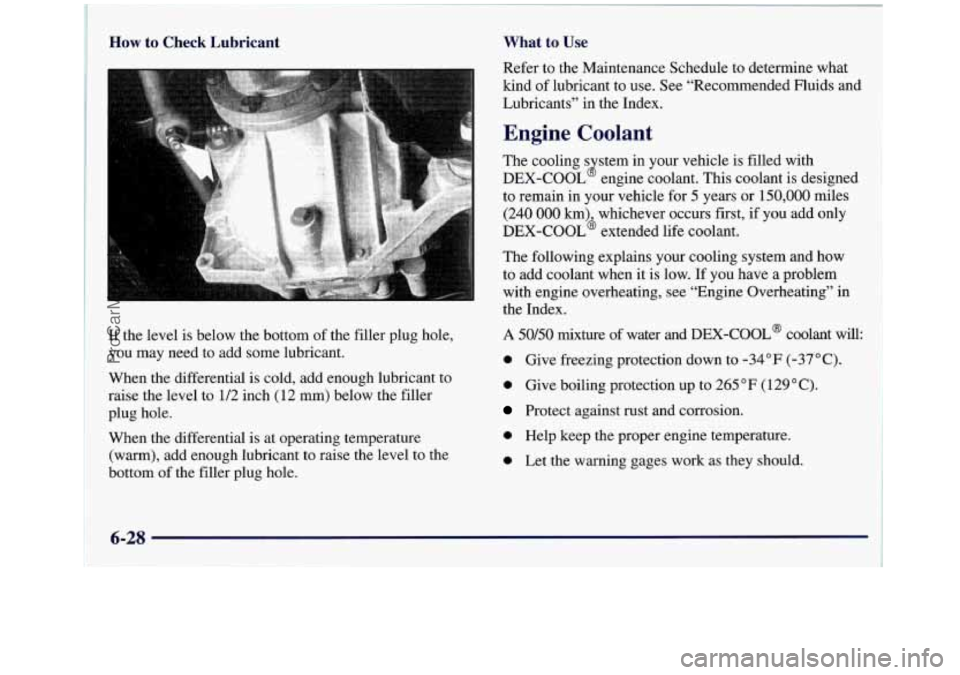
How to Check Lubricant
If the level is below the bottom of the filler plug hole,
you may need to add some lubricant.
When the differential is cold, add enough lubricant to
raise the level to 1/2 inch (12
mrn) below the filler
plug hole.
When the differential is at operating temperature
(warm), add enough lubricant to raise the level to the
bottom
of the filler plug hole.
What to Use
Refer to the Maintenance Schedule to determine what
kind of lubricant to use. See “Recommended Fluids and
Lubricants” in the Index.
Engine Coolant
The cooling s stem in your vehicle is filled with
DEX-COOL engine coolant. This coolant is designed
~
to remain in your vehicle for 5 years or 150,000 miles I
(240 000 km) whichever occurs first, if you add only ~
DEX-COOL’ extended life coolant.
8
The following explains your cooling system and how
to add coolant when it is low. If you have a problem
i
with engine overheating, see “Engine Overheating” in 1
the Index.
A 50/50 mixture of water and DEX-COOL@ coolant will: 1
0 Give freezing protection down to -34°F (-37°C).
0 Give boiling protection up to 265 OF (1 29 O C).
Protect against rust and corrosion.
0 Help keep the proper engine temperature.
0 Let the warning gages work as they should.
6-28 ;L
ProCarManuals.com
Page 319 of 452
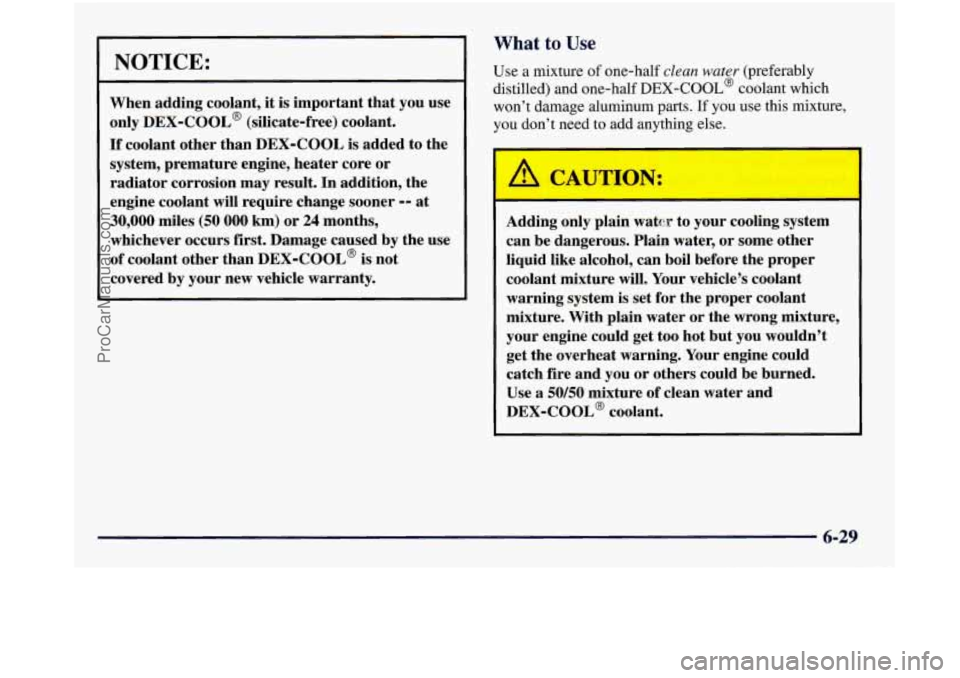
NOTICE:
When adding coolant, it is important that you use
only
DEX-COOL@ (silicate-free) coolant.
If coolant other than DEX-COOL is added to the
system, premature engine, heater core or
radiator corrosion may result. In addition, the
engine coolant will require change sooner
-- at
30,000 miles (50 000 km) or 24 months,
whichever occurs first. Damage caused by the use
of coolant other than DEX-COOL@ is not
covered by your new vehicle warranty.
What to Use
Use a mixture of one-half clean water (preferably
distilled) and one-half
DEX-COOL@ coolant which
won’t damage aluminum
parts. If you use this mixture,
you don’t need to add anything else.
CAUTION:
Adding only plain water to your cooling system
can be dangerous. Plain water, or some other
liquid like alcohol, can boil before the proper
coolant mixture will. Your vehicle’s coolant
warning system is set for the proper coolant
mixture. With plain water or the wrong mixture,
your engine could get too hot but you wouldn’t
get the overheat warning. Your engine could
catch fire and you or others could be burned.
Use a
50/50 mixture of clean water and
DEX-COOL@ coolant.
6-29
ProCarManuals.com
Page 320 of 452
- ~ ~~
NOTICE:
If you use an improper coolant mixture, your
engine could overheat and be badly damaged.
The repair cost wouldn’t be covered by your
warranty.
Too much water in the mixture can
freeze and crack the engine, radiator, heater core
and other parts.
If you have to add coolant more than four times a year,
have your dealer check your cooling system.
NOTICE:
If you use the proper coolant, you don’t have to
add extra inhibitors or additives which claim
to
improve the system. These can be harmful.
Checking Coolant
If your vehicle has a diesel engine, see “Checking
Coolant”
in the Diesel Engine Supplement.
,:. . .,. ..... I.. .;> .:... ...,,.. ::l:. ..
.. .
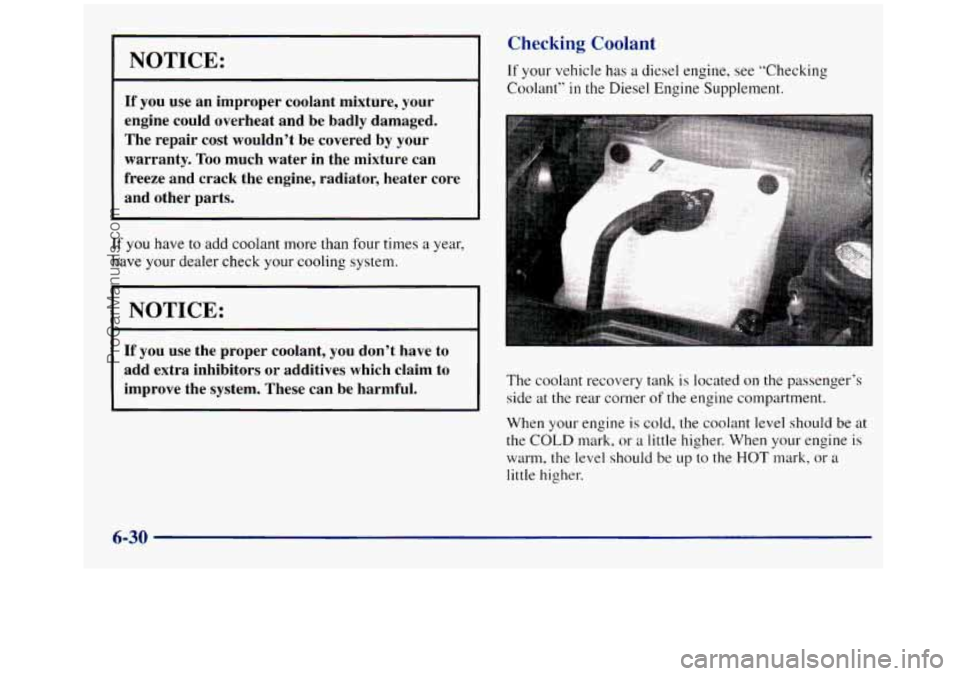
The coolant recovery tank is located on the passenger’s
side at the rear corner
of the engine compartment.
When your engine
is cold, the coolant level should be at
the
COLD mark, or a little higher. When your engine is
warm,
the level should be up to the HOT mark, or a
little higher.
6-30
ProCarManuals.com
Page 322 of 452
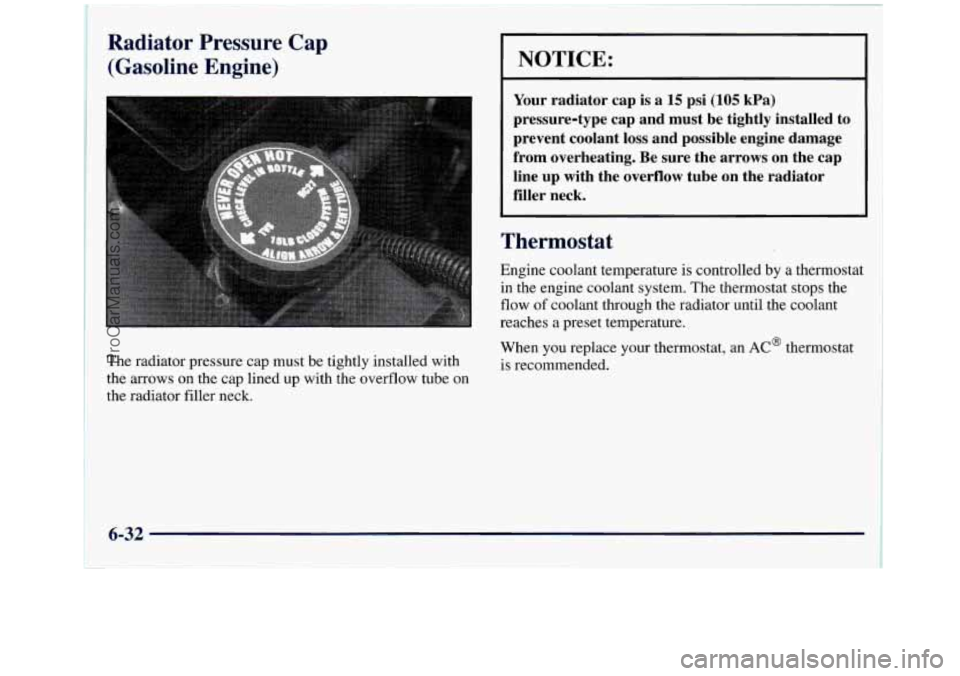
Radiator Pressure Cap
(Gasoline Engine)
The radiator pressure cap must be tightly installed with
the arrows
on the cap lined up with the overflow tube on
the radiator filler neck.
~~~ ~
NOTICE:
Your radiator cap is a 15 psi (105 kPa)
pressure-type cap and must be tightly installed to
prevent coolant loss and possible engine damage
from overheating. Be sure the arrows on the cap
line up with the overflow tube on the radiator
filler neck.
Thermostat
Engine coolant temperature is controlled by a thermostat
in the engine coolant system. The thermostat stops the
flow of coolant through the radiator until the coolant
reaches a preset temperature.
When you replace your thermostat, an
AC@ thermostat
is recommended.
6-32
ProCarManuals.com
Page 441 of 452
Manual Transmission Check
...................................... 7-41
Fluid
.................................. 6.24, 7.46
Shifting
................................ 2- 18. 2. I9
Starting Your Engine .......................... 2- 13
Manualwindows
............................... 2-32
Memo Pad Holder
......................... 2.55. 2.57
Methanol
...................................... 6- 5
Mirrors ....................................... 2-45
CamperType
................................ 2-48
Convex Outside
.............................. 2-50
Electrochromic Daymight Rearview
.............. 2-46
Inside Daymight Rearview
..................... 2-45
Manual
..................................... 2-48
Power Remote Control
......................... 2-50
WestCoastType
.............................. 2-50
MMT
......................................... 6-4
Model Reference
................................. vi
MountainRoads ................................ 4-34
New Vehicle Break-In
.......................... 2- 10
Nightvision ................................... 4-27
Noise Control System ........................... 6- 13
Normal Maintenance. Normal Replacement Parts
...... 6-78
Odometer
.................................... 2-63
Odometer. Trip
................................. 2-63
Off-Road Driving
.............................. 4- I4
Off-Road Recovery
............................. 4- I I
Oil. Engine ............................... 6-14. 7-46
Opener. Garage Door
............................ 2-51
Overheating Engine ............................. 5- 13 Owner Checks
and Services
....................... 7-40
Owner Publications. Ordering
................ 8- 1 1. 8- 12
Paint Spotting. Chemical
........................ 6-68
Park. Shifting Into
.............................. 2-26
Park. Shifting Out of
............................ 2-29
Parking
AtNight
..................................... 2-9
Brake
...................................... 2-25
Brake Mechanism Check
....................... 7-43
Over Things That Burn
........................ 2-30
With a Trailer ................................ 4-58
Your Vehicle. Manual Transmission
.............. 2-29
Passenger Position
.............................. 1-23
Lots
........................................ 2-9
Passin;
@ ..................................... 4-11
Passlock
................................ 2- 10, 2-73
Periodic Maintenance Inspections
.................. 7-44
Pickup Box Identification Lamp Bulb Replacement
.... 6-47
Pickup Conversion to Chassis Cab
................. 4-48
Power
Accessory Outlet
............................. 2-59
DoorLocks
................................... 2-6
Driver’sSeat ................................. 1-3
Option Fuses
................................ 6-71
Remote Control Mirror
........................ 2-50
Steering ..................................... 4-8
Steering Fluid ........................... 6-33, 7-46
Take-Off .................................... 4-61
Winches
.................................... 4-61
Windows
................................... 2-32
ProCarManuals.com