tires GMC SIERRA 1998 User Guide
[x] Cancel search | Manufacturer: GMC, Model Year: 1998, Model line: SIERRA, Model: GMC SIERRA 1998Pages: 452, PDF Size: 23.65 MB
Page 217 of 452
Rain and wet roads can mean driving trouble. On a wet
road,
you can’t stop, accelerate or turn as well because
your tire-to-road traction
isn’t as good as on dry roads.
And, if your tires don’t have much tread left, you’ll get
even less traction. It’s always wise to go slower and be
cautious if rain starts to fall while
you are driving. The
surface may get wet suddenly when your reflexes are
tuned for driving on dry pavement.
The heavier the rain, the harder
it is to see. Even if your
windshield wiper blades are in good shape, a heavy rain
can make it harder to see road signs and traffic signals,
pavement markings, the edge of the road and even
people walking.
It’s wise
to keep your wiping equipment in good shape
and keep your windshield washer tank filled with
washer fluid. Replace your windshield wiper inserts
when
they show signs of streaking or missing areas on
the windshield, or when strips of rubber start to separate
from the inserts. Driving too fast
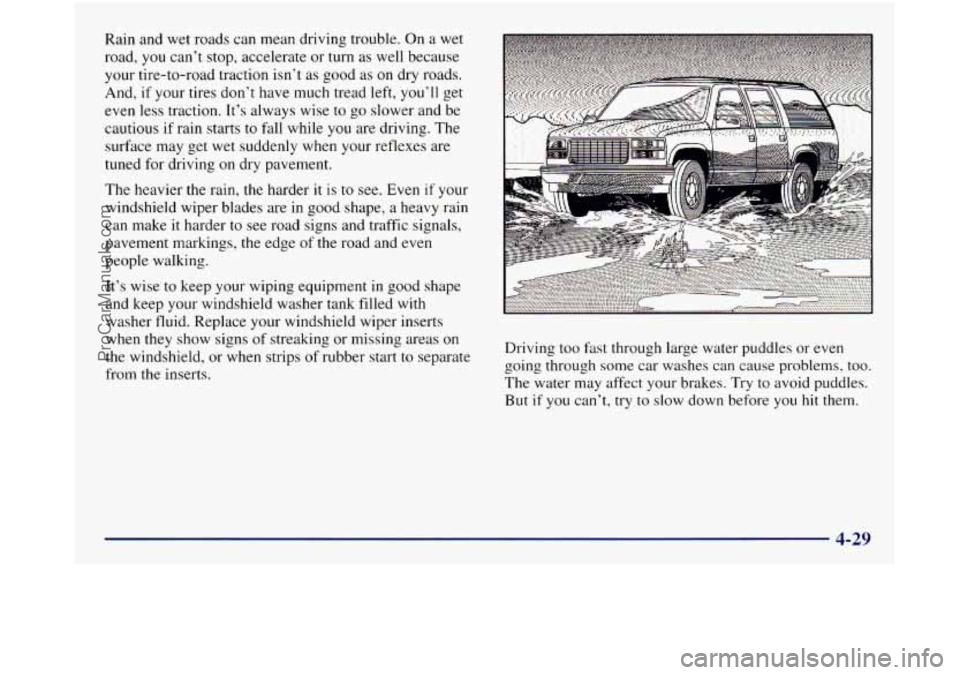
through large water puddles or even
going through some car washes can cause problems, too.
The water may affect your brakes. Try to avoid puddles.
But if you can’t, try to slow down before you hit them.
4-29
ProCarManuals.com
Page 218 of 452
J L
Wet brakes can cause accidents. They won’t work
as well in a quick stop and may cause pulling to
one side. You could lose control
of the vehicle.
After driving through
a large puddle of water or
a car wash, apply your brake pedal lightly until
your brakes work normally.
Hydroplaning
Hydroplaning is dangerous. So much water can build up
under your tires that they can actually ride
on the water.
This can happen if the road
is wet enough and you’re
going
fast enough. When your vehicle is hydroplaning,
it has little or no contact with the road.
Hydroplaning doesn’t happen often. But it can if your
tires do not have much tread or if the pressure in
one or
more
is low. It can happen if a lot of water is standing on
the road. If you can see reflections from trees, telephone
poles or other vehicles, and raindrops “dimple” the
water’s surface, there could be hydroplaning. Hydroplaning usually happens at higher
speeds, There
just
isn’t a hard and fast rule about hydroplaning. The
best advice
is to slow down when it is raining.
Driving Through Deep Standing Water
c
NOTICE:
If you drive too quickly through deep puddles or
standing water, water can come in through your
engine’s air intake and badly damage your
engine. Never drive through water that is slightly
lower than the underbody
of your vehicle. If you
can’t avoid deep puddles or standing water, drive
through them very slowly.
Some Other Rainy Weather Tips
0 Besides slowing down, allow some extra following
distance. And be especially careful when you pass
another vehicle. Allow yourself more clear room
ahead, and be prepared to have your view restricted
by road spray.
0 Have good tires with proper tread depth. (See
“Tires”
in the Index.)
4-30
ProCarManuals.com
Page 221 of 452
The exit speed is usually posted.
Reduce your speed according
to your speedometer, not
to your sense of motion. After driving for any distance
at higher speeds,
you may tend to think you are going
slower than you actually are.
Before Leaving on a Long Trip
Make sure you’re ready. Try to oe wed rested. If you
must start when you’re not fresh
-- such as after a day’s
work
-- don’t plan to make too many miles that first part
of the journey. Wear comfortable clothing and shoes you
can easily drive in.
Is your vehicle ready for a long trip? If you keep it
serviced and maintained, it’s ready to
go. If it needs
service, have
it done before starting out. Of course,
you’ll find experienced and able service experts in
GM
dealerships all across North America. They’ll be ready
and willing
to help if you need it.
Here are some things you can check before a trip:
0 Windshield Washer Fluid: Is the reservoir full? Are
all windows clean inside and outside?
Wiper Blades: Are they in good shape?
0
0
0
0
0
Fuel, Engine Oil, Other Fluids: Have you checked
all levels?
Lamps: Are they all working? Are the lenses clean?
Tires: They are vitally important to a safe,
trouble-free trip.
Is the tread good enough for
long-distance driving? Are the tires all inflated to the
recommended pressure?
Weather Forecasts: What’s the weather outlook
along your route? Should you delay your trip
a short
time
to avoid a major storm system?
Maps: Do you have up-to-date maps?
Highway Hypnosis
Is there actually such a condition as “highway hypnosis”?
Or is
it just plain falling asleep at the wheel? Call it
highway hypnosis, lack of awareness, or whatever.
There
is something about an easy stretch of road with the
same scenery, along with the hum of the tires on the road,
the drone of
the engine, and the rush of the wind against
the vehicle that can make you sleepy. Don’t let it happen to you! If it does, your vehicle can leave
the road in less
than n second, and you could crash and be injured.
4-33
ProCarManuals.com
Page 223 of 452
0
0
Keep your vehicle in good shape. Check all fluid
levels and also the brakes, tires, cooling system and
transmission. These parts can work hard on
mountain roads.
Know how to go down hills. The most important
thing to know
is this: let your engine do some of the
slowing down. Shift to
a lower gear when you go
down a steep or long hill.
I A CAJTION: I
If you don’t shift down, your brakes could get so
hot that they wouldn’t work well. You would then
have poor braking or even none going down
a hill.
You could crash. Shift down to let your engine
assist your brakes on a steep downhill slope. Coasung
aownhill in NEUTRAL
(N) or with the
ignition
off is dangerous. Your brakes will have
to do all the work
of slowing down. They could
get
so hot that they wouldn’t work well. You
would then have poor braking or even none going
down
a hill. You could crash. Always have your
engine running and your vehicle in gear when
you go downhill.
0
0
Know how ro g6 uphill. You may want to shift down
to a lower gear.
The lower gears help cool your engine
and transmission, and you can climb the hill better.
Stay in your own lane when driving on two-lane
roads in hills or mountains. Don’t swing wide or cut
across the center
of the road. Drive at speeds that let
you stay in your own lane.
0
0 As you go over the top of a hill, be alert. There could be
something in your lane, like a stalled car
or an accident.
You may see highway signs
on mountains that warn of
special problems. Examples are long grades, passing or
no-passing zones, a falling rocks area or winding
roads. Be alert
to these and take appropriate action.
4-35
ProCarManuals.com
Page 225 of 452
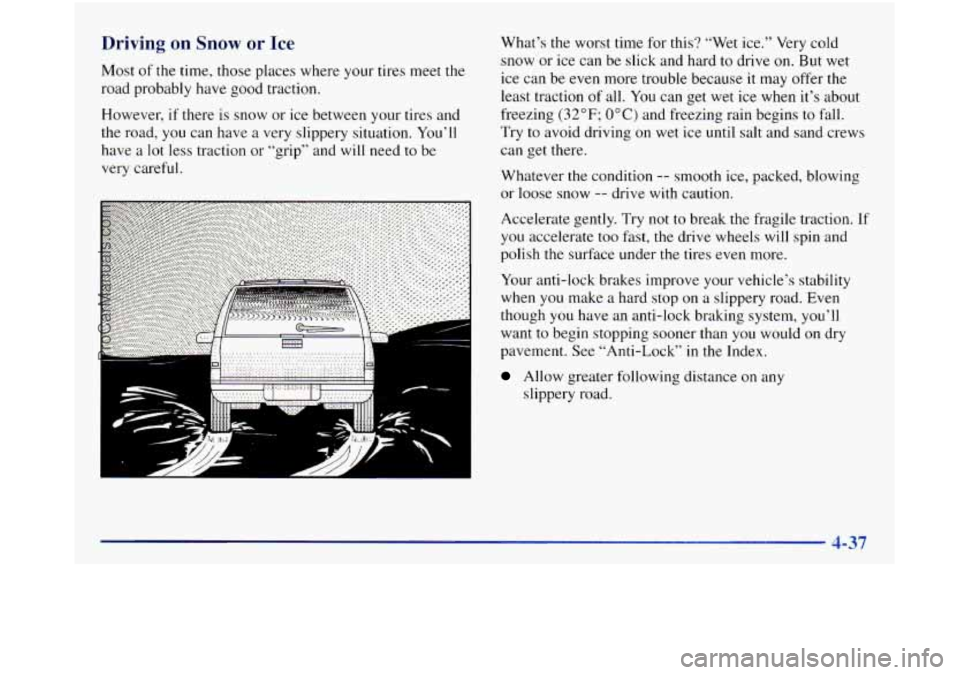
Driving on Snow or Ice
Most of the time, those places where your tires meet the
road probably have good traction.
However, if there is snow or ice between your tires and
the road,
you can have a very slippery situation. You’ll
have a
lot less traction or “grip” and will need to be
very careful. What’s the worst time
for this? “Wet ice.” Very cold
snow or ice can be slick and hard to drive
on. But wet
ice can be even more trouble because it may offer the
least traction of all. You
can get wet ice when it’s about
freezing
(32°F; 0°C) and freezing rain begins to fall.
Try to avoid driving
on wet ice until salt and sand crews
can get there.
Whatever
the condition -- smooth ice, packed, blowing
or loose snow
-- drive with caution.
Accelerate gently. Try not to break the fragile traction. If
you accelerate too fast, the drive wheels will spin and
polish the surface under the tires even more.
Your anti-lock brakes improve your vehicle’s stability
when
you make a hard stop on a slippery road. Even
though you have
an anti-lock braking system, you’ll
want to begin stopping sooner than you would on dry
pavement. See “Anti-Lock‘’ in the Index.
Allow greater following distance on any
slippery road.
4-37
ProCarManuals.com
Page 230 of 452
Four-Wheel-Drive Vehicles
(Manual Transfer Case Only)
‘A
-
Shifting the transfer case into NEUTRAL (N) can
cause your vehicle to roll even if the transmission
is in
PARK (P), for an automatic transmission, or
if your vehicle is in gear, for
a manual
transmission.
You or others could be injured.
Make sure the parking brake is firmly set before
you shift the transfer case into NEUTRAL (N).
Use the following procedure to correctly tow your
vehicle on all four wheels:
1.
2.
3.
4.
5.
6.
Firmly set the parking brake.
Place the transmission in
PARK (P) or a manual
transmission in FIRST
(1).
Securely attach the vehicle being towed to the
tow vehicle.
With the engine running, shift the transfer case to
NEUTRAL
(N). See “Four-wheel Drive” in the
Index for the proper procedure to select the neutral
position for your vehicle.
Release the parking brake only after the vehicle
being towed is firmly attached to the towing vehicle.
Turn the ignition to
OFF, The OFF position unlocks the
steering column and reduces battery
drain. Unlocking
the steering column will allow the proper movement
of
the front wheels and tires during towing.
4-42
ProCarManuals.com
Page 231 of 452
Loading Your Vehicle
~EE ~NER'S MANUAL FOR ADDITIONAL INFORMATION. TI
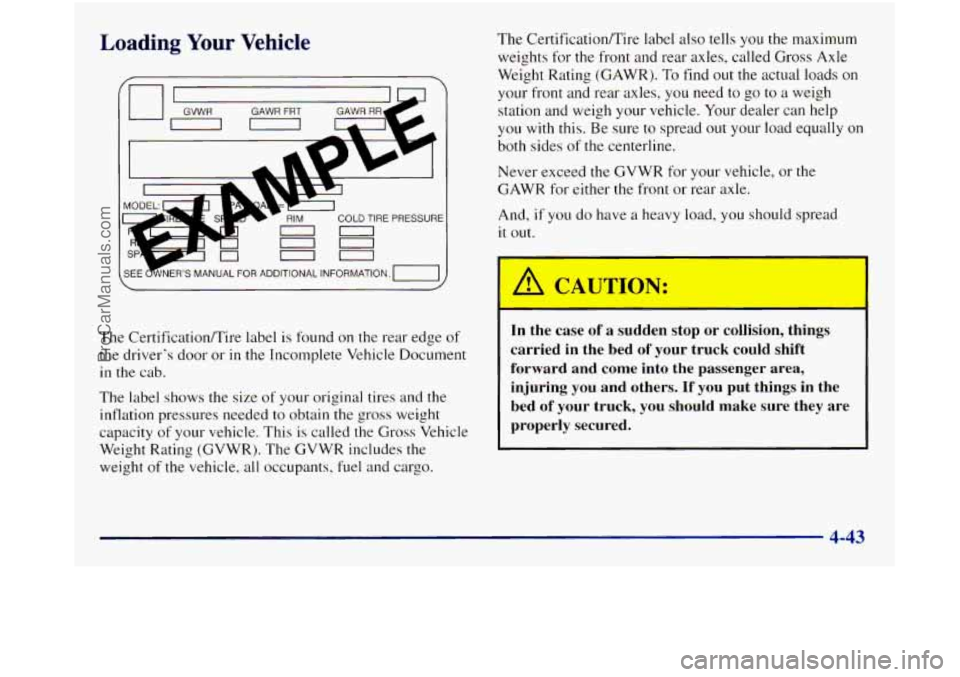
The CertificatiodTire label is found on the rear edge of
the driver's door or in the Incomplete Vehicle Document
in the cab.
The label shows the size of your original tires and the
inflation pressures needed to obtain the gross weight
capacity
of your vehicle. This is called the Gross Vehicle
Weight Rating (GVWR). The GVWR includes the
weight
of the vehicle, all occupants, fuel and cargo.
The CertificatiodTire label also tells you the maximum
weights for the front and rear axles, called Gross Axle
Weight Rating (GAWR).
To find out the actual loads on
your front and rear axles, you need to
go to a weigh
station and weigh your vehicle. Your dealer can help
you with this. Be sure to spread out your load equally on
both sides
of the centerline.
Never exceed the GVWR
for your vehicle, or the
GAWR for either the front or rear axle.
And,
if you do have a heavy load, you should spread
it out.
A CAUTION:
In the case of a sudden stop or collision, things
carried in the bed of your truck could shift
forward and come into the passenger area,
injuring
you and others. If you put things in the
bed of your truck, you should make sure they are
properly secured.
4-43
ProCarManuals.com
Page 238 of 452
If You Do Decide To Pull A Trailer
If you do, here are some important points:
0
0
0
0
There are many different laws, including speed limit
restrictions, having to
do with trailering. Make sure
your rig will be legal, not only where you live but
also where you’ll be driving.
A good source for this
information
can be state or provincial police.
Consider using
a sway control if your trailer will
weigh less than
the capacity stamped on your step
bumper. You should always use a sway control
if
your trailer will weigh more than the capacity
stamped
on your step bumper. You can ask a hitch
dealer about sway controls.
Don’t tow a trailer at all during the first
500 miles
(800 km) your new vehicle is driven. Your engine,
axle or other parts could be damaged.
Then, during the first
500 miles (800 km) that you
tow
a trailer, don’t drive over 50 mph (80 kdh) and
don’t make starts at
full throttle. This helps your
engine and other parts
of your vehicle wear in at the
heavier loads.
0 If you have an automatic transmission, you can tow
in OVERDRIVE
(a). You may want to shift the
transmission to
THIRD (3) or, if necessary, a lower
gear selection if the transmission shifts too often
(e.g., under heavy loads and/or
hilly conditions). If
you have
a manual transmission and you are towing
a trailer, it’s better not to use
FIFTH (5) gear. Just
drive
in FOURTH (4) gear (or, as you need to, a
lower gear).
Three important considerations have
to do with weight:
0 the weight of the trailer,
0 the weight of the trailer tongue
0 and the weight on your vehicle’s tires.
Weigl- - 3e Trailer
How heavy can a trailer safely be?
It depends
on how you plan to use your rig. For
example, speed, altitude, road grades, outside
temperature and how much your vehicle is used to
pull a
trailer are all important. And,
it can also depend on any
special equipment that you have
on your vehicle.
4-50
ProCarManuals.com
Page 243 of 452
A B
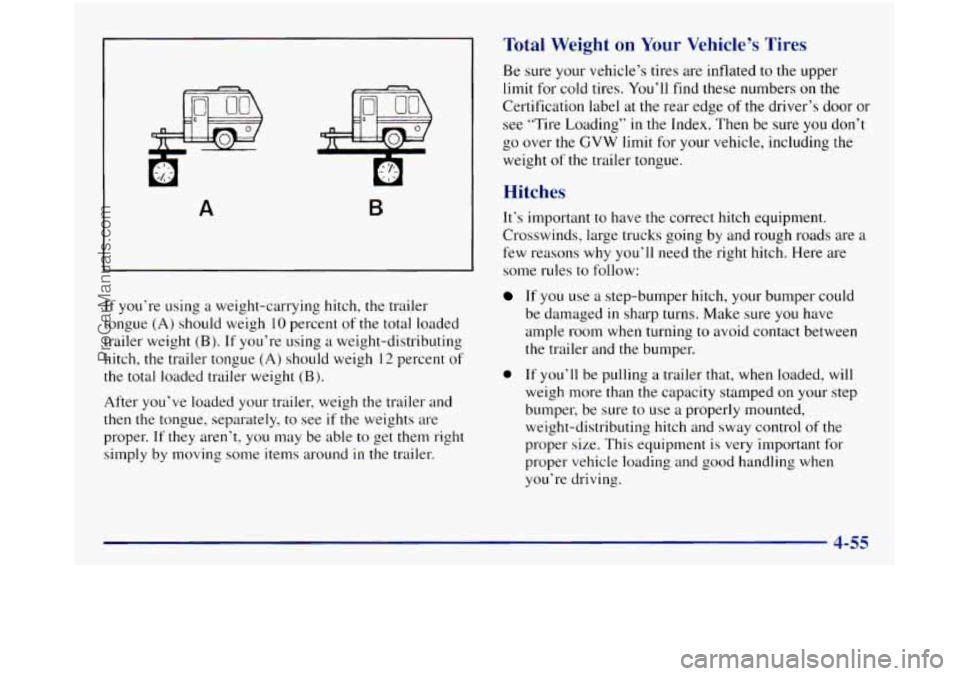
If you’re using a weight-carrying hitch, the trailer
tongue (A) should weigh
10 percent of the total loaded
trailer weight
(B j. If you’re using a weight-distributing
hitch, the trailer tongue
(A) should weigh 12 percent of
the total loaded trailer weight (B).
After you’ve loaded your trailer, weigh the trailer and
then the tongue, separately, to see
if the weights are
proper.
If they aren’t, you may be able to get them right
simply by moving some items around
in the trailer.
Total Weight on Your Vehicle’s Tires
Be sure your vehicle’s tires are inflated to the upper
limit for cold tires.
You’ll find these numbers on the
Certification label at the rear edge
of the driver’s door or
see ”Tire Loading” in the Index. Then be sure you don’t
go over the
GVW limit for your vehicle, including the
weight of the trailer tongue.
Hitches
It’s important to have the correct hitch equipment.
Crosswinds, large trucks going by and rough roads are a
few reasons
why you’ll need the right hitch. Here are
some rules to follow:
If you use a step-bumper hitch, your bumper could
be damaged
in sharp turns. Make sure you have
ample room when turning to avoid contact between
the trailer and the bumper.
0 If you’ll be pulling a trailer that, when loaded, will
weigh more than
the capacity stamped on your step
bumper, be sure
to use a properly mounted,
weight-distributing hitch and sway control
of the
proper size. This equipment
is very important for
proper vehicle loading and good handling when
you’re driving.
ProCarManuals.com
Page 244 of 452
Safety Chains
You should always attach chains between your vehicle
and your trailer. Cross the safety chains under the tongue
of the trailer so that’the tongue will not drop to the road
if it becomes separated from the hitch. Instructions
about safety chains may be provided by the hitch
manufacturer or by the trailer manufacturer. Follow the
manufacturer’s recommendation for attaching safety
chains and do not attach them to the bumper. Always
leave just enough slack
so you can turn with your rig.
And, never allow safety chains
to drag on the ground.
Trailer Brakes
If your trailer weighs more than 1,000 Ibs. (450 kg)
loaded, then it needs its own brakes
-- and they must be
adequate. Be sure to read and follow the instructions for
the trailer brakes so you’ll be able to install, adjust and
maintain them properly.
Your trailer brake system can tap into the vehicle’s
hydraulic brake system only if
0 The trailer parts can withstand 3,000 psi
(20 650 kPa) of pressure.
0 The trailer’s brake system will use less than
0.02 cubic inch (0.3 cc) of fluid from your vehicle’s
master cylinder. Otherwise, both braking systems
won’t work well. You could even lose your brakes.
If everything checks out this far, make the brake tap at
the port
on the master cylinder that sends the fluid to the
rear brakes.
But don’t use copper tubing for this. If you
do,
it will bend and finally break off. Use steel
brake tubing.
Driving with a Trailer
Towing a trailer requires a certain amount of experience.
Before setting out for the open road, you’ll want to get
to
know your rig. Acquaint yourself with the feel of
handling and braking with the added weight of
the
trailer. And always keep in mind that the vehicle you are
driving is now a good deal longer and not nearly as
responsive as your vehicle
is by itself.
Before you start, check
the trailer hitch and platform
(and attachments), safety chains, electrical connector,
lamps, tires and mirror adjustment.
If the trailer has
electric brakes, start your vehicle and trailer moving and
then apply
the trailer brake controller by hand to be sure
the brakes are working. This lets you check your
electrical connection at the same time.
4-56
ProCarManuals.com