brake GMC SIERRA 1998 Owner's Manual
[x] Cancel search | Manufacturer: GMC, Model Year: 1998, Model line: SIERRA, Model: GMC SIERRA 1998Pages: 452, PDF Size: 23.65 MB
Page 125 of 452
Ending Cruise Control
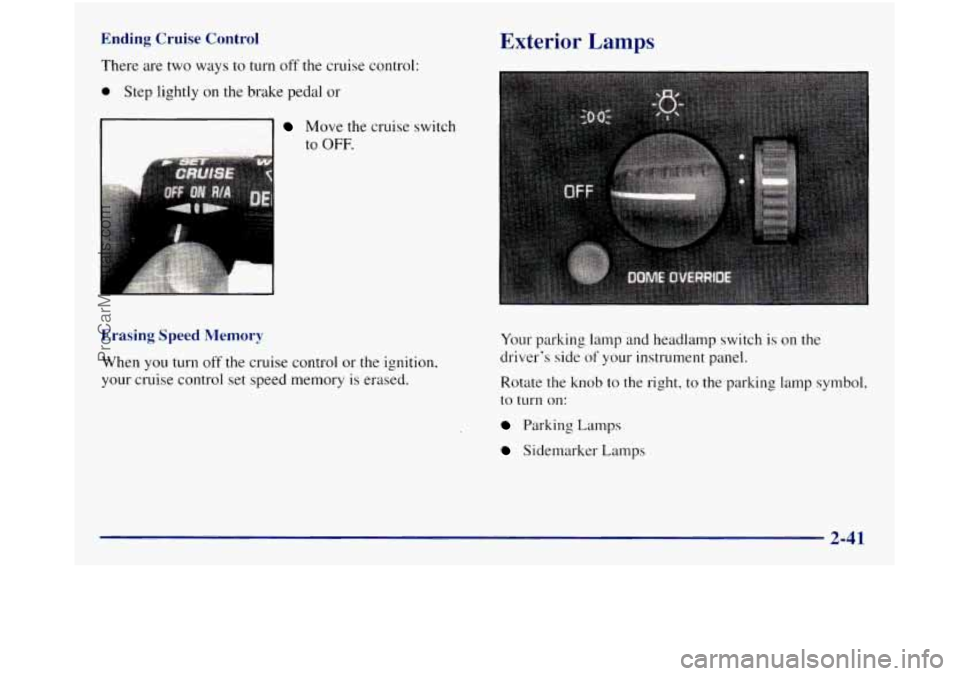
There are two ways to turn off the cruise control:
0 Step lightly on the brake pedal or
Move the cruise switch
to
OFF.
Erasing Speed Memory
When you turn off the cruise control or the ignition,
your cruise control set speed memory is erased.
Exterior Lamps
Your parking lamp and headlamp switch is on the
driver's side
of your instrument panel.
Rotate the knob to the right, to the parking lamp symbol.
to
turn on:
Parking Lamps
Sidemarker Lamps
2-41
ProCarManuals.com
Page 126 of 452
Clearance Lamps (If Equipped)
Taillamps License Plate Lamps
Instrument Panel Lights
Transfer Case Shift Indicator Light (Four-Wheel-Drive Vehicles)
Rotate the knob to the right again to the master
lighting symbol
to turn on all the lamps listed as
well as the headlamps.
Rotate the knob to the left,
to OFF, to turn off
your lamps.
Rotate the thumb wheel next to
the knob up to adjust
instrument panel lights. Rotate the thumb wheel
up to
the first notch to return the radio display and gearshift
indicator
LED display to full intensity when the
headlamps or parking lamps are on.
You can switch your headlamps from high
to low beams
by pulling on the turn signal/multifunction lever.
Headlamps On Reminder
A buzzer will sound when your headlamps are turned on
and the key
is turned to the OFF, LOCK or
ACCESSORY position.
If you need to use your
headlamps when the key is turned to OFF-
LOCK or ACCESSORY, the
buzzer can be turned off by turning
the thumb wheel next
to the parking lamp/headlamp
knob all the way down.
Daytime Running Lamps
Daytime Running Lamps (DRL) can make it easier for
others to see the front of your vehicle during the day.
DRL can be helpful
in many different driving
conditions, but they can be especially helpful
in the
short periods after dawn and before sunset.
The DRL system
will make your headlamps come on at
a reduced brightness when:
0 the ignition is on,
0 the headlamp switch is off and
the parking brake is released.
When the DRL are on, only your headlamps will be on.
The taillamps, sidemarker and other lamps won’t
be on.
Your instrument panel won’t be lit
up either.
When it begins to get dark, your DRL indicator light is a
reminder to turn your headlamp switch on. The other lamps
that come
on with your headlanips will also come on.
When you
turn off the headlamp switch, the regular
lamps will
go off, and your headlamps will change to
the reduced brightness of DRL.
2-42
ProCarManuals.com
Page 127 of 452
To idle your vehicle with the DRL off, set the parking
brake. The DRL will stay
off until you release the
parking brake.
As with any vehicle, you should turn on the regular
headlamp system when you need it.
Fog Lamps (If Equipped)
If you have fog lamps, use them for better vision in
foggy or misty conditions.
Your parking lamps and/or
low-beam headlamps must be on for your fog lamps
to work.
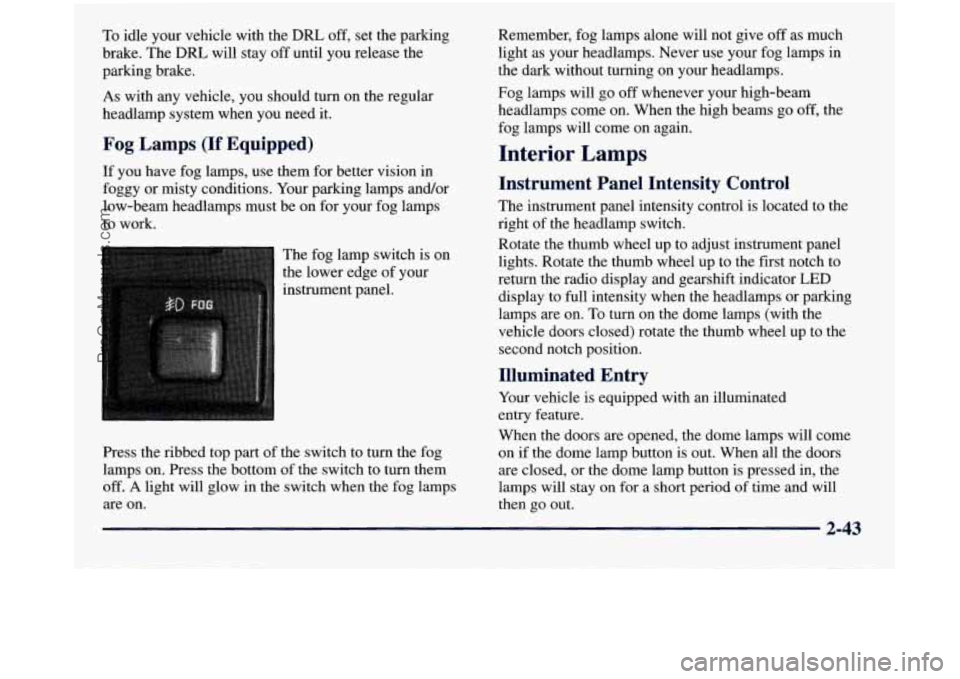
The fog lamp switch is on
the lower edge of your
instrument panel.
Press the ribbed top part of the switch to turn the fog
lamps on. Press
the bottom of the switch to turn them
off.
A light will glow in the switch when the fog lamps
are on. Remember,
fog lamps alone will not give off as much
light as your headlamps. Never use your fog lamps in
the dark without turning on your headlamps.
Fog lamps will go off whenever your high-beam
headlamps come on. When the high beams go
off, the
fog lamps will come on again.
Interior Lamps
Instrument Panel Intensity Control
The instrument panel intensity control is located to the
right of the headlamp switch.
Rotate the thumb wheel up to adjust instrument panel
lights. Rotate the thumb wheel up to the first notch to
return the radio display and gearshift indicator LED
display to full intensity when the headlamps or parking
lamps are on. To turn on the dome lamps (with the
vehicle doors closed) rotate the thumb wheel up to the second notch position.
Illuminated Entry
Your vehicle is equipped with an illuminated
entry feature.
When the doors are opened, the dome lamps will come
on if the dome lamp button is out. When all the doors
are closed, or the dome lamp button is pressed in, the
lamps will stay on for
a short period of time and will
then go out.
2-43
ProCarManuals.com
Page 145 of 452
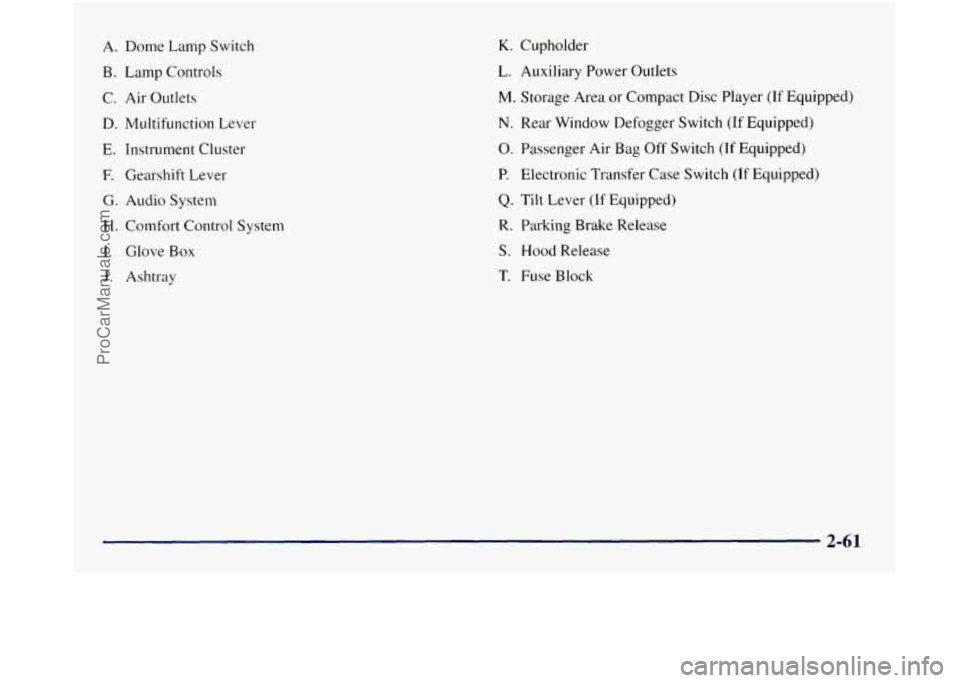
A. Dome Lamp Switch
B. Lamp Controls
C. Air Outlets
D. Multifunction Lever
E. Instrument Cluster
F. Gearshift Lever
G. Audio System
H. Comfort Control System
I. Glove Box
J. Ashtray
K. Cupholder
L. Auxiliary Power Outlets
M. Storage Area or Compact Disc Player (If Equipped)
N. Rear Window Defogger Switch (If Equipped)
0. Passenger Air Bag Off Switch (If Equipped)
P. Electronic Transfer Case Switch (If Equipped)
Q. Tilt Lever (If Equipped)
R. Parking Brake Release
S. Hood Release
T. Fuse
Block
2-61
ProCarManuals.com
Page 146 of 452
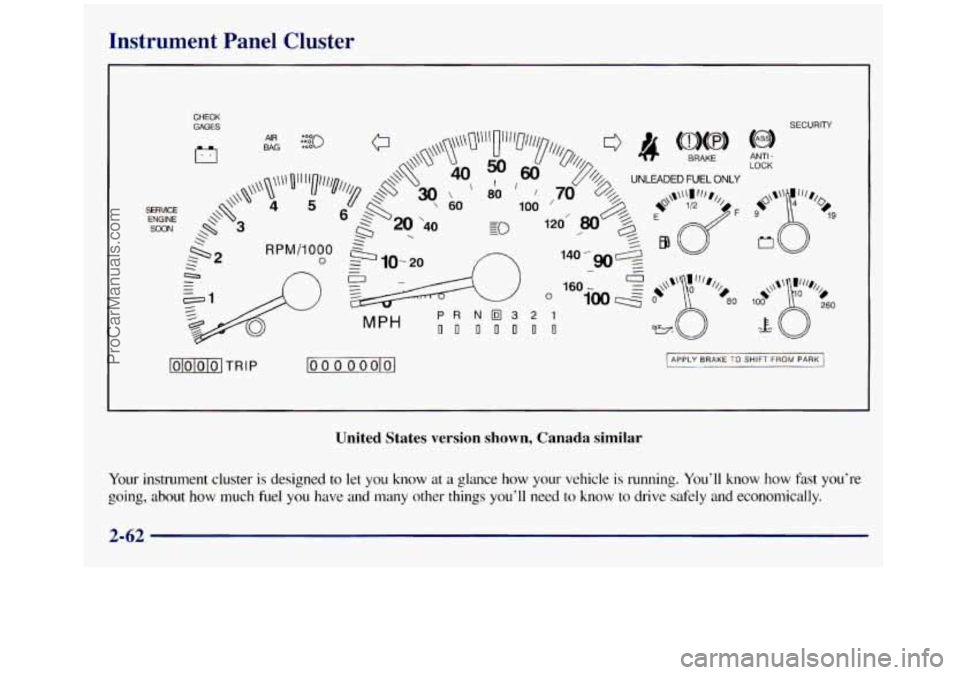
Instrument Panel Cluster
CHECK
GAGES SECURITY
MPH
lolololo1 TRIP loo 0 0 oolol
LOCK ANTI -
I APPLY BRAKE TO SHIFT FROM PARK I
United States version shown, Canada similar
Your instrument cluster is designed to let you know at a glance how your vehicle is running. You'll know how fast you're
going, about
how much fuel you have and many other things you'll need to know to drive safely and economically.
2-62
ProCarManuals.com
Page 151 of 452
After the engine starts, the light should go out. If it stays
on or comes on while you are driving, you may have a
problem with your charging system. It could indicate a
problem with the generator
drive belt, or some other
charging system problem. Have it checked right away.
Driving while this light
is on could drain your battery.
If you must drive a short distance with this light on, it
helps to turn off all your accessories, such as the radio
and the
air conditioner.
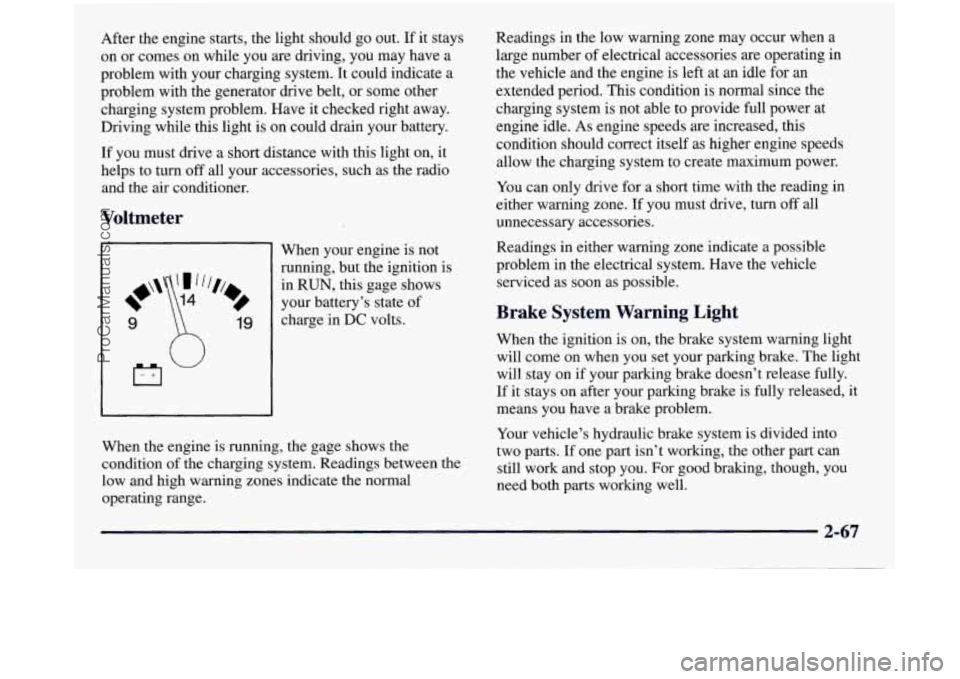
Voltmeter
19
When your engine is not
running, but the ignition is
in RUN, this gage shows
your battery’s state of
charge in
DC volts.
When the engine is running, the gage shows the
condition of the charging system. Readings between the
low and high warning zones indicate the normal
operating range. Readings
in the low warning zone may occur when a
large number
of electrical accessories are operating in
the vehicle and the engine is left at an idle for an
extended period.. This condition is normal since the
charging system
is not able to provide full power at
engine idle. As engine speeds are increased, this
condition should correct itself as higher engine speeds
allow the charging system to create maximum power.
You can only drive for a short time with the reading in
either warning zone. If you must drive, turn off all
unnecessary accessories.
Readings in either warning zone indicate a possible
problem in the electrical system. Have the vehicle
serviced as soon as possible.
Brake System Warning Light
When the ignition is on, the brake system warning light
will come on when you set your parking brake. The light
will stay on
if your parking brake doesn’t release fully.
If it stays on after your parking brake is fully released, it
means you have a brake problem.
Your vehicle’s hydraulic brake system is divided into
two parts. If one part isn’t working, the other part can
still work and stop you. For good braking, though,
you
need both parts working well.
2-67
ProCarManuals.com
Page 152 of 452
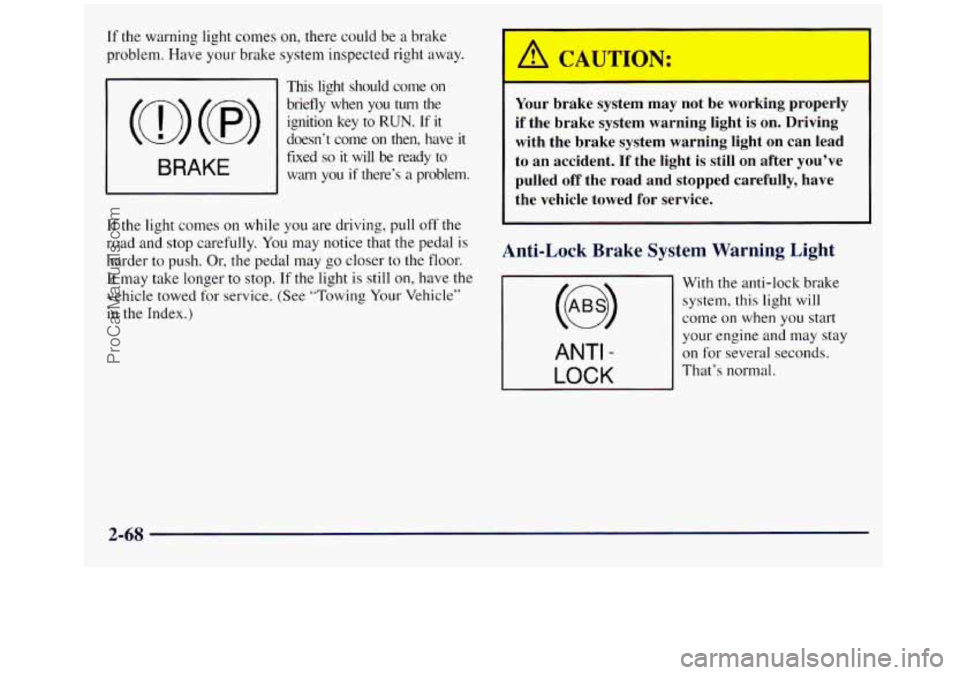
If the warning light comes on, there co11ld be a brake
problem. Have your brake system inspected right away.
This light should come on
(a) (@)
briefly when you turn the
ignition key
to RUN. If it
doesn‘t come on then, have
it
fixed so it will be ready to
warn you if there’s a problem. BRAKE
If the light comes on while you are driving, pull off the
road and
stop carefully. You may notice that the pedal is
harder
to push. Or, the pedal may go closer to the floor.
It may take longer to stop.
If the light is still on, have the
vehicle towed
for service. (See “Towing Your Vehicle”
in the Index.)
Your brake system may not be working properly
if the brake system warning light is
on. Driving
with the brake system warning light on can lead
to an accident.
If the light is still on after you’ve
pulled off the road and stopped carefully, have
the vehicle towed for service.
Anti-Lock Brake System Warning Light
With the anti-lock brake
system,
this light will
come on when you start
ANTI -
LOCK
your engine and may stay
on for several seconds.
That’s normal.
2-68
ProCarManuals.com
Page 153 of 452
If the light stays on, or comes on when you’re driving,
your vehicle needs service.
If the regular brake system
warning light isn’t on, you still have brakes, but you
don’t have anti-lock brakes.
If the regular brake system
warning light is also on, you don’t have anti-lock brakes
and there‘s a problem
with your regular brakes. See
“Brake System Warning Light” earlier
in this section.
The anti-lock brake system warning light should come
on briefly when you turn the ignition key to RUN. If the
light doesn‘t come on then. have it fixed
so it will be
ready to warn you
if there is a problem.
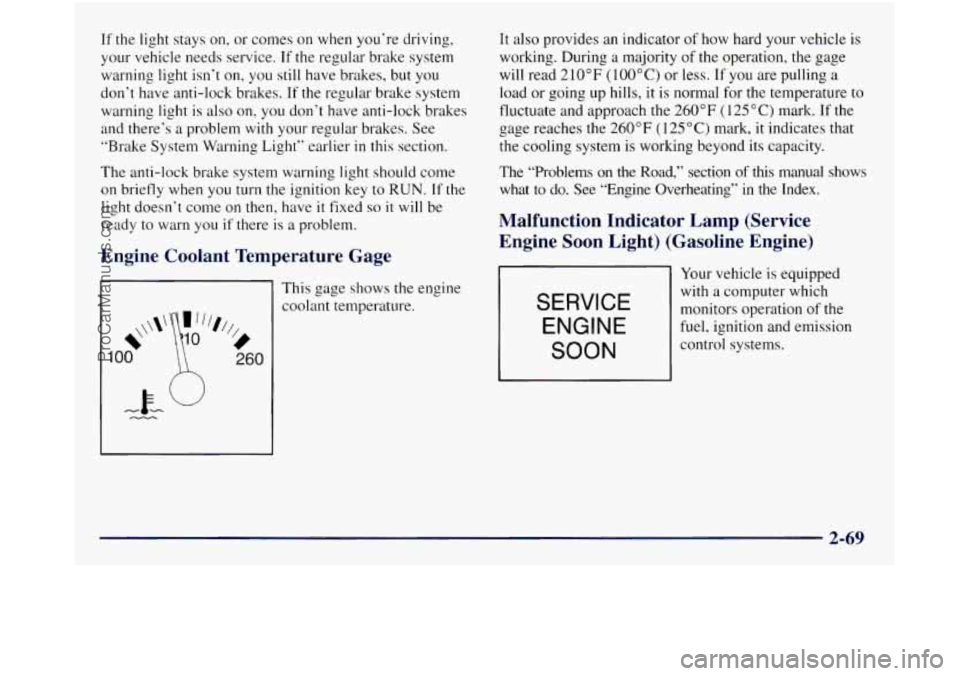
Engine Coolant Temperature Gage
1
This gage shows the engine
coolant temperature.
It also provides an indicator of how hard your vehicle is
working. During a majority of the operation, the gage
will read
210°F (100°C) or less. If you are pulling a
load or going up hills, it is normal for the temperature to
fluctuate and approach the
260°F (1 25 “C) mark. If the
gage reaches the
260°F (125°C) mark, it indicates that
the cooling system is working beyond its capacity.
The “Problems on
the Road,” section of this manual shows
what
to do. See “Engine Overheating” in the Index.
Malfunction Indicator Lamp (Service
Engine
Soon Light) (Gasoline Engine)
SERVICE
ENGINE
SOON
Your vehicle is equipped
with a computer which
monitors operation
of the
fuel, ignition and emission
control systems.
2-69
ProCarManuals.com
Page 190 of 452
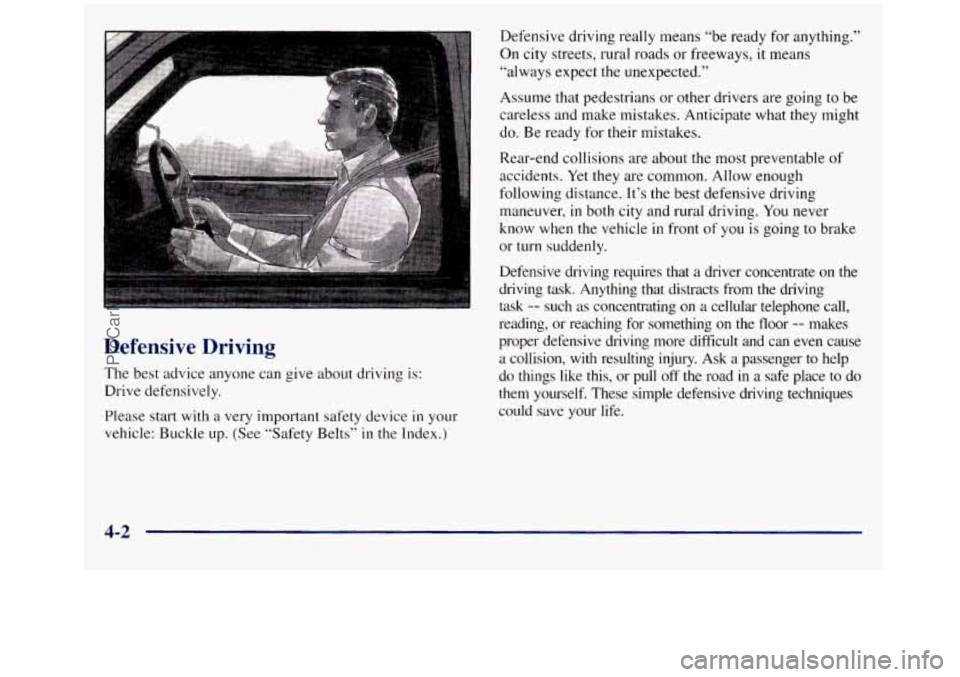
Defensive Driving
The best advice anyone can give about driving is: Drive defensively.
Please start
with a very important safety device in your
vehicle: Buckle up.
(See “Safety Belts” in the Index.) Defensive driving really means “be ready for anything.”
On city streets, rural roads
or freeways, it means
“always expect the unexpected.”
Assume that pedestrians or other drivers are going
to be
careless and make mistakes. Anticipate what they might
do. Be ready for their mistakes.
Rear-end collisions are about the most preventable
of
accidents. Yet they are common. Allow enough
following distance. It’s the best defensive driving
maneuver,
in both city and rural driving. You never
know when the vehicle in front
of you is going to brake
or turn suddenly.
Defensive driving requires that a driver concentrate on the
driving task. Anything that distracts from the driving
task
-- such as concentrating on a cellular telephone call,
reading, or reaching for something on the
floor -- makes
proper defensive driving more difficult and can even cause
a collision, with resulting injury. Ask a passenger to help
do things like this, or pull
off the road in a safe place to do
them yourself. These simple defensive driving techniques
could save your life.
4-2
ProCarManuals.com
Page 193 of 452
The body takes about an hour to rid itself of the alcohol
in one drink. No amount of coffee or number of cold
showers will speed that up.
“I’ll be careful” isn’t the
right answer. What
if there’s an emergency, a need to
take sudden action, as when a child darts into the street?
A person with even a moderate BAC might not be able
to react quickly enough to avoid the collision.
There‘s something else about drinking and driving that
many people don’t know. Medical research shows that
alcohol
in a person’s system can make crash injuries
worse, especially injuries to the brain, spinal cord or
heart. This means that when anyone who has been
drinking
-- driver or passenger -- is in a crash, that
person’s chance of being killed or permanently disabled
is higher than if the person had not been drinking.
A CAUTION:
Drinking and then driving is very dangerous.
Your reflexes, perceptions, attentiveness and
judgment can be affected by even a small amount
of alcohol. You can have a serious
-- or even
fatal
-- collision if you drive after drinking.
Please don’t drink and drive or ride with
a driver
who has been drinking. Ride home in
a cab; or if
you’re with
a group, designate a driver who will
not drink.
Control of a Vehicle
You have three systems that make your vehicle go where
you want
it to go. They are the brakes, the steering and
the accelerator.
All three systems have to do their work
at the places where the tires meet
the road.
4-5
ProCarManuals.com