coolant GMC SIERRA 1998 Owner's Manual
[x] Cancel search | Manufacturer: GMC, Model Year: 1998, Model line: SIERRA, Model: GMC SIERRA 1998Pages: 452, PDF Size: 23.65 MB
Page 308 of 452
What to Do with Used Oil
Did you know that used engine oil contains certain
e.lements
that may be unhealthy for your skin and could
even cause cancer? Don’t let used oil stay on your skin
for very long. Clean your skin and nails with soap and
water, or a good hand cleaner. Wash or properly throw
away clothing or rags containing used engine oil. (See
the manufacturer’s warnings about
the use and disposal
of oil products.)
Used oil can be a real threat
to the environment. If you
change your own
oil, be sure to drain all free-flowing oil
from the filter before disposal. Don’t ever dispose of oil
by putting
it in the trash, pouring it on the ground, into
sewers, or into streams
or bodies of water. Instead,
recycle it by taking it to a place that collects used oil.
If
you have a problem properly disposing of your used oil,
ask your dealer, a service station or a local recycling
center for help.
Air Cleaner (Gasoline Engines)
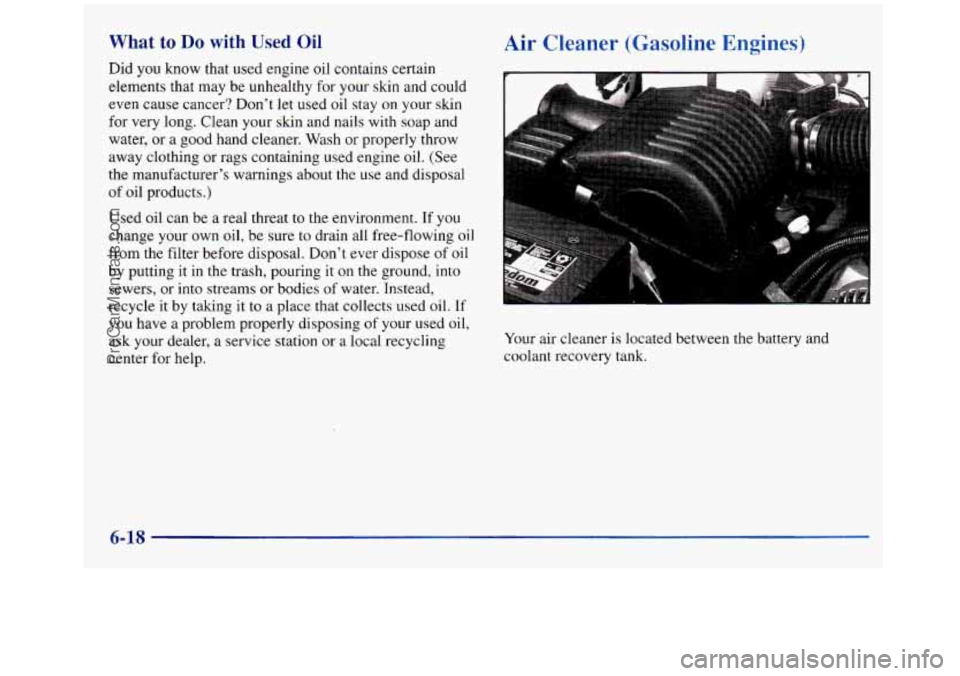
Your air cleaner is located between the battery and
coolant recovery tank.
6-18
ProCarManuals.com
Page 318 of 452
How to Check Lubricant
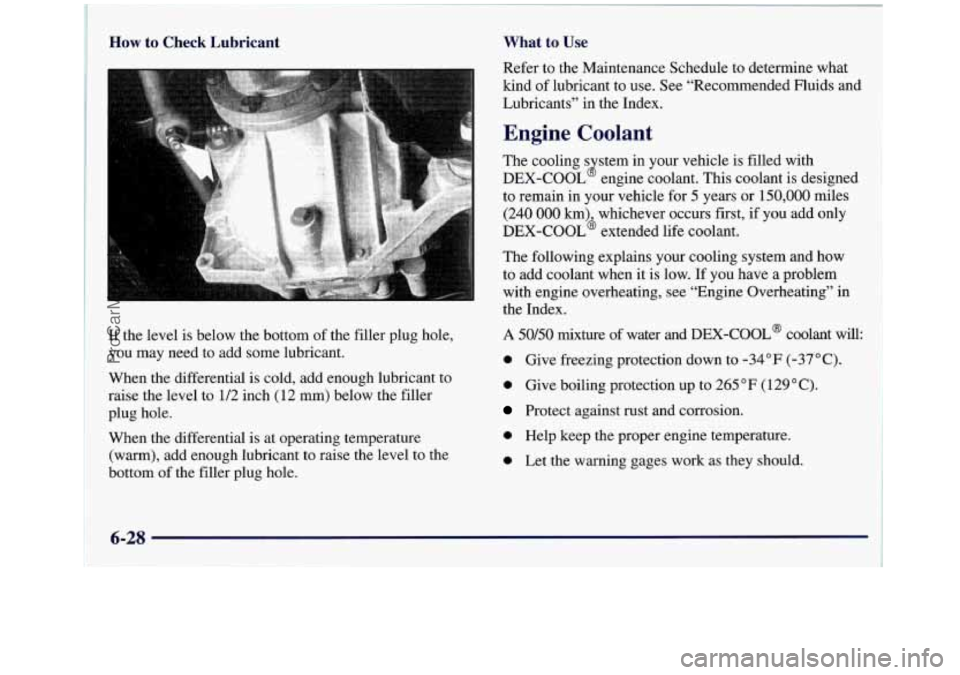
If the level is below the bottom of the filler plug hole,
you may need to add some lubricant.
When the differential is cold, add enough lubricant to
raise the level to 1/2 inch (12
mrn) below the filler
plug hole.
When the differential is at operating temperature
(warm), add enough lubricant to raise the level to the
bottom
of the filler plug hole.
What to Use
Refer to the Maintenance Schedule to determine what
kind of lubricant to use. See “Recommended Fluids and
Lubricants” in the Index.
Engine Coolant
The cooling s stem in your vehicle is filled with
DEX-COOL engine coolant. This coolant is designed
~
to remain in your vehicle for 5 years or 150,000 miles I
(240 000 km) whichever occurs first, if you add only ~
DEX-COOL’ extended life coolant.
8
The following explains your cooling system and how
to add coolant when it is low. If you have a problem
i
with engine overheating, see “Engine Overheating” in 1
the Index.
A 50/50 mixture of water and DEX-COOL@ coolant will: 1
0 Give freezing protection down to -34°F (-37°C).
0 Give boiling protection up to 265 OF (1 29 O C).
Protect against rust and corrosion.
0 Help keep the proper engine temperature.
0 Let the warning gages work as they should.
6-28 ;L
ProCarManuals.com
Page 319 of 452
NOTICE:
When adding coolant, it is important that you use
only
DEX-COOL@ (silicate-free) coolant.
If coolant other than DEX-COOL is added to the
system, premature engine, heater core or
radiator corrosion may result. In addition, the
engine coolant will require change sooner
-- at
30,000 miles (50 000 km) or 24 months,
whichever occurs first. Damage caused by the use
of coolant other than DEX-COOL@ is not
covered by your new vehicle warranty.
What to Use
Use a mixture of one-half clean water (preferably
distilled) and one-half
DEX-COOL@ coolant which
won’t damage aluminum
parts. If you use this mixture,
you don’t need to add anything else.
CAUTION:
Adding only plain water to your cooling system
can be dangerous. Plain water, or some other
liquid like alcohol, can boil before the proper
coolant mixture will. Your vehicle’s coolant
warning system is set for the proper coolant
mixture. With plain water or the wrong mixture,
your engine could get too hot but you wouldn’t
get the overheat warning. Your engine could
catch fire and you or others could be burned.
Use a
50/50 mixture of clean water and
DEX-COOL@ coolant.
6-29
ProCarManuals.com
Page 320 of 452
- ~ ~~
NOTICE:
If you use an improper coolant mixture, your
engine could overheat and be badly damaged.
The repair cost wouldn’t be covered by your
warranty.
Too much water in the mixture can
freeze and crack the engine, radiator, heater core
and other parts.
If you have to add coolant more than four times a year,
have your dealer check your cooling system.
NOTICE:
If you use the proper coolant, you don’t have to
add extra inhibitors or additives which claim
to
improve the system. These can be harmful.
Checking Coolant
If your vehicle has a diesel engine, see “Checking
Coolant”
in the Diesel Engine Supplement.
,:. . .,. ..... I.. .;> .:... ...,,.. ::l:. ..
.. .
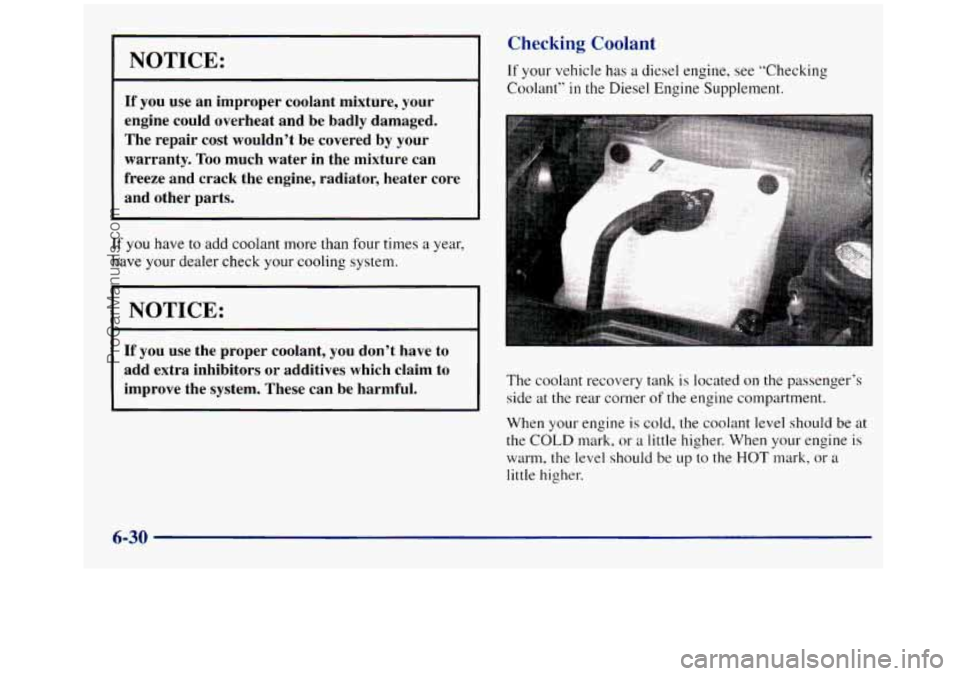
The coolant recovery tank is located on the passenger’s
side at the rear corner
of the engine compartment.
When your engine
is cold, the coolant level should be at
the
COLD mark, or a little higher. When your engine is
warm,
the level should be up to the HOT mark, or a
little higher.
6-30
ProCarManuals.com
Page 321 of 452
Adding Coolant
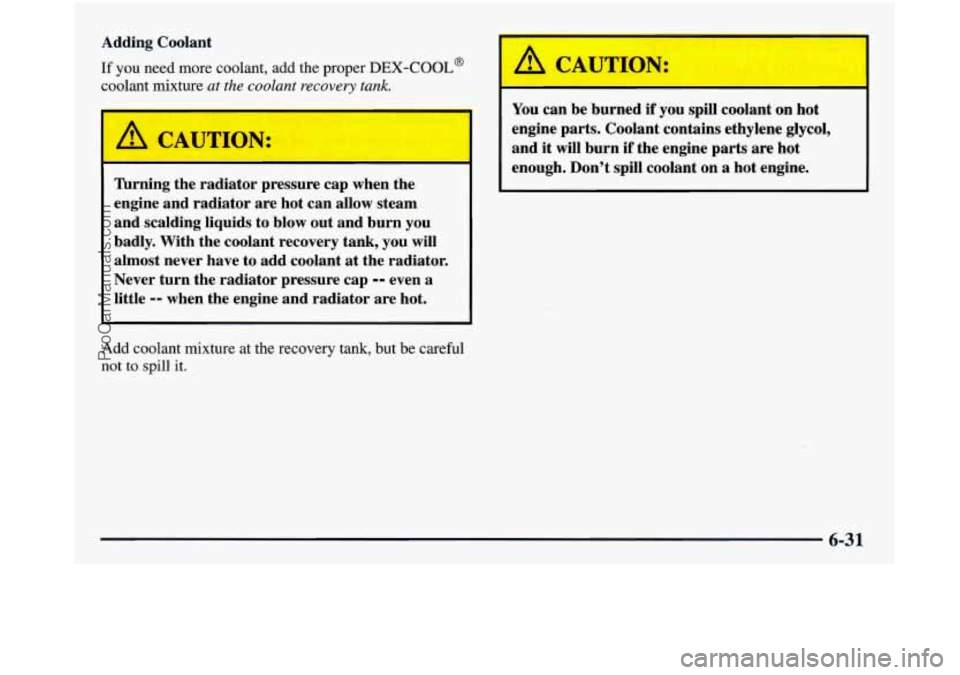
If you need more coolant, add the proper DEX-COOL@
coolant mixture at the coolant recovery tank.
,
A CAUTION:
'krning the radiator pressure cap when the
engine and radiator are hot can allow steam
and scalding liquids to blow out and burn you
badly. With the coolant recovery tank, you will
almost never have to add coolant at the radiator.
Never turn the radiator pressure cap
-- even a
little
-- when the engine and radiator are hot.
Add coolant mixture at the recovery tank, but be careful
not to
spill it.
A CAUTION:
You can be burned if you spill coolant on hot
engine parts. Coolant contains ethylene glycol,
and it
will burn if the engine parts are hot
enough. Don't spill coolant on a hot engine.
6-31
ProCarManuals.com
Page 322 of 452
Radiator Pressure Cap
(Gasoline Engine)
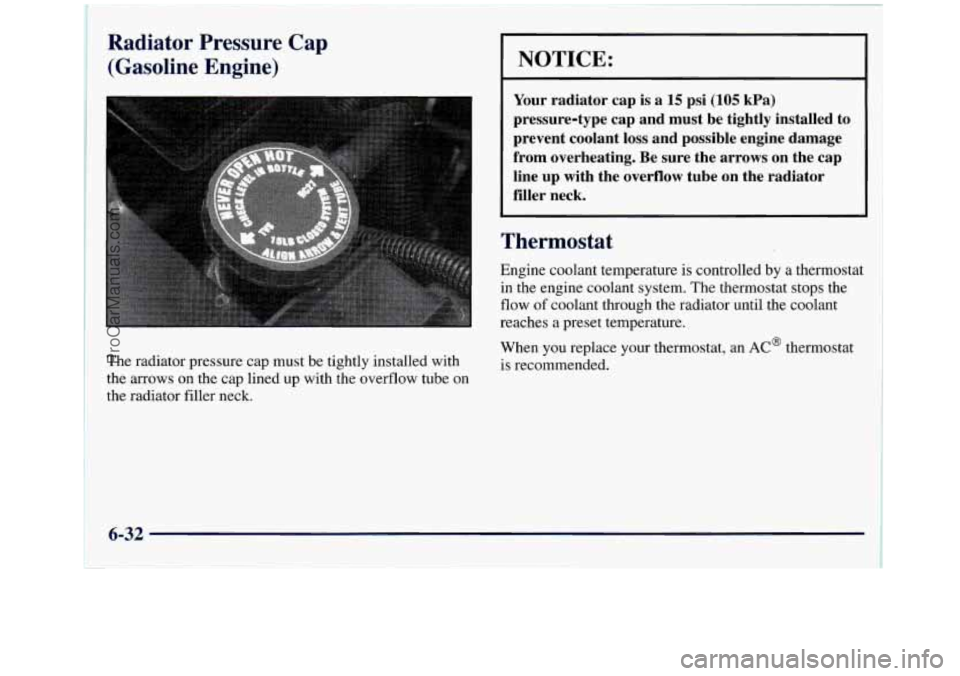
The radiator pressure cap must be tightly installed with
the arrows
on the cap lined up with the overflow tube on
the radiator filler neck.
~~~ ~
NOTICE:
Your radiator cap is a 15 psi (105 kPa)
pressure-type cap and must be tightly installed to
prevent coolant loss and possible engine damage
from overheating. Be sure the arrows on the cap
line up with the overflow tube on the radiator
filler neck.
Thermostat
Engine coolant temperature is controlled by a thermostat
in the engine coolant system. The thermostat stops the
flow of coolant through the radiator until the coolant
reaches a preset temperature.
When you replace your thermostat, an
AC@ thermostat
is recommended.
6-32
ProCarManuals.com
Page 324 of 452
Adding Washer Fluid
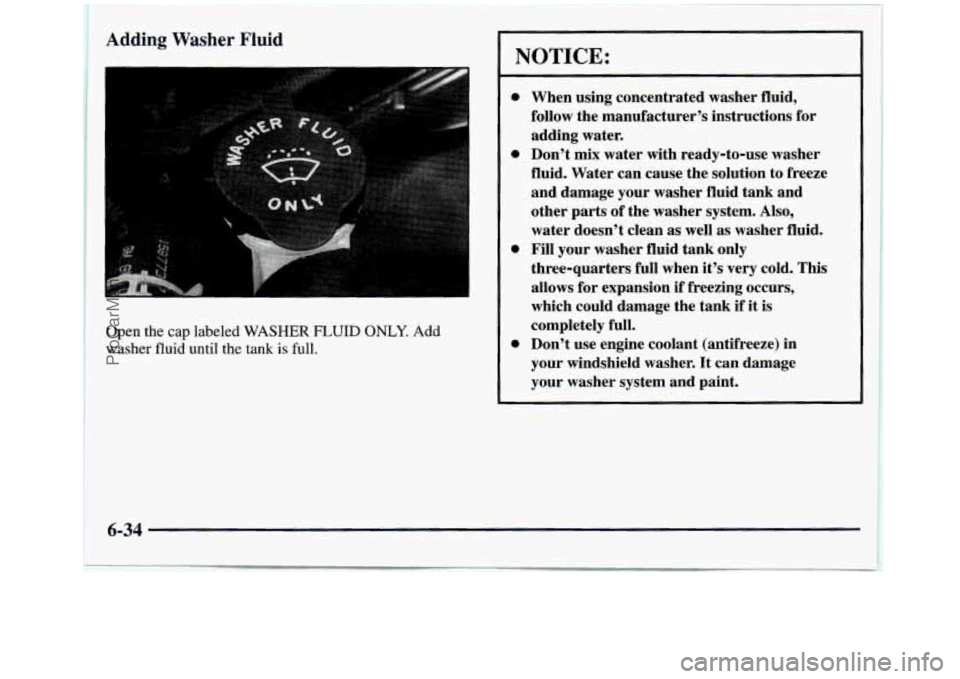
Open the cap labeled WASHER FLUID ONLY. Add
washer fluid until the tank is full.
1
NOTICE:
0
0
0
0
When using concentrated washer fluid,
follow the manufacturer’s instructions for
adding water.
Don’t mix water with ready-to-use washer
fluid. Water can cause the solution to freeze
and damage your washer fluid tank and
other parts of the washer system. Also,
water doesn’t clean as well as washer fluid.
Fill your washer fluid tank only
three-quarters full when it’s very cold. This
allows for expansion if freezing occurs,
which could damage the tank if it is
completely full.
Don’t use engine coolant (antifreeze) in
your windshield washer. It can damage
your washer system and paint.
6-34
ProCarManuals.com
Page 363 of 452
FuseKircuit Breaker
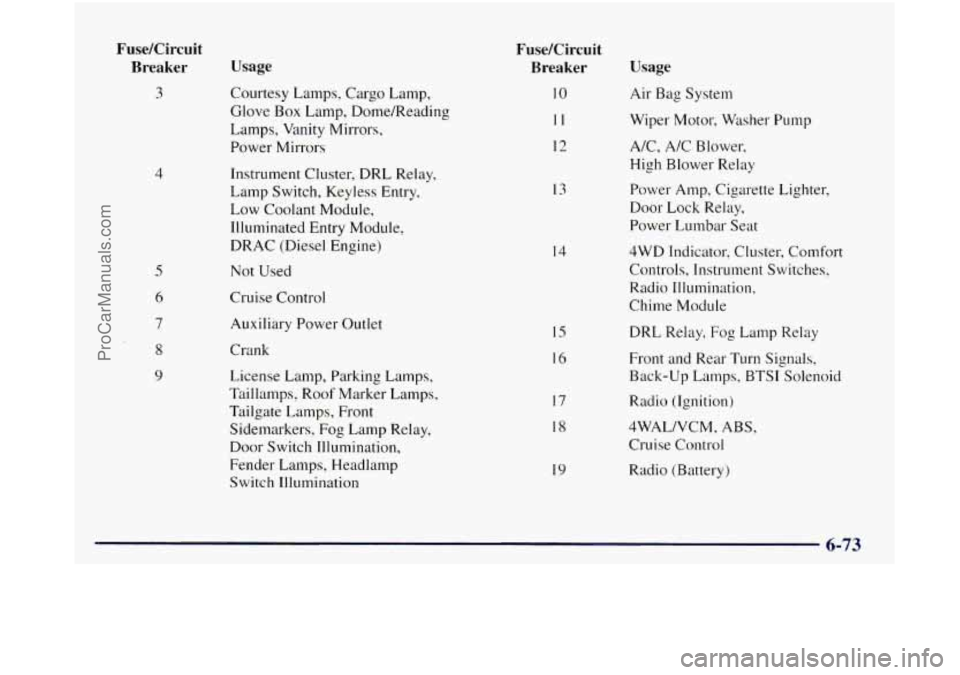
3
4
Usage
Courtesy Lamps, Cargo Lamp,
Glove Box Lamp, Dome/Reading
Lamps, Vanity Mirrors,
Power Mirrors
Instrument Cluster, DRL Relay,
Lamp Switch, Keyless Entry,
Low Coolant Module, Illuminated Entry Module,
DRAC (Diesel Engine)
Not Used
Cruise Control
Auxiliary Power Outlet
Crank
License Lamp, Parking Lamps,
Taillamps,
Roof Marker Lamps,
Tailgate Lamps, Front
Sidemarkers, Fog Lamp Relay,
Door Switch Illumination,
Fender Lamps, Headlamp Switch Illumination
FuseKircuit
Breaker
10
11
12
13
14
15
I6
17
18
19
Usage
Air Bag System
Wiper Motor, Washer Pump
A/C,
A/C Blower,
High Blower Relay
Power
Amp, Cigarette Lighter,
Door Lock Relay,
Power Lumbar Seat
4WD Indicator, Cluster, Comfort
Controls, Instrument Switches,
Radio Illumination,
Chime Module
DRL Relay,
Fog Lamp Relay
Front and Rear Turn Signals,
Back-up Lamps, BTSl Solenoid
Radio (Ignition)
4WAL/VCM, ABS. Cruise Control
Radio (Batterv)
6-73
ProCarManuals.com
Page 397 of 452
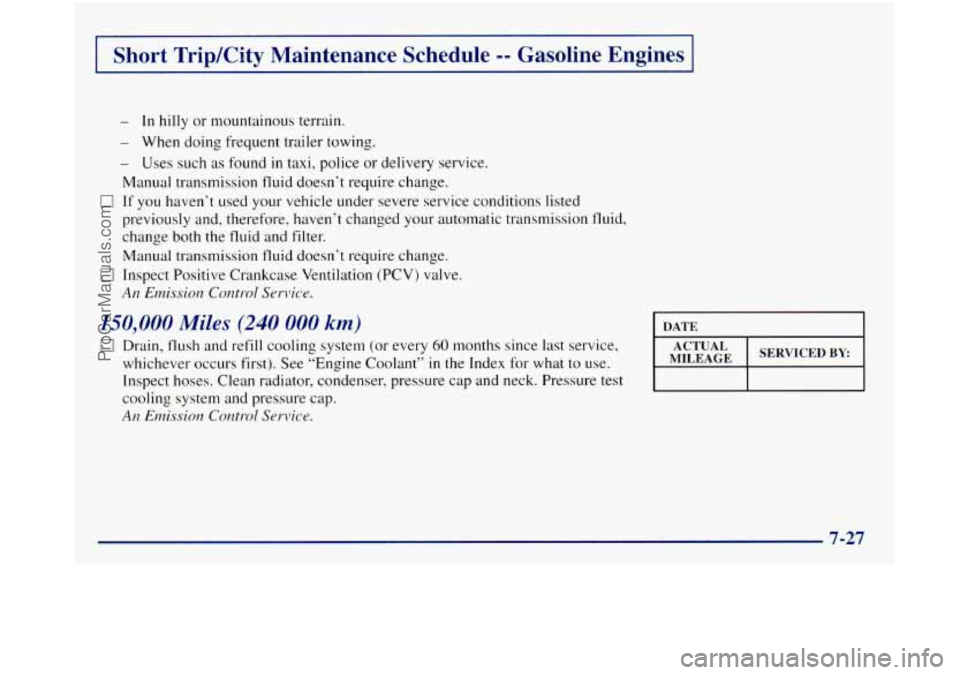
Short TripKity Maintenance Schedule -- Gasoline Engines
- In hilly or mountainous terrain.
- When doing frequent trailer towing.
- Uses such as found in taxi, police or delivery service.
Manual transmission fluid doesn’t require change.
previously and, therefore, haven‘t changed your automatic transmission fluid,
change both the fluid and filter.
Manual transmission fluid doesn’t require change.
17 Inspect Positive Crankcase Ventilation (PCV) valve.
Arz Emission Control Service.
0 If you haven’t used your vehicle under severe service conditions listed
150,000 Miles (240 000 km)
0 Drain, flush and refill cooling system (or every 60 months since last service,
whichever occurs first). See “Engine Coolant”
in the Index for what to use.
DATE
I MILEAGE ACTUAL I SERVICED BY:
Inspect hoses. Clean radiator, condenser, pressure cap and neck. Pressure test I I
cooling system and pressure cap.
AH Emission Control Service.
7-27
ProCarManuals.com
Page 409 of 452
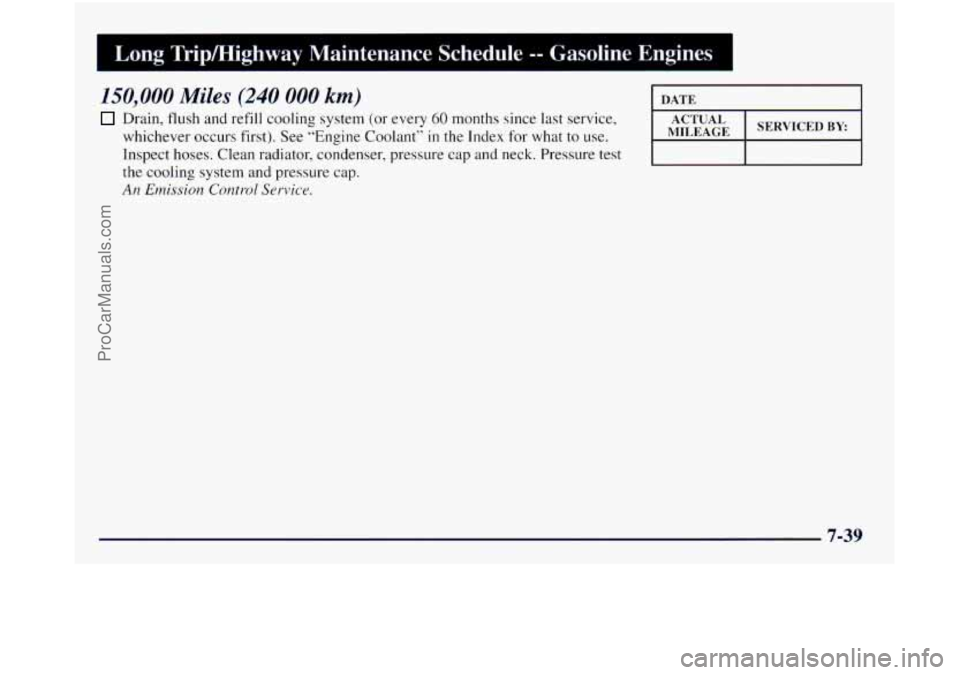
1 Long Tripmighway Maintenance Schedule -- Gasoline Engines
150,000 Miles (240 000 km) DATE
Drain, flush and refill cooling system (or every 60 months since last service,
Inspect hoses. Clean radiator, condenser, pressure cap
and neck. Pressure test
the cooling system and pressure cap.
An Emissim Control Sc~l-~?ic.r.
whichever occurs first). See "Engine Coolant" in the Index for what to use. MILEAGE
7-39
ProCarManuals.com