flat tire GMC SIERRA 1998 Owner's Manual
[x] Cancel search | Manufacturer: GMC, Model Year: 1998, Model line: SIERRA, Model: GMC SIERRA 1998Pages: 452, PDF Size: 23.65 MB
Page 346 of 452
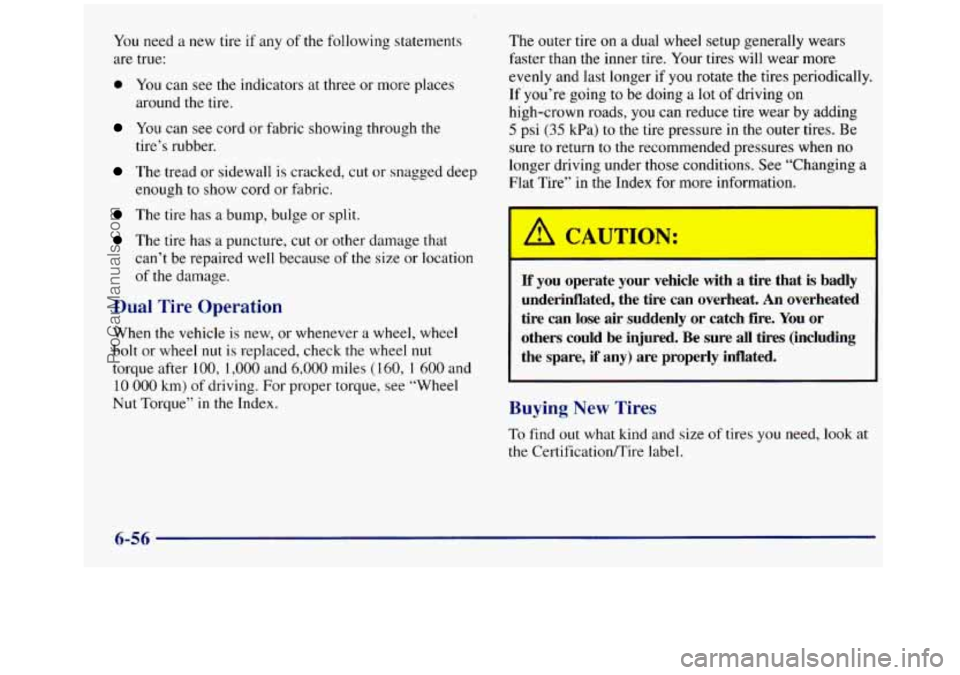
You need a new tire if any of the following statements
are true:
0 You can see the indicators at three or more places
around the tire.
You can see cord or fabric showing through the
tire’s rubber.
The tread or sidewall is cracked, cut or snagged deep
enough to show cord or fabric.
The tire has a bump, bulge or split.
The tire has a puncture, cut or other damage that
can’t be repaired well because of the size or location
of the damage.
Dual Tire Operation
When the vehicle is new, or whenever a wheel, wheel
bolt or wheel
nut is replaced, check the wheel nut
torque after 100, 1,000 and 6’000 miles (160, 1 600 and
10 000 km) of driving. For proper torque, see “Wheel
Nut Torque”
in the Index. The outer
tire
on a dual wheel setup generally wears
Faster than the inner tire. Your tires will wear more
evenly and last longer if
you rotate the tires periodically.
If you’re going to be doing a lot
of driving on
high-crown roads,
you can reduce tire wear by adding
5 psi (35 kPa) to the tire pressure in the outer tires. Be
sure to return to the recommended pressures when
no
longer driving under those conditions. See “Changing a
Flat Tire’’ in the Index for more information.
If you operate your vehicle with a tire that is badly
underinflated, the tire can overheat. An overheated
tire can lose air suddenly or catch fire.
You or
others could be injured. Be sure all tires (including
the spare,
if any) are properly inflated.
Buying New Tires
To find out what kind and size of tires you need, look at
the CertificatiodTire label.
6-56
ProCarManuals.com
Page 348 of 452
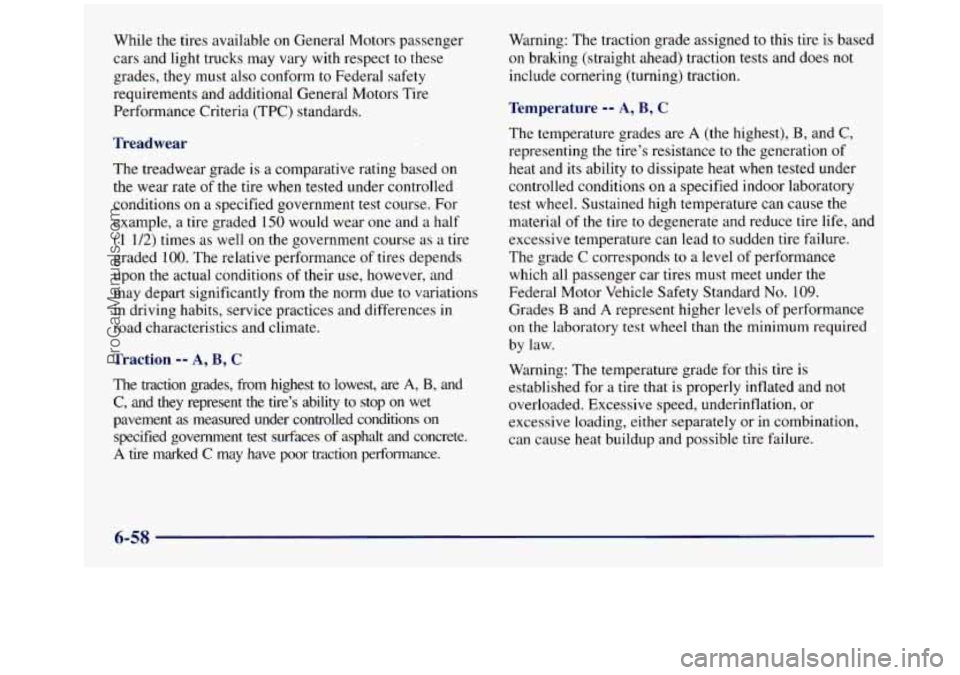
While the tires available on General Motors passenger
cars and light trucks may vary with respect to these
grades, they must also conform to Federal safety
requirements and additional General Motors Tire
Performance Criteria (TPC) standards.
Treadwear
The treadwear grade is a comparative rating based on
the wear rate of the tire when tested under controlled
conditions on a specified government test course. For
example, a tire graded 150 would wear one and a half
(1 1/2) times as well on the government course as a tire
graded
100. The relative performance of tires depends
upon the actual conditions of their use, however, and
may depart significantly from the norm due to variations
in driving habits, service practices and differences in
road characteristics and climate.
Traction -- A, B, C
The traction grades, from highest to lowest, are A, B, and
C, and they represent the tire’s ability to stop
on wet
pavement
as measured under controlled conditions on
specified government test surfaces of asphalt and concrete.
A tire marked C may have poor traction performance. Warning:
The traction grade assigned to this tire is based
on braking (straight ahead) traction tests and does not
include cornering (turning) traction.
Temperature -- A, B, C
The temperature grades are A (the highest), B, and C,
representing the tire’s resistance to the generation of
heat and its ability
to dissipate heat when tested under
controlled conditions
on a specified indoor laboratory
test wheel. Sustained high temperature can cause the
material of
the tire to degenerate and reduce tire life, and
excessive temperature can lead to sudden tire failure.
The grade
C corresponds to a level of performance
which
all passenger car tires must meet under the
Federal Motor Vehicle Safety Standard
No. 109.
Grades B and A represent higher levels of performance
on the laboratory test wheel than the minimum required
by law.
Warning: The temperature grade for this tire is
established for a tire that is properly inflated and
not
overloaded. Excessive speed, underinflation, or
excessive loading, either separately or in combination,
can cause heat buildup and possible tire failure.
6-58
ProCarManuals.com
Page 350 of 452
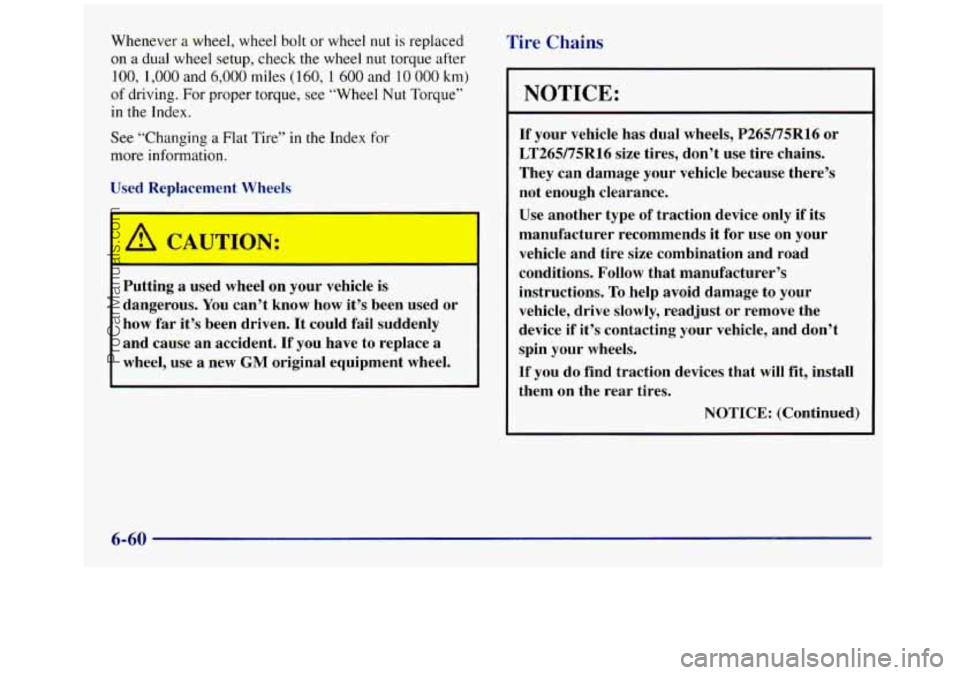
Whenever a wheel, wheel bolt or wheel nut is replaced
on
a dual wheel setup, check the wheel nut torque after
100, 1,000 and 6,000 miles ( 160, 1 600 and 10 000 km)
of driving. For proper torque, see “Wheel Nut Torque’’
in the Index.
See “Changing
a Flat Tire” in the Index for
more information.
Used Replacement Wheels
/!1 CAUTION:
Putting a used wheel on your vehicle is
dangerous.
You can’t know how it’s been used or
how
far it’s been driven. It could fail suddenly
and cause an accident. If
you have to replace a
wheel, use a new GM original equipment wheel.
Tire Chains
NOTICE:
If your vehicle has dual wheels, P265/75R16 or
LT265/75R16 size tires, don’t use tire chains.
They can damage your vehicle because there’s
not enough clearance.
Use another type of traction device only
if its
manufacturer recommends it for
use on your
vehicle and tire size combination and road
conditions.
Follow that manufacturer’s
instructions. To help avoid damage to your
vehicle, drive slowly, readjust or remove the
device
if it’s contacting your vehicle, and don’t
spin your wheels.
If you do find traction devices that will fit, install
them on the rear tires.
NOTICE: (Continued)
6-60
ProCarManuals.com
Page 372 of 452
LE
IMPORTANT-
KEEP ENGINE OIL
AT THE PROPER
,VEL AND CHANGE
RECOMMENDED
AS
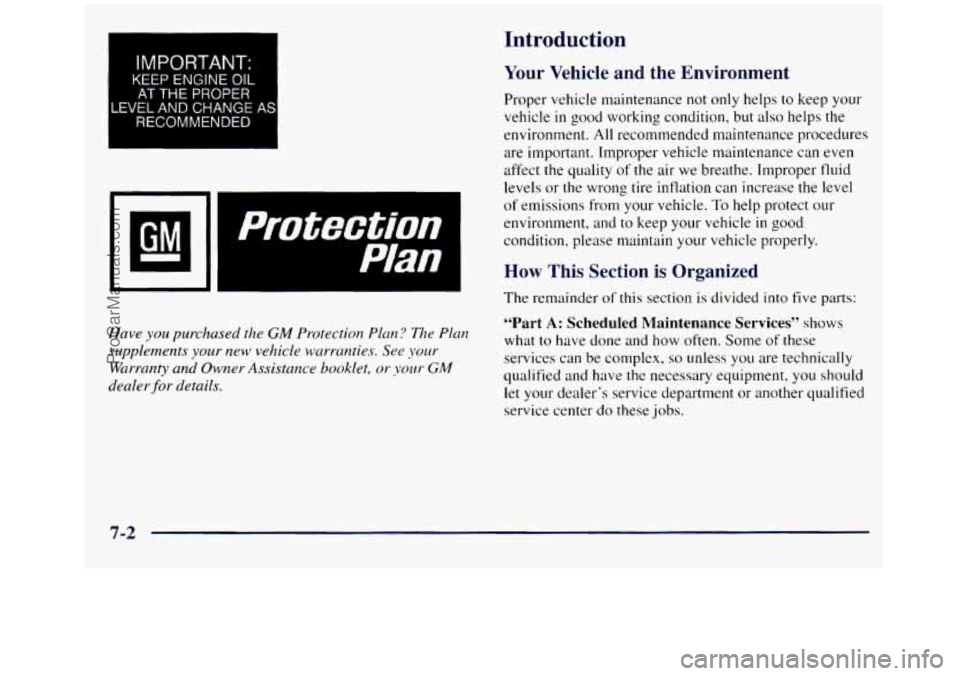
Have you purchased the GM Protection Pl~rn? The Plan
supplements your new vehicle M:u-ranties. See your
Warranty and Owner Assistance booklet,
or your GM
dealer-for details.
Introduction
Your Vehicle and the Environment
Proper vehicle maintenance not only helps to keep your
vehicle in good working condition, but also helps the
environment.
All recommended maintenance procedures
are important. Improper vehicle maintenance can even affect the quality
of the air we breathe. Improper fluid
levels or the wrong tire inflation can increase the level
of emissions from your vehicle.
To help protect our
environment, and to keep your vehicle
in good
condition, please maintain your vehicle properly.
How This Section is Organized
The remainder of this section is divided into five parts:
“Part A: Scheduled Maintenance Services” shows
what to have done and how often. Some
of these
services can be complex,
so unless YOLI are technically
qualified and have the necessary equipment, you should
let
your dealer‘s service department or another qualified
service center do these
jobs.
7-2
ProCarManuals.com
Page 410 of 452
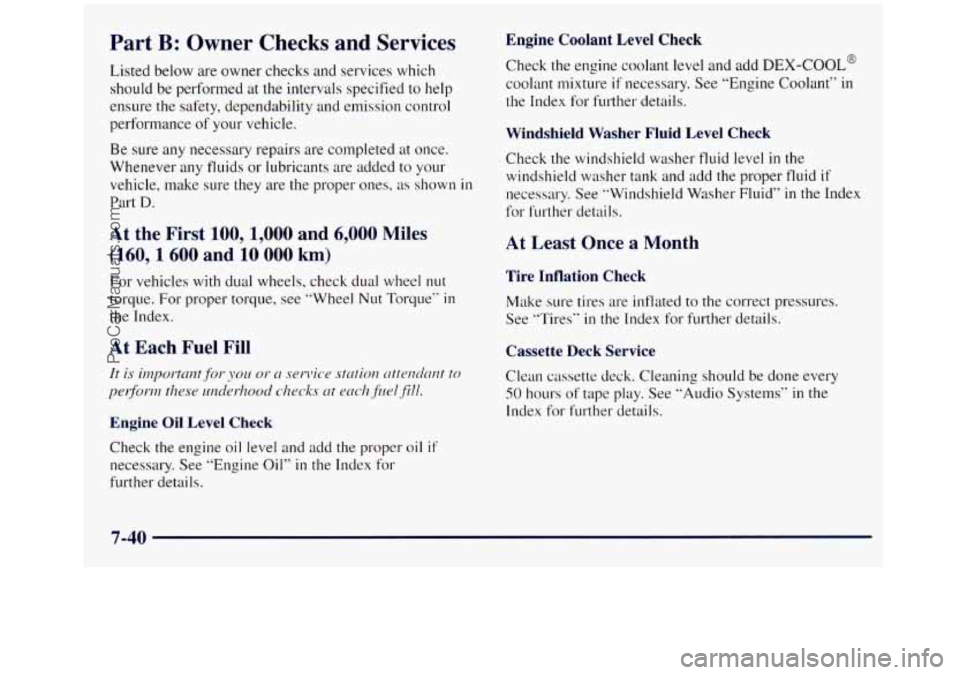
Part B: Owner Checks and Services
Listed below are owner checks and services which
should be performed at the intervals specified
to help
ensure
the safety, dependability and emission control
performance
of your vehicle.
Be sure any necessary repairs are completed at once.
Whenever
any fluids or lubricants are added to your
vehicle, make sure they are the proper ones.
as shown in
Part D.
At the First 100, 1,000 and 6,000 Miles
(160,1600 and 10 000 km)
For vehicles with dual wheels, check dual wheel nut
torque. For proper torque, see “Wheel Nut Torque” in
the Index.
At Each Fue-
Engine Oil Level Check
Check the engine oil level and add the proper oil if
necessary. See “Engine Oil” in the Index for
further details.
Engine Coolant Level Check
Check the engine coolant level and add DEX-COOL@
coolant mixture if necessary. See “Engine Coolant” in
the Index for further details.
Windshield Washer Fluid Level Check
Check the windshield washer fluid level in the
windshield washer tank and add the proper fluid
if
necessary. See ”Windshield Washer Fluid” in the Index
for ElIrther details.
At Least Once a Month
Tire Inflation Check
Make sure tires are inflated to the correct pressures.
See “Tires”
in the Index for further details.
Cassette Deck Service
Clean cassette deck. Cleaning should be done every
50 hours of tape play. See “Audio Systems“ in the
Index for further details.
ProCarManuals.com
Page 435 of 452
Section 9 Index
Accessory Power Outlet ......................... 2-59
AirBag ....................................... 1-23
Adding Equipment
............................ 1-3 1
How Does it Restrain .......................... 1-28
How it Works ................................ 1 -26
Location .................................... 1-26
Readiness Light ......................... 1.25, 2.65
What Makes it Inflate .......................... 1-27
What Will You See After
it Inflates ............... 1-28
When Should it Inflate ......................... 1-27
Air Bag
Off Light .......................... 1.58. 2.65
Air Cleaner
.................................... 6- 18
Air Cleaner Filter Restriction Indicator Check ........ 7-41
Air Conditioning ............................ 3.3. 3.4
Air Conditionillg Refrigerants ..................... 6-79
Alignment and Balance. Tire
...................... 6-59
Antenna
...................................... 3-26
Antifreeze
........................... 6-28.6-79.7-46
Anti-Lock Brake System Warning Light
................ 2.68. 4.7
Brakes ...................................... 4-7
Appearance Care
............................... 6-6 I
Adding Equipment to the Outside of Your Vehicle ...... 6-3
Servicing
................................... 1-30
Aluminum Wheels. Cleaning ...................... 6-67
Appearance Care and Materials .................... 6-69
Arbitration Program .............................. 8-9
Armrest Storage Compartment
.................... 2-56
Audio Equipment. Adding
........................ 3-24
Audio System
.................................. 3-7
Automatic Transmission
Check
...................................... 7-41
Fluid
.................................. 6-21. 7-47
Operation ................................... 2-15
Park Mechanism Check
........................ 7-43
Starting Your Engine
.......................... 2-12
Axle. Front
............................... 6-27. 7-47
Axle. Locking Rear
............................. 2-32
Axle. Rear
............................... 6-26. 7-47
Ashtrays ...................................... 2-58
Battery
...................................... 6-39
Jump Starting
................................. 5-3
Warnings ................................ 5-3. 5-5
BBB Auto Line ................................. 8-9
Better Business Bureau Mediation ................... 8-9
Blizzard. Driving
In ............................. 4-38
Replacement.
Keyless Entry ..................... 2-8
9-1
ProCarManuals.com
Page 444 of 452
Steering ....................................... 4-8
In Emergencies ............................... 4- 10
Power ....................................... 4-8
Speed Sensitive
............................... 4-9
Tips
......................................... 4-9
Wheel’Tilt
.................................. 2-34
Step-Bumper Pad
............................... 4-63
Storage Areas
.................................. 2-5 1
Storage. Overhead .............................. 2-5 1
Storage. Vehicle ................................ 6-39
Stuck: In Sand. Mud. Ice or Snow
.................. 5-36
Sunvisors
.................................... 2-59
Sunglasses Storage
.............................. 2-53
Symbols. Vehicle
.................................. v
Tachometer .................................. 2-63
Tailgate Removal
................................ 2-3
Taillamp Bulb Replacement
.................. 6-48’6-49
Tape Player Care
............................... 3-25
Temperature Control. Climate Control System
..... 3-2. 3-3
Theft
.......................................... 2-9
Theft-Deterrent Feature .......................... 3-2 1
THEFTLOCK” ................................ 3-21
Thermostat
.................................... 6-32
Third Door
..................................... 2-4
Tilt Steering Wheel
............................. 2-34
Time. Setting the
................................ 3-7
Tire Chains
.................................... 6-60
TireLoading
................................... 4-43 Tires
......................................... 6-51
Alignment and Balance
........................ 6-59
BuyingNew
................................. 6-56
Chains
..................................... 6-60
Changing
a Flat .............................. 5-23
Cleaning
.................................... 6-67
Dual Operation
............................... 6-56
Inflation
.................................... 6-52
Inflation Check
............................... 7-40
Inspection and Rotation
........................ 6-53
Loading
.................................... 4-43
Pressure
.................................... 6-52
Temperature
................................. 6-58
Traction
.................................... 6-58
Treadwear
................................... 6-58
Uniform Quality Grading
....................... 6-57
Wear Indicators
.............................. 6-55
Wheel Replacement
........................... 6-59
When It’s Time for New
....................... 6-55
TopStrap
..................................... 1-50
TorqueLock ................................... 2-28
Torque, Wheel
Nut ......................... 5-32, 6-77
Towing
a Trailer ................................ 4-49
Towing, Recreational Vehicle
..................... 4-41
Towing Your Vehicle
............................. 5-8
Trailer Brakes
..................................... 4-56
Driving on Grades
............................ 4-58
Driving with
................................. 4-56
9-10
ProCarManuals.com