oil GMC SIERRA 1998 Owner's Manual
[x] Cancel search | Manufacturer: GMC, Model Year: 1998, Model line: SIERRA, Model: GMC SIERRA 1998Pages: 452, PDF Size: 23.65 MB
Page 307 of 452
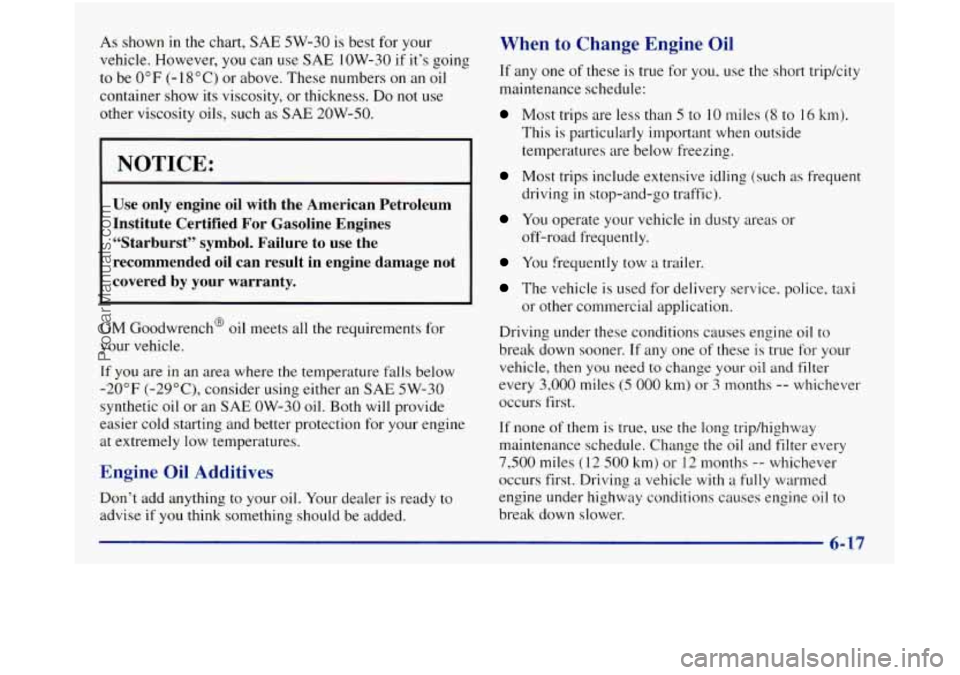
As shown in the chart, SAE 5W-30 is best for your
vehicle. However,
you can use SAE 1OW-30 if it’s going
to be
0°F (- 18 “C) or above. These numbers on an oil
container show
its viscosity, or thickness. Do not use
other viscosity oils, such
as SAE 20W-50.
NOTICE:
Use only engine oil with the American Petroleum
Institute Certified For Gasoline Engines “Starburst” symbol. Failure to use the
recommended oil can result in engine damage not
covered by your warranty.
GM Goodwrench@ oil meets all the requirements for
your vehicle.
If you are in an area where the temperature falls below
-20°F (-29°C)’ consider using either an SAE 5W-30
synthetic oil or an
SAE OW-30 oil. Both will provide
easier cold starting and better protection for your engine
at extremely low temperatures.
Engine Oil Additives
Don’t add anything to your oil. Your dealer is ready to
advise if
you think something should be added.
When to Change Engine Oil
If any one of these is true for you, use the short tripkity
maintenance schedule:
Most trips are less than 5 to 10 miles (8 to 16 km).
This is particularly important when outside
temperatures are below freezing.
Most trips include extensive idling (such as frequent
driving
in stop-and-go traffic).
You operate your vehicle in dusty areas or
off-road frequently.
You frequently tow a trailer.
The vehicle is used for delivery service, police, taxi
or other commercial application.
Driving under these conditions causes engine
oil to
break down sooner.
If any one of these is true for your
vehicle,
then you need to change your oil and filter
every
3,000 miles (5 000 km) or 3 months -- whichever
occurs first.
If none of them is true, use the long trip/highway
maintenance schedule. Change the oil and filter every
7,500 miles (12 500 km) or 12 months -- whichever
occurs first. Driving a vehicle with
a fully warmed
engine under highway conditions causes engine
oil to
break down slower.
6-S7
ProCarManuals.com
Page 308 of 452
What to Do with Used Oil
Did you know that used engine oil contains certain
e.lements
that may be unhealthy for your skin and could
even cause cancer? Don’t let used oil stay on your skin
for very long. Clean your skin and nails with soap and
water, or a good hand cleaner. Wash or properly throw
away clothing or rags containing used engine oil. (See
the manufacturer’s warnings about
the use and disposal
of oil products.)
Used oil can be a real threat
to the environment. If you
change your own
oil, be sure to drain all free-flowing oil
from the filter before disposal. Don’t ever dispose of oil
by putting
it in the trash, pouring it on the ground, into
sewers, or into streams
or bodies of water. Instead,
recycle it by taking it to a place that collects used oil.
If
you have a problem properly disposing of your used oil,
ask your dealer, a service station or a local recycling
center for help.
Air Cleaner (Gasoline Engines)
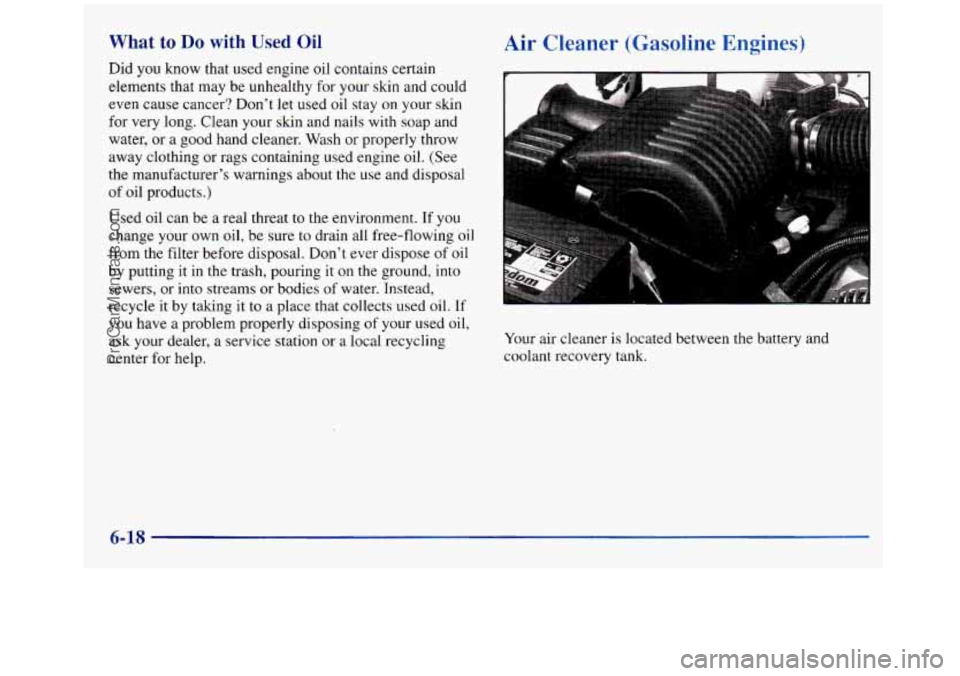
Your air cleaner is located between the battery and
coolant recovery tank.
6-18
ProCarManuals.com
Page 311 of 452
Automatic Transmission Fluid
If your vehicle has a diesel engine, see “Automatic
Transmission Fluid”
in the Diesel Supplement.
When to Check and Change
A good time to check your automatic transmission fluid
level is when the engine oil is changed.
Change both the fluid and filter every
50,000 miles
(83
000 km) if the vehicle’s GVWR is over 8,600 or
if the vehicle is mainly driven under one or more of
these conditions:
In heavy city traffic where the outside temperature
In hilly or mountainous terrain.
When doing frequent trailer towing.
Uses such as found in taxi, police or delivery service.
regularly
reaches
90°F (32°C) or higher.
If your vehicle’s GVWR is not over 8,600 and you do not
use your vehicle under any
of these conditions, change the
fluid and filter every
100,000 miles (166 000 km).
See “Scheduled Maintenance Services’’ in the Index.
How to Check
Because this operation can be a little difficult, you
may choose to have this done at your
GM dealership
Service Department.
If you do it yourself, be sure to follow all the instructions
here, or you could get a false reading on the dipstick.
NOTICE:
Too much or too little fluid can damage your
transmission.
Too much can mean that some of
the fluid could come
out and fall on hot engine
parts or exhaust system parts, starting a fire.
Be
sure to get an accurate reading if you check your
transmission fluid.
Wait at least 30 minutes before checking the
transmission fluid level if you have been driving:
When outside temperatures are above 90°F (32°C).
At high speed for quite a while.
In heavy traffic -- especially in hot weather.
While pulling a trailer.
To get the right reading, the fluid should be at normal
operating temperature, which is
180°F to 200°F (82°C
to 93°C). See “Checking Transmission Fluid Hot“ in
the Index.
6-21
ProCarManuals.com
Page 314 of 452
Manual Transmission Fluid
When to Check
A good time to have it checked is when the engine oil is
changed. However, the fluid in your manual
transmission doesn’t require changing.
How to Check
Because this operation can be a little difficult, you
may choose to have this done at your GM dealership
Service Department.
If you do it yourself, be sure to follow all the
instructions here, or you could get a fdse reading.
NOTICE:
Too much or too little fluid can damage your
transmission.
Too much can mean that some of
the fluid could come out and fall on hot engine
parts or exhaust system parts, starting a fire. Be
sure to get an accurate reading if you check your
transmission fluid.
Check the fluid level only when your engine is off, the
vehicle is parked on a level place and the transmission is
cool enough
for you to rest your fingers on the
transmission case.
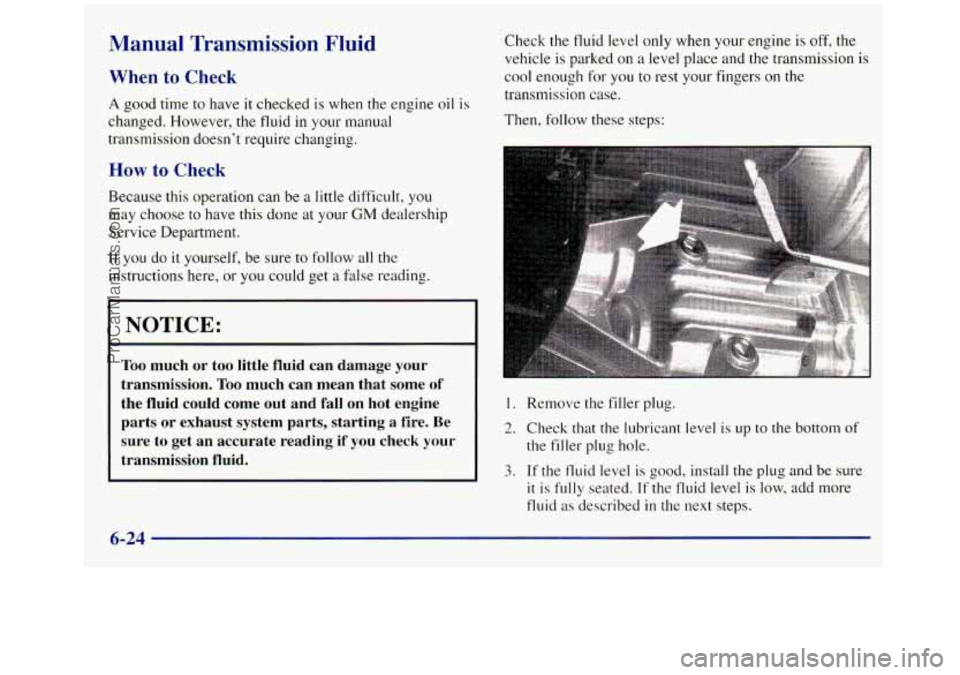
Then, follow these steps:
I. Remove the filler plug.
2. Check that the lubricant level is up to the bottom of
the filler plug hole.
3. If the fluid level is good, install the plug and be sure
it is fully seated. If the fluid level is low, add more
fluid as described in the next steps.
6-24
ProCarManuals.com
Page 318 of 452
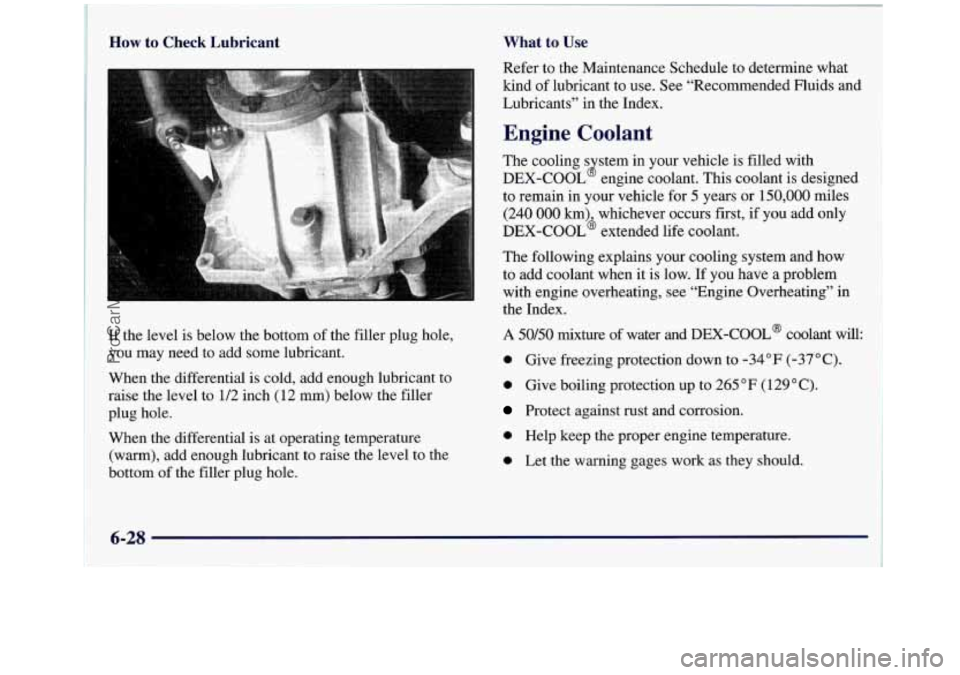
How to Check Lubricant
If the level is below the bottom of the filler plug hole,
you may need to add some lubricant.
When the differential is cold, add enough lubricant to
raise the level to 1/2 inch (12
mrn) below the filler
plug hole.
When the differential is at operating temperature
(warm), add enough lubricant to raise the level to the
bottom
of the filler plug hole.
What to Use
Refer to the Maintenance Schedule to determine what
kind of lubricant to use. See “Recommended Fluids and
Lubricants” in the Index.
Engine Coolant
The cooling s stem in your vehicle is filled with
DEX-COOL engine coolant. This coolant is designed
~
to remain in your vehicle for 5 years or 150,000 miles I
(240 000 km) whichever occurs first, if you add only ~
DEX-COOL’ extended life coolant.
8
The following explains your cooling system and how
to add coolant when it is low. If you have a problem
i
with engine overheating, see “Engine Overheating” in 1
the Index.
A 50/50 mixture of water and DEX-COOL@ coolant will: 1
0 Give freezing protection down to -34°F (-37°C).
0 Give boiling protection up to 265 OF (1 29 O C).
Protect against rust and corrosion.
0 Help keep the proper engine temperature.
0 Let the warning gages work as they should.
6-28 ;L
ProCarManuals.com
Page 319 of 452
NOTICE:
When adding coolant, it is important that you use
only
DEX-COOL@ (silicate-free) coolant.
If coolant other than DEX-COOL is added to the
system, premature engine, heater core or
radiator corrosion may result. In addition, the
engine coolant will require change sooner
-- at
30,000 miles (50 000 km) or 24 months,
whichever occurs first. Damage caused by the use
of coolant other than DEX-COOL@ is not
covered by your new vehicle warranty.
What to Use
Use a mixture of one-half clean water (preferably
distilled) and one-half
DEX-COOL@ coolant which
won’t damage aluminum
parts. If you use this mixture,
you don’t need to add anything else.
CAUTION:
Adding only plain water to your cooling system
can be dangerous. Plain water, or some other
liquid like alcohol, can boil before the proper
coolant mixture will. Your vehicle’s coolant
warning system is set for the proper coolant
mixture. With plain water or the wrong mixture,
your engine could get too hot but you wouldn’t
get the overheat warning. Your engine could
catch fire and you or others could be burned.
Use a
50/50 mixture of clean water and
DEX-COOL@ coolant.
6-29
ProCarManuals.com
Page 327 of 452
NOTICE:
0
0
Using the wrong fluid can badly damage
brake system parts. For example, just a few
drops of mineral-based oil, such as engine
oil, in your brake system can damage brake
system parts
so badly that they’ll have to be
replaced. Don’t let someone put in the
wrong kind of fluid.
If you spill brake fluid on your vehicle’s
painted surfaces, the paint finish can be
damaged.
Be careful not to spill brake fluid
on your vehicle. If you do, wash it
off
immediately. See “Appearance Care” in
the Index.
Brake Wear
If you have a C 3500 HD model, it has four-wheel disc
brakes without wear indicators. If you ever hear
a brake
rubbing noise, have the brake linings inspected.
If your pickup is not a
C 3500 HD model, it has front
disc brakes and rear drum brakes. Disc brake pads
(except
C 3500 HD models) have
built-in wear indicators that make a high-pitched
warning sound when the brake pads are worn and new
pads
are needed. The sound may come and go or be
heard
all the time your vehicle is moving (except when
you are pushing
on the brake pedal firmly).
I
The brake wear warning sound means that soon
your brakes won’t work well. That could lead to
an accident. When you hear the brake wear
warning sound, have your vehicle serviced.
I NOTICE:
Continuing to drive with worn-out brake pads
could result in costly brake repair.
6-37
ProCarManuals.com
Page 352 of 452
Cleaning the Inside of Your Vehicle
Use a vacuum cleaner often to get rid of dust and loose
dirt. Wipe
vinyl, leather, plastic and painted surfaces
with a clean, damp cloth.
Your dealer has two cleaners, Multi-Purpose Interior
Cleaner and Capture Non-Solvent Dry Spot and Soil
Remover for cleaning fabric and carpet. They
will
clean normal spots and stains very well. You can get
GM-approved cleaning products from your dealer. (See
“Appearance Care and Materials‘‘
in the Index.)
Here are some cleaning tips:
Always read the instructions on the cleaner label.
Clean up stains as soon
as you can -- before they set.
Carefully scrape
off any excess stain.
Use a clean cloth or sponge, and change to a
clean area often.
A soft brush may be used if
stains are stubborn.
If a ring forms after spot cleaning, clean the entire
area immediately
or it will set.
Using Multi-Purpose Interior Cleaner
on Fabric
1.
2.
3.
4.
5.
6.
7.
Vacuum and brush the area to remove any loose dirt.
Always clean a whole trim panel or section.
Mask
surrounding trim along stitch or welt lines.
Mix powdered cleaner following the directions on
the container label to form thick suds.
Use suds only and apply with a clean sponge. Don’t
saturate the material and don’t rub
it roughly.
As soon as you’ve cleaned the section, use a sponge
to remove the suds.
Wipe cleaned area with
a clean, damp towel or cloth.
Wipe with a clean cloth and let dry.
6-62
ProCarManuals.com
Page 353 of 452
Special Fabric Cleaning Problems
Stains caused by catsup, coffee (black), egg, fruit, fruit
juice, milk, soft drinks, wine, vomit, urine and blood can
be removed as follows:
1. Carefully scrape off excess stain, then sponge the
soiled area with cool water.
2. If a stain remains, follow the multi-purpose interior
3.
If an odor lingers after cleaning vomit or urine, treat
cleaner instructions described
earlier.
the area
with a watedbaking soda solution:
1 teaspoon (5 ml) of baking soda to I cup (250 ml)
of lukewarm water.
4. Let dry.
Stains caused by candy, ice cream, mayonnaise, chili
sauce and unknown stains can be removed as follows:
1. Carefully scrape off excess stain.
2. First, clean with cool water and allow to
dry completely.
Multi-Purpose Interior Cleaner.
3.
If a
stain remains, follow instructions for
Fabric Protection
Your vehicle has upholstery and carpet that has been
treated
with Scotchgard" Fabric Protector, a 3M
product. It protects fabrics by repelling oil and water,
which are the carriers
of most stains. Even with this
protection, you still need to clean your upholstery and
carpet often to keep it looking new.
Further information on cleaning is available by calling
1-800-433-3296
(in Minnesota, 1-800-642-6167).
Cleaning Vinyl
Use warm water and a clean cloth.
0 Rub with a clean, damp cloth to remove dirt. You
may have to
do it more than once.
Things like tar, asphalt and shoe polish will stain if you
don't get them off quickly. Use a clean cloth and a
vinyVleather cleaner. See your dealer for this product.
6-63
ProCarManuals.com
Page 354 of 452
Cleaning Leather
Use a soft cloth with lukewarm water and a mild soap or
saddle soap and wipe dry with a soft cloth. Then, let the
leather dry naturally.
Do not use heat to dry.
For stubborn stains, use a leather cleaner. See your
dealer for this product.
Never use oils, varnishes, solvent-based or abrasive
cleaners, furniture polish or shoe polish on leather.
Soiled or stained leather should be cleaned
immediately.
If dirt is allowed to work into the
finish, it can harm the leather.
Cleaning the Top of the Instrument Panel
Use only mild soap and water to clean the top surfxes
of the instrument panel. Sprays containing silicones or
waxes may cause annoying reflections in the windshield
and even make
it difficult to see through the windshield
under certain conditions.
Cleaning Interior Plastic Components
Use only a mild soap and water solution on a soft
cloth or sponge. Commercial cleaners may affect the
surface finish.
Care of Safety Belts
Keep belts clean and dry.
Do not bleach or dye safety belts. If you do, it
may severely weaken them. In a crash, they
might not be able to provide adequate protection.
Clean safety belts only with mild soap and
lukewarm water.
6-64
ProCarManuals.com