transmission GMC SIERRA 1998 Owner's Manual
[x] Cancel search | Manufacturer: GMC, Model Year: 1998, Model line: SIERRA, Model: GMC SIERRA 1998Pages: 452, PDF Size: 23.65 MB
Page 208 of 452
What should I do if my vehicle stalls, or is about
to stall, and I can’t make it up the hill?
A: If this happens, there are some things you should
do, and there
are some things you must not do.
First, here’s what you
should do:
0 Push the brake pedal to stop the vehicle and keep it
from rolling backwards.
Also, apply the parking brake.
0 If your engine is still running, shift the transmission
to REVERSE (R), release the parking brake, and
slowly back down the hill in REVERSE (R).
0 If your engine has stopped running, you’ll need to
restart
it. With the brake pedal depressed and the
parking brake still applied, shift the transmission to
PARK
(P) (or, shift to NEUTRAL (N) if your
vehicle has a manual transmission) and restart the
engine. Then, shift to REVERSE (R), release the
parking brake, and slowly back down the hill as
straight as possible in REVERSE (R).
0 As you are backing down the hill, put your left hand
on the steering wheel at the 12 o’clock position. This
way, you’ll be able to tell if your wheels are straight
and maneuver as you back down. It’s best that you back down
the hill with your wheels straight rather
than in the left or right direction. Turning the wheel
too far to the left or right will increase the possibility
of a rollover.
Here are some things you
must not do if you stall, or are
about to stall, when going up a hill.
0 Never attempt to prevent a stall by shifting into
NEUTRAL (N) (or depressing the clutch, if you
have a manual transmission) to “rev-up” the engine
and regain forward momentum. This won’t work.
Your vehicle will roll backwards very quickly and
you could
go out of control.
Instead, apply the regular brake to stop the vehicle.
Then apply the parking brake. Shift to
REVERSE (R), release the parking brake, and slowly back straight down.
Never attempt to turn around if you are about to stall
when going up a hill. If the hill is steep enough
to
stall your vehicle, it’s steep enough to cause you to
roll over if
you turn around. If you can’t make it up
the hill,
you must back straight down the hill.
4-20
ProCarManuals.com
Page 209 of 452
@ Suppose, after stalling, I try to back down the
hill and decide
I just can’t do it. What should
I do?
A: Set the parking brake, put your transmission in
PARK (P) (or the manual transmission in
FIRST (1)) and turn off the engine. Leave the
vehicle
and go get some help. Exit on the uphill
side and stay clear of
the path the vehicle would
take if it rolled downhill. Do not shift the transfer
case
to NEUTRAL (N) when you leave the vehicle.
Leave
it in some gear. Shifting the transfer case to NEUTRAL
(N) can
cause your vehicle to roll even if the transmission
is in PARK
(P) (or, if you have the manual
transmission, even if you’re in gear). This is
because the NEUTRAL
(N) position on the
transfer case overrides the transmission.
You or
someone else could be injured.
If you are going to
leave your vehicle, set the parking brake and
shift the transmission to PARK
(P) (or, put your
manual transmission in FIRST
(1)). But do not
shift the transfer case to the NEUTRAL (N)
position. Leave the transfer case in the
2 Wheel,
4 High or 4 Low position.
4-21
ProCarManuals.com
Page 210 of 452
Driving Downhill
When off-roading takes you downhill, you’ll want to
consider
a number of things:
How steep is the downhill? Will I be able to maintain
vehicle control?
What’s the surface like? Smooth‘? Rough‘? Slippery?
Hard-packed dirt? Gravel?
Are there hidden surfxe obstacles’? Ruts? Logs?
Boulders?
What’s at the bottom of the hill‘? Is there a hidden
creek bank or even
a river bottom with large rocks‘?
If you decide you can go down a hill safely, then try to
keep your vehicle headed straight down, and use a low
gear. This way, engine drag can help your brakes and
they won’t have to do all the work. Descend slowly,
keeping your vehicle under control at all times.
Heavy braking when going down a hill can cause
your brakes to overheat and fade. This could cause
loss of control and a serious accident. Apply the
brakes lightly when descending a hill and use a
low
gear to keep vehicle speed under control.
Are there some things
I should not do when
driving down a hill?
A: Yes! These are important because if you
0
0
ignore them you could lose control and have a
serious accident.
When driving downhill, avoid turns that take you
across the incline of the
hill. A hill that’s not too
steep to drive down may be too steep to drive across.
You could
roll over if you don’t drive straight down.
Never
go downhill with the transmission in
NEUTRAL (N), or with the clutch pedal depressed
in a manual shift. This is called “free-wheeling.”
Your brakes
will have to do all the work and could
overheat
and fade.
4-22
ProCarManuals.com
Page 211 of 452
Q.' Am I likely to stall when going downhill?
A: It's much more likely to happen going uphill. But if
it happens going downhill, here's what to do.
Stop your vehicle by applying the regular brakes.
Apply the parking brake.
Shift to PARK (Pj (or to NEUTRAL (Nj with the
manual transmission) and, while still braking, restart
the engine.
Shift back to a low gear, release the parking brake,
and drive straight down.
0 If the engine won't start, get out and get help.
Driving Across an Incline
Sooner or later, an off-road trail will probably go across
the incline of a
hill. If this happens, you have to decide
whether to try to drive across the incline. Here are some
things to consider:
A hill that can be driven straight up or down may be
too steep to drive across. When you go straight up or
down a
hill, the length of the wheel base (the
distance from the front wheels to the rear wheels)
reduces the likelihood the vehicle will tumble end over end.
But when
you drive across an incline, the
much more narrow track width (the distance between
the left and right wheels) may not prevent the vehicle
from tilting and rolling over.
Also, driving across an
incline puts more weight on the downhill wheels.
This could cause
a downhill slide or a rollover.
Surface conditions can be a problem when you drive
across
a hill. Loose gravel, muddy spots, or even wet
grass can cause your tires to slip sideways, downhill.
If the vehicle slips sideways, it can hit something
that will trip
it (a rock, a rut, etc.) and roll over.
Hidden obstacles can make the steepness of the
incline even worse.
If you drive across a rock with
the uphill wheels, or
if the downhill wheels drop into
a rut or depression, your vehicle can tilt even more.
For reasons like these, you need to decide carefully
whether to try to drive across an incline. Just because
the trail goes across the incline doesn't mean you
have to drive it. The last vehicle to try
it might have
rolled over.
4-23
ProCarManuals.com
Page 223 of 452
0
0
Keep your vehicle in good shape. Check all fluid
levels and also the brakes, tires, cooling system and
transmission. These parts can work hard on
mountain roads.
Know how to go down hills. The most important
thing to know
is this: let your engine do some of the
slowing down. Shift to
a lower gear when you go
down a steep or long hill.
I A CAJTION: I
If you don’t shift down, your brakes could get so
hot that they wouldn’t work well. You would then
have poor braking or even none going down
a hill.
You could crash. Shift down to let your engine
assist your brakes on a steep downhill slope. Coasung
aownhill in NEUTRAL
(N) or with the
ignition
off is dangerous. Your brakes will have
to do all the work
of slowing down. They could
get
so hot that they wouldn’t work well. You
would then have poor braking or even none going
down
a hill. You could crash. Always have your
engine running and your vehicle in gear when
you go downhill.
0
0
Know how ro g6 uphill. You may want to shift down
to a lower gear.
The lower gears help cool your engine
and transmission, and you can climb the hill better.
Stay in your own lane when driving on two-lane
roads in hills or mountains. Don’t swing wide or cut
across the center
of the road. Drive at speeds that let
you stay in your own lane.
0
0 As you go over the top of a hill, be alert. There could be
something in your lane, like a stalled car
or an accident.
You may see highway signs
on mountains that warn of
special problems. Examples are long grades, passing or
no-passing zones, a falling rocks area or winding
roads. Be alert
to these and take appropriate action.
4-35
ProCarManuals.com
Page 229 of 452
Recreational Vehicle Towing
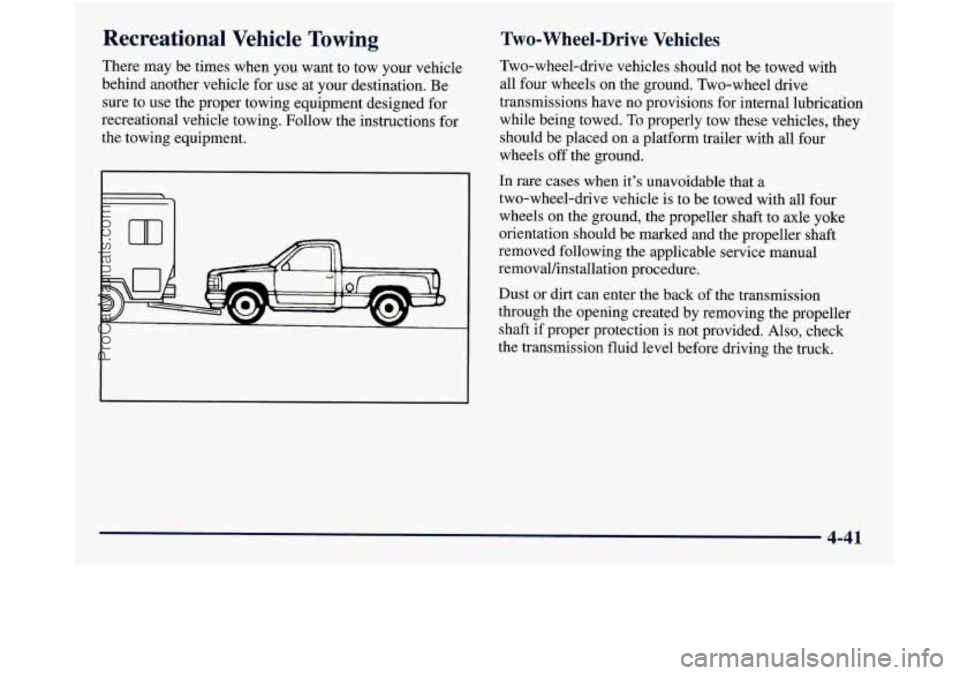
There may be times when you want to tow your vehicle
behind another vehicle for use at your destination. Be
sure to use the proper towing equipment designed for
recreational vehicle towing. Follow the instructions for
the towing equipment.
I
I1
c
Two-Wheel-Drive Vehicles
Two-wheel-drive vehicles should not be towed with
all four wheels on the ground. Two-wheel drive
transmissions have no provisions for internal lubrication
while being towed. To properly tow these vehicles, they
should be placed on a platform trailer with all four
wheels off the ground.
In
rare cases when it's unavoidable that a
two-wheel-drive vehicle is to be towed with all 'four
wheels on the ground, the propeller shaft to axle yoke
orientation should be marked and the propeller shaft
removed following the applicable service manual
removal/installation procedure.
Dust or dirt can enter the back of the transmission
through the opening created by removing the propeller
shaft if proper protection is not provided. Also, check
the transmission fluid level before driving the truck.
4-41
ProCarManuals.com
Page 230 of 452
Four-Wheel-Drive Vehicles
(Manual Transfer Case Only)
‘A
-
Shifting the transfer case into NEUTRAL (N) can
cause your vehicle to roll even if the transmission
is in
PARK (P), for an automatic transmission, or
if your vehicle is in gear, for
a manual
transmission.
You or others could be injured.
Make sure the parking brake is firmly set before
you shift the transfer case into NEUTRAL (N).
Use the following procedure to correctly tow your
vehicle on all four wheels:
1.
2.
3.
4.
5.
6.
Firmly set the parking brake.
Place the transmission in
PARK (P) or a manual
transmission in FIRST
(1).
Securely attach the vehicle being towed to the
tow vehicle.
With the engine running, shift the transfer case to
NEUTRAL
(N). See “Four-wheel Drive” in the
Index for the proper procedure to select the neutral
position for your vehicle.
Release the parking brake only after the vehicle
being towed is firmly attached to the towing vehicle.
Turn the ignition to
OFF, The OFF position unlocks the
steering column and reduces battery
drain. Unlocking
the steering column will allow the proper movement
of
the front wheels and tires during towing.
4-42
ProCarManuals.com
Page 238 of 452
If You Do Decide To Pull A Trailer
If you do, here are some important points:
0
0
0
0
There are many different laws, including speed limit
restrictions, having to
do with trailering. Make sure
your rig will be legal, not only where you live but
also where you’ll be driving.
A good source for this
information
can be state or provincial police.
Consider using
a sway control if your trailer will
weigh less than
the capacity stamped on your step
bumper. You should always use a sway control
if
your trailer will weigh more than the capacity
stamped
on your step bumper. You can ask a hitch
dealer about sway controls.
Don’t tow a trailer at all during the first
500 miles
(800 km) your new vehicle is driven. Your engine,
axle or other parts could be damaged.
Then, during the first
500 miles (800 km) that you
tow
a trailer, don’t drive over 50 mph (80 kdh) and
don’t make starts at
full throttle. This helps your
engine and other parts
of your vehicle wear in at the
heavier loads.
0 If you have an automatic transmission, you can tow
in OVERDRIVE
(a). You may want to shift the
transmission to
THIRD (3) or, if necessary, a lower
gear selection if the transmission shifts too often
(e.g., under heavy loads and/or
hilly conditions). If
you have
a manual transmission and you are towing
a trailer, it’s better not to use
FIFTH (5) gear. Just
drive
in FOURTH (4) gear (or, as you need to, a
lower gear).
Three important considerations have
to do with weight:
0 the weight of the trailer,
0 the weight of the trailer tongue
0 and the weight on your vehicle’s tires.
Weigl- - 3e Trailer
How heavy can a trailer safely be?
It depends
on how you plan to use your rig. For
example, speed, altitude, road grades, outside
temperature and how much your vehicle is used to
pull a
trailer are all important. And,
it can also depend on any
special equipment that you have
on your vehicle.
4-50
ProCarManuals.com
Page 246 of 452
Driving On Grades
Reduce speed and shift to a lower gear before you start
down a long or steep downgrade. If
you don’t shift
down,
you might have to use your brakes so much that
they would
get hot and no longer work well.
On a long uphill grade, shift down and reduce your
speed
to around 45 mph (70 kdh) to reduce the
possibility
of engine and transmission overheating.
If you have an automatic transmission, you can tow in
AUTOMATIC OVERDRIVE
(@). You may want to
shift the transmission
to THIRD (3) or, if necessary, a
lower gear selection
if the transmission shifts too often
(e.g., under heavy loads and/or hilly conditions).
If
you have a manual transmission and you are towing a
trailer, it’s better not to
use FIFTH (5) gear. Just drive in
FOURTH
(4) gear (or, as you need to, a lower gear).
When towing at high altitude
on steep uphill grades,
consider the following: Engine coolant
will boil at a
lower temperature than at normal altitudes. If you turn
your engine off immediately after towing
at high altitude
on steep uphill grades, your vehicle may show signs
similar to engine overheating. To avoid this, let the
engine run while parked (preferably on level ground) with
the automatic transmission in
PARK (P) (or the
manual transmission out of gear and the parking brake
applied) for a few minutes before turning the engine
off.
If you do get the overheat warning, see “Engine
Overheating’’ in
the Index.
Parking on Hills
You really should not park your vehicle, with a trailer
attached, on a
hill. If something goes wrong, your rig
could start to move. People can be injured, and both
your vehicle and the trailer can be damaged.
But
if you ever have to park your rig on a hill, here’s
how to do it:
1.
2.
3.
4.
Apply your regular brakes, but don’t shift into
PARK
(P) yet for an automatic transmission, or into
gear for a manual transmission.
Have someone place chocks under the trailer wheels.
When the wheel chocks are
in place, release the
regular brakes until the chocks absorb the load.
Reapply the regular brakes. Then apply your parking brake and
shift into PARK (P) for an automatic
transmission, or REVERSE (R)
for a manual
transmission.
4-58
ProCarManuals.com
Page 247 of 452
5. If you have a four-wheel-drive vehicle,
be sure the transfer case is in
a drive gear and not
in
NEUTRAL (N).
6. Release the regular brakes.
-
/r CAUTIOIA:
It can be dangerous to get out of your vehicle if
the shift lever is not fully in
PARK (P) with the
parking brake firmly set. Your vehicle can roll.
If you have left the engine running, the vehicle
can move suddenly. You or others could be
injured.
To be sure your vehicle won’t move, even
when you’re on fairly level ground, use the steps
that follow.
If you have four-wheel drive and your transfer
case is in
NEUTRAL (N), your vehicle will be free
to
roll, even if your shift lever is in PARK (P). So,
be sure the transfer case is in a drive gear -- not
in
NEUTRAL (N).
When You Are Ready to Leave After
Parking
on a Hill
1. Apply your regular brakes and hold the pedal down
while you:
Start your engine;
Shift into a gear; and
Release the parking brake.
2. Let up on the brake pedal.
3. Drive slowly
until the trailer is clear of the chocks.
4. Stop and have someone pick up and store the chocks.
Maintenance When Trailer Towing
Your vehicle will need service more often when you’re
pulling
a trailer. See the Maintenance Schedule for more
on this. Things that are especially important
in trailer
operation are automatic transmission fluid (don’t
overfill), engine
oil, axle lubricant, belt, cooling system
and brake adjustment. Each of these is covered in this
manual, and the Index will help you find them quickly.
If you’re trailering, it’s a good idea to review these
sections before
you start your trip.
Check periodically
to see that all hitch nuts and bolts
are tight.
ProCarManuals.com