belt GMC SIERRA 1998 Repair Manual
[x] Cancel search | Manufacturer: GMC, Model Year: 1998, Model line: SIERRA, Model: GMC SIERRA 1998Pages: 452, PDF Size: 23.65 MB
Page 204 of 452
Traveling to Remote Areas
It makes sense to plan your trip, especially when going
to a remote area. Know
the terrain and plan your route.
You are much less likely to get bad surprises. Get
accurate maps of trails and terrain. Try to learn of any
blocked or closed roads. Controlling your vehicle
is
the key to successful
off-road driving. One of the best ways
to control your
vehicle
is to control your speed. Here are some things to
keep
in mind. At higher speeds:
0 you approach things faster and you have less time to
scan the terrain for obstacles.
It’s also
a good idea to travel with at least one other
vehicle. If something happens to one of them, the other
can help quickly. you have less time to react.
0 you have more vehicle bounce when you drive
over obstacles.
Does your vehicle have a winch?
If so, be sure to read
the winch instructions. In a remote area, a winch can be
handy
if you get stuck. But you’ll want to know how to
use
it properly.
Getting Familiar with Off-Road Driving
It’s a good idea to practice in an area that’s safe and
close to home before you
go into the wilderness.
Off-road driving does require some new and different
driving skills. Here’s what we mean.
Tune your senses to different kinds of signals. Your
eyes, for example, need to constantly sweep the terrain
for unexpected obstacles. Your ears need to listen for
unusual tire or engine sounds. With your arms, hands,
feet and body, you’ll need
to respond to vibrations and
vehicle bounce.
0 you’ll need more distance for braking, especially
since you’re on an unpaved surface.
When you’re driving off-road, bouncing and
quick changes in direction can easily throw you
out of position. This could cause you to lose
control and crash.
So, whether you’re driving on
or
off the road, you and your passengers should
wear safety belts.
ProCarManuals.com
Page 247 of 452
5. If you have a four-wheel-drive vehicle,
be sure the transfer case is in
a drive gear and not
in
NEUTRAL (N).
6. Release the regular brakes.
-
/r CAUTIOIA:
It can be dangerous to get out of your vehicle if
the shift lever is not fully in
PARK (P) with the
parking brake firmly set. Your vehicle can roll.
If you have left the engine running, the vehicle
can move suddenly. You or others could be
injured.
To be sure your vehicle won’t move, even
when you’re on fairly level ground, use the steps
that follow.
If you have four-wheel drive and your transfer
case is in
NEUTRAL (N), your vehicle will be free
to
roll, even if your shift lever is in PARK (P). So,
be sure the transfer case is in a drive gear -- not
in
NEUTRAL (N).
When You Are Ready to Leave After
Parking
on a Hill
1. Apply your regular brakes and hold the pedal down
while you:
Start your engine;
Shift into a gear; and
Release the parking brake.
2. Let up on the brake pedal.
3. Drive slowly
until the trailer is clear of the chocks.
4. Stop and have someone pick up and store the chocks.
Maintenance When Trailer Towing
Your vehicle will need service more often when you’re
pulling
a trailer. See the Maintenance Schedule for more
on this. Things that are especially important
in trailer
operation are automatic transmission fluid (don’t
overfill), engine
oil, axle lubricant, belt, cooling system
and brake adjustment. Each of these is covered in this
manual, and the Index will help you find them quickly.
If you’re trailering, it’s a good idea to review these
sections before
you start your trip.
Check periodically
to see that all hitch nuts and bolts
are tight.
ProCarManuals.com
Page 347 of 452
The tires installed on your vehicle when it was new had
a Tire Performance Criteria Specification (TPC Spec)
number on each tire’s sidewall. When
you get new tires,
get ones with that same TPC Spec number. That way
your vehicle will continue to have tires that are designed
to give proper endurance, handling, speed rating,
traction, ride and other things during normal service
on
your vehicle. If your tires have an all-season tread
design, the
TPC number will be followed by an “MS”
(for mud and snow).
If you ever replace your tires with those not having a
TPC Spec number, make sure they are the same size,
load range, speed rating and construction type (bias,
bias-belted or radial) as your original tires.
Mixing tires could cause you to lose control while
driving.
If you mix tires of different sizes or types
(radial and bias-belted tires), the vehicle may not
handle properly, and you could have a crash.
Using tires of different sizes may also cause
damage to your vehicle. Be sure to use the same
size and type tires on all wheels.
I A CAUTION:
If you use biasuply tires on your vehicle, the
wheel rim flanges could develop cracks after
many miles of driving.
A tire and/or wheel could
fail suddenly, causing a crash. Use only radial-ply
tires with the wheels on your vehicle.
Uniform Tire Quality Grading
The following information relates to the system
developed by the United States National Highway
Traffic Safety Administration, which grades tires by
I treadwear, traction and temperature performance. (This
applies only to vehicles sold
in the United States.) The
grades are molded on the sidewalls of most passenger
car tires. The Uniform Tire Quality Grading system does
not apply to deep tread, winter-type snow tires,
space-saver or temporary use spare tires, tires
with
nominal rim diameters of 10 to I2 inches (25 to 30 cm),
or to some limited-production tires.
6-57
ProCarManuals.com
Page 354 of 452
Cleaning Leather
Use a soft cloth with lukewarm water and a mild soap or
saddle soap and wipe dry with a soft cloth. Then, let the
leather dry naturally.
Do not use heat to dry.
For stubborn stains, use a leather cleaner. See your
dealer for this product.
Never use oils, varnishes, solvent-based or abrasive
cleaners, furniture polish or shoe polish on leather.
Soiled or stained leather should be cleaned
immediately.
If dirt is allowed to work into the
finish, it can harm the leather.
Cleaning the Top of the Instrument Panel
Use only mild soap and water to clean the top surfxes
of the instrument panel. Sprays containing silicones or
waxes may cause annoying reflections in the windshield
and even make
it difficult to see through the windshield
under certain conditions.
Cleaning Interior Plastic Components
Use only a mild soap and water solution on a soft
cloth or sponge. Commercial cleaners may affect the
surface finish.
Care of Safety Belts
Keep belts clean and dry.
Do not bleach or dye safety belts. If you do, it
may severely weaken them. In a crash, they
might not be able to provide adequate protection.
Clean safety belts only with mild soap and
lukewarm water.
6-64
ProCarManuals.com
Page 375 of 452
Maintenance Schedule
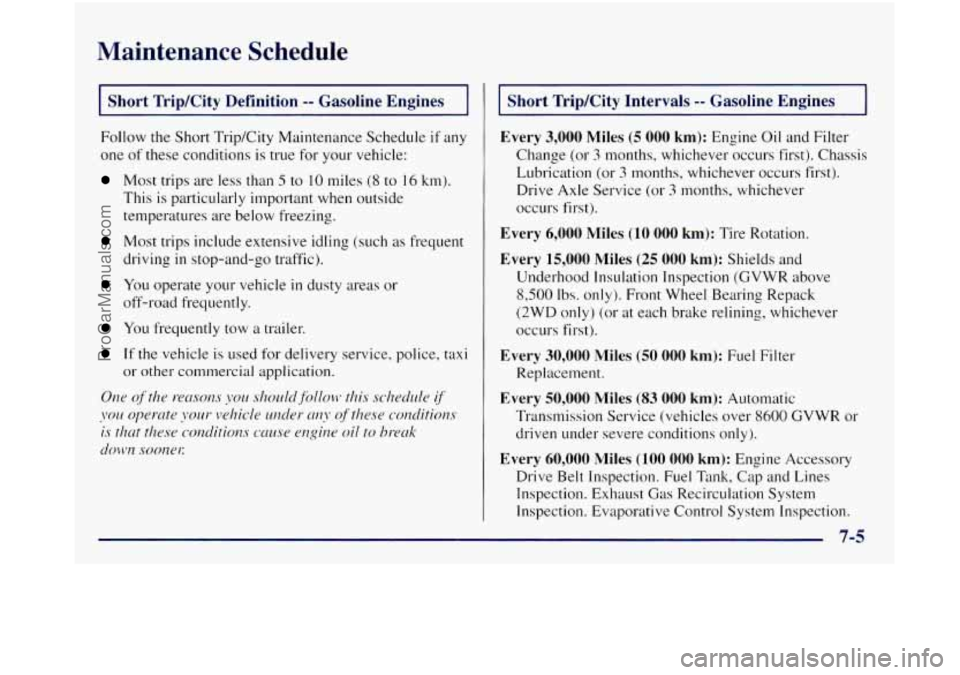
Short Trip/City Definition -- Gasoline Engines
Follow the Short Trip/City Maintenance Schedule if any
one of these conditions is true for your vehicle:
Most trips are less than 5 to 10 miles (8 to I6 km).
This is particularly important when outside
temperatures are below freezing.
Most trips include extensive idling (such as frequent
driving
in stop-and-go traffic).
You operate your vehicle in dusty areas or
off-road frequently.
You frequently tow a trailer.
If the vehicle is used for delivery service, police, taxi
or other commercial application.
One oj*tlw reclsorzs yo14 sl~or.~ld~foIlo~~~ this scI~edniv if
you operate yo1.w vehicle urlcler CIIZJ ojthese cor-zditions
is that these cwm1ition.s CCJLIS~ eqirw oil to break
dOC1!12 Sool-zel:
Short Trip/City Intervals -- Gasoline Engines
Every
3,000 Miles (5 000 km): Engine Oil and Filter
Change (or 3 months, whichever occurs first). Chassis
Lubrication (or 3 months, whichever occurs first).
Drive Axle Service (or 3 months, whichever
occurs first).
Every 6,000 Miles (10 000 km): Tire Rotation.
Every 15,000 Miles (25 000 km): Shields and
Underhood Insulation Inspection (GVWR above
8,500 lbs. only). Front Wheel Bearing Repack
(2WD only) (or at each brake relining, whichever
occurs first).
Every 30,000 Miles (50 000 km): Fuel Filter
Every 50,000 Miles (83 000 km): Automatic
Replacement.
Transmission Service (vehicles over
8600 GVWR or
driven under severe conditions only).
Every 60,000 Miles (100 000 km): Engine Accessory
Drive Belt Inspection. Fuel Tank, Cap and Lines
Inspection. Exhaust Gas Recirculation System
Inspection. Evaporative Control System Inspection.
ProCarManuals.com
Page 377 of 452
Maintenance Schedule
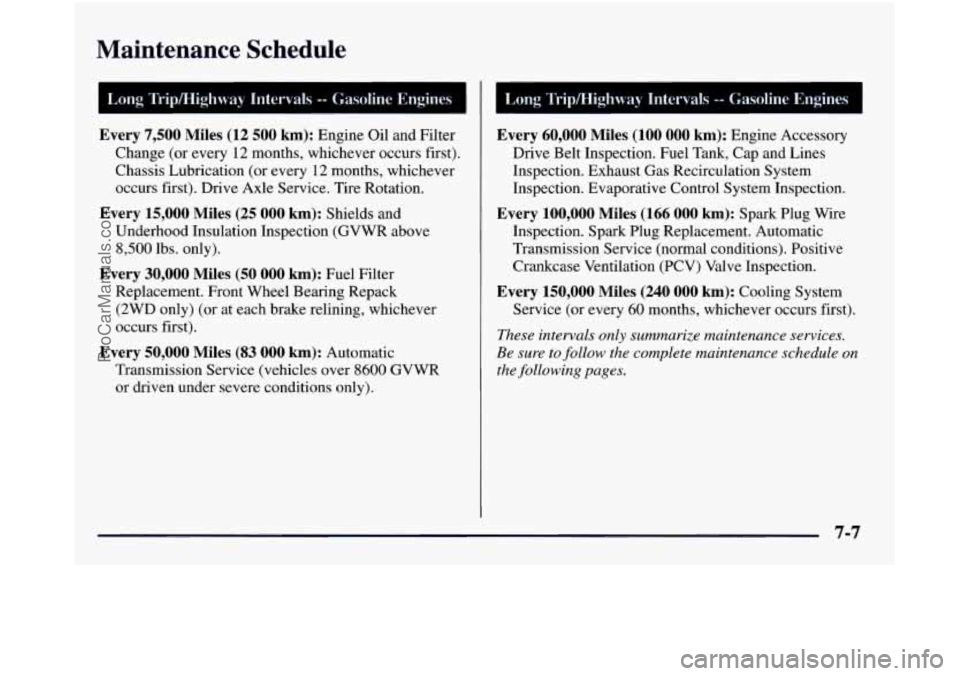
Long TriplHighway Intervals -- Gasoline Engines
Every
7,500 Miles (12 500 km): Engine Oil and Filter
Change (or every 12 months, whichever occurs first).
Chassis Lubrication (or every
12 months, whichever
occurs first). Drive Axle Service. Tire Rotation.
Every 15,000 Miles (25 000 km): Shields and
Underhood Insulation Inspection (GVWR above
8,500 lbs. only).
Every 30,000 Miles (50 000 km): Fuel Filter
Replacement. Front Wheel Bearing Repack
(2WD only) (or at each brake relining, whichever
occurs first).
Every 50,000 Miles (83 000 km): Automatic
Transmission Service (vehicles over
8600 GVWR
or driven under severe conditions only).
I Long; TripMighway Intervals -- Gasoline Engines I
Every 60,000 Miles (100 000 km): Engine Accessory
Drive Belt Inspection. Fuel Tank, Cap and Lines
Inspection. Exhaust Gas Recirculation System
Inspection. Evaporative Control System Inspection.
Every 100,000 Miles (166 000 km): Spark Plug Wire
Inspection. Spark Plug Replacement. Automatic
Transmission Service (normal conditions). Positive
Crankcase Ventilation (PCV) Valve Inspection.
Every 150,000 Miles (240 000 km): Cooling System
Service (or every
60 months, whichever occurs first).
These intervals only summarize maintenance services.
Be sure to follow the complete maintenance schedule on
the following pages.
7-7
ProCarManuals.com
Page 389 of 452
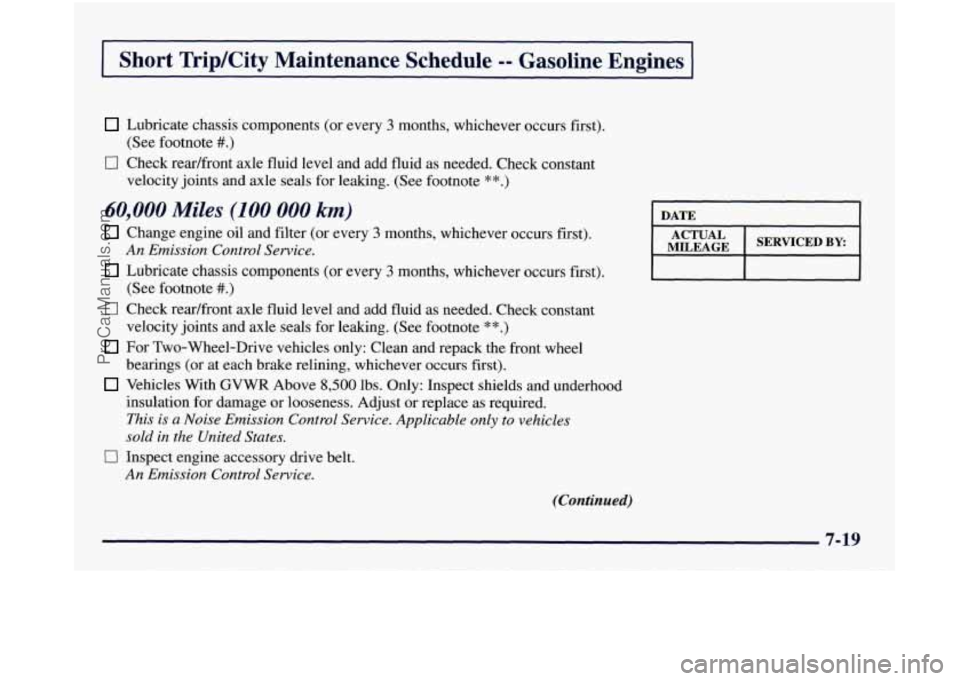
I Short Trip/City Maintenance Schedule -- Gasoline Engines I
Lubricate chassis components (or every 3 monms, whichever occurs first).
0 Check readfront axle fluid level and add fluid as needed. Check constant
(See
footnote
#.)
velocity joints and axle seals for leaking. (See footnote **.)
60,000 Miles (100 000 km)
Change engine oil and filter (or every 3 months, whichever occurs first).
An Emission Control Service.
Lubricate chassis components (or every 3 months, whichever occurs first).
0 Check readfront axle fluid level and add fluid as needed. Check constant
For Two-Wheel-Drive vehicles only: Clean and repack the front wheel
Vehicles With GVWR Above 8,500 lbs. Only: Inspect shields and underhood
(See footnote
#.)
velocity
joints and axle seals for leaking. (See footnote **.)
bearings (or at each brake relining, whichever occurs first).
insulation for damage or looseness. Adjust or replace
as required.
This is a Noise Emission Control Service. Applicable only to vehicles
sold in the United States.
An Emission Control Service.
0 Inspect engine accessory drive belt.
DATE I
MILEAGE
(Continued)
ProCarManuals.com
Page 404 of 452
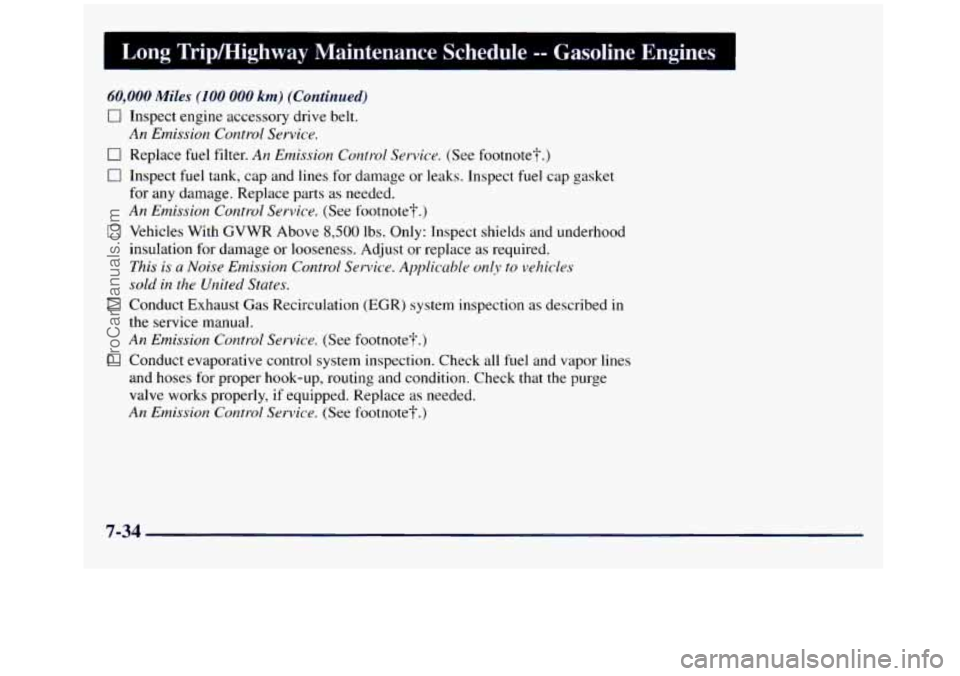
I Lono Tripmighway Maintenance Schedule -- Gasoline Engines I
-
,000 Miles (100 000 km) (Continued)
An Emission Control Service.
0 Inspect engine
accessory drive belt.
0 Replace fuel filter. An Em.issiorz Control Service. (See footnote?.)
0 Inspect fuel tank, c.ap and lines for damage or leaks. inspect fuel cap gasket
for any damage. Replace parts as needed.
An Emission Control Service. (See footnote?.)
insulation for damage or looseness. Adjust or replace
as required.
This is a Noise Emission Control Service. Applical?lc) only to vehicles
sold in the United States.
the service manual.
An Emission Control Service. (See footnote?.)
17 Conduct evaporative control system inspection. Check all fuel and vapor lines
and hoses for proper hook-up, routing and condition. Check that the purge
valve works properly, if equipped. Replace as needed.
An Emission Control Sen,ic:e. (See footnote?.)
0 Vehicles With GVWR Above 8,500 lbs. Only: Inspect shields and underhood
0 Conduct Exhaust Gas Recirculation (EGR) system inspection as described in
7-34
ProCarManuals.com
Page 411 of 452
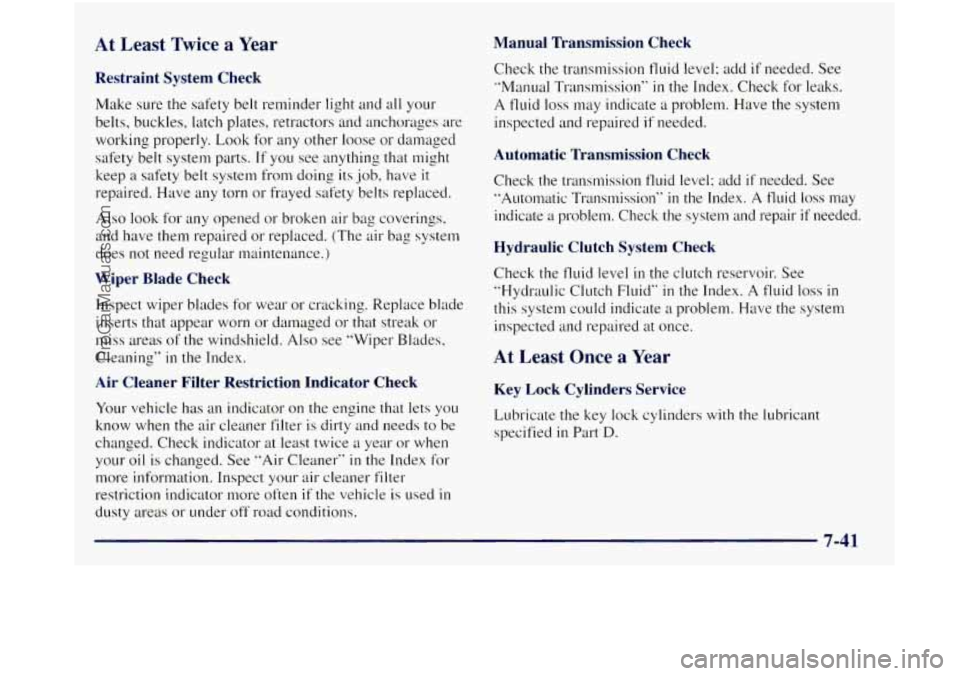
At Least Twice a Year Manual Transmission Check
Restraint System Check
Make sure the safety belt reminder light and all your
belts, buckles, latch plates, retractors and anchorages are
working properly. Look
for any other loose or damaged
safety belt system parts.
If you see anything that might
keep a safety belt system from doing its
job, ha\:e it
repaired. Have any torn or frayed safety belts replaced.
Also look for any opened or broken
air bag coverings,
and have them repaired or replaced. (The air
bag system
does
not need regular maintenance.)
Wiper Blade Check
Inspect wiper blades for wear or cracking. Replace blade
inserts that appear worn
or damaged or that streak or
miss areas
of the windshield. Also see "Wiper Blactes,
Cleaning"
in the Index.
Air Cleaner Filter Restriction Indicator Check
Your vehicle has an indicator on the engine that lets you
know when the air cleaner filter
is dirty and needs to be
changed. Check indicator at least twice
a year or when
your
oil is changed. See "Air Cleaner" in the Index for
more information. Inspect your air cleaner filter
restriction indicator more often
if the vehicle is used in
dusty areas or under off road conditions. Check the transmission fluid
level; add
if needed. See
"Manual Transmission"
in the Index. Check for leaks.
A fluid loss may indicate a problem. Have the system
inspected and repaired
if needed.
Automatic Transmission Check
Check the transmission fluid level: add if needed. See
"Automatic Transmission"
in the Index. A fluid loss may
indicate a problem. Check the system and repair
if needed.
Hydraulic Clutch System Check
Check the fluid level in the clutch reservoir. See
"Hydraulic Clutch Fluid"
in the Index. A fluid loss in
this system could indicate a problem. Have the system
inspected and repaired at once.
At Least Once a Year
Key Lock Cylinders Service
Lubricate the key lock cylinders with the lubricant
specified
in Part D.
7-41
ProCarManuals.com
Page 442 of 452
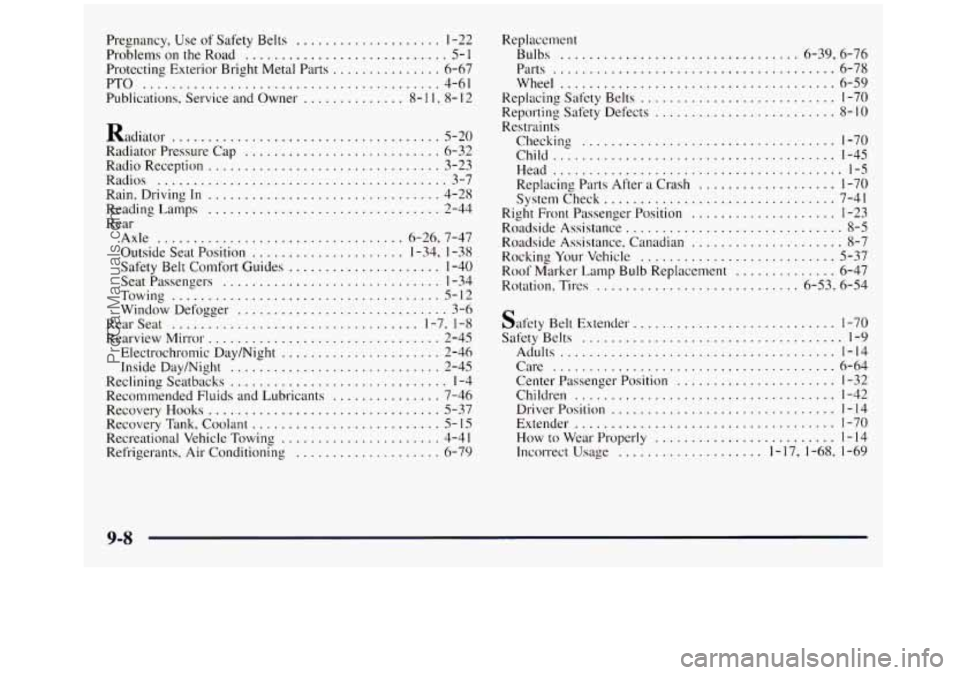
Pregnancy. Use of Safety Belts .................... 1-22
Problems on the Road ............................ 5- 1
Protecting Exterior Bright Metal Parts ............... 6-67
PTO
......................................... 4-61
Publications. Service and Owner
.............. 8- 1 I . 8- I2
Radiator
..................................... 5-20
Radiator Pressure Cap
........................... 6-32
Radio Reception
................................ 3-23
Radios
........................................ 3-7
Rain. Driving
In ................................ 4-28
Rear
Reading
Lamps
................................ 2-44
Axle
.................................. 6-26.7-47
Outside Seat Position
..................... 1-34. 1-38
Safety Belt Comfort Guides ..................... 1-40
Seat Passengers
.............................. 1-34
Towing
..................................... 5-12
Window Defogger ............................. 3-6
RearSeat
.................................. 1-7.1-8
Rearview Mirror
................................ 2-45
Electrochromic Day/Night
...................... 2-46
Inside Day/Night
............................. 2-45
Reclining Seatbacks
.............................. 1-4
Recommended Fluids and Lubricants
............... 7-46
Recovery
Hooks ................................ 5-37
Recovery Tank, Coolant
.......................... 5- 15
Recreational Vehicle Towin?
...................... 4-4 1
Refrigerants, Air Conditionlng .................... 6-79 Replacement
Bulbs
................................. 6.39. 6.76
Wheel
...................................... 6-59
Parts
....................................... 6-78
Replacing Safety Belts ........................... 1-70
Reporting Safety Defects ......................... 8-10
Restraints Checking
................................... 1-70
Child
....................................... 1-45
Head
........................................ 1-5
Replacing Parts After
a Crash ................... 1-70
System Check ................................ 7-41
Right Front Passenger Position
.................... 1-23
Roadside Assistance .............................. 8-5
Roadside Assistance. Canadian
..................... 8-7
Rocking Your Vehicle ........................... 5-37
Roof Marker Lamp Bulb Replacement
.............. 6-47
Rotation
. Tires ............................ 6-53. 6-54
Safety Bell Extender ............................ 1-70
Safety Belts .................................... 1-9
Adults ...................................... 1-14
Care
....................................... 6-64
Children .................................... 1-42
Driver Position
............................... 1-14
Extender
.................................... 1-70
Incorrect Usage
.................... 1 . 17. 1.68. 1-69
Center
Passenger Position
...................... 1-32
How to Wear Properly ......................... 1-14
9-8
ProCarManuals.com