lock GMC SIERRA 1998 Repair Manual
[x] Cancel search | Manufacturer: GMC, Model Year: 1998, Model line: SIERRA, Model: GMC SIERRA 1998Pages: 452, PDF Size: 23.65 MB
Page 262 of 452
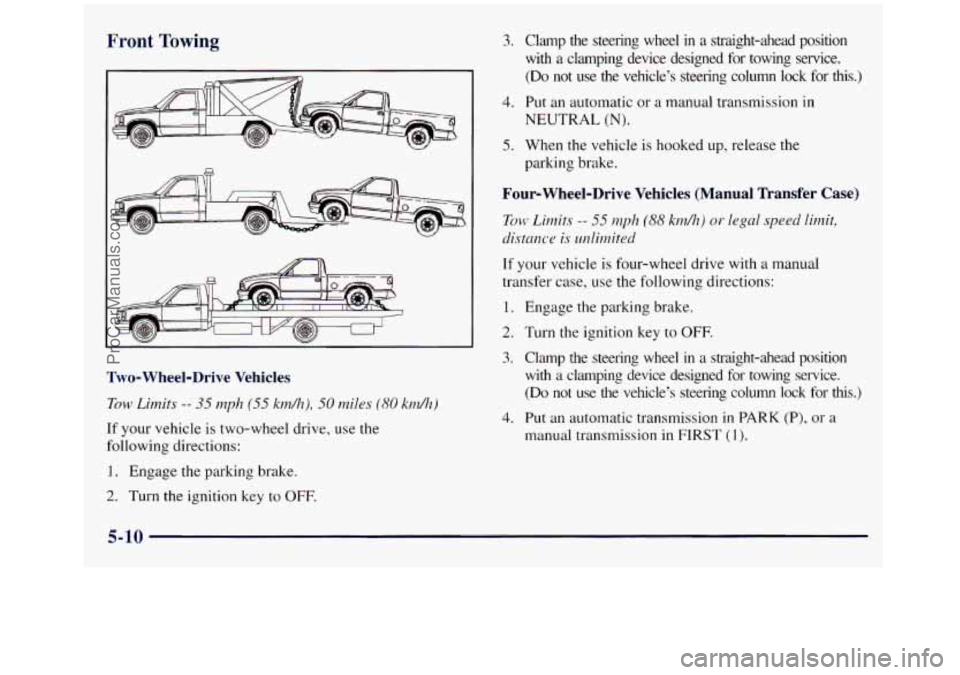
Front Towing
Two- Wheel-Drive Vehicles
Tow Lirnits -- 35 nzph (55 kdh), 50 miles (80 kr.n/h)
If your vehicle is two-wheel drive, use the
following directions:
I. Engage the parking brake.
2. Turn the ignition key to OFF.
3. Clamp the steering wheel in a straight-ahead position
with a clamping device designed for towing service.
(Do not use the vehicle’s steering column lock for this.)
4. Put an automatic or a manual transmission in
NEUTRAL (N).
5. When the vehicle is hooked up, release the
parking brake.
Four-Wheel-Drive Vehicles (Manual Transfer Case)
Tow Lirnits -- 55 rnph (88 knzdh) or legtrl speed limit,
distance
is unlimited
If your vehicle is four-wheel drive with a manual
transfer case, use the following directions:
1. Engage the parking brake.
2. Turn the ignition key to OFF.
3. Clamp the steering wheel in a straight-ahead position
with
a clamping device designed for towing service.
(Do not use the vehicle’s steering column lock for this.)
4. Put an automatic transmission in PARK (P), or a
manual transmission
in FIRST (1).
5-10
ProCarManuals.com
Page 263 of 452
5. Put the transfer case in NEUTRAL (N). See
“Four-wheel Drive” in the Index
for the proper
procedure to select NEUTRAL
(N).
6. When the vehicle is hooked up, release the
parking brake.
4. Put the transmission in NEUTRAL (N).
5. Put the transfer case in 2 High (2HI).
6. When the vehicle is hooked up, release the
parking brake.
Four- Wheel Drive-Vehicles (Electronic
Transfer Case)
Tow Limits -- 35 mph (55 krdh), 50 miles (80 krn/l1)
If your vehicle is four-wheel drive with an electronic
transfer case, use the following directions:
1. Engage the parking brake.
2. Turn the ignition key to OFF.
3. Clamp the steering wheel in a straight-ahead position
with a clamping device designed for towing service.
(Do not use the vehicle’s steering column lock for this.)
NOTICE:
If your vehicle is equipped with an electronic
transfer case and the tow limits must be
exceeded, a towing dolly must be used under the rear wheels or vehicle/powertrain damage
will occur.
5-11
ProCarManuals.com
Page 264 of 452
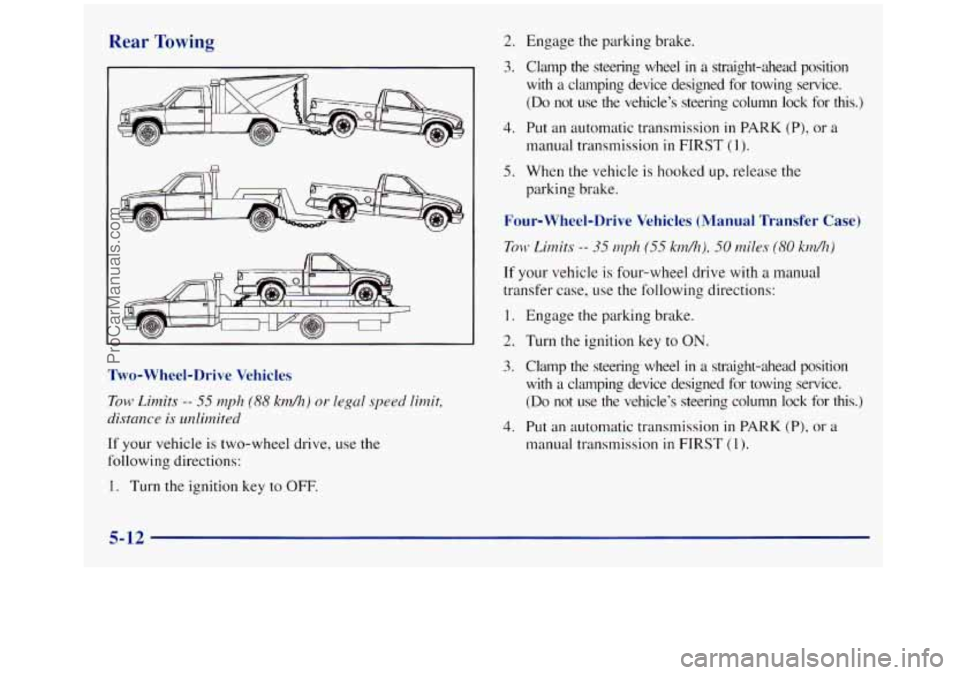
Rear Towing
Two-Wheel-Drive Vehicles
Tow Limits -- 55 ~zph (88 krdh) or legal speed limit,
distmce is ditnited
If your vehicle is two-wheel drive, use the
following directions:
1. Turn the ignition key to OFF.
2.
3.
4.
5.
Engage the parking brake.
Clamp the steering wheel in a straight-ahedd position
with a clamping device designed for towing service.
(Do not use the vehicle’s steering column lock for this.)
Put an automatic transmission
in PARK (P), or a
manual transmission in FIRST (1).
When the vehicle is hooked up, release the
parking brake.
Four-Wheel-Drive Vehicles (Manual Transfer Case)
If your vehicle is four-wheel drive with a manual
transfer case, use the following directions:
1.
2.
3.
4.
Engage the parking brake.
Turn the ignition
key to ON.
Clamp the steering wheel in a straight-ahead position
with a clamping device designed for towing service.
(Do not use the vehicle’s steering column lock for this.)
Put an automatic transmission
in PARK (P), or a
manual transmission in FIRST (1).
5-12
ProCarManuals.com
Page 265 of 452
5. Put the transfer case in NEUTRAL (N). See
“Four-Wheel Drive’’
in the Index for the proper
procedure to select NEUTRAL
(N).
6. When the vehicle is hooked up. release the
parking brake.
7. Turn the ignition key to OFF.
Four- Wheel-Drive Vehicles (Electronic
Transfer Case)
Eml Limits -- 35 mph (55 km/JZ), 50 milc?s (80 kndh)
If your vehicle is four-wheel drive with an electronic
transfer case, use the following directions:
I. Engage the parking brake.
2. Turn the ignition key to ON.
3. Clamp the steering wheel in a straight-ahead position
with
a clamping device designed for towing service.
(Do not use the vehicle’s steering column lock for this.)
4. Put the transmission in NEUTRAL (N).
5. Put the transfer case in 2 High (2HI).
6. When the vehicle is hooked up, release the
parking brake.
7. Turn the ignition key to OFF.
NOTICE:
If your vehicle is equipped with four-wheel drive
and the towing limits must be exceeded, a towing
dolly must be used under the front wheels or
vehicle/powertrain damage will occur.
I NOTICE:
Towing pickup models from the rear while loaded
with heavy cargo may cause the frame side rails
to flex sufficiently to allow the pickup box to
contact the cab and could cause damage to the
cab and/or box.
Engine Overheating (Gasoline Engine)
You will find a coolant temperature gage on your
vehicle’s instrument panel. See “Engine Coolant
Temperature Gage”
in the Index.
If your vehicle has a diesel engine, see “Engine
Overheating”
in the Diesel Engine Supplement.
5-13
ProCarManuals.com
Page 272 of 452
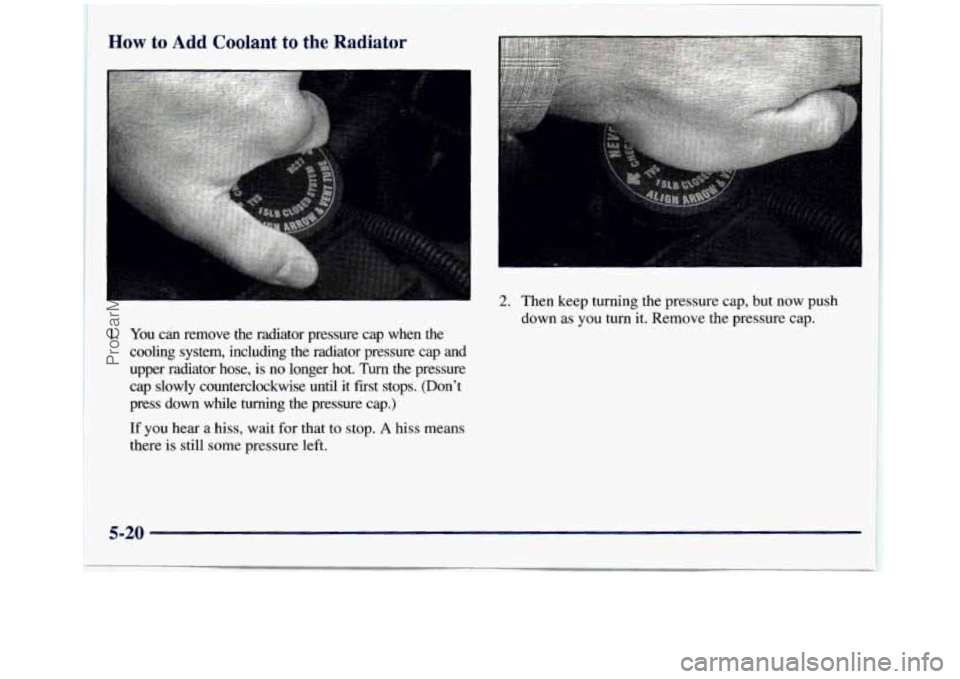
How to Add Coolant to the Radiator
1. You can remove the radiator pressure cap when the
cooling system, including the radiator pressure cap and
upper radiator hose,
is no longer hot. Turn the pressure
cap slowly counterclockwise until it first stops. (Don't
press down while
turning the pressure cap.)
2. Then keep turning the pressure cap, but now push
down
as you turn it. Remove the pressure cap.
If you hear
a hiss, wait for that to stop. A hiss means
there is still some pressure left.
5-20
ProCarManuals.com
Page 276 of 452
Changing a Flat Tire
If a tire goes flat, avoid further tire and wheel damage
by driving slowly to a level place. Turn on your hazard
warning flashers.
Changing a tire can cause an injury. The vehicle
can slip off the jack and roll over you or other
people. You and they could be badly injured.
Find
a level place to change your tire. To help
prevent the vehicle from moving:
1. Set the parking brake firmly.
2. Put an automatic transmission shift
lever in PARK
(P) or shift a manual
transmission to FIRST
(1) or
REVERSE (R).
3. If you have a four-wheel-drive vehicle,
be sure the transfer case is in a drive
gear
-- not in NEUTRAL (N).
4. nrn off the engine.
CAUTION: (Continued)
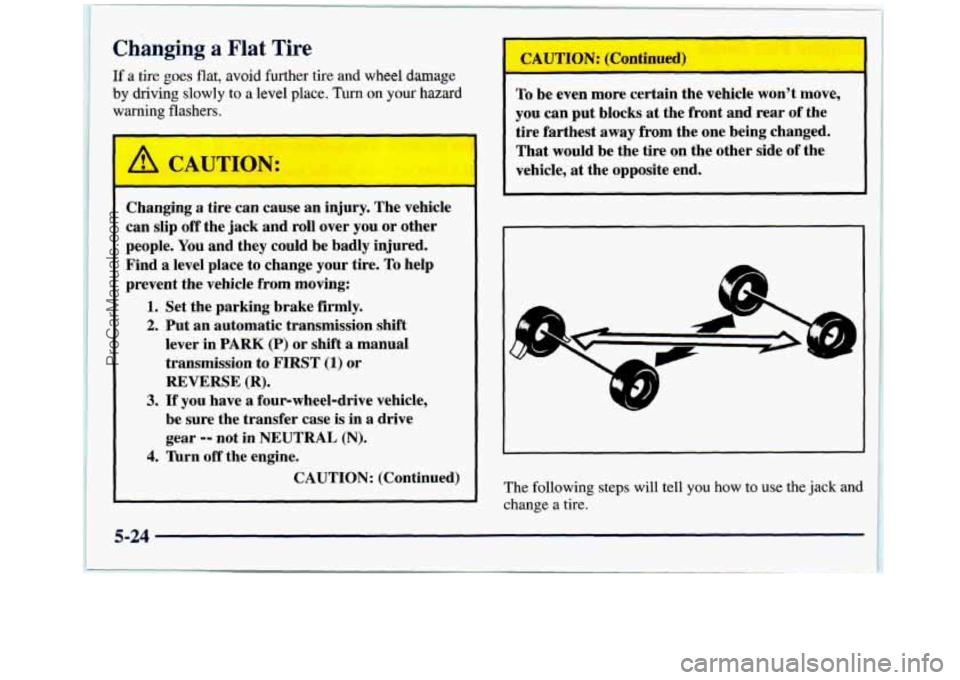
To be even more certain the vehicle won’t move,
you can put blocks
at the front and rear of the
tire farthest away from the one being changed.
That would be the tire on the other side of the
vehicle.
at the opposite end.
V
The following steps will tell you how to use the jack and
change a tire.
ProCarManuals.com
Page 297 of 452
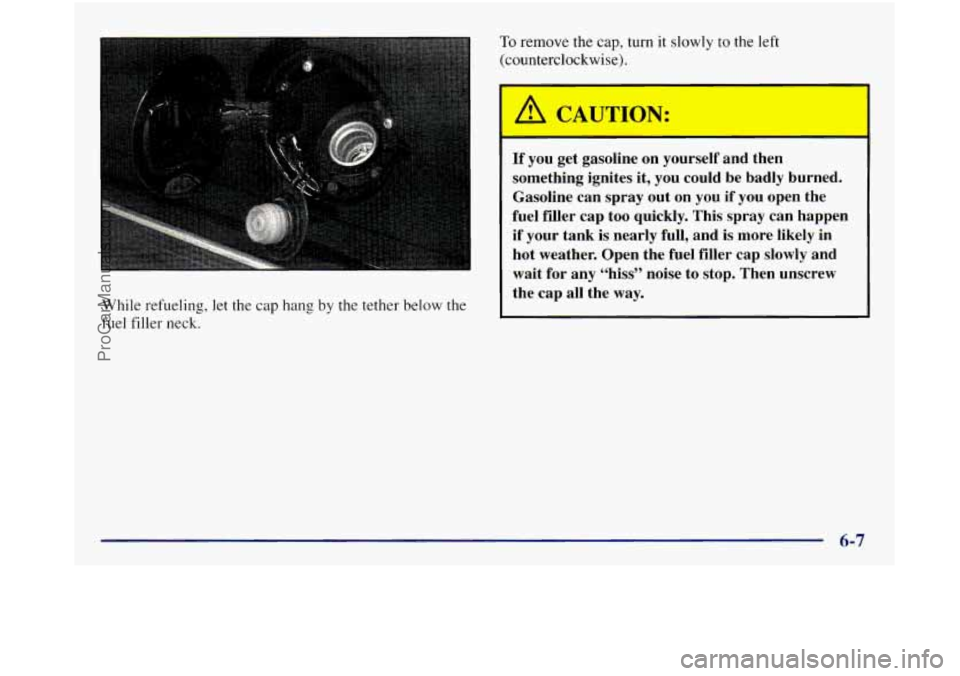
While refueling, let the cap hang by the tether below the
fuel filler neck.
To remove the cap, turn it slowly to the left
(counterclockwise).
If you get gasoline on yourself and then
something ignites it, you could be badly burnea.
Gasoline can spray out on you if you open the
fuel filler cap
too quickly. This spray can happen
if your tank is nearly full, and is more likely in
hot weather. Open the fuel filler cap slowly and
wait for any “hiss” noise to stop. Then unscrew
the cap
all the way.
6-7
ProCarManuals.com
Page 298 of 452
~ Be
careful not to spill gasoline. Clean gasoline from
~ painted surfaces as soon as possible. See “Cleaning the
i Outside of Your Vehicle” in the Index.
When you put
the cap back on, turn it to the right
(clockwise)
until you hear a clicking sound. Make sure you
fully install the cap. The diagnostic system can determine if
the fuel cap has been left off or improperly installed. This
would allow fuel to evaporate into the atmosphere. See
“Malfunction Indicator Lamp”
in the Index.
NOTICE:
If you need a new cap, be sure to get the right
type. Your dealer can get one for you. If you get
the wrong type, it may not
fit properly. This may
cause your malfunction indicator lamp to light
and your fuel tank and emissions system may be
damaged. See ‘LMalfunction Indicator Lamp” in
the Index.
Filling a Portable Fuel Container
Never fill a portable fuel container while it is in
your vehicle. Static electricity discharge from the
container can ignite the gasoline vapor. You can
be badly burned and your vehicle damaged
if this
occurs.
To help avoid injury to you and others:
Dispense gasoline only into
approved containers.
Do not fill a container while it is inside a
vehicle, in
a vehicle’s trunk, pickup bed or
on any surface other than the ground.
inside of the
fill opening before operating
the nozzle. Contact should be maintained
until the filling is complete.
0 Bring the fill nozzle in contact with the
0 Don’t smoke while pumping gasoline.
6-8
I
ProCarManuals.com
Page 313 of 452
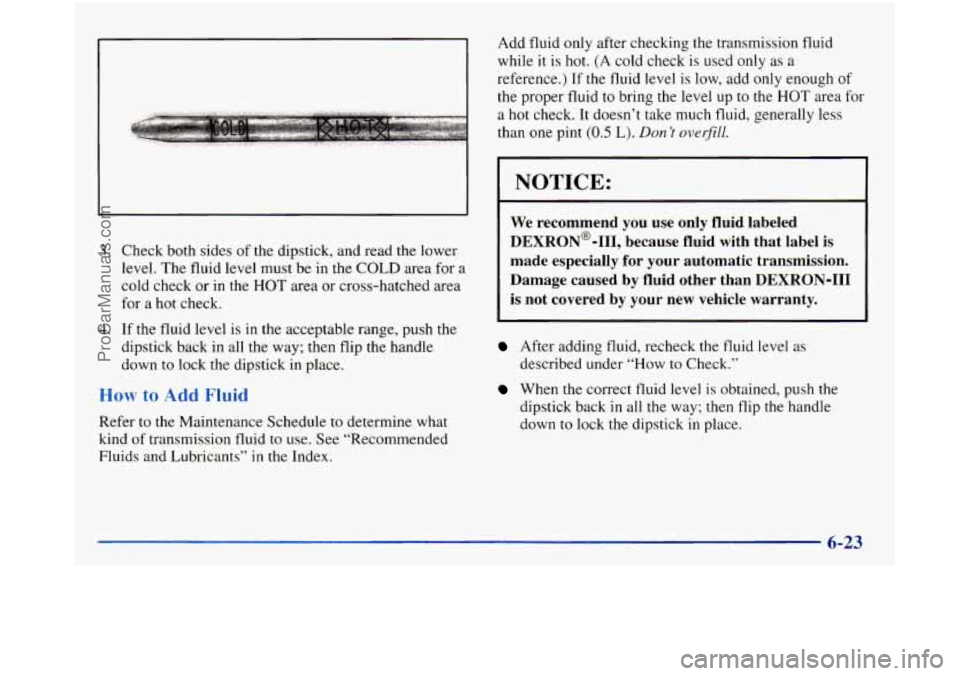
3. Check both sides of the dipstick, and read the lower
level. The fluid level must be in the COLD area for a
cold check or in the
HOT area or cross-hatched area
for a
hot check.
4. If the fluid level is in the acceptable range, push the
dipstick back in all the way; then flip the handle
down
to lock the dipstick in place.
io dd Fluid
Refer to the Maintenance Schedule to determine what
kind
of transmission fluid to use. See “Recommended
Fluids and Lubricants”
in the Index. Add
fluid only after checking the transmission fluid
while
it is hot. (A cold check is used only as a
reference.)
If the fluid level is low, add only enough of
the proper fluid
to bring the level up to the HOT area for
a hot check. It doesn’t take much fluid, generally less
than one pint
(0.5 L). Don’t overfill.
I NOTICE:
We recommend you use only fluid labeled
DEXRON@-111, because fluid with that label is
made especially for your automatic transmission.
Damage caused by fluid other than DEXRON-111
is not covered by your new vehicle warranty.
After adding fluid, recheck the fluid level as
described under “How to Check.”
When the correct fluid level is obtained, push the
dipstick back
in all the way; then flip the handle
down to lock the dipstick
in place.
6-23
ProCarManuals.com
Page 332 of 452
Front Turn Signal Lamps
/c
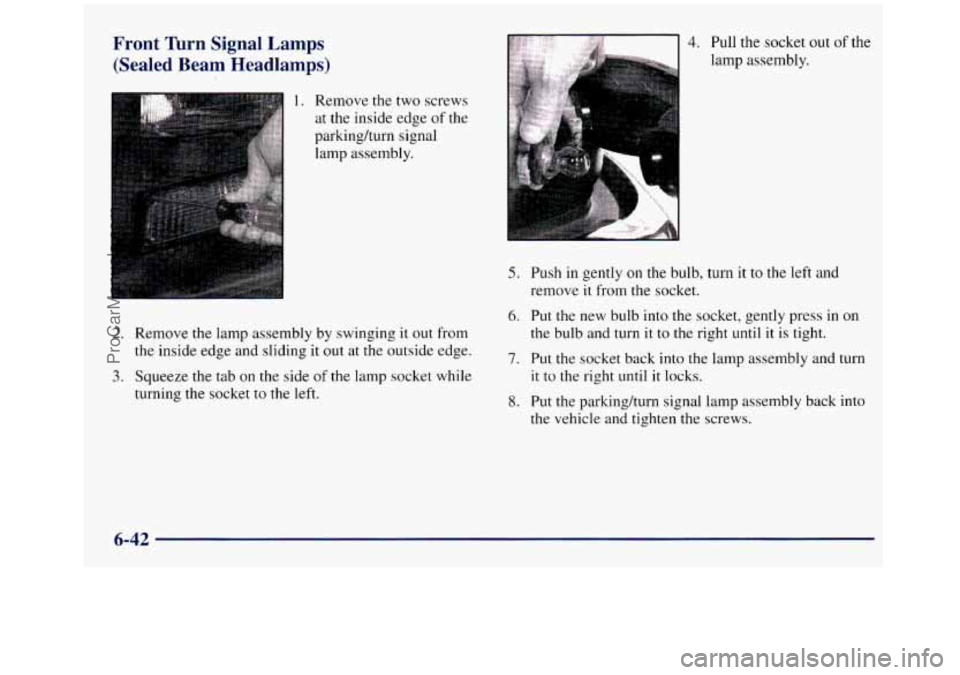
1. Remove the two screws at the inside edge
of the
parkinghurn signal lamp assembly.
2. Remove the lamp assembly by swinging it out from
the inside edge and sliding
it out at the outside edge.
3. Squeeze the tab on the side of the lamp socket while
turning the socket to the left.
4. Pull the socket out of the
lamp assembly.
5. Push in gently on the bulb, turn it to the left and
remove
it from the socket.
6. Put the new bulb into the socket, gently press in on
the bulb and
turn it to the right until it is tight.
7. Put the socket back into the lamp assembly and turn
it to the right until it locks.
8. Put the parkinghrn signal lamp assembly back into
the vehicle and tighten the screws.
6-42
ProCarManuals.com