change wheel GMC SIERRA 2001 User Guide
[x] Cancel search | Manufacturer: GMC, Model Year: 2001, Model line: SIERRA, Model: GMC SIERRA 2001Pages: 468, PDF Size: 3.2 MB
Page 325 of 468
5-19
Changing a Flat Tire
If a tire goes flat, avoid further tire and wheel damage
by driving slowly to a level place. Turn on your hazard
warning flashers.
CAUTION:
Changing a tire can cause an injury. The vehicle
can slip off the jack and roll over you or other
people. You and they could be badly injured.
Find a level place to change your tire. To help
prevent the vehicle from moving:
1. Set the parking brake firmly.
2. Put an automatic transmission shift lever in
PARK (P) or shift a manual transmission
to FIRST (1) or REVERSE (R).
3. If you have a four
-wheel-drive vehicle,
be sure the transfer case is in a drive
gear
-- not in NEUTRAL.
CAUTION: (Continued)
CAUTION: (Continued)
4. Turn off the engine.
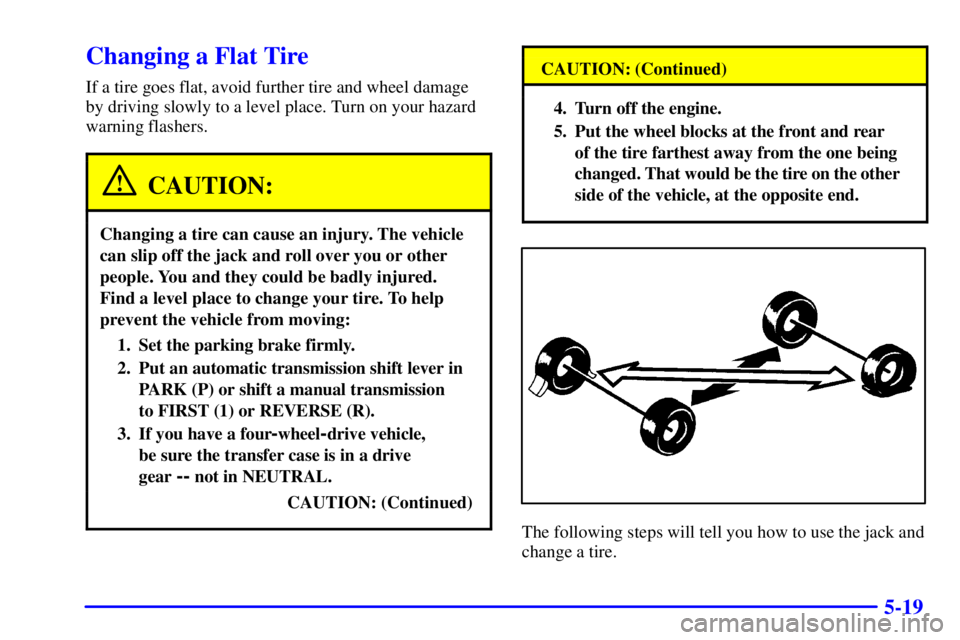
5. Put the wheel blocks at the front and rear
of the tire farthest away from the one being
changed. That would be the tire on the other
side of the vehicle, at the opposite end.
The following steps will tell you how to use the jack and
change a tire.
Page 334 of 468
5-28
CAUTION:
Rust or dirt on the wheel, or on the parts to
which it is fastened, can make the wheel nuts
become loose after a time. The wheel could come
off and cause an accident. When you change a
wheel, remove any rust or dirt from the places
where the wheel attaches to the vehicle. In an
emergency, you can use a cloth or a paper towel
to do this; but be sure to use a scraper or wire
brush later, if you need to, to get all the rust or
dirt off.
CAUTION:
Never use oil or grease on studs or nuts. If you
do, the nuts might come loose. Your wheel could
fall off, causing a serious accident.
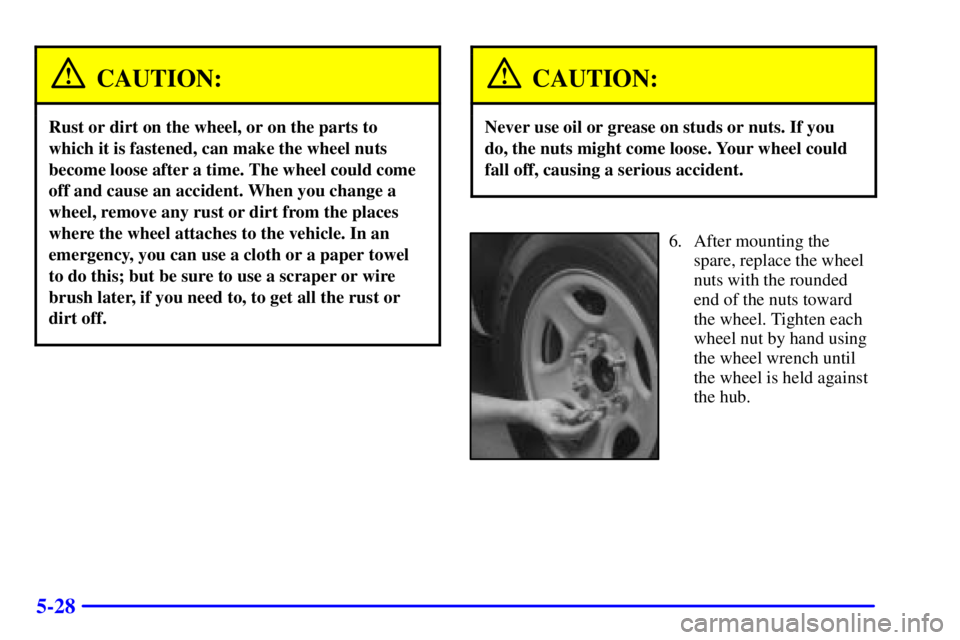
6. After mounting the
spare, replace the wheel
nuts with the rounded
end of the nuts toward
the wheel. Tighten each
wheel nut by hand using
the wheel wrench until
the wheel is held against
the hub.
Page 384 of 468
6-42
NOTICE:
Continuing to drive with worn-out brake pads
could result in costly brake repair.
Some driving conditions or climates may cause a brake
squeal when the brakes are first applied or lightly
applied. This does not mean something is wrong with
your brakes.
Properly torqued wheel nuts are necessary to help prevent
brake pulsation. When tires are rotated, inspect brake
pads for wear and evenly tighten wheel nuts in the proper
sequence to GM torque specifications.
Brake linings should always be replaced as complete
axle sets.
See ªBrake System Inspectionº in Section 7 of this
manual under Part C ªPeriodic Maintenance Inspections.º
Brake Pedal Travel
See your dealer if the brake pedal does not return to
normal height, or if there is a rapid increase in pedal
travel. This could be a sign of brake trouble.
Brake Adjustment
Every time you make a brake stop, your disc brakes
adjust for wear.
Replacing Brake System Parts
The braking system on a vehicle is complex. Its many
parts have to be of top quality and work well together
if the vehicle is to have really good braking. Your
vehicle was designed and tested with top
-quality
GM brake parts. When you replace parts of your braking
system
-- for example, when your brake linings wear
down and you have to have new ones put in
-- be sure
you get new approved GM replacement parts. If you
don't, your brakes may no longer work properly.
For example, if someone puts in brake linings that
are wrong for your vehicle, the balance between your
front and rear brakes can change
-- for the worse.
The braking performance you've come to expect can
change in many other ways if someone puts in the
wrong replacement brake parts.
Page 397 of 468
6-55
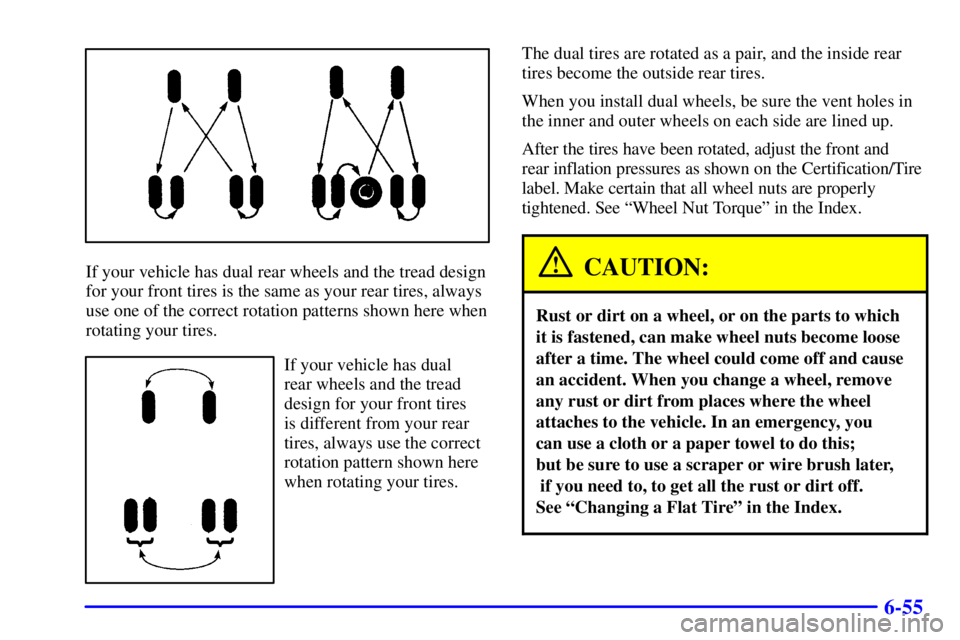
If your vehicle has dual rear wheels and the tread design
for your front tires is the same as your rear tires, always
use one of the correct rotation patterns shown here when
rotating your tires.
If your vehicle has dual
rear wheels and the tread
design for your front tires
is different from your rear
tires, always use the correct
rotation pattern shown here
when rotating your tires.The dual tires are rotated as a pair, and the inside rear
tires become the outside rear tires.
When you install dual wheels, be sure the vent holes in
the inner and outer wheels on each side are lined up.
After the tires have been rotated, adjust the front and
rear inflation pressures as shown on the Certification/Tire
label. Make certain that all wheel nuts are properly
tightened. See ªWheel Nut Torqueº in the Index.
CAUTION:
Rust or dirt on a wheel, or on the parts to which
it is fastened, can make wheel nuts become loose
after a time. The wheel could come off and cause
an accident. When you change a wheel, remove
any rust or dirt from places where the wheel
attaches to the vehicle. In an emergency, you
can use a cloth or a paper towel to do this;
but be sure to use a scraper or wire brush later,
if you need to, to get all the rust or dirt off.
See ªChanging a Flat Tireº in the Index.
Page 444 of 468

7-19 At Least Twice a Year
Restraint System Check
Make sure the safety belt reminder light and all your
belts, buckles, latch plates, retractors and anchorages are
working properly. Look for any other loose or damaged
safety belt system parts. If you see anything that might
keep a safety belt system from doing its job, have it
repaired. Have any torn or frayed safety belts replaced.
Also look for any opened or broken air bag coverings,
and have them repaired or replaced. (The air bag system
does not need regular maintenance.)
Wiper Blade Check
Inspect wiper blades for wear or cracking. Replace blade
inserts that appear worn or damaged or that streak or
miss areas of the windshield. Also see ªWiper Blades,
Cleaningº in the Index.Spare Tire Check
At least twice a year, after the monthly inflation check
of the spare tire determines that the spare is inflated to
the correct tire inflation pressure, make sure that the
spare tire is stored securely. Push, pull, and then try
to rotate or turn the tire. If it moves, use the wheel
wrench/ratchet to tighten the cable. See ªStoring the
Spare Tire and Toolsº in the Index.
Engine Air Cleaner Filter Restriction Indicator Check
Your vehicle has an indicator located on the air cleaner
in the engine compartment that lets you know when the
air cleaner filter is dirty and needs to be changed. Check
indicator at least twice a year or when your engine oil is
changed, whichever occurs first. See ªAir Cleanerº in
the Index for more information. Inspect your air cleaner
filter restriction indicator more often if the vehicle is
used in dusty areas or under off road conditions.
Page 449 of 468

7-24 Throttle System Inspection
Inspect the throttle system for interference or binding,
and for damaged or missing parts. Replace parts as
needed. Replace any components that have high effort
or excessive wear. Do not lubricate accelerator and
cruise control cables.
Transfer Case and Front Axle
(Four-Wheel Drive) Inspection
Every 12 months or at engine oil change intervals,
check front axle and transfer case and add lubricant
when necessary. A fluid loss could indicate a problem;
check and have it repaired, if needed. On manual
shift transfer case, oil the control lever pivot point.
Check vent hose at transfer case for kinks and proper
installation. More frequent lubrication may be required
on off
-road use.
Brake System Inspection
Inspect the complete system. Inspect brake lines and
hoses for proper hook
-up, binding, leaks, cracks,
chafing, etc. Inspect disc brake pads for wear and
rotors for surface condition. Inspect other brake parts,
including calipers, parking brake, etc. You may need to
have your brakes inspected more often if your driving
habits or conditions result in frequent braking.