section 7 GMC SIERRA 2001 Owner's Manual
[x] Cancel search | Manufacturer: GMC, Model Year: 2001, Model line: SIERRA, Model: GMC SIERRA 2001Pages: 468, PDF Size: 3.2 MB
Page 4 of 468
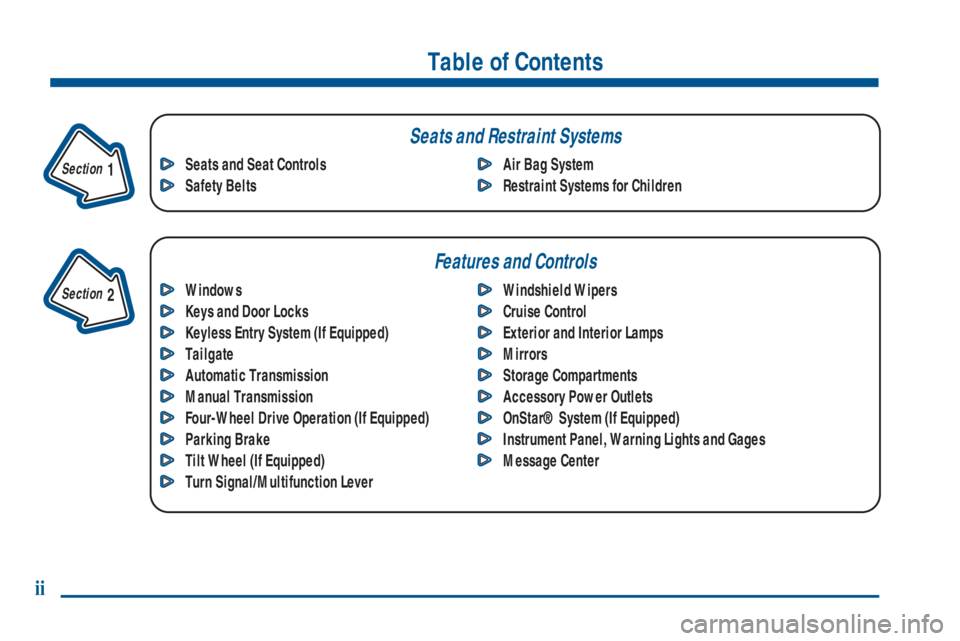
ii
Table of Contents
Windows
Keys and Door Locks
Keyless Entry System (If Equipped)
Tailgate
Automatic Transmission
Manual Transmission
Four-Wheel Drive Operation (If Equipped)
Parking Brake
Tilt Wheel (If Equipped)
Turn Signal/Multifunction LeverWindshield Wipers
Cruise Control
Exterior and Interior Lamps
Mirrors
Storage Compartments
Accessory Power Outlets
OnStar® System (If Equipped)
Instrument Panel, Warning Lights and Gages
Message Center Seats and Seat Controls
Safety BeltsAir Bag System
Restraint Systems for Children
Section
1
Section
2
Seats and Restraint Systems
Features and Controls
Page 5 of 468
iii
Section
3
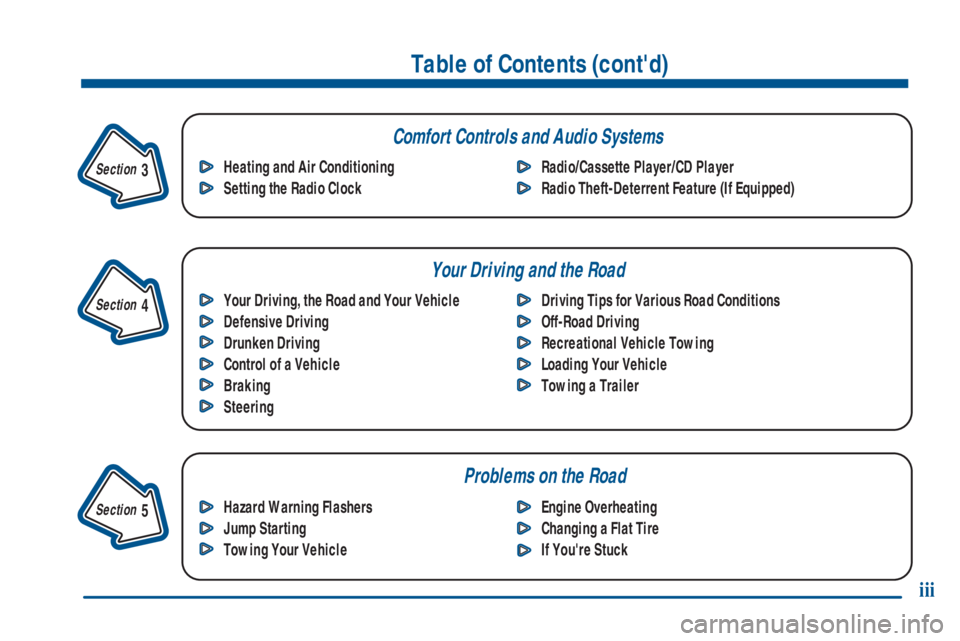
Comfort Controls and Audio Systems
Section
4
Your Driving and the Road
Section
5
Table of Contents (cont'd)
Your Driving, the Road and Your Vehicle
Defensive Driving
Drunken Driving
Control of a Vehicle
Braking
SteeringDriving Tips for Various Road Conditions
Off-Road Driving
Recreational Vehicle Towing
Loading Your Vehicle
Towing a Trailer Heating and Air Conditioning
Setting the Radio ClockRadio/Cassette Player/CD Player
Radio Theft-Deterrent Feature (If Equipped)
Hazard Warning Flashers
Jump Starting
Towing Your VehicleEngine Overheating
Changing a Flat Tire
If You're Stuck
Problems on the Road
Page 6 of 468
iv
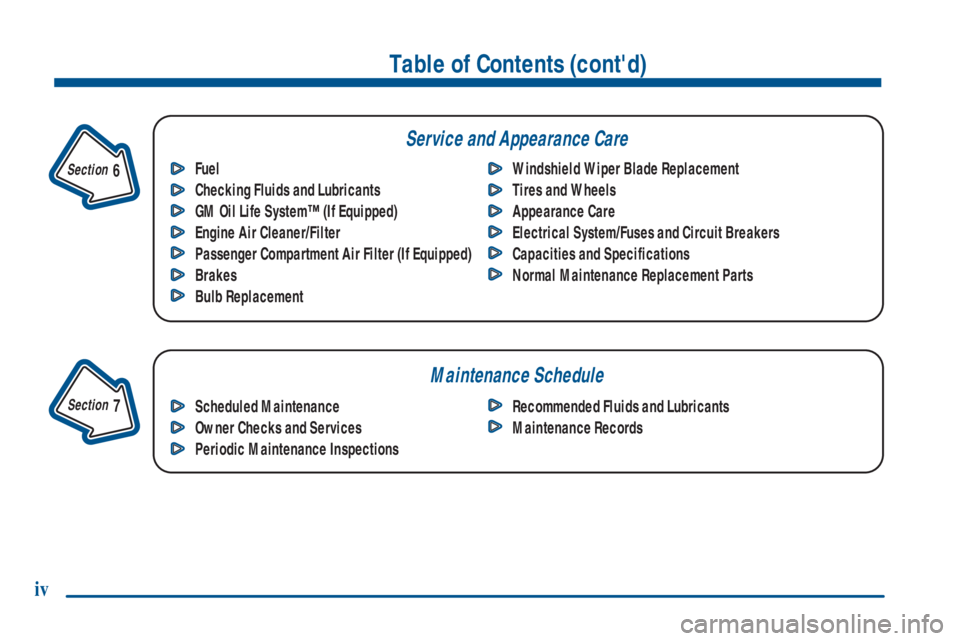
Fuel
Checking Fluids and Lubricants
GM Oil Life System™ (If Equipped)
Engine Air Cleaner/Filter
Passenger Compartment Air Filter (If Equipped)
Brakes
Bulb ReplacementWindshield Wiper Blade Replacement
Tires and Wheels
Appearance Care
Electrical System/Fuses and Circuit Breakers
Capacities and Specifications
Normal Maintenance Replacement Parts
Table of Contents (cont'd)
Maintenance Schedule Service and Appearance Care
Section
7
Section
6
Scheduled Maintenance
Owner Checks and Services
Periodic Maintenance InspectionsRecommended Fluids and Lubricants
Maintenance Records
Page 7 of 468
v
Table of Contents (cont'd)
Customer Assistance Information
In the Index you will find an alphabetical listing of almost every subject in this manual.
You can use it to quickly find something you want to read.
Section
8Customer Satisfaction Procedures
Customer Assistance Offices
Roadside Assistance and Courtesy Transportation
Warranty Information (See Warranty Manual)
Reporting Safety Defects on page 8-10
Service Publications
Index
Section
9
Please refer to the last page of this manual for your Service Station Guide
Page 13 of 468
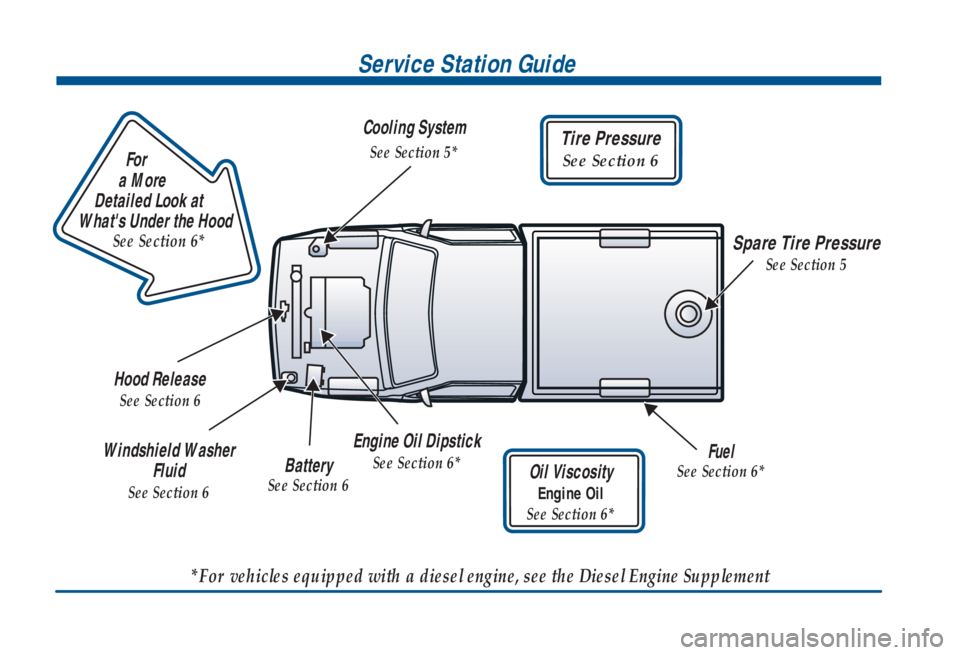
For
a More
Detailed Look at
What's Under the Hood
See Section 6*
Service Station Guide
Oil Viscosity
Engine Oil
See Section 6*
Engine Oil Dipstick
See Section 6*
Cooling System
See Section 5*
Hood Release
See Section 6
Windshield Washer
Fluid
See Section 6
Tire Pressure
See Section 6
Spare Tire Pressure
See Section 5
Battery
See Section 6
Fuel
See Section 6*
*For vehicles equipped with a diesel engine, see the Diesel Engine Supplement
Page 14 of 468
1-
1-1
Section 1 Seats and Restraint Systems
Here you'll find information about the seats in your vehicle and how to use your safety belts properly. You can also
learn about some things you should not do with air bags and safety belts.
1
-2 Seats and Seat Controls
1
-12 Safety Belts: They're for Everyone
1
-17 Here Are Questions Many People Ask
About Safety Belts
-- and the Answers
1
-18 How to Wear Safety Belts Properly
1
-18 Driver Position
1
-24 Safety Belt Use During Pregnancy
1
-25 Right Front Passenger Position
1
-25 Air Bag System
1
-35 Center Passenger Position1
-36 Rear Seat Passengers
1
-40 Rear Safety Belt Comfort Guides for
Children and Small Adults
1
-42 Children
1
-46 Restraint Systems for Children
1
-67 Older Children
1
-70 Safety Belt Extender
1
-70 Checking Your Restraint Systems
1
-70 Replacing Restraint System Parts
After a Crash
Page 15 of 468
1-2
Seats and Seat Controls
This section tells you about the seats -- how to adjust
them, and fold them up and down. It also tells you about
reclining front seatbacks and head restraints.
Manual Front Seat
CAUTION:
You can lose control of the vehicle if you try to
adjust a manual driver's seat while the vehicle is
moving. The sudden movement could startle and
confuse you, or make you push a pedal when you
don't want to. Adjust the driver's seat only when
the vehicle is not moving.
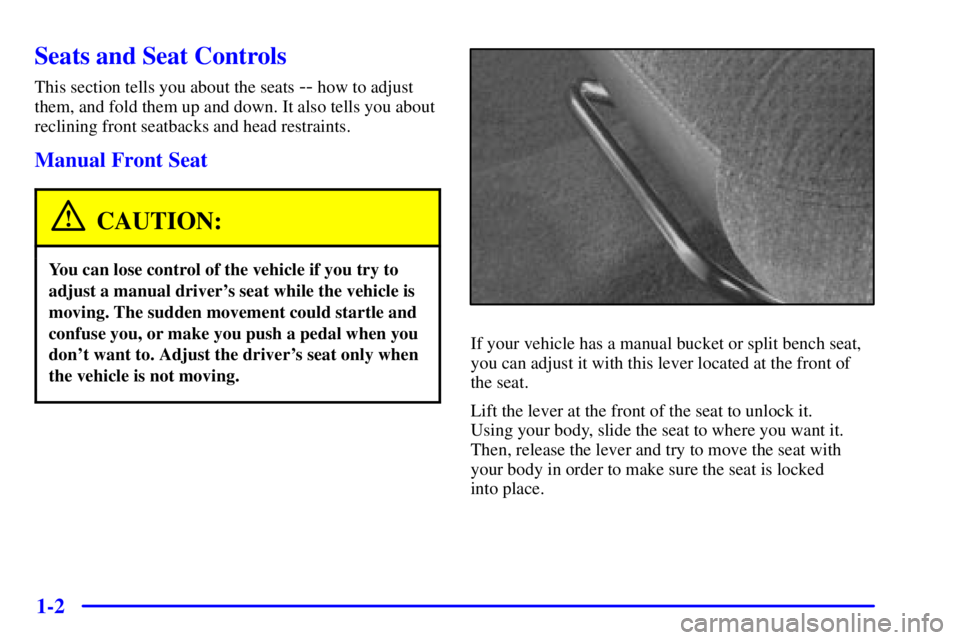
If your vehicle has a manual bucket or split bench seat,
you can adjust it with this lever located at the front of
the seat.
Lift the lever at the front of the seat to unlock it.
Using your body, slide the seat to where you want it.
Then, release the lever and try to move the seat with
your body in order to make sure the seat is locked
into place.
Page 32 of 468
1-19
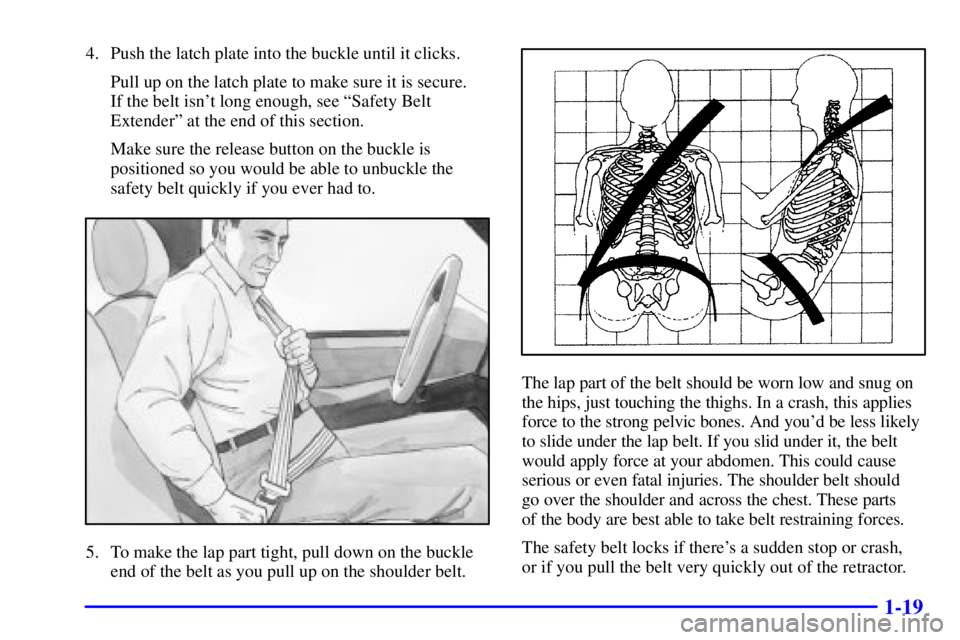
4. Push the latch plate into the buckle until it clicks.
Pull up on the latch plate to make sure it is secure.
If the belt isn't long enough, see ªSafety Belt
Extenderº at the end of this section.
Make sure the release button on the buckle is
positioned so you would be able to unbuckle the
safety belt quickly if you ever had to.
5. To make the lap part tight, pull down on the buckle
end of the belt as you pull up on the shoulder belt.
The lap part of the belt should be worn low and snug on
the hips, just touching the thighs. In a crash, this applies
force to the strong pelvic bones. And you'd be less likely
to slide under the lap belt. If you slid under it, the belt
would apply force at your abdomen. This could cause
serious or even fatal injuries. The shoulder belt should
go over the shoulder and across the chest. These parts
of the body are best able to take belt restraining forces.
The safety belt locks if there's a sudden stop or crash,
or if you pull the belt very quickly out of the retractor.
Page 38 of 468
1-25
The best way to protect the fetus is to protect the
mother. When a safety belt is worn properly, it's more
likely that the fetus won't be hurt in a crash. For
pregnant women, as for anyone, the key to making
safety belts effective is wearing them properly.
Right Front Passenger Position
To learn how to wear the right front passenger's safety belt
properly, see ªDriver Positionº earlier in this section.
The right front passenger's safety belt works the same
way as the driver's safety belt
-- except for one thing.
If you ever pull the shoulder portion of the belt out all
the way, you will engage the child restraint locking
feature. If this happens, just let the belt go back all the
way and start again.
Air Bag System
This part explains the air bag system.
Your vehicle has air bags
-- one air bag for the driver
and another air bag for the right front passenger.
Frontal air bags are designed to help reduce the risk of
injury from the force of an inflating air bag. But these
air bags must inflate very quickly to do their job and
comply with federal regulations.Here are the most important things to know about the
air bag system:
CAUTION:
You can be severely injured or killed in a crash if
you aren't wearing your safety belt
-- even if you
have air bags. Wearing your safety belt during a
crash helps reduce your chance of hitting things
inside the vehicle or being ejected from it.
Air bags are ªsupplemental restraintsº to the
safety belts. All air bags are designed to work
with safety belts, but don't replace them.
Air bags are designed to work only in moderate
to severe crashes where the front of your vehicle
hits something. They aren't designed to inflate
at all in rollover, rear, side or low
-speed frontal
crashes. And, for unrestrained occupants,
air bags may provide less protection in frontal
crashes than more forceful air bags have
provided in the past. Everyone in your vehicle
should wear a safety belt properly
-- whether or
not there's an air bag for that person.
Page 49 of 468
1-36
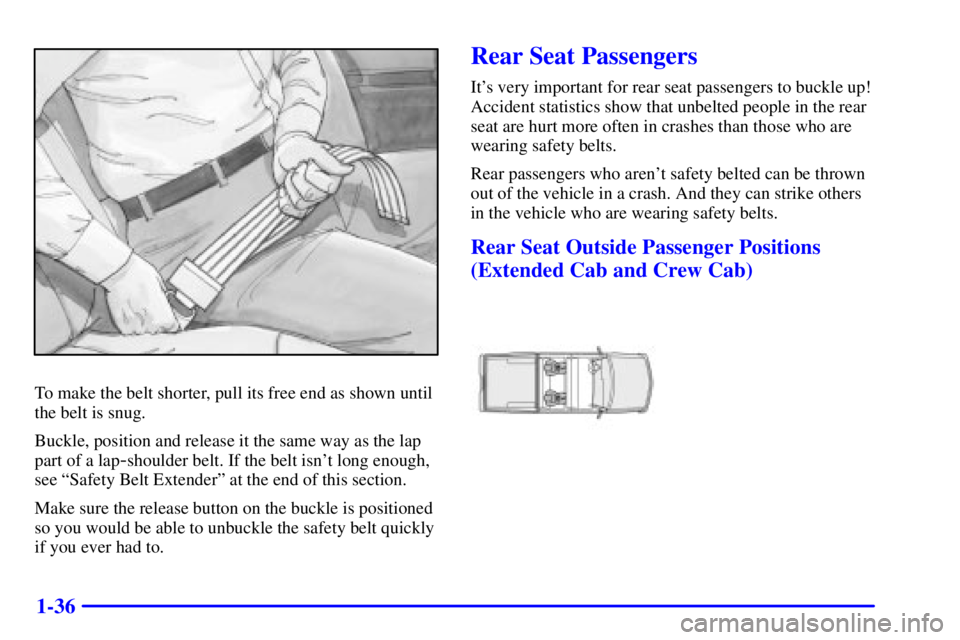
To make the belt shorter, pull its free end as shown until
the belt is snug.
Buckle, position and release it the same way as the lap
part of a lap
-shoulder belt. If the belt isn't long enough,
see ªSafety Belt Extenderº at the end of this section.
Make sure the release button on the buckle is positioned
so you would be able to unbuckle the safety belt quickly
if you ever had to.
Rear Seat Passengers
It's very important for rear seat passengers to buckle up!
Accident statistics show that unbelted people in the rear
seat are hurt more often in crashes than those who are
wearing safety belts.
Rear passengers who aren't safety belted can be thrown
out of the vehicle in a crash. And they can strike others
in the vehicle who are wearing safety belts.
Rear Seat Outside Passenger Positions
(Extended Cab and Crew Cab)