DIC GMC SIERRA 2003 Owners Manual
[x] Cancel search | Manufacturer: GMC, Model Year: 2003, Model line: SIERRA, Model: GMC SIERRA 2003Pages: 408, PDF Size: 2.58 MB
Page 305 of 408

All-Wheel Drive
Lubricant checks in this section also apply to these
vehicles. However, there are two additional systems that
need lubrication.
Transfer Case
When to Check Lubricant
Refer to the Maintenance Schedule to determine how
often to check the lubricant. SeePart C: Periodic
Maintenance Inspections on page 6-14.
How to Check Lubricant
To get an accurate reading, the vehicle should be on a
level surface.
If the level is below the bottom of thefiller plug hole,
you’ll need to add some lubricant. Add enough lubricant
to raise the level to the bottom of thefiller plug hole.
Use care not to overtighten the plug.
What to Use
Refer to the Maintenance Schedule to determine what
kind of lubricant to use. SeePart D: Recommended
Fluids and Lubricants on page 6-15.
(A) Fill Plug (B) Drain Plug
5-45
2003 - Sierra Denali
Page 319 of 408
{CAUTION:
Rust or dirt on a wheel, or on the parts to
which it is fastened, can make wheel nuts
become loose after a time. The wheel could
come off and cause an accident. When you
change a wheel, remove any rust or dirt from
places where the wheel attaches to the vehicle.
In an emergency, you can use a cloth or a
paper towel to do this; but be sure to use a
scraper or wire brush later, if you need to, to
get all the rust or dirt off. See“Changing a Flat
Tire”in the Index.
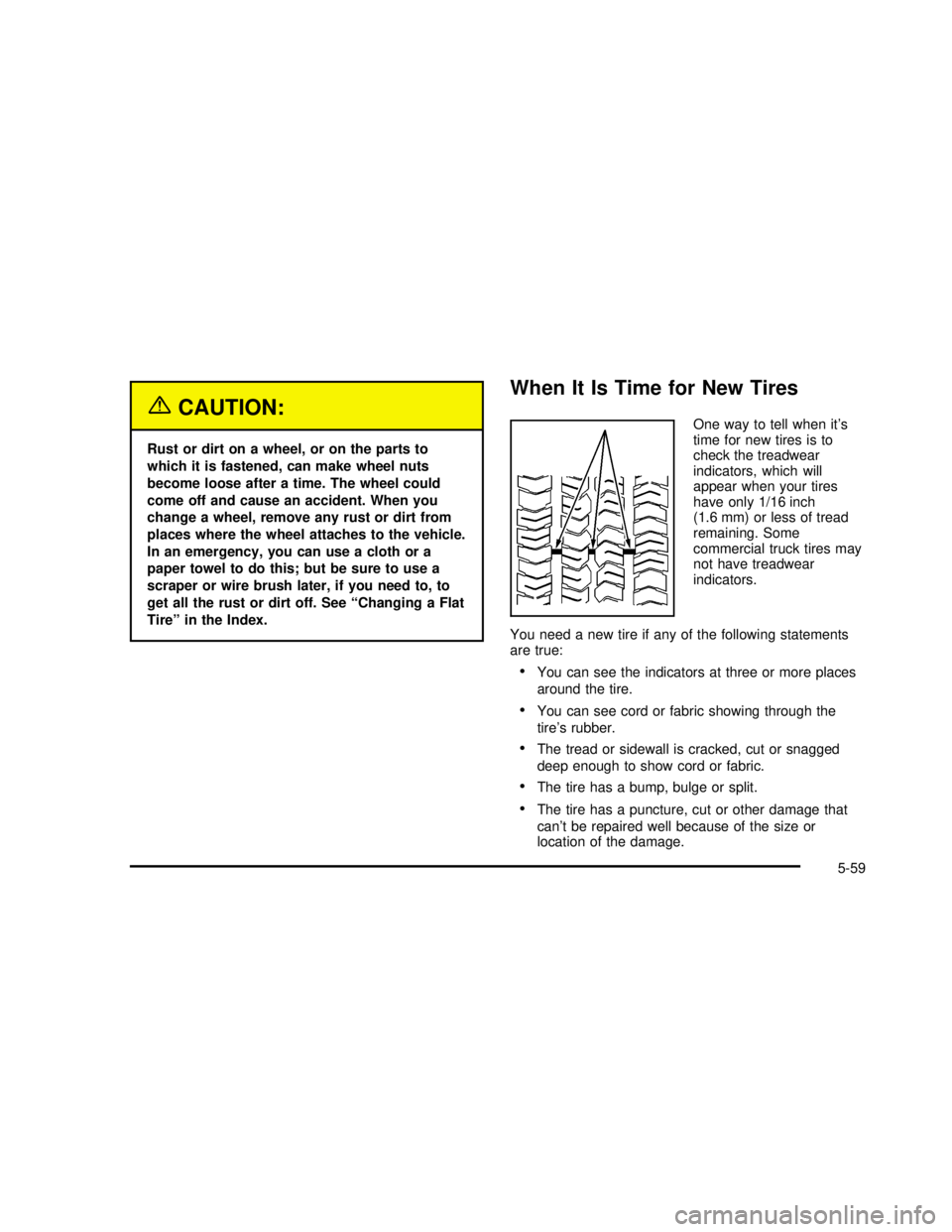
When It Is Time for New Tires
One way to tell when it’s
time for new tires is to
check the treadwear
indicators, which will
appear when your tires
have only 1/16 inch
(1.6 mm) or less of tread
remaining. Some
commercial truck tires may
not have treadwear
indicators.
You need a new tire if any of the following statements
are true:
•You can see the indicators at three or more places
around the tire.
•You can see cord or fabric showing through the
tire’s rubber.
•The tread or sidewall is cracked, cut or snagged
deep enough to show cord or fabric.
•The tire has a bump, bulge or split.
•The tire has a puncture, cut or other damage that
can’t be repaired well because of the size or
location of the damage.
5-59
2003 - Sierra Denali
Page 358 of 408

Fuses Usage
IGN 1 Ignition Relay
PCM 1 Powertrain Control Module
ETC/ECMElectronic Throttle Control,
Electronic Brake Controller
IGN EInstrument Panel Cluster, Air
Conditioning Relay, Turn
Signal/Hazard Switch, Starter
Relay
RTD Ride Control
TRL B/U Backup Lamps Trailer Wiring
PCM BPowertrain Control Module,
Fuel Pump
F/PMP Fuel Pump (Relay)
B/U LPBack-up Lamps, Automatic
Transmission Shift Lock
Control System
RR DEFOG Rear Window Defogger
HDLP-HI Headlamp High Beam Relay
PRIME Not Used
02B Oxygen Sensors
SIRSupplemental Inflatable
Restraint System
FRT PARKFront Parking Lamps,
Sidemarker Lamps
DRLDaytime Running Lamps
(Relay)Fuses Usage
SEO IGN Rear Defog Relay
TBC IGN1 Truck Body Controller Ignition
HI HDLP-LT High Beam Headlamp-Left
LH HID Not Used
DRL Daytime Running Lamps
IPC/DICInstrument Panel
Cluster/Driver Information
Center
HVAC/ECAS Climate Control Controller
CIG LTR Cigarette Lighter
HI HDLP-RT High Beam Headlamp-Right
HDLP-LOW Headlamp Low Beam Relay
A/C COMP Air Conditioning Compressor
A/C COMPAir Conditioning Compressor
Relay
RR WPR Not Used
RADIO Audio System
SEO B1Mid Bussed Electrical Center,
Rear Heated Seats,
HomeLink
LO HDLP-LT Headlamp Low Beam-Left
BTSIBrake Transmission Shift
Interlock System
CRANK Starting System
LO HDLP-RT Headlamp Low Beam-Right
5-98
2003 - Sierra Denali
Page 361 of 408

Maintenance Schedule......................................6-2
Introduction...................................................6-2
Your Vehicle and the Environment....................6-2
Maintenance Requirements..............................6-2
How This Section is Organized.........................6-3
Part A: Scheduled Maintenance Services...........6-4
Using Your Maintenance Schedule....................6-4
Scheduled Maintenance...................................6-5
Part B: Owner Checks and Services................6-10
At Each Fuel Fill..........................................6-10
At Least Once a Month.................................6-10
At Least Twice a Year...................................6-10At Least Once a Year
...................................6-11
Part C: Periodic Maintenance Inspections
.........6-14
Steering and Suspension Inspection
................6-14
Exhaust System Inspection
............................6-14
Fuel System Inspection
..................................6-14
Engine Cooling System Inspection
...................6-14
Transfer Case and Front Axle (All-Wheel
Drive) Inspection
.......................................6-15
Brake System Inspection
................................6-15
Part D: Recommended Fluids and Lubricants
. . . .6-15
Part E: Maintenance Record
...........................6-17
Section 6 Maintenance Schedule
6-1
2003 - Sierra Denali
Page 363 of 408

How This Section is Organized
This maintenance schedule is divided intofive parts:
“Part A: Scheduled Maintenance Services”explains
what to have done and how often. Some of these
services can be complex, so unless you are technically
qualified and have the necessary equipment, you
should let your GM dealer’s service department do these
jobs.
Your GM dealer has GM-trained and supported service
people that will perform the work using genuine GM
parts.
{CAUTION:
Performing maintenance work on a vehicle can
be dangerous. In trying to do some jobs, you
can be seriously injured. Do your own
maintenance work only if you have the
required know-how and the proper tools and
equipment for the job. If you have any doubt,
have a qualified technician do the work.
If you want to get the service information, seeService
Publications Ordering Information on page 7-9.“Part B: Owner Checks and Services”tells you what
should be checked and when. It also explains what
you can easily do to help keep your vehicle in good
condition.
“Part C: Periodic Maintenance Inspections”explains
important inspections that your dealer’s service
department can perform for you.
“Part D: Recommended Fluids and Lubricants”lists
some recommended products necessary to help
keep your vehicle properly maintained. These products,
or their equivalents, should be used whether you do
the work yourself or have it done.
“Part E: Maintenance Record”is a place for you to
record and keep track of the maintenance performed on
your vehicle. Keep your maintenance receipts. They
may be needed to qualify your vehicle for warranty
repairs.
6-3
2003 - Sierra Denali
Page 364 of 408

Part A: Scheduled Maintenance
Services
This part contains engine oil and chassis lubrication
scheduled maintenance which explains the engine oil life
system and how it indicates when to change the
engine oil andfilter. Lubricate chassis components with
each oil change. Also, listed are scheduled maintenance
services which are to be performed at the mileage
intervals specified.
Using Your Maintenance Schedule
We at General Motors want to help you keep your
vehicle in good condition. But we don’t know exactly how
you’ll drive it. You may drive very short distances only
a few times a week. Or you may drive long distances in
very hot, dusty weather. You may use your vehicle in
making deliveries. Or you may drive it to work, to
do errands or in many other ways.
Because of all the different ways people use their
vehicles, maintenance needs vary. You may need more
frequent checks and replacements. So please read
the following and note how you drive. If you have any
questions on how to keep your vehicle in good condition,
see your dealer.This part tells you the maintenance services you should
have done and when to schedule them.
When you go to your dealer for your service needs,
you’ll know that GM-trained and supported service
people will perform the work using genuine GM parts.
The properfluids and lubricants to use are listed in
Part D. Make sure whoever services your vehicle uses
these. All parts should be replaced and all necessary
repairs done before you or anyone else drives the
vehicle.
This schedule is for vehicles that:•carry passengers and cargo within recommended
limits. You willfind these limits on your vehicle’s
Certification/Tire label. SeeLoading Your Vehicle on
page 4-47.
•are driven on reasonable road surfaces within legal
driving limits.
•are driven off-road in the recommended manner.
SeeOperating Your All-Wheel-Drive Vehicle Off
Paved Roads on page 4-18.
•use the recommended fuel. SeeGasoline Octane
on page 5-4.
6-4
2003 - Sierra Denali
Page 365 of 408

Scheduled Maintenance
The services shown in this schedule up to 100,000 miles
(166 000 km) should be repeated after 100,000 miles
(166 000 km) at the same intervals for the life of
this vehicle. The services shown at 150,000 miles
(240 000 km) and 200,000 miles (332 000 km) should
be repeated at the same intervals after 150,000 miles
(240 000 km) and 200,000 miles (332 000 km) for the life
of this vehicle.
SeePart B: Owner Checks and Services on page 6-10
andPart C: Periodic Maintenance Inspections on
page 6-14.
Footnotes
†The U.S. Environmental Protection Agency or the
California Air Resources Board has determined that the
failure to perform this maintenance item will not nullify
the emission warranty or limit recall liability prior to
the completion of the vehicle ’s useful life. We, however,
urge that all recommended maintenance services be
performed at the indicated intervals and the
maintenance be recorded.
+A good time to check your brakes is during tire
rotation. See Brake System Inspection on page 6-15.
Engine Oil and Chassis Lubrication
Scheduled Maintenance
Change engine oil and filter as indicated by the GM
Oil Life System (or every 12 months, whichever
occurs first). Reset the system.
Your vehicle has a computer system that lets you know
when to change the engine oil andfilter. This is
based on engine revolutions and engine temperature,
and not on mileage. Based on driving conditions,
the mileage at which an oil change will be indicated can
vary considerably. For the oil life system to work
properly, you must reset the system every time the oil is
changed.
When the system has calculated that oil life has been
diminished, it will indicate that an oil change is
necessary. A CHANGE ENGINE OIL message will
come on. Change your oil as soon as possible within
the next two times you stop for fuel. It is possible that,
if you are driving under the best conditions, the oil
life system may not indicate that an oil change is
necessary for over a year. However, your engine oil and
filter must be changed at least once a year and at
this time the system must be reset. Your dealer has
GM-trained service people who will perform this
work using genuine GM parts and reset the system.
It is also important to check your oil regularly and keep
it at the proper level.
6-5
2003 - Sierra Denali
Page 366 of 408

If the system is ever reset accidentally, you must
change your oil at 3,000 miles (5 000 km) since your
last oil change. Remember to reset the oil life system
whenever the oil is changed. SeeEngine Oil on
page 5-13for information on resetting the system.
An Emission Control Service.
Lubricate chassis components with each engine oil
and filter change.
Lubricate the front suspension, ball joints, steering
linkage, transmission shift linkage, transfer case shift
linkage and parking brake cable guides. Ball joints
should not be lubricated unless their temperature is 10°F
(-12°C) or higher or they could be damaged.
See the mileage intervals following for additional
services that may be performed with an engine oil
change and chassis lubrication. After the services are
performed, record the date, odometer reading and
who performed the service on the maintenance record
pages in Part E of this schedule.
7,500 Miles (12 500 km)
❑Check rear/front axlefluid level and addfluid as
needed. Check constant velocity joints and axle seals
for leaking.
❑Rotate tires. SeeTire Inspection and Rotation on
page 5-58for proper rotation pattern and additional
information.(See footnote +.)
15,000 Miles (25 000 km)
❑Inspect engine air cleanerfilter change indicator.
If necessary, replace thefilter. If vehicle is driven
in dusty/dirty conditions, inspectfilter change
indicator at every engine oil change. SeeEngine Air
Cleaner/Filter on page 5-18for more information.
An Emission Control Service. (See footnote†.)
❑Check rear/front axlefluid level and addfluid as
needed. Check constant velocity joints and axle seals
for leaking.
❑Rotate tires. SeeTire Inspection and Rotation on
page 5-58for proper rotation pattern and additional
information.(See footnote +.)
22,500 Miles (37 500 km)
❑Check rear/front axlefluid level and addfluid as
needed. Check constant velocity joints and axle seals
for leaking.
❑Rotate tires. SeeTire Inspection and Rotation on
page 5-58for proper rotation pattern and additional
information.(See footnote +.)
30,000 Miles (50 000 km)
❑Inspect engine air cleanerfilter change indicator.
If necessary, replace thefilter. If vehicle is driven
in dusty/dirty conditions, inspectfilter change
indicator at every engine oil change. SeeEngine Air
Cleaner/Filter on page 5-18for more information.
An Emission Control Service. (See footnote†.)
6-6
2003 - Sierra Denali
Page 367 of 408

❑Check rear/front axlefluid level and addfluid as
needed. Check constant velocity joints and axle seals
for leaking.
❑Rotate tires. SeeTire Inspection and Rotation on
page 5-58for proper rotation pattern and additional
information.(See footnote +.)
❑Replace fuelfilter.An Emission Control Service.
(See footnote†.)
37,500 Miles (62 500 km)
❑Check rear/front axlefluid level and addfluid as
needed. Check constant velocity joints and axle seals
for leaking.
❑Rotate tires. SeeTire Inspection and Rotation on
page 5-58for proper rotation pattern and additional
information.(See footnote +.)
45,000 Miles (75 000 km)
❑Inspect engine air cleanerfilter change indicator.
If necessary, replace thefilter. If vehicle is driven
in dusty/dirty conditions, inspectfilter change
indicator at every engine oil change. SeeEngine Air
Cleaner/Filter on page 5-18for more information.
An Emission Control Service. (See footnote†.)
❑Check rear/front axlefluid level and addfluid as
needed. Check constant velocity joints and axle seals
for leaking.❑Rotate tires. SeeTire Inspection and Rotation on
page 5-58for proper rotation pattern and additional
information.(See footnote +.)
50,000 Miles (83 000 km)
❑Change automatic transmissionfluid andfilter if the
vehicle is mainly driven under one or more of these
conditions:
In heavy city traffic where the outside
temperature regularly reaches 90°F (32°C) or
higher.
In hilly or mountainous terrain.
When doing frequent trailer towing.
Uses such as found in taxi, police or delivery
service.
If you do not use your vehicle under any of these
conditions, change the fluid and filter at 100,000 miles
(166 000 km).
52,500 Miles (87 500 km)
❑Check rear/front axle uid level and add uid as
needed. Check constant velocity joints and axle seals
for leaking.
❑Rotate tires. SeeTire Inspection and Rotation on
page 5-58for proper rotation pattern and additional
information.(See footnote +.)
6-7
2003 - Sierra Denali
Page 368 of 408

60,000 Miles (100 000 km)
❑Inspect engine air cleanerlter change indicator.
If necessary, replace thelter. If vehicle is driven
in dusty/dirty conditions, inspectlter change
indicator at every engine oil change. SeeEngine Air
Cleaner/Filter on page 5-18for more information.
An Emission Control Service. (See footnote†.)
❑Check rear/front axleuid level and adduid as
needed. Check constant velocity joints and axle seals
for leaking.
❑Rotate tires. SeeTire Inspection and Rotation on
page 5-58for proper rotation pattern and additional
information.(See footnote +.)
❑Replace fuellter.An Emission Control Service.
(See footnote†.)
❑Inspect Evaporative Control System. Check all fuel
and vapor lines and hoses for proper hook-up,
routing and condition. Check that the purge valve
works properly, if equipped. Replace as needed.
An Emission Control Service. (See footnote†.)
67,500 Miles (112 500 km)
❑Check rear/front axleuid level and adduid as
needed. Check constant velocity joints and axle seals
for leaking.
❑Rotate tires. SeeTire Inspection and Rotation on
page 5-58for proper rotation pattern and additional
information.(See footnote +.)
75,000 Miles (125 000 km)
❑Inspect engine air cleanerlter change indicator.
If necessary, replace thelter. If vehicle is driven
in dusty/dirty conditions, inspectlter change
indicator at every engine oil change. SeeEngine Air
Cleaner/Filter on page 5-18for more information.
An Emission Control Service. (See footnote†.)
❑Check rear/front axleuid level and adduid as
needed. Check constant velocity joints and axle seals
for leaking.
❑Rotate tires. SeeTire Inspection and Rotation on
page 5-58for proper rotation pattern and additional
information.(See footnote +.)
82,500 Miles (137 500 km)
❑Check rear/front axleuid level and adduid as
needed. Check constant velocity joints and axle seals
for leaking.
❑Rotate tires. SeeTire Inspection and Rotation on
page 5-58for proper rotation pattern and additional
information.(See footnote +.)
90,000 Miles (150 000 km)
❑Inspect engine air cleanerlter change indicator.
If necessary, replace thelter. If vehicle is driven
in dusty/dirty conditions, inspectlter change
indicator at every engine oil change. SeeEngine Air
Cleaner/Filter on page 5-18for more information.
An Emission Control Service. (See footnote†.)
6-8
2003 - Sierra Denali