Engine cooling system GMC SIERRA 2003 User Guide
[x] Cancel search | Manufacturer: GMC, Model Year: 2003, Model line: SIERRA, Model: GMC SIERRA 2003Pages: 408, PDF Size: 2.58 MB
Page 291 of 408
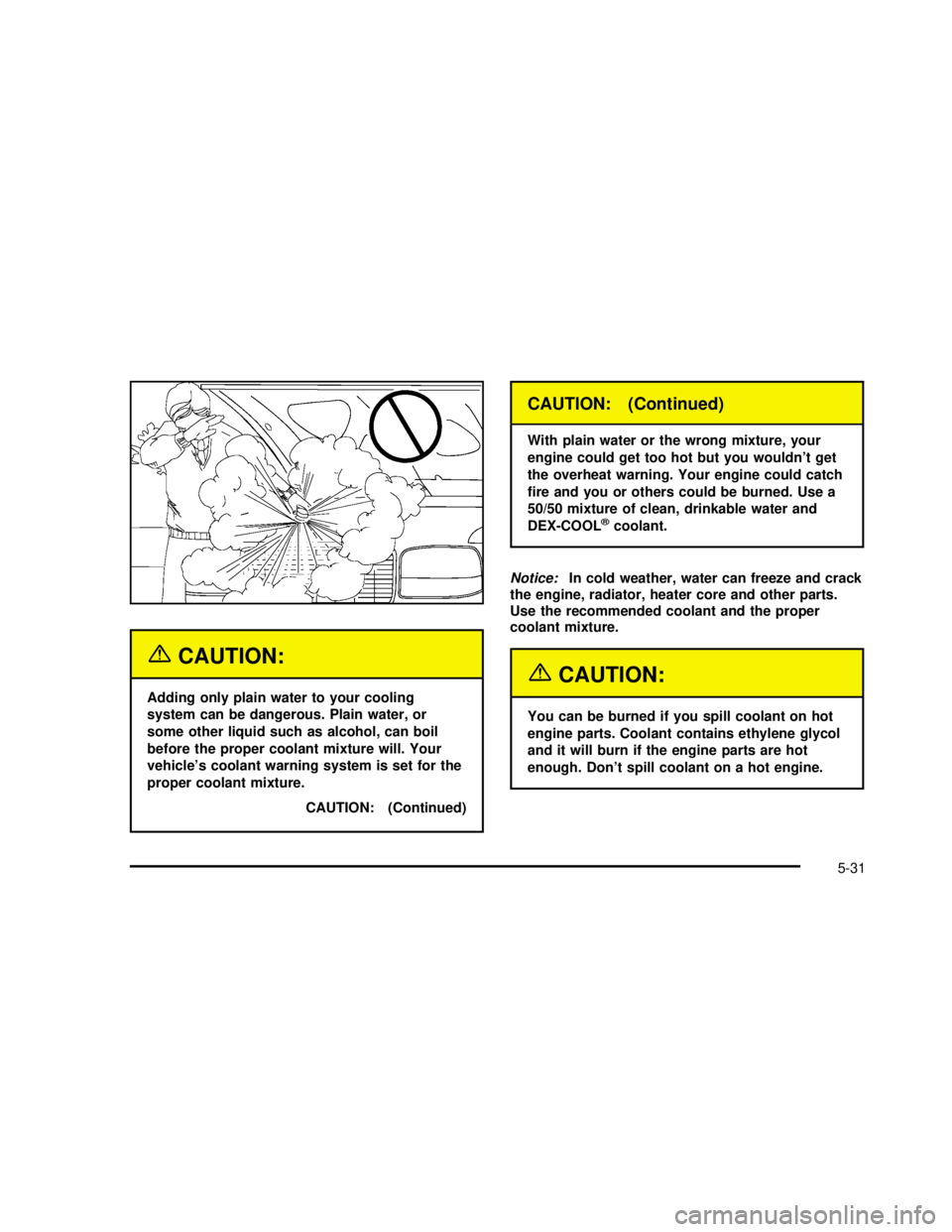
{CAUTION:
Adding only plain water to your cooling
system can be dangerous. Plain water, or
some other liquid such as alcohol, can boil
before the proper coolant mixture will. Your
vehicle’s coolant warning system is set for the
proper coolant mixture.
CAUTION: (Continued)
CAUTION: (Continued)
With plain water or the wrong mixture, your
engine could get too hot but you wouldn’t get
the overheat warning. Your engine could catch
fire and you or others could be burned. Use a
50/50 mixture of clean, drinkable water and
DEX-COOL
®coolant.
Notice:In cold weather, water can freeze and crack
the engine, radiator, heater core and other parts.
Use the recommended coolant and the proper
coolant mixture.
{CAUTION:
You can be burned if you spill coolant on hot
engine parts. Coolant contains ethylene glycol
and it will burn if the engine parts are hot
enough. Don’t spill coolant on a hot engine.
5-31
2003 - Sierra Denali
Page 294 of 408
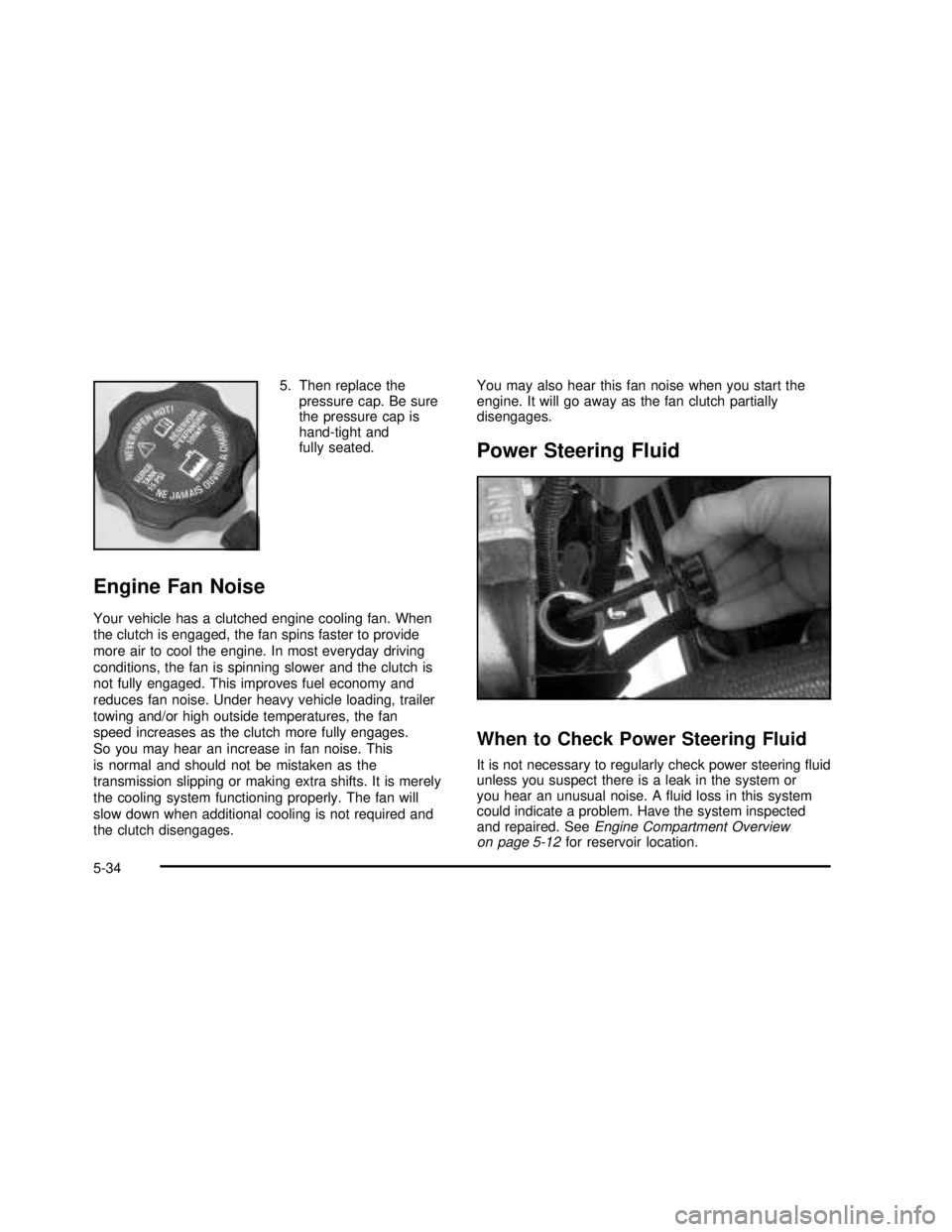
5. Then replace the
pressure cap. Be sure
the pressure cap is
hand-tight and
fully seated.
Engine Fan Noise
Your vehicle has a clutched engine cooling fan. When
the clutch is engaged, the fan spins faster to provide
more air to cool the engine. In most everyday driving
conditions, the fan is spinning slower and the clutch is
not fully engaged. This improves fuel economy and
reduces fan noise. Under heavy vehicle loading, trailer
towing and/or high outside temperatures, the fan
speed increases as the clutch more fully engages.
So you may hear an increase in fan noise. This
is normal and should not be mistaken as the
transmission slipping or making extra shifts. It is merely
the cooling system functioning properly. The fan will
slow down when additional cooling is not required and
the clutch disengages.You may also hear this fan noise when you start the
engine. It will go away as the fan clutch partially
disengages.
Power Steering Fluid
When to Check Power Steering Fluid
It is not necessary to regularly check power steeringfluid
unless you suspect there is a leak in the system or
you hear an unusual noise. Afluid loss in this system
could indicate a problem. Have the system inspected
and repaired. SeeEngine Compartment Overview
on page 5-12for reservoir location.
5-34
2003 - Sierra Denali
Page 359 of 408

Fuses Usage
FOG LP Fog Lamp Relay
FOG LP Fog Lamps
HORN Horn Relay
W/S WASHWindshield Washer Pump
Relay
W/S WASH Windshield Washer Pump
INFOOnStar/Rear Seat
EntertainmentFuses Usage
RADIO AMP Radio Amplifier
RH HID Not Used
HORN Horn
EAP Not Used
TREC All-Wheel Drive Module
SBA Supplemental Brake Assist
Capacities and Specifications
Capacities and Specifications
ApplicationCapacities
English Metric
Cooling System 14.8 quarts 14.0 L
Engine Oil with Filter 6.0 quarts 5.7 L
Fuel Tank 26.0 gallons 98.4 L
Air Conditioning Refrigerant R134a 1.6 lbs. 0.7 kg
Use Refrigerant Oil, R134a Systems
All capacities are approximate. When adding, be sure tofill to the approximate level, as recommended in this
manual. SeePart D: Recommended Fluids and Lubricants on page 6-15.
5-99
2003 - Sierra Denali
Page 361 of 408

Maintenance Schedule......................................6-2
Introduction...................................................6-2
Your Vehicle and the Environment....................6-2
Maintenance Requirements..............................6-2
How This Section is Organized.........................6-3
Part A: Scheduled Maintenance Services...........6-4
Using Your Maintenance Schedule....................6-4
Scheduled Maintenance...................................6-5
Part B: Owner Checks and Services................6-10
At Each Fuel Fill..........................................6-10
At Least Once a Month.................................6-10
At Least Twice a Year...................................6-10At Least Once a Year
...................................6-11
Part C: Periodic Maintenance Inspections
.........6-14
Steering and Suspension Inspection
................6-14
Exhaust System Inspection
............................6-14
Fuel System Inspection
..................................6-14
Engine Cooling System Inspection
...................6-14
Transfer Case and Front Axle (All-Wheel
Drive) Inspection
.......................................6-15
Brake System Inspection
................................6-15
Part D: Recommended Fluids and Lubricants
. . . .6-15
Part E: Maintenance Record
...........................6-17
Section 6 Maintenance Schedule
6-1
2003 - Sierra Denali
Page 369 of 408

❑Check rear/front axleuid level and adduid as
needed. Check constant velocity joints and axle seals
for leaking.
❑Replace fuellter.An Emission Control Service.
(See Footnote†.)
❑Rotate tires. SeeTire Inspection and Rotation on
page 5-58for proper rotation pattern and additional
information.(See footnote +.)
97,500 Miles (162 500 km)
❑Check rear/front axleuid level and adduid as
needed. Check constant velocity joints and axle seals
for leaking.
❑Rotate tires. SeeTire Inspection and Rotation on
page 5-58for proper rotation pattern and additional
information.(See footnote +.)
100,000 Miles (166 000 km)
❑Inspect spark plug wires.An Emission Control
Service.
❑Replace spark plugs.An Emission Control Service.❑Change automatic transmissionuid andlter if the
vehicle is mainly driven under one or more of these
conditions:
In heavy city traffic where the outside
temperature regularly reaches 90°F (32°C) or
higher.
In hilly or mountainous terrain.
When doing frequent trailer towing.
Uses such as found in taxi, police or delivery
service.
❑If you haven’t used your vehicle under severe service
conditions listed previously and, therefore, haven’t
changed your automatic transmissionuid, change
both theuid andlter.
❑Inspect Positive Crankcase Ventilation (PCV) valve.
An Emission Control Service.
150,000 Miles (240 000 km)
❑Drain,ush and rell cooling system (or every
60 months since last service, whichever occursrst).
SeeEngine Coolant on page 5-23for what to use.
Inspect hoses. Clean radiator, condenser, pressure
cap and neck. Pressure test the cooling system
and pressure cap.An Emission Control Service.
❑Inspect engine accessory drive belt.An Emission
Control Service.
6-9
2003 - Sierra Denali
Page 374 of 408

Part C: Periodic Maintenance
Inspections
Listed in this part are inspections and services which
should be performed at least twice a year (for instance,
each spring and fall).You should let your dealer’s
service department do these jobs. Make sure any
necessary repairs are completed at once.
Proper procedures to perform these services may be
found in a service manual. SeeService Publications
Ordering Information on page 7-9.
Steering and Suspension Inspection
Inspect the front and rear suspension and steering
system for damaged, loose or missing parts, signs of
wear or lack of lubrication. Inspect the power steering
lines and hoses for proper hook-up, binding, leaks,
cracks, chang, etc.
Exhaust System Inspection
Inspect the complete exhaust system. Inspect the body
near the exhaust system. Look for broken, damaged,
missing or out-of-position parts as well as open seams,
holes, loose connections or other conditions which
could cause a heat build-up in theoor pan or could let
exhaust fumes into the vehicle. SeeEngine Exhaust
on page 2-26.
Fuel System Inspection
Inspect the complete fuel system for damage or leaks.
Engine Cooling System Inspection
Inspect the hoses and have them replaced if they
are cracked, swollen or deteriorated. Inspect all pipes,
ttings and clamps; replace as needed. Clean the
outside of the radiator and air conditioning condenser.
To help ensure proper operation, a pressure test of
the cooling system and pressure cap is recommended
at least once a year.
6-14
2003 - Sierra Denali
Page 394 of 408

Cleaning the Windshield and Wiper Blades.........5-86
Cleaning Tires................................................5-87
Cleaning Vinyl................................................5-83
Cleaning Wood Panels....................................5-84
Climate Control System
Dual Automatic............................................3-18
Compact Disc Changer Errors..........................3-75
Compact Disc Messages..................................3-70
Compass Calibration.......................................2-30
Compass Variance..........................................2-29
Content Theft-Deterrent....................................2-13
Control of a Vehicle.......................................... 4-5
Coolant
Engine Temperature Gage............................3-36
Heater, Engine............................................2-18
Surge Tank Pressure Cap.............................5-26
Cooling System..............................................5-29
Cruise Control.................................................. 3-8
Cruise Control Light........................................3-40
Cupholder(s)..................................................2-39
Current and Past Model Order Forms................7-10
Customer Assistance Information
Courtesy Transportation
.................................. 7-7
Customer Assistance for Text Telephone (TTY)
Users
....................................................... 7-3
Customer Assistance Offices
........................... 7-4
Customer Satisfaction Procedure
..................... 7-2
GM Mobility Program for Persons with
Disabilities
................................................ 7-5
Reporting Safety Defects to General Motors
...... 7-9Customer Assistance Information (cont.)
Reporting Safety Defects to the Canadian
Government.............................................. 7-9
Reporting Safety Defects to the United States
Government.............................................. 7-8
Roadside Assistance Program......................... 7-5
Service Publications Ordering Information......... 7-9
D
Daytime Running Lamps..................................3-13
Defensive Driving............................................. 4-2
Defogging and Defrosting.................................3-22
Doing Your Own Service Work........................... 5-3
Dome Lamps .................................................3-16
Door
Locks.......................................................... 2-6
Power Door Locks......................................... 2-7
Programmable Automatic Door Locks............... 2-7
Rear Doors.................................................. 2-9
Driver
Position, Safety Belt.....................................1-12
DRIVER DOOR AJAR.....................................3-56
Driver Information Center (DIC).........................3-42
DIC Operation and Displays..........................3-42
DIC Warnings and Messages........................3-51
Driving
At Night.....................................................4-30
City ...........................................................4-35
Defensive..................................................... 4-2
4
2003 - Sierra Denali
Page 395 of 408

Driving (cont.)
Drunken....................................................... 4-2
Freeway.....................................................4-36
Hill and Mountain Roads..............................4-38
In Rain and on Wet Roads...........................4-32
Winter........................................................4-40
Driving Across an Incline..................................4-27
Driving Downhill..............................................4-25
Driving in Mud, Sand, Snow or Ice....................4-28
Driving in Water..............................................4-29
Driving On Grades..........................................4-59
Driving on Off-Road Hills.................................4-23
Driving on Snow or Ice....................................4-40
Driving Through Deep Standing Water...............4-34
Driving Through Flowing Water.........................4-34
Driving Uphill..................................................4-24
Driving with a Trailer.......................................4-58
Dual Automatic Climate Control System.............3-18
E
Easy Exit Seat...............................................2-42
Electrical System
Add-On Equipment......................................5-91
Fuses and Circuit Breakers...........................5-91
Power Windows and Other Power Options......5-91
Windshield Wiper Fuses...............................5-91
Electrochromic Mirror Operation........................2-28
Emissions Inspection and Maintenance
Programs...................................................3-39Engine
Air Cleaner/Filter
.........................................5-18
Battery
.......................................................5-39
Check and Service Engine Soon Light
............3-37
Compartment Overview
................................5-12
Coolant
......................................................5-23
Coolant Heater
............................................2-18
Coolant Temperature Gage
...........................3-36
Cooling System Inspection
............................6-14
Exhaust
.....................................................2-26
Fan Noise
..................................................5-34
Oil
.............................................................5-13
Overheating
................................................5-26
Starting
......................................................2-17
ENGINE COOLANT HOT
.................................3-52
Engine Coolant Level Check
.............................6-10
Engine Hour Meter Display
...............................3-26
Engine Oil Additives
........................................5-16
Engine Oil Level Check
...................................6-10
ENGINE OVERHEATED
..................................3-52
Entry Lighting
.................................................3-15
Environmental Concerns
..................................4-20
Erasing HomeLink
®Buttons
..............................2-38
Exit Lighting
...................................................3-15
Express-Down Windows
...................................2-12
Extender, Safety Belt
.......................................1-28
Exterior Lamps
...............................................3-11
5
2003 - Sierra Denali
Page 397 of 408

H
Hazard Warning Flashers................................... 3-4
Head Restraints............................................... 1-5
Headlamp High/Low Beam Changer.................... 3-6
Headlamps....................................................5-48
Bulb Replacement.......................................5-48
Front Turn Signal, Sidemarker and Daytime
Running Lamps........................................5-49
Halogen Bulbs............................................5-48
Pickup Box Identification and Fender
Marker Lamps.........................................5-54
Roof Marker Lamps.....................................5-51
Heated Seats................................................... 1-3
Heating.........................................................3-22
Highway Hypnosis...........................................4-38
Hill and Mountain Roads..................................4-38
Hitches..........................................................4-57
HomeLink
®Transmitter, Programming................2-35
HomeLink®Transmitter....................................2-35
Hood
Checking Things Under................................5-10
Release.....................................................5-10
Horn ............................................................... 3-5
How to Add Coolant to the Coolant Surge Tank......5-30
How to Add Fluid............................................5-22
How to Check........................................5-20, 5-57
How to Check Lubricant...................................5-46
How to Check Power Steering Fluid..................5-35How to Inspect...............................................5-18
How to Use This Manual...................................... ii
How to Wear Safety Belts Properly...................1-12
Hydroplaning..................................................4-33
I
If No Steam Is Coming From Your Engine..........5-28
If Steam Is Coming From Your Engine...............5-27
If the Light is Flashing.....................................3-38
If the Light Is On Steady.................................3-38
If You Are Stuck in Sand, Mud, Ice or Snow.......4-44
If You Do Decide To Pull A Trailer.....................4-53
If You’re Caught in a Blizzard...........................4-42
Ignition Positions.............................................2-16
Ignition Transmission Lock Check......................6-13
Illuminated Visor Vanity Mirrors.........................2-13
Infants and Young Children, Restraints...............1-31
Inflation -- Tire Pressure..................................5-57
Inspection
Brake System
.............................................6-15
Engine Cooling System
................................6-14
Exhaust System
..........................................6-14
Fuel System
...............................................6-14
Part C - Periodic Maintenance
.......................6-14
Steering and Suspension
..............................6-14
Transfer Case and Front Axle
(All-Wheel Drive)
......................................6-15
7
2003 - Sierra Denali
Page 399 of 408

M
Maintenance, Normal Replacement Parts..........5-100
Maintenance Schedule
At Each Fuel Fill.........................................6-10
At Least Once a Month................................6-10
At Least Once a Year..................................6-11
At Least Twice a Year..................................6-10
Brake System Inspection..............................6-15
Engine Cooling System Inspection.................6-14
Exhaust System Inspection...........................6-14
Fuel System Inspection................................6-14
How This Section is Organized....................... 6-3
Introduction.................................................. 6-2
Maintenance Requirements............................. 6-2
Part A - Scheduled Maintenance Services......... 6-4
Part B - Owner Checks and Services.............6-10
Part C - Periodic Maintenance Inspections......6-14
PartD-Recommended Fluids and Lubricants....6-15
PartE-Maintenance Record........................6-17
Scheduled Maintenance................................. 6-5
Steering and Suspension Inspection...............6-14
Transfer Case and Front Axle (All-Wheel
Drive) Inspection......................................6-15
Using Your................................................... 6-4
Your Vehicle and the Environment................... 6-2
Maintenance When Trailer Towing.....................4-60Making Turns.................................................4-59
Malfunction Indicator Light................................3-37
Manual Selectable Ride..................................... 4-9
Matching Transmitter(s) to Your Vehicle............... 2-5
Memory Seat.................................................2-41
Message
DIC Warnings and Messages........................3-51
Mexico, Central America and Caribbean Islands/
Countries (Except Puerto Rico and U.S. Virgin
Islands)....................................................... 7-4
Mirrors
Automatic Dimming Rearview with OnStar
®,
Compass and Temperature Display.............2-28
Outside Automatic Dimming Mirror.................2-32
Outside Convex Mirror.................................2-32
Outside Curb View Assist Mirrors...................2-32
Outside Heated Mirrors................................2-32
Outside Power Foldaway Mirrors....................2-31
Outside Power Mirrors..................................2-31
MyGMLink.com
................................................ 7-3
N
Navigation/Radio System
..................................3-70
New Vehicle Break-In
......................................2-15
Normal Maintenance Replacement Parts
...........5-100
9
2003 - Sierra Denali