Fluid GMC SIERRA 2003 User Guide
[x] Cancel search | Manufacturer: GMC, Model Year: 2003, Model line: SIERRA, Model: GMC SIERRA 2003Pages: 408, PDF Size: 2.58 MB
Page 296 of 408
Brakes
Brake Fluid
Your brake master cylinder reservoir isfilled with DOT-3
brakefluid. SeeEngine Compartment Overview on
page 5-12for the location of the reservoir.
There are only two reasons why the brakefluid level in
the reservoir might go down. Thefirst is that the
brakefluid goes down to an acceptable level during
normal brake lining wear. When new linings are put in,
thefluid level goes back up. The other reason is
thatfluid is leaking out of the brake system. If it is, you
should have your brake systemfixed, since a leak
means that sooner or later your brakes won’t work well,
or won’t work at all.
So, it isn’t a good idea to“top off”your brakefluid.
Adding brakefluid won’t correct a leak. If you addfluid
when your linings are worn, then you’ll have too
muchfluid when you get new brake linings. You should
add (or remove) brakefluid, as necessary, only when
work is done on the brake hydraulic system.
{CAUTION:
If you have too much brakefluid, it can spill on
the engine. Thefluid will burn if the engine is
hot enough. You or others could be burned,
and your vehicle could be damaged. Add brake
fluid only when work is done on the brake
hydraulic system. See“Checking Brake Fluid”
in this section.
Refer to the Maintenance Schedule to determine when
to check your brakefluid. SeePart C: Periodic
Maintenance Inspections on page 6-14.
5-36
2003 - Sierra Denali
Page 297 of 408
Checking Brake Fluid
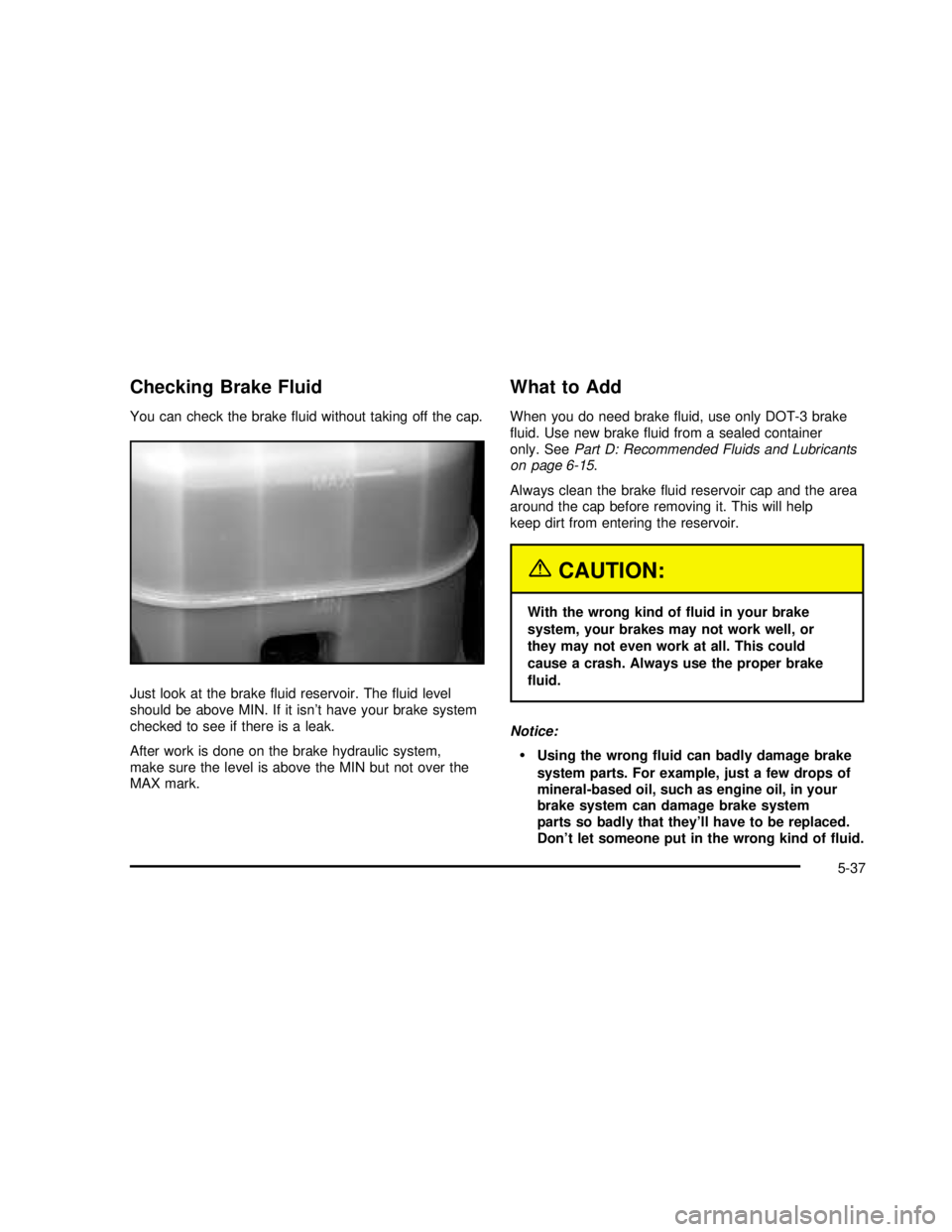
You can check the brakefluid without taking off the cap.
Just look at the brakefluid reservoir. Thefluid level
should be above MIN. If it isn’t have your brake system
checked to see if there is a leak.
After work is done on the brake hydraulic system,
make sure the level is above the MIN but not over the
MAX mark.
What to Add
When you do need brakefluid, use only DOT-3 brake
fluid. Use new brakefluid from a sealed container
only. SeePart D: Recommended Fluids and Lubricants
on page 6-15.
Always clean the brakefluid reservoir cap and the area
around the cap before removing it. This will help
keep dirt from entering the reservoir.
{CAUTION:
With the wrong kind offluid in your brake
system, your brakes may not work well, or
they may not even work at all. This could
cause a crash. Always use the proper brake
fluid.
Notice:
•Using the wrongfluid can badly damage brake
system parts. For example, just a few drops of
mineral-based oil, such as engine oil, in your
brake system can damage brake system
parts so badly that they’ll have to be replaced.
Don’t let someone put in the wrong kind offluid.
5-37
2003 - Sierra Denali
Page 305 of 408

All-Wheel Drive
Lubricant checks in this section also apply to these
vehicles. However, there are two additional systems that
need lubrication.
Transfer Case
When to Check Lubricant
Refer to the Maintenance Schedule to determine how
often to check the lubricant. SeePart C: Periodic
Maintenance Inspections on page 6-14.
How to Check Lubricant
To get an accurate reading, the vehicle should be on a
level surface.
If the level is below the bottom of thefiller plug hole,
you’ll need to add some lubricant. Add enough lubricant
to raise the level to the bottom of thefiller plug hole.
Use care not to overtighten the plug.
What to Use
Refer to the Maintenance Schedule to determine what
kind of lubricant to use. SeePart D: Recommended
Fluids and Lubricants on page 6-15.
(A) Fill Plug (B) Drain Plug
5-45
2003 - Sierra Denali
Page 306 of 408

Rear Axle
When to Check Lubricant
Refer to the Maintenance Schedule to determine how
often to check the lubricant. SeePart A: Scheduled
Maintenance Services on page 6-4.
How to Check Lubricant
To get an accurate reading, the vehicle should be on a
level surface.The proper level is from 5/8 inch to 1 5/8 inch (15 mm to
40 mm) below the bottom of thefiller plug hole. Add
only enoughfluid to reach the proper level. The proper
level for vehicles with QUADRASTEER™(4 Wheel
Steer) is from 0 to 1/4 inch (0 to 6 mm) below thefiller
plug hole. Add only enoughfluid to reach the proper
level.
What to Use
Refer to the Maintenance Schedule to determine what
kind of lubricant to use. SeePart D: Recommended
Fluids and Lubricants on page 6-15.
5-46
2003 - Sierra Denali
Page 307 of 408
Front Axle
When to Check Lubricant
Refer to the Maintenance Schedule to determine how
often to check the lubricant. See Part A:Part A:
Scheduled Maintenance Services on page 6-4.
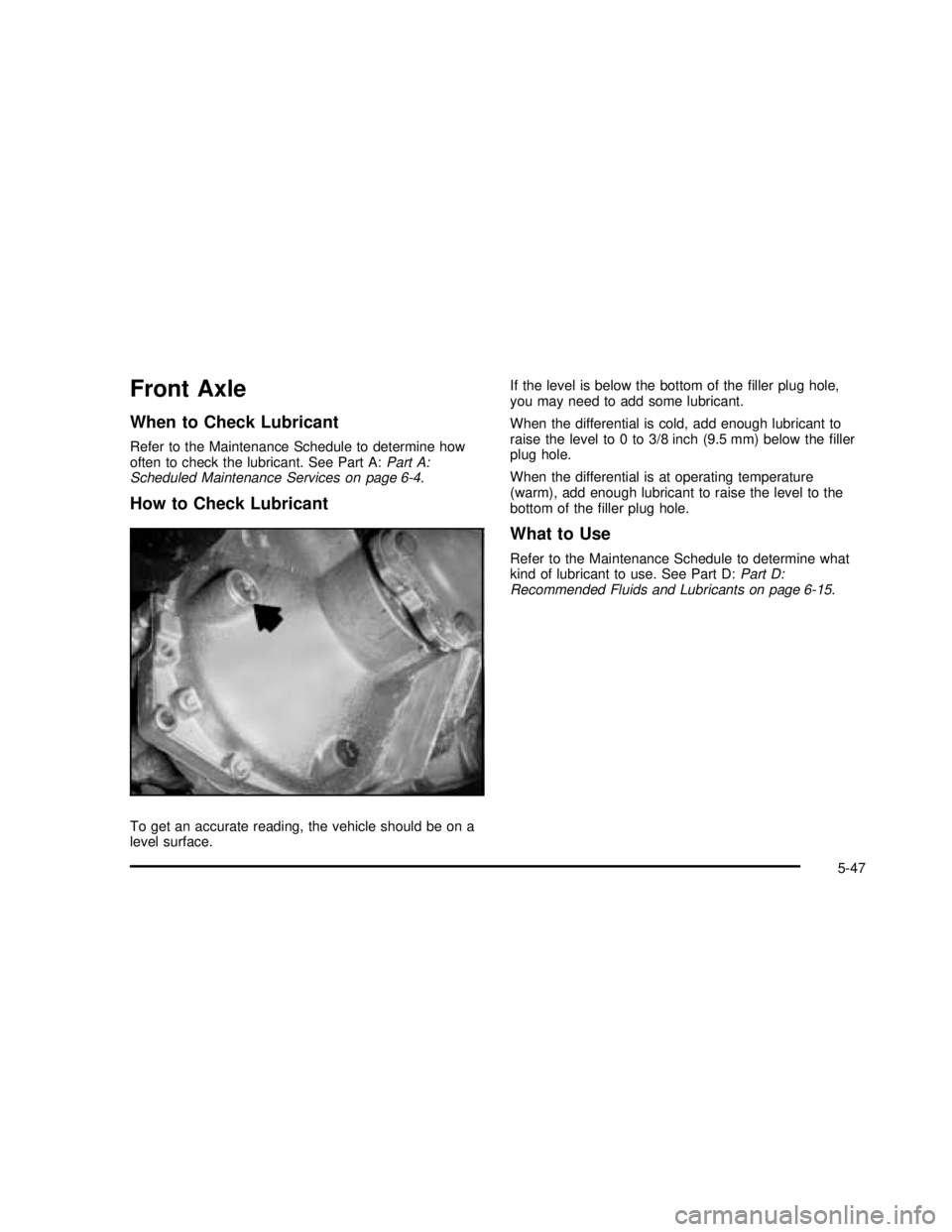
How to Check Lubricant
To get an accurate reading, the vehicle should be on a
level surface.If the level is below the bottom of thefiller plug hole,
you may need to add some lubricant.
When the differential is cold, add enough lubricant to
raise the level to 0 to 3/8 inch (9.5 mm) below thefiller
plug hole.
When the differential is at operating temperature
(warm), add enough lubricant to raise the level to the
bottom of thefiller plug hole.
What to Use
Refer to the Maintenance Schedule to determine what
kind of lubricant to use. See Part D:Part D:
Recommended Fluids and Lubricants on page 6-15.
5-47
2003 - Sierra Denali
Page 345 of 408

Weatherstrips
Silicone grease on weatherstrips will make them last
longer, seal better, and not stick or squeak. Apply
silicone grease with a clean cloth at least every six
months. During very cold, damp weather more frequent
application may be required. SeePart D: Recommended
Fluids and Lubricants on page 6-15.
Cleaning the Outside of Your
Vehicle
The paintfinish on your vehicle provides beauty, depth
of color, gloss retention and durability.
Washing Your Vehicle
The best way to preserve your vehicle’sfinish is to keep
it clean by washing it often with lukewarm or cold
water.
Don’t wash your vehicle in the direct rays of the sun.
Use a car washing soap. Don’t use strong soaps
or chemical detergents. Be sure to rinse the vehicle
well, removing all soap residue completely. You can get
GM-approved cleaning products from your dealer.
SeeGM Vehicle Care/Appearance Materials on
page 5-88.Don’t use cleaning agents that are petroleum
based, or that contain acid or abrasives.All cleaning agents should beflushed promptly and not
allowed to dry on the surface, or they could stain.
Dry thefinish with a soft, clean chamois or an all-cotton
towel to avoid surface scratches and water spotting.
High pressure car washes may cause water to
enter your vehicle.
If your vehicle is equipped with QUADRASTEER™see
QUADRASTEER™on page 4-12.
Cleaning Exterior Lamps/Lenses
Use only lukewarm or cold water, a soft cloth and a car
washing soap to clean exterior lamps and lenses.
Follow instructions under“Washing Your Vehicle.”
Finish Care
Occasional waxing or mild polishing of your vehicle by
hand may be necessary to remove residue from the
paintfinish. You can get GM-approved cleaning products
from your dealer. SeeGM Vehicle Care/Appearance
Materials on page 5-88.
If your vehicle has a“basecoat/clearcoat”paintfinish.
The clearcoat gives more depth and gloss to the colored
basecoat. Always use waxes and polishes that are
non-abrasive and made for a basecoat/clearcoat paint
finish.
5-85
2003 - Sierra Denali
Page 349 of 408

GM Vehicle Care/Appearance Materials
(cont’d)
Description Usage
Chrome and Wire Wheel
CleanerRemoves dirt and grime
from chrome wheels and
wire wheel covers.
Finish EnhancerRemoves dust,
fingerprints, and surface
contaminants, Spray on
wipe off.
Swirl Remover PolishRemoves swirl marks,
fine scratches and other
light surface
contamination.
Cleaner WaxRemoves light scratches
and protectsfinish.
Foaming Tire Shine Low
GlossCleans, shines and
protects in one easy step,
no wiping necessary.
GM Vehicle Care/Appearance Materials
(cont’d)
Description Usage
Wash Wax ConcentrateMedium foaming
shampoo. Cleans and
lightly waxes.
Biodegradable and
phosphate free.
Spot LifterQuickly and easily
removes spots and stains
from carpets, vinyl and
cloth upholstery.
Odor EliminatorOdorless spray odor
eliminator used on
fabrics, vinyl, leather and
carpet.
See your General Motors parts department for these
products. SeePart D: Recommended Fluids and
Lubricants on page 6-15.
5-89
2003 - Sierra Denali
Page 359 of 408

Fuses Usage
FOG LP Fog Lamp Relay
FOG LP Fog Lamps
HORN Horn Relay
W/S WASHWindshield Washer Pump
Relay
W/S WASH Windshield Washer Pump
INFOOnStar/Rear Seat
EntertainmentFuses Usage
RADIO AMP Radio Amplifier
RH HID Not Used
HORN Horn
EAP Not Used
TREC All-Wheel Drive Module
SBA Supplemental Brake Assist
Capacities and Specifications
Capacities and Specifications
ApplicationCapacities
English Metric
Cooling System 14.8 quarts 14.0 L
Engine Oil with Filter 6.0 quarts 5.7 L
Fuel Tank 26.0 gallons 98.4 L
Air Conditioning Refrigerant R134a 1.6 lbs. 0.7 kg
Use Refrigerant Oil, R134a Systems
All capacities are approximate. When adding, be sure tofill to the approximate level, as recommended in this
manual. SeePart D: Recommended Fluids and Lubricants on page 6-15.
5-99
2003 - Sierra Denali
Page 361 of 408

Maintenance Schedule......................................6-2
Introduction...................................................6-2
Your Vehicle and the Environment....................6-2
Maintenance Requirements..............................6-2
How This Section is Organized.........................6-3
Part A: Scheduled Maintenance Services...........6-4
Using Your Maintenance Schedule....................6-4
Scheduled Maintenance...................................6-5
Part B: Owner Checks and Services................6-10
At Each Fuel Fill..........................................6-10
At Least Once a Month.................................6-10
At Least Twice a Year...................................6-10At Least Once a Year
...................................6-11
Part C: Periodic Maintenance Inspections
.........6-14
Steering and Suspension Inspection
................6-14
Exhaust System Inspection
............................6-14
Fuel System Inspection
..................................6-14
Engine Cooling System Inspection
...................6-14
Transfer Case and Front Axle (All-Wheel
Drive) Inspection
.......................................6-15
Brake System Inspection
................................6-15
Part D: Recommended Fluids and Lubricants
. . . .6-15
Part E: Maintenance Record
...........................6-17
Section 6 Maintenance Schedule
6-1
2003 - Sierra Denali
Page 363 of 408

How This Section is Organized
This maintenance schedule is divided intofive parts:
“Part A: Scheduled Maintenance Services”explains
what to have done and how often. Some of these
services can be complex, so unless you are technically
qualified and have the necessary equipment, you
should let your GM dealer’s service department do these
jobs.
Your GM dealer has GM-trained and supported service
people that will perform the work using genuine GM
parts.
{CAUTION:
Performing maintenance work on a vehicle can
be dangerous. In trying to do some jobs, you
can be seriously injured. Do your own
maintenance work only if you have the
required know-how and the proper tools and
equipment for the job. If you have any doubt,
have a qualified technician do the work.
If you want to get the service information, seeService
Publications Ordering Information on page 7-9.“Part B: Owner Checks and Services”tells you what
should be checked and when. It also explains what
you can easily do to help keep your vehicle in good
condition.
“Part C: Periodic Maintenance Inspections”explains
important inspections that your dealer’s service
department can perform for you.
“Part D: Recommended Fluids and Lubricants”lists
some recommended products necessary to help
keep your vehicle properly maintained. These products,
or their equivalents, should be used whether you do
the work yourself or have it done.
“Part E: Maintenance Record”is a place for you to
record and keep track of the maintenance performed on
your vehicle. Keep your maintenance receipts. They
may be needed to qualify your vehicle for warranty
repairs.
6-3
2003 - Sierra Denali