fuel cap GMC SIERRA 2003 User Guide
[x] Cancel search | Manufacturer: GMC, Model Year: 2003, Model line: SIERRA, Model: GMC SIERRA 2003Pages: 408, PDF Size: 2.58 MB
Page 273 of 408
A. Engine Air Cleaner/Filter
B. Coolant Surge Tank
C. Air Cleaner/Filter Restriction Indicator
D. Engine Oil Dipstick
E. Engine Oil Fill Cap
F. Automatic Transmission Dipstick
G. Fan
H. Remote Negative (−) Terminal (GND)
I. Remote Positive (+) Terminal
J. Power Steering Fluid Reservoir
K. Brake Fluid Reservoir
L. Underhood Fuse Block
M. Battery
N. Windshield Washer Fluid Reservoir
Engine Oil
If the CHECK OIL LEVEL light appears on the
instrument cluster, it means you need to check your
engine oil level right away. For more information,
see“CHECK OIL LEVEL”underDIC Warnings and
Messages on page 3-51.
You should check your engine oil level regularly; this is
an added reminder.
Checking Engine Oil
It’s a good idea to check your engine oil every time you
get fuel. In order to get an accurate reading, the oil
must be warm and the vehicle must be on level ground.
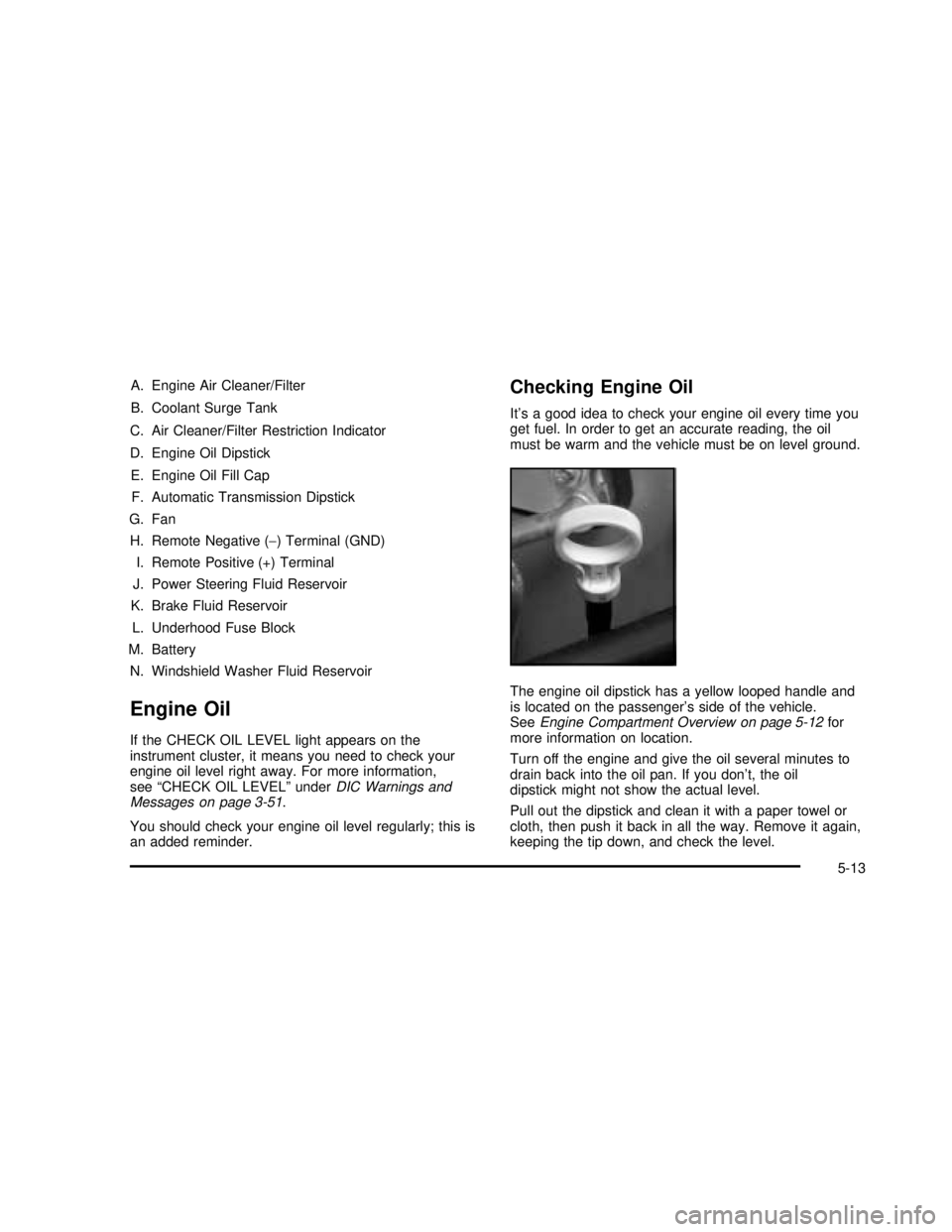
The engine oil dipstick has a yellow looped handle and
is located on the passenger’s side of the vehicle.
SeeEngine Compartment Overview on page 5-12for
more information on location.
Turn off the engine and give the oil several minutes to
drain back into the oil pan. If you don’t, the oil
dipstick might not show the actual level.
Pull out the dipstick and clean it with a paper towel or
cloth, then push it back in all the way. Remove it again,
keeping the tip down, and check the level.
5-13
2003 - Sierra Denali
Page 294 of 408
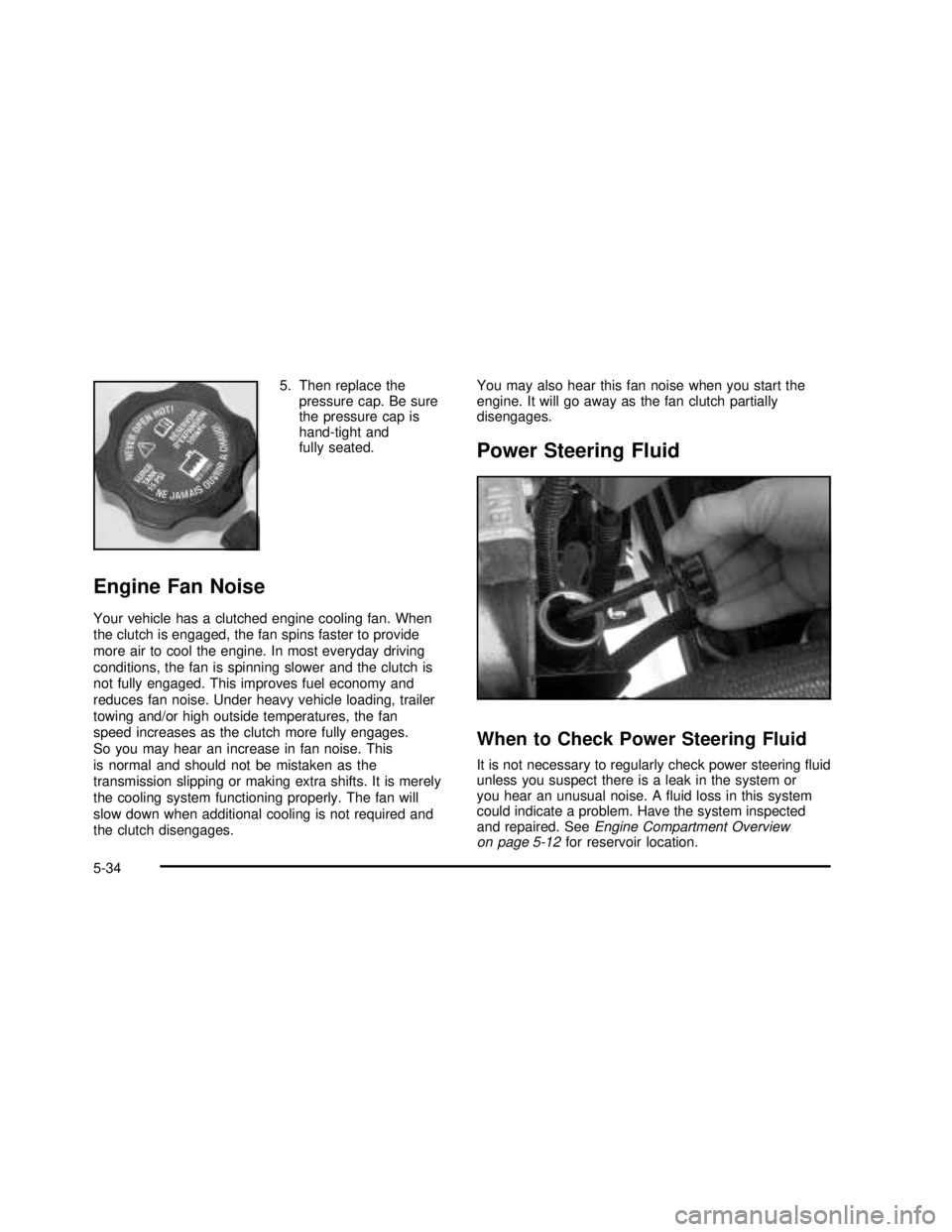
5. Then replace the
pressure cap. Be sure
the pressure cap is
hand-tight and
fully seated.
Engine Fan Noise
Your vehicle has a clutched engine cooling fan. When
the clutch is engaged, the fan spins faster to provide
more air to cool the engine. In most everyday driving
conditions, the fan is spinning slower and the clutch is
not fully engaged. This improves fuel economy and
reduces fan noise. Under heavy vehicle loading, trailer
towing and/or high outside temperatures, the fan
speed increases as the clutch more fully engages.
So you may hear an increase in fan noise. This
is normal and should not be mistaken as the
transmission slipping or making extra shifts. It is merely
the cooling system functioning properly. The fan will
slow down when additional cooling is not required and
the clutch disengages.You may also hear this fan noise when you start the
engine. It will go away as the fan clutch partially
disengages.
Power Steering Fluid
When to Check Power Steering Fluid
It is not necessary to regularly check power steeringfluid
unless you suspect there is a leak in the system or
you hear an unusual noise. Afluid loss in this system
could indicate a problem. Have the system inspected
and repaired. SeeEngine Compartment Overview
on page 5-12for reservoir location.
5-34
2003 - Sierra Denali
Page 317 of 408
CAUTION: (Continued)
•
Underinflated tires pose the same danger
as overloaded tires. The resulting accident
could cause serious injury. Check all tires
frequently to maintain the recommended
pressure. Tire pressure should be checked
when your tires are cold.
•Overinflated tires are more likely to be
cut, punctured or broken by a sudden
impact—such as when you hit a pothole.
Keep tires at the recommended pressure.
•Worn, old tires can cause accidents.
If your tread is badly worn, or if your tires
have been damaged, replace them.
Inflation -- Tire Pressure
The Certification/Tire label, which is on the rear edge of
the driver’s door, shows the correct inflation pressures
for your tires when they’re cold.“Cold”means your
vehicle has been sitting for at least three hours or driven
no more than 1 mile (1.6 km).
Notice:Don’t let anyone tell you that underinflation
or overinflation is all right. It’s not. If your tires
don’t have enough air (underinflation), you can get
the following:
•Too muchflexing
•Too much heat
•Tire overloading
•Bad wear
•Bad handling
•Bad fuel economy
If your tires have too much air (overinflation), you
can get the following:
•Unusual wear
•Bad handling
•Rough ride
•Needless damage from road hazards
When to Check
Check your tires once a month or more.
Also, check the tire pressure of the spare tire.
How to Check
Use a good quality pocket-type gage to check tire
pressure. You can’t tell if your tires are properly inflated
simply by looking at them. Radial tires may look
properly inflated even when they’re underinflated.
Be sure to put the valve caps back on the valve stems.
They help prevent leaks by keeping out dirt and
moisture.
5-57
2003 - Sierra Denali
Page 359 of 408

Fuses Usage
FOG LP Fog Lamp Relay
FOG LP Fog Lamps
HORN Horn Relay
W/S WASHWindshield Washer Pump
Relay
W/S WASH Windshield Washer Pump
INFOOnStar/Rear Seat
EntertainmentFuses Usage
RADIO AMP Radio Amplifier
RH HID Not Used
HORN Horn
EAP Not Used
TREC All-Wheel Drive Module
SBA Supplemental Brake Assist
Capacities and Specifications
Capacities and Specifications
ApplicationCapacities
English Metric
Cooling System 14.8 quarts 14.0 L
Engine Oil with Filter 6.0 quarts 5.7 L
Fuel Tank 26.0 gallons 98.4 L
Air Conditioning Refrigerant R134a 1.6 lbs. 0.7 kg
Use Refrigerant Oil, R134a Systems
All capacities are approximate. When adding, be sure tofill to the approximate level, as recommended in this
manual. SeePart D: Recommended Fluids and Lubricants on page 6-15.
5-99
2003 - Sierra Denali
Page 369 of 408

❑Check rear/front axleuid level and adduid as
needed. Check constant velocity joints and axle seals
for leaking.
❑Replace fuellter.An Emission Control Service.
(See Footnote†.)
❑Rotate tires. SeeTire Inspection and Rotation on
page 5-58for proper rotation pattern and additional
information.(See footnote +.)
97,500 Miles (162 500 km)
❑Check rear/front axleuid level and adduid as
needed. Check constant velocity joints and axle seals
for leaking.
❑Rotate tires. SeeTire Inspection and Rotation on
page 5-58for proper rotation pattern and additional
information.(See footnote +.)
100,000 Miles (166 000 km)
❑Inspect spark plug wires.An Emission Control
Service.
❑Replace spark plugs.An Emission Control Service.❑Change automatic transmissionuid andlter if the
vehicle is mainly driven under one or more of these
conditions:
In heavy city traffic where the outside
temperature regularly reaches 90°F (32°C) or
higher.
In hilly or mountainous terrain.
When doing frequent trailer towing.
Uses such as found in taxi, police or delivery
service.
❑If you haven’t used your vehicle under severe service
conditions listed previously and, therefore, haven’t
changed your automatic transmissionuid, change
both theuid andlter.
❑Inspect Positive Crankcase Ventilation (PCV) valve.
An Emission Control Service.
150,000 Miles (240 000 km)
❑Drain,ush and rell cooling system (or every
60 months since last service, whichever occursrst).
SeeEngine Coolant on page 5-23for what to use.
Inspect hoses. Clean radiator, condenser, pressure
cap and neck. Pressure test the cooling system
and pressure cap.An Emission Control Service.
❑Inspect engine accessory drive belt.An Emission
Control Service.
6-9
2003 - Sierra Denali
Page 374 of 408

Part C: Periodic Maintenance
Inspections
Listed in this part are inspections and services which
should be performed at least twice a year (for instance,
each spring and fall).You should let your dealer’s
service department do these jobs. Make sure any
necessary repairs are completed at once.
Proper procedures to perform these services may be
found in a service manual. SeeService Publications
Ordering Information on page 7-9.
Steering and Suspension Inspection
Inspect the front and rear suspension and steering
system for damaged, loose or missing parts, signs of
wear or lack of lubrication. Inspect the power steering
lines and hoses for proper hook-up, binding, leaks,
cracks, chang, etc.
Exhaust System Inspection
Inspect the complete exhaust system. Inspect the body
near the exhaust system. Look for broken, damaged,
missing or out-of-position parts as well as open seams,
holes, loose connections or other conditions which
could cause a heat build-up in theoor pan or could let
exhaust fumes into the vehicle. SeeEngine Exhaust
on page 2-26.
Fuel System Inspection
Inspect the complete fuel system for damage or leaks.
Engine Cooling System Inspection
Inspect the hoses and have them replaced if they
are cracked, swollen or deteriorated. Inspect all pipes,
ttings and clamps; replace as needed. Clean the
outside of the radiator and air conditioning condenser.
To help ensure proper operation, a pressure test of
the cooling system and pressure cap is recommended
at least once a year.
6-14
2003 - Sierra Denali
Page 392 of 408

Audio System(s) (cont.)
XM™Satellite Radio Antenna System............3-78
Automatic Headlamp System............................3-12
Automatic Transmission
Fluid..........................................................5-20
Operation...................................................2-19
Automatic Transmission Check..........................6-11
Automatic Transmission Shift Lock Control
System Check.............................................6-12
B
Backing Up....................................................4-58
Battery..........................................................5-39
BATTERY NOT CHARGING.............................3-52
Battery Replacement......................................... 2-5
Battery Run-Down Protection............................3-16
Battery Warning Light......................................3-33
Before Leaving on a Long Trip.........................4-37
Before You Go Off-Roading..............................4-18
Body Lubrication Service..................................6-11
Brake
Parking......................................................2-22
System Inspection.......................................6-15
System Warning Light..................................3-34
Brake Adjustment............................................5-38
Brake Fluid....................................................5-36
Brake Pedal Travel.........................................5-38
Brake Wear...................................................5-38
Brakes..........................................................5-36Braking........................................................... 4-5
Braking in Emergencies..................................... 4-8
Break-In, New Vehicle.....................................2-15
Bulb Replacement...........................................5-48
Center High-Mounted Stoplamp (CHMSL)
and Cargo Lamp......................................5-52
Front Turn Signal, Sidemarker and Daytime
Running Lamps........................................5-49
Halogen Bulbs............................................5-48
Headlamps.................................................5-48
Pickup Box Identification and Fender
Marker Lamps.........................................5-54
Replacement Bulbs......................................5-55
Roof Marker Lamps.....................................5-51
Taillamps....................................................5-54
Buying New Tires...........................................5-60
C
California Fuel.................................................. 5-5
Canada........................................................... 7-4
Canadian Owners................................................ ii
Canadian Roadside Assistance........................... 7-6
Capacities and Specifications............................5-99
Car Washes for QUADRASTEER™Equipped
Vehicles.....................................................4-14
Carbon Monoxide...................4-40, 4-53, 2-10, 2-26
Care of
Safety Belts................................................5-84
Your Cassette Tape Player............................3-77
2
2003 - Sierra Denali