ride GMC SIERRA 2003 User Guide
[x] Cancel search | Manufacturer: GMC, Model Year: 2003, Model line: SIERRA, Model: GMC SIERRA 2003Pages: 408, PDF Size: 2.58 MB
Page 188 of 408

CD Adapter Kits
It is possible to use a portable CD player adapter kit
with your cassette tape player after activating the bypass
feature on your tape player.
To activate the bypass feature, perform the following
steps:
1. Turn the ignition on.
2. Turn the radio off.
3. Press and hold the TAPE DISC button forfive
seconds. The radio will display READY and the
tape symbol on the display willflash, indicating the
feature is active.
4. Insert the adapter into the cassette tape slot. It will
power up the radio and begin playing.
The override feature will remain active until the eject
symbol is pressed.
Playing a Compact Disc
Insert a disc partway into the slot, label side up. The
player will pull it in and the disc should begin playing.
The display will show the CD symbol. If you want
to insert a compact disc with the ignition off,first press
DISP or the eject symbol.
If playing a CD-R the sound quality may be reduced
due to CD-R quality, the method of recording, the quality
of the music that has been recorded and the way theCD-R has been handled. You may experience an
increase in skipping, difficulty infinding tracks and/or
difficulty in loading and ejecting. If these problems occur
try a known good CD.
Do not add paper labels to discs, they could get caught
in the CD player.
Do not play 3 inch discs without a standard
adapter disc.
If an error appears on the display, see“Compact Disc
Messages”later in this section.
1 PREV (Previous):Press this pushbutton to go to the
previous track if the current track has been playing
for less than eight seconds. If pressed when the current
track has been playing for more than eight seconds,
it will go to the beginning of the current track. TRACK
and the track number will appear on the display. If
you hold this pushbutton or press it more than once, the
player will continue moving back through the disc.
2 NEXT:Press this pushbutton to go to the next track.
TRACK and the track number will appear on the
display. If you hold this pushbutton or press it more than
once, the player will continue moving forward through
the disc.
3-68
2003 - Sierra Denali
Page 191 of 408
The radio system can also communicate with your
navigation system to broadcast announcements
on traffic, weather and emergency alert communications.
For information on how to use this system, see the
“Navigation/Radio System Supplement”.
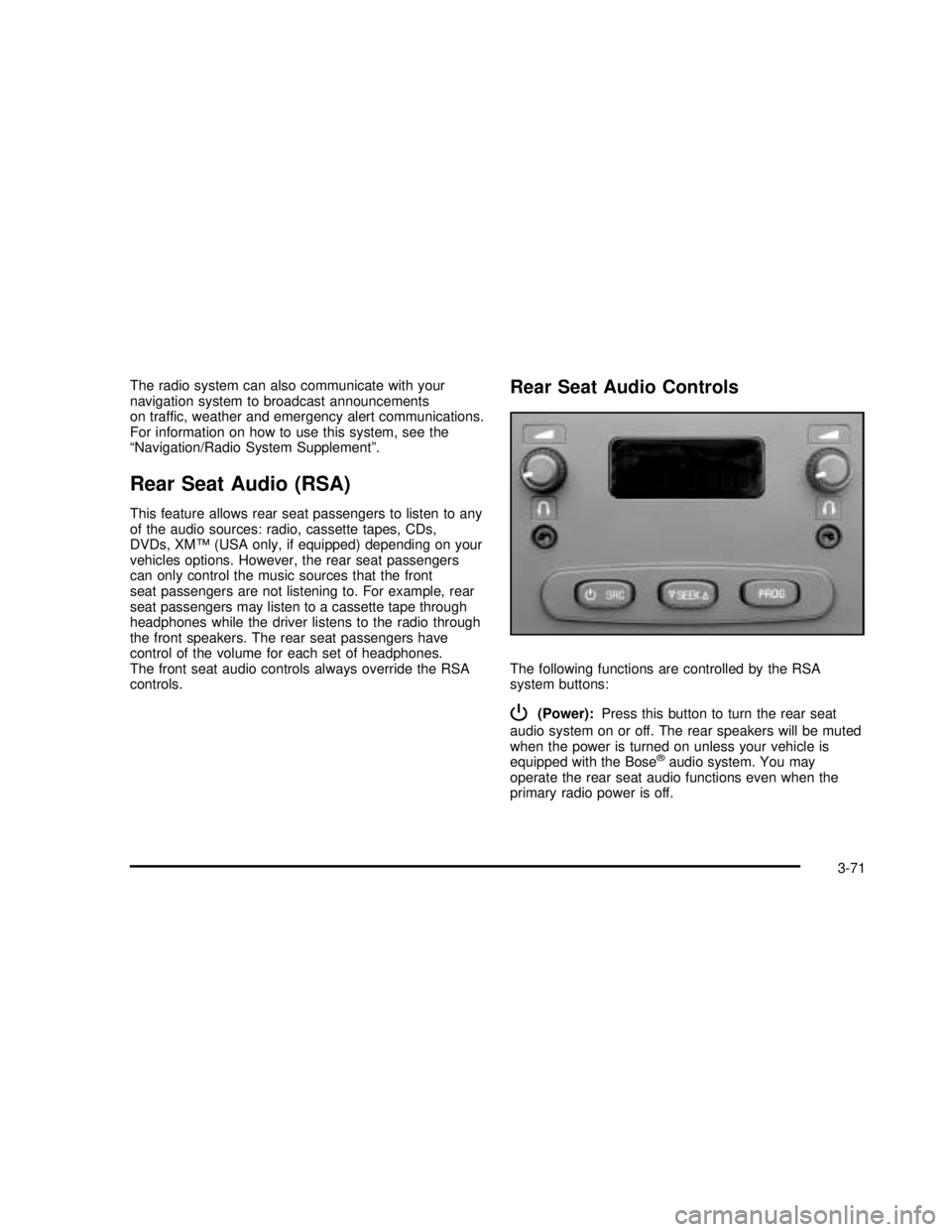
Rear Seat Audio (RSA)
This feature allows rear seat passengers to listen to any
of the audio sources: radio, cassette tapes, CDs,
DVDs, XM™(USA only, if equipped) depending on your
vehicles options. However, the rear seat passengers
can only control the music sources that the front
seat passengers are not listening to. For example, rear
seat passengers may listen to a cassette tape through
headphones while the driver listens to the radio through
the front speakers. The rear seat passengers have
control of the volume for each set of headphones.
The front seat audio controls always override the RSA
controls.
Rear Seat Audio Controls
The following functions are controlled by the RSA
system buttons:
P(Power):Press this button to turn the rear seat
audio system on or off. The rear speakers will be muted
when the power is turned on unless your vehicle is
equipped with the Bose
®audio system. You may
operate the rear seat audio functions even when the
primary radio power is off.
3-71
2003 - Sierra Denali
Page 199 of 408

Your Driving, the Road, and Your Vehicle..........4-2
Defensive Driving...........................................4-2
Drunken Driving.............................................4-2
Control of a Vehicle........................................4-5
Braking.........................................................4-5
Manual Selectable Ride...................................4-9
Locking Rear Axle........................................4-10
Steering......................................................4-10
QUADRASTEER™........................................4-12
Off-Road Recovery.......................................4-15
Passing.......................................................4-15
Loss of Control.............................................4-16
Operating Your All-Wheel-Drive Vehicle Off
Paved Roads............................................4-18
Driving at Night
............................................4-30
Driving in Rain and on Wet Roads
..................4-32City Driving..................................................4-35
Freeway Driving...........................................4-36
Before Leaving on a Long Trip.......................4-37
Highway Hypnosis........................................4-38
Hill and Mountain Roads................................4-38
Winter Driving..............................................4-40
If You Are Stuck: In Sand, Mud, Ice or Snow........4-44
Towing..........................................................4-46
Towing Your Vehicle.....................................4-46
Recreational Vehicle Towing...........................4-47
Loading Your Vehicle....................................4-47
Truck-Camper Loading Information..................4-50
Trailer Recommendations...............................4-52
Pickup Conversion to
Chassis Cab.............................................4-52
Towing a Trailer...........................................4-53
Section 4 Driving Your Vehicle
4-1
2003 - Sierra Denali
Page 202 of 408

means that a woman generally will reach a higher BAC
level than a man of her same body weight will when
each has the same number of drinks.
The law in an increasing number of U.S. states, and
throughout Canada, sets the legal limit at 0.08 percent.
In some other countries, the limit is even lower. For
example, it is 0.05 percent in both France and Germany.
The BAC limit for all commercial drivers in the United
States is 0.04 percent.
The BAC will be over 0.10 percent after three to six
drinks (in one hour). Of course, as we’ve seen, it
depends on how much alcohol is in the drinks, and how
quickly the person drinks them.
But the ability to drive is affected well below a BAC of
0.10 percent. Research shows that the driving skills
of many people are impaired at a BAC approaching
0.05 percent, and that the effects are worse at night.
All drivers are impaired at BAC levels above
0.05 percent. Statistics show that the chance of being in
a collision increases sharply for drivers who have a
BAC of 0.05 percent or above. A driver with a BAC level
of 0.06 percent has doubled his or her chance of
having a collision. At a BAC level of 0.10 percent, the
chance of this driver having a collision is 12 times
greater; at a level of 0.15 percent, the chance is
25 times greater!
The body takes about an hour to rid itself of the alcohol
in one drink. No amount of coffee or number of cold
showers will speed that up.“I’ll be careful”isn’t the rightanswer. What if there’s an emergency, a need to take
sudden action, as when a child darts into the street?
A person with even a moderate BAC might not be able
to react quickly enough to avoid the collision.
There’s something else about drinking and driving that
many people don’t know. Medical research shows
that alcohol in a person’s system can make crash
injuries worse, especially injuries to the brain, spinal
cord or heart. This means that when anyone who
has been drinking—driver or passenger—is in a
crash, that person’s chance of being killed or
permanently disabled is higher than if the person had
not been drinking.
{CAUTION:
Drinking and then driving is very dangerous.
Your reflexes, perceptions, attentiveness and
judgment can be affected by even a small
amount of alcohol.You can have a serious—or
even fatal—collision if you drive after drinking.
Please don’t drink and drive or ride with a
driver who has been drinking.Ride home in a
cab; or if you’re with a group, designate a
driver who will not drink.
4-4
2003 - Sierra Denali
Page 207 of 408

Manual Selectable Ride
The main function of this system is to provide superior
ride comfort while trailering or fully loaded, as well
as for unloaded driving. This system also helps
to provide:
Improved trailering stability
Improved handling response when trailering or fully
loaded
This button is located on
the center of the
instrument panel near the
radio. Press it to activate
the selectable ride
setting as desired.
An indicator light near the
button will illuminate
whenever the system is
active.
It is recommended to use this system as follows:
For optimum ride comfort in an unloaded vehicle
the button should be out and the indicator light
will not be illuminated. This switch position indicates
NORMAL levels of ride control or damping.
For optimum ride comfort when trailering, fully
loaded, driving off-road, or when personal
preferences demand more control the button should
be pressed in with the indicator light illuminated.
This switch position indicates FIRM levels of
ride control or damping.
The following guide can also be used to help determine
the best setting.
NORMAL:The indicator light will be off when the
system is in this setting. Use for normal city and highway
driving. Provides a smooth, soft ride when the vehicle
is unloaded.
FIRM (Unloaded):Press the switch to activate this
setting, the indicator light will illuminate. Use this setting
when road conditions or personal preference demand
more control. Provides more“feel″or response to
the road conditions.
FIRM (Loaded):Press the switch to activate this
setting, the indicator light will illuminate. Use this setting
to minimize trailer inputs to the vehicle or when the
vehicle is fully loaded. This setting is also appropriate
for off-road driving.
You can select a setting at any time based on road and
trailering conditions to provide the best ride and
handling. Select a new setting whenever driving
conditions change.
4-9
2003 - Sierra Denali
Page 220 of 408

Surface Obstacles:Unseen or hidden obstacles can
be hazardous. A rock, log, hole, rut or bump can startle
you if you’re not prepared for them. Often these
obstacles are hidden by grass, bushes, snow or even
the rise and fall of the terrain itself. Here are some
things to consider:
Is the path ahead clear?
Will the surface texture change abruptly up ahead?
Does the travel take you uphill or downhill?
(There’s more discussion of these subjects later.)
Will you have to stop suddenly or change direction
quickly?
When you drive over obstacles or rough terrain, keep a
rm grip on the steering wheel. Ruts, troughs or
other surface features can jerk the wheel out of your
hands if you’re not prepared.
When you drive over bumps, rocks, or other obstacles,
your wheels can leave the ground. If this happens,
even with one or two wheels, you can’t control
the vehicle as well or at all.Because you will be on an unpaved surface, it’s
especially important to avoid sudden acceleration,
sudden turns or sudden braking.
In a way, off-road driving requires a different kind of
alertness from driving on paved roads and highways.
There are no road signs, posted speed limits or
signal lights. You have to use your own good judgment
about what is safe and what isn’t.
Drinking and driving can be very dangerous on any
road. And this is certainly true for off-road driving. At the
very time you need special alertness and driving
skills, your reexes, perceptions and judgment can be
affected by even a small amount of alcohol. You
could have a serious—or even fatal—accident if you
drink and drive or ride with a driver who has been
drinking. SeeDrunken Driving on page 4-2.
4-22
2003 - Sierra Denali
Page 231 of 408

Driving too fast through large water puddles or even
going through some car washes can cause problems,
too. The water may affect your brakes. Try to avoid
puddles. But if you can’t, try to slow down before you
hit them.
{CAUTION:
Wet brakes can cause accidents. They won’t
work as well in a quick stop and may cause
pulling to one side. You could lose control of
the vehicle.
After driving through a large puddle of water
or a car wash, apply your brake pedal lightly
until your brakes work normally.
Hydroplaning
Hydroplaning is dangerous. So much water can build up
under your tires that they can actually ride on the
water. This can happen if the road is wet enough and
you’re going fast enough. When your vehicle is
hydroplaning, it has little or no contact with the road.
Hydroplaning doesn’t happen often. But it can if
your tires do not have much tread or if the pressure in
one or more is low. It can happen if a lot of water is
standing on the road. If you can see reections
from trees, telephone poles or other vehicles, and
raindrops“dimple”the water’s surface, there could be
hydroplaning.
Hydroplaning usually happens at higher speeds. There
just isn’t a hard and fast rule about hydroplaning.
The best advice is to slow down when it is raining.
4-33
2003 - Sierra Denali
Page 317 of 408

CAUTION: (Continued)
•
Underinflated tires pose the same danger
as overloaded tires. The resulting accident
could cause serious injury. Check all tires
frequently to maintain the recommended
pressure. Tire pressure should be checked
when your tires are cold.
•Overinflated tires are more likely to be
cut, punctured or broken by a sudden
impact—such as when you hit a pothole.
Keep tires at the recommended pressure.
•Worn, old tires can cause accidents.
If your tread is badly worn, or if your tires
have been damaged, replace them.
Inflation -- Tire Pressure
The Certification/Tire label, which is on the rear edge of
the driver’s door, shows the correct inflation pressures
for your tires when they’re cold.“Cold”means your
vehicle has been sitting for at least three hours or driven
no more than 1 mile (1.6 km).
Notice:Don’t let anyone tell you that underinflation
or overinflation is all right. It’s not. If your tires
don’t have enough air (underinflation), you can get
the following:
•Too muchflexing
•Too much heat
•Tire overloading
•Bad wear
•Bad handling
•Bad fuel economy
If your tires have too much air (overinflation), you
can get the following:
•Unusual wear
•Bad handling
•Rough ride
•Needless damage from road hazards
When to Check
Check your tires once a month or more.
Also, check the tire pressure of the spare tire.
How to Check
Use a good quality pocket-type gage to check tire
pressure. You can’t tell if your tires are properly inflated
simply by looking at them. Radial tires may look
properly inflated even when they’re underinflated.
Be sure to put the valve caps back on the valve stems.
They help prevent leaks by keeping out dirt and
moisture.
5-57
2003 - Sierra Denali
Page 320 of 408

Buying New Tires
Tofind out what kind and size of tires you need, look at
the Certification/Tire label.
The tires installed on your vehicle when it was new had
a Tire Performance Criteria Specifications (TPC
Spec) number on each tire’s sidewall. When you get
new tires, get ones with that same TPC Spec number.
That way your vehicle will continue to have tires
that are designed to give proper endurance, handling,
speed rating, traction, ride and other things during
normal service on your vehicle. If your tires have an
all-season tread design, the TPC number will be
followed by an“MS”(for mud and snow).
If you ever replace your tires with those not having a
TPC Spec number, make sure they are the same size,
load range, speed rating and construction type (bias,
bias-belted or radial) as your original tires.
{CAUTION:
Mixing tires could cause you to lose control
while driving. If you mix tires of different sizes
or types (radial and bias-belted tires), the
vehicle may not handle properly, and you
CAUTION: (Continued)
CAUTION: (Continued)
could have a crash. Using tires of different
sizes may also cause damage to your vehicle.
Be sure to use the same size and type tires on
all wheels. If your vehicle has 17 inch road tires
(those originally installed on your vehicle) it is
all right to drive with the 16 inch spare tire that
came with your vehicle. When new, your vehicle
included a spare tire and wheel assembly with
the same overall diameter as your vehicle’s
road tires and wheels. Because this spare tire
was developed for use on your vehicle, it will
not affect vehicle handling or cause damage to
your vehicle.
{CAUTION:
If you use bias-ply tires on your vehicle, the
wheel rimflanges could develop cracks after
many miles of driving. A tire and/or wheel
could fail suddenly, causing a crash. Use only
radial-ply tires with the wheels on your vehicle.
5-60
2003 - Sierra Denali
Page 342 of 408

Spare Tire
Your vehicle, when new, had a fully inflated spare tire.
A spare tire may lose air over time, so check its
inflation pressure regularly. SeeInflation -- Tire Pressure
on page 5-57andLoading Your Vehicle on page 4-47
for information regarding proper tire inflation and loading
your vehicle. For instruction on how to remove, install
or store a spare tire, seeChanging a Flat Tire on
page 5-65.
After installing the spare tire on your vehicle, you should
stop as soon as possible and make sure the spare is
correctly inflated. Have the damaged orflat road
tire repaired or replaced as soon as you can and
installed back onto your vehicle. This way, a spare tire
will be available in case you need it again.
If your vehicle has a spare tire that does not match your
vehicle’s original road tires and wheels in size and
type, do not include the spare in the tire rotation.
Appearance Care
Remember, cleaning products can be hazardous. Some
are toxic. Others can burst intoflames if you strike a
match or get them on a hot part of the vehicle. Some are
dangerous if you breathe their fumes in a closed
space. When you use anything from a container to cleanyour vehicle, be sure to follow the manufacturer’s
warnings and instructions. And always open your doors
or windows when you’re cleaning the inside.
Neveruse these to clean your vehicle:
•Gasoline
•Benzene
•Naphtha
•Carbon Tetrachloride
•Acetone
•Paint Thinner
•Turpentine
•Lacquer Thinner
•Nail Polish Remover
They can all be hazardous–some more than
others–and they can all damage your vehicle, too.
Don’t use any of these unless this manual says you can.
In many uses, these will damage your vehicle:
•Alcohol
•Laundry Soap
•Bleach
•Reducing Agents
5-82
2003 - Sierra Denali