check engine GMC SIERRA 2003 Owner's Guide
[x] Cancel search | Manufacturer: GMC, Model Year: 2003, Model line: SIERRA, Model: GMC SIERRA 2003Pages: 408, PDF Size: 2.58 MB
Page 294 of 408
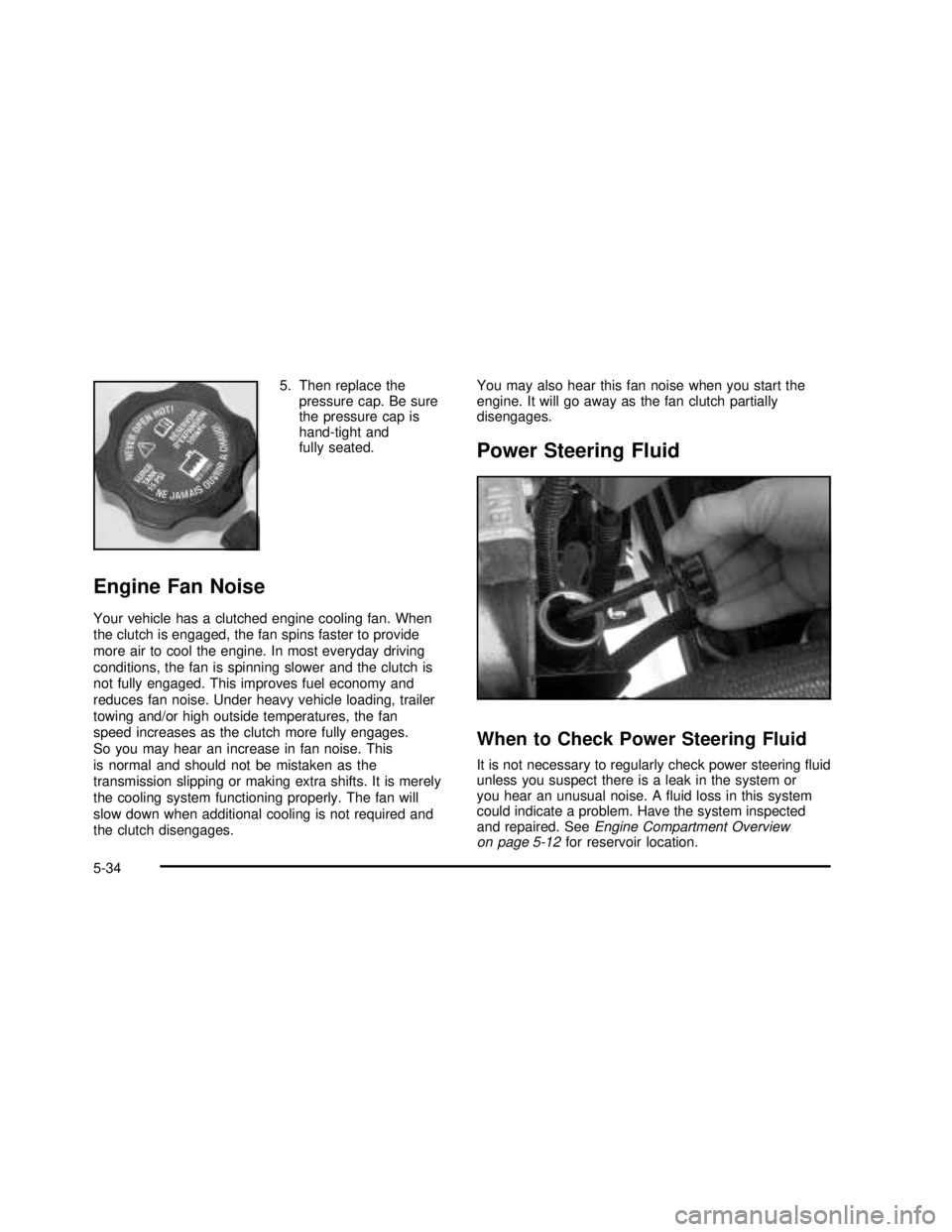
5. Then replace the
pressure cap. Be sure
the pressure cap is
hand-tight and
fully seated.
Engine Fan Noise
Your vehicle has a clutched engine cooling fan. When
the clutch is engaged, the fan spins faster to provide
more air to cool the engine. In most everyday driving
conditions, the fan is spinning slower and the clutch is
not fully engaged. This improves fuel economy and
reduces fan noise. Under heavy vehicle loading, trailer
towing and/or high outside temperatures, the fan
speed increases as the clutch more fully engages.
So you may hear an increase in fan noise. This
is normal and should not be mistaken as the
transmission slipping or making extra shifts. It is merely
the cooling system functioning properly. The fan will
slow down when additional cooling is not required and
the clutch disengages.You may also hear this fan noise when you start the
engine. It will go away as the fan clutch partially
disengages.
Power Steering Fluid
When to Check Power Steering Fluid
It is not necessary to regularly check power steeringfluid
unless you suspect there is a leak in the system or
you hear an unusual noise. Afluid loss in this system
could indicate a problem. Have the system inspected
and repaired. SeeEngine Compartment Overview
on page 5-12for reservoir location.
5-34
2003 - Sierra Denali
Page 295 of 408

How to Check Power Steering Fluid
Turn the key off, let the engine compartment cool down,
wipe the cap and the top of the reservoir clean, then
unscrew the cap and wipe the dipstick with a clean rag.
Replace the cap and completely tighten it. Then remove
the cap again and look at thefluid level on the dipstick.
The level should be at the FULL COLD mark. If
necessary, add only enoughfluid to bring the level up to
the mark.
What to Use
To determine what kind offluid to use, seePart D:
Recommended Fluids and Lubricants on page 6-15.
Always use the properfluid. Failure to use the proper
fluid can cause leaks and damage hoses and seals.
Windshield Washer Fluid
What to Use
When you need windshield washerfluid, be sure to read
the manufacturer’s instructions before use. If you will
be operating your vehicle in an area where the
temperature may fall below freezing, use afluid that has
sufficient protection against freezing. SeeEngine
Compartment Overview on page 5-12for reservoir
location.
Adding Washer Fluid
Open the cap with the
washer symbol on it. Add
washerfluid until the
tank is full.
Notice:
•When using concentrated washerfluid, follow the
manufacturer’s instructions for adding water.
•Don’t mix water with ready-to-use washerfluid.
Water can cause the solution to freeze and
damage your washerfluid tank and other parts of
the washer system. Also, water doesn’t clean as
well as washerfluid.
•Fill your washerfluid tank only three-quarters full
when it’s very cold. This allows for expansion if
freezing occurs, which could damage the tank if
it is completely full.
•Don’t use engine coolant (antifreeze) in your
windshield washer. It can damage your washer
system and paint.
5-35
2003 - Sierra Denali
Page 296 of 408
Brakes
Brake Fluid
Your brake master cylinder reservoir isfilled with DOT-3
brakefluid. SeeEngine Compartment Overview on
page 5-12for the location of the reservoir.
There are only two reasons why the brakefluid level in
the reservoir might go down. Thefirst is that the
brakefluid goes down to an acceptable level during
normal brake lining wear. When new linings are put in,
thefluid level goes back up. The other reason is
thatfluid is leaking out of the brake system. If it is, you
should have your brake systemfixed, since a leak
means that sooner or later your brakes won’t work well,
or won’t work at all.
So, it isn’t a good idea to“top off”your brakefluid.
Adding brakefluid won’t correct a leak. If you addfluid
when your linings are worn, then you’ll have too
muchfluid when you get new brake linings. You should
add (or remove) brakefluid, as necessary, only when
work is done on the brake hydraulic system.
{CAUTION:
If you have too much brakefluid, it can spill on
the engine. Thefluid will burn if the engine is
hot enough. You or others could be burned,
and your vehicle could be damaged. Add brake
fluid only when work is done on the brake
hydraulic system. See“Checking Brake Fluid”
in this section.
Refer to the Maintenance Schedule to determine when
to check your brakefluid. SeePart C: Periodic
Maintenance Inspections on page 6-14.
5-36
2003 - Sierra Denali
Page 297 of 408
Checking Brake Fluid
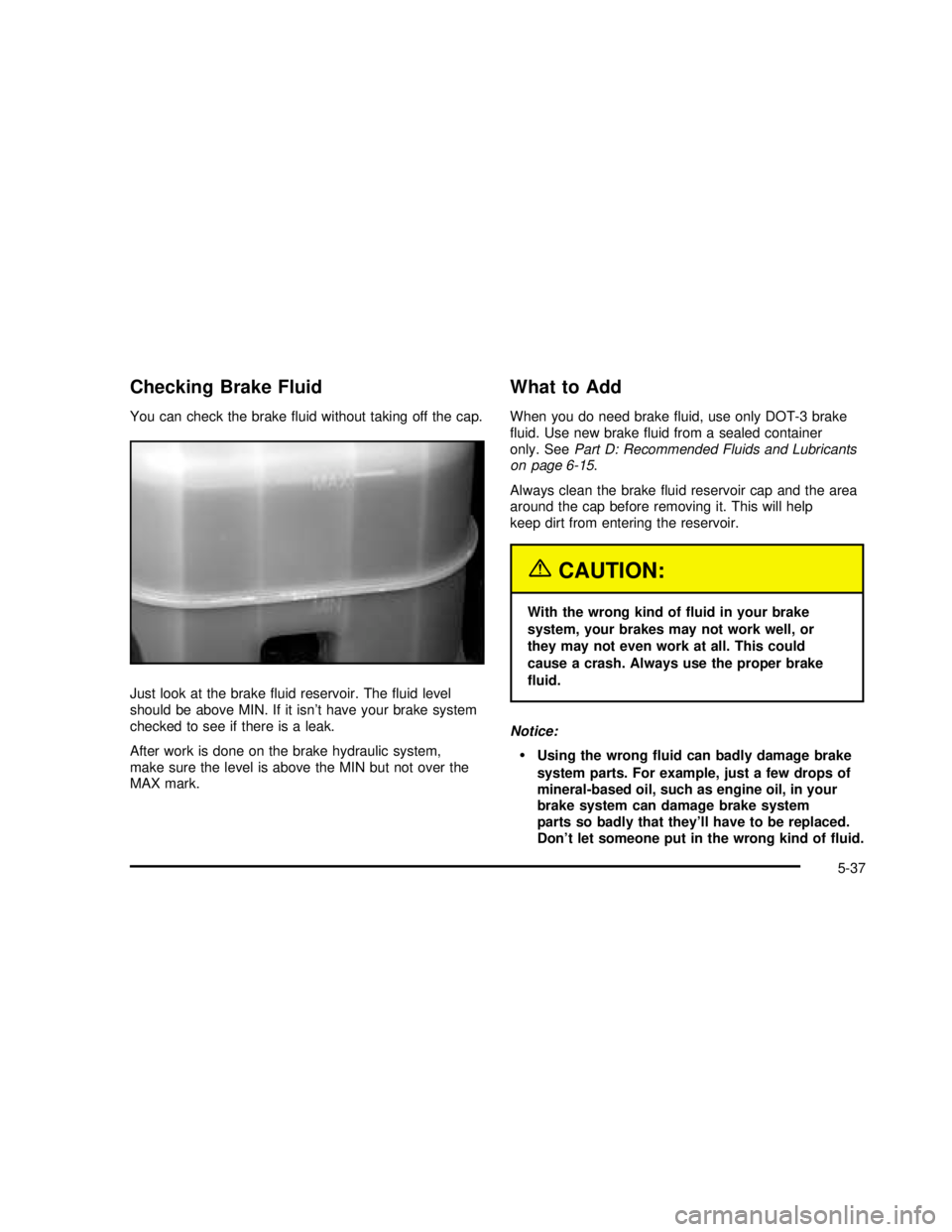
You can check the brakefluid without taking off the cap.
Just look at the brakefluid reservoir. Thefluid level
should be above MIN. If it isn’t have your brake system
checked to see if there is a leak.
After work is done on the brake hydraulic system,
make sure the level is above the MIN but not over the
MAX mark.
What to Add
When you do need brakefluid, use only DOT-3 brake
fluid. Use new brakefluid from a sealed container
only. SeePart D: Recommended Fluids and Lubricants
on page 6-15.
Always clean the brakefluid reservoir cap and the area
around the cap before removing it. This will help
keep dirt from entering the reservoir.
{CAUTION:
With the wrong kind offluid in your brake
system, your brakes may not work well, or
they may not even work at all. This could
cause a crash. Always use the proper brake
fluid.
Notice:
•Using the wrongfluid can badly damage brake
system parts. For example, just a few drops of
mineral-based oil, such as engine oil, in your
brake system can damage brake system
parts so badly that they’ll have to be replaced.
Don’t let someone put in the wrong kind offluid.
5-37
2003 - Sierra Denali
Page 302 of 408
{CAUTION:
Fans or other moving engine parts can injure
you badly. Keep your hands away from moving
parts once the engine is running.
5. Check that the jumper cables don’t have loose or
missing insulation. If they do, you could get a
shock. The vehicles could be damaged too.
Before you connect the cables, here are some
basic things you should know. Positive (+) will go to
positive (+) or a remote positive (+) terminal if the
vehicle has one. Negative (−) will go to a heavy,
unpainted metal engine part or a remote
negative (−) terminal if the vehicle has one.
Don’t connect positive (+) to negative (−)oryou’ll
get a short that would damage the battery and
maybe other parts too. And don’t connect the
negative (−) cable to the negative (−) terminal on
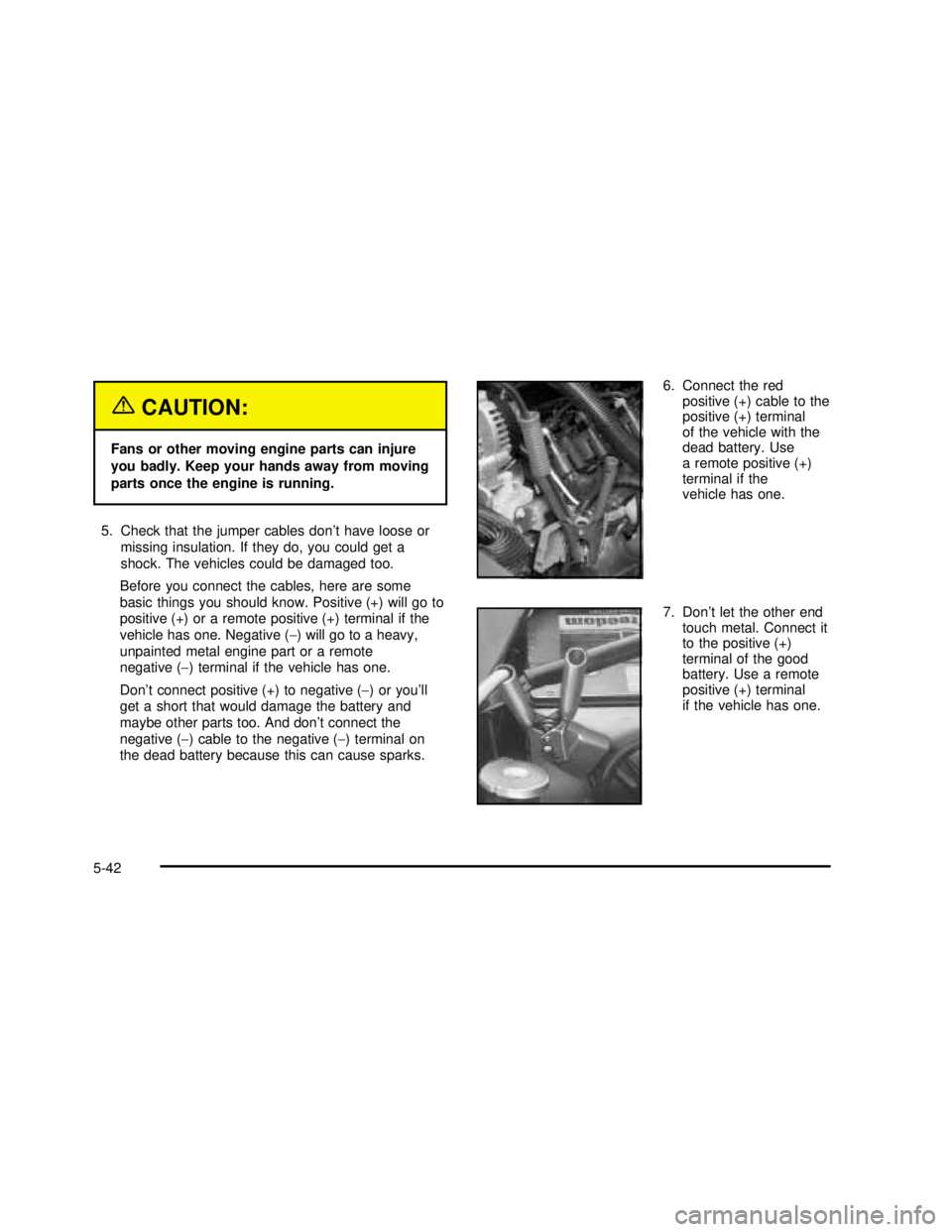
the dead battery because this can cause sparks.6. Connect the red
positive (+) cable to the
positive (+) terminal
of the vehicle with the
dead battery. Use
a remote positive (+)
terminal if the
vehicle has one.
7. Don’t let the other end
touch metal. Connect it
to the positive (+)
terminal of the good
battery. Use a remote
positive (+) terminal
if the vehicle has one.
5-42
2003 - Sierra Denali
Page 361 of 408

Maintenance Schedule......................................6-2
Introduction...................................................6-2
Your Vehicle and the Environment....................6-2
Maintenance Requirements..............................6-2
How This Section is Organized.........................6-3
Part A: Scheduled Maintenance Services...........6-4
Using Your Maintenance Schedule....................6-4
Scheduled Maintenance...................................6-5
Part B: Owner Checks and Services................6-10
At Each Fuel Fill..........................................6-10
At Least Once a Month.................................6-10
At Least Twice a Year...................................6-10At Least Once a Year
...................................6-11
Part C: Periodic Maintenance Inspections
.........6-14
Steering and Suspension Inspection
................6-14
Exhaust System Inspection
............................6-14
Fuel System Inspection
..................................6-14
Engine Cooling System Inspection
...................6-14
Transfer Case and Front Axle (All-Wheel
Drive) Inspection
.......................................6-15
Brake System Inspection
................................6-15
Part D: Recommended Fluids and Lubricants
. . . .6-15
Part E: Maintenance Record
...........................6-17
Section 6 Maintenance Schedule
6-1
2003 - Sierra Denali
Page 362 of 408

Maintenance Schedule
Introduction
Important: Keep engine oil at the proper level and
change as recommended.
Have you purchased the GM Protection Plan? The Plan
supplements your new vehicle warranties. See your
Warranty and Owner Assistance booklet or your dealer
for details.
Your Vehicle and the Environment
Proper vehicle maintenance not only helps to keep your
vehicle in good working condition, but also helps the
environment. Improper vehicle maintenance can
even affect the quality of the air we breathe. Improper
fluid levels or the wrong tire inflation can increase
the level of emissions from your vehicle. To help protect
our environment, and to keep your vehicle in good
condition, be sure to maintain your vehicle properly.
Maintenance Requirements
Maintenance intervals, checks, inspections and
recommended fluids and lubricants as prescribed in this
manual are necessary to keep your vehicle in good
working condition. Any damage caused by failure
to follow scheduled maintenance may not be covered by
warranty.
6-2
2003 - Sierra Denali
Page 364 of 408

Part A: Scheduled Maintenance
Services
This part contains engine oil and chassis lubrication
scheduled maintenance which explains the engine oil life
system and how it indicates when to change the
engine oil andfilter. Lubricate chassis components with
each oil change. Also, listed are scheduled maintenance
services which are to be performed at the mileage
intervals specified.
Using Your Maintenance Schedule
We at General Motors want to help you keep your
vehicle in good condition. But we don’t know exactly how
you’ll drive it. You may drive very short distances only
a few times a week. Or you may drive long distances in
very hot, dusty weather. You may use your vehicle in
making deliveries. Or you may drive it to work, to
do errands or in many other ways.
Because of all the different ways people use their
vehicles, maintenance needs vary. You may need more
frequent checks and replacements. So please read
the following and note how you drive. If you have any
questions on how to keep your vehicle in good condition,
see your dealer.This part tells you the maintenance services you should
have done and when to schedule them.
When you go to your dealer for your service needs,
you’ll know that GM-trained and supported service
people will perform the work using genuine GM parts.
The properfluids and lubricants to use are listed in
Part D. Make sure whoever services your vehicle uses
these. All parts should be replaced and all necessary
repairs done before you or anyone else drives the
vehicle.
This schedule is for vehicles that:•carry passengers and cargo within recommended
limits. You willfind these limits on your vehicle’s
Certification/Tire label. SeeLoading Your Vehicle on
page 4-47.
•are driven on reasonable road surfaces within legal
driving limits.
•are driven off-road in the recommended manner.
SeeOperating Your All-Wheel-Drive Vehicle Off
Paved Roads on page 4-18.
•use the recommended fuel. SeeGasoline Octane
on page 5-4.
6-4
2003 - Sierra Denali
Page 365 of 408

Scheduled Maintenance
The services shown in this schedule up to 100,000 miles
(166 000 km) should be repeated after 100,000 miles
(166 000 km) at the same intervals for the life of
this vehicle. The services shown at 150,000 miles
(240 000 km) and 200,000 miles (332 000 km) should
be repeated at the same intervals after 150,000 miles
(240 000 km) and 200,000 miles (332 000 km) for the life
of this vehicle.
SeePart B: Owner Checks and Services on page 6-10
andPart C: Periodic Maintenance Inspections on
page 6-14.
Footnotes
†The U.S. Environmental Protection Agency or the
California Air Resources Board has determined that the
failure to perform this maintenance item will not nullify
the emission warranty or limit recall liability prior to
the completion of the vehicle ’s useful life. We, however,
urge that all recommended maintenance services be
performed at the indicated intervals and the
maintenance be recorded.
+A good time to check your brakes is during tire
rotation. See Brake System Inspection on page 6-15.
Engine Oil and Chassis Lubrication
Scheduled Maintenance
Change engine oil and filter as indicated by the GM
Oil Life System (or every 12 months, whichever
occurs first). Reset the system.
Your vehicle has a computer system that lets you know
when to change the engine oil andfilter. This is
based on engine revolutions and engine temperature,
and not on mileage. Based on driving conditions,
the mileage at which an oil change will be indicated can
vary considerably. For the oil life system to work
properly, you must reset the system every time the oil is
changed.
When the system has calculated that oil life has been
diminished, it will indicate that an oil change is
necessary. A CHANGE ENGINE OIL message will
come on. Change your oil as soon as possible within
the next two times you stop for fuel. It is possible that,
if you are driving under the best conditions, the oil
life system may not indicate that an oil change is
necessary for over a year. However, your engine oil and
filter must be changed at least once a year and at
this time the system must be reset. Your dealer has
GM-trained service people who will perform this
work using genuine GM parts and reset the system.
It is also important to check your oil regularly and keep
it at the proper level.
6-5
2003 - Sierra Denali
Page 366 of 408

If the system is ever reset accidentally, you must
change your oil at 3,000 miles (5 000 km) since your
last oil change. Remember to reset the oil life system
whenever the oil is changed. SeeEngine Oil on
page 5-13for information on resetting the system.
An Emission Control Service.
Lubricate chassis components with each engine oil
and filter change.
Lubricate the front suspension, ball joints, steering
linkage, transmission shift linkage, transfer case shift
linkage and parking brake cable guides. Ball joints
should not be lubricated unless their temperature is 10°F
(-12°C) or higher or they could be damaged.
See the mileage intervals following for additional
services that may be performed with an engine oil
change and chassis lubrication. After the services are
performed, record the date, odometer reading and
who performed the service on the maintenance record
pages in Part E of this schedule.
7,500 Miles (12 500 km)
❑Check rear/front axlefluid level and addfluid as
needed. Check constant velocity joints and axle seals
for leaking.
❑Rotate tires. SeeTire Inspection and Rotation on
page 5-58for proper rotation pattern and additional
information.(See footnote +.)
15,000 Miles (25 000 km)
❑Inspect engine air cleanerfilter change indicator.
If necessary, replace thefilter. If vehicle is driven
in dusty/dirty conditions, inspectfilter change
indicator at every engine oil change. SeeEngine Air
Cleaner/Filter on page 5-18for more information.
An Emission Control Service. (See footnote†.)
❑Check rear/front axlefluid level and addfluid as
needed. Check constant velocity joints and axle seals
for leaking.
❑Rotate tires. SeeTire Inspection and Rotation on
page 5-58for proper rotation pattern and additional
information.(See footnote +.)
22,500 Miles (37 500 km)
❑Check rear/front axlefluid level and addfluid as
needed. Check constant velocity joints and axle seals
for leaking.
❑Rotate tires. SeeTire Inspection and Rotation on
page 5-58for proper rotation pattern and additional
information.(See footnote +.)
30,000 Miles (50 000 km)
❑Inspect engine air cleanerfilter change indicator.
If necessary, replace thefilter. If vehicle is driven
in dusty/dirty conditions, inspectfilter change
indicator at every engine oil change. SeeEngine Air
Cleaner/Filter on page 5-18for more information.
An Emission Control Service. (See footnote†.)
6-6
2003 - Sierra Denali