seats GMC SIERRA 2004 User Guide
[x] Cancel search | Manufacturer: GMC, Model Year: 2004, Model line: SIERRA, Model: GMC SIERRA 2004Pages: 588, PDF Size: 3.74 MB
Page 31 of 588
The best way to protect the fetus is to protect the
mother. When a safety belt is worn properly, it's more
likely that the fetus won't be hurt in a crash. For
pregnant women, as for anyone, the key to making
safety belts effective is wearing them properly.
Right Front Passenger Position
To learn how to wear the right front passenger's safety
belt properly, seeDriver Position on page 1-16.
The right front passenger's safety belt works the same
way as the driver's safety beltÐexcept for one thing.
If you ever pull the shoulder portion of the belt out all the
way, you will engage the child restraint locking feature
which may turn off the passenger's frontal air bag. If this
happens unintentionally, just let the belt go back all
the way and start again.
Center Passenger Position
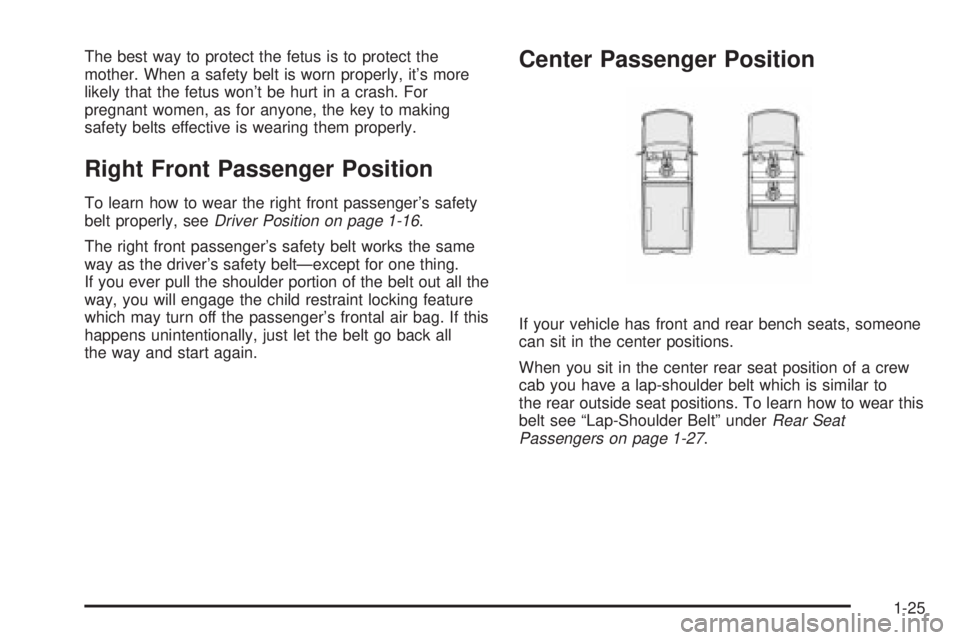
If your vehicle has front and rear bench seats, someone
can sit in the center positions.
When you sit in the center rear seat position of a crew
cab you have a lap-shoulder belt which is similar to
the rear outside seat positions. To learn how to wear this
belt see ªLap-Shoulder Beltº under
Rear Seat
Passengers on page 1-27.
1-25
Page 36 of 588
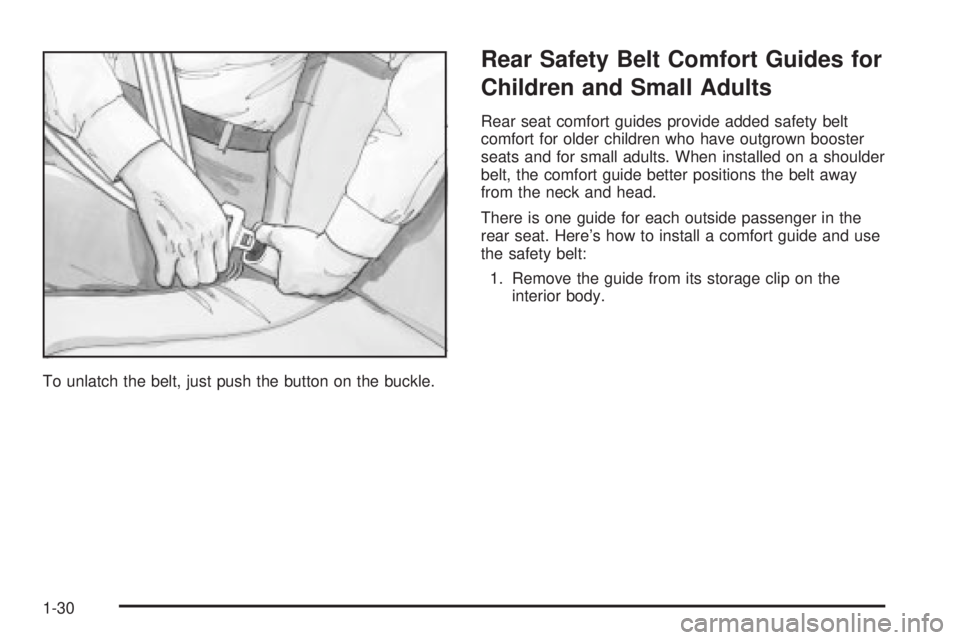
To unlatch the belt, just push the button on the buckle.
Rear Safety Belt Comfort Guides for
Children and Small Adults
Rear seat comfort guides provide added safety belt
comfort for older children who have outgrown booster
seats and for small adults. When installed on a shoulder
belt, the comfort guide better positions the belt away
from the neck and head.
There is one guide for each outside passenger in the
rear seat. Here's how to install a comfort guide and use
the safety belt:
1. Remove the guide from its storage clip on the
interior body.
1-30
Page 39 of 588
Child Restraints
Older Children
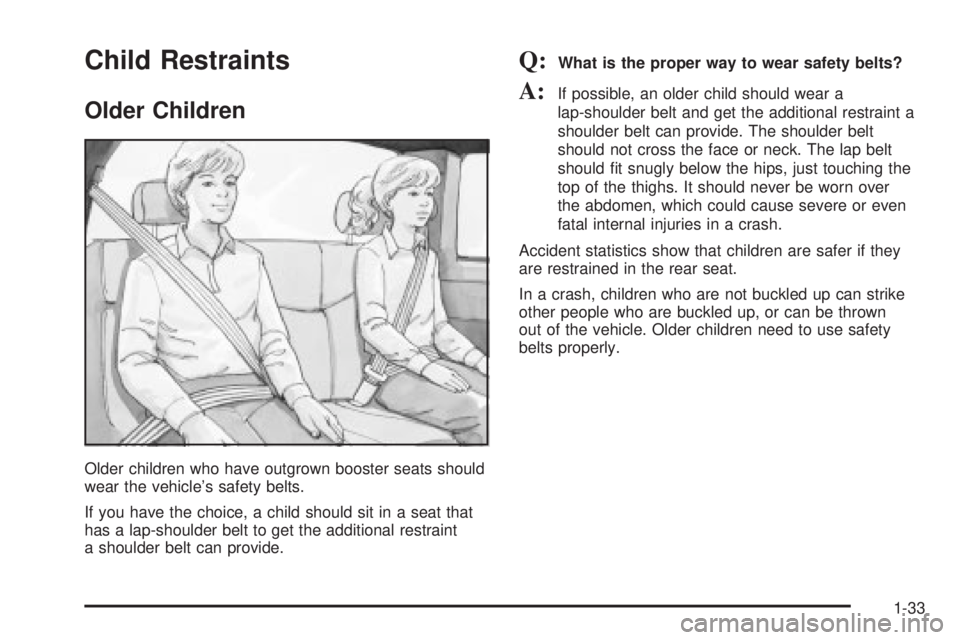
Older children who have outgrown booster seats should
wear the vehicle's safety belts.
If you have the choice, a child should sit in a seat that
has a lap-shoulder belt to get the additional restraint
a shoulder belt can provide.
Q:What is the proper way to wear safety belts?
A:If possible, an older child should wear a
lap-shoulder belt and get the additional restraint a
shoulder belt can provide. The shoulder belt
should not cross the face or neck. The lap belt
should ®t snugly below the hips, just touching the
top of the thighs. It should never be worn over
the abdomen, which could cause severe or even
fatal internal injuries in a crash.
Accident statistics show that children are safer if they
are restrained in the rear seat.
In a crash, children who are not buckled up can strike
other people who are buckled up, or can be thrown
out of the vehicle. Older children need to use safety
belts properly.
1-33
Page 46 of 588
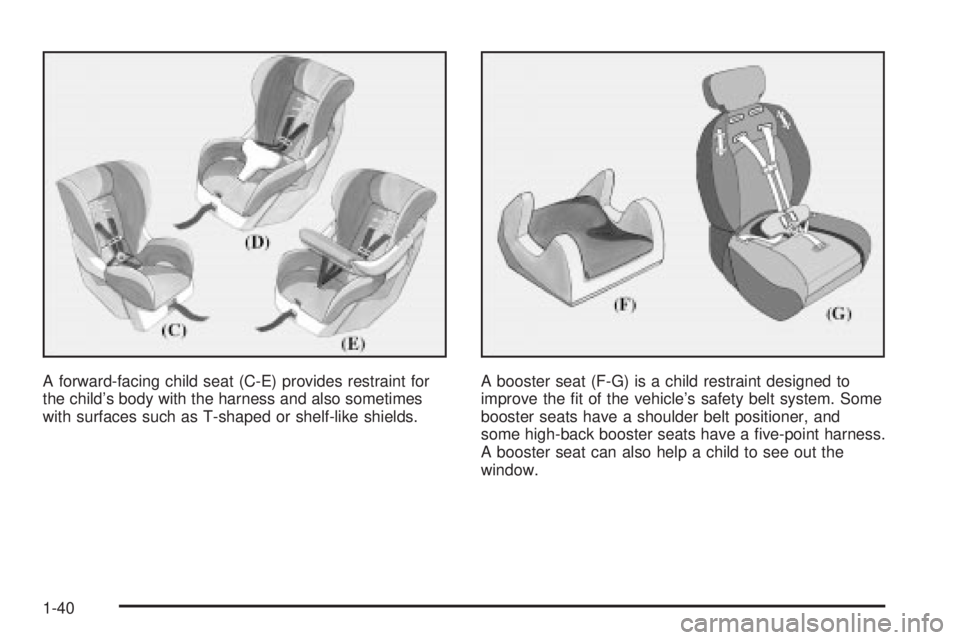
A forward-facing child seat (C-E) provides restraint for
the child's body with the harness and also sometimes
with surfaces such as T-shaped or shelf-like shields.A booster seat (F-G) is a child restraint designed to
improve the ®t of the vehicle's safety belt system. Some
booster seats have a shoulder belt positioner, and
some high-back booster seats have a ®ve-point harness.
A booster seat can also help a child to see out the
window.
1-40
Page 58 of 588
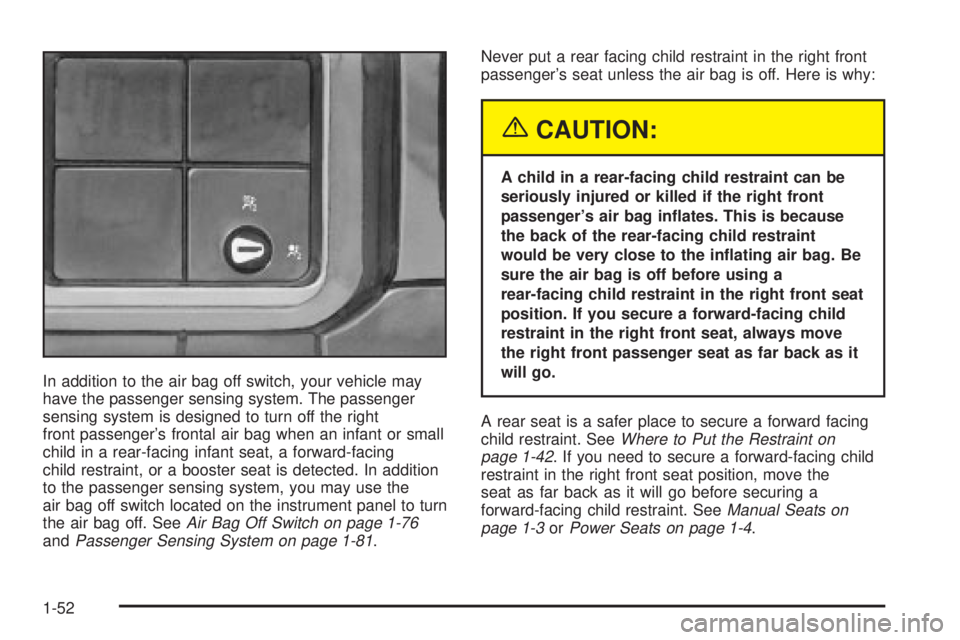
In addition to the air bag off switch, your vehicle may
have the passenger sensing system. The passenger
sensing system is designed to turn off the right
front passenger's frontal air bag when an infant or small
child in a rear-facing infant seat, a forward-facing
child restraint, or a booster seat is detected. In addition
to the passenger sensing system, you may use the
air bag off switch located on the instrument panel to turn
the air bag off. See
Air Bag Off Switch on page 1-76andPassenger Sensing System on page 1-81.Never put a rear facing child restraint in the right front
passenger's seat unless the air bag is off. Here is why:
{CAUTION:
A child in a rear-facing child restraint can be
seriously injured or killed if the right front
passenger's air bag in¯ates. This is because
the back of the rear-facing child restraint
would be very close to the in¯ating air bag. Be
sure the air bag is off before using a
rear-facing child restraint in the right front seat
position. If you secure a forward-facing child
restraint in the right front seat, always move
the right front passenger seat as far back as it
will go.
A rear seat is a safer place to secure a forward facing
child restraint. See
Where to Put the Restraint on
page 1-42. If you need to secure a forward-facing child
restraint in the right front seat position, move the
seat as far back as it will go before securing a
forward-facing child restraint. See
Manual Seats on
page 1-3orPower Seats on page 1-4.
1-52
Page 59 of 588
{CAUTION:
If the air bag readiness light in the instrument
panel cluster ever comes on when you have
turned off the air bag, it means that something
may be wrong with the air bag system. The
right front passenger's air bag could in¯ate
even though the switch is off. If this ever
happens, have the vehicle serviced promptly.
Until you have the vehicle serviced, do not let
anyone whom the national government has
identi®ed as a member of a passenger air bag
risk group sit in the right front passenger's
position (for example, do not secure a
rear-facing child restraint in the right front
passenger's seat). See²Air Bag Off Switch²in
the Index.1. Your vehicle has a right front passenger's frontal air
bag. See
Air Bag Off Switch on page 1-76andPassenger Sensing System on page 1-81. If your
child restraint is forward-facing, move the seat as far
back as it will go before securing the restraint in
this seat. See
Manual Seats on page 1-3orPower
Seats on page 1-4. If you need to use a rear-facing
child restraint in this seat, make sure the air bag
is off once the child restraint has been installed.
When the passenger sensing system or the air bag
off switch has turned off the right front passenger's
frontal air bag, the off indicator in the passenger
air bag status indicator should light and stay lit when
you turn the ignition to RUN or START. See
Passenger Air Bag Status Indicator on page 3-40.
2. Find the LATCH anchorages where the bottom of
the seatback meets the back of the cushion.
3. Put the child restraint on the seat.
4. Attach and tighten the LATCH attachments on the
child restraint to the LATCH anchorages in the
vehicle. The child restraint instructions will show
you how.
5. If the child restraint is forward-facing, attach and
tighten the top tether to the top tether anchorage.
The child restraint instructions will show you
how. Also see
Top Strap on page 1-43.
1-53
Page 67 of 588
Securing a Child Restraint in the
Right Front Seat Position
(Crew Cab)
If your child restraint is equipped with the LATCH
system, seeLower Anchorages and Top Tethers for
Children (LATCH System) on page 1-48. SeeTop Strap
on page 1-43if your child restraint has one.
Your vehicle has a right front passenger air bag.
Neverput a rear-facing child restraint in the right front
passenger's seat. Here's why:
{CAUTION:
A child in a rear-facing child restraint can be
seriously injured or killed if the right front
passenger's air bag in¯ates. This is because
the back of the rear-facing child restraint
would be very close to the in¯ating air bag.
Always secure a rear-facing child restraint in a
rear seat.A rear seat is a safer place to secure a forward-facing
child restraint. If you need to secure a forward-facing
child restraint in the right front seat position, see
Where
to Put the Restraint on page 1-42.
You'll be using the lap-shoulder belt to secure the
restraint in this position. Be sure to follow the
instructions that came with the child restraint. Secure
the child in the child restraint when and as the
instructions say.
1. Because your vehicle has a right front passenger's
frontal air bag, always move the seat as far back as
it will go before securing a forward-facing child
restraint. See
Manual Seats on page 1-3orPower
Seats on page 1-4.
2. Put the restraint on the seat.
3. Pick up the latch plate, and run the lap and shoulder
portions of the vehicle's safety belt through or
around the restraint. The child restraint instructions
will show you how.
1-61
Page 72 of 588
A rear seat is a safer place to secure a forward facing
child restraint. SeeWhere to Put the Restraint on
page 1-42. If you need to secure a forward-facing child
restraint in the right front seat position, move the
seat as far back as it will go before securing a
forward-facing child restraint. See
Manual Seats on
page 1-3orPower Seats on page 1-4.
{CAUTION:
If the air bag readiness light in the instrument
panel cluster ever comes on when you have
turned off the air bag, it means that something
may be wrong with the air bag system. The
right front passenger's air bag could in¯ate
even though the switch is off. If this ever
happens, have the vehicle serviced promptly.
Until you have the vehicle serviced, do not let
anyone whom the national government has
identi®ed as a member of a passenger air bag
risk group sit in the right front passenger's
position (for example, do not secure a
rear-facing child restraint in the right front
passenger's seat). See²Air Bag Off Switch²in
the Index.If your child restraint is equipped with the LATCH
system, see
Lower Anchorages and Top Tethers for
Children (LATCH System) on page 1-48. SeeTop Strap
on page 1-43if your child restraint has one.
If your child restraint does not have the LATCH system,
you will be using the lap-shoulder belt to secure the
child restraint in this position. Be sure to follow the
instructions that came with the child restraint. Secure
the child in the child restraint when and as the
instructions say.
1. Your vehicle has a right front passenger's frontal air
bag. See
Air Bag Off Switch on page 1-76andPassenger Sensing System on page 1-81. If your
child restraint is forward-facing, move the seat as far
back as it will go before securing the restraint in
this seat. See
Manual Seats on page 1-3orPower
Seats on page 1-4. If you need to use a rear-facing
child restraint in this seat, make sure the air bag
is off once the child restraint has been installed.
When the passenger sensing system or the air bag
off switch has turned off the right front passenger's
frontal air bag, the off indicator in the passenger
air bag status indicator should light and stay lit when
you turn the ignition to RUN or START. See
Passenger Air Bag Status Indicator on page 3-40.
2. Put the child restraint on the seat.
1-66
Page 80 of 588
Dual Stage Air Bags
If your vehicle has frontal air bags with dual stage
deployment, the amount of restraint will adjust according
to crash severity. For moderate frontal impacts, these
air bags in¯ate at a level less than full deployment. For
more severe frontal impacts, full deployment occurs.
If the front of your vehicle goes straight into a wall that
does not move or deform, the threshold level for the
reduced deployment is about 10 to 16 mph
(16 to 25 km/h), and the threshold level for a full
deployment is about 20 to 25 mph (32 to 40 km/h). The
threshold level can vary, however, with speci®c
vehicle design, so that it can be somewhat above or
below this range.
If your vehicle strikes something that will move or
deform, such as a parked car, the threshold level will be
higher. The air bag is not designed to in¯ate in
rollovers, rear impacts, or in many side impacts because
in¯ation would not help the occupant.
Seat Position Sensors
Vehicle's with dual stage air bags are also equipped
with special sensors which enable the sensing system to
monitor the position of both the driver and passenger
front seats. The seat position sensor provides
information which is used to determine if the air bags
should deploy at a reduced level or at full deployment.
Single Stage Air Bags
If your vehicle has frontal air bags with single stage
deployment and your vehicle goes straight into a wall
that does not move or deform, the threshold level
is about 13 to 16 mph (20 to 25 km/h). The threshold
level can vary, however, with speci®c vehicle design, so
that it can be somewhat above or below this range.
If your vehicle strikes something that will move or
deform, such as a parked car, the threshold level will be
higher. The air bag is not designed to in¯ate in
rollovers, rear impacts, or in many side impacts because
in¯ation would not help the occupant.
What Makes an Air Bag In¯ate?
In an impact of sufficient severity, the air bag sensing
system detects that the vehicle is in a crash. The
sensing system triggers a release of gas from the
in¯ator, which in¯ates the air bag. The in¯ator, air bag,
and related hardware are all part of the air bag
modules inside the steering wheel and in the instrument
panel in front of the right front passenger.
1-74
Page 93 of 588
Q:What if I added a snow plow? Will it keep the
air bags from working properly?
A:We've designed our air bag systems to work
properly under a wide range of conditions,
including snow plowing with vehicles equipped
with the optional Snow Plow Prep Package (RPO
VYU). But don't change or defeat the snow
plow's²tripping mechanism.²If you do, it can
damage your snow plow and your vehicle, and it
may cause an air bag in¯ation.
Q:Because I have a disability, I have to get my
vehicle modi®ed. How can I ®nd out whether
this will affect my advanced air bag system?
A:Changing or moving any parts of the front seats,
safety belts, the air bag sensing and diagnostic
module (located under the driver's seat), or
the inside rearview mirror can affect the operation
of the advanced air bag system. If you have
questions, call Customer Assistance. The phone
numbers and addresses for Customer Assistance
are in Step Two of the Customer Satisfaction
Procedure in this manual. See²Customer
Satisfaction Procedure²in the Index.
Restraint System Check
Checking Your Restraint Systems
Now and then, make sure the safety belt reminder light
and all your belts, buckles, latch plates, retractors
and anchorages are working properly. Look for any other
loose or damaged safety belt system parts. If you see
anything that might keep a safety belt system from doing
its job, have it repaired.
Torn or frayed safety belts may not protect you in a
crash. They can rip apart under impact forces. If a belt
is torn or frayed, get a new one right away.
Also look for any opened or broken air bag covers, and
have them repaired or replaced. (The air bag system
does not need regular maintenance.)
1-87