heating GMC SIERRA 2005 User Guide
[x] Cancel search | Manufacturer: GMC, Model Year: 2005, Model line: SIERRA, Model: GMC SIERRA 2005Pages: 574, PDF Size: 2.95 MB
Page 395 of 574
Service............................................................5-4
Doing Your Own Service Work.........................5-5
Adding Equipment to the Outside
of Your Vehicle...........................................5-6
Fuel................................................................5-6
Gasoline Octane............................................5-6
Gasoline Specications....................................5-7
California Fuel...............................................5-7
Additives.......................................................5-7
Fuel E-85 (85% Ethanol).................................5-8
Fuels in Foreign Countries...............................5-9
Filling Your Tank..........................................5-10
Filling a Portable Fuel Container.....................5-12
Checking Things Under the Hood....................5-12
Hood Release..............................................5-13
Engine Compartment Overview.......................5-14
Engine Oil (Gasoline Engine)..........................5-20
Engine Oil Life System (Gasoline Engine)........5-23
Engine Air Cleaner/Filter................................5-25
Automatic Transmission Fluid
(Except Allison Transmission
®) ....................5-27
Automatic Transmission Fluid
(Allison Transmission
®) ...............................5-30
Manual Transmission Fluid.............................5-33
Hydraulic Clutch...........................................5-34Engine Coolant.............................................5-35
Coolant Surge Tank Pressure Cap..................5-37
Engine Overheating.......................................5-37
Overheated Engine Protection Operating
Mode (V8 Engines Only)............................5-39
Cooling System............................................5-40
Engine Fan Noise.........................................5-45
Power Steering Fluid.....................................5-46
Windshield Washer Fluid................................5-48
Brakes........................................................5-49
Battery........................................................5-52
Jump Starting...............................................5-53
Rear Axle.......................................................5-58
Four-Wheel Drive............................................5-58
Front Axle......................................................5-60
Noise Control System.....................................5-61
Tampering with Noise Control System
Prohibited.................................................5-61
Bulb Replacement..........................................5-62
Halogen Bulbs..............................................5-62
Headlamps..................................................5-63
Front Turn Signal, Sidemarker and
Daytime Running Lamps.............................5-64
Roof Marker Lamps......................................5-65
Section 5 Service and Appearance Care
5-1
Page 429 of 574
When to Check and What to Use
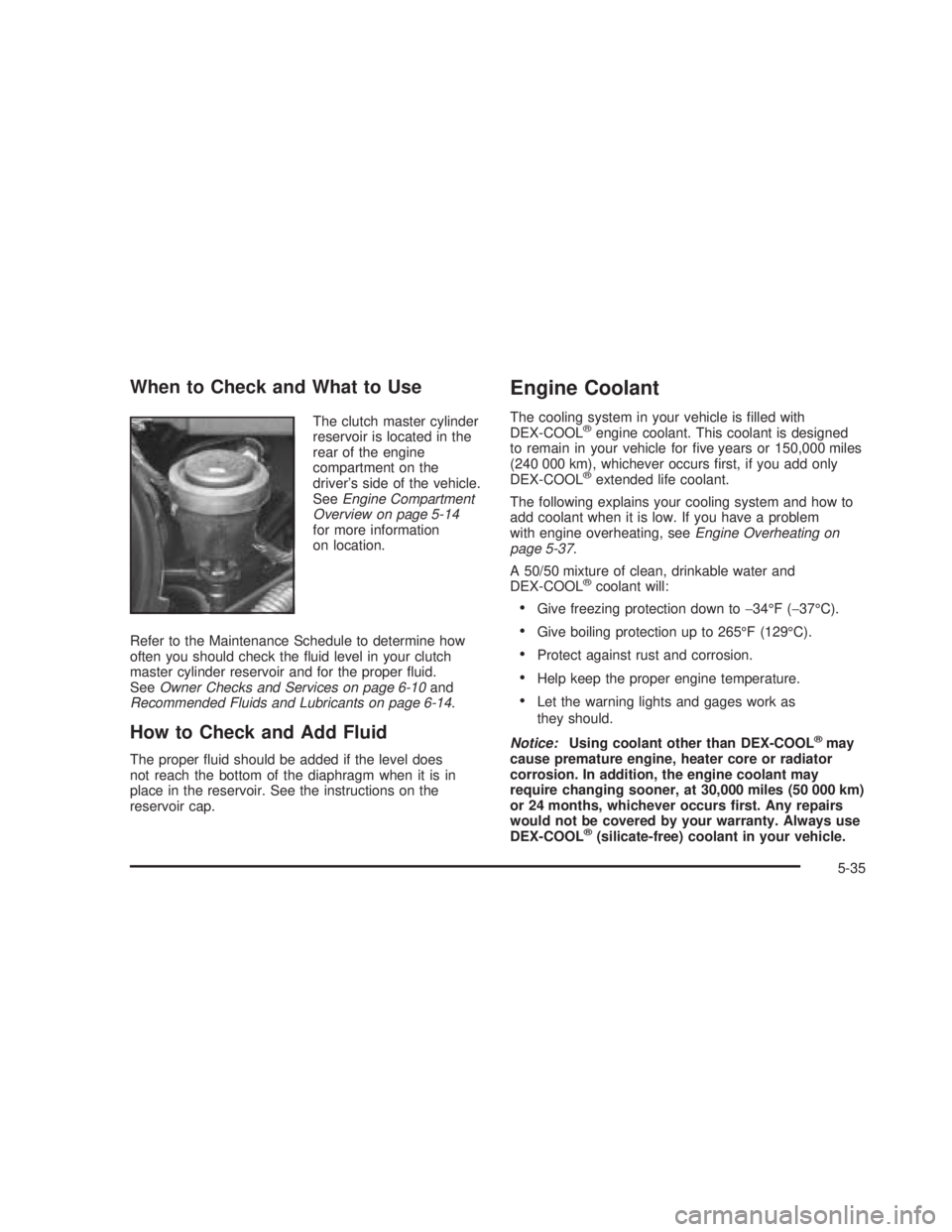
The clutch master cylinder
reservoir is located in the
rear of the engine
compartment on the
driver’s side of the vehicle.
SeeEngine Compartment
Overview on page 5-14
for more information
on location.
Refer to the Maintenance Schedule to determine how
often you should check the uid level in your clutch
master cylinder reservoir and for the proper uid.
SeeOwner Checks and Services on page 6-10and
Recommended Fluids and Lubricants on page 6-14.
How to Check and Add Fluid
The proper uid should be added if the level does
not reach the bottom of the diaphragm when it is in
place in the reservoir. See the instructions on the
reservoir cap.
Engine Coolant
The cooling system in your vehicle is lled with
DEX-COOL®engine coolant. This coolant is designed
to remain in your vehicle for ve years or 150,000 miles
(240 000 km), whichever occurs rst, if you add only
DEX-COOL
®extended life coolant.
The following explains your cooling system and how to
add coolant when it is low. If you have a problem
with engine overheating, seeEngine Overheating on
page 5-37.
A 50/50 mixture of clean, drinkable water and
DEX-COOL
®coolant will:
Give freezing protection down to−34°F (−37°C).
Give boiling protection up to 265°F (129°C).
Protect against rust and corrosion.
Help keep the proper engine temperature.
Let the warning lights and gages work as
they should.
Notice:Using coolant other than DEX-COOL
®may
cause premature engine, heater core or radiator
corrosion. In addition, the engine coolant may
require changing sooner, at 30,000 miles (50 000 km)
or 24 months, whichever occurs rst. Any repairs
would not be covered by your warranty. Always use
DEX-COOL
®(silicate-free) coolant in your vehicle.
5-35
Page 431 of 574
If your vehicle is equipped with a low coolant sensor,
and the LOW COOLANT LEVEL message comes
on and stays on, it means you are low on engine
coolant. See “LOW COOLANT LEVEL” underDIC
Warnings and Messages on page 3-54.
Adding Coolant
If you need more coolant, add the proper DEX-COOL®
coolant mixtureat the surge tank, but only when the
engine is cool.
{CAUTION:
You can be burned if you spill coolant on hot
engine parts. Coolant contains ethylene glycol,
and it will burn if the engine parts are hot
enough. Do not spill coolant on a hot engine.
When replacing the pressure cap, make sure it is
hand-tight.
Coolant Surge Tank Pressure Cap
The coolant surge tank pressure cap must be fully
installed on the coolant surge tank. SeeEngine
Compartment Overview on page 5-14for more
information on location.
Notice:If the pressure cap is not tightly installed,
coolant loss and possible engine damage may
occur. Be sure the cap is properly and tightly
secured.
Engine Overheating
You will nd a coolant temperature gage on your
vehicle’s instrument panel. SeeEngine Coolant
Temperature Gage on page 3-42.
In addition, you will nd an ENGINE OVERHEATED
and a REDUCED ENGINE POWER message in
the Driver Information Center (DIC) on the instrument
panel. SeeDIC Warnings and Messages on page 3-54.
5-37
Page 467 of 574
{CAUTION:
Poorly maintained and improperly used tires
are dangerous.
Overloading your tires can cause
overheating as a result of too much
friction. You could have an air-out and a
serious accident. SeeLoading Your
Vehicle on page 4-50.
Underinated tires pose the same danger
as overloaded tires. The resulting accident
could cause serious injury. Check all tires
frequently to maintain the recommended
pressure. Tire pressure should be checked
when your tires are cold. SeeInflation - Tire
Pressure on page 5-79.
Overinated tires are more likely to be
cut, punctured or broken by a sudden
impact —such as when you hit a pothole.
Keep tires at the recommended pressure.
Worn, old tires can cause accidents. If your
tread is badly worn, or if your tires have
been damaged, replace them.
20-Inch Tires
If your vehicle has the optional 20-inch P275/55R20
size tires, they are classied as touring tires and
are designed for on road use. The low-prole, wide
tread design is not recommended for “off-road” driving
or commercial uses such as snow plowing. See
Off-Road Driving with Your Four-Wheel-Drive Vehicle on
page 4-20andAdding a Snow Plow or Similar
Equipment on page 4-56for additional information.
5-73
Page 565 of 574
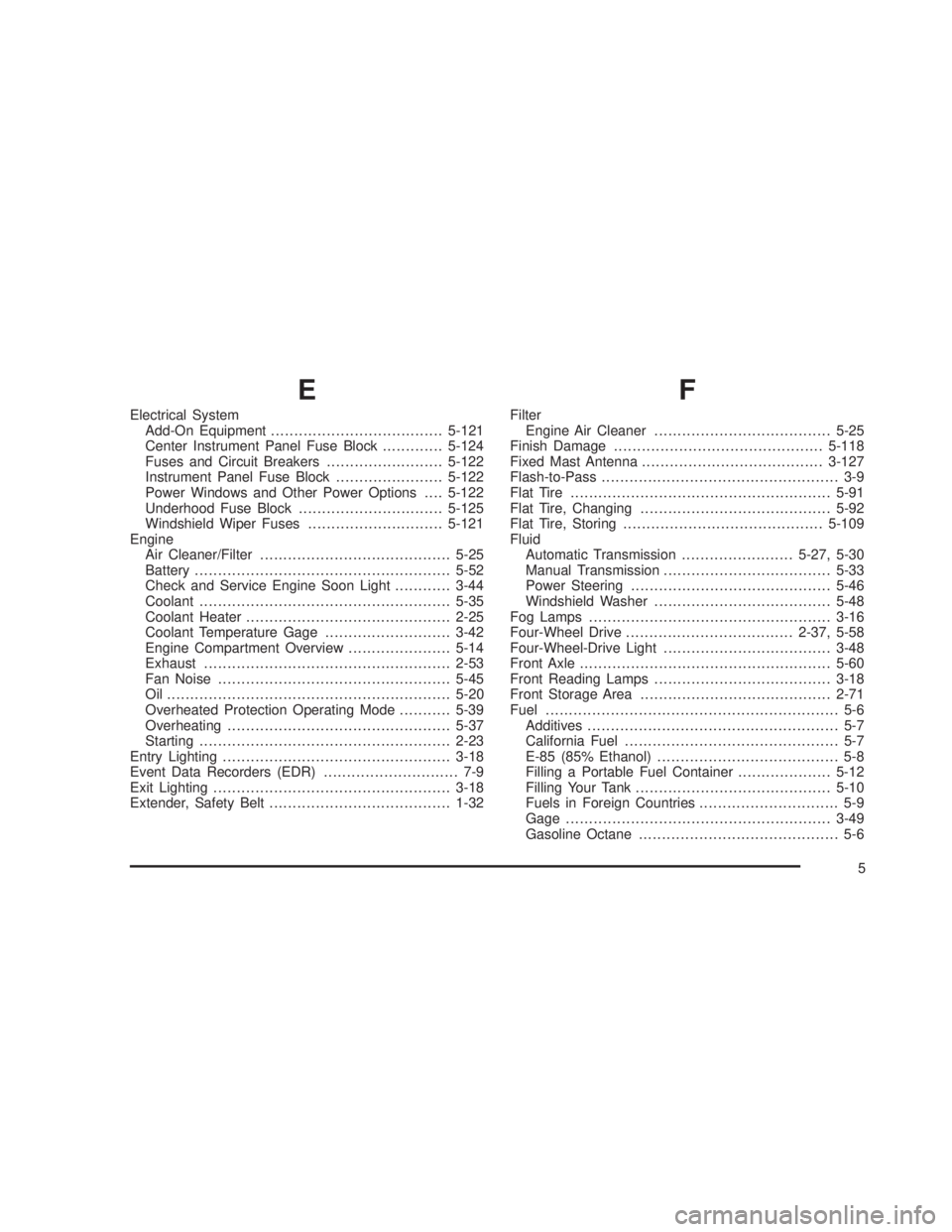
E
Electrical System
Add-On Equipment.....................................5-121
Center Instrument Panel Fuse Block.............5-124
Fuses and Circuit Breakers.........................5-122
Instrument Panel Fuse Block.......................5-122
Power Windows and Other Power Options....5-122
Underhood Fuse Block...............................5-125
Windshield Wiper Fuses.............................5-121
Engine
Air Cleaner/Filter.........................................5-25
Battery.......................................................5-52
Check and Service Engine Soon Light............3-44
Coolant......................................................5-35
Coolant Heater............................................2-25
Coolant Temperature Gage...........................3-42
Engine Compartment Overview......................5-14
Exhaust.....................................................2-53
Fan Noise..................................................5-45
Oil .............................................................5-20
Overheated Protection Operating Mode...........5-39
Overheating................................................5-37
Starting......................................................2-23
Entry Lighting.................................................3-18
Event Data Recorders (EDR)............................. 7-9
Exit Lighting...................................................3-18
Extender, Safety Belt.......................................1-32
F
Filter
Engine Air Cleaner......................................5-25
Finish Damage.............................................5-118
Fixed Mast Antenna.......................................3-127
Flash-to-Pass................................................... 3-9
Flat Tire........................................................5-91
Flat Tire, Changing.........................................5-92
Flat Tire, Storing...........................................5-109
Fluid
Automatic Transmission........................5-27, 5-30
Manual Transmission....................................5-33
Power Steering...........................................5-46
Windshield Washer......................................5-48
Fog Lamps....................................................3-16
Four-Wheel Drive....................................2-37, 5-58
Four-Wheel-Drive Light....................................3-48
Front Axle......................................................5-60
Front Reading Lamps......................................3-18
Front Storage Area.........................................2-71
Fuel............................................................... 5-6
Additives...................................................... 5-7
California Fuel.............................................. 5-7
E-85 (85% Ethanol)....................................... 5-8
Filling a Portable Fuel Container....................5-12
Filling Your Tank..........................................5-10
Fuels in Foreign Countries.............................. 5-9
Gage.........................................................3-49
Gasoline Octane........................................... 5-6
5