engine GMC SIERRA 2006 User Guide
[x] Cancel search | Manufacturer: GMC, Model Year: 2006, Model line: SIERRA, Model: GMC SIERRA 2006Pages: 600, PDF Size: 3.49 MB
Page 122 of 600
NEUTRAL (N):In this position, your engine does not
connect with the wheels. To restart when you are
already moving, use NEUTRAL (N) only. Also, use
NEUTRAL (N) when your vehicle is being towed.
{CAUTION:
Shifting into a drive gear while your engine is
running at high speed is dangerous. Unless
your foot is rmly on the brake pedal, your
vehicle could move very rapidly. You could
lose control and hit people or objects. Do not
shift into a drive gear while your engine is
running at high speed.
Notice:Shifting out of PARK (P) or NEUTRAL (N)
with the engine running at high speed may damage
the transmission. The repairs would not be covered
by your warranty. Be sure the engine is not running
at high speed when shifting your vehicle.DRIVE (D):This position is for normal driving. If you
need more power for passing, and you are:
Going less than about 35 mph (55 km/h), push your
accelerator pedal about halfway down.
Going about 35 mph (55 km/h) or more, push the
accelerator all the way down.
By doing this, the vehicle shifts down to the next gear
and has more power.
DRIVE (D) can be used when towing a trailer, carrying a
heavy load, driving on steep hills, or for off-road driving.
You may want to shift the transmission to THIRD (3) or,
if necessary, a lower gear selection if the transmission
shifts too often.
If your vehicle has the Allison Transmission
®, it will
shift into rst range when DRIVE (D) is selected. As
vehicle speed increases, the transmission will upshift
automatically through each available range up to
SIXTH (6). As the vehicle slows, the transmission will
downshift automatically.
2-28
Page 123 of 600
The Allison Transmission®uses a shift stabilization
feature that adjusts the transmission shifting to the
current driving conditions in order to reduce rapid upshifts
and downshifts. This shift stabilization feature is designed
to determine before making an upshift if the engine will be
able to maintain vehicle speed by analyzing things such
as throttle position, vehicle load, and hill grade. If the
shift stabilization feature determines that current vehicle
speed cannot be maintained, the transmission does not
upshift and instead holds the current gear. In some
cases, this may appear to be a delayed shift, however
the transmission is operating normally.
The Allison Transmission
®also uses adaptive shift
controls. Adaptive shift controls continually compares
key shift parameters to pre-programmed ideal shift
conditions. The Allison Transmission
®constantly makes
adjustments to improve vehicle performance according
to the way the vehicle is being used, such as with a
heavy load. During this adaptive shift controls process,
some shifts may feel different as the transmission
determines optimum settings for a particular shift.
MANUAL MODE (M):This position, is available on
vehicles with the Allison Transmission
®. It lets drivers
select the range of gears appropriate for current driving
conditions. If your vehicle has this feature, see Range
Select Mode (Allison Transmission
®) later in this section.THIRD (3):This position is also used for normal driving,
however it offers more power and lower fuel economy
than DRIVE (D).
SECOND (2):This position gives you more power
but lower fuel economy. You can use SECOND (2) on
hills. It can help control your speed as you go down
steep mountain roads, but then you would also want
to use your brakes off and on.
If you manually select SECOND (2) in an automatic
transmission, the transmission will start in second gear.
You may use this feature for reducing the speed of
the rear wheels when you are trying to start your vehicle
from a stop on slippery road surfaces.
FIRST (1):This position gives you even more power (but
lower fuel economy) than SECOND (2). You can use it on
very steep hills, or in deep snow or mud. If the shift lever
is put in FIRST (1) while the vehicle is moving forward,
the transmission will not shift into rst gear until the
vehicle is going slowly enough.
Notice:Spinning the tires or holding the vehicle in
one place on a hill using only the accelerator pedal
may damage the transmission. If you are stuck, do
not spin the tires. When stopping on a hill, use the
brakes to hold the vehicle in place.
2-29
Page 124 of 600
Range Selection Mode
(Allison Transmission®)
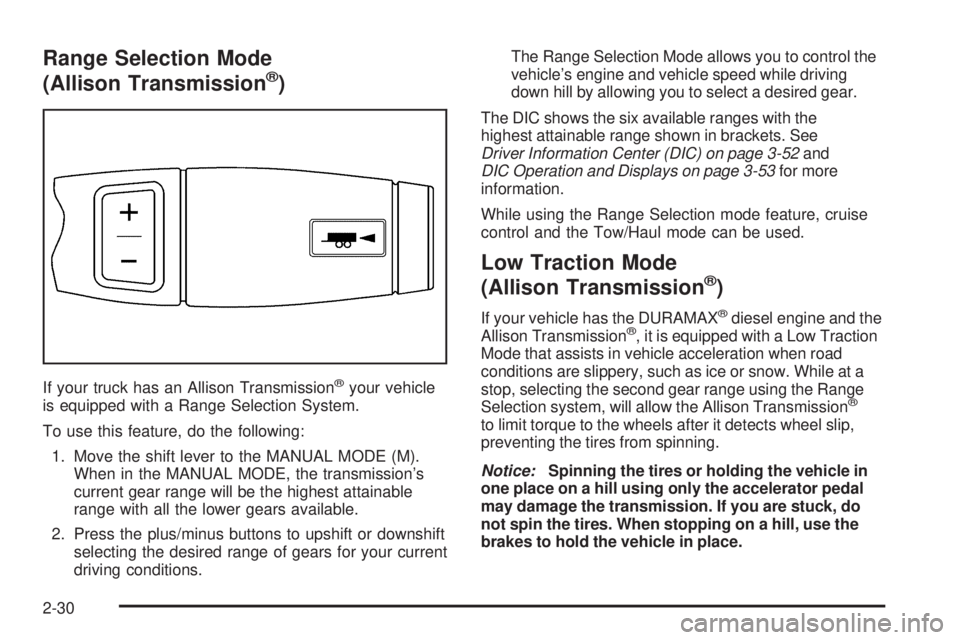
If your truck has an Allison Transmission®your vehicle
is equipped with a Range Selection System.
To use this feature, do the following:
1. Move the shift lever to the MANUAL MODE (M).
When in the MANUAL MODE, the transmission’s
current gear range will be the highest attainable
range with all the lower gears available.
2. Press the plus/minus buttons to upshift or downshift
selecting the desired range of gears for your current
driving conditions.The Range Selection Mode allows you to control the
vehicle’s engine and vehicle speed while driving
down hill by allowing you to select a desired gear.
The DIC shows the six available ranges with the
highest attainable range shown in brackets. See
Driver Information Center (DIC) on page 3-52and
DIC Operation and Displays on page 3-53for more
information.
While using the Range Selection mode feature, cruise
control and the Tow/Haul mode can be used.
Low Traction Mode
(Allison Transmission®)
If your vehicle has the DURAMAX®diesel engine and the
Allison Transmission®, it is equipped with a Low Traction
Mode that assists in vehicle acceleration when road
conditions are slippery, such as ice or snow. While at a
stop, selecting the second gear range using the Range
Selection system, will allow the Allison Transmission
®
to limit torque to the wheels after it detects wheel slip,
preventing the tires from spinning.
Notice:Spinning the tires or holding the vehicle in
one place on a hill using only the accelerator pedal
may damage the transmission. If you are stuck, do
not spin the tires. When stopping on a hill, use the
brakes to hold the vehicle in place.
2-30
Page 125 of 600
Cold Weather Operation
(Allison Transmission®)
On cold days, approximately 32°F (0°C) or colder, your
automatic transmission is designed to shift differently.
The transmission uses a warm-up mode shift schedule
until the engine reaches normal operating temperature.
While the transmission is in warm-up mode it is normal for
transmission upshifts to be delayed or held longer. This
feature improves heater performance by giving quicker
vehicle warm-ups.
When temperatures are below−13°F (−25°C), the
transmission will prevent certain operations to protect
against damage. When active the DIC will display
the message “Trans in Warm-up”.
SeeDIC Warnings and Messages on page 3-55for
more information.
Tow/Haul Mode
If your vehicle has an automatic transmission, it may
have a Tow/Haul mode. If your vehicle has an
Allison Transmission
®see “Tow/Haul Mode (Allison
Transmission®) following. Tow/Haul mode adjusts
the transmission shift pattern to reduce shift cycling,
providing increased performance, vehicle control, and
transmission cooling when towing or hauling heavy loads.
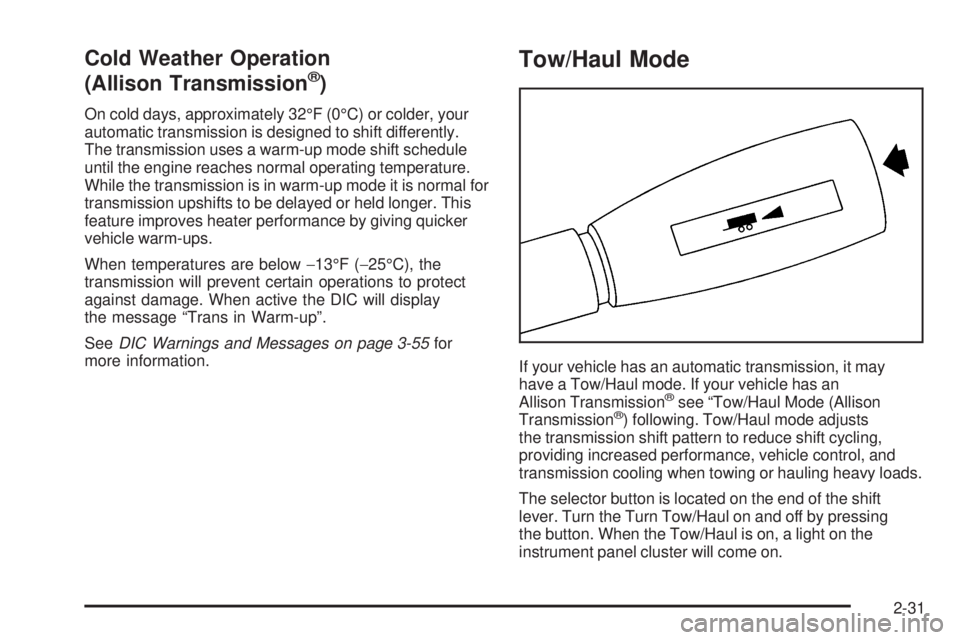
The selector button is located on the end of the shift
lever. Turn the Turn Tow/Haul on and off by pressing
the button. When the Tow/Haul is on, a light on the
instrument panel cluster will come on.
2-31
Page 127 of 600
Grade Braking and Cruise Grade
Braking (Allison Transmission®)
Grade Braking and Cruise Grade Braking assists when
driving on a downhill grade. It maintains the vehicle’s
speed by automatically implementing a shift schedule
that uses the engine and the transmission to slow the
vehicle. This reduces wear on the brakes system and
increases control of the vehicle. The system constantly
monitors the vehicle’s speed, acceleration, engine torque,
and brake pedal usage. It detects when the truck is on a
downhill grade and the driver’s desire to slow down by
pressing the brake.Cruise Grade Braking is available on the
6.6L DURAMAX
®diesel engine. Cruise Grade
Braking monitors a vehicle’s cruise state, engine torque,
acceleration, vehicle speed, and the cruise set speed.
Using this information, it detects when the truck is
accelerating on a downhill grade and will automatically
downshift to slow the vehicle if it exceeds the cruise set
speed by a certain amount.
SeeCruise Control on page 3-10for more information.
The Tow/Haul mode and Grade Braking shift modes can
be activated by pressing the button on the front of the
shift control stalk. If your vehicle has the DURAMAX
®
Diesel Engine or the 8.1L Vortec gasoline engine, Grade
Braking is only available while the Tow/Haul Mode is
selected. While in the Range Selection Mode, Grade
Braking is deactivated allowing the driver to select a
desired gear.
SeeAutomatic Transmission Operation on page 2-26for
more information.
Also seeTowing a Trailer on page 4-67for more
information.
2-33
Page 128 of 600
Manual Transmission Operation
Five-Speed
(VORTEC™ 6.0L V8 Engine)
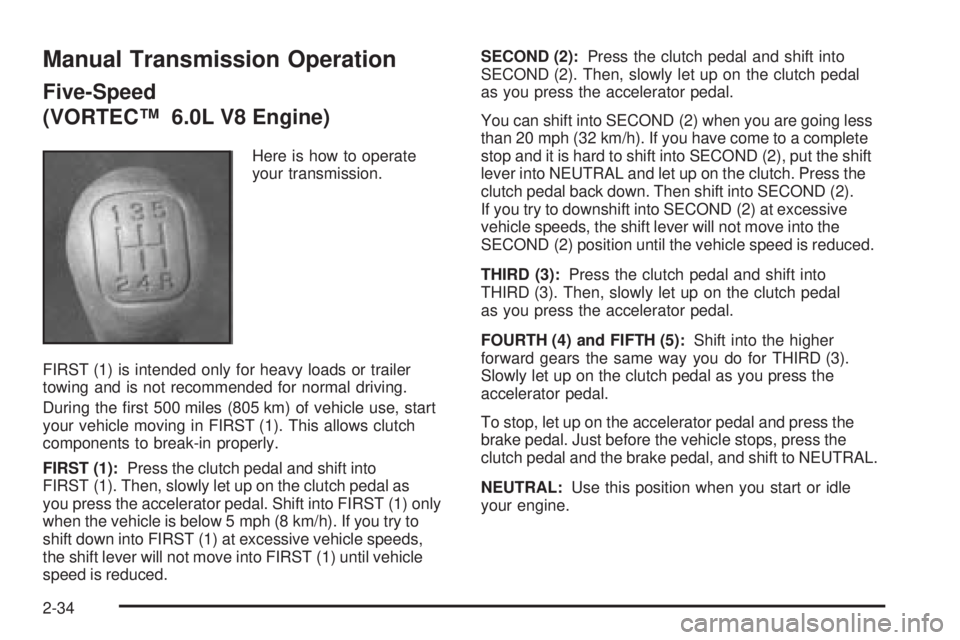
Here is how to operate
your transmission.
FIRST (1) is intended only for heavy loads or trailer
towing and is not recommended for normal driving.
During the rst 500 miles (805 km) of vehicle use, start
your vehicle moving in FIRST (1). This allows clutch
components to break-in properly.
FIRST (1):Press the clutch pedal and shift into
FIRST (1). Then, slowly let up on the clutch pedal as
you press the accelerator pedal. Shift into FIRST (1) only
when the vehicle is below 5 mph (8 km/h). If you try to
shift down into FIRST (1) at excessive vehicle speeds,
the shift lever will not move into FIRST (1) until vehicle
speed is reduced.SECOND (2):Press the clutch pedal and shift into
SECOND (2). Then, slowly let up on the clutch pedal
as you press the accelerator pedal.
You can shift into SECOND (2) when you are going less
than 20 mph (32 km/h). If you have come to a complete
stop and it is hard to shift into SECOND (2), put the shift
lever into NEUTRAL and let up on the clutch. Press the
clutch pedal back down. Then shift into SECOND (2).
If you try to downshift into SECOND (2) at excessive
vehicle speeds, the shift lever will not move into the
SECOND (2) position until the vehicle speed is reduced.
THIRD (3):Press the clutch pedal and shift into
THIRD (3). Then, slowly let up on the clutch pedal
as you press the accelerator pedal.
FOURTH (4) and FIFTH (5):Shift into the higher
forward gears the same way you do for THIRD (3).
Slowly let up on the clutch pedal as you press the
accelerator pedal.
To stop, let up on the accelerator pedal and press the
brake pedal. Just before the vehicle stops, press the
clutch pedal and the brake pedal, and shift to NEUTRAL.
NEUTRAL:Use this position when you start or idle
your engine.
2-34
Page 129 of 600
REVERSE (R):To back up, rst press down the clutch
pedal. Wait for the vehicle to stop moving and then,
shift into REVERSE (R). Let up on the clutch pedal
slowly while pressing the accelerator pedal.
Notice:Shifting to REVERSE (R) while your vehicle
is moving forward could damage the transmission.
The repairs would not be covered by your warranty.
Shift to REVERSE (R) only after your vehicle is
stopped.
Also, use REVERSE (R), along with the parking brake,
when turning off your engine and parking your vehicle.
Five-Speed (VORTEC™ 4.3L V6 and
4.8L V8 Engines)
Here is how to operate your transmission:
FIRST (1):Press the clutch pedal and shift into
FIRST (1). Then, slowly let up on the clutch pedal
as you press the accelerator pedal.
You can shift into FIRST (1) when you are going less
than 20 mph (32 km/h). If you have come to a complete
stop and it is hard to shift into FIRST (1), put the shift
lever into NEUTRAL and let up on the clutch. Press the
clutch pedal back down. Then shift into FIRST (1).SECOND (2):Press the clutch pedal as you let up on
the accelerator pedal and shift into SECOND (2). Then,
slowly let up on the clutch pedal as you press the
accelerator pedal.
THIRD (3), FOURTH (4) and FIFTH (5):Shift into
THIRD (3), FOURTH (4) and FIFTH (5) the same way
you do for SECOND (2). Slowly let up on the clutch
pedal as you press the accelerator pedal.
To stop, let up on the accelerator pedal and press the
brake pedal. Just before the vehicle stops, press the
clutch pedal and the brake pedal, and shift to NEUTRAL.
NEUTRAL:Use this position when you start or idle
your engine.
REVERSE (R):To back up, rst press down the clutch
pedal. Wait for the vehicle to stop moving and then, shift
into REVERSE (R). Let up on the clutch pedal slowly
while pressing the accelerator pedal.
Notice:Shifting to REVERSE (R) while your vehicle
is moving forward could damage the transmission.
The repairs would not be covered by your warranty.
Shift to REVERSE (R) only after your vehicle is
stopped.
Also, use REVERSE (R), along with the parking brake,
when turning off your engine and parking your vehicle.
2-35
Page 130 of 600
Six-Speed (VORTEC™ 8.1L V8 and
DURAMAX®™ 6.6L V8 Engines)
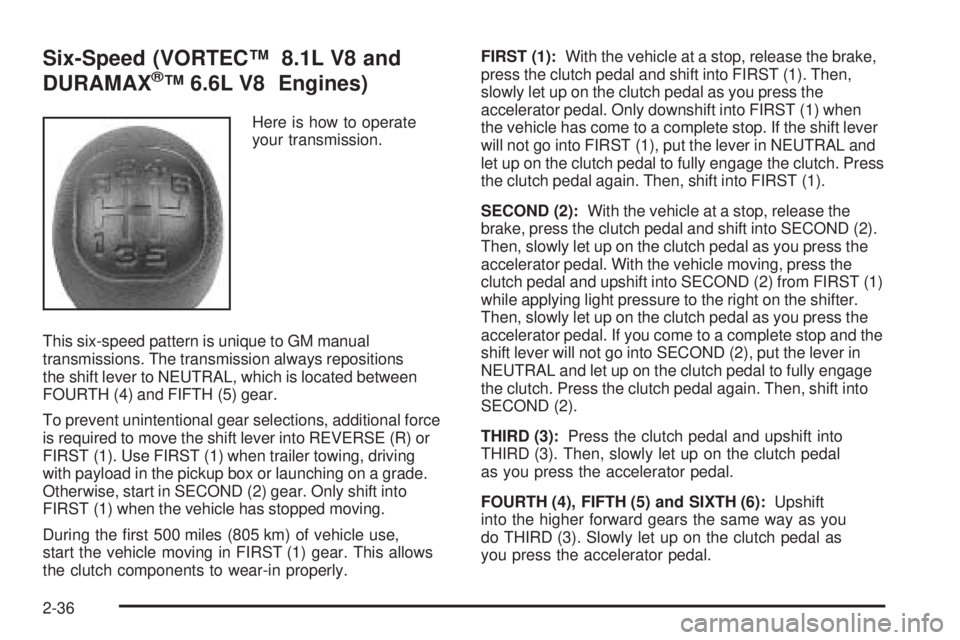
Here is how to operate
your transmission.
This six-speed pattern is unique to GM manual
transmissions. The transmission always repositions
the shift lever to NEUTRAL, which is located between
FOURTH (4) and FIFTH (5) gear.
To prevent unintentional gear selections, additional force
is required to move the shift lever into REVERSE (R) or
FIRST (1). Use FIRST (1) when trailer towing, driving
with payload in the pickup box or launching on a grade.
Otherwise, start in SECOND (2) gear. Only shift into
FIRST (1) when the vehicle has stopped moving.
During the rst 500 miles (805 km) of vehicle use,
start the vehicle moving in FIRST (1) gear. This allows
the clutch components to wear-in properly.FIRST (1):With the vehicle at a stop, release the brake,
press the clutch pedal and shift into FIRST (1). Then,
slowly let up on the clutch pedal as you press the
accelerator pedal. Only downshift into FIRST (1) when
the vehicle has come to a complete stop. If the shift lever
will not go into FIRST (1), put the lever in NEUTRAL and
let up on the clutch pedal to fully engage the clutch. Press
the clutch pedal again. Then, shift into FIRST (1).
SECOND (2):With the vehicle at a stop, release the
brake, press the clutch pedal and shift into SECOND (2).
Then, slowly let up on the clutch pedal as you press the
accelerator pedal. With the vehicle moving, press the
clutch pedal and upshift into SECOND (2) from FIRST (1)
while applying light pressure to the right on the shifter.
Then, slowly let up on the clutch pedal as you press the
accelerator pedal. If you come to a complete stop and the
shift lever will not go into SECOND (2), put the lever in
NEUTRAL and let up on the clutch pedal to fully engage
the clutch. Press the clutch pedal again. Then, shift into
SECOND (2).
THIRD (3):Press the clutch pedal and upshift into
THIRD (3). Then, slowly let up on the clutch pedal
as you press the accelerator pedal.
FOURTH (4), FIFTH (5) and SIXTH (6):Upshift
into the higher forward gears the same way as you
do THIRD (3). Slowly let up on the clutch pedal as
you press the accelerator pedal.
2-36
Page 131 of 600
NEUTRAL:Use this position when you start or idle
your engine.
REVERSE (R):To back up, press the clutch pedal.
Wait for the vehicle to stop moving and then, shift
to REVERSE (R). Let up on the clutch slowly while
pressing the accelerator pedal. Also, use REVERSE (R),
along with the parking brake, when turning off your
engine and parking your vehicle.
Shift Speeds
{CAUTION:
If you skip a gear when you downshift, you
could lose control of your vehicle. You could
injure yourself or others. Do not shift down
more than one gear at a time when you
downshift.Do not allow the engine rpm to overspeed and enter the
tachometer red lines. Engine overspeed occurs when
downshifting, or descending a grade, at too high a vehicle
speed. When going down steep grades, always select a
gear at least one position lower than you would use on
climbing a grade. This will allow the vehicle’s engine to
provide some braking and help to slow the vehicle as it
goes down the grade. Monitor your vehicle speed,
acceleration and engine rpm while applying the brakes
as you go down the grade to ensure you have complete
control over the vehicle.
If your engine speed drops below 600 rpm, or if the
engine is not running smoothly, you should downshift to
the next lower gear. When operating on slippery surfaces,
downshift at lower than normal vehicle speeds to prevent
the tires from slipping.
In bench seat equipped vehicles, move the tallest
beverage containers to the right cupholder to provide
additional clearance for the shift lever.
For vehicles equipped with a center console, the front
cup holder pulls out and turns 180° to provide additional
clearance between tall beverage containers and the
shift lever.
2-37
Page 132 of 600
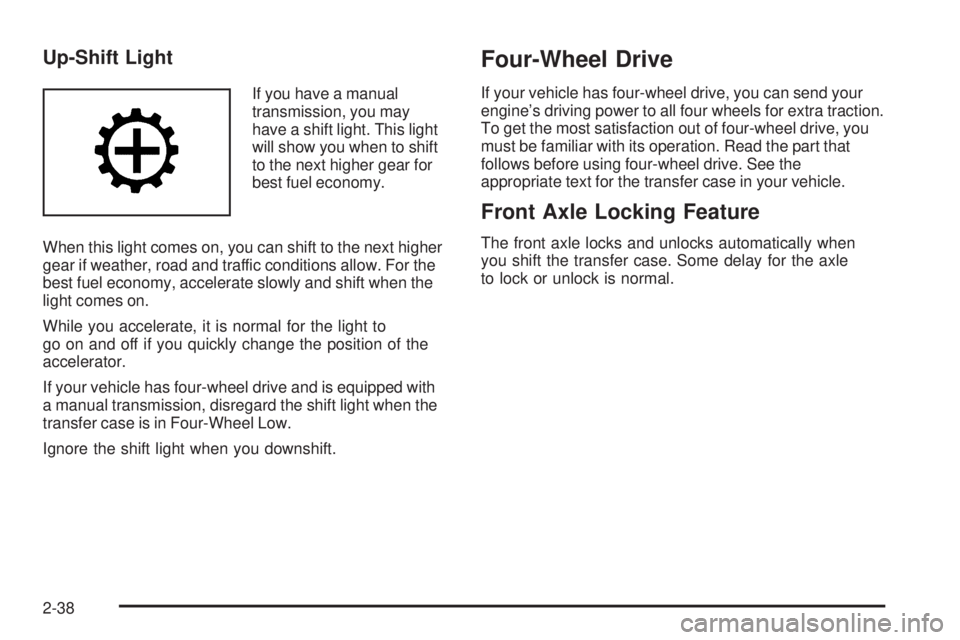
Up-Shift Light
If you have a manual
transmission, you may
have a shift light. This light
will show you when to shift
to the next higher gear for
best fuel economy.
When this light comes on, you can shift to the next higher
gear if weather, road and traffic conditions allow. For the
best fuel economy, accelerate slowly and shift when the
light comes on.
While you accelerate, it is normal for the light to
go on and off if you quickly change the position of the
accelerator.
If your vehicle has four-wheel drive and is equipped with
a manual transmission, disregard the shift light when the
transfer case is in Four-Wheel Low.
Ignore the shift light when you downshift.
Four-Wheel Drive
If your vehicle has four-wheel drive, you can send your
engine’s driving power to all four wheels for extra traction.
To get the most satisfaction out of four-wheel drive, you
must be familiar with its operation. Read the part that
follows before using four-wheel drive. See the
appropriate text for the transfer case in your vehicle.
Front Axle Locking Feature
The front axle locks and unlocks automatically when
you shift the transfer case. Some delay for the axle
to lock or unlock is normal.
2-38