trailer GMC SIERRA 2006 Owner's Guide
[x] Cancel search | Manufacturer: GMC, Model Year: 2006, Model line: SIERRA, Model: GMC SIERRA 2006Pages: 600, PDF Size: 3.49 MB
Page 374 of 600
Towing
Towing Your Vehicle
Consult your dealer or a professional towing service
if you need to have your disabled vehicle towed.
SeeRoadside Assistance Program on page 7-6.
If you want to tow your vehicle behind another vehicle
for recreational purposes (such as behind a motorhome),
see “Recreational Vehicle Towing” following.
Recreational Vehicle Towing
Recreational vehicle towing means towing your vehicle
behind another vehicle – such as behind a motorhome.
The two most common types of recreational vehicle
towing are known as dinghy towing, towing your vehicle
will all four wheels on the ground, and dolly towing,
towing your vehicle with two wheels on the ground
and two wheels up on a device known as a “dolly”.
With the proper preparation and equipment, many
vehicles can be towed in these ways. See “Dinghy
Towing” and “Dolly Towing” following.Here are some important things to consider before you
do recreational vehicle towing:
What’s the towing capacity of the towing vehicle?
Be sure you read the tow vehicle manufacturer’s
recommendations.
How far will you tow? Some vehicles have
restrictions on how far and how long they can tow.
Do you have the proper towing equipment? See your
dealer or trailering professional for additional advice
and equipment recommendations.
Is your vehicle ready to be towed? Just as you would
prepare your vehicle for a long trip, you’ll want to
make sure your vehicle is prepared to be towed.
SeeBefore Leaving on a Long Trip on page 4-38.
Dinghy Towing
Two-Wheel-Drive Vehicles
Notice:If you tow your vehicle with all four wheels
on the ground, the drivetrain components could be
damaged. The repairs would not be covered by your
warranty. Do not tow your vehicle with all four wheels
on the ground.
Two-wheel-drive vehicles should not be towed
with all four wheels on the ground. Two-wheel-drive
transmissions have no provisions for internal lubrication
while being towed.
4-62
Page 379 of 600
Towing a Trailer
Do not tow a trailer during break-in. SeeNew Vehicle
Break-In on page 2-21
{CAUTION:
If you do not use the correct equipment and
drive properly, you can lose control when you
pull a trailer. For example, if the trailer is too
heavy, the brakes may not work well — or even
at all. You and your passengers could be
seriously injured. Pull a trailer only if you have
followed all the steps in this section. Ask your
dealer for advice and information about towing
a trailer with your vehicle.Notice:Pulling a trailer improperly can damage
your vehicle and result in costly repairs not covered
by your warranty. To pull a trailer correctly, follow
the advice in this part, and see your dealer for
important information about towing a trailer with
your vehicle.
To identify the trailering capacity of your vehicle, you
should read the information in “Weight of the Trailer”
that appears later in this section.
Trailering is different than just driving your vehicle by
itself. Trailering means changes in acceleration, braking,
handling, durability and fuel economy. Successful, safe
trailering takes correct equipment, and it has to be used
properly.
That’s the reason for this part. In it are many time-tested,
important trailering tips and safety rules. Many of these
are important for your safety and that of your passengers.
So please read this section carefully before you pull a
trailer.
4-67
Page 380 of 600
If You Do Decide To Pull A Trailer
If you do, here are some important points:
There are many different laws, including speed limit
restrictions, having to do with trailering. Make sure
your rig will be legal, not only where you live but also
where you’ll be driving. A good source for this
information can be state or provincial police.
Consider using a sway control. See “Hitches” later in
this section.
Don’t tow a trailer at all during the rst
500 miles (800 km) your new vehicle is driven.
Your engine, axle or other parts could be damaged.
Then, during the rst 500 miles (800 km) that you tow
a trailer, don’t drive over 50 mph (80 km/h) and don’t
make starts at full throttle. This helps your engine
and other parts of your vehicle wear in at the heavier
loads.
If you have an automatic transmission, you can tow
in DRIVE (D). You may want to shift the transmission
to THIRD (3) or, if necessary, a lower gear selection
if the transmission shifts too often, such as under
heavy loads and/or hilly conditions. If you have a
manual transmission and you are towing a trailer,
it’s better not to use the highest gear. SeeTow/Haul
Mode Light on page 3-50.Three important considerations have to do with weight:
The weight of the trailer
The weight of the trailer tongue
The weight on your vehicle’s tires
Tow/Haul Mode
Tow/Haul is a feature on automatic transmission
equipped vehicles that assists when pulling a heavy
trailer or a large or heavy load. SeeTow/Haul Mode
on page 2-31for more information.
Tow/Haul is designed to be most effective when the
vehicle and trailer combined weight is at least 75 percent
of the vehicle’s Gross Combined Weight Rating (GCWR).
See “Weight of the Trailer” later in the section. Tow/Haul
is most useful under the following driving conditions:
When pulling a heavy trailer or a large or heavy load
through rolling terrain.
When pulling a heavy trailer or a large or heavy load
in stop and go traffic.
When pulling a heavy trailer or a large or heavy load
in busy parking lots where improved low speed
control of the vehicle is desired.
4-68
Page 381 of 600
Operating the vehicle in Tow/Haul when lightly loaded
or with no trailer at all will not cause damage. However,
there is no benet to the selection of Tow/Haul when the
vehicle is unloaded. Such a selection when unloaded
may result in unpleasant engine and transmission driving
characteristics and reduced fuel economy. Tow/Haul is
recommended only when pulling a heavy trailer or a large
or heavy load.
Weight of the Trailer
How heavy can a trailer safely be?
It depends on how you plan to use your rig. For example,
speed, altitude, road grades, outside temperature and
how much your vehicle is used to pull a trailer are all
important. It can also depend on any special equipment
that you have on your vehicle, and the amount of tongue
weight the vehicle can carry. See “Weight of the Trailer
Tongue” later in this section for more information.Maximum trailer weight is calculated assuming only the
driver is in the tow vehicle and it has all the required
trailering equipment. The weight of additional optional
equipment, passengers and cargo in the tow vehicle
must be subtracted from the maximum trailer weight.
Above the 5,000 lb (2 268 kg) trailer rating, the
handling/trailering suspension is required on
C-1500 models and the handling/trailering or
off-road suspension is required on K-1500 models.
Use one of the following charts to determine how much
your vehicle can weigh, based upon your vehicle model
and options.
4-69
Page 382 of 600
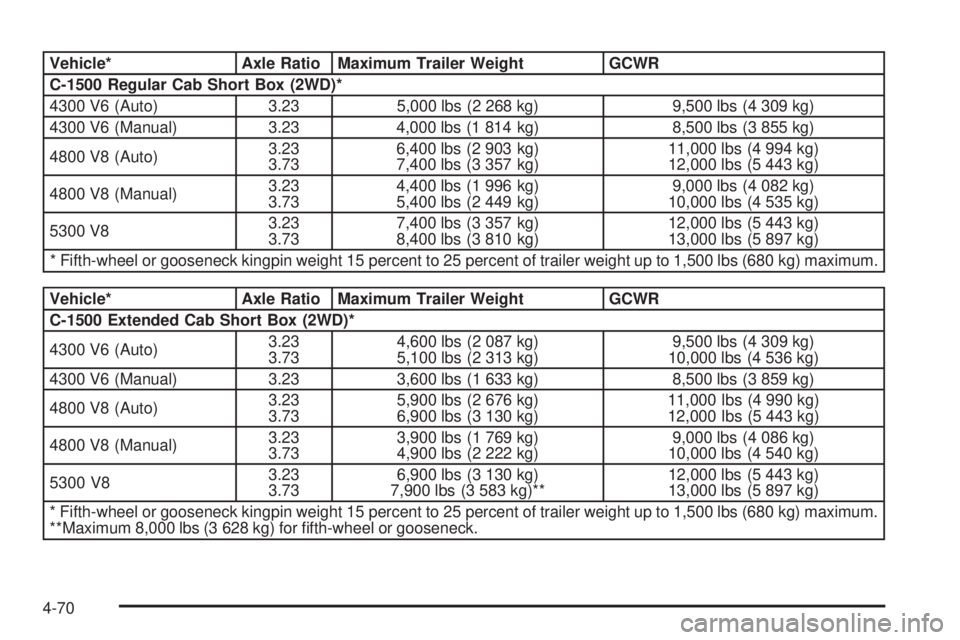
Vehicle* Axle Ratio Maximum Trailer Weight GCWR
C-1500 Regular Cab Short Box (2WD)*
4300 V6 (Auto) 3.23 5,000 lbs (2 268 kg) 9,500 lbs (4 309 kg)
4300 V6 (Manual) 3.23 4,000 lbs (1 814 kg) 8,500 lbs (3 855 kg)
4800 V8 (Auto)3.23
3.736,400 lbs (2 903 kg)
7,400 lbs (3 357 kg)11,000 lbs (4 994 kg)
12,000 lbs (5 443 kg)
4800 V8 (Manual)3.23
3.734,400 lbs (1 996 kg)
5,400 lbs (2 449 kg)9,000 lbs (4 082 kg)
10,000 lbs (4 535 kg)
5300 V83.23
3.737,400 lbs (3 357 kg)
8,400 lbs (3 810 kg)12,000 lbs (5 443 kg)
13,000 lbs (5 897 kg)
* Fifth-wheel or gooseneck kingpin weight 15 percent to 25 percent of trailer weight up to 1,500 lbs (680 kg) maximum.
Vehicle* Axle Ratio Maximum Trailer Weight GCWR
C-1500 Extended Cab Short Box (2WD)*
4300 V6 (Auto)3.23
3.734,600 lbs (2 087 kg)
5,100 lbs (2 313 kg)9,500 lbs (4 309 kg)
10,000 lbs (4 536 kg)
4300 V6 (Manual) 3.23 3,600 lbs (1 633 kg) 8,500 lbs (3 859 kg)
4800 V8 (Auto)3.23
3.735,900 lbs (2 676 kg)
6,900 lbs (3 130 kg)11,000 lbs (4 990 kg)
12,000 lbs (5 443 kg)
4800 V8 (Manual)3.23
3.733,900 lbs (1 769 kg)
4,900 lbs (2 222 kg)9,000 lbs (4 086 kg)
10,000 lbs (4 540 kg)
5300 V83.23
3.736,900 lbs (3 130 kg)
7,900 lbs (3 583 kg)**12,000 lbs (5 443 kg)
13,000 lbs (5 897 kg)
* Fifth-wheel or gooseneck kingpin weight 15 percent to 25 percent of trailer weight up to 1,500 lbs (680 kg) maximum.
**Maximum 8,000 lbs (3 628 kg) for fth-wheel or gooseneck.
4-70
Page 383 of 600
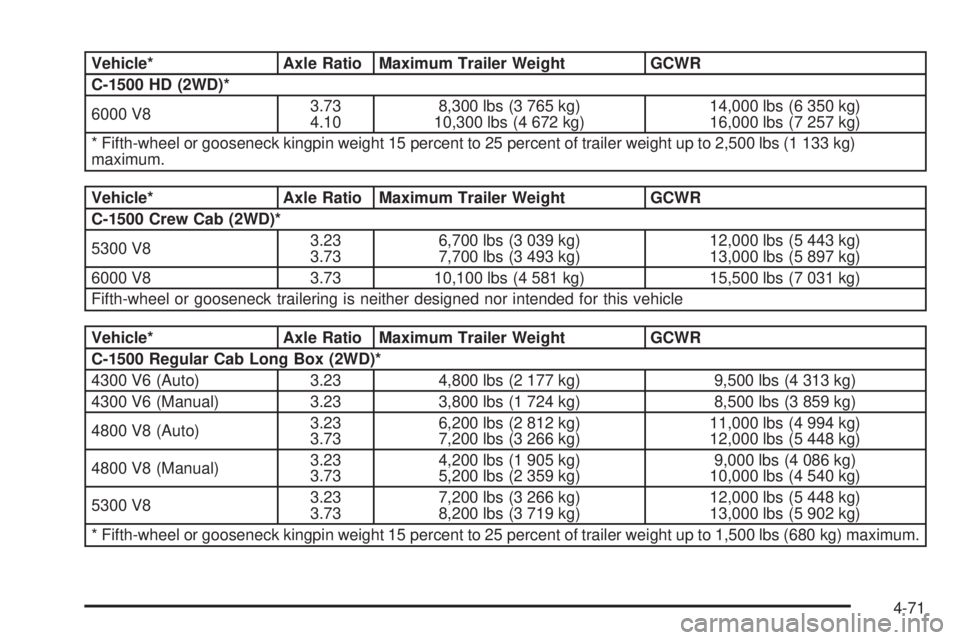
Vehicle* Axle Ratio Maximum Trailer Weight GCWR
C-1500 HD (2WD)*
6000 V83.73
4.108,300 lbs (3 765 kg)
10,300 lbs (4 672 kg)14,000 lbs (6 350 kg)
16,000 lbs (7 257 kg)
* Fifth-wheel or gooseneck kingpin weight 15 percent to 25 percent of trailer weight up to 2,500 lbs (1 133 kg)
maximum.
Vehicle* Axle Ratio Maximum Trailer Weight GCWR
C-1500 Crew Cab (2WD)*
5300 V83.23
3.736,700 lbs (3 039 kg)
7,700 lbs (3 493 kg)12,000 lbs (5 443 kg)
13,000 lbs (5 897 kg)
6000 V8 3.73 10,100 lbs (4 581 kg) 15,500 lbs (7 031 kg)
Fifth-wheel or gooseneck trailering is neither designed nor intended for this vehicle
Vehicle* Axle Ratio Maximum Trailer Weight GCWR
C-1500 Regular Cab Long Box (2WD)*
4300 V6 (Auto) 3.23 4,800 lbs (2 177 kg) 9,500 lbs (4 313 kg)
4300 V6 (Manual) 3.23 3,800 lbs (1 724 kg) 8,500 lbs (3 859 kg)
4800 V8 (Auto)3.23
3.736,200 lbs (2 812 kg)
7,200 lbs (3 266 kg)11,000 lbs (4 994 kg)
12,000 lbs (5 448 kg)
4800 V8 (Manual)3.23
3.734,200 lbs (1 905 kg)
5,200 lbs (2 359 kg)9,000 lbs (4 086 kg)
10,000 lbs (4 540 kg)
5300 V83.23
3.737,200 lbs (3 266 kg)
8,200 lbs (3 719 kg)12,000 lbs (5 448 kg)
13,000 lbs (5 902 kg)
* Fifth-wheel or gooseneck kingpin weight 15 percent to 25 percent of trailer weight up to 1,500 lbs (680 kg) maximum.
4-71
Page 384 of 600
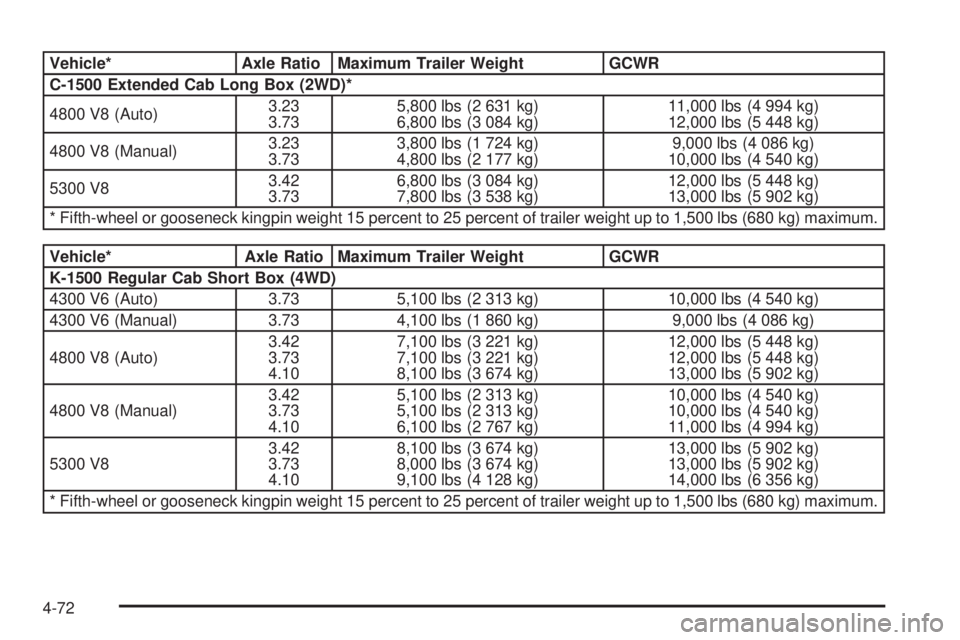
Vehicle* Axle Ratio Maximum Trailer Weight GCWR
C-1500 Extended Cab Long Box (2WD)*
4800 V8 (Auto)3.23
3.735,800 lbs (2 631 kg)
6,800 lbs (3 084 kg)11,000 lbs (4 994 kg)
12,000 lbs (5 448 kg)
4800 V8 (Manual)3.23
3.733,800 lbs (1 724 kg)
4,800 lbs (2 177 kg)9,000 lbs (4 086 kg)
10,000 lbs (4 540 kg)
5300 V83.42
3.736,800 lbs (3 084 kg)
7,800 lbs (3 538 kg)12,000 lbs (5 448 kg)
13,000 lbs (5 902 kg)
* Fifth-wheel or gooseneck kingpin weight 15 percent to 25 percent of trailer weight up to 1,500 lbs (680 kg) maximum.
Vehicle* Axle Ratio Maximum Trailer Weight GCWR
K-1500 Regular Cab Short Box (4WD)
4300 V6 (Auto) 3.73 5,100 lbs (2 313 kg) 10,000 lbs (4 540 kg)
4300 V6 (Manual) 3.73 4,100 lbs (1 860 kg) 9,000 lbs (4 086 kg)
4800 V8 (Auto)3.42
3.73
4.107,100 lbs (3 221 kg)
7,100 lbs (3 221 kg)
8,100 lbs (3 674 kg)12,000 lbs (5 448 kg)
12,000 lbs (5 448 kg)
13,000 lbs (5 902 kg)
4800 V8 (Manual)3.42
3.73
4.105,100 lbs (2 313 kg)
5,100 lbs (2 313 kg)
6,100 lbs (2 767 kg)10,000 lbs (4 540 kg)
10,000 lbs (4 540 kg)
11,000 lbs (4 994 kg)
5300 V83.42
3.73
4.108,100 lbs (3 674 kg)
8,000 lbs (3 674 kg)
9,100 lbs (4 128 kg)13,000 lbs (5 902 kg)
13,000 lbs (5 902 kg)
14,000 lbs (6 356 kg)
* Fifth-wheel or gooseneck kingpin weight 15 percent to 25 percent of trailer weight up to 1,500 lbs (680 kg) maximum.
4-72
Page 385 of 600
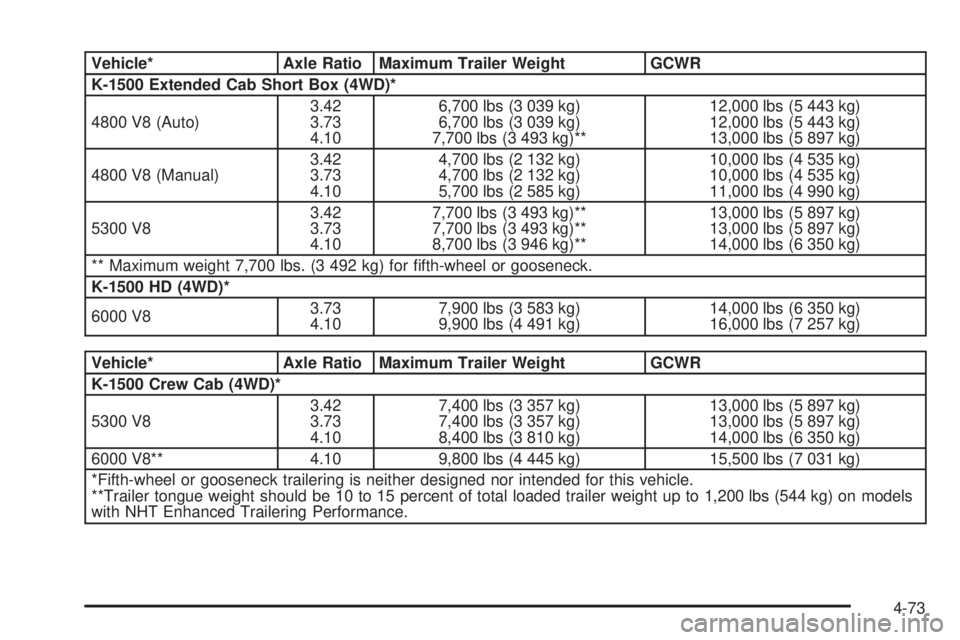
Vehicle* Axle Ratio Maximum Trailer Weight GCWR
K-1500 Extended Cab Short Box (4WD)*
4800 V8 (Auto)3.42
3.73
4.106,700 lbs (3 039 kg)
6,700 lbs (3 039 kg)
7,700 lbs (3 493 kg)**12,000 lbs (5 443 kg)
12,000 lbs (5 443 kg)
13,000 lbs (5 897 kg)
4800 V8 (Manual)3.42
3.73
4.104,700 lbs (2 132 kg)
4,700 lbs (2 132 kg)
5,700 lbs (2 585 kg)10,000 lbs (4 535 kg)
10,000 lbs (4 535 kg)
11,000 lbs (4 990 kg)
5300 V83.42
3.73
4.107,700 lbs (3 493 kg)**
7,700 lbs (3 493 kg)**
8,700 lbs (3 946 kg)**13,000 lbs (5 897 kg)
13,000 lbs (5 897 kg)
14,000 lbs (6 350 kg)
** Maximum weight 7,700 lbs. (3 492 kg) for fth-wheel or gooseneck.
K-1500 HD (4WD)*
6000 V83.73
4.107,900 lbs (3 583 kg)
9,900 lbs (4 491 kg)14,000 lbs (6 350 kg)
16,000 lbs (7 257 kg)
Vehicle* Axle Ratio Maximum Trailer Weight GCWR
K-1500 Crew Cab (4WD)*
5300 V83.42
3.73
4.107,400 lbs (3 357 kg)
7,400 lbs (3 357 kg)
8,400 lbs (3 810 kg)13,000 lbs (5 897 kg)
13,000 lbs (5 897 kg)
14,000 lbs (6 350 kg)
6000 V8** 4.10 9,800 lbs (4 445 kg) 15,500 lbs (7 031 kg)
*Fifth-wheel or gooseneck trailering is neither designed nor intended for this vehicle.
**Trailer tongue weight should be 10 to 15 percent of total loaded trailer weight up to 1,200 lbs (544 kg) on models
with NHT Enhanced Trailering Performance.
4-73
Page 386 of 600
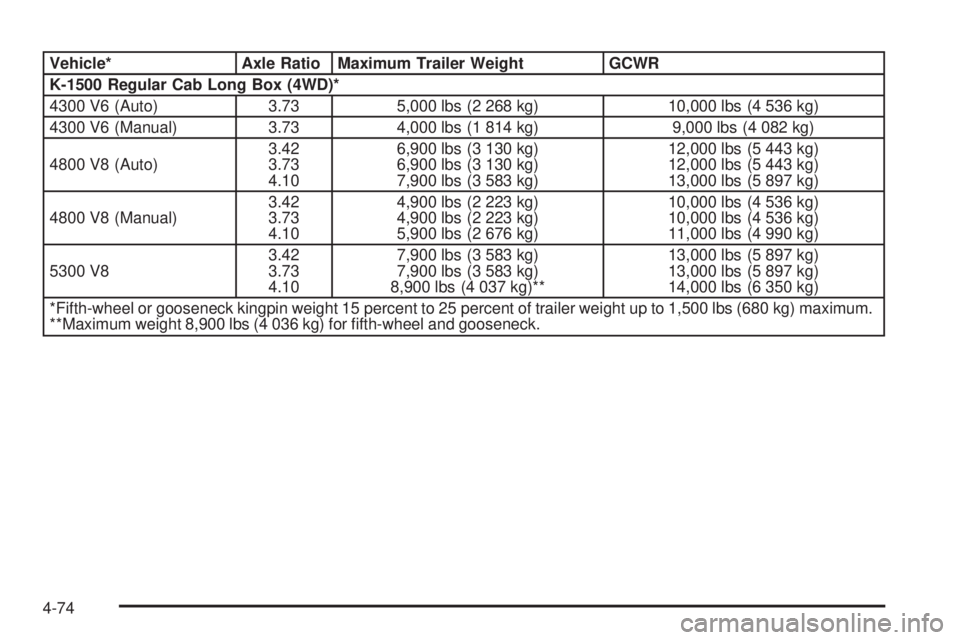
Vehicle* Axle Ratio Maximum Trailer Weight GCWR
K-1500 Regular Cab Long Box (4WD)*
4300 V6 (Auto) 3.73 5,000 lbs (2 268 kg) 10,000 lbs (4 536 kg)
4300 V6 (Manual) 3.73 4,000 lbs (1 814 kg) 9,000 lbs (4 082 kg)
4800 V8 (Auto)3.42
3.73
4.106,900 lbs (3 130 kg)
6,900 lbs (3 130 kg)
7,900 lbs (3 583 kg)12,000 lbs (5 443 kg)
12,000 lbs (5 443 kg)
13,000 lbs (5 897 kg)
4800 V8 (Manual)3.42
3.73
4.104,900 lbs (2 223 kg)
4,900 lbs (2 223 kg)
5,900 lbs (2 676 kg)10,000 lbs (4 536 kg)
10,000 lbs (4 536 kg)
11,000 lbs (4 990 kg)
5300 V83.42
3.73
4.107,900 lbs (3 583 kg)
7,900 lbs (3 583 kg)
8,900 lbs (4 037 kg)**13,000 lbs (5 897 kg)
13,000 lbs (5 897 kg)
14,000 lbs (6 350 kg)
*Fifth-wheel or gooseneck kingpin weight 15 percent to 25 percent of trailer weight up to 1,500 lbs (680 kg) maximum.
**Maximum weight 8,900 lbs (4 036 kg) for fth-wheel and gooseneck.
4-74
Page 387 of 600
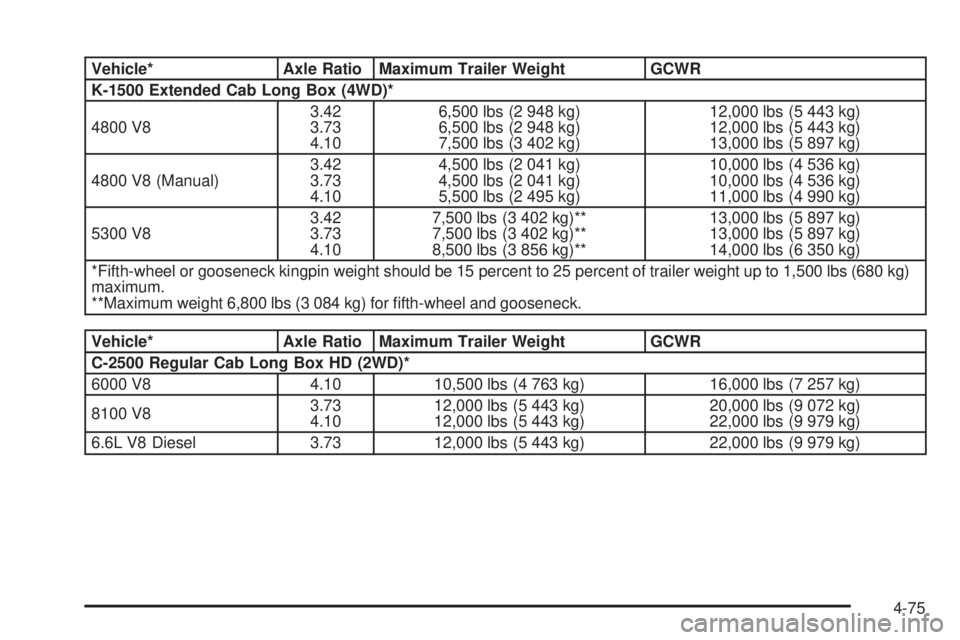
Vehicle* Axle Ratio Maximum Trailer Weight GCWR
K-1500 Extended Cab Long Box (4WD)*
4800 V83.42
3.73
4.106,500 lbs (2 948 kg)
6,500 lbs (2 948 kg)
7,500 lbs (3 402 kg)12,000 lbs (5 443 kg)
12,000 lbs (5 443 kg)
13,000 lbs (5 897 kg)
4800 V8 (Manual)3.42
3.73
4.104,500 lbs (2 041 kg)
4,500 lbs (2 041 kg)
5,500 lbs (2 495 kg)10,000 lbs (4 536 kg)
10,000 lbs (4 536 kg)
11,000 lbs (4 990 kg)
5300 V83.42
3.73
4.107,500 lbs (3 402 kg)**
7,500 lbs (3 402 kg)**
8,500 lbs (3 856 kg)**13,000 lbs (5 897 kg)
13,000 lbs (5 897 kg)
14,000 lbs (6 350 kg)
*Fifth-wheel or gooseneck kingpin weight should be 15 percent to 25 percent of trailer weight up to 1,500 lbs (680 kg)
maximum.
**Maximum weight 6,800 lbs (3 084 kg) for fth-wheel and gooseneck.
Vehicle* Axle Ratio Maximum Trailer Weight GCWR
C-2500 Regular Cab Long Box HD (2WD)*
6000 V8 4.10 10,500 lbs (4 763 kg) 16,000 lbs (7 257 kg)
8100 V83.73
4.1012,000 lbs (5 443 kg)
12,000 lbs (5 443 kg)20,000 lbs (9 072 kg)
22,000 lbs (9 979 kg)
6.6L V8 Diesel 3.73 12,000 lbs (5 443 kg) 22,000 lbs (9 979 kg)
4-75