instrument panel GMC SIERRA 2006 Workshop Manual
[x] Cancel search | Manufacturer: GMC, Model Year: 2006, Model line: SIERRA, Model: GMC SIERRA 2006Pages: 600, PDF Size: 3.49 MB
Page 322 of 600
The Traction Assist System, as delivered from the
factory, will automatically come on whenever you start
your vehicle. To limit wheel spin, especially in slippery
road conditions, you should always leave the system on.
But you can turn the TAS off if you ever need to. You
should turn the TAS off if your vehicle ever gets stuck in
sand, mud or snow and rocking the vehicle is required.
SeeRocking Your Vehicle to Get It Out on page 4-46and
If Your Vehicle is Stuck in Sand, Mud, Ice or Snow on
page 4-46.
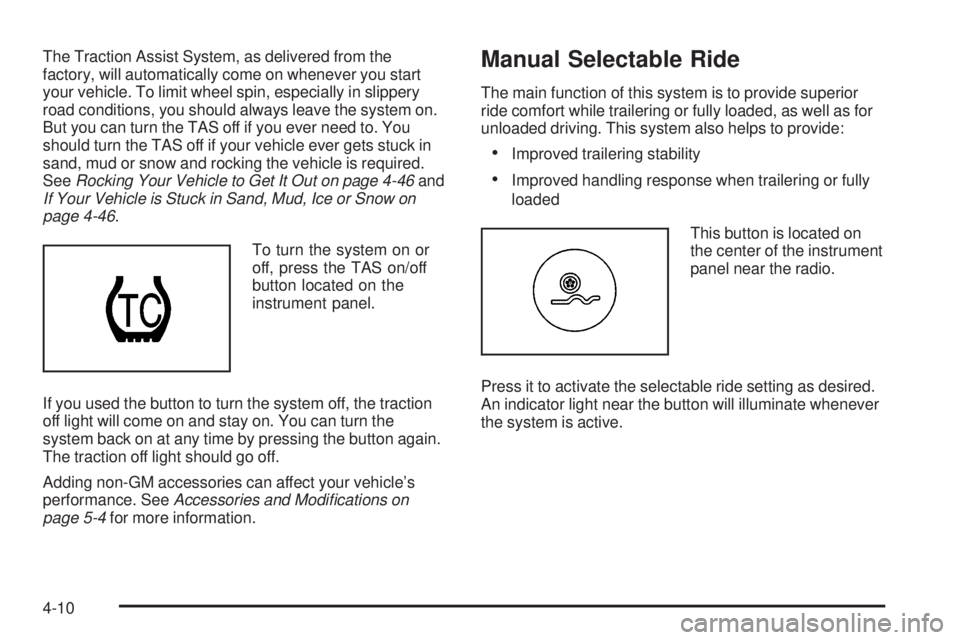
To turn the system on or
off, press the TAS on/off
button located on the
instrument panel.
If you used the button to turn the system off, the traction
off light will come on and stay on. You can turn the
system back on at any time by pressing the button again.
The traction off light should go off.
Adding non-GM accessories can affect your vehicle’s
performance. SeeAccessories and Modications on
page 5-4for more information.Manual Selectable Ride
The main function of this system is to provide superior
ride comfort while trailering or fully loaded, as well as for
unloaded driving. This system also helps to provide:
Improved trailering stability
Improved handling response when trailering or fully
loaded
This button is located on
the center of the instrument
panel near the radio.
Press it to activate the selectable ride setting as desired.
An indicator light near the button will illuminate whenever
the system is active.
4-10
Page 402 of 600
Making Turns
Notice:Making very sharp turns while trailering
could cause the trailer to come in contact with the
vehicle. Your vehicle could be damaged. Avoid
making very sharp turns while trailering.
When you’re turning with a trailer, make wider turns than
normal. Do this so your trailer won’t strike soft shoulders,
curbs, road signs, trees or other objects. Avoid jerky or
sudden maneuvers. Signal well in advance.
Turn Signals When Towing a Trailer
The arrows on your instrument panel will ash whenever
you signal a turn or lane change. Properly hooked up, the
trailer lamps will also ash, telling other drivers you’re
about to turn, change lanes or stop.
When towing a trailer, the arrows on your instrument
panel will ash for turns even if the bulbs on the trailer are
burned out. Thus, you may think drivers behind you are
seeing your signal when they are not. It’s important to
check occasionally to be sure the trailer bulbs are still
working.
Driving On Grades
Reduce speed and shift to a lower gearbeforeyou start
down a long or steep downgrade. If you don’t shift down,
you might have to use your brakes so much that they
would get hot and no longer work well.If you have an automatic transmission, you can tow
in DRIVE (D). You may want to shift the transmission to
a lower gear selection if the transmission shifts too
often (e.g., under heavy loads and/or hilly conditions).
You may also want to activate the tow/haul mode if
the transmission shifts too often. SeeTow/Haul Mode
Light on page 3-50.
If you have a 5-speed manual transmission and you are
towing a trailer, it’s better not to use FIFTH (5) gear.
Just drive in FOURTH (4) gear (or, as you need to, a
lower gear).
If you have a 6-speed manual transmission and you are
towing a trailer, it’s better not to use SIXTH (6) gear.
Drive in FIFTH (5) gear (or, as you need to, a lower gear).
When towing at high altitude on steep uphill grades,
consider the following: Engine coolant at or near sea level
will boil at a lower temperature than at higher altitudes.
If you turn your engine off immediately after towing at
high altitude on steep uphill grades, your vehicle may
show signs similar to engine overheating. To avoid this,
let the engine run while parked, preferably on level
ground, with the automatic transmission in PARK (P) for
at least ve minutes before turning the engine off. For
manual transmissions, let the engine run while parked,
preferably on level ground, with the transmission out
of gear and the parking brake applied, for at least ve
minutes before turning the engine off. If you do get the
overheat warning, seeEngine Overheating on page 5-37.
4-90
Page 414 of 600
Bulb Replacement..........................................5-63
Halogen Bulbs..............................................5-63
Headlamps..................................................5-63
Front Turn Signal, Sidemarker and
Daytime Running Lamps.............................5-64
Roof Marker Lamps......................................5-66
Center High-Mounted Stoplamp (CHMSL)
and Cargo Lamp........................................5-67
Pickup Box Identication and Fender
Marker Lamps...........................................5-68
Taillamps, Turn Signal, Stoplamps and
Back-up Lamps.........................................5-68
Replacement Bulbs.......................................5-70
Windshield Wiper Blade Replacement..............5-71
Tires..............................................................5-72
Tire Sidewall Labeling...................................5-73
Tire Terminology and Denitions.....................5-76
Ination - Tire Pressure.................................5-79
Dual Tire Operation.......................................5-80
Tire Inspection and Rotation...........................5-81
When It Is Time for New Tires.......................5-83
Buying New Tires.........................................5-84
Different Size Tires and Wheels......................5-85Uniform Tire Quality Grading..........................5-86
Wheel Alignment and Tire Balance..................5-87
Wheel Replacement......................................5-87
Tire Chains..................................................5-89
If a Tire Goes Flat........................................5-90
Changing a Flat Tire.....................................5-91
Removing the Spare Tire and Tools................5-92
Removing the Flat Tire and Installing the
Spare Tire................................................5-96
Secondary Latch System..............................5-105
Storing a Flat or Spare Tire and Tools...........5-108
Spare Tire.................................................5-112
Appearance Care..........................................5-113
Cleaning the Inside of Your Vehicle...............5-113
Fabric/Carpet..............................................5-114
Leather......................................................5-115
Instrument Panel, Vinyl, and
Other Plastic Surfaces..............................5-115
Care of Safety Belts....................................5-116
Weatherstrips.............................................5-116
Washing Your Vehicle..................................5-116
Cleaning Exterior Lamps/Lenses....................5-117
Finish Care................................................5-117
Section 5 Service and Appearance Care
5-2
Page 415 of 600
Windshield and Wiper Blades.......................5-118
Aluminum or Chrome-Plated Wheels..............5-118
Tires.........................................................5-119
Sheet Metal Damage...................................5-119
Finish Damage...........................................5-120
Underbody Maintenance...............................5-120
Chemical Paint Spotting...............................5-120
Vehicle Care/Appearance Materials................5-121
Vehicle Identication.....................................5-122
Vehicle Identication Number (VIN)................5-122
Service Parts Identication Label...................5-122Electrical System..........................................5-123
Add-On Electrical Equipment.........................5-123
Windshield Wiper Fuses...............................5-123
Power Windows and Other Power Options......5-123
Fuses and Circuit Breakers..........................5-123
Instrument Panel Fuse Block........................5-124
Center Instrument Panel Fuse Block..............5-126
Underhood Fuse Block................................5-127
Capacities and Specications........................5-133
Section 5 Service and Appearance Care
5-3
Page 418 of 600
Gasoline
The 8th digit of your vehicle identication number (VIN)
shows the code letter or number that identies your
engine. You will nd the VIN at the top left of the
instrument panel. SeeVehicle Identication
Number (VIN) on page 5-122.
If your vehicle has the 5.3L V8 engine (VIN Code Z),
you may use either regular unleaded gasoline or ethanol
fuel containing up to 85% ethanol (E85); also see
Fuel E85 (85% Ethanol) on page 5-8. In all other
gasoline engines, use only regular unleaded gasoline.
Gasoline Octane
For all vehicles, except those with the 6.0L V8 engine
(VIN Code N), use regular unleaded gasoline with a
posted octane rating of 87 or higher. If the octane rating is
less than 87, you may notice an audible knocking noise
when you drive, commonly referred to as spark knock.
If this occurs, use a gasoline rated at 87 octane or higher
as soon as possible. If you are using gasoline rated at
87 octane or higher and you hear heavy knocking, your
engine needs service.If your vehicle has the 6.0L V8 engine (VIN Code N), use
premium unleaded gasoline with a posted octane rating
of 91 or higher. You may also use regular unleaded
gasoline rated at 87 octane or higher, but your vehicle’s
acceleration may be slightly reduced, and you may notice
a slight audible knocking noise, commonly referred to as
spark knock. If the octane is less than 87, you may notice
a heavy knocking noise when you drive. If this occurs,
use a gasoline rated at 87 octane or higher as soon as
possible. Otherwise, you might damage your engine.
If you are using gasoline rated at 87 octane or higher and
you hear heavy knocking, your engine needs service.
Gasoline Specications
At a minimum, gasoline should meet ASTM
specication D 4814 in the United States or
CAN/CGSB-3.5 in Canada. Some gasolines
may contain an octane-enhancing additive called
methylcyclopentadienyl manganese tricarbonyl (MMT).
General Motors recommends against the use of
gasolines containing MMT. SeeAdditives on page 5-7
for additional information.
5-6
Page 420 of 600
Gasolines containing oxygenates, such as ethers and
ethanol, and reformulated gasolines may be available
in your area. General Motors recommends that you use
these gasolines if they comply with the specications
described earlier. However, E85 (85% ethanol) and other
fuels containing more than 10% ethanol must not be
used in vehicles that were not designed for those fuels.
Notice:Your vehicle was not designed for fuel
that contains methanol. Do not use fuel containing
methanol. It can corrode metal parts in your fuel
system and also damage the plastic and rubber
parts. That damage would not be covered under
your warranty.
Some gasolines that are not reformulated for low
emissions may contain an octane-enhancing
additive called methylcyclopentadienyl manganese
tricarbonyl (MMT); ask the attendant where you buy
gasoline whether the fuel contains MMT. General Motors
recommends against the use of such gasolines. Fuels
containing MMT can reduce the life of spark plugs and
the performance of the emission control system may be
affected. The malfunction indicator lamp may turn on.
If this occurs, return to your authorized GM dealer for
service.Fuel E85 (85% Ethanol)
The 8th digit of your vehicle identication number (VIN)
shows the code letter or number that identies your
engine. You will nd the VIN at the top left of the
instrument panel. SeeVehicle Identication
Number (VIN) on page 5-122.
If your vehicle has the 5.3L V8 engine (VIN Code Z only),
you may use either regular unleaded gasoline or ethanol
fuel containing up to 85% ethanol (E85); also seeFuel on
page 5-5. In all other engines, including the 5.3L V8 (VIN
Code T), use only regular unleaded gasoline.
Only vehicles that have the 5.3L V8 engine (VIN Code Z)
may use 85% ethanol fuel (E85). General Motors
encourages the use of E85 in vehicles that are designed
to use it. The ethanol in E85 is a “renewable” fuel,
meaning it is made from renewable sources such as
corn and other crops.
Many service stations will not have an 85% ethanol
fuel (E85) pump available. The U. S. Department
of Energy has an alternative fuels website
(http://www.eere.energy.gov/afdc/infrastructure/
locator.html) that can help you nd E85 fuel. Those
stations that do have E85 should have a label indicating
ethanol content. Do not use the fuel if the ethanol content
isgreaterthan 85%.
At a minimum, E85 should meet ASTM Specication
D 5798.
5-8
Page 449 of 600
The vehicle must be on a level surface. When your
engine is cold, the coolant level should be at the
FULL COLD mark.
If your vehicle is equipped with a low coolant sensor
and the LOW COOLANT LEVEL message comes
on and stays on, it means you are low on engine
coolant. See “LOW COOLANT LEVEL” underDIC
Warnings and Messages on page 3-55.
Adding Coolant
If you need more coolant, add the proper DEX-COOL®
coolant mixture at the surge tank, but only when the
engine is cool.
{CAUTION:
You can be burned if you spill coolant on hot
engine parts. Coolant contains ethylene glycol,
and it will burn if the engine parts are hot
enough. Do not spill coolant on a hot engine.
When replacing the pressure cap, make sure it is
hand-tight and fully seated.
Coolant Surge Tank Pressure Cap
Notice:If the pressure cap is not tightly installed,
coolant loss and possible engine damage may
occur. Be sure the cap is properly and tightly
secured.
The coolant surge tank pressure cap must be fully
installed on the coolant surge tank. SeeEngine
Compartment Overview on page 5-14for more
information on location.
Engine Overheating
You will nd a coolant temperature gage on your
vehicle’s instrument panel. SeeEngine Coolant
Temperature Gage on page 3-43.
In addition, you will nd an ENGINE OVERHEATED and
a REDUCED ENGINE POWER message in the Driver
Information Center (DIC) on the instrument panel.
SeeDIC Warnings and Messages on page 3-55.
5-37
Page 527 of 600
If any of the soil remains, a commercial fabric cleaner or
spot lifter may be necessary. When a commercial
upholstery cleaner or spot lifter is to be used, test a
small hidden area for colorfastness rst. If the locally
cleaned area gives any impression that a ring formation
may result, clean the entire surface.
After the cleaning process has been completed, a paper
towel can be used to blot excess moisture from the
fabric or carpet.
Leather
A soft cloth dampened with water may be used to
remove dust. If a more thorough cleaning is necessary,
a soft cloth dampened with a mild soap solution can
be used. Allow the leather to dry naturally. Do not use
heat to dry. Never use steam to clean leather. Never
use spot lifters or spot removers on leather. Many
commercial leather cleaners and coatings that are sold
to preserve and protect leather may permanently
change the appearance and feel of your leather and are
not recommended. Do not use silicone or wax-based
products, or those containing organic solvents to clean
your vehicle’s interior because they can alter the
appearance by increasing the gloss in a non-uniform
manner. Never use shoe polish on your leather.
Instrument Panel, Vinyl, and
Other Plastic Surfaces
A soft cloth dampened with water may be used to
remove dust. If a more thorough cleaning is necessary,
a clean soft cloth dampened with a mild soap solution
can be used to gently remove dust and dirt. Never use
spot lifters or removers on plastic surfaces. Many
commercial cleaners and coatings that are sold to
preserve and protect soft plastic surfaces may
permanently change the appearance and feel of your
interior and are not recommended. Do not use silicone
or wax-based products, or those containing organic
solvents to clean your vehicle’s interior because
they can alter the appearance by increasing the gloss in
a non-uniform manner.
Some commercial products may increase gloss on your
instrument panel. The increase in gloss may cause
annoying reections in the windshield and even make it
difficult to see through the windshield under certain
conditions.
5-115
Page 534 of 600
Vehicle Identication
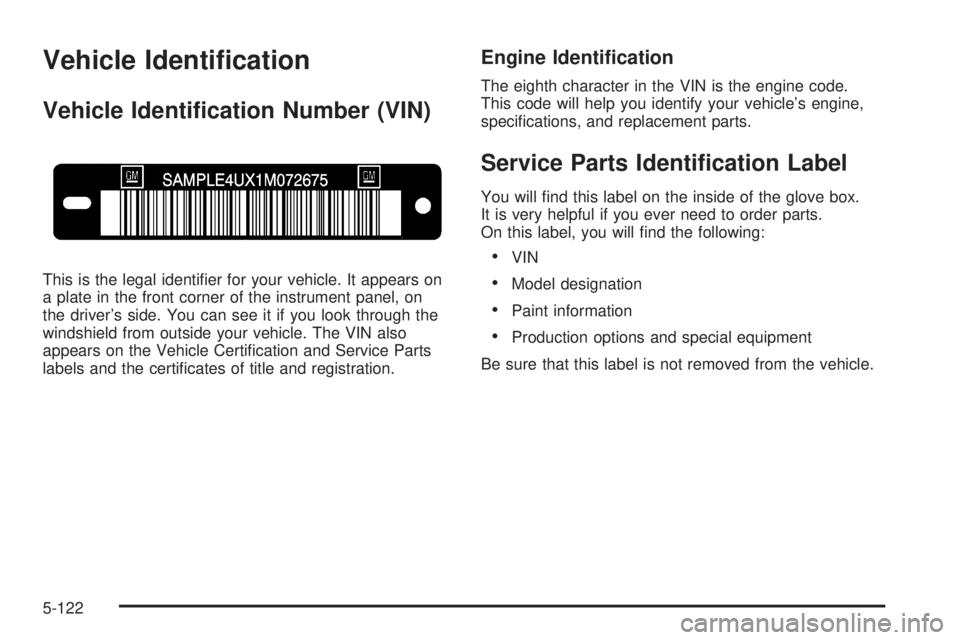
Vehicle Identication Number (VIN)
This is the legal identier for your vehicle. It appears on
a plate in the front corner of the instrument panel, on
the driver’s side. You can see it if you look through the
windshield from outside your vehicle. The VIN also
appears on the Vehicle Certication and Service Parts
labels and the certicates of title and registration.
Engine Identication
The eighth character in the VIN is the engine code.
This code will help you identify your vehicle’s engine,
specications, and replacement parts.
Service Parts Identication Label
You will nd this label on the inside of the glove box.
It is very helpful if you ever need to order parts.
On this label, you will nd the following:
VIN
Model designation
Paint information
Production options and special equipment
Be sure that this label is not removed from the vehicle.
5-122
Page 536 of 600
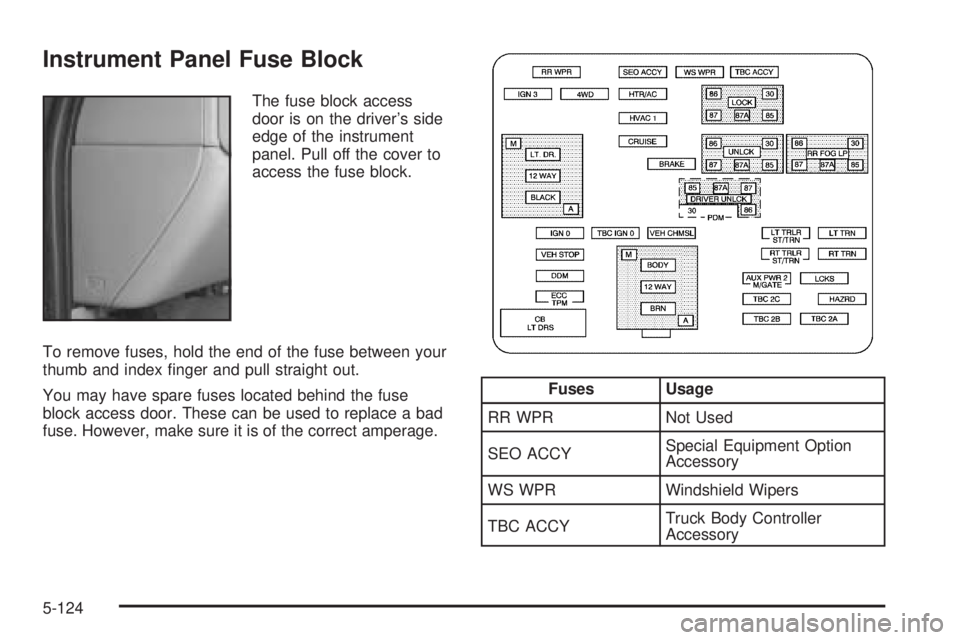
Instrument Panel Fuse Block
The fuse block access
door is on the driver’s side
edge of the instrument
panel. Pull off the cover to
access the fuse block.
To remove fuses, hold the end of the fuse between your
thumb and index nger and pull straight out.
You may have spare fuses located behind the fuse
block access door. These can be used to replace a bad
fuse. However, make sure it is of the correct amperage.
Fuses Usage
RR WPR Not Used
SEO ACCYSpecial Equipment Option
Accessory
WS WPR Windshield Wipers
TBC ACCYTruck Body Controller
Accessory
5-124