tow GMC SIERRA 2007 Owners Manual
[x] Cancel search | Manufacturer: GMC, Model Year: 2007, Model line: SIERRA, Model: GMC SIERRA 2007Pages: 680, PDF Size: 3.42 MB
Page 576 of 680
If a Tire Goes Flat
It is unusual for a tire to blowout while you are
driving, especially if you maintain your vehicle’s
tires properly. If air goes out of a tire, it is
much more likely to leak out slowly. But if you
should ever have a blowout, here are a few tips
about what to expect and what to do:
If a front tire fails, the at tire will create a drag
that pulls the vehicle toward that side. Take your
foot off the accelerator pedal and grip the
steering wheel rmly. Steer to maintain lane
position, and then gently brake to a stop well out
of the traffic lane.
A rear blowout, particularly on a curve, acts much
like a skid and may require the same correction
you would use in a skid. In any rear blowout
remove your foot from the accelerator pedal. Get
the vehicle under control by steering the way
you want the vehicle to go. It may be very bumpy
and noisy, but you can still steer. Gently brake
to a stop, well off the road if possible.{CAUTION:
Lifting a vehicle and getting under it to do
maintenance or repairs is dangerous
without the appropriate safety equipment
and training. The jack provided with your
vehicle is designed only for changing a
at tire. If it is used for anything else, you
or others could be badly injured or killed
if the vehicle slips off the jack. Use the
jack provided with your vehicle only for
changing a at tire.
If a tire goes at, the next part shows how to use
the jacking equipment to change a at tire safely.
Changing a Flat Tire
If a tire goes at, avoid further tire and wheel
damage by driving slowly to a level place. Turn on
your hazard warning ashers. SeeHazard
Warning Flashers on page 211for more
information.
576
Page 581 of 680
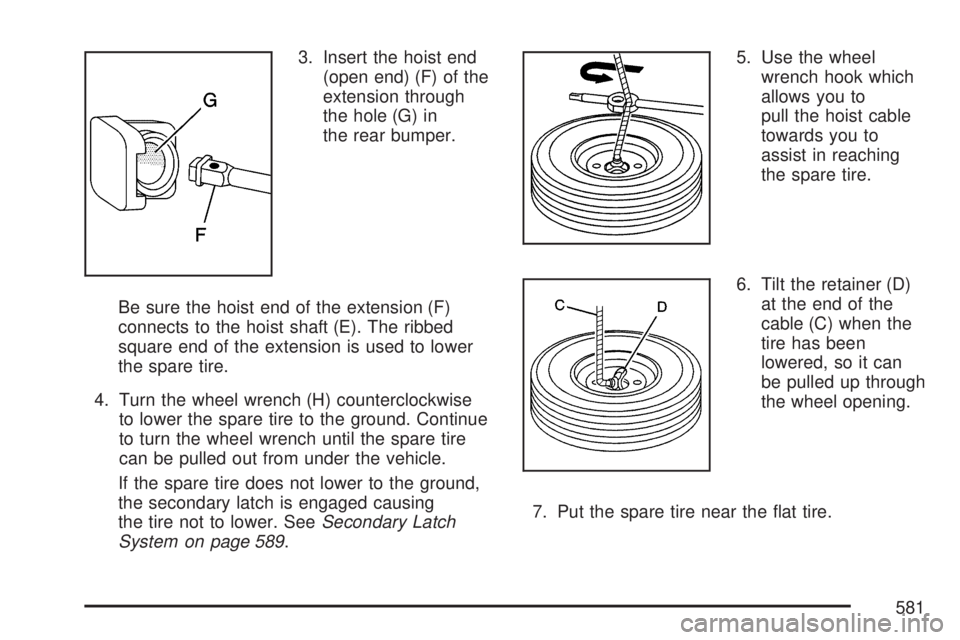
3. Insert the hoist end
(open end) (F) of the
extension through
the hole (G) in
the rear bumper.
Be sure the hoist end of the extension (F)
connects to the hoist shaft (E). The ribbed
square end of the extension is used to lower
the spare tire.
4. Turn the wheel wrench (H) counterclockwise
to lower the spare tire to the ground. Continue
to turn the wheel wrench until the spare tire
can be pulled out from under the vehicle.
If the spare tire does not lower to the ground,
the secondary latch is engaged causing
the tire not to lower. SeeSecondary Latch
System on page 589.5. Use the wheel
wrench hook which
allows you to
pull the hoist cable
towards you to
assist in reaching
the spare tire.
6. Tilt the retainer (D)
at the end of the
cable (C) when the
tire has been
lowered, so it can
be pulled up through
the wheel opening.
7. Put the spare tire near the at tire.
581
Page 586 of 680
4. Turn the wheel wrench clockwise to raise the
vehicle. Raise the vehicle far enough off the
ground so there is enough room for the spare
tire to t under the wheel well.
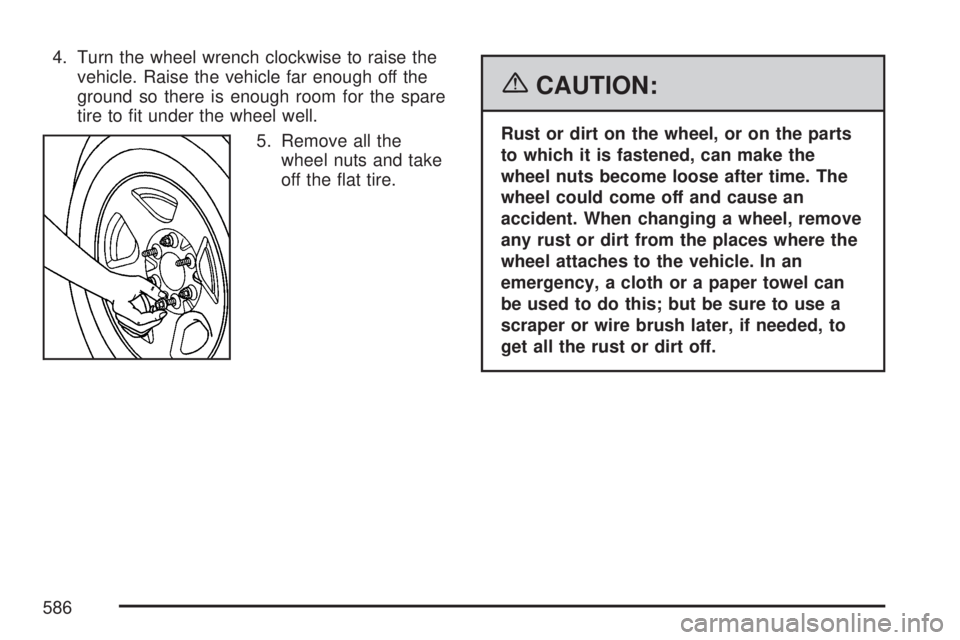
5. Remove all the
wheel nuts and take
off the at tire.
{CAUTION:
Rust or dirt on the wheel, or on the parts
to which it is fastened, can make the
wheel nuts become loose after time. The
wheel could come off and cause an
accident. When changing a wheel, remove
any rust or dirt from the places where the
wheel attaches to the vehicle. In an
emergency, a cloth or a paper towel can
be used to do this; but be sure to use a
scraper or wire brush later, if needed, to
get all the rust or dirt off.
586
Page 587 of 680
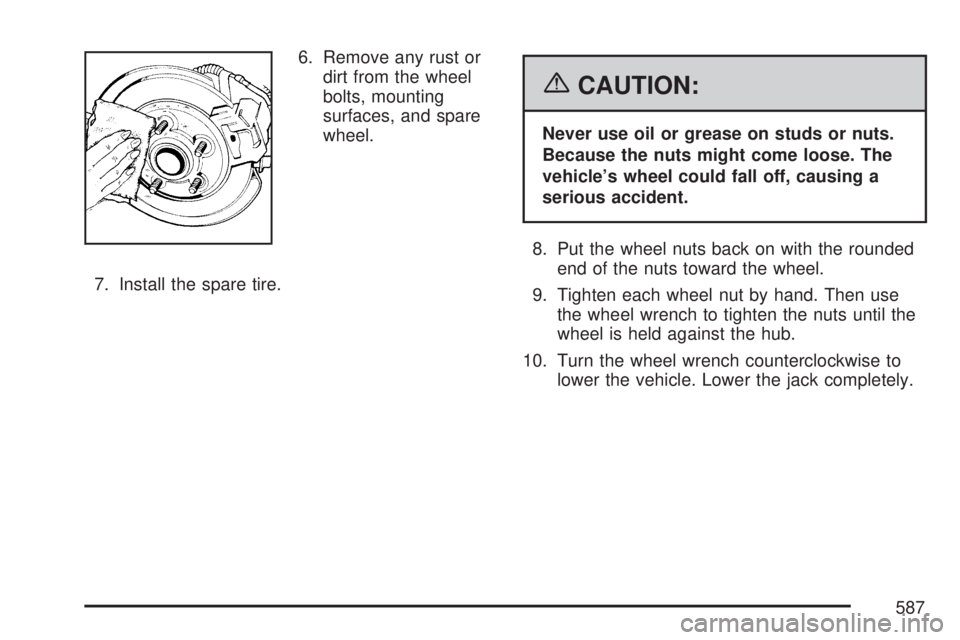
6. Remove any rust or
dirt from the wheel
bolts, mounting
surfaces, and spare
wheel.
7. Install the spare tire.
{CAUTION:
Never use oil or grease on studs or nuts.
Because the nuts might come loose. The
vehicle’s wheel could fall off, causing a
serious accident.
8. Put the wheel nuts back on with the rounded
end of the nuts toward the wheel.
9. Tighten each wheel nut by hand. Then use
the wheel wrench to tighten the nuts until the
wheel is held against the hub.
10. Turn the wheel wrench counterclockwise to
lower the vehicle. Lower the jack completely.
587
Page 590 of 680
5. If the spare tire does not lower, turn the wheel
wrench counterclockwise until approximately
6 inches (15 cm) of cable is exposed.
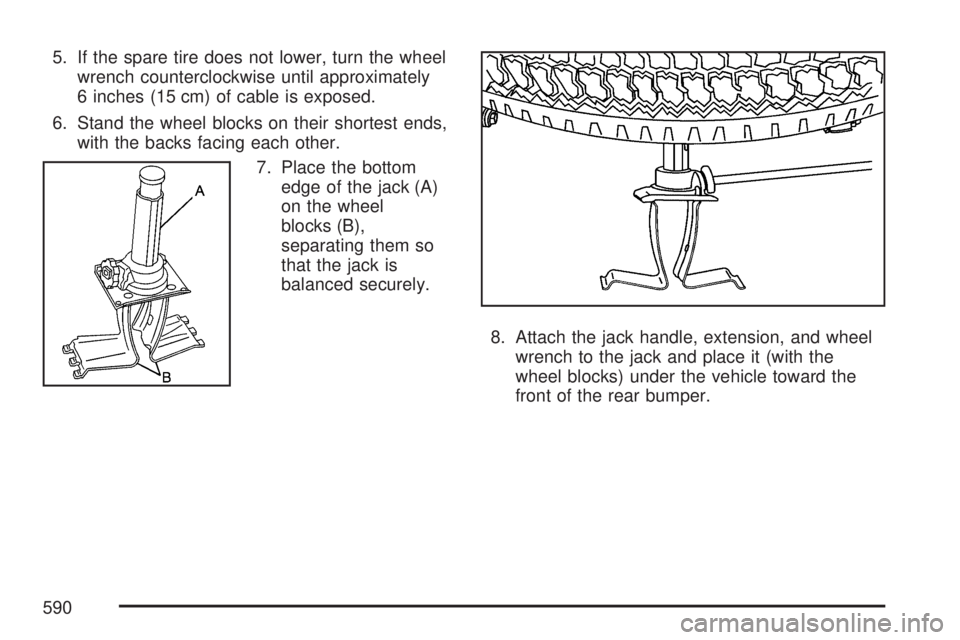
6. Stand the wheel blocks on their shortest ends,
with the backs facing each other.
7. Place the bottom
edge of the jack (A)
on the wheel
blocks (B),
separating them so
that the jack is
balanced securely.
8. Attach the jack handle, extension, and wheel
wrench to the jack and place it (with the
wheel blocks) under the vehicle toward the
front of the rear bumper.
590
Page 592 of 680
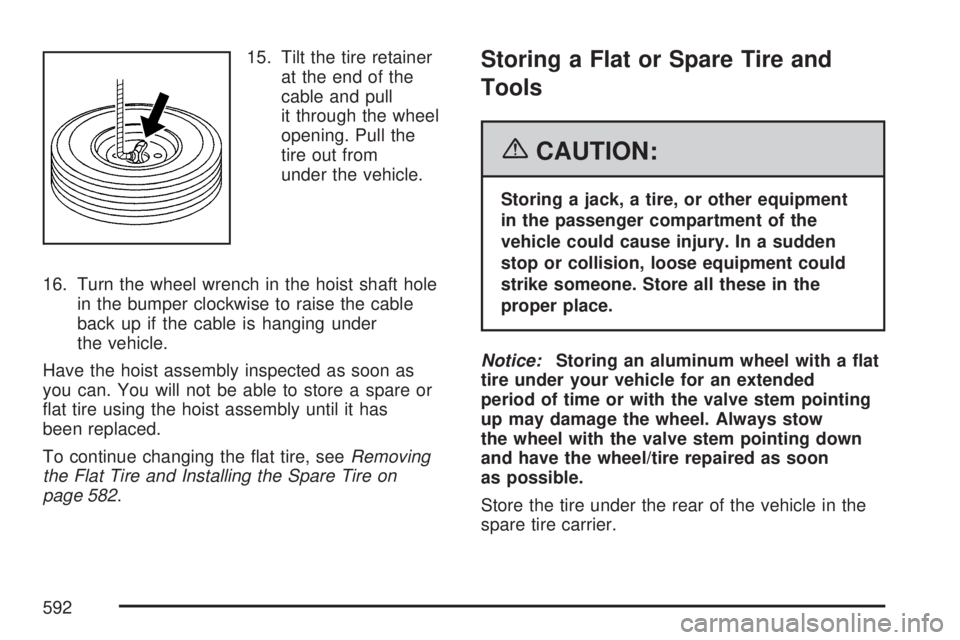
15. Tilt the tire retainer
at the end of the
cable and pull
it through the wheel
opening. Pull the
tire out from
under the vehicle.
16. Turn the wheel wrench in the hoist shaft hole
in the bumper clockwise to raise the cable
back up if the cable is hanging under
the vehicle.
Have the hoist assembly inspected as soon as
you can. You will not be able to store a spare or
at tire using the hoist assembly until it has
been replaced.
To continue changing the at tire, seeRemoving
the Flat Tire and Installing the Spare Tire on
page 582.Storing a Flat or Spare Tire and
Tools
{CAUTION:
Storing a jack, a tire, or other equipment
in the passenger compartment of the
vehicle could cause injury. In a sudden
stop or collision, loose equipment could
strike someone. Store all these in the
proper place.
Notice:Storing an aluminum wheel with a at
tire under your vehicle for an extended
period of time or with the valve stem pointing
up may damage the wheel. Always stow
the wheel with the valve stem pointing down
and have the wheel/tire repaired as soon
as possible.
Store the tire under the rear of the vehicle in the
spare tire carrier.
592
Page 599 of 680
Fabric/Carpet
Use a vacuum cleaner with a soft brush
attachment frequently to remove dust and loose
dirt. A canister vacuum with a beater bar in
the nozzle may only be used on oor carpet and
carpeted oor mats. For soils, always try to remove
them rst with plain water or club soda. Before
cleaning, gently remove as much of the soil
as possible using one of the following techniques:
For liquids: gently blot the remaining soil
with a paper towel. Allow the soil to absorb
into the paper towel until no more can
be removed.
For solid dry soils: remove as much as
possible and then vacuum.
To clean, use the following instructions:
1. Saturate a lint-free, clean white cloth with
water or club soda.
2. Wring the cloth to remove excess moisture.3. Start on the outside edge of the soil and
gently rub toward the center. Continue
cleaning, using a clean area of the cloth each
time it becomes soiled.
4. Continue to gently rub the soiled area until the
cleaning cloth remains clean.
5. If the soil is not completely removed, use a
mild soap solution and repeat the cleaning
process that was used with plain water.
If any of the soil remains, a commercial fabric
cleaner or spot lifter may be necessary. When a
commercial upholstery cleaner or spot lifter is to be
used, test a small hidden area for colorfastness
rst. If the locally cleaned area gives any
impression that a ring formation may result, clean
the entire surface.
After the cleaning process has been completed, a
paper towel can be used to blot excess moisture
from the fabric or carpet.
599
Page 601 of 680
Care of Safety Belts
Keep belts clean and dry.
{CAUTION:
Do not bleach or dye safety belts. If you
do, it may severely weaken them. In a
crash, they might not be able to provide
adequate protection. Clean safety belts
only with mild soap and lukewarm water.
Weatherstrips
Silicone grease on weatherstrips will make them
last longer, seal better, and not stick or squeak.
Apply silicone grease with a clean cloth. During
very cold, damp weather frequent application may
be required. SeeRecommended Fluids and
Lubricants on page 635.
Washing Your Vehicle
The paint nish on the vehicle provides beauty,
depth of color, gloss retention, and durability.
The best way to preserve the vehicle’s nish is to
keep it clean by washing it often with lukewarm
or cold water.
Do not wash the vehicle in the direct rays of the
sun. Use a car washing soap. Do not use
strong soaps or chemical detergents. Be sure to
rinse the vehicle well, removing all soap
residue completely. Approved cleaning products
can be obtained from your dealer. SeeVehicle
Care/Appearance Materials on page 606.Donot
use cleaning agents that are petroleum based,
or that contain acid or abrasives. All cleaning
agents should be ushed promptly and not allowed
to dry on the surface, or they could stain. Dry
the nish with a soft, clean chamois or an
all-cotton towel to avoid surface scratches and
water spotting.
High pressure car washes may cause water to
enter the vehicle.
601
Page 603 of 680
Windshield and Wiper Blades
If the windshield is not clear after using the
windshield washer, or if the wiper blade chatters
when running, wax, sap, or other material may
be on the blade or windshield.
Clean the outside of the windshield with a glass
cleaning liquid or powder and water solution.
The windshield is clean if beads do not form when
it is rinsed with water.
Grime from the windshield will stick to the wiper
blades and affect their performance. Clean
the blade by wiping vigorously with a cloth soaked
in full-strength windshield washer solvent. Then
rinse the blade with water.
Check the wiper blades and clean them as
necessary; replace blades that look worn.
Aluminum or Chrome-Plated Wheels
and Trim
Your vehicle may have either aluminum or
chrome-plated wheels.
Keep the wheels clean using a soft clean cloth
with mild soap and water. Rinse with clean water.
After rinsing thoroughly, dry with a soft clean
towel. A wax may then be applied.
Notice:Chrome wheels and other chrome trim
may be damaged if you do not wash your
vehicle after driving on roads that have been
sprayed with magnesium, calcium or sodium
chloride. These chlorides are used on roads for
conditions such as ice and dust. This damage
would not be covered by your vehicle’s
warranty. Always wash your vehicle’s chrome
with soap and water after exposure.
603
Page 630 of 680
(e)Make sure the safety belt reminder light and all
your belts, buckles, latch plates, retractors, and
anchorages are working properly. Look for
any other loose or damaged safety belt system
parts. If you see anything that might keep a safety
belt system from doing its job, have it repaired.
Have any torn or frayed safety belts replaced. Also
look for any opened or broken airbag coverings,
and have them repaired or replaced. The
airbag system does not need regular maintenance.
(f)Lubricate all key lock cylinders, body door
hinges, hood latch assembly, secondary latch,
pivots, spring anchor, release pawl, tailgate hinges,
tailgate linkage, tailgate handle pivot points,
latch bolt, fuel door hinge, locks, and folding seat
hardware. More frequent lubrication may be
required when exposed to a corrosive
environment. Applying silicone grease on
weatherstrips with a clean cloth will make them
last longer, seal better, and not stick or squeak.
(g)Check vent hose at transfer case for kinks and
proper installation. Check to be sure vent hose
is unobstructed, clear, and free of debris.(h)Change automatic transmission uid and lter
if the vehicle Gross Vehicle Weight Rating
(GVWR) is over 8600 lbs or if the vehicle is mainly
driven under one or more of these conditions:
In heavy city traffic where the outside
temperature regularly reaches 90°F (32°C) or
higher.
In hilly or mountainous terrain.
When doing frequent trailer towing.
Uses such as found in taxi, police or delivery
service.
(i)Drain, ush, and rell cooling system. This
service can be complex; you should have
your dealer perform this service. See Engine
Coolant on page 513 for what to use. Inspect
hoses. Clean radiator, condenser, pressure cap,
and ller neck. Pressure test the cooling
system and pressure cap.
(j)A uid loss in any vehicle system could indicate
a problem. Have the system inspected and
repaired and the uid level checked. Add uid if
needed.
630