ABS GMC SIERRA 2007 User Guide
[x] Cancel search | Manufacturer: GMC, Model Year: 2007, Model line: SIERRA, Model: GMC SIERRA 2007Pages: 680, PDF Size: 3.42 MB
Page 420 of 680
The Anti-Lock Brake System (ABS) improves your
vehicle’s stability when you make a hard stop
on a slippery road. Even though you have ABS,
you will want to begin stopping sooner than
you would on dry pavement. SeeAnti-Lock Brake
System (ABS) on page 379.
Allow greater following distance on any
slippery road.
Watch for slippery spots. The road might be
ne until you hit a spot that is covered with
ice. On an otherwise clear road, ice patches
may appear in shaded areas where the
sun cannot reach, such as around clumps of
trees, behind buildings, or under bridges.
Sometimes the surface of a curve or an
overpass may remain icy when the
surrounding roads are clear. If you see a
patch of ice ahead of you, brake before you
are on it. Try not to brake while you are
actually on the ice, and avoid sudden steering
maneuvers.
If You Are Caught in a Blizzard
If you are stopped by heavy snow, you could be in
a serious situation. You should probably stay
with your vehicle unless you know for sure that you
are near help and you can hike through the
snow. Here are some things to do to summon
help and keep yourself and your passengers safe:
Turn on your hazard ashers.
Tie a red cloth to your vehicle to alert police
that you have been stopped by the snow.
Put on extra clothing or wrap a blanket
around you. If you do not have blankets or
extra clothing, make body insulators from
newspapers, burlap bags, rags, oor
mats — anything you can wrap around yourself
or tuck under your clothing to keep warm.
420
Page 476 of 680
Parking on Hills
{CAUTION:
You really should not park your vehicle,
with a trailer attached, on a hill. If
something goes wrong, your rig could
start to move. People can be injured, and
both your vehicle and the trailer can be
damaged.
But if you ever have to park your rig on a hill,
here’s how to do it:
1. Apply your regular brakes, but don’t shift into
PARK (P) yet.
2. Have someone place chocks under the trailer
wheels.3. When the wheel chocks are in place, release
the regular brakes until the chocks absorb
the load.
4. Reapply the regular brakes. Then apply your
parking brake and shift into PARK (P).
5. If you have a four-wheel-drive vehicle, be sure
the transfer case is in a drive gear and not in
NEUTRAL.
6. Release the regular brakes.
476
Page 585 of 680
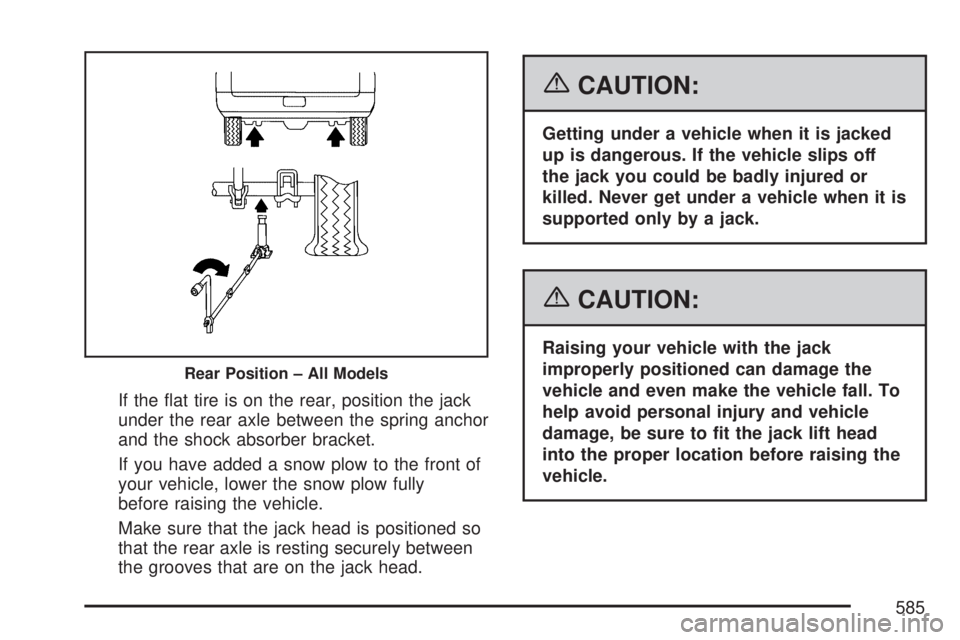
If the at tire is on the rear, position the jack
under the rear axle between the spring anchor
and the shock absorber bracket.
If you have added a snow plow to the front of
your vehicle, lower the snow plow fully
before raising the vehicle.
Make sure that the jack head is positioned so
that the rear axle is resting securely between
the grooves that are on the jack head.
{CAUTION:
Getting under a vehicle when it is jacked
up is dangerous. If the vehicle slips off
the jack you could be badly injured or
killed. Never get under a vehicle when it is
supported only by a jack.
{CAUTION:
Raising your vehicle with the jack
improperly positioned can damage the
vehicle and even make the vehicle fall. To
help avoid personal injury and vehicle
damage, be sure to t the jack lift head
into the proper location before raising the
vehicle.
Rear Position – All Models
585
Page 599 of 680
Fabric/Carpet
Use a vacuum cleaner with a soft brush
attachment frequently to remove dust and loose
dirt. A canister vacuum with a beater bar in
the nozzle may only be used on oor carpet and
carpeted oor mats. For soils, always try to remove
them rst with plain water or club soda. Before
cleaning, gently remove as much of the soil
as possible using one of the following techniques:
For liquids: gently blot the remaining soil
with a paper towel. Allow the soil to absorb
into the paper towel until no more can
be removed.
For solid dry soils: remove as much as
possible and then vacuum.
To clean, use the following instructions:
1. Saturate a lint-free, clean white cloth with
water or club soda.
2. Wring the cloth to remove excess moisture.3. Start on the outside edge of the soil and
gently rub toward the center. Continue
cleaning, using a clean area of the cloth each
time it becomes soiled.
4. Continue to gently rub the soiled area until the
cleaning cloth remains clean.
5. If the soil is not completely removed, use a
mild soap solution and repeat the cleaning
process that was used with plain water.
If any of the soil remains, a commercial fabric
cleaner or spot lifter may be necessary. When a
commercial upholstery cleaner or spot lifter is to be
used, test a small hidden area for colorfastness
rst. If the locally cleaned area gives any
impression that a ring formation may result, clean
the entire surface.
After the cleaning process has been completed, a
paper towel can be used to blot excess moisture
from the fabric or carpet.
599
Page 656 of 680
Vehicle Data Collection and Event
Data Recorders
Your vehicle, like other modern motor vehicles,
has a number of sophisticated computer
systems that monitor and control several
aspects of the vehicle’s performance. Your
vehicle uses on-board vehicle computers
to monitor emission control components to
optimize fuel economy, to monitor conditions
for airbag deployment and, if the vehicle
has the Anti-lock Brake System (ABS), to
provide anti-lock braking and to help the driver
control the vehicle in difficult driving
situations. Some information may be stored
during regular operations to facilitate repair of
detected malfunctions; other information is
stored only in a crash event by computer
systems, such as those commonly called Event
Data Recorders (EDR).
In a crash event, computer systems, such as
the airbag Sensing and Diagnostic Module
(SDM) in your vehicle may record information
about the condition of the vehicle and how
it was operated, such as data related to engine
speed, brake application, throttle position,vehicle speed, safety belt usage, airbag
readiness, airbag performance, and the
severity of a collision. This information has
been used to improve vehicle crash
performance and may be used to improve
crash performance of future vehicles and
driving safety. Unlike the data recorders on
many airplanes, these on-board systems do not
record sounds, such as conversation of
vehicle occupants.
To read this information, special equipment is
needed and access to the vehicle or the
device that stores the data is required. GM will
not access information about a crash event
or share it with others other than:
with the consent of the vehicle owner or, if
the vehicle is leased, with the consent of
the lessee,
in response to an official request of police
or similar government office,
as part of GM’s defense of litigation
through the discovery process, or
as required by law.
656