warning GMC SIERRA 2007 Repair Manual
[x] Cancel search | Manufacturer: GMC, Model Year: 2007, Model line: SIERRA, Model: GMC SIERRA 2007Pages: 680, PDF Size: 3.42 MB
Page 531 of 680
Brake Pedal Travel
See your dealer/retailer if the brake pedal does
not return to normal height, or if there is a
rapid increase in pedal travel. This could be a sign
that brake service might be required.
Brake Adjustment
Every time you make a brake stop, the brakes
adjust for wear.
Replacing Brake System Parts
The braking system on a vehicle is complex. Its
many parts have to be of top quality and work well
together if the vehicle is to have really good
braking. Your vehicle was designed and tested
with top-quality brake parts. When you replace
parts of the braking system — for example, when
the brake linings wear down and you need
new ones put in — be sure you get new approved
replacement parts. If you do not, the brakesmight not work properly. For example, if someone
puts in brake linings that are wrong for your
vehicle, the balance between the front and rear
brakes can change — for the worse. The braking
performance you have come to expect can
change in many other ways if someone puts in the
wrong replacement brake parts.
Battery
Your vehicle has a maintenance free battery.
When it is time for a new battery, get one that has
the replacement number shown on the original
battery’s label. We recommend an ACDelco
®
replacement battery. SeeEngine Compartment
Overview on page 498for battery location.
Warning:Battery posts, terminals, and related
accessories contain lead and lead compounds,
chemicals known to the State of California
to cause cancer and reproductive harm. Wash
hands after handling.
531
Page 561 of 680
Tire Pressure Monitor System
The Tire Pressure Monitor System (TPMS) uses
radio and sensor technology to check tire pressure
levels. If your vehicle has this feature, sensors
are mounted on each tire and wheel assembly,
except the spare tire. The TPMS sensors monitor
the air pressure in your vehicle’s tires and
transmit tire pressure readings to a receiver
located in the vehicle.
The TPMS is designed to alert the driver, if a low
tire pressure condition exists. If your vehicle has the
Driver Information Center (DIC), the driver may also
check tire pressure levels using the DIC.
When a low tire pressure condition is detected,
the TPMS will illuminate the low tire pressure
warning symbol located on the instrument panel
cluster. If your vehicle has the DIC feature, a
message to check the pressure in a specic tire
will also appear on the DIC display. The low
tire pressure warning symbol on the instrument
panel cluster and the CHECK TIRE PRESSURE
warning message on the DIC display will appear at
each ignition cycle until the tires are inated to
the correct ination pressure.For additional information and details about the
DIC operation and displays seeDIC Operation and
Displays (With DIC Buttons) on page 268orDIC
Operation and Displays (Without DIC Buttons)
on page 275andDIC Warnings and Messages on
page 279.
You may notice, during cooler weather conditions,
that the tire pressure monitor light, located on
the instrument panel cluster, and the CHECK TIRE
PRESSURE message will appear when the
vehicle is rst started and then turn off as you
start to drive the vehicle. This could be an early
indicator that the tire pressures are getting low and
need to be inated to the proper pressure.
Each tire, including the spare (if provided), should
be checked monthly when cold and inated to
the ination pressure recommended by the vehicle
manufacturer on the vehicle placard or tire
ination pressure label. (If your vehicle has tires of
a different size than the size indicated on the
vehicle placard or tire ination pressure label, you
should determine the proper tire ination
pressure for those tires.)
561
Page 562 of 680
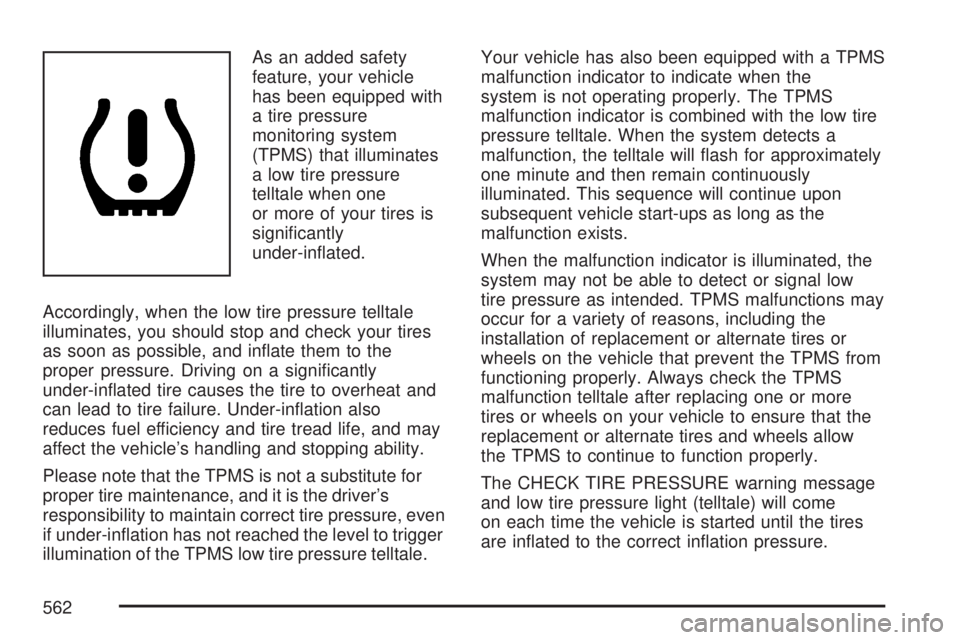
As an added safety
feature, your vehicle
has been equipped with
a tire pressure
monitoring system
(TPMS) that illuminates
a low tire pressure
telltale when one
or more of your tires is
signicantly
under-inated.
Accordingly, when the low tire pressure telltale
illuminates, you should stop and check your tires
as soon as possible, and inate them to the
proper pressure. Driving on a signicantly
under-inated tire causes the tire to overheat and
can lead to tire failure. Under-ination also
reduces fuel efficiency and tire tread life, and may
affect the vehicle’s handling and stopping ability.
Please note that the TPMS is not a substitute for
proper tire maintenance, and it is the driver’s
responsibility to maintain correct tire pressure, even
if under-ination has not reached the level to trigger
illumination of the TPMS low tire pressure telltale.Your vehicle has also been equipped with a TPMS
malfunction indicator to indicate when the
system is not operating properly. The TPMS
malfunction indicator is combined with the low tire
pressure telltale. When the system detects a
malfunction, the telltale will ash for approximately
one minute and then remain continuously
illuminated. This sequence will continue upon
subsequent vehicle start-ups as long as the
malfunction exists.
When the malfunction indicator is illuminated, the
system may not be able to detect or signal low
tire pressure as intended. TPMS malfunctions may
occur for a variety of reasons, including the
installation of replacement or alternate tires or
wheels on the vehicle that prevent the TPMS from
functioning properly. Always check the TPMS
malfunction telltale after replacing one or more
tires or wheels on your vehicle to ensure that the
replacement or alternate tires and wheels allow
the TPMS to continue to function properly.
The CHECK TIRE PRESSURE warning message
and low tire pressure light (telltale) will come
on each time the vehicle is started until the tires
are inated to the correct ination pressure.
562
Page 569 of 680
{CAUTION:
Mixing tires could cause you to lose
control while driving. If you mix tires of
different sizes, brands, or types (radial
and bias-belted tires), the vehicle may not
handle properly, and you could have a
crash. Using tires of different sizes,
brands or types may also cause damage
to your vehicle. Be sure to use the same
size, brand, and type tires on all wheels.
Your vehicle may have a different size
spare than the road tires (those originally
installed on your vehicle). When new, your
vehicle included a spare tire and wheel
assembly with a similar overall diameter
as your vehicle’s road tires and wheels,
so it is all right to drive on it. Because
this spare was developed for use on your
vehicle, it will not affect vehicle handling.
{CAUTION:
If you use bias-ply tires on your vehicle,
the wheel rim anges could develop
cracks after many miles of driving. A tire
and/or wheel could fail suddenly, causing
a crash. Use only radial-ply tires with the
wheels on your vehicle.
If you must replace your vehicle’s tires with those
that do not have a TPC Spec number, make
sure they are the same size, load range, speed
rating, and construction type (radial and
bias-belted tires) as your vehicle’s original tires.
Vehicles that have a tire pressure monitoring
system may give an inaccurate low-pressure
warning if non-TPC spec rated tires are installed
on your vehicle. Non-TPC Spec rated tires
may give a low-pressure warning that is higher or
lower than the proper warning level you would
get with TPC Spec rated tires. SeeTire Pressure
Monitor System on page 561.
569
Page 571 of 680
Uniform Tire Quality Grading
Quality grades can be found where applicable on
the tire sidewall between tread shoulder and
maximum section width. For example:
Treadwear 200 Traction AA Temperature A
The following information relates to the system
developed by the United States National Highway
Traffic Safety Administration (NHTSA), which
grades tires by treadwear, traction, and
temperature performance. This applies only to
vehicles sold in the United States. The grades are
molded on the sidewalls of most passenger car
tires. The Uniform Tire Quality Grading (UTQG)
system does not apply to deep tread, winter-type
snow tires, space-saver, or temporary use
spare tires, tires with nominal rim diameters of
10 to 12 inches (25 to 30 cm), or to some
limited-production tires.
While the tires available on General Motors
passenger cars and light trucks may vary with
respect to these grades, they must also conform
to federal safety requirements and additional
General Motors Tire Performance Criteria (TPC)
standards.
Treadwear
The treadwear grade is a comparative rating
based on the wear rate of the tire when tested
under controlled conditions on a specied
government test course. For example, a tire
graded 150 would wear one and a half (1.5) times
as well on the government course as a tire
graded 100. The relative performance of tires
depends upon the actual conditions of their use,
however, and may depart signicantly from
the norm due to variations in driving habits, service
practices, and differences in road characteristics
and climate.
Traction – AA, A, B, C
The traction grades, from highest to lowest, are
AA, A, B, and C. Those grades represent the tire’s
ability to stop on wet pavement as measured
under controlled conditions on specied
government test surfaces of asphalt and concrete.
A tire marked C may have poor traction
performance.
Warning:The traction grade assigned to this tire
is based on straight-ahead braking traction
tests, and does not include acceleration, cornering,
hydroplaning, or peak traction characteristics.
571
Page 572 of 680
Temperature – A, B, C
The temperature grades are A (the highest), B,
and C, representing the tire’s resistance to
the generation of heat and its ability to dissipate
heat when tested under controlled conditions on a
specied indoor laboratory test wheel. Sustained
high temperature can cause the material of the tire
to degenerate and reduce tire life, and excessive
temperature can lead to sudden tire failure.
The grade C corresponds to a level of performance
which all passenger car tires must meet under
the Federal Motor Vehicle Safety Standard
No. 109. Grades B and A represent higher levels
of performance on the laboratory test wheel
than the minimum required by law.
Warning:The temperature grade for this tire is
established for a tire that is properly inated
and not overloaded. Excessive speed,
under-ination, or excessive loading, either
separately or in combination, can cause heat
buildup and possible tire failure.
Wheel Alignment and Tire Balance
The tires and wheels on your vehicle were aligned
and balanced carefully at the factory to give you
the longest tire life and best overall performance.
Adjustments to wheel alignment and tire
balancing will not be necessary on a regular basis.
However, if you notice unusual tire wear or your
vehicle pulling to one side or the other, the
alignment may need to be checked. If you notice
your vehicle vibrating when driving on a smooth
road, your tires and wheels may need to be
rebalanced. See your dealer/retailer for proper
diagnosis.
572
Page 576 of 680
If a Tire Goes Flat
It is unusual for a tire to blowout while you are
driving, especially if you maintain your vehicle’s
tires properly. If air goes out of a tire, it is
much more likely to leak out slowly. But if you
should ever have a blowout, here are a few tips
about what to expect and what to do:
If a front tire fails, the at tire will create a drag
that pulls the vehicle toward that side. Take your
foot off the accelerator pedal and grip the
steering wheel rmly. Steer to maintain lane
position, and then gently brake to a stop well out
of the traffic lane.
A rear blowout, particularly on a curve, acts much
like a skid and may require the same correction
you would use in a skid. In any rear blowout
remove your foot from the accelerator pedal. Get
the vehicle under control by steering the way
you want the vehicle to go. It may be very bumpy
and noisy, but you can still steer. Gently brake
to a stop, well off the road if possible.{CAUTION:
Lifting a vehicle and getting under it to do
maintenance or repairs is dangerous
without the appropriate safety equipment
and training. The jack provided with your
vehicle is designed only for changing a
at tire. If it is used for anything else, you
or others could be badly injured or killed
if the vehicle slips off the jack. Use the
jack provided with your vehicle only for
changing a at tire.
If a tire goes at, the next part shows how to use
the jacking equipment to change a at tire safely.
Changing a Flat Tire
If a tire goes at, avoid further tire and wheel
damage by driving slowly to a level place. Turn on
your hazard warning ashers. SeeHazard
Warning Flashers on page 211for more
information.
576
Page 665 of 680

A
Accessories and Modications..................... 486
Adding a Snow Plow or Similar
Equipment................................................ 432
Adding Equipment to Your Airbag-Equipped
Vehicle..................................................... 102
Additives, Fuel............................................ 490
Add-On Electrical Equipment....................... 608
Adjustable Throttle and Brake Pedal............ 136
Air Cleaner/Filter, Engine............................. 505
Air Conditioning.........................234, 237, 238
Airbag
Off Light.................................................. 250
Passenger Status Indicator....................... 252
Readiness Light....................................... 250
Airbag Sensing and Diagnostic
Module (SDM).......................................... 656
Airbag System............................................... 83
What Will You See After an Airbag
Inates?................................................. 92
When Should an Airbag Inate?................. 89
Where Are the Airbags?............................. 86
Airbag Systems
Adding Equipment to Your
Airbag-Equipped Vehicle....................... 102
Airbag Off Switch....................................... 93Airbag Systems (cont.)
How Does an Airbag Restrain?.................. 91
Passenger Sensing System....................... 97
Servicing Your Airbag-Equipped Vehicle.... 102
What Makes an Airbag Inate?.................. 91
AM-FM Radio.............................................. 304
Antenna, Fixed Mast................................... 371
Antenna, XM™ Satellite Radio Antenna
System.................................................... 371
Anti-Lock Brake System.............................. 379
Anti-Lock Brake, System Warning Light....... 257
Appearance Care
Aluminum or Chrome-Plated Wheels........ 603
Care of Safety Belts................................ 601
Chemical Paint Spotting........................... 605
Cleaning Exterior Lamps/Lenses.............. 602
Cleaning the Inside of Your Vehicle.......... 597
Fabric/Carpet........................................... 599
Finish Care.............................................. 602
Finish Damage......................................... 605
Instrument Panel, Vinyl, and Other
Plastic Surfaces.................................... 600
Leather.................................................... 600
Sheet Metal Damage............................... 604
Tires........................................................ 604
Underbody Maintenance........................... 605
Vehicle Care/Appearance Materials.......... 606
665
Page 666 of 680
Appearance Care (cont.)
Washing Your Vehicle.............................. 601
Weatherstrips........................................... 601
Windshield and Wiper Blades................... 603
Ashtray....................................................... 233
Audio System.............................................. 300
AM-FM Radio.......................................... 304
Audio Steering Wheel Controls................. 368
Care of Your CD and DVD Player............ 371
Care of Your CDs and DVDs................... 370
Fixed Mast Antenna................................. 371
Navigation/Radio System, see Navigation
Manual................................................. 355
Radio with CD................................306, 312
Rear Seat Audio (RSA)............................ 366
Setting the Time...................................... 301
Theft-Deterrent Feature............................ 368
Understanding Radio Reception............... 369
XM™ Satellite Radio Antenna System...... 371
Audio System(s)
Radio with CD and DVD.......................... 322
Automatic Headlamp System....................... 223
Automatic Transmission
Fluid........................................................ 508
Operation................................................. 138
Auxiliary Roof Mounted Lamp Switch.......... 225B
Battery........................................................ 531
Electric Power Management..................... 227
Run-Down Protection............................... 228
Before Leaving on a Long Trip.................... 414
Brake
Emergencies............................................ 381
Parking.................................................... 162
Brakes........................................................ 528
System Warning Light.............................. 256
Braking....................................................... 378
Braking in Emergencies............................... 381
Break-In, New Vehicle................................. 132
Bulb Replacement....................................... 543
Center High-Mounted Stoplamp (CHMSL)
and Cargo Lamp.................................. 545
Halogen Bulbs......................................... 544
Headlamps............................................... 544
License Plate Lamps................................ 548
Pickup Box Identication and Fender
Marker Lamps...................................... 546
Replacement Bulbs.................................. 549
Taillamps, Turn Signal, Stoplamps and
Back-up Lamps..................................... 546
Buying New Tires........................................ 568
666
Page 667 of 680
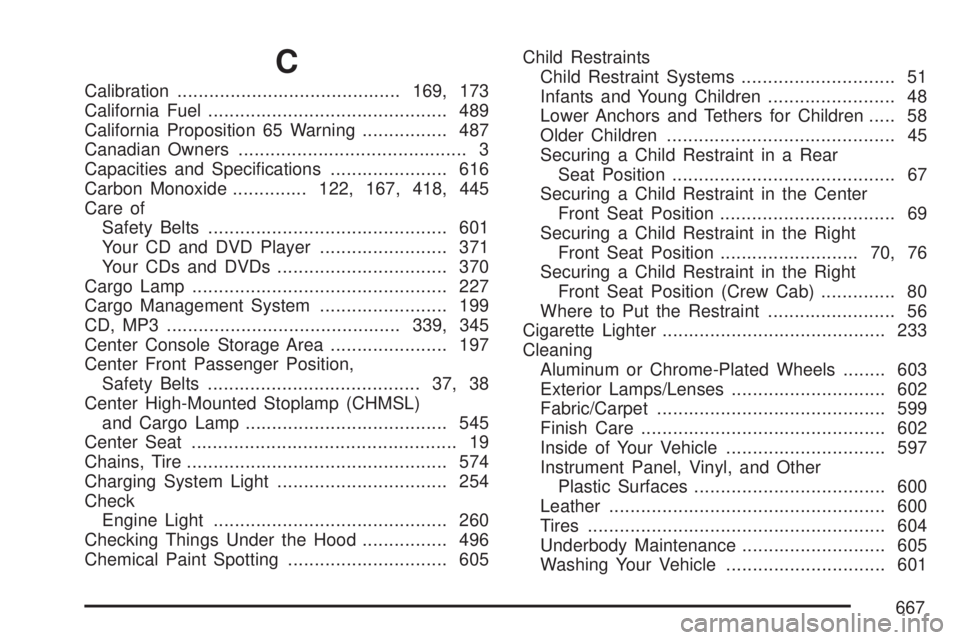
C
Calibration..........................................169, 173
California Fuel............................................. 489
California Proposition 65 Warning................ 487
Canadian Owners........................................... 3
Capacities and Specications...................... 616
Carbon Monoxide..............122, 167, 418, 445
Care of
Safety Belts............................................. 601
Your CD and DVD Player........................ 371
Your CDs and DVDs................................ 370
Cargo Lamp................................................ 227
Cargo Management System........................ 199
CD, MP3 ............................................339, 345
Center Console Storage Area...................... 197
Center Front Passenger Position,
Safety Belts........................................ 37, 38
Center High-Mounted Stoplamp (CHMSL)
and Cargo Lamp...................................... 545
Center Seat.................................................. 19
Chains, Tire................................................. 574
Charging System Light................................ 254
Check
Engine Light............................................ 260
Checking Things Under the Hood................ 496
Chemical Paint Spotting.............................. 605Child Restraints
Child Restraint Systems............................. 51
Infants and Young Children........................ 48
Lower Anchors and Tethers for Children..... 58
Older Children........................................... 45
Securing a Child Restraint in a Rear
Seat Position.......................................... 67
Securing a Child Restraint in the Center
Front Seat Position ................................. 69
Securing a Child Restraint in the Right
Front Seat Position.......................... 70, 76
Securing a Child Restraint in the Right
Front Seat Position (Crew Cab).............. 80
Where to Put the Restraint........................ 56
Cigarette Lighter.......................................... 233
Cleaning
Aluminum or Chrome-Plated Wheels........ 603
Exterior Lamps/Lenses............................. 602
Fabric/Carpet........................................... 599
Finish Care.............................................. 602
Inside of Your Vehicle.............................. 597
Instrument Panel, Vinyl, and Other
Plastic Surfaces.................................... 600
Leather.................................................... 600
Tires........................................................ 604
Underbody Maintenance........................... 605
Washing Your Vehicle.............................. 601
667