ECU GMC SIERRA 2009 Manual PDF
[x] Cancel search | Manufacturer: GMC, Model Year: 2009, Model line: SIERRA, Model: GMC SIERRA 2009Pages: 596, PDF Size: 3.25 MB
Page 493 of 596
Make certain that all wheel nuts are properly
tightened. See “Wheel Nut Torque” under
Capacities and Specifications on page 5-129.
{CAUTION:
Rust or dirt on a wheel, or on the parts to
which it is fastened, can make wheel nuts
become loose after time. The wheel could
come off and cause an accident. When you
change a wheel, remove any rust or dirt from
places where the wheel attaches to the
vehicle. In an emergency, you can use a
cloth or a paper towel to do this; but be sure
to use a scraper or wire brush later, if
needed, to get all the rust or dirt off. See
Changing a Flat Tire on page 5-92.
If your vehicle has a Tire Pressure Monitor
System (TPMS), reset the TPMS sensors after
rotating the tires. SeeTire Pressure Monitor
Operation on page 5-77.
Make sure the spare tire, if your vehicle has one,
is stored securely. Push, pull, and then try to
rotate or turn the tire. If it moves, tighten the cable.
SeeStoring a Flat or Spare Tire and Tools on
page 5-109.
When It Is Time for New Tires
Various factors, such as maintenance, temperatures,
driving speeds, vehicle loading, and road conditions,
inuence when you need new tires.
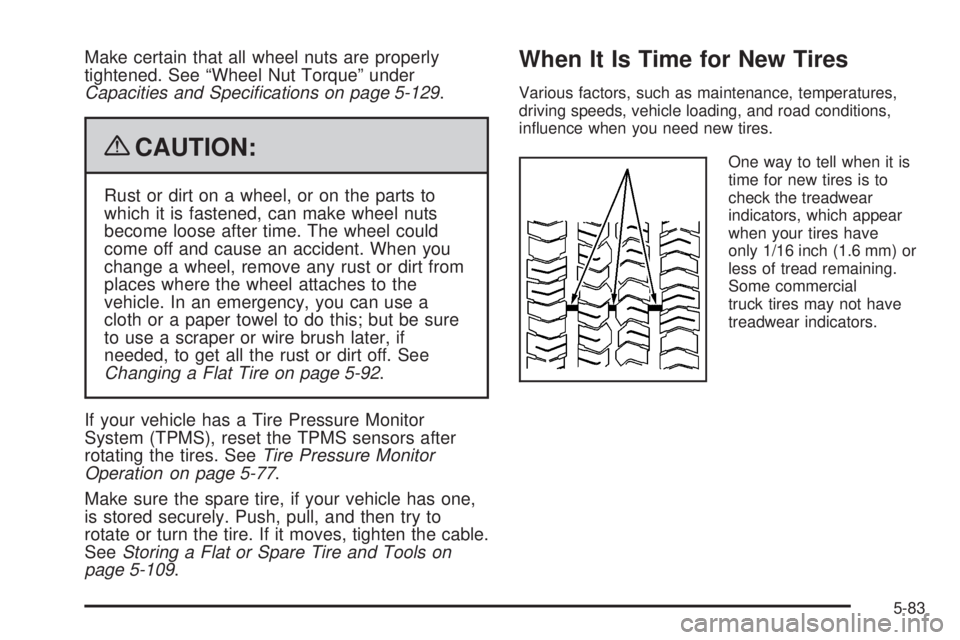
One way to tell when it is
time for new tires is to
check the treadwear
indicators, which appear
when your tires have
only 1/16 inch (1.6 mm) or
less of tread remaining.
Some commercial
truck tires may not have
treadwear indicators.
5-83
Page 500 of 596
Used Replacement Wheels
{CAUTION:
Putting a used wheel on the vehicle is dangerous.
You cannot know how it has been used or how far
it has been driven. It could fail suddenly and
cause a crash. If you have to replace a wheel, use
a new GM original equipment wheel.
Tire Chains
{CAUTION:
If your vehicle has dual wheels or P265/65R18,
P275/55R20 or LT265/70R17 size tires, do not
use tire chains. They can damage your vehicle
because there is not enough clearance. Tire
chains used on a vehicle without the proper
amount of clearance can cause damage to the
CAUTION: (Continued)
CAUTION: (Continued)
brakes, suspension, or other vehicle parts. The
area damaged by the tire chains could cause you
to lose control of your vehicle and you or others
may be injured in a crash.
Use another type of traction device only if its
manufacturer recommends it for use on your
vehicle and tire size combination and road
conditions. Follow that manufacturer’s instructions.
To help avoid damage to your vehicle, drive
slowly, readjust, or remove the device if it is
contacting your vehicle, and do not spin your
vehicle’s wheels.
If you do nd traction devices that will t, install
them on the rear tires.
Notice:If your vehicle does not have dual wheels
and has a tire size other than P265/65R18,
P275/55R20 or LT265/70R17, use tire chains only
where legal and only when you must. Use chains
that are the proper size for your tires. Install them
on the tires of the rear axle. Do not use chains
on the tires of the front axle. Tighten them as tightly
as possible with the ends securely fastened.
5-90
Page 512 of 596
If you have added a snow plow to the front of your
vehicle, lower the snow plow fully before raising
the vehicle.
Make sure that the jack head is positioned so that
the rear axle is resting securely between the
grooves that are on the jack head.
{CAUTION:
Getting under a vehicle when it is jacked up is
dangerous. If the vehicle slips off the jack, you
could be badly injured or killed. Never get under a
vehicle when it is supported only by a jack.
{CAUTION:
Raising your vehicle with the jack improperly
positioned can damage the vehicle and even
make the vehicle fall. To help avoid personal injury
and vehicle damage, be sure to t the jack lift
head into the proper location before raising the
vehicle.5. Turn the wheel wrench clockwise to raise the vehicle.
Raise the vehicle far enough off the ground so there
is enough room for the spare tire to t under the
wheel well.
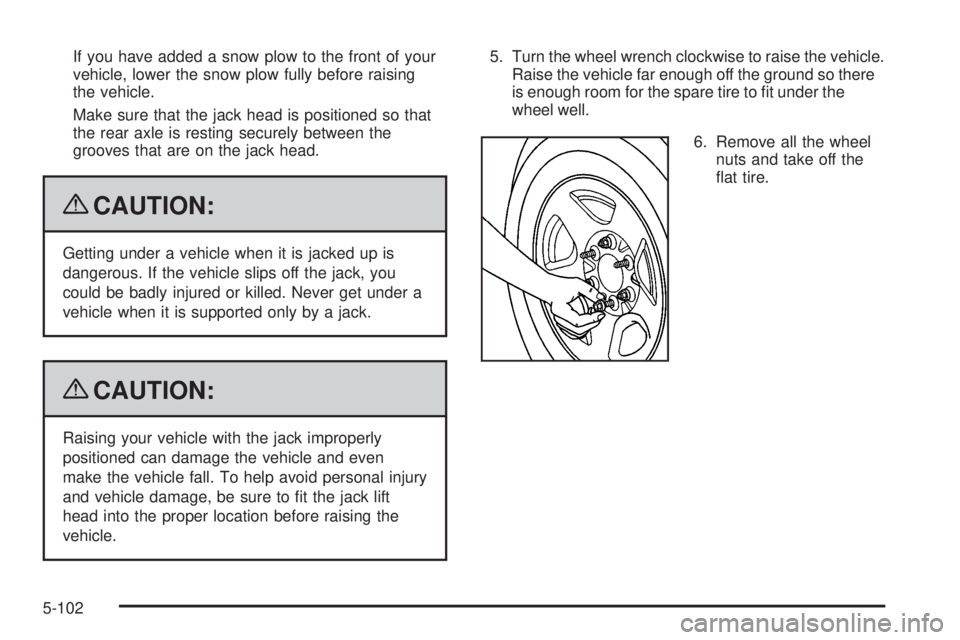
6. Remove all the wheel
nuts and take off the
at tire.
5-102
Page 517 of 596
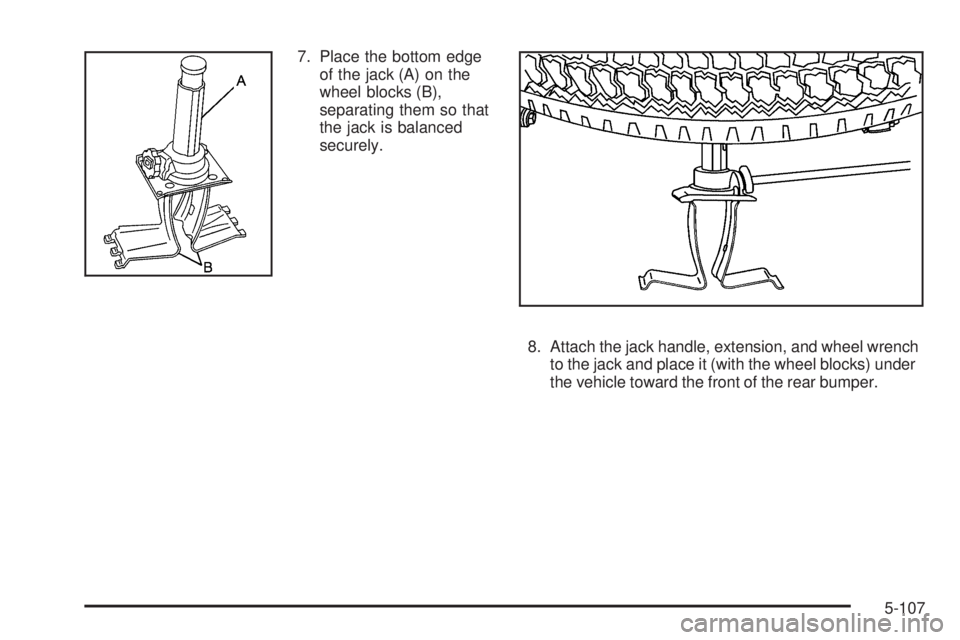
7. Place the bottom edge
of the jack (A) on the
wheel blocks (B),
separating them so that
the jack is balanced
securely.
8. Attach the jack handle, extension, and wheel wrench
to the jack and place it (with the wheel blocks) under
the vehicle toward the front of the rear bumper.
5-107
Page 521 of 596
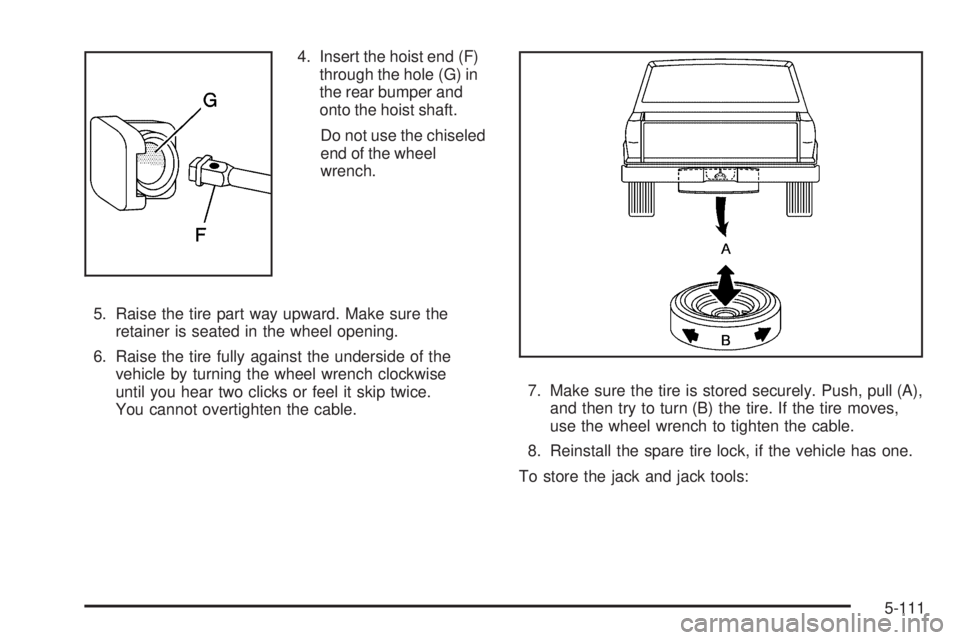
4. Insert the hoist end (F)
through the hole (G) in
the rear bumper and
onto the hoist shaft.
Do not use the chiseled
end of the wheel
wrench.
5. Raise the tire part way upward. Make sure the
retainer is seated in the wheel opening.
6. Raise the tire fully against the underside of the
vehicle by turning the wheel wrench clockwise
until you hear two clicks or feel it skip twice.
You cannot overtighten the cable.7. Make sure the tire is stored securely. Push, pull (A),
and then try to turn (B) the tire. If the tire moves,
use the wheel wrench to tighten the cable.
8. Reinstall the spare tire lock, if the vehicle has one.
To store the jack and jack tools:
5-111
Page 554 of 596
Engine Coolant Level Check
Check the engine coolant level and add DEX-COOL®
coolant mixture if necessary. SeeEngine Coolant
on page 5-29.
Windshield Washer Fluid Level Check
Check the windshield washer uid level in the windshield
washer uid reservoir and add the proper uid if
necessary.
At Least Once a Month
Tire Ination Check
Inspect the vehicle’s tires and make sure they are
inated to the correct pressures. Do not forget to check
the spare tire. SeeInflation - Tire Pressure on page 5-73.
Check to make sure the spare tire is stored securely.
SeeChanging a Flat Tire on page 5-92.
Tire Wear Inspection
Tire rotation may be required for high mileage highway
drivers prior to the Engine Oil Life System service
notication. Check the tires for wear and, if necessary,
rotate the tires. SeeTire Inspection and Rotation on
page 5-81.
At Least Once a Year
Starter Switch Check
{CAUTION:
When you are doing this inspection, the vehicle
could move suddenly. If the vehicle moves, you or
others could be injured.
1. Before starting this check, be sure there is enough
room around the vehicle.
2. Firmly apply both the parking brake and the regular
brake. SeeParking Brake on page 2-50.
Do not use the accelerator pedal, and be ready to
turn off the engine immediately if it starts.
3. Try to start the engine in each gear. The vehicle
should start only in P (Park) or N (Neutral). If the
vehicle starts in any other position, contact
your dealer/retailer for service.
6-12
Page 572 of 596
Coverage
Services are provided up to 5 years/100,000 miles
(160 000 km), whichever comes rst.
In the U.S., anyone driving the vehicle is covered.
In Canada, a person driving the vehicle without
permission from the owner is not covered.
Roadside Assistance is not a part of the New Vehicle
Limited Warranty. GMC and General Motors of Canada
Limited reserve the right to make any changes or
discontinue the Roadside Assistance program at any
time without notication.
GMC and General Motors of Canada Limited reserve
the right to limit services or payment to an owner
or driver if they decide the claims are made too often, or
the same type of claim is made many times.
Services Provided
Emergency Fuel Delivery:Delivery of enough fuel
for the vehicle to get to the nearest service station.
Lock-Out Service:Service is provided to unlock the
vehicle if you are locked out. A remote unlock may
be available if you have OnStar
®. For security
reasons, the driver must present identication
before this service is given.
Emergency Tow From a Public Road or Highway:
Tow to the nearest GMC dealer for warranty service,
or if the vehicle was in a crash and cannot be driven.
Assistance is also given when the vehicle is stuck in
the sand, mud, or snow.
Flat Tire Change:Service is provided to change a
at tire with the spare tire. The spare tire, if equipped,
must be in good condition and properly inated.
It is the owner’s responsibility for the repair or
replacement of the tire if it is not covered by the
warranty.
Battery Jump Start:Service is provided to jump
start a dead battery.
Trip Routing Service:Detailed maps of North
America are provided when requested either with
the most direct route or the most scenic route.
Additional travel information is also available.
Allow three weeks for delivery.
Trip Interruption Benets and Assistance:If your
trip is interrupted due to a warranty failure, incidental
expenses may be reimbursed during the 5 years/
100,000 miles (160 000 km) Powertrain warranty
period. Items considered are hotel, meals, and
rental car.
7-8
Page 582 of 596
OnStar®
If your vehicle has OnStar and you subscribe to the
OnStar services, please refer to the OnStar Terms
and Conditions for information on data collection and
use. See alsoOnStar
®System on page 2-71in
this manual for more information.
Navigation System
If your vehicle has a navigation system, use of the
system may result in the storage of destinations,
addresses, telephone numbers, and other trip
information. Refer to the navigation system operating
manual for information on stored data and for deletion
instructions.
Radio Frequency
Identication (RFID)
RFID technology is used in some vehicles for functions
such as tire pressure monitoring and ignition system
security, as well as in connection with conveniences
such as key fobs for remote door locking/unlocking and
starting, and in-vehicle transmitters for garage door
openers. RFID technology in GM vehicles does not use
or record personal information or link with any other
GM system containing personal information.
7-18
Page 585 of 596
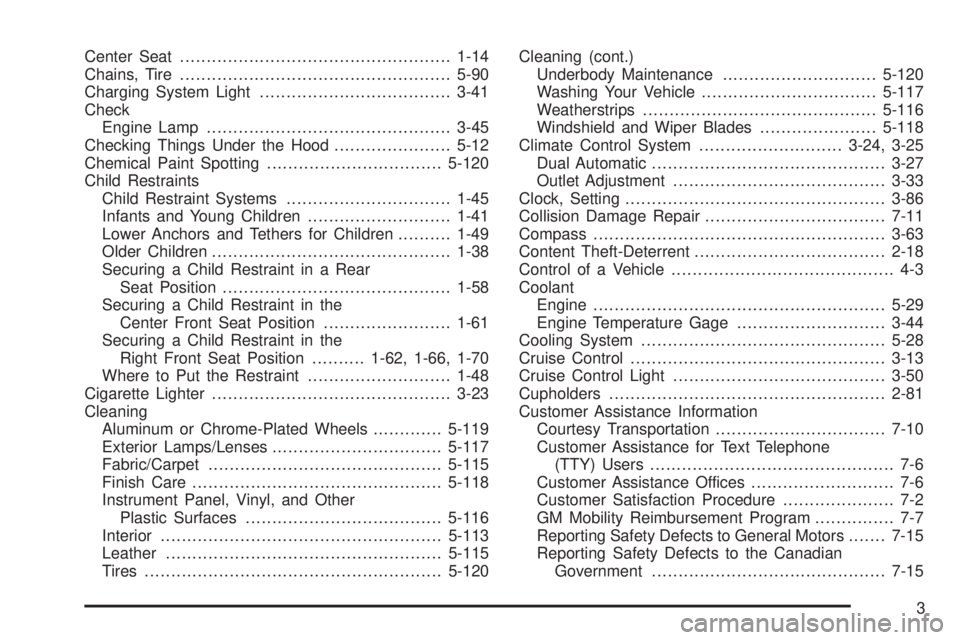
Center Seat...................................................1-14
Chains, Tire...................................................5-90
Charging System Light....................................3-41
Check
Engine Lamp..............................................3-45
Checking Things Under the Hood......................5-12
Chemical Paint Spotting.................................5-120
Child Restraints
Child Restraint Systems...............................1-45
Infants and Young Children...........................1-41
Lower Anchors and Tethers for Children..........1-49
Older Children.............................................1-38
Securing a Child Restraint in a Rear
Seat Position...........................................1-58
Securing a Child Restraint in the
Center Front Seat Position........................1-61
Securing a Child Restraint in the
Right Front Seat Position..........1-62, 1-66, 1-70
Where to Put the Restraint...........................1-48
Cigarette Lighter.............................................3-23
Cleaning
Aluminum or Chrome-Plated Wheels.............5-119
Exterior Lamps/Lenses................................5-117
Fabric/Carpet............................................5-115
Finish Care...............................................5-118
Instrument Panel, Vinyl, and Other
Plastic Surfaces.....................................5-116
Interior.....................................................5-113
Leather....................................................5-115
Tires........................................................5-120Cleaning (cont.)
Underbody Maintenance.............................5-120
Washing Your Vehicle.................................5-117
Weatherstrips............................................5-116
Windshield and Wiper Blades......................5-118
Climate Control System...........................3-24, 3-25
Dual Automatic............................................3-27
Outlet Adjustment........................................3-33
Clock, Setting.................................................3-86
Collision Damage Repair..................................7-11
Compass.......................................................3-63
Content Theft-Deterrent....................................2-18
Control of a Vehicle.......................................... 4-3
Coolant
Engine.......................................................5-29
Engine Temperature Gage............................3-44
Cooling System..............................................5-28
Cruise Control................................................3-13
Cruise Control Light........................................3-50
Cupholders....................................................2-81
Customer Assistance Information
Courtesy Transportation................................7-10
Customer Assistance for Text Telephone
(TTY) Users.............................................. 7-6
Customer Assistance Offices........................... 7-6
Customer Satisfaction Procedure..................... 7-2
GM Mobility Reimbursement Program............... 7-7
Reporting Safety Defects to General Motors.......7-15
Reporting Safety Defects to the Canadian
Government............................................7-15
3
Page 586 of 596
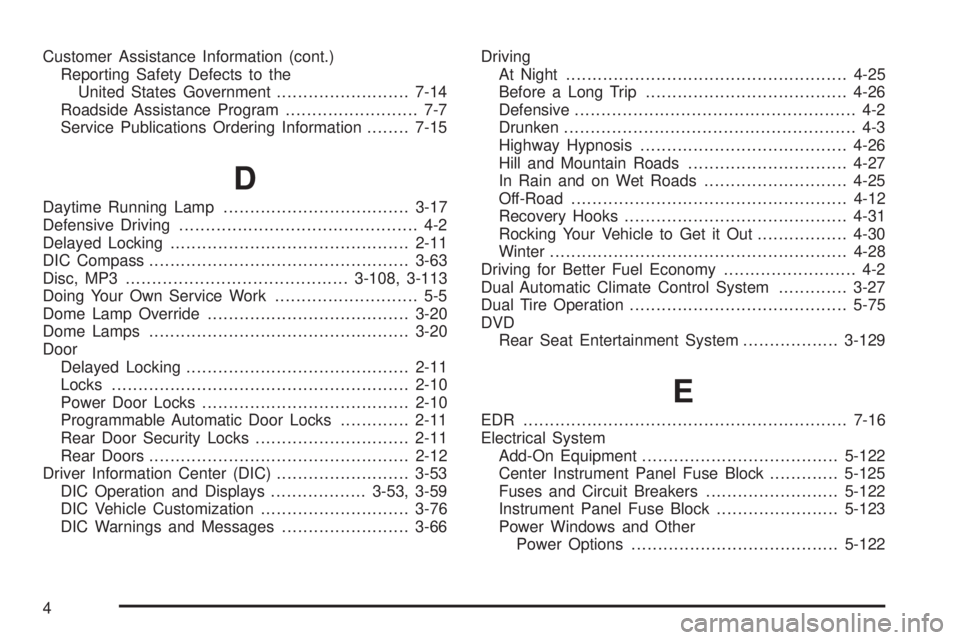
Customer Assistance Information (cont.)
Reporting Safety Defects to the
United States Government.........................7-14
Roadside Assistance Program......................... 7-7
Service Publications Ordering Information........7-15
D
Daytime Running Lamp...................................3-17
Defensive Driving............................................. 4-2
Delayed Locking.............................................2-11
DIC Compass.................................................3-63
Disc, MP3..........................................3-108, 3-113
Doing Your Own Service Work........................... 5-5
Dome Lamp Override......................................3-20
Dome Lamps .................................................3-20
Door
Delayed Locking..........................................2-11
Locks........................................................2-10
Power Door Locks.......................................2-10
Programmable Automatic Door Locks.............2-11
Rear Door Security Locks.............................2-11
Rear Doors.................................................2-12
Driver Information Center (DIC).........................3-53
DIC Operation and Displays..................3-53, 3-59
DIC Vehicle Customization............................3-76
DIC Warnings and Messages........................3-66Driving
At Night.....................................................4-25
Before a Long Trip......................................4-26
Defensive..................................................... 4-2
Drunken....................................................... 4-3
Highway Hypnosis.......................................4-26
Hill and Mountain Roads..............................4-27
In Rain and on Wet Roads...........................4-25
Off-Road ....................................................4-12
Recovery Hooks..........................................4-31
Rocking Your Vehicle to Get it Out.................4-30
Winter........................................................4-28
Driving for Better Fuel Economy......................... 4-2
Dual Automatic Climate Control System.............3-27
Dual Tire Operation.........................................5-75
DVD
Rear Seat Entertainment System..................3-129
E
EDR .............................................................7-16
Electrical System
Add-On Equipment.....................................5-122
Center Instrument Panel Fuse Block.............5-125
Fuses and Circuit Breakers.........................5-122
Instrument Panel Fuse Block.......................5-123
Power Windows and Other
Power Options.......................................5-122
4