oil temperature GMC SIERRA 2010 User Guide
[x] Cancel search | Manufacturer: GMC, Model Year: 2010, Model line: SIERRA, Model: GMC SIERRA 2010Pages: 630, PDF Size: 4.65 MB
Page 465 of 630
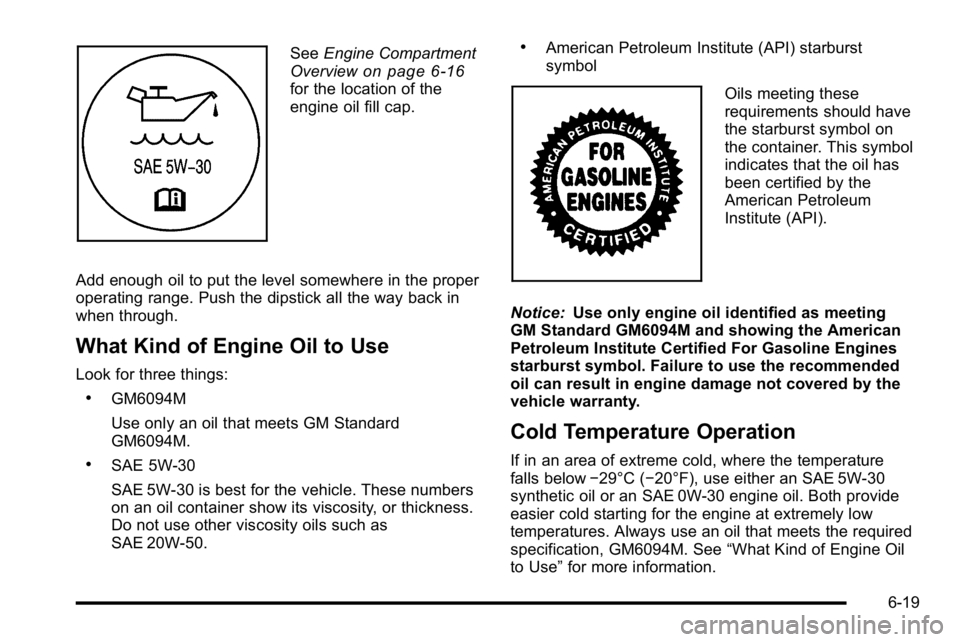
SeeEngine Compartment
Overviewon page 6‑16for the location of the
engine oil fill cap.
Add enough oil to put the level somewhere in the proper
operating range. Push the dipstick all the way back in
when through.
What Kind of Engine Oil to Use
Look for three things:
.GM6094M
Use only an oil that meets GM Standard
GM6094M.
.SAE 5W-30
SAE 5W-30 is best for the vehicle. These numbers
on an oil container show its viscosity, or thickness.
Do not use other viscosity oils such as
SAE 20W-50.
.American Petroleum Institute (API) starburst
symbol
Oils meeting these
requirements should have
the starburst symbol on
the container. This symbol
indicates that the oil has
been certified by the
American Petroleum
Institute (API).
Notice: Use only engine oil identified as meeting
GM Standard GM6094M and showing the American
Petroleum Institute Certified For Gasoline Engines
starburst symbol. Failure to use the recommended
oil can result in engine damage not covered by the
vehicle warranty.
Cold Temperature Operation
If in an area of extreme cold, where the temperature
falls below −29°C (−20°F), use either an SAE 5W-30
synthetic oil or an SAE 0W-30 engine oil. Both provide
easier cold starting for the engine at extremely low
temperatures. Always use an oil that meets the required
specification, GM6094M. See “What Kind of Engine Oil
to Use” for more information.
6-19
Page 466 of 630
Engine Oil Additives / Engine Oil
Flushes
Do not add anything to the oil. The recommended oils
with the starburst symbol that meet GM Standard
GM6094M are all that is needed for good performance
and engine protection.
Engine oil system flushes are not recommended and
could cause engine damage not covered by the
vehicle warranty.
Engine Oil Life System
When to Change Engine Oil
This vehicle has a computer system that indicates when
to change the engine oil and filter. This is based on
engine revolutions and engine temperature, and not on
mileage. Based on driving conditions, the mileage at
which an oil change is indicated can vary considerably.
For the oil life system to work properly, the system must
be reset every time the oil is changed.
On some vehicles, when the system has calculated that
oil life has been diminished, a CHANGE ENGINE OIL
SOON message comes on to indicate that an oil
change is necessary. SeeDIC Warnings and Messages
on page 4‑65. Change the oil as soon as possible
within the next 1 000 km (600 miles). It is possible that, if driving under the best conditions, the oil life system
might not indicate that an oil change is necessary for
over a year. However, the engine oil and filter must be
changed at least once a year and at this time the
system must be reset. For vehicles without the
CHANGE ENGINE OIL SOON message, An oil change
is needed when the OIL LIFE REMAINING percentage
is near 0%. Your dealer/retailer has trained service
people who will perform this work using genuine parts
and reset the system. It is also important to check the
oil regularly and keep it at the proper level.
If the system is ever reset accidentally, the oil must be
changed at 5 000 km (3,000 miles) since the last oil
change. Remember to reset the oil life system
whenever the oil is changed.
How to Reset the Engine Oil Life
System
The Engine Oil Life System calculates when to
change the engine oil and filter based on vehicle use.
Whenever the oil is changed, reset the system so it can
calculate when the next oil change is required. If a
situation occurs where the oil is changed prior to a
CHANGE ENGINE OIL SOON message coming on,
reset the system.
6-20
Page 477 of 630
Notice:Using coolant other than DEX-COOL®can
cause premature engine, heater core, or radiator
corrosion. In addition, the engine coolant could
require changing sooner, at 50 000 km (30,000 miles)
or 24 months, whichever occurs first. Any repairs
would not be covered by the vehicle warranty.
Always use DEX-COOL
®(silicate-free) coolant in
the vehicle.
Engine Coolant
The cooling system in the vehicle is filled with
DEX-COOL®engine coolant. This coolant is designed
to remain in the vehicle for five years or 150,000 miles
(240 000 km), whichever occurs first.
The following explains the cooling system and how to
check and add coolant when it is low. If there is a
problem with engine overheating, see Engine
Overheating on page 6‑34.
What to Use
{WARNING:
Adding only plain water to the cooling system can
be dangerous. Plain water, or some other liquid
such as alcohol, can boil before the proper
coolant mixture will. The vehicle's coolant warning
system is set for the proper coolant mixture. With
plain water or the wrong mixture, the engine could
get too hot but you would not get the overheat
warning. The engine could catch fire and you or
others could be burned. Use a 50/50 mixture of
clean, drinkable water and DEX-COOL
®coolant.
Use a 50/50 mixture of clean, drinkable water and
DEX-COOL
®coolant. If using this mixture, nothing else
needs to be added. This mixture:
.Gives freezing protection down to −34°F (−37°C),
outside temperature.
.Gives boiling protection up to 265°F (129°C),
engine temperature.
6-31
Page 478 of 630
.Protects against rust and corrosion.
.Will not damage aluminum parts.
.Helps keep the proper engine temperature.
Notice: If an improper coolant mixture is used, the
engine could overheat and be badly damaged. The
repair cost would not be covered by the vehicle
warranty. Too much water in the mixture can freeze
and crack the engine, radiator, heater core, and
other parts.
Notice: If extra inhibitors and/or additives are used
in the vehicle's cooling system, the vehicle could be
damaged. Use only the proper mixture of the engine
coolant listed in this manual for the cooling system.
See Recommended Fluids and Lubricants
on
page 7‑12for more information.
Checking Coolant
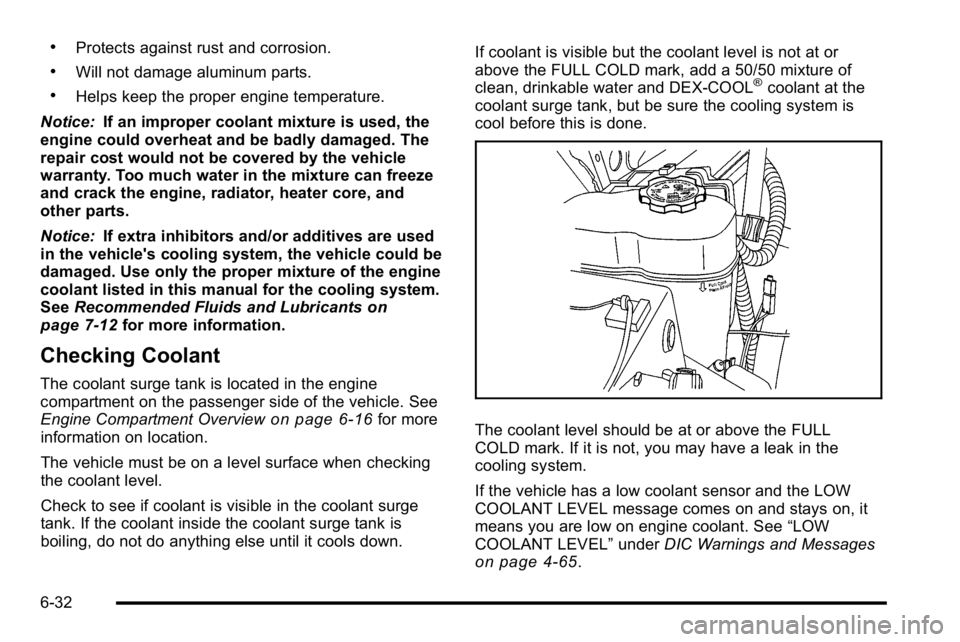
The coolant surge tank is located in the engine
compartment on the passenger side of the vehicle. See
Engine Compartment Overview
on page 6‑16for more
information on location.
The vehicle must be on a level surface when checking
the coolant level.
Check to see if coolant is visible in the coolant surge
tank. If the coolant inside the coolant surge tank is
boiling, do not do anything else until it cools down. If coolant is visible but the coolant level is not at or
above the FULL COLD mark, add a 50/50 mixture of
clean, drinkable water and DEX-COOL
®coolant at the
coolant surge tank, but be sure the cooling system is
cool before this is done.
The coolant level should be at or above the FULL
COLD mark. If it is not, you may have a leak in the
cooling system.
If the vehicle has a low coolant sensor and the LOW
COOLANT LEVEL message comes on and stays on, it
means you are low on engine coolant. See “LOW
COOLANT LEVEL” underDIC Warnings and Messages
on page 4‑65.
6-32
Page 483 of 630
Notice:After driving in the overheated engine
protection operating mode, to avoid engine damage,
allow the engine to cool before attempting any
repair. The engine oil will be severely degraded.
Repair the cause of coolant loss, change the oil and
reset the oil life system. See Engine Oil
on
page 6‑18.
Engine Fan Noise
If the vehicle has a clutched engine cooling fan, when
the clutch is engaged, the fan spins faster to provide
more air to cool the engine. In most everyday driving
conditions, the fan is spinning slower and the clutch is
not fully engaged. This improves fuel economy and
reduces fan noise. Under heavy vehicle loading, trailer
towing, and/or high outside temperatures, the fan speed
increases as the clutch more fully engages, so you may
hear an increase in fan noise. This is normal and should
not be mistaken as the transmission slipping or making
extra shifts. It is merely the cooling system functioning
properly. The fan will slow down when additional cooling
is not required and the clutch disengages.
You may also hear this fan noise when you start the
engine. It will go away as the fan clutch partially
disengages.
If the vehicle has electric cooling fans, you may hear
the fans spinning at low speed during most everyday
driving. The fans may turn off if no cooling is required. Under heavy vehicle loading, trailer towing, and/or high
outside temperatures, or if you are operating the air
conditioning system, the fans may change to high
speed and you may hear an increase in fan noise.
This is normal and indicates that the cooling system is
functioning properly. The fans will change to low speed
when additional cooling is no longer required.
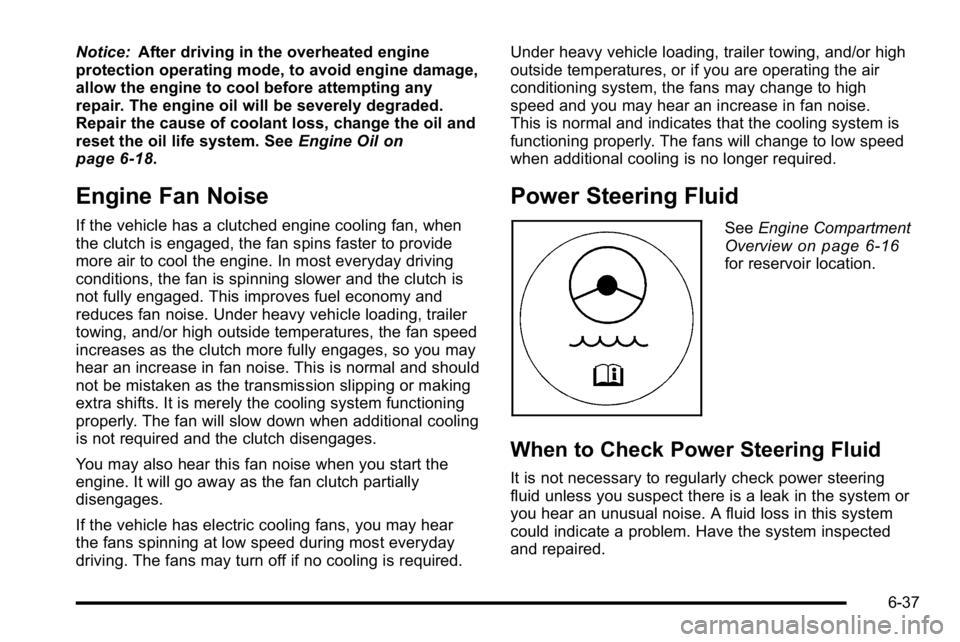
Power Steering Fluid
See
Engine Compartment
Overviewon page 6‑16for reservoir location.
When to Check Power Steering Fluid
It is not necessary to regularly check power steering
fluid unless you suspect there is a leak in the system or
you hear an unusual noise. A fluid loss in this system
could indicate a problem. Have the system inspected
and repaired.
6-37
Page 578 of 630
When the Change Engine Oil Soon message
displays, certain services, checks, and inspections are
required. The services described for MaintenanceI
should be performed at every engine oil change.
The services described for Maintenance IIshould be
performed when:
.Maintenance Iwas performed the last time the
engine oil was changed.
.It has been 10 months or more since the Change
Engine Oil Soon message has displayed or since
the last service.
Maintenance I
.Change engine oil and filter. See Engine Oilon
page 6‑18. An Emission Control Service.
.Engine coolant level check. See Engine Coolanton page 6‑31.
.Windshield washer fluid level check. See
Windshield Washer Fluid on page 6‑38.
.Tire inflation check. SeeInflation - Tire Pressureon page 6‑72.
.Tire wear inspection. See Tire Inspection and
Rotation on page 6‑80.
.Rotate tires. See Tire Inspection and Rotationon
page 6‑80.
.Fluids visual leak check (or every 12 months,
whichever occurs first). A leak in any system
must be repaired and the fluid level checked.
.Engine air cleaner filter inspection (vehicles
driven in dusty conditions only). See Engine Air
Cleaner/Filter on page 6‑21.
.Brake system inspection (or every 12 months,
whichever occurs first).
.For vehicles with Allison Transmission®only:
At the first engine oil change only, replace external
transmission filter.
Maintenance II
.Perform all services described in Maintenance I.
.Steering and suspension inspection. Visual
inspection for damaged, loose, or missing parts or
signs of wear.
.Lubricate the front suspension, steering linkage,
and parking brake cable guides. Control arm
ball joints on 2500/3500 series vehicles require
lubrication but should not be lubricated unless their
temperature is−12°C (10°F) or higher, or they
could be damaged. Control arm ball joints on
1500 series vehicles are maintenance‐free.
Vehicles used under severe commercial operating
conditions require lubrication on a regular basis
every 5 000 km/3,000 miles.
7-4
Page 620 of 630

Engine (cont.)Coolant . . . . . . . . . . . . . . . . . . . . . . . . . . . . . . . . . . . . . . . . . . . 6-31
Coolant Heater . . . . . . . . . . . . . . . . . . . . . . . . . . . . . . . . . . . 3-26
Coolant Temperature Gage . . . . . . . . . . . . . . . . . . . . . . . 4-41
Cooling System . . . . . . . . . . . . . . . . . . . . . . . . . . . . . . . . . . . 6-30
Drive Belt Routing . . . . . . . . . . . . . . . . . . . . . . . . . . . . . . . . 7-16
Exhaust . . . . . . . . . . . . . . . . . . . . . . . . . . . . . . . . . . . . . . . . . . 3-54
Fan Noise . . . . . . . . . . . . . . . . . . . . . . . . . . . . . . . . . . . . . . . . 6-37
Fast Idle System . . . . . . . . . . . . . . . . . . . . . . . . . . . . . . . . . . 3-25
Oil . . . . . . . . . . . . . . . . . . . . . . . . . . . . . . . . . . . . . . . . . . . . . . . . 6-18
Overheated Protection Operating Mode . . . . . . . . . . 6-36
Overheating . . . . . . . . . . . . . . . . . . . . . . . . . . . . . . . . . . . . . . 6-34
Starting . . . . . . . . . . . . . . . . . . . . . . . . . . . . . . . . . . . . . . . . . . . 3-23
Engine Oil
Life System . . . . . . . . . . . . . . . . . . . . . . . . . . . . . . . . . . . . . . . 6-20
Entry Lighting . . . . . . . . . . . . . . . . . . . . . . . . . . . . . . . . . . . . . . 4-15
Event Data Recorders . . . . . . . . . . . . . . . . . . . . . . . . . . . . . 8-18
Exit Lighting . . . . . . . . . . . . . . . . . . . . . . . . . . . . . . . . . . . . . . . 4-15
Extender, Safety Belt . . . . . . . . . . . . . . . . . . . . . . . . . . . . . . 2-38
Exterior Lamps . . . . . . . . . . . . . . . . . . . . . . . . . . . . . . . . . . . . 4-10F
Fast Idle System . . . . . . . . . . . . . . . . . . . . . . . . . . . . . . . . . . . 3-25
Filter Engine Air Cleaner . . . . . . . . . . . . . . . . . . . . . . . . . . . . . . . 6-21
Finish Damage . . . . . . . . . . . . . . . . . . . . . . . . . . . . . . . . . . . 6-116
Fixed Mast Antenna . . . . . . . . . . . . . . . . . . . . . . . . . . . . . . 4-149
Flash-to-Pass . . . . . . . . . . . . . . . . . . . . . . . . . . . . . . . . . . . . . . . .4-5
Flashers, Hazard Warning . . . . . . . . . . . . . . . . . . . . . . . . . . .4-3
Flat Tire . . . . . . . . . . . . . . . . . . . . . . . . . . . . . . . . . . . . . . . . . . . 6-89
Flat Tire, Changing . . . . . . . . . . . . . . . . . . . . . . . . . . . . . . . . 6-90
Flat Tire, Storing . . . . . . . . . . . . . . . . . . . . . . . . . . . . . . . . . . 6-106
Fluid Automatic Transmission . . . . . . . . . . . . . . . . . . . . 6-23, 6-26
Power Steering . . . . . . . . . . . . . . . . . . . . . . . . . . . . . . . . . . . 6-37
Windshield Washer . . . . . . . . . . . . . . . . . . . . . . . . . . . . . . . 6-38
Fog Lamps
Bulb Replacement . . . . . . . . . . . . . . . . . . . . . . . . . . . . . . . . 4-13
Light . . . . . . . . . . . . . . . . . . . . . . . . . . . . . . . . . . . . . . . . . . . . . . 4-48
Four-Wheel Drive . . . . . . . . . . . . . . . . . . . . . . . . . . . . 3-36, 6-50
Four-Wheel-Drive Light . . . . . . . . . . . . . . . . . . . . . . . . . . . . 4-49
Front Axle . . . . . . . . . . . . . . . . . . . . . . . . . . . . . . . . . . . . . . . . . 6-52
i - 6
Page 621 of 630
Fuel . . . . . . . . . . . . . . . . . . . . . . . . . . . . . . . . . . . . . . . . . . . . . . . . .6-6Additives . . . . . . . . . . . . . . . . . . . . . . . . . . . . . . . . . . . . . . . . . . 6-8
California Fuel . . . . . . . . . . . . . . . . . . . . . . . . . . . . . . . . . . . . . 6-8
E85 (85% Ethanol) . . . . . . . . . . . . . . . . . . . . . . . . . . . . . . . . 6-9
Filling a Portable Fuel Container . . . . . . . . . . . . . . . . . . 6-13
Filling the Tank . . . . . . . . . . . . . . . . . . . . . . . . . . . . . . . . . . . 6-11
Fuels in Foreign Countries . . . . . . . . . . . . . . . . . . . . . . . . 6-11
Gage . . . . . . . . . . . . . . . . . . . . . . . . . . . . . . . . . . . . . . . . . . . . . 4-49
Gasoline Octane . . . . . . . . . . . . . . . . . . . . . . . . . . . . . . . . . . . 6-7
Gasoline Specifications . . . . . . . . . . . . . . . . . . . . . . . . . . . . 6-7
Low Fuel Warning Light . . . . . . . . . . . . . . . . . . . . . . . . . . . 4-50
Management, Active . . . . . . . . . . . . . . . . . . . . . . . . . . . . . . 3-27
Fuel Economy Driving for Better . . . . . . . . . . . . . . . . . . . . . . . . . . . . . . . . . 1-33
Fuses Center Instrument Panel Fuse Block . . . . . . . . . . . . .6-121
Fuses and Circuit Breakers . . . . . . . . . . . . . . . . . . . . . . 6-118
Instrument Panel Fuse Block . . . . . . . . . . . . . . . . . . . . 6-119
Underhood Fuse Block . . . . . . . . . . . . . . . . . . . . . . . . . .6-122
Windshield Wiper . . . . . . . . . . . . . . . . . . . . . . . . . . . . . . . . 6-118G
Gages
Engine Coolant Temperature . . . . . . . . . . . . . . . . . . . . . 4-41
Fuel . . . . . . . . . . . . . . . . . . . . . . . . . . . . . . . . . . . . . . . . . . . . . . 4-49
Oil Pressure . . . . . . . . . . . . . . . . . . . . . . . . . . . . . . . . . . . . . . 4-46
Speedometer . . . . . . . . . . . . . . . . . . . . . . . . . . . . . . . . . . . . . 4-31
Tachometer . . . . . . . . . . . . . . . . . . . . . . . . . . . . . . . . . . . . . . . 4-31
Trip Odometer . . . . . . . . . . . . . . . . . . . . . . . . . . . . . . . . . . . . 4-31
Voltmeter Gage . . . . . . . . . . . . . . . . . . . . . . . . . . . . . . . . . . . 4-38
Garage Door Opener . . . . . . . . . . . . . . . . . . . . . . . . . . . . . . 3-69
Gasoline Octane . . . . . . . . . . . . . . . . . . . . . . . . . . . . . . . . . . . . . . . . . . . . 6-7
Specifications . . . . . . . . . . . . . . . . . . . . . . . . . . . . . . . . . . . . . . 6-7
Glove Box . . . . . . . . . . . . . . . . . . . . . . . . . . . . . . . . . . . . . . . . . 3-75
GM Mobility Reimbursement Program . . . . . . . . . . . . . . .8-7
H
Halogen Bulbs . . . . . . . . . . . . . . . . . . . . . . . . . . . . . . . . . . . . . 6-57
Hazard Warning Flashers . . . . . . . . . . . . . . . . . . . . . . . . . . . .4-3
Head Restraints . . . . . . . . . . . . . . . . . . . . . . . . . . . . . . . . . . . . .2-3
Headlamps . . . . . . . . . . . . . . . . . . . . . . . . . . . . . . . . . . . . . . . . 6-57 Aiming . . . . . . . . . . . . . . . . . . . . . . . . . . . . . . . . . . . . . . . . . . . . 6-54
Bulb Replacement . . . . . . . . . . . . . . . . . . . . . . . . . . . . . . . . 6-57
Daytime Running Lamps (DRL) . . . . . . . . . . . . . . . . . . . 4-12
i - 7