tire pressure GMC SIERRA 2011 User Guide
[x] Cancel search | Manufacturer: GMC, Model Year: 2011, Model line: SIERRA, Model: GMC SIERRA 2011Pages: 594, PDF Size: 6.55 MB
Page 322 of 594
Black plate (28,1)GMC Sierra Owner Manual - 2011
9-28 Driving and Operating
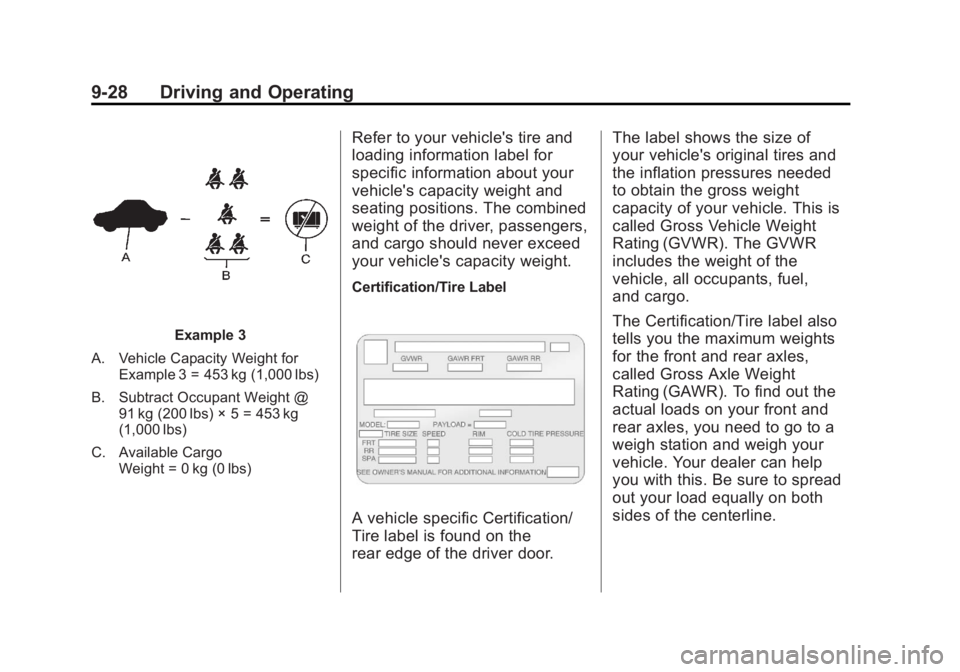
Example 3
A. Vehicle Capacity Weight for Example 3 = 453 kg (1,000 lbs)
B. Subtract Occupant Weight @ 91 kg (200 lbs) × 5 = 453 kg
(1,000 lbs)
C. Available Cargo Weight = 0 kg (0 lbs)
Refer to your vehicle's tire and
loading information label for
specific information about your
vehicle's capacity weight and
seating positions. The combined
weight of the driver, passengers,
and cargo should never exceed
your vehicle's capacity weight.
Certification/Tire Label
A vehicle specific Certification/
Tire label is found on the
rear edge of the driver door. The label shows the size of
your vehicle's original tires and
the inflation pressures needed
to obtain the gross weight
capacity of your vehicle. This is
called Gross Vehicle Weight
Rating (GVWR). The GVWR
includes the weight of the
vehicle, all occupants, fuel,
and cargo.
The Certification/Tire label also
tells you the maximum weights
for the front and rear axles,
called Gross Axle Weight
Rating (GAWR). To find out the
actual loads on your front and
rear axles, you need to go to a
weigh station and weigh your
vehicle. Your dealer can help
you with this. Be sure to spread
out your load equally on both
sides of the centerline.
Page 405 of 594
Black plate (111,1)GMC Sierra Owner Manual - 2011
Driving and Operating 9-111
Vehicle Series Hitch TypeMaximum Tongue
Weight
1500 Weight Carrying 272 kg (600 lbs)
2500HD/3500 Weight Carrying 453 kg (1,000 lbs)
1500 Weight Distributing 499 kg (1,100 lbs)
2500HD/3500 Weight Distributing 680 kg (1,500 lbs)
1500 Fifth-Wheel Gooseneck 680 kg (1,500 lbs)
2500HD Fifth-Wheel Gooseneck 1 134 kg (2,500 lbs)
3500 Single Rear
Wheels Fifth-Wheel Gooseneck 1 360 kg (3,000 lbs)
3500 Dual Rear
Wheels Fifth-Wheel Gooseneck 1 587 kg (3,500 lbs)
Do not exceed the maximum
allowable tongue weight for the
vehicle. Choose the shortest hitch
extension that will position the hitch
ball closest to the vehicle. This will
help reduce the effect of trailer
tongue weight on the rear axle. Trailering may be limited by the
vehicle's ability to carry tongue
weight. Tongue or kingpin weight
cannot cause the vehicle to exceed
the GVWR (Gross Vehicle Weight
Rating) or the RGAWR (Rear Gross
Axle Weight Rating). See
“Total
Weight on the Vehicle's Tires” later
in this section for more information. After loading the trailer, weigh
the trailer and then the tongue,
separately, to see if the weights are
proper. If they are not, adjustments
might be made by moving some
items around in the trailer.
Total Weight on the Vehicle's
Tires
Be sure the vehicle's tires are
inflated to the inflation pressures
found on the Certification Tire label
on the drivers door or see
Vehicle
Load Limits on page 9‑25 for more
information. Make sure not to
exceed the GVWR limit for the
vehicle, or the RGAWR, with the
tow vehicle and trailer fully loaded
for the trip including the weight
of the trailer tongue. If using a
weight-distributing hitch, make
sure not to exceed the RGAWR
before applying the weight
distribution spring bars.
Page 408 of 594
Black plate (114,1)GMC Sierra Owner Manual - 2011
9-114 Driving and Operating
Trailer Brakes
A loaded trailer that weighs more
than 900 kg (2,000 lbs) needs to
have its own brake system that
is adequate for the weight of the
trailer. Be sure to read and follow
the instructions for the trailer brakes
so they are installed, adjusted, and
maintained properly.
If the vehicle is equipped with
StabiliTrak, the trailer cannot tap
into the vehicle's hydraulic brake
system.
The trailer brake system can tap
into the vehicle's hydraulic brake
system only if:
.The trailer parts can withstand
20 650 kPa (3,000 psi) of
pressure.
.The trailer's brake system
will use less than 0.3 cc
(0.02 cubic inch) of fluid from
the vehicle's master cylinder.
Otherwise, both braking systems
will not work well or at all.If everything checks out this far,
make the brake tap at the port on
the master cylinder that sends the
fluid to the rear brakes. Use only
steel brake tubing to make the tap.
Auxiliary Battery
The auxiliary battery provision can
be used to supply electrical power
to additional equipment that may be
added, such as a slide-in camper.
If the vehicle has this provision,
this relay will be located on the
driver side of the vehicle, next to
the underhood electrical center.
Be sure to follow the proper
installation instructions included
with any electrical equipment that
is installed.
Notice:
Leaving electrical
equipment on for extended
periods will drain the battery.
Always turn off electrical
equipment when not in use
and do not use equipment that
exceeds the maximum amperage
rating for the auxiliary battery
provision.
Trailer Wiring Harness
The vehicle is equipped with one of
the following wiring harnesses for
towing a trailer or hauling a slide-in
camper.
Basic Trailer Wiring
All regular, extended cab and crew
cab pickups have a seven‐wire
trailer towing harness.
For vehicles not equipped with
heavy duty trailering, the harness
is secured to the vehicle's frame
behind the spare tire mount.
The harness requires the installation
of a trailer connector, which is
available through your dealer.
If towing a light‐duty trailer with
a standard four‐way round pin
connector, an adapter is available
from your dealer.
Page 426 of 594
Black plate (2,1)GMC Sierra Owner Manual - 2011
10-2 Vehicle Care
Wheels and Tires
Tires . . . . . . . . . . . . . . . . . . . . . . . . 10-57
Tire Sidewall Labeling . . . . . . 10-58
Tire Designations . . . . . . . . . . . 10-61
Tire Terminology andDefinitions . . . . . . . . . . . . . . . . 10-62
Tire Pressure . . . . . . . . . . . . . . . 10-66
Tire Pressure for High-Speed Operation . . . . . . . . . . . . . . . . . 10-67
Tire Pressure Monitor System . . . . . . . . . . . . . . . . . . . 10-68
Tire Pressure Monitor Operation . . . . . . . . . . . . . . . . . 10-69
Tire Inspection . . . . . . . . . . . . . . 10-73
Tire Rotation . . . . . . . . . . . . . . . 10-73
Dual Tire Rotation . . . . . . . . . . 10-75
When It Is Time for New Tires . . . . . . . . . . . . . . . . . . . . . . 10-76
Buying New Tires . . . . . . . . . . . 10-77
Different Size Tires and Wheels . . . . . . . . . . . . . . . . . . . 10-79 Uniform Tire Quality
Grading . . . . . . . . . . . . . . . . . . . 10-80
Wheel Alignment and Tire Balance . . . . . . . . . . . . . . . . . . . 10-81
Wheel Replacement . . . . . . . . 10-82
Tire Chains . . . . . . . . . . . . . . . . . 10-83
If a Tire Goes Flat . . . . . . . . . . 10-84
Tire Changing . . . . . . . . . . . . . . 10-86
Full-Size Spare Tire . . . . . . . . 10-97
Jump Starting
Jump Starting . . . . . . . . . . . . . . 10-98
Towing
Towing the Vehicle . . . . . . . . 10-103
Recreational Vehicle
Towing . . . . . . . . . . . . . . . . . . . 10-103
Appearance Care
Exterior Care . . . . . . . . . . . . . . 10-108
Interior Care . . . . . . . . . . . . . . . 10-112
Floor Mats . . . . . . . . . . . . . . . . . 10-116
General Information
For service and parts needs,
visit your dealer. You will receive
genuine GM parts and GM-trained
and supported service people.
Genuine GM parts have one of
these marks:
Page 481 of 594
Black plate (57,1)GMC Sierra Owner Manual - 2011
Vehicle Care 10-57
Wheels and Tires
Tires
Your new vehicle comes with
high-quality tires made by
a leading tire manufacturer.
If you ever have questions about
your tire warranty and where to
obtain service, see your vehicle
Warranty booklet for details.
For additional information refer
to the tire manufacturer.
{WARNING
.Poorly maintained and
improperly used tires are
dangerous.
.Overloading the tires can
cause overheating as a result
of too much flexing. There
could be a blowout and a
serious crash. SeeVehicle
Load Limits on page 9‑25.
(Continued)
WARNING (Continued)
.Underinflated tires pose the
same danger as overloaded
tires. The resulting crash
could cause serious injury.
Check all tires frequently to
maintain the recommended
pressure. Tire pressure
should be checked when
the tires are cold.
.Overinflated tires are more
likely to be cut, punctured,
or broken by a sudden
impact—such as when
hitting a pothole. Keep tires at
the recommended pressure.
.Worn or old tires can cause
a crash. If the tread is badly
worn, replace them.
.Replace any tires that have
been damaged by impacts
with potholes, curbs, etc.
(Continued)
WARNING (Continued)
.Improperly repaired tires
can cause a crash. Only the
dealer or an authorized tire
service center should repair,
replace, dismount, and mount
the tires.
.Do not spin the tires in
excess of 55 km/h (35 mph)
on slippery surfaces such
as snow, mud, ice, etc.
Excessive spinning may
cause the tires to explode.
See Tire Pressure for High-Speed
Operation on page 10‑67 for
inflation pressure adjustment for
high speed driving.
Page 482 of 594
Black plate (58,1)GMC Sierra Owner Manual - 2011
10-58 Vehicle Care
20‐Inch Tires
If your vehicle has the optional
20‐inch P275/55R20 size tires,
they are classified as touring
tires and are designed for
on road use. The low‐profile,
wide tread design is not
recommended for“off‐road”
driving or commercial uses
such as snow plowing. See
Off-Road Driving on page 9‑7
and Adding a Snow Plow
or Similar Equipment on
page 9‑125 for additional
information.
Notice: If the vehicle has
low‐profile tires, they are more
susceptible to damage from
road hazards or curb impact
than standard profile tires. Tire and/or wheel assembly
damage can occur when
coming into contact with
road hazards like, potholes,
or sharp edged objects,
or when sliding into a curb.
The vehicle warranty does
not cover this type of damage.
Keep tires set to the correct
inflation pressure and, when
possible avoid contact with
curbs, potholes, and other
road hazards.
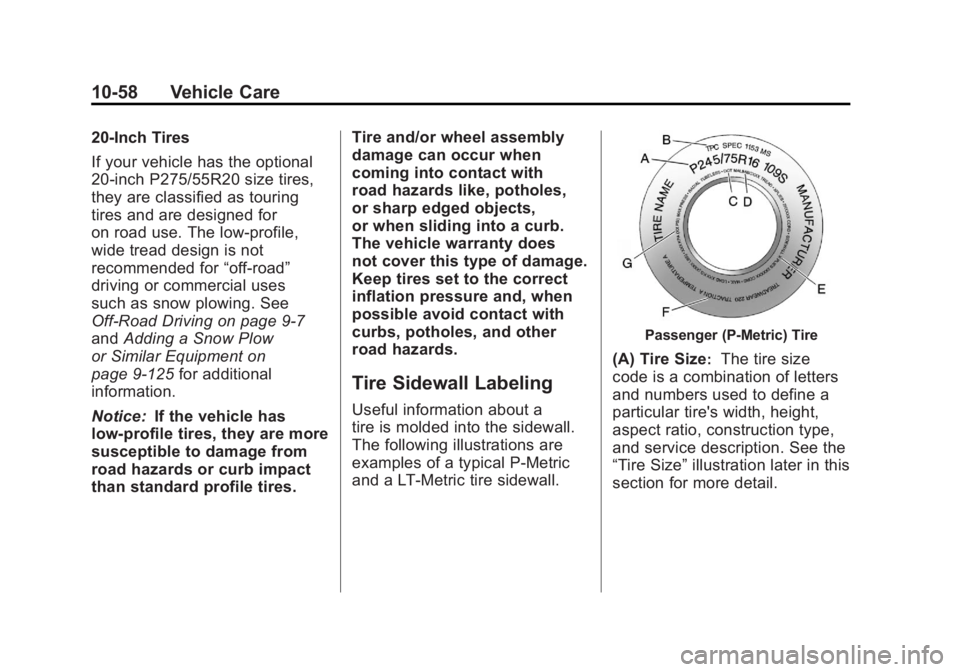
Tire Sidewall Labeling
Useful information about a
tire is molded into the sidewall.
The following illustrations are
examples of a typical P‐Metric
and a LT‐Metric tire sidewall.
Passenger (P‐Metric) Tire
(A) Tire Size:The tire size
code is a combination of letters
and numbers used to define a
particular tire's width, height,
aspect ratio, construction type,
and service description. See the
“Tire Size” illustration later in this
section for more detail.
Page 483 of 594
Black plate (59,1)GMC Sierra Owner Manual - 2011
Vehicle Care 10-59
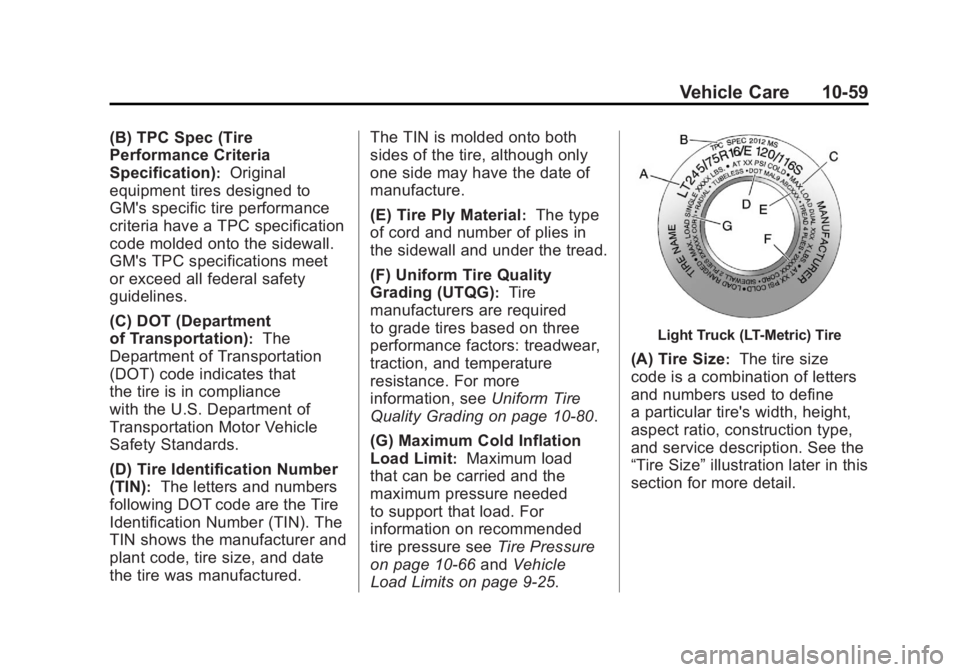
(B) TPC Spec (Tire
Performance Criteria
Specification)
:Original
equipment tires designed to
GM's specific tire performance
criteria have a TPC specification
code molded onto the sidewall.
GM's TPC specifications meet
or exceed all federal safety
guidelines.
(C) DOT (Department
of Transportation)
:The
Department of Transportation
(DOT) code indicates that
the tire is in compliance
with the U.S. Department of
Transportation Motor Vehicle
Safety Standards.
(D) Tire Identification Number
(TIN)
:The letters and numbers
following DOT code are the Tire
Identification Number (TIN). The
TIN shows the manufacturer and
plant code, tire size, and date
the tire was manufactured. The TIN is molded onto both
sides of the tire, although only
one side may have the date of
manufacture.
(E) Tire Ply Material
:The type
of cord and number of plies in
the sidewall and under the tread.
(F) Uniform Tire Quality
Grading (UTQG)
:Tire
manufacturers are required
to grade tires based on three
performance factors: treadwear,
traction, and temperature
resistance. For more
information, see Uniform Tire
Quality Grading on page 10‑80.
(G) Maximum Cold Inflation
Load Limit
:Maximum load
that can be carried and the
maximum pressure needed
to support that load. For
information on recommended
tire pressure see Tire Pressure
on page 10‑66 andVehicle
Load Limits on page 9‑25.
Light Truck (LT-Metric) Tire
(A) Tire Size:The tire size
code is a combination of letters
and numbers used to define
a particular tire's width, height,
aspect ratio, construction type,
and service description. See the
“Tire Size” illustration later in this
section for more detail.
Page 484 of 594
Black plate (60,1)GMC Sierra Owner Manual - 2011
10-60 Vehicle Care
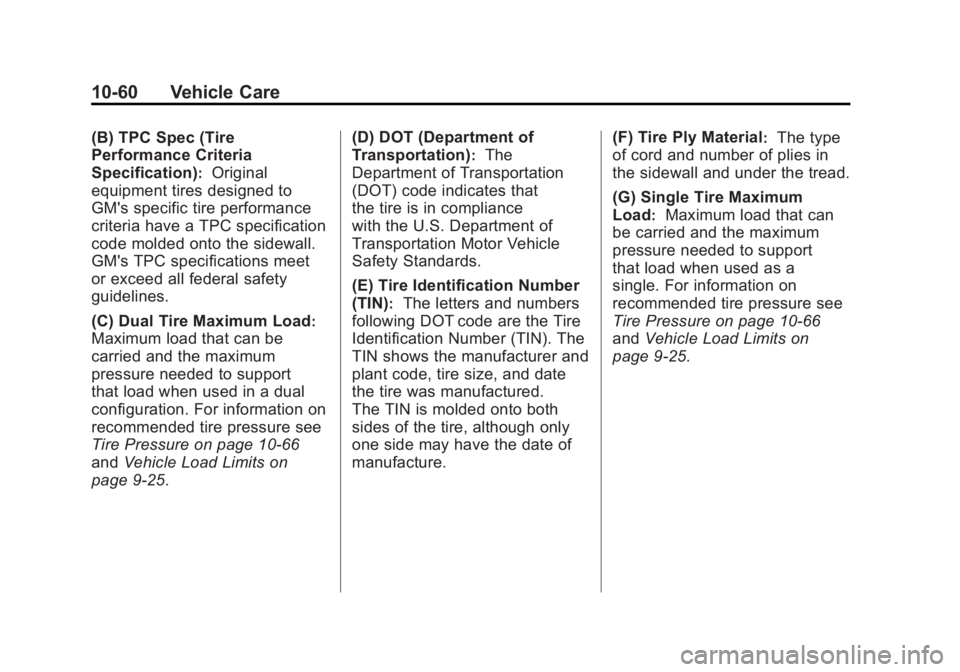
(B) TPC Spec (Tire
Performance Criteria
Specification)
:Original
equipment tires designed to
GM's specific tire performance
criteria have a TPC specification
code molded onto the sidewall.
GM's TPC specifications meet
or exceed all federal safety
guidelines.
(C) Dual Tire Maximum Load
:
Maximum load that can be
carried and the maximum
pressure needed to support
that load when used in a dual
configuration. For information on
recommended tire pressure see
Tire Pressure on page 10‑66
and Vehicle Load Limits on
page 9‑25. (D) DOT (Department of
Transportation)
:The
Department of Transportation
(DOT) code indicates that
the tire is in compliance
with the U.S. Department of
Transportation Motor Vehicle
Safety Standards.
(E) Tire Identification Number
(TIN)
:The letters and numbers
following DOT code are the Tire
Identification Number (TIN). The
TIN shows the manufacturer and
plant code, tire size, and date
the tire was manufactured.
The TIN is molded onto both
sides of the tire, although only
one side may have the date of
manufacture. (F) Tire Ply Material
:The type
of cord and number of plies in
the sidewall and under the tread.
(G) Single Tire Maximum
Load
:Maximum load that can
be carried and the maximum
pressure needed to support
that load when used as a
single. For information on
recommended tire pressure see
Tire Pressure on page 10‑66
and Vehicle Load Limits on
page 9‑25.
Page 486 of 594
Black plate (62,1)GMC Sierra Owner Manual - 2011
10-62 Vehicle Care
(B) Tire Width:The three‐digit
number indicates the tire section
width in millimeters from
sidewall to sidewall.
(C) Aspect Ratio
:A two‐digit
number that indicates the tire
height‐to‐width measurements.
For example, if the tire size
aspect ratio is 75, as shown
in item C of the light truck
(LT‐Metric) tire illustration,
it would mean that the tire's
sidewall is 75 percent as high
as it is wide.
(D) Construction Code
:A
letter code is used to indicate
the type of ply construction in
the tire. The letter R means
radial ply construction; the
letter D means diagonal or
bias ply construction; and the
letter B means belted‐bias ply
construction. (E) Rim Diameter
:Diameter of
the wheel in inches.
(F) Load Range
:Load Range.
(G) Service Description
:The
service description indicates the
load index and speed rating of a
tire. If two numbers are given as
in the example, 120/116, then
this represents the load index for
single versus dual wheel usage
(single/dual). The speed rating
is the maximum speed a tire is
certified to carry a load.
Tire Terminology and
Definitions
Air Pressure:The amount
of air inside the tire pressing
outward on each square inch
of the tire. Air pressure is
expressed in psi (pounds per
square inch) or kPa (kilopascal). Accessory Weight
:This
means the combined weight
of optional accessories.
Some examples of optional
accessories are, automatic
transmission, power steering,
power brakes, power windows,
power seats, and air
conditioning.
Aspect Ratio
:The relationship
of a tire's height to its width.
Belt
:A rubber coated layer of
cords that is located between
the plies and the tread. Cords
may be made from steel or
other reinforcing materials.
Bead
:The tire bead contains
steel wires wrapped by steel
cords that hold the tire onto
the rim.
Page 487 of 594
Black plate (63,1)GMC Sierra Owner Manual - 2011
Vehicle Care 10-63
Bias Ply Tire:A pneumatic
tire in which the plies are laid
at alternate angles less than
90 degrees to the centerline
of the tread.
Cold Tire Pressure
:The
amount of air pressure in a tire,
measured in kPa (kilopascal)
or psi (pounds per square inch)
before a tire has built up heat
from driving. See Tire Pressure
on page 10‑66.
Curb Weight
:The weight of a
motor vehicle with standard and
optional equipment including
the maximum capacity of fuel,
oil, and coolant, but without
passengers and cargo. DOT Markings
:A code
molded into the sidewall of
a tire signifying that the tire
is in compliance with the U.S.
Department of Transportation
(DOT) motor vehicle safety
standards. The DOT code
includes the Tire Identification
Number (TIN), an alphanumeric
designator which can also
identify the tire manufacturer,
production plant, brand, and
date of production.
GVWR
:Gross Vehicle Weight
Rating. See Vehicle Load Limits
on page 9‑25.
GAWR FRT
:Gross Axle
Weight Rating for the front axle.
See Vehicle Load Limits on
page 9‑25. GAWR RR
:Gross Axle
Weight Rating for the rear axle.
See Vehicle Load Limits on
page 9‑25.
Intended Outboard Sidewall
:
The side of an asymmetrical tire,
that must always face outward
when mounted on a vehicle.
Kilopascal (kPa)
:The metric
unit for air pressure.
Light Truck (LT‐Metric) Tire
:A
tire used on light duty trucks and
some multipurpose passenger
vehicles.
Load Index
:An assigned
number ranging from 1 to 279
that corresponds to the load
carrying capacity of a tire.