transmission oil GMC SIERRA 2011 User Guide
[x] Cancel search | Manufacturer: GMC, Model Year: 2011, Model line: SIERRA, Model: GMC SIERRA 2011Pages: 594, PDF Size: 6.55 MB
Page 437 of 594
Black plate (13,1)GMC Sierra Owner Manual - 2011
Vehicle Care 10-13
Automatic
Transmission Fluid
(4-Speed Transmission)
When to Check and Change
Automatic Transmission Fluid
A good time to check the automatic
transmission fluid level is when the
engine oil is changed.
Change the fluid and filter at
the intervals listed inScheduled
Maintenance on page 11‑2 and be
sure to use the transmission fluid
listed in Recommended Fluids and
Lubricants on page 11‑8.
How to Check Automatic
Transmission Fluid
Because this operation can be a
little difficult, it may be best to have
this done at the dealer service
department.
If not taken to the dealer, be sure to
follow all the instructions here or a
false reading on the dipstick could
result.
Notice: Too much or too
little fluid can damage the
transmission. Too much can
mean that some of the fluid could
come out and fall on hot engine
parts or exhaust system parts,
starting a fire. Too little fluid
could cause the transmission
to overheat. Be sure to get an
accurate reading if checking
the transmission fluid. Wait at least 30 minutes before
checking the transmission fluid
level if you have been driving:.When outside temperatures are
above 32°C (90°F).
.At high speed for quite a while.
.In heavy traffic
—especially in
hot weather.
.While pulling a trailer.
To get the right reading, the fluid
should be at normal operating
temperature, which is 82°C to 93°C
(180°F to 200°F).
Get the vehicle warmed up by
driving about 24 km (15 miles) when
outside temperatures are above
10°C (50°F). If it is colder than 10°C
(50°F), drive the vehicle in 3 (Third)
until the engine temperature gauge
moves and then remains steady for
10 minutes.
Page 443 of 594
Black plate (19,1)GMC Sierra Owner Manual - 2011
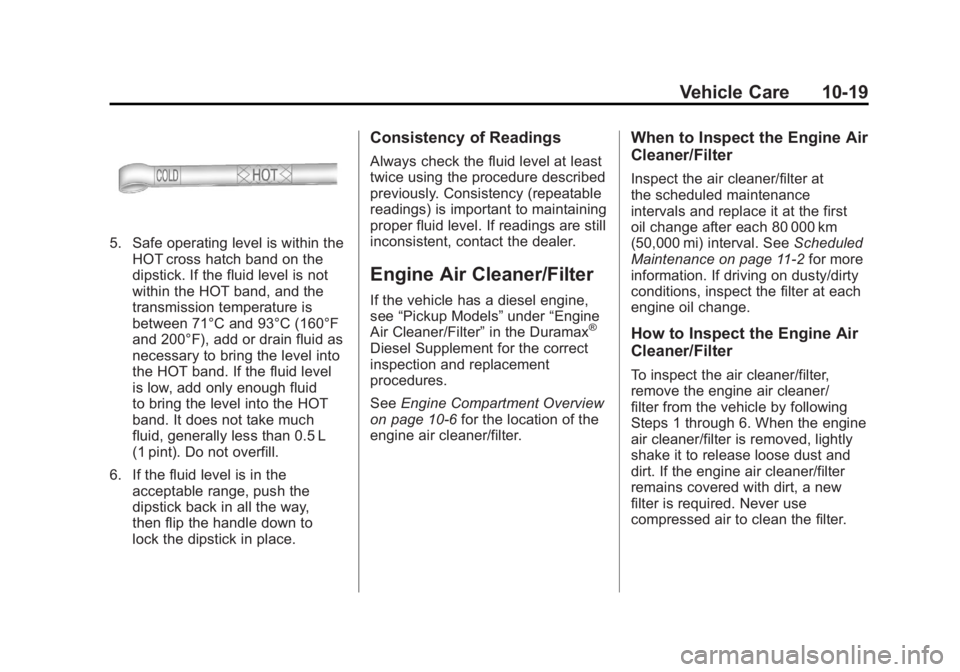
Vehicle Care 10-19
5. Safe operating level is within theHOT cross hatch band on the
dipstick. If the fluid level is not
within the HOT band, and the
transmission temperature is
between 71°C and 93°C (160°F
and 200°F), add or drain fluid as
necessary to bring the level into
the HOT band. If the fluid level
is low, add only enough fluid
to bring the level into the HOT
band. It does not take much
fluid, generally less than 0.5 L
(1 pint). Do not overfill.
6. If the fluid level is in the acceptable range, push the
dipstick back in all the way,
then flip the handle down to
lock the dipstick in place.
Consistency of Readings
Always check the fluid level at least
twice using the procedure described
previously. Consistency (repeatable
readings) is important to maintaining
proper fluid level. If readings are still
inconsistent, contact the dealer.
Engine Air Cleaner/Filter
If the vehicle has a diesel engine,
see “Pickup Models” under“Engine
Air Cleaner/Filter” in the Duramax
®
Diesel Supplement for the correct
inspection and replacement
procedures.
SeeEngine Compartment Overview
on page 10‑6 for the location of the
engine air cleaner/filter.
When to Inspect the Engine Air
Cleaner/Filter
Inspect the air cleaner/filter at
the scheduled maintenance
intervals and replace it at the first
oil change after each 80 000 km
(50,000 mi) interval. See Scheduled
Maintenance on page 11‑2 for more
information. If driving on dusty/dirty
conditions, inspect the filter at each
engine oil change.
How to Inspect the Engine Air
Cleaner/Filter
To inspect the air cleaner/filter,
remove the engine air cleaner/
filter from the vehicle by following
Steps 1 through 6. When the engine
air cleaner/filter is removed, lightly
shake it to release loose dust and
dirt. If the engine air cleaner/filter
remains covered with dirt, a new
filter is required. Never use
compressed air to clean the filter.
Page 452 of 594
Black plate (28,1)GMC Sierra Owner Manual - 2011
10-28 Vehicle Care
Overheated Engine
Protection
Operating Mode
If an overheated engine condition
exists and the ENGINE POWER IS
REDUCED message displays, an
overheat protection mode which
alternates firing groups of cylinders
helps to prevent engine damage.
In this mode, a loss in power and
engine performance will be noticed.
This operating mode allows the
vehicle to be driven to a safe
place in an emergency. Driving
extended km (mi) and/or towing a
trailer in the overheat protection
mode should be avoided.
Notice:After driving in the
overheated engine protection
operating mode, to avoid engine
damage, allow the engine to cool
before attempting any repair.
The engine oil will be severely
degraded. Repair the cause
of coolant loss, change the oil
and reset the oil life system.
See Engine Oil on page 10‑7.
Engine Fan
If the vehicle has a clutched engine
cooling fan, when the clutch is
engaged, the fan spins faster to
provide more air to cool the engine.
In most everyday driving conditions,
the fan is spinning slower and
the clutch is not fully engaged.
This improves fuel economy and
reduces fan noise. Under heavy
vehicle loading, trailer towing,
and/or high outside temperatures,
the fan speed increases as the
clutch more fully engages, so an
increase in fan noise may be heard.
This is normal and should not be
mistaken as the transmission
slipping or making extra shifts.
It is merely the cooling system
functioning properly. The fan will
slow down when additional cooling
is not required and the clutch
disengages. This fan noise may also be heard
when starting the engine. It will go
away as the fan clutch partially
disengages.
If the vehicle has electric cooling
fans, the fans may be heard
spinning at low speed during
most everyday driving. The fans
may turn off if no cooling is required.
Under heavy vehicle loading, trailer
towing, high outside temperatures,
or operation of the air conditioning
system, the fans may change to
high speed and an increase in fan
noise may be heard. This is normal
and indicates that the cooling
system is functioning properly.
The fans will change to low speed
when additional cooling is no
longer required.
Page 475 of 594
Black plate (51,1)GMC Sierra Owner Manual - 2011
Vehicle Care 10-51
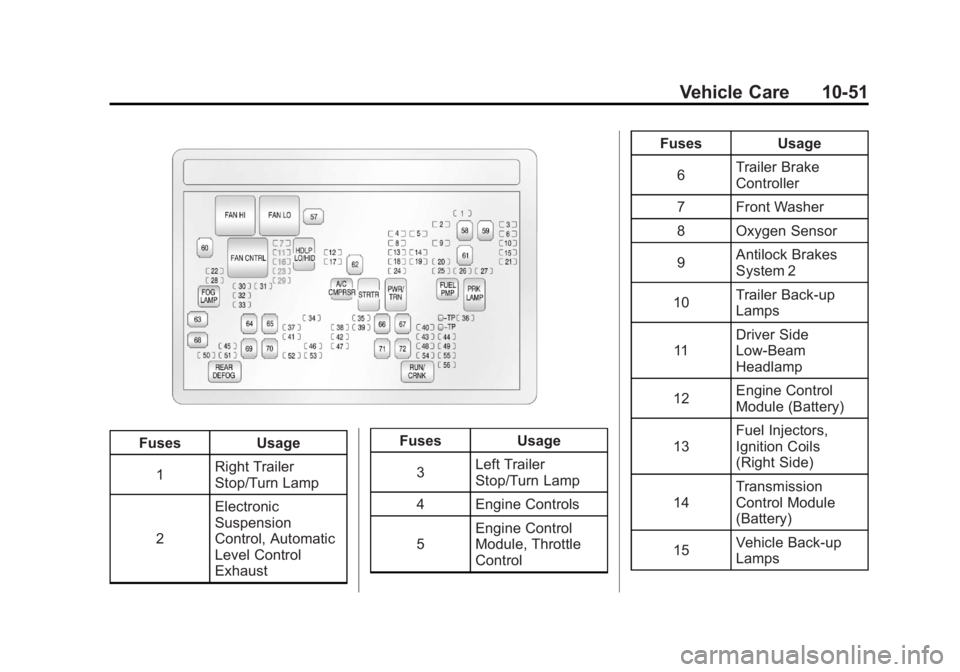
FusesUsage
1 Right Trailer
Stop/Turn Lamp
2 Electronic
Suspension
Control, Automatic
Level Control
Exhaust Fuses
Usage
3 Left Trailer
Stop/Turn Lamp
4 Engine Controls
5 Engine Control
Module, Throttle
Control Fuses
Usage
6 Trailer Brake
Controller
7 Front Washer
8 Oxygen Sensor
9 Antilock Brakes
System 2
10 Trailer Back-up
Lamps
11 Driver Side
Low-Beam
Headlamp
12 Engine Control
Module (Battery)
13 Fuel Injectors,
Ignition Coils
(Right Side)
14 Transmission
Control Module
(Battery)
15 Vehicle Back-up
Lamps
Page 476 of 594
Black plate (52,1)GMC Sierra Owner Manual - 2011
10-52 Vehicle Care
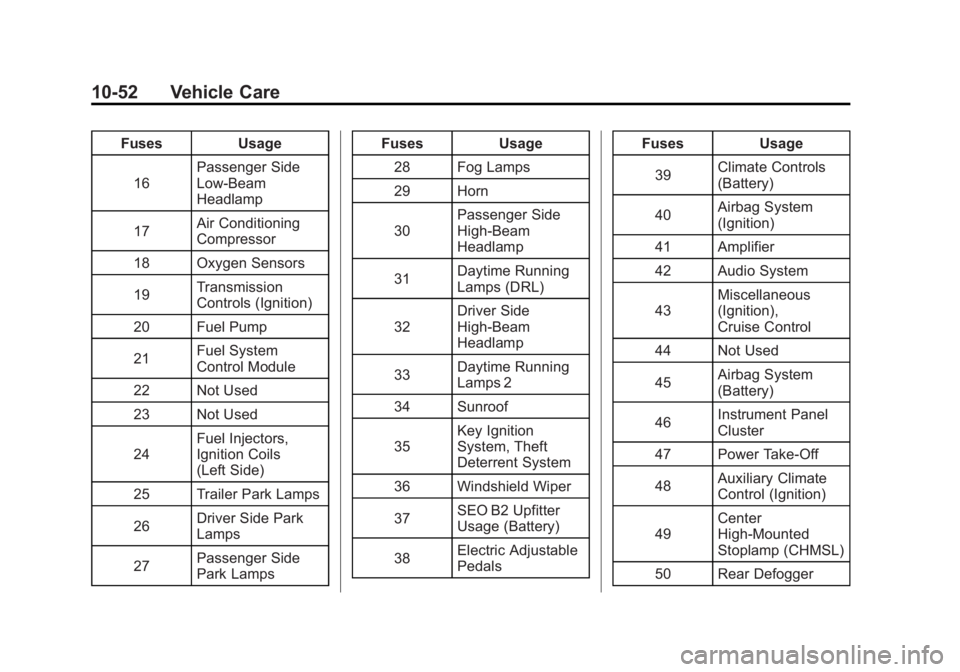
FusesUsage
16 Passenger Side
Low-Beam
Headlamp
17 Air Conditioning
Compressor
18 Oxygen Sensors
19 Transmission
Controls (Ignition)
20 Fuel Pump
21 Fuel System
Control Module
22 Not Used
23 Not Used
24 Fuel Injectors,
Ignition Coils
(Left Side)
25 Trailer Park Lamps
26 Driver Side Park
Lamps
27 Passenger Side
Park Lamps Fuses
Usage
28 Fog Lamps
29 Horn
30 Passenger Side
High-Beam
Headlamp
31 Daytime Running
Lamps (DRL)
32 Driver Side
High-Beam
Headlamp
33 Daytime Running
Lamps 2
34 Sunroof
35 Key Ignition
System, Theft
Deterrent System
36 Windshield Wiper
37 SEO B2 Upfitter
Usage (Battery)
38 Electric Adjustable
Pedals Fuses
Usage
39 Climate Controls
(Battery)
40 Airbag System
(Ignition)
41 Amplifier
42 Audio System
43 Miscellaneous
(Ignition),
Cruise Control
44 Not Used
45 Airbag System
(Battery)
46 Instrument Panel
Cluster
47 Power Take-Off
48 Auxiliary Climate
Control (Ignition)
49 Center
High-Mounted
Stoplamp (CHMSL)
50 Rear Defogger
Page 543 of 594
Black plate (3,1)GMC Sierra Owner Manual - 2011
Service and Maintenance 11-3
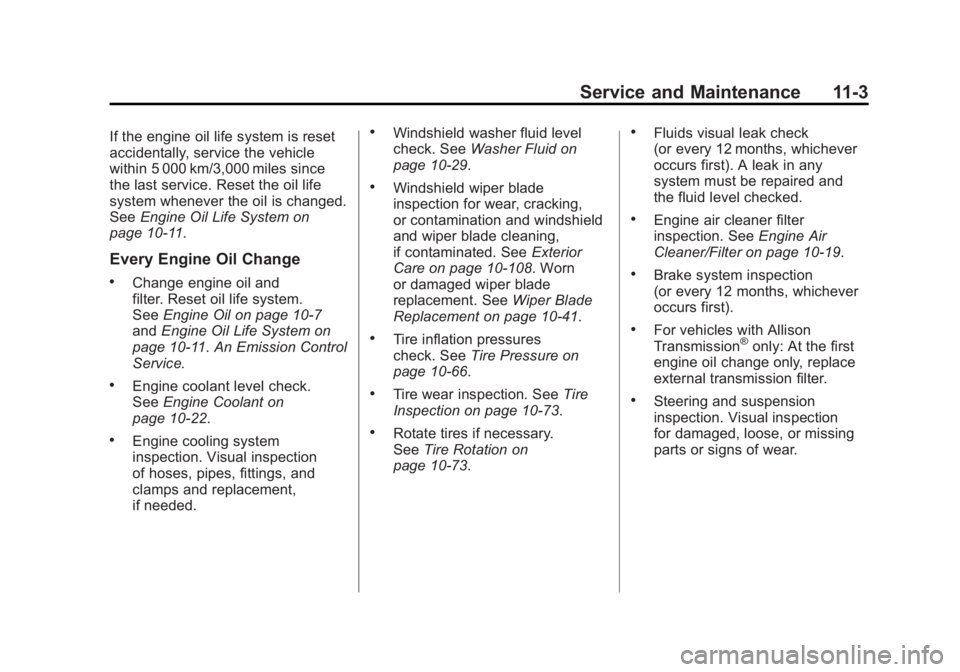
If the engine oil life system is reset
accidentally, service the vehicle
within 5 000 km/3,000 miles since
the last service. Reset the oil life
system whenever the oil is changed.
SeeEngine Oil Life System on
page 10‑11.
Every Engine Oil Change
.Change engine oil and
filter. Reset oil life system.
See Engine Oil on page 10‑7
and Engine Oil Life System on
page 10‑11. An Emission Control
Service.
.Engine coolant level check.
See Engine Coolant on
page 10‑22.
.Engine cooling system
inspection. Visual inspection
of hoses, pipes, fittings, and
clamps and replacement,
if needed.
.Windshield washer fluid level
check. See Washer Fluid on
page 10‑29.
.Windshield wiper blade
inspection for wear, cracking,
or contamination and windshield
and wiper blade cleaning,
if contaminated. See Exterior
Care on page 10‑108. Worn
or damaged wiper blade
replacement. See Wiper Blade
Replacement on page 10‑41.
.Tire inflation pressures
check. See Tire Pressure on
page 10‑66.
.Tire wear inspection. See Tire
Inspection on page 10‑73.
.Rotate tires if necessary.
See Tire Rotation on
page 10‑73.
.Fluids visual leak check
(or every 12 months, whichever
occurs first). A leak in any
system must be repaired and
the fluid level checked.
.Engine air cleaner filter
inspection. See Engine Air
Cleaner/Filter on page 10‑19.
.Brake system inspection
(or every 12 months, whichever
occurs first).
.For vehicles with Allison
Transmission®only: At the first
engine oil change only, replace
external transmission filter.
.Steering and suspension
inspection. Visual inspection
for damaged, loose, or missing
parts or signs of wear.
Page 545 of 594
Black plate (5,1)GMC Sierra Owner Manual - 2011
Service and Maintenance 11-5
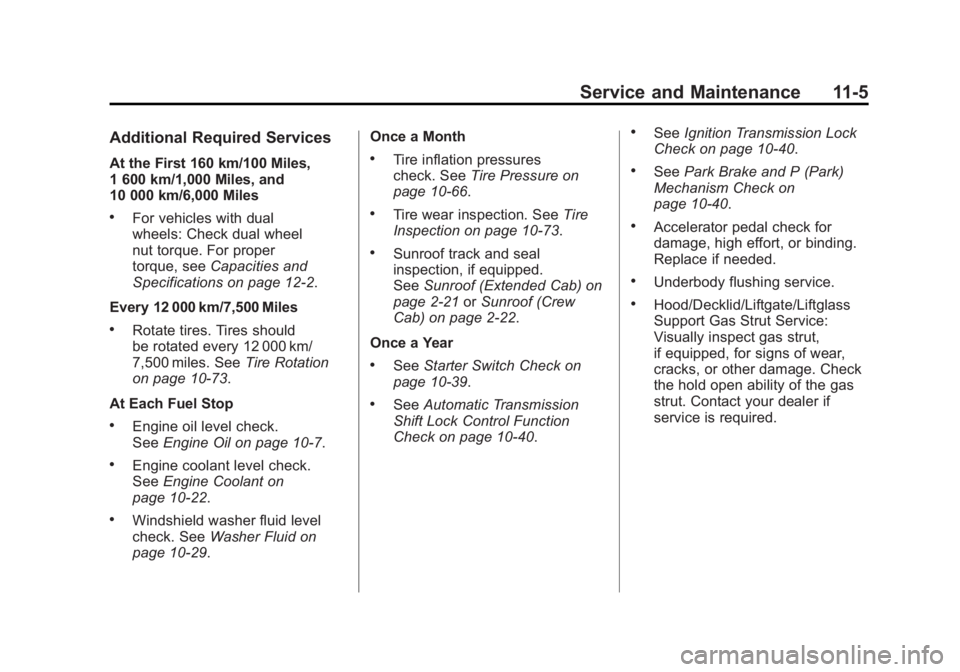
Additional Required Services
At the First 160 km/100 Miles,
1 600 km/1,000 Miles, and
10 000 km/6,000 Miles
.For vehicles with dual
wheels: Check dual wheel
nut torque. For proper
torque, seeCapacities and
Specifications on page 12‑2.
Every 12 000 km/7,500 Miles
.Rotate tires. Tires should
be rotated every 12 000 km/
7,500 miles. See Tire Rotation
on page 10‑73.
At Each Fuel Stop
.Engine oil level check.
See Engine Oil on page 10‑7.
.Engine coolant level check.
SeeEngine Coolant on
page 10‑22.
.Windshield washer fluid level
check. See Washer Fluid on
page 10‑29. Once a Month
.Tire inflation pressures
check. See
Tire Pressure on
page 10‑66.
.Tire wear inspection. See Tire
Inspection on page 10‑73.
.Sunroof track and seal
inspection, if equipped.
See Sunroof (Extended Cab) on
page 2‑21 orSunroof (Crew
Cab) on page 2‑22.
Once a Year
.See Starter Switch Check on
page 10‑39.
.See Automatic Transmission
Shift Lock Control Function
Check on page 10‑40.
.See Ignition Transmission Lock
Check on page 10‑40.
.See Park Brake and P (Park)
Mechanism Check on
page 10‑40.
.Accelerator pedal check for
damage, high effort, or binding.
Replace if needed.
.Underbody flushing service.
.Hood/Decklid/Liftgate/Liftglass
Support Gas Strut Service:
Visually inspect gas strut,
if equipped, for signs of wear,
cracks, or other damage. Check
the hold open ability of the gas
strut. Contact your dealer if
service is required.
Page 546 of 594
Black plate (6,1)GMC Sierra Owner Manual - 2011
11-6 Service and Maintenance
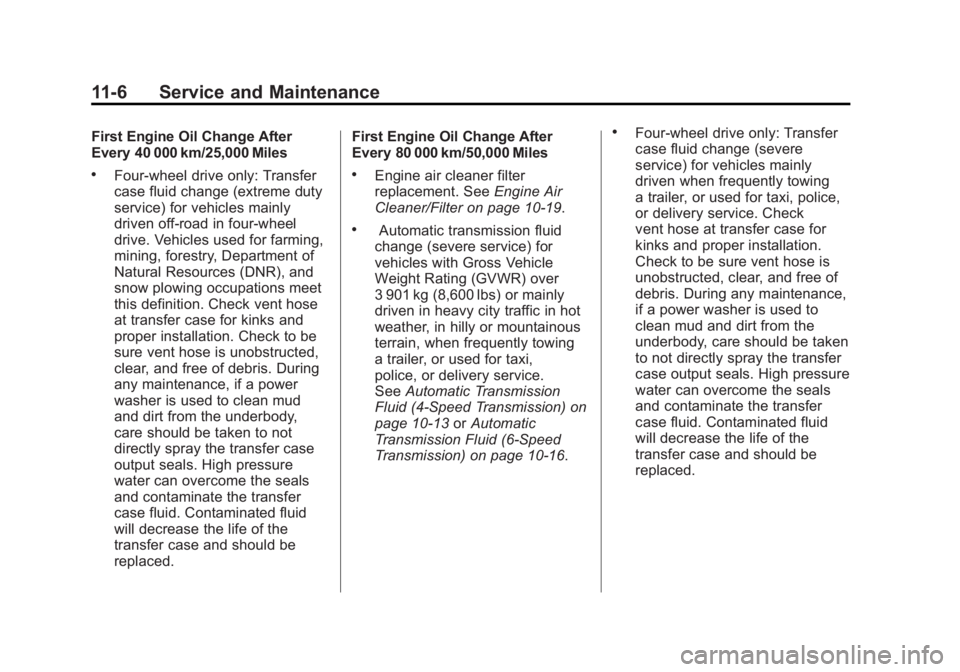
First Engine Oil Change After
Every 40 000 km/25,000 Miles
.Four‐wheel drive only: Transfer
case fluid change (extreme duty
service) for vehicles mainly
driven off‐road in four‐wheel
drive. Vehicles used for farming,
mining, forestry, Department of
Natural Resources (DNR), and
snow plowing occupations meet
this definition. Check vent hose
at transfer case for kinks and
proper installation. Check to be
sure vent hose is unobstructed,
clear, and free of debris. During
any maintenance, if a power
washer is used to clean mud
and dirt from the underbody,
care should be taken to not
directly spray the transfer case
output seals. High pressure
water can overcome the seals
and contaminate the transfer
case fluid. Contaminated fluid
will decrease the life of the
transfer case and should be
replaced.First Engine Oil Change After
Every 80 000 km/50,000 Miles.Engine air cleaner filter
replacement. See
Engine Air
Cleaner/Filter on page 10‑19.
.Automatic transmission fluid
change (severe service) for
vehicles with Gross Vehicle
Weight Rating (GVWR) over
3 901 kg (8,600 lbs) or mainly
driven in heavy city traffic in hot
weather, in hilly or mountainous
terrain, when frequently towing
a trailer, or used for taxi,
police, or delivery service.
See Automatic Transmission
Fluid (4-Speed Transmission) on
page 10‑13 orAutomatic
Transmission Fluid (6-Speed
Transmission) on page 10‑16.
.Four‐wheel drive only: Transfer
case fluid change (severe
service) for vehicles mainly
driven when frequently towing
a trailer, or used for taxi, police,
or delivery service. Check
vent hose at transfer case for
kinks and proper installation.
Check to be sure vent hose is
unobstructed, clear, and free of
debris. During any maintenance,
if a power washer is used to
clean mud and dirt from the
underbody, care should be taken
to not directly spray the transfer
case output seals. High pressure
water can overcome the seals
and contaminate the transfer
case fluid. Contaminated fluid
will decrease the life of the
transfer case and should be
replaced.
Page 547 of 594

Black plate (7,1)GMC Sierra Owner Manual - 2011
Service and Maintenance 11-7
.Evaporative control system
inspection. Check all fuel and
vapor lines and hoses for proper
hook‐up, routing, and condition.
Check that the purge valve,
if the vehicle has one, works
properly. Replace as needed.
An Emission Control Service.
The U.S. Environmental
Protection Agency or the
California Air Resources Board
has determined that the failure
to perform this maintenance
item will not nullify the emission
warranty or limit recall liability
prior to the completion of
the vehicle's useful life.
We, however, urge that all
recommended maintenance
services be performed at the
indicated intervals and the
maintenance be recorded.First Engine Oil Change After
Every 160 000 km/100,000 Miles
.Automatic transmission fluid
change (normal service).
See
Automatic Transmission
Fluid (4-Speed Transmission) on
page 10‑13 orAutomatic
Transmission Fluid (6-Speed
Transmission) on page 10‑16.
.Four‐wheel drive only: Transfer
case fluid change (normal
service). Check vent hose at
transfer case for kinks and
proper installation. Check to be
sure vent hose is unobstructed,
clear, and free of debris. During
any maintenance, if a power
washer is used to clean mud
and dirt from the underbody,
care should be taken to not
directly spray the transfer case
output seals. High pressure
water can overcome the seals and contaminate the transfer
case fluid. Contaminated fluid
will decrease the life of the
transfer case and should be
replaced.
.Spark plug replacement and
spark plug wires inspection.
An Emission Control Service.
First Engine Oil Change After
Every 240 000 km/150,000 Miles
.Engine cooling system drain,
flush, and refill (or every five
years, whichever occurs first).
See Engine Coolant on
page 10‑22. An Emission
Control Service.
.Engine drive belts inspection
for fraying, excessive cracks,
or obvious damage (or every
10 years, whichever occurs
first). Replace, if needed.
Page 548 of 594

Black plate (8,1)GMC Sierra Owner Manual - 2011
11-8 Service and Maintenance
Recommended Fluids, Lubricants, and Parts
Recommended Fluids and Lubricants
This maintenance section applies to vehicles with a gasoline engine. If the vehicle has a diesel engine and/or an
Allison Transmission, see the maintenance schedule section in the DURAMAX®Diesel manual.
Fluids and lubricants identified below by name, part number, or specification can be obtained from your dealer.
Usage Fluid/Lubricant
Engine Oil The engine requires engine oil approved to the dexos specification. Oils
meeting this specification can be identified with the dexos certification
mark. Look for and use only an engine oil that displays the dexos
certification mark of the proper viscosity grade. See
Engine Oil on
page 10‑7.
Engine Coolant 50/50 mixture of clean, drinkable water and use only DEX-COOL coolant.
See
Engine Coolant on page 10‑22.
Hydraulic Brake System DOT 3 Hydraulic Brake Fluid (GM Part No. 12377967,
in Canada 89021320).
Windshield Washer Optikleen
®Washer Solvent.
Power Steering System GM Power Steering Fluid (GM Part No. 89021184, in Canada 89021186).
Automatic Transmission DEXRON
®-VI Automatic Transmission Fluid.
Key Lock Cylinders Multi-Purpose Lubricant, Superlube (GM Part No. 12346241,
in Canada 10953474).