wheel GMC SIERRA 2013 Manual PDF
[x] Cancel search | Manufacturer: GMC, Model Year: 2013, Model line: SIERRA, Model: GMC SIERRA 2013Pages: 534, PDF Size: 6.47 MB
Page 323 of 534
Black plate (57,1)GMC Sierra Owner Manual - 2013 - crc - 8/14/12
Driving and Operating 9-57
[(Cancel):Press to disengage
cruise control without erasing the
set speed from memory.
Setting Cruise Control
If the cruise button is on when not in
use, it could get bumped and go into
cruise when not desired. Keep the
cruise control switch off when cruise
is not being used.
The cruise control light on the
instrument panel cluster will come
on after the cruise control has been
set to the desired speed.
1. Press
I.
2. Get up to the desired speed.
3. Press the SET− button located
on the steering wheel and
release it.
4. Take your foot off the accelerator. Resuming a Set Speed
If the cruise control is set at a
desired speed and then the brakes
are applied, the cruise control is
disengaged without erasing the set
speed from memory.
Once the vehicle speed reaches
about 40 km/h (25 mph) or more,
press the +RES button on the
steering wheel. The vehicle returns
to the previous set speed and stays
there.
Increasing Speed While Using
Cruise Control
If the cruise control system is
already activated,
.Press and hold the +RES button
on the steering wheel until the
desired speed is reached, then
release it.
.To increase vehicle speed in
small amounts, press the +RES
button. Each time this is done,
the vehicle goes about 1.6 km/h
(1 mph) faster.Reducing Speed While Using
Cruise Control
If the cruise control system is
already activated,
.Press and hold the SET–
button
on the steering wheel until the
desired lower speed is reached,
then release it.
.To slow down in small amounts,
press the SET– button on the
steering wheel briefly. Each time
this is done, the vehicle goes
about 1.6 km/h (1 mph) slower.
Passing Another Vehicle While
Using Cruise Control
Use the accelerator pedal to
increase the vehicle speed. When
you take your foot off the pedal, the
vehicle will slow down to the
previous set cruise speed.
Page 324 of 534
Black plate (58,1)GMC Sierra Owner Manual - 2013 - crc - 8/14/12
9-58 Driving and Operating
Using Cruise Control on Hills
How well the cruise control works
on hills depends on the vehicle
speed, the load, and the steepness
of the hills. When going up steep
hills, pressing the accelerator pedal
may be necessary to maintain
vehicle speed.
While going downhill:
.Vehicles with a four speed
automatic transmission may
need to have the brakes applied
or the transmission shifted to a
lower gear to maintain driver
selected speed.
.Vehicles with a six speed
automatic transmission and a
gasoline engine have Cruise
Grade Braking to help maintain
driver selected speed.Cruise Grade Braking is enabled
when the vehicle is started and
Cruise Control is active. It is not
enabled in Range Selection
Mode. It assists in maintaining
driver selected speed when
driving on downhill grades by
using the engine and
transmission to slow the vehicle.
To disable and enable Cruise
Grade Braking for the current
ignition key cycle, press and
hold the Tow/Haul button for
three seconds. A DIC message
displays. See
Transmission
Messages on page 5‑44..Vehicles with a diesel engine
have Cruise Grade Braking
enabled when Tow/Haul Mode is
on, the exhaust brake is on,
or both are on.
For other forms of Grade Braking,
see Automatic Transmission on
page 9‑32 andTow/Haul Mode on
page 9‑37. Ending Cruise Control
There are three ways to end cruise
control:
.To disengage cruise control;
step lightly on the brake pedal.
.Press[on the steering wheel.
.To turn off the cruise control,
press
Ion the steering wheel.
Erasing Speed Memory
The cruise control set speed is
erased from memory by pressing
Ior if the ignition is turned off.
Page 328 of 534
Black plate (62,1)GMC Sierra Owner Manual - 2013 - crc - 8/14/12
9-62 Driving and Operating
The symbols appear near objects
detected by the URPA system. The
symbol may cover the object when
viewing the navigation screen.
To turn the symbols on or off:
1. Make sure that URPA has notbeen disabled.
2. Shift into P (Park).
3. Press MENU to enter the configure menu options. Turn
the Multifunction knob until the
Display feature is highlighted
and press the Multifunction
knob. Or press the Display
screen button
4. Select the Rear Camera Options screen button. The Rear Camera
Options screen displays.
5. Touch the Symbols screen button. The screen button will be
highlighted when on. Guidelines
The RVC system has a guideline
overlay that can help the driver align
the vehicle when backing into a
parking spot.
If the vehicle has dual rear wheels,
this feature will not be available.
To turn the guidelines on or off:
1. Make sure that URPA has not
been disabled.
2. Shift into P (Park).
3. Press MENU to enter the configure menu options. Turn
the Multifunction knob until the
Display feature is highlighted
and press the Multifunction
knob. Or press the Display
screen button
4. Select the Rear Camera Options screen button. The Rear Camera
Options screen displays.
5. Touch the Guidelines screen button. The screen button will be
highlighted when on.RVC Location
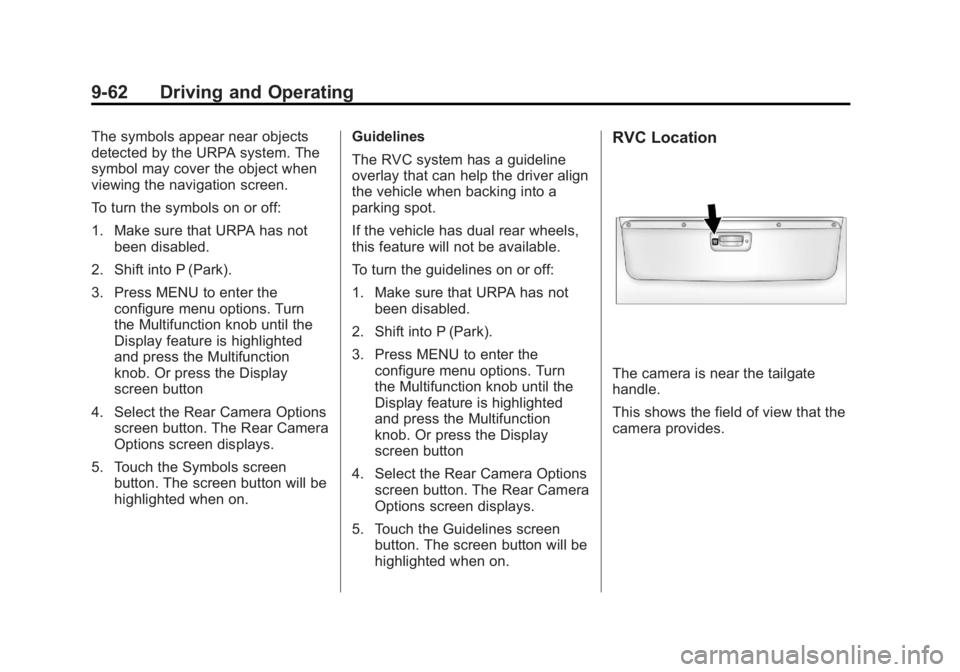
The camera is near the tailgate
handle.
This shows the field of view that the
camera provides.
Page 338 of 534
Black plate (72,1)GMC Sierra Owner Manual - 2013 - crc - 8/14/12
9-72 Driving and Operating
combination moving and then apply
the trailer brake controller by hand
to be sure the brakes work.
During the trip, check occasionally
to be sure that the load is secure
and the lamps and any trailer
brakes still work.
Following Distance
Stay at least twice as far behind the
vehicle ahead as you would when
driving the vehicle without a trailer.
This can help to avoid heavy
braking and sudden turns.
Passing
More passing distance is needed
when towing a trailer. The
combination will not accelerate as
quickly and is longer so it is
necessary to go much farther
beyond the passed vehicle before
returning to the lane.
Backing Up
Hold the bottom of the steering
wheel with one hand. To move the
trailer to the left, move that hand tothe left. To move the trailer to the
right, move your hand to the right.
Always back up slowly and,
if possible, have someone
guide you.
Making Turns
Notice:
Making very sharp turns
while trailering could cause the
trailer to come in contact with the
vehicle. The vehicle could be
damaged. Avoid making very
sharp turns while trailering.
When turning with a trailer, make
wider turns than normal. Do this so
the trailer will not strike soft
shoulders, curbs, road signs, trees,
or other objects. Avoid jerky or
sudden maneuvers. Signal well in
advance.
If the trailer turn signal bulbs burn
out, the arrows on the instrument
cluster will still flash for turns. It is
important to check occasionally to
be sure the trailer bulbs are still
working.
Driving on Grades
Reduce speed and shift to a lower
gear before starting down a long or
steep downgrade. If the
transmission is not shifted down, the
brakes might get hot and no longer
work well.
Vehicles can tow in D (Drive). Shift
the transmission to a lower gear if
the transmission shifts too often
under heavy loads and/or hilly
conditions.
The Tow/Haul Mode may be used if
the transmission shifts too often.
See Tow/Haul Mode on page 9‑37.
When towing at high altitude on
steep uphill grades, consider the
following: Engine coolant will boil at
a lower temperature than at normal
altitudes. If the engine is turned off
immediately after towing at high
altitude on steep uphill grades, the
vehicle may show signs similar to
engine overheating. To avoid this,
let the engine run while parked,
preferably on level ground, with the
automatic transmission in P (Park)
Page 339 of 534
Black plate (73,1)GMC Sierra Owner Manual - 2013 - crc - 8/14/12
Driving and Operating 9-73
for a few minutes before turning the
engine off. If the overheat warning
comes on, seeEngine Overheating
on page 10‑20.
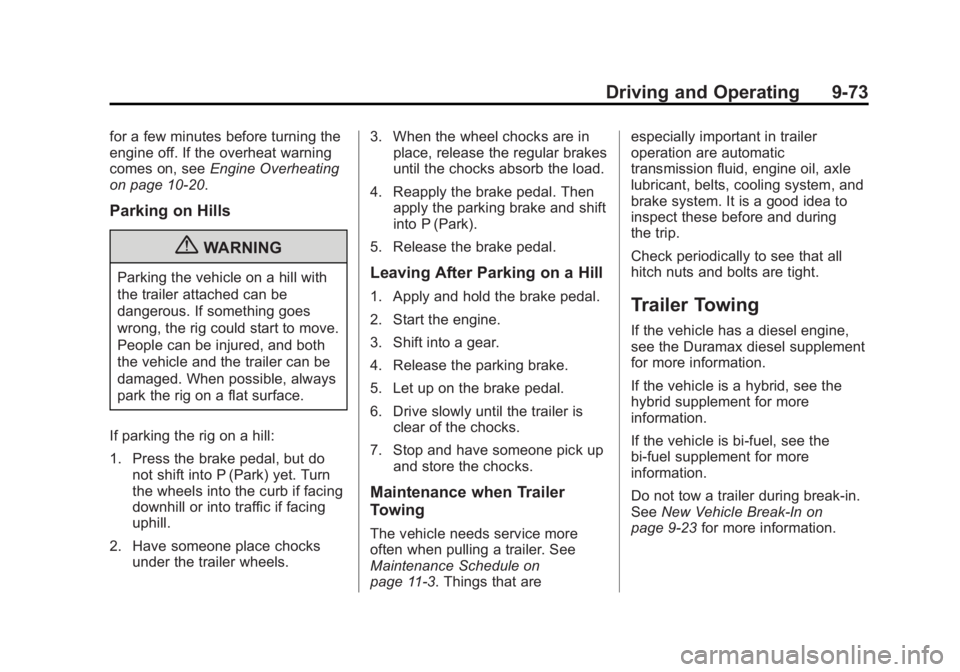
Parking on Hills
{WARNING
Parking the vehicle on a hill with
the trailer attached can be
dangerous. If something goes
wrong, the rig could start to move.
People can be injured, and both
the vehicle and the trailer can be
damaged. When possible, always
park the rig on a flat surface.
If parking the rig on a hill:
1. Press the brake pedal, but do not shift into P (Park) yet. Turn
the wheels into the curb if facing
downhill or into traffic if facing
uphill.
2. Have someone place chocks under the trailer wheels. 3. When the wheel chocks are in
place, release the regular brakes
until the chocks absorb the load.
4. Reapply the brake pedal. Then apply the parking brake and shift
into P (Park).
5. Release the brake pedal.Leaving After Parking on a Hill
1. Apply and hold the brake pedal.
2. Start the engine.
3. Shift into a gear.
4. Release the parking brake.
5. Let up on the brake pedal.
6. Drive slowly until the trailer is clear of the chocks.
7. Stop and have someone pick up and store the chocks.
Maintenance when Trailer
Towing
The vehicle needs service more
often when pulling a trailer. See
Maintenance Schedule on
page 11‑3. Things that are especially important in trailer
operation are automatic
transmission fluid, engine oil, axle
lubricant, belts, cooling system, and
brake system. It is a good idea to
inspect these before and during
the trip.
Check periodically to see that all
hitch nuts and bolts are tight.
Trailer Towing
If the vehicle has a diesel engine,
see the Duramax diesel supplement
for more information.
If the vehicle is a hybrid, see the
hybrid supplement for more
information.
If the vehicle is bi-fuel, see the
bi-fuel supplement for more
information.
Do not tow a trailer during break-in.
See
New Vehicle Break-In on
page 9‑23 for more information.
Page 341 of 534
Black plate (75,1)GMC Sierra Owner Manual - 2013 - crc - 8/14/12
Driving and Operating 9-75
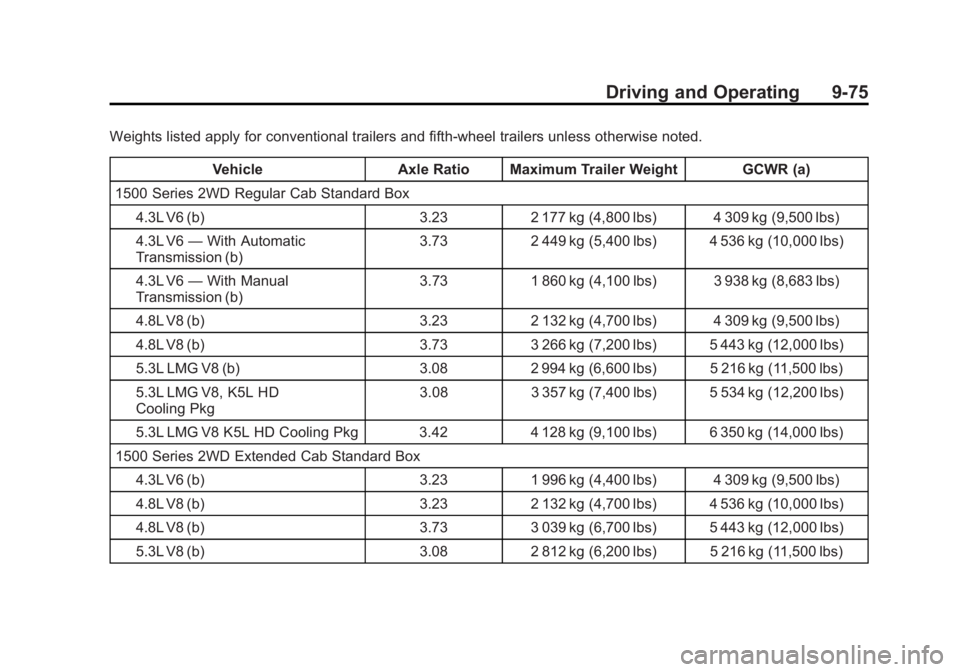
Weights listed apply for conventional trailers and fifth-wheel trailers unless otherwise noted.Vehicle Axle Ratio Maximum Trailer Weight GCWR (a)
1500 Series 2WD Regular Cab Standard Box
4.3L V6 (b) 3.232 177 kg (4,800 lbs) 4 309 kg (9,500 lbs)
4.3L V6 —With Automatic
Transmission (b) 3.73
2 449 kg (5,400 lbs) 4 536 kg (10,000 lbs)
4.3L V6 —With Manual
Transmission (b) 3.73
1 860 kg (4,100 lbs) 3 938 kg (8,683 lbs)
4.8L V8 (b) 3.232 132 kg (4,700 lbs) 4 309 kg (9,500 lbs)
4.8L V8 (b) 3.733 266 kg (7,200 lbs) 5 443 kg (12,000 lbs)
5.3L LMG V8 (b) 3.082 994 kg (6,600 lbs) 5 216 kg (11,500 lbs)
5.3L LMG V8, K5L HD
Cooling Pkg 3.08
3 357 kg (7,400 lbs) 5 534 kg (12,200 lbs)
5.3L LMG V8 K5L HD Cooling Pkg 3.42 4 128 kg (9,100 lbs) 6 350 kg (14,000 lbs)
1500 Series 2WD Extended Cab Standard Box 4.3L V6 (b) 3.231 996 kg (4,400 lbs) 4 309 kg (9,500 lbs)
4.8L V8 (b) 3.232 132 kg (4,700 lbs) 4 536 kg (10,000 lbs)
4.8L V8 (b) 3.733 039 kg (6,700 lbs) 5 443 kg (12,000 lbs)
5.3L V8 (b) 3.082 812 kg (6,200 lbs) 5 216 kg (11,500 lbs)
Page 342 of 534
Black plate (76,1)GMC Sierra Owner Manual - 2013 - crc - 8/14/12
9-76 Driving and Operating
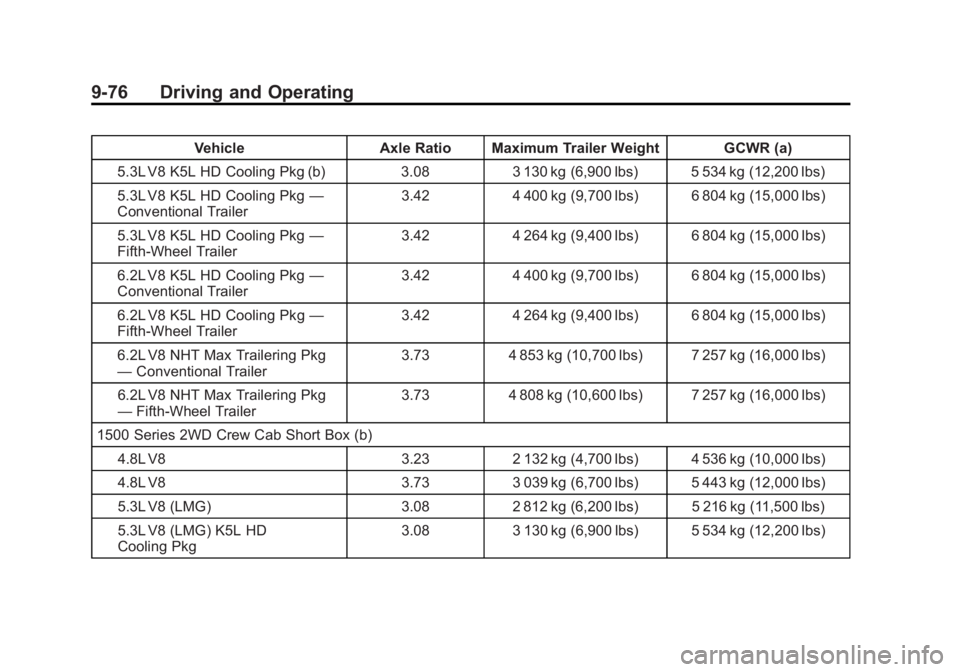
VehicleAxle Ratio Maximum Trailer Weight GCWR (a)
5.3L V8 K5L HD Cooling Pkg (b) 3.083 130 kg (6,900 lbs) 5 534 kg (12,200 lbs)
5.3L V8 K5L HD Cooling Pkg —
Conventional Trailer 3.42
4 400 kg (9,700 lbs) 6 804 kg (15,000 lbs)
5.3L V8 K5L HD Cooling Pkg —
Fifth-Wheel Trailer 3.42
4 264 kg (9,400 lbs) 6 804 kg (15,000 lbs)
6.2L V8 K5L HD Cooling Pkg —
Conventional Trailer 3.42
4 400 kg (9,700 lbs) 6 804 kg (15,000 lbs)
6.2L V8 K5L HD Cooling Pkg —
Fifth-Wheel Trailer 3.42
4 264 kg (9,400 lbs) 6 804 kg (15,000 lbs)
6.2L V8 NHT Max Trailering Pkg
— Conventional Trailer 3.73
4 853 kg (10,700 lbs) 7 257 kg (16,000 lbs)
6.2L V8 NHT Max Trailering Pkg
— Fifth-Wheel Trailer 3.73
4 808 kg (10,600 lbs) 7 257 kg (16,000 lbs)
1500 Series 2WD Crew Cab Short Box (b) 4.8L V8 3.232 132 kg (4,700 lbs) 4 536 kg (10,000 lbs)
4.8L V8 3.733 039 kg (6,700 lbs) 5 443 kg (12,000 lbs)
5.3L V8 (LMG) 3.082 812 kg (6,200 lbs) 5 216 kg (11,500 lbs)
5.3L V8 (LMG) K5L HD
Cooling Pkg 3.08
3 130 kg (6,900 lbs) 5 534 kg (12,200 lbs)
Page 343 of 534
Black plate (77,1)GMC Sierra Owner Manual - 2013 - crc - 8/14/12
Driving and Operating 9-77
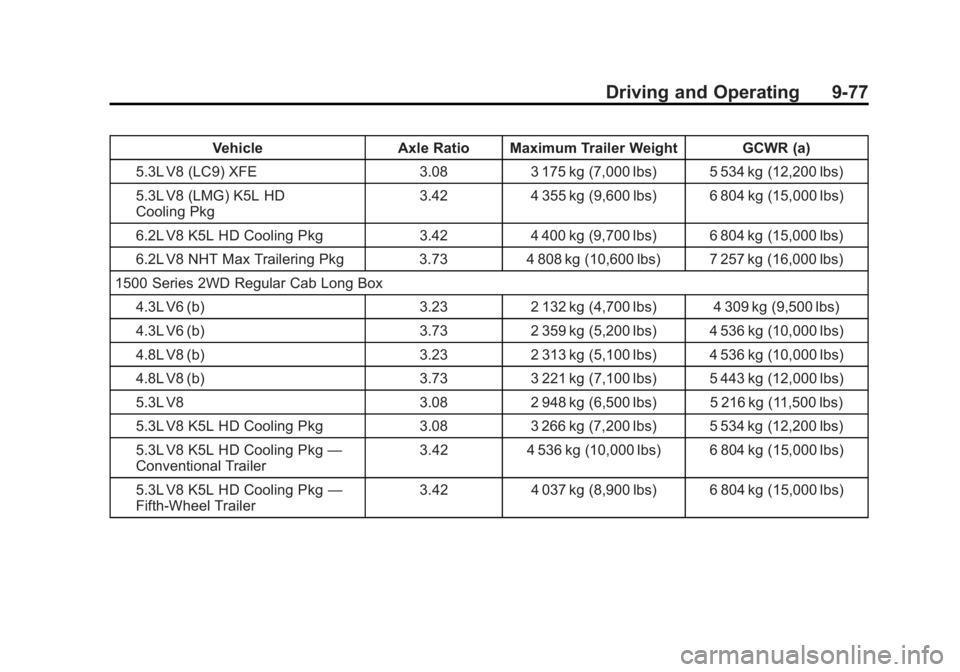
VehicleAxle Ratio Maximum Trailer Weight GCWR (a)
5.3L V8 (LC9) XFE 3.083 175 kg (7,000 lbs) 5 534 kg (12,200 lbs)
5.3L V8 (LMG) K5L HD
Cooling Pkg 3.42
4 355 kg (9,600 lbs) 6 804 kg (15,000 lbs)
6.2L V8 K5L HD Cooling Pkg 3.424 400 kg (9,700 lbs) 6 804 kg (15,000 lbs)
6.2L V8 NHT Max Trailering Pkg 3.734 808 kg (10,600 lbs) 7 257 kg (16,000 lbs)
1500 Series 2WD Regular Cab Long Box 4.3L V6 (b) 3.232 132 kg (4,700 lbs) 4 309 kg (9,500 lbs)
4.3L V6 (b) 3.732 359 kg (5,200 lbs) 4 536 kg (10,000 lbs)
4.8L V8 (b) 3.232 313 kg (5,100 lbs) 4 536 kg (10,000 lbs)
4.8L V8 (b) 3.733 221 kg (7,100 lbs) 5 443 kg (12,000 lbs)
5.3L V8 3.082 948 kg (6,500 lbs) 5 216 kg (11,500 lbs)
5.3L V8 K5L HD Cooling Pkg 3.083 266 kg (7,200 lbs) 5 534 kg (12,200 lbs)
5.3L V8 K5L HD Cooling Pkg —
Conventional Trailer 3.42
4 536 kg (10,000 lbs) 6 804 kg (15,000 lbs)
5.3L V8 K5L HD Cooling Pkg —
Fifth-Wheel Trailer 3.42
4 037 kg (8,900 lbs) 6 804 kg (15,000 lbs)
Page 344 of 534
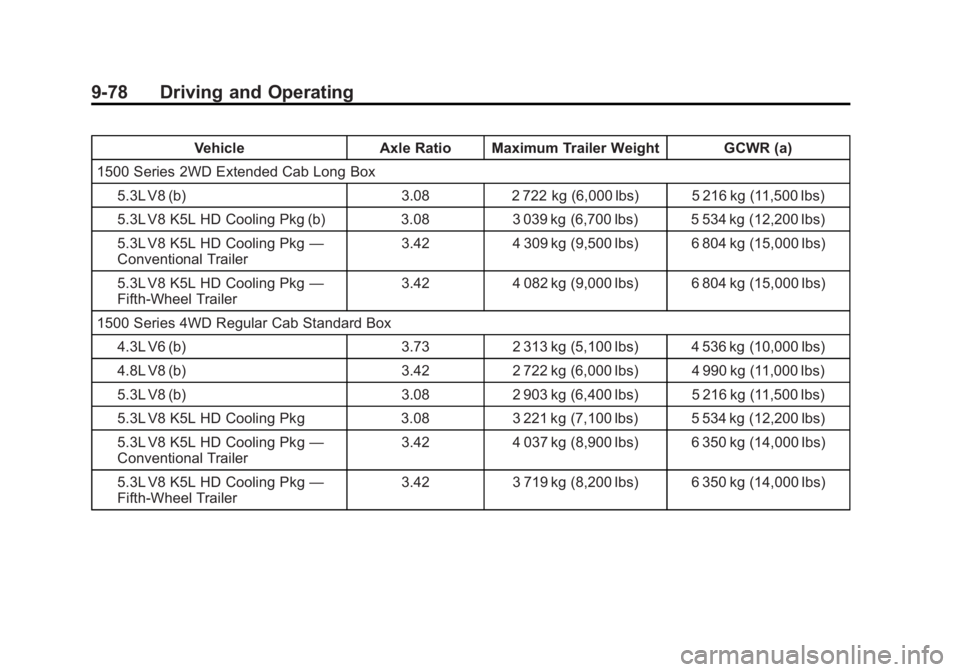
Black plate (78,1)GMC Sierra Owner Manual - 2013 - crc - 8/14/12
9-78 Driving and Operating
VehicleAxle Ratio Maximum Trailer Weight GCWR (a)
1500 Series 2WD Extended Cab Long Box 5.3L V8 (b) 3.082 722 kg (6,000 lbs) 5 216 kg (11,500 lbs)
5.3L V8 K5L HD Cooling Pkg (b) 3.083 039 kg (6,700 lbs) 5 534 kg (12,200 lbs)
5.3L V8 K5L HD Cooling Pkg —
Conventional Trailer 3.42
4 309 kg (9,500 lbs) 6 804 kg (15,000 lbs)
5.3L V8 K5L HD Cooling Pkg —
Fifth-Wheel Trailer 3.42
4 082 kg (9,000 lbs) 6 804 kg (15,000 lbs)
1500 Series 4WD Regular Cab Standard Box 4.3L V6 (b) 3.732 313 kg (5,100 lbs) 4 536 kg (10,000 lbs)
4.8L V8 (b) 3.422 722 kg (6,000 lbs) 4 990 kg (11,000 lbs)
5.3L V8 (b) 3.082 903 kg (6,400 lbs) 5 216 kg (11,500 lbs)
5.3L V8 K5L HD Cooling Pkg 3.083 221 kg (7,100 lbs) 5 534 kg (12,200 lbs)
5.3L V8 K5L HD Cooling Pkg —
Conventional Trailer 3.42
4 037 kg (8,900 lbs) 6 350 kg (14,000 lbs)
5.3L V8 K5L HD Cooling Pkg —
Fifth-Wheel Trailer 3.42
3 719 kg (8,200 lbs) 6 350 kg (14,000 lbs)
Page 345 of 534
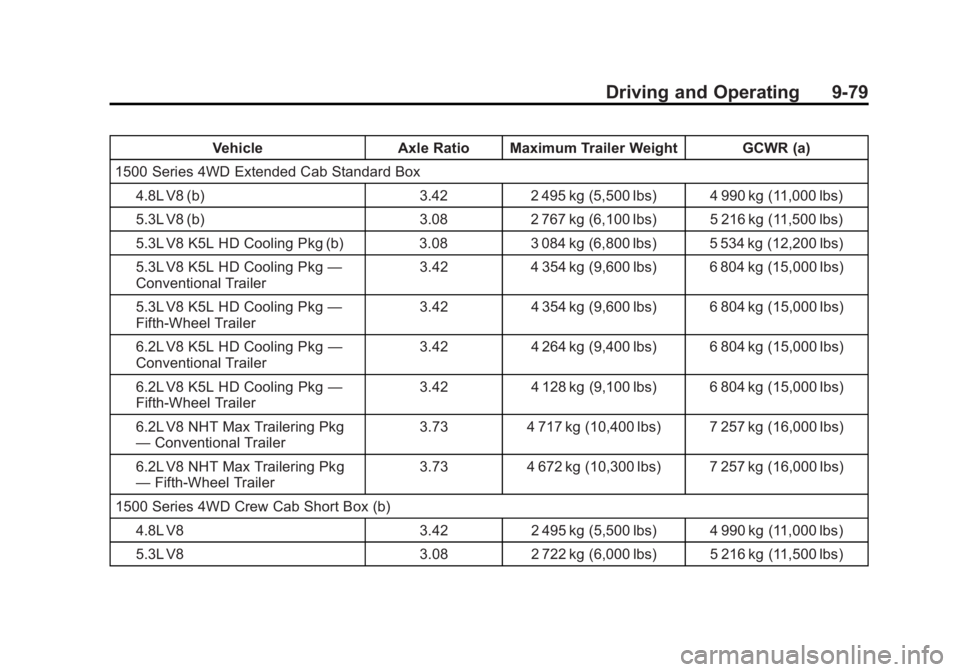
Black plate (79,1)GMC Sierra Owner Manual - 2013 - crc - 8/14/12
Driving and Operating 9-79
VehicleAxle Ratio Maximum Trailer Weight GCWR (a)
1500 Series 4WD Extended Cab Standard Box 4.8L V8 (b) 3.422 495 kg (5,500 lbs) 4 990 kg (11,000 lbs)
5.3L V8 (b) 3.082 767 kg (6,100 lbs) 5 216 kg (11,500 lbs)
5.3L V8 K5L HD Cooling Pkg (b) 3.083 084 kg (6,800 lbs) 5 534 kg (12,200 lbs)
5.3L V8 K5L HD Cooling Pkg —
Conventional Trailer 3.42
4 354 kg (9,600 lbs) 6 804 kg (15,000 lbs)
5.3L V8 K5L HD Cooling Pkg —
Fifth-Wheel Trailer 3.42
4 354 kg (9,600 lbs) 6 804 kg (15,000 lbs)
6.2L V8 K5L HD Cooling Pkg —
Conventional Trailer 3.42
4 264 kg (9,400 lbs) 6 804 kg (15,000 lbs)
6.2L V8 K5L HD Cooling Pkg —
Fifth-Wheel Trailer 3.42
4 128 kg (9,100 lbs) 6 804 kg (15,000 lbs)
6.2L V8 NHT Max Trailering Pkg
— Conventional Trailer 3.73
4 717 kg (10,400 lbs) 7 257 kg (16,000 lbs)
6.2L V8 NHT Max Trailering Pkg
— Fifth-Wheel Trailer 3.73
4 672 kg (10,300 lbs) 7 257 kg (16,000 lbs)
1500 Series 4WD Crew Cab Short Box (b) 4.8L V8 3.422 495 kg (5,500 lbs) 4 990 kg (11,000 lbs)
5.3L V8 3.082 722 kg (6,000 lbs) 5 216 kg (11,500 lbs)