wheel GMC SIERRA 2017 Manual Online
[x] Cancel search | Manufacturer: GMC, Model Year: 2017, Model line: SIERRA, Model: GMC SIERRA 2017Pages: 511, PDF Size: 5.21 MB
Page 314 of 511
GMC Sierra/Sierra Denali Owner Manual (GMNA-Localizing-U.S./Canada/
Mexico-9955992) - 2017 - crc - 4/18/17
Driving and Operating 313
When LDW is on,@is green if
LDW is available to warn of a lane
departure. If the vehicle crosses a
detected lane marking without using
the turn signal in that direction,
@
changes to amber and flashes.
Additionally, there may be three
beeps, or the driver seat may pulse
three times on the right or left,
depending on the lane departure
direction.
When the System Does Not
Seem to Work Properly
The system may not detect lanes as
well when there are:
. Close vehicles ahead.
. Sudden lighting changes, such
as when driving through tunnels.
. Banked roads. If the LDW system is not functioning
properly when lane markings are
clearly visible, cleaning the
windshield may help.
LDW alerts may occur due to tar
marks, shadows, cracks in the road,
temporary or construction lane
markings, or other road
imperfections. This is normal system
operation; the vehicle does not need
service. Turn LDW off if these
conditions continue.
Lane Keep Assist (LKA)
(1500 Series)
If equipped, LKA may help avoid
crashes due to unintentional lane
departures. It may assist by gently
turning the steering wheel if the
vehicle approaches a detected lane
marking without using a turn signal
in that direction. It may also provide
a Lane Departure Warning (LDW)
system alert as the lane marking is
crossed. The LKA system will not
assist or provide an LDW alert if it
detects that you are actively
steering. Override LKA by turning
the steering wheel. LKA uses a camera to detect lane markings
between 60 km/h (37 mph) and
180 km/h (112 mph).
{Warning
The LKA system does not
continuously steer the vehicle.
It may not keep the vehicle in the
lane or give a Lane Departure
Warning (LDW) alert, even if a
lane marking is detected.
The LKA and LDW systems
may not:
. Provide an alert or enough
steering assist to avoid a
lane departure or crash.
. Detect lane markings under
poor weather or visibility
conditions. This can occur if
the windshield or
headlamps are blocked by
dirt, snow, or ice, if they are
not in proper condition, or if
the sun shines directly into
the camera.
. Detect road edges.
(Continued)
Page 315 of 511
GMC Sierra/Sierra Denali Owner Manual (GMNA-Localizing-U.S./Canada/
Mexico-9955992) - 2017 - crc - 4/18/17
314 Driving and Operating
Warning (Continued)
.Detect lanes on winding or
hilly roads.
If LKA only detects lane markings
on one side of the road, it will
only assist or provide an LDW
alert when approaching the lane
on the side where it has detected
a lane marking. Even with LKA
and LDW, you must steer the
vehicle. Always keep your
attention on the road and
maintain proper vehicle position
within the lane, or vehicle
damage, injury, or death could
occur. Always keep the
windshield, headlamps, and
camera sensors clean and in
good repair. Do not use LKA in
bad weather conditions.
{Warning
Using LKA while towing a trailer
or on slippery roads could cause
loss of control of the vehicle and
a crash. Turn the system off.
How the System Works
The LKA camera sensor is on the
windshield ahead of the rearview
mirror.
To turn LKA on and off, press
A
on the center stack.
When on,
Ais green if LKA is
available to assist and provide LDW
alerts. It may assist by gently
turning the steering wheel and
display
Aas amber if the vehicle
approaches a detected lane marking
without using a turn signal in that
direction. It may also provide an
LDW alert by flashing
Aamber
as the lane marking is crossed.
Additionally, there may be three
beeps, or the driver seat may pulse three times, on the right or left,
depending on the lane departure
direction.
Take Steering
The LKA system does not
continuously steer the vehicle.
If LKA does not detect active driver
steering, an alert, chime, or DIC
message may be provided. Move
the steering wheel to dismiss.
When the System Does Not
Seem to Work Properly
The system performance may be
affected by:
.
Close vehicles ahead.
. Sudden lighting changes, such
as when driving through tunnels.
. Banked roads.
. Roads with poor lane markings,
such as two-lane roads.
If the LKA system is not functioning
properly when lane markings are
clearly visible, cleaning the
windshield may help.
Page 322 of 511
GMC Sierra/Sierra Denali Owner Manual (GMNA-Localizing-U.S./Canada/
Mexico-9955992) - 2017 - crc - 4/18/17
Driving and Operating 321
vehicle itself. Get acquainted with
the handling and braking of the rig
before setting out for the open road.
The structure, tires, and brakes of
the trailer must be rated to carry the
load. Inadequate trailer equipment
can cause the combination to
operate in an unexpected or unsafe
manner.
Before starting, check all trailer hitch
parts and attachments, safety
chains, electrical connectors, lamps,
tires, and mirrors. Get familiar with
the handling and braking of the rig.
If the trailer has electric brakes, start
the combination moving and then
apply the trailer brake controller by
hand to be sure the brakes work.
During the trip, check occasionally
to be sure that the load is secure
and the lamps and any trailer
brakes still work.
Following Distance
Stay at least twice as far behind the
vehicle ahead as you would when
driving the vehicle without a trailer.
This can help to avoid heavy
braking and sudden turns.
Passing
More passing distance is needed
when towing a trailer. The
combination will not accelerate as
quickly and is longer so it is
necessary to go much farther
beyond the passed vehicle before
returning to the lane.
Backing Up
Hold the bottom of the steering
wheel with one hand. To move the
trailer to the left, move that hand to
the left. To move the trailer to the
right, move your hand to the right.
Always back up slowly and,
if possible, have someone
guide you.
Making TurnsCaution
Making very sharp turns while
trailering could cause the trailer to
come in contact with the vehicle.
The vehicle could be damaged.
Avoid making very sharp turns
while trailering. When turning with a trailer, make
wider turns than normal. Do this so
the trailer will not strike soft
shoulders, curbs, road signs, trees,
or other objects. Avoid jerky or
sudden maneuvers. Signal well in
advance.
If the trailer turn signal bulbs burn
out, the arrows on the instrument
cluster will still flash for turns. It is
important to check occasionally to
be sure the trailer bulbs are still
working.
Driving on Grades
Reduce speed and shift to a lower
gear
before starting down a long or
steep downgrade. If the
transmission is not shifted down, the
brakes might get hot and no longer
work well.
Vehicles can tow in D (Drive). Shift
the transmission to a lower gear if
the transmission shifts too often
under heavy loads and/or hilly
conditions.
The Tow/Haul Mode may be used if
the transmission shifts too often.
See Tow/Haul Mode 0288.
Page 323 of 511
GMC Sierra/Sierra Denali Owner Manual (GMNA-Localizing-U.S./Canada/
Mexico-9955992) - 2017 - crc - 4/18/17
322 Driving and Operating
When towing at high altitude on
steep uphill grades, consider the
following: Engine coolant will boil at
a lower temperature than at normal
altitudes. If the engine is turned off
immediately after towing at high
altitude on steep uphill grades, the
vehicle may show signs similar to
engine overheating. To avoid this,
let the engine run while parked,
preferably on level ground, with the
transmission in P (Park) for a few
minutes before turning the engine
off. If the overheat warning comes
on, seeEngine Overheating 0376.
Parking on Hills
{Warning
Parking the vehicle on a hill with
the trailer attached can be
dangerous. If something goes
wrong, the rig could start to move.
People can be injured, and both
the vehicle and the trailer can be
damaged. When possible, always
park the rig on a flat surface. If parking the rig on a hill:
1. Press the brake pedal, but do not shift into P (Park) yet. Turn
the wheels into the curb if
facing downhill or into traffic if
facing uphill.
2. Have someone place chocks under the trailer wheels.
3. When the wheel chocks are in place, release the regular
brakes until the chocks absorb
the load.
4. Reapply the brake pedal. Then apply the parking brake and
shift into P (Park).
5. Release the brake pedal.Leaving After Parking on a Hill
1. Apply and hold the brake pedal.
2. Start the engine.
3. Shift into a gear.
4. Release the parking brake. 5. Let up on the brake pedal.
6. Drive slowly until the trailer is
clear of the chocks.
7. Stop and have someone pick up and store the chocks.
Maintenance when Trailer
Towing
The vehicle needs service more
often when pulling a trailer. See
Maintenance Schedule 0455.
Things that are especially important
in trailer operation are automatic
transmission fluid, engine oil, axle
lubricant, belts, cooling system, and
brake system. It is a good idea to
inspect these before and during
the trip.
Check periodically to see that all
hitch nuts and bolts are tight.
Page 325 of 511
GMC Sierra/Sierra Denali Owner Manual (GMNA-Localizing-U.S./Canada/
Mexico-9955992) - 2017 - crc - 4/18/17
324 Driving and Operating
For kingpin weight and trailer
tongue weight information, see
“Weight of the Trailer Tongue”later
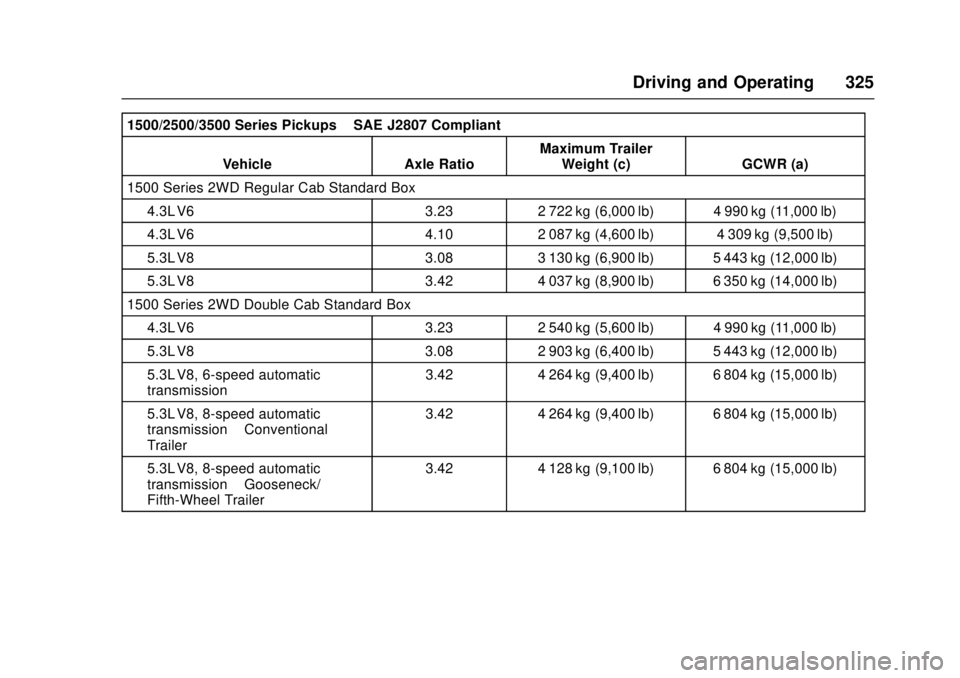
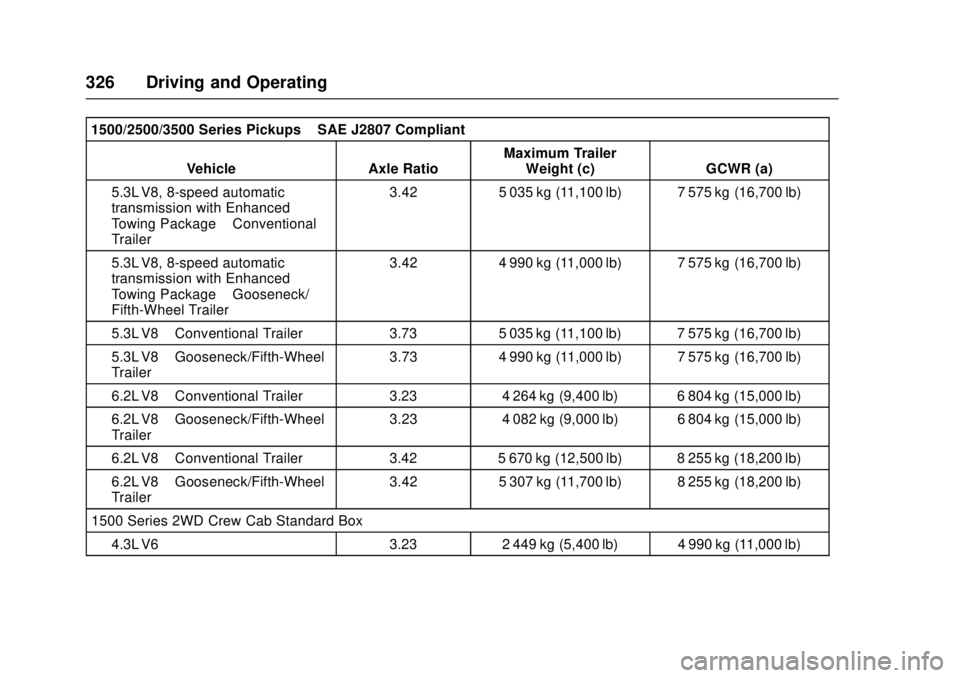
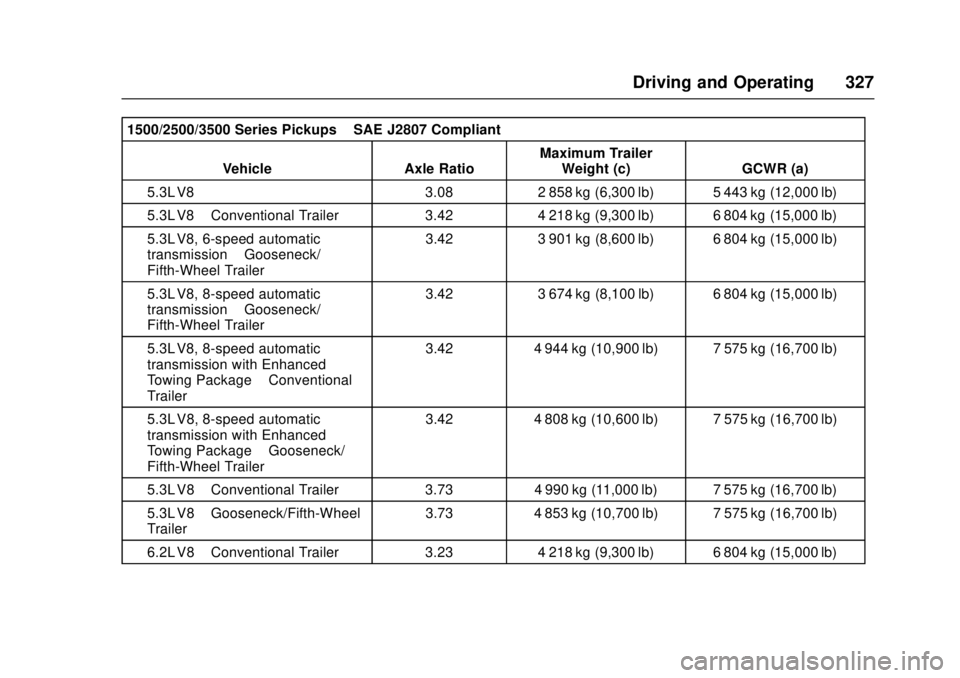
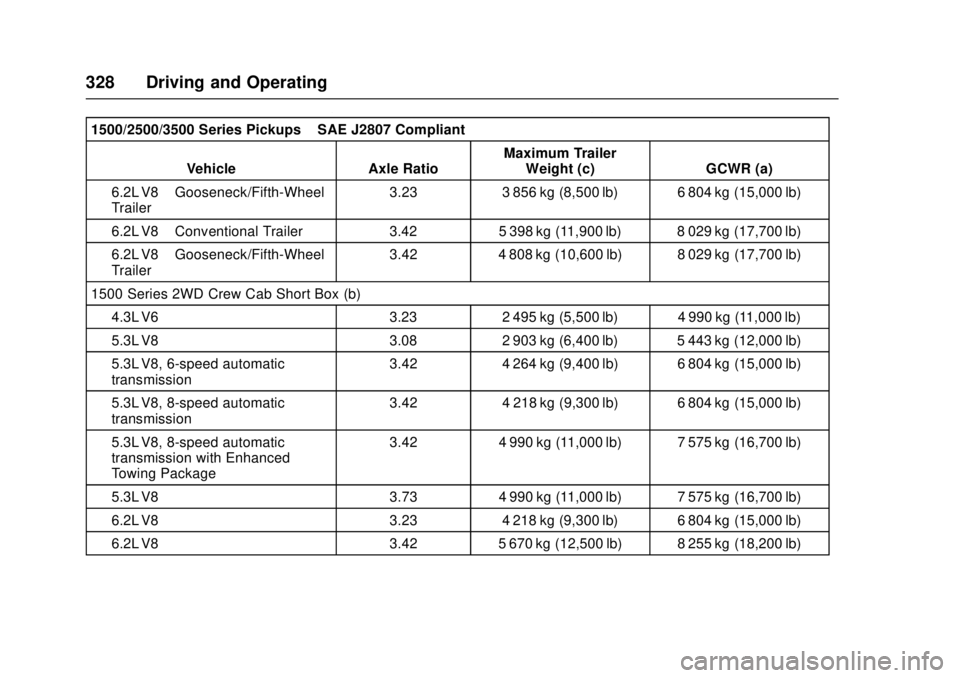
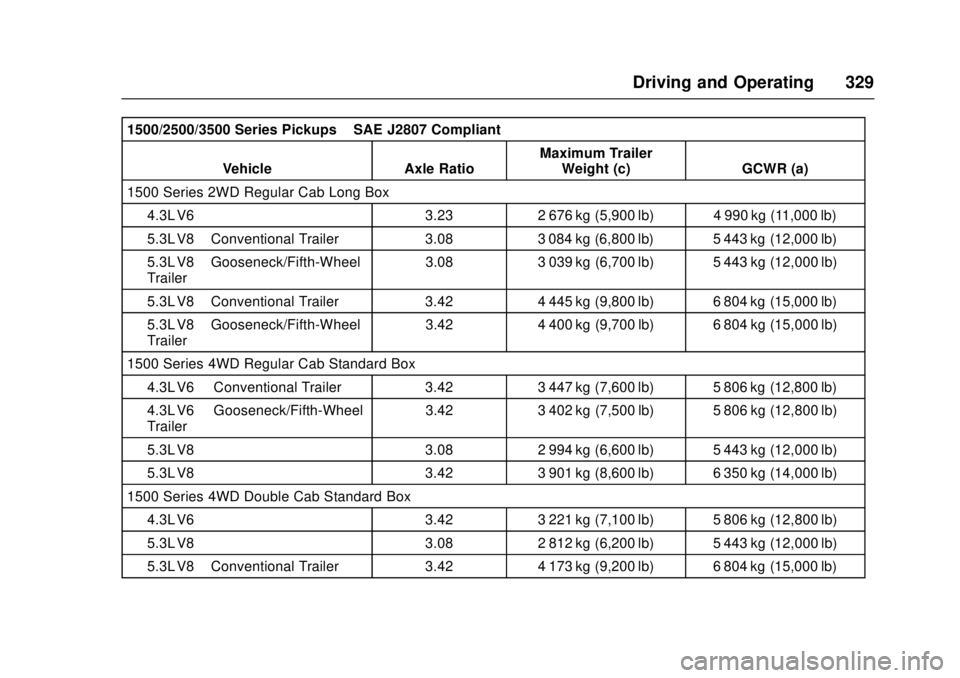
in this section. Use the following chart to determine
how much the vehicle can weigh,
based upon the vehicle model and
options.Weights listed apply for
conventional trailers and
gooseneck/fifth-wheel trailers unless
otherwise noted.
Page 326 of 511
GMC Sierra/Sierra Denali Owner Manual (GMNA-Localizing-U.S./Canada/
Mexico-9955992) - 2017 - crc - 4/18/17
Driving and Operating 325
1500/2500/3500 Series Pickups–SAE J2807 Compliant
Vehicle Axle Ratio Maximum Trailer
Weight (c) GCWR (a)
1500 Series 2WD Regular Cab Standard Box 4.3L V6 3.23 2 722 kg (6,000 lb) 4 990 kg (11,000 lb)
4.3L V6 4.10 2 087 kg (4,600 lb) 4 309 kg (9,500 lb)
5.3L V8 3.08 3 130 kg (6,900 lb) 5 443 kg (12,000 lb)
5.3L V8 3.42 4 037 kg (8,900 lb) 6 350 kg (14,000 lb)
1500 Series 2WD Double Cab Standard Box 4.3L V6 3.23 2 540 kg (5,600 lb) 4 990 kg (11,000 lb)
5.3L V8 3.08 2 903 kg (6,400 lb) 5 443 kg (12,000 lb)
5.3L V8, 6-speed automatic
transmission 3.42 4 264 kg (9,400 lb) 6 804 kg (15,000 lb)
5.3L V8, 8-speed automatic
transmission –Conventional
Trailer 3.42 4 264 kg (9,400 lb) 6 804 kg (15,000 lb)
5.3L V8, 8-speed automatic
transmission –Gooseneck/
Fifth-Wheel Trailer 3.42 4 128 kg (9,100 lb) 6 804 kg (15,000 lb)
Page 327 of 511
GMC Sierra/Sierra Denali Owner Manual (GMNA-Localizing-U.S./Canada/
Mexico-9955992) - 2017 - crc - 4/18/17
326 Driving and Operating
1500/2500/3500 Series Pickups–SAE J2807 Compliant
Vehicle Axle Ratio Maximum Trailer
Weight (c) GCWR (a)
5.3L V8, 8-speed automatic
transmission with Enhanced
Towing Package –Conventional
Trailer 3.42 5 035 kg (11,100 lb) 7 575 kg (16,700 lb)
5.3L V8, 8-speed automatic
transmission with Enhanced
Towing Package –Gooseneck/
Fifth-Wheel Trailer 3.42 4 990 kg (11,000 lb) 7 575 kg (16,700 lb)
5.3L V8 –Conventional Trailer 3.735 035 kg (11,100 lb) 7 575 kg (16,700 lb)
5.3L V8 –Gooseneck/Fifth-Wheel
Trailer 3.73
4 990 kg (11,000 lb) 7 575 kg (16,700 lb)
6.2L V8 –Conventional Trailer 3.234 264 kg (9,400 lb) 6 804 kg (15,000 lb)
6.2L V8 –Gooseneck/Fifth-Wheel
Trailer 3.23
4 082 kg (9,000 lb) 6 804 kg (15,000 lb)
6.2L V8 –Conventional Trailer 3.425 670 kg (12,500 lb) 8 255 kg (18,200 lb)
6.2L V8 –Gooseneck/Fifth-Wheel
Trailer 3.42
5 307 kg (11,700 lb) 8 255 kg (18,200 lb)
1500 Series 2WD Crew Cab Standard Box 4.3L V6 3.232 449 kg (5,400 lb) 4 990 kg (11,000 lb)
Page 328 of 511
GMC Sierra/Sierra Denali Owner Manual (GMNA-Localizing-U.S./Canada/
Mexico-9955992) - 2017 - crc - 4/18/17
Driving and Operating 327
1500/2500/3500 Series Pickups–SAE J2807 Compliant
Vehicle Axle Ratio Maximum Trailer
Weight (c) GCWR (a)
5.3L V8 3.08 2 858 kg (6,300 lb) 5 443 kg (12,000 lb)
5.3L V8 –Conventional Trailer 3.424 218 kg (9,300 lb) 6 804 kg (15,000 lb)
5.3L V8, 6-speed automatic
transmission –Gooseneck/
Fifth-Wheel Trailer 3.42
3 901 kg (8,600 lb) 6 804 kg (15,000 lb)
5.3L V8, 8-speed automatic
transmission –Gooseneck/
Fifth-Wheel Trailer 3.42
3 674 kg (8,100 lb) 6 804 kg (15,000 lb)
5.3L V8, 8-speed automatic
transmission with Enhanced
Towing Package –Conventional
Trailer 3.42
4 944 kg (10,900 lb) 7 575 kg (16,700 lb)
5.3L V8, 8-speed automatic
transmission with Enhanced
Towing Package –Gooseneck/
Fifth-Wheel Trailer 3.42
4 808 kg (10,600 lb) 7 575 kg (16,700 lb)
5.3L V8 –Conventional Trailer 3.734 990 kg (11,000 lb) 7 575 kg (16,700 lb)
5.3L V8 –Gooseneck/Fifth-Wheel
Trailer 3.73
4 853 kg (10,700 lb) 7 575 kg (16,700 lb)
6.2L V8 –Conventional Trailer 3.234 218 kg (9,300 lb) 6 804 kg (15,000 lb)
Page 329 of 511
GMC Sierra/Sierra Denali Owner Manual (GMNA-Localizing-U.S./Canada/
Mexico-9955992) - 2017 - crc - 4/18/17
328 Driving and Operating
1500/2500/3500 Series Pickups–SAE J2807 Compliant
Vehicle Axle Ratio Maximum Trailer
Weight (c) GCWR (a)
6.2L V8 –Gooseneck/Fifth-Wheel
Trailer 3.23 3 856 kg (8,500 lb) 6 804 kg (15,000 lb)
6.2L V8 –Conventional Trailer 3.425 398 kg (11,900 lb) 8 029 kg (17,700 lb)
6.2L V8 –Gooseneck/Fifth-Wheel
Trailer 3.42
4 808 kg (10,600 lb) 8 029 kg (17,700 lb)
1500 Series 2WD Crew Cab Short Box (b) 4.3L V6 3.232 495 kg (5,500 lb) 4 990 kg (11,000 lb)
5.3L V8 3.082 903 kg (6,400 lb) 5 443 kg (12,000 lb)
5.3L V8, 6-speed automatic
transmission 3.42
4 264 kg (9,400 lb) 6 804 kg (15,000 lb)
5.3L V8, 8-speed automatic
transmission 3.42
4 218 kg (9,300 lb) 6 804 kg (15,000 lb)
5.3L V8, 8-speed automatic
transmission with Enhanced
Towing Package 3.42
4 990 kg (11,000 lb) 7 575 kg (16,700 lb)
5.3L V8 3.734 990 kg (11,000 lb) 7 575 kg (16,700 lb)
6.2L V8 3.234 218 kg (9,300 lb) 6 804 kg (15,000 lb)
6.2L V8 3.425 670 kg (12,500 lb) 8 255 kg (18,200 lb)
Page 330 of 511
GMC Sierra/Sierra Denali Owner Manual (GMNA-Localizing-U.S./Canada/
Mexico-9955992) - 2017 - crc - 4/18/17
Driving and Operating 329
1500/2500/3500 Series Pickups–SAE J2807 Compliant
Vehicle Axle Ratio Maximum Trailer
Weight (c) GCWR (a)
1500 Series 2WD Regular Cab Long Box 4.3L V6 3.23 2 676 kg (5,900 lb) 4 990 kg (11,000 lb)
5.3L V8 –Conventional Trailer 3.08 3 084 kg (6,800 lb) 5 443 kg (12,000 lb)
5.3L V8 –Gooseneck/Fifth-Wheel
Trailer 3.08 3 039 kg (6,700 lb) 5 443 kg (12,000 lb)
5.3L V8 –Conventional Trailer 3.424 445 kg (9,800 lb) 6 804 kg (15,000 lb)
5.3L V8 –Gooseneck/Fifth-Wheel
Trailer 3.42
4 400 kg (9,700 lb) 6 804 kg (15,000 lb)
1500 Series 4WD Regular Cab Standard Box 4.3L V6 –Conventional Trailer 3.423 447 kg (7,600 lb) 5 806 kg (12,800 lb)
4.3L V6 –Gooseneck/Fifth-Wheel
Trailer 3.42
3 402 kg (7,500 lb) 5 806 kg (12,800 lb)
5.3L V8 3.082 994 kg (6,600 lb) 5 443 kg (12,000 lb)
5.3L V8 3.423 901 kg (8,600 lb) 6 350 kg (14,000 lb)
1500 Series 4WD Double Cab Standard Box 4.3L V6 3.423 221 kg (7,100 lb) 5 806 kg (12,800 lb)
5.3L V8 3.082 812 kg (6,200 lb) 5 443 kg (12,000 lb)
5.3L V8 –Conventional Trailer 3.424 173 kg (9,200 lb) 6 804 kg (15,000 lb)