engine GMC SIERRA CLASSIC 2007 Owners Manual
[x] Cancel search | Manufacturer: GMC, Model Year: 2007, Model line: SIERRA CLASSIC, Model: GMC SIERRA CLASSIC 2007Pages: 674, PDF Size: 3.5 MB
Page 523 of 674
5. Open the hoods and locate the positive (+)
and negative (−) terminal locations of the
other vehicle.
Your vehicle has a remote positive (+) jump
starting terminal and a remote negative (−)
jump starting terminal. You should always
use these remote terminals instead of
the terminals on the battery.
The remote positive (+) terminal is located
behind a red plastic cover, near the engine
accessory drive bracket, if your vehicle
has one. To uncover the remote positive (+)
terminal, open the red plastic cover.
The remote negative (−) terminal is located
on the engine drive bracket on all V8 and
diesel engines, and on the thermostat housing
on the 8.1L engine. On V8 engines it is
marked GND (Ground).
On V6 engines the remote negative (−)
terminal is located on a tab attached to the
engine accessory drive bracket where it
is marked GND (Ground).
SeeEngine Compartment Overview on
page 480for more information on the location
of the remote positive (+) and remote
negative (−) terminals.
{CAUTION:
Using a match near a battery can cause
battery gas to explode. People have been
hurt doing this, and some have been
blinded. Use a ashlight if you need more
light.
Be sure the battery has enough water.
You do not need to add water to the
battery installed in your new vehicle. But
if a battery has ller caps, be sure the
right amount of uid is there. If it is low,
add water to take care of that rst. If you
do not, explosive gas could be present.
Battery uid contains acid that can
burn you. Do not get it on you. If you
accidentally get it in your eyes or on your
skin, ush the place with water and get
medical help immediately.
523
Page 524 of 674
{CAUTION:
Fans or other moving engine parts can
injure you badly. Keep your hands away
from moving parts once the engine is
running.
6. Check that the jumper cables do not have
loose or missing insulation. If they do, you
could get a shock. The vehicles could
be damaged too.
Before you connect the cables, here are some
basic things you should know. Positive (+)
will go to positive (+) or a remote positive
terminal (+) if the vehicle has one. Negative (−)
will go to a heavy, unpainted metal engine
part or a remote negative (−) terminal if
the vehicle has one.Do not connect positive (+) to negative (−)or
you will get a short that would damage
the battery and maybe other parts too. And
do not connect the negative (−) cable to
the negative (−) terminal on the dead battery
because this can cause sparks.
On vehicles that have dual batteries, make all
battery connections to the remote positive (+)
and remote negative (−) terminals.
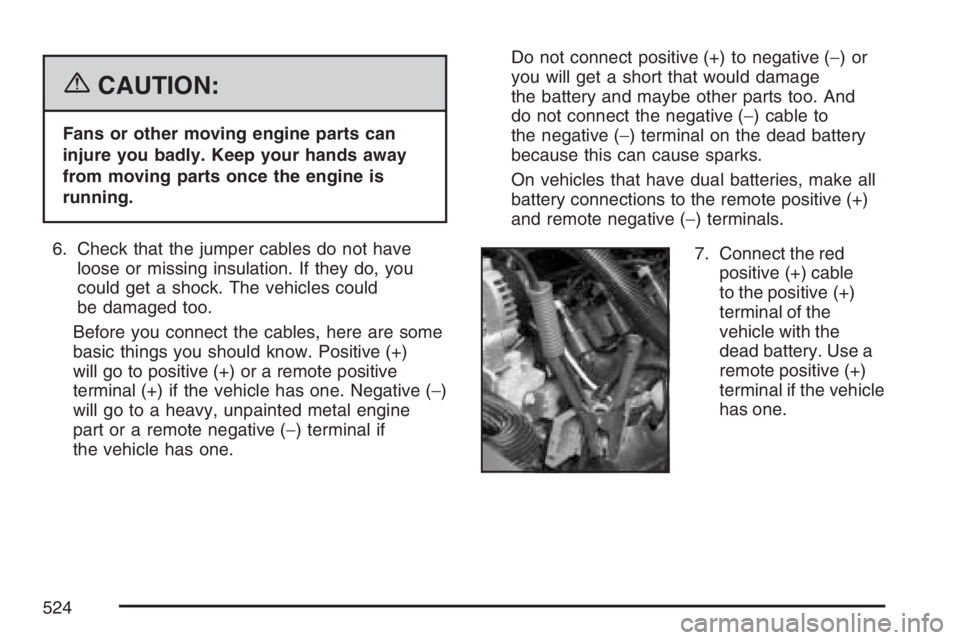
7. Connect the red
positive (+) cable
to the positive (+)
terminal of the
vehicle with the
dead battery. Use a
remote positive (+)
terminal if the vehicle
has one.
524
Page 525 of 674
8. Do not let the other end touch metal. Connect
it to the positive (+) terminal of the good
battery. Use a remote positive (+) terminal if
the vehicle has one.
9. Now connect the black negative (−) cable to
the negative (−) terminal of the good battery.
Use a remote negative (−) terminal if the
vehicle has one. The vehicle’s remote
negative (–) terminal is marked GND.
10. Do not let the other end touch anything until the
next step. The other end of the negative (−)
cable does not go to the dead battery. It goes
to a heavy unpainted metal engine part of the
vehicle with the dead battery, or to a remote
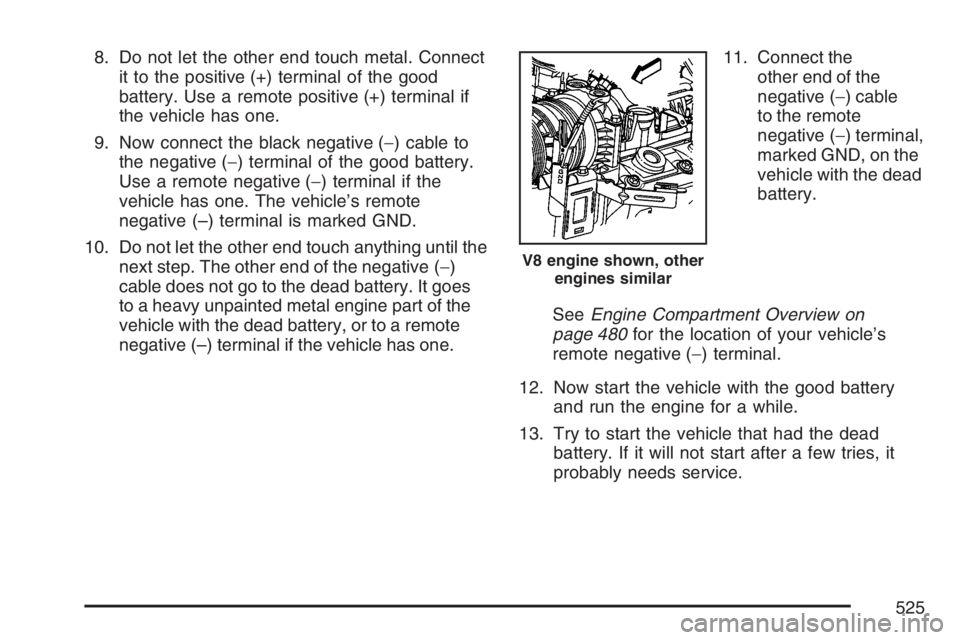
negative (–) terminal if the vehicle has one.11. Connect the
other end of the
negative (−) cable
to the remote
negative (−) terminal,
marked GND, on the
vehicle with the dead
battery.
SeeEngine Compartment Overview on
page 480for the location of your vehicle’s
remote negative (−) terminal.
12. Now start the vehicle with the good battery
and run the engine for a while.
13. Try to start the vehicle that had the dead
battery. If it will not start after a few tries, it
probably needs service.
V8 engine shown, other
engines similar
525
Page 526 of 674
Notice:If the jumper cables are connected or
removed in the wrong order, electrical shorting
may occur and damage the vehicle. The repairs
would not be covered by your warranty. Always
connect and remove the jumper cables in the
correct order, making sure that the cables do
not touch each other or other metal.
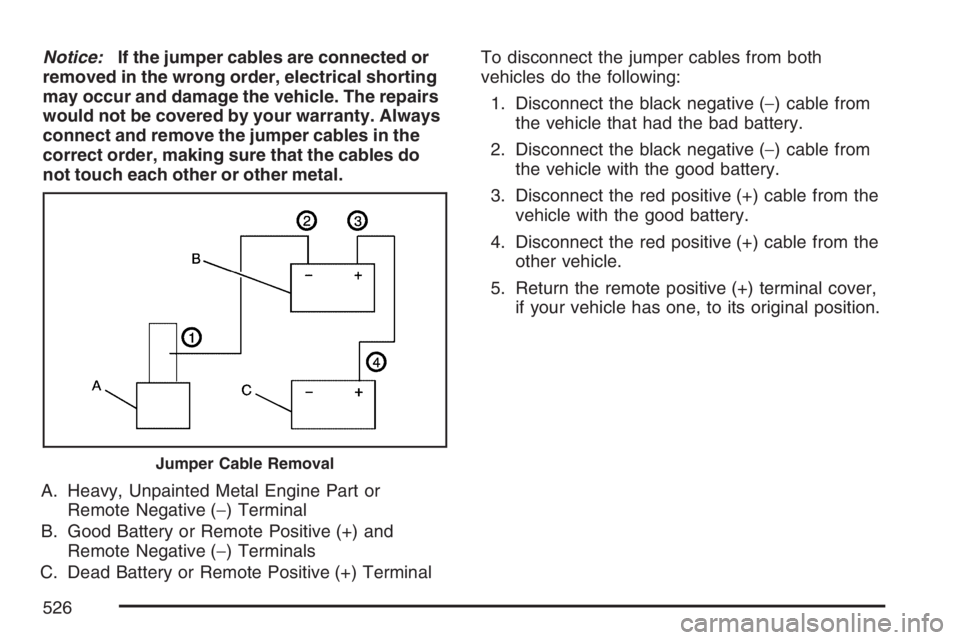
A. Heavy, Unpainted Metal Engine Part or
Remote Negative (−) Terminal
B. Good Battery or Remote Positive (+) and
Remote Negative (−) Terminals
C. Dead Battery or Remote Positive (+) TerminalTo disconnect the jumper cables from both
vehicles do the following:
1. Disconnect the black negative (−) cable from
the vehicle that had the bad battery.
2. Disconnect the black negative (−) cable from
the vehicle with the good battery.
3. Disconnect the red positive (+) cable from the
vehicle with the good battery.
4. Disconnect the red positive (+) cable from the
other vehicle.
5. Return the remote positive (+) terminal cover,
if your vehicle has one, to its original position.
Jumper Cable Removal
526
Page 527 of 674
Rear Axle
When to Check Lubricant
It is not necessary to regularly check rear axle
uid unless you suspect there is a leak or you hear
an unusual noise. A uid loss could indicate a
problem. Have it inspected and repaired.
All axle assemblies are lled by volume of uid
during production. They are not lled to reach
a certain level. When checking the uid level on
any axle, variations in the readings can be caused
by factory ll differences between the minimum
and the maximum uid volume. Also, if a vehicle
has just been driven before checking the uid
level, it may appear lower than normal because
uid has traveled out along the axle tubes and has
not drained back to the sump area. Therefore, a
reading taken ve minutes after the vehicle
has been driven will appear to have a lower uid
level than a vehicle that has been stationary
for an hour or two. Remember that the rear axle
assembly must be supported to get a true reading.
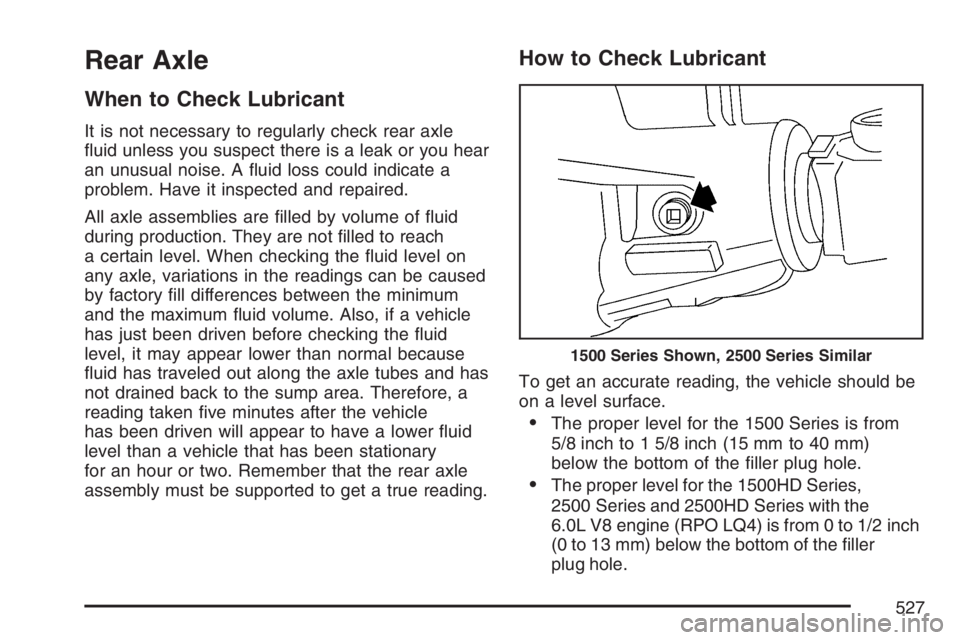
How to Check Lubricant
To get an accurate reading, the vehicle should be
on a level surface.
The proper level for the 1500 Series is from
5/8 inch to 1 5/8 inch (15 mm to 40 mm)
below the bottom of the ller plug hole.
The proper level for the 1500HD Series,
2500 Series and 2500HD Series with the
6.0L V8 engine (RPO LQ4) is from 0 to 1/2 inch
(0 to 13 mm) below the bottom of the ller
plug hole.
1500 Series Shown, 2500 Series Similar
527
Page 528 of 674
The proper level for the 2500HD with the
6.6L diesel engine (RPO LLY) or 8.1L V8
engine (RPO L18), and 3500 Series is from
0.6 to 0.8 inch (17 mm to 21 mm) below the
bottom of the ller plug hole.
Add only enough uid to reach the proper level.
What to Use
To determine what kind of lubricant to use see
Recommended Fluids and Lubricants on page 629.
Four-Wheel Drive
Lubricant checks in this section also apply to
these vehicles. There are two additional systems
that need lubrication.
Transfer Case
When to Check Lubricant
It is not necessary to regularly check transfer case
uid unless you suspect there is a leak or you
hear an unusual noise. A uid loss could indicate
a problem. Have it inspected and repaired.
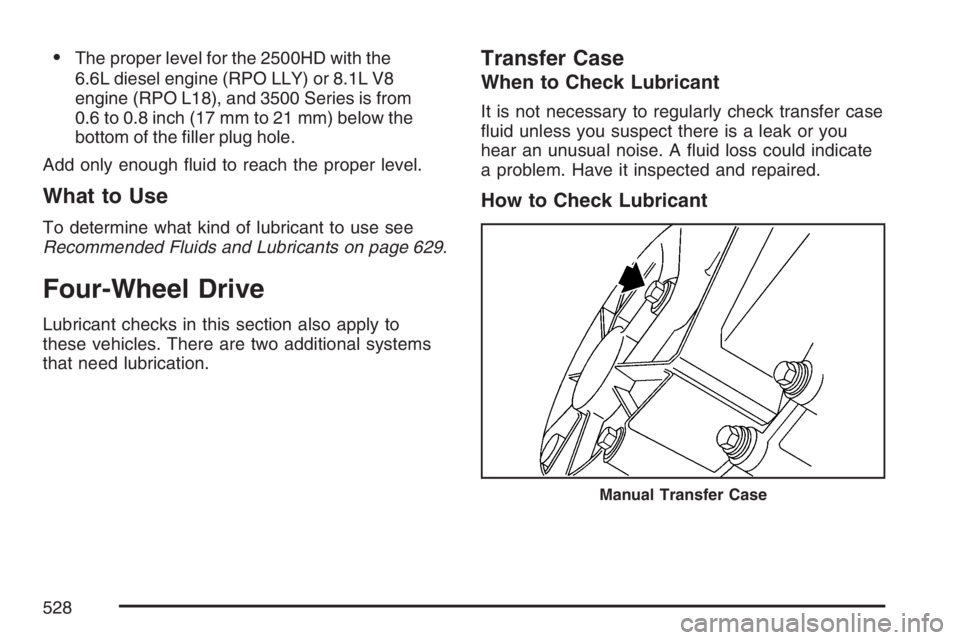
How to Check Lubricant
Manual Transfer Case
528
Page 529 of 674
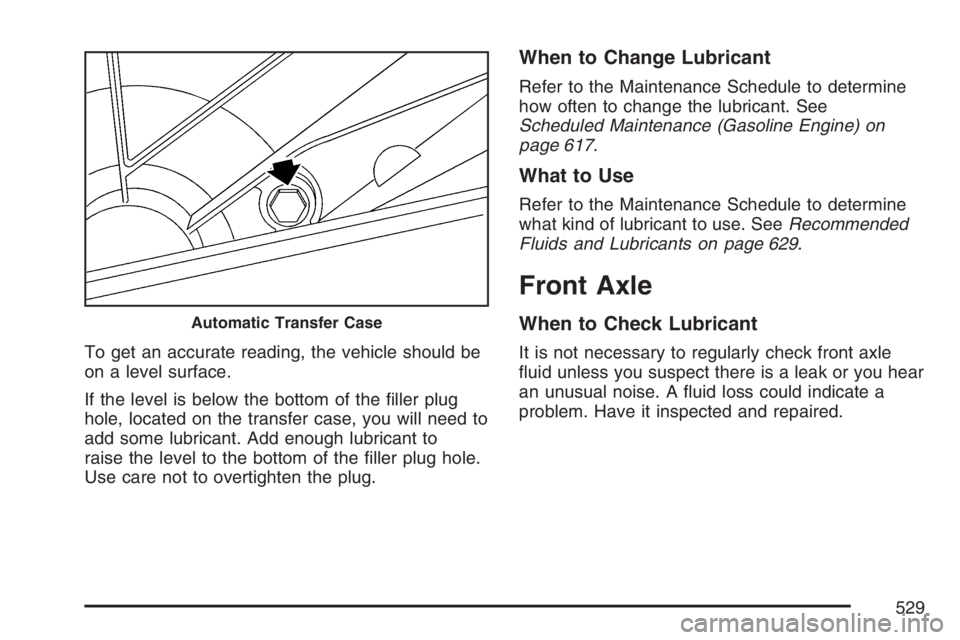
To get an accurate reading, the vehicle should be
on a level surface.
If the level is below the bottom of the ller plug
hole, located on the transfer case, you will need to
add some lubricant. Add enough lubricant to
raise the level to the bottom of the ller plug hole.
Use care not to overtighten the plug.
When to Change Lubricant
Refer to the Maintenance Schedule to determine
how often to change the lubricant. See
Scheduled Maintenance (Gasoline Engine) on
page 617.
What to Use
Refer to the Maintenance Schedule to determine
what kind of lubricant to use. SeeRecommended
Fluids and Lubricants on page 629.
Front Axle
When to Check Lubricant
It is not necessary to regularly check front axle
uid unless you suspect there is a leak or you hear
an unusual noise. A uid loss could indicate a
problem. Have it inspected and repaired.
Automatic Transfer Case
529
Page 531 of 674
Noise Control System
Tampering with Noise Control
System Prohibited
The following information relates to compliance
with federal noise emission standards for vehicles
with a Gross Vehicle Weight Rating (GVWR) of
more than 10,000 lbs (4 536 kg). The Maintenance
Schedule provides information on maintaining
the noise control system to minimize degradation
of the noise emission control system during
the life of your vehicle. The noise control system
warranty is given in your warranty booklet.
These standards apply only to vehicles sold in the
United States.Federal law prohibits the following acts or the
causing thereof:
1. The removal or rendering inoperative by
any person, other than for purposes of
maintenance, repair or replacement, of any
device or element of design incorporated into
any new vehicle for the purpose of noise
control, prior to its sale or delivery to the
ultimate purchaser or while it is in use; or
2. The use of the vehicle after such device or
element of design has been removed or
rendered inoperative by any person.
Among those acts presumed to constitute
tampering are the acts listed below.
Insulation:
Removal of the noise shields or any
underhood insulation.
Engine:
Removal or rendering engine speed governor,
if the vehicle has one, inoperative so as to
allow engine speed to exceed manufacturer
specications.
531
Page 542 of 674
Windshield Wiper Blade
Replacement
Windshield wiper blades should be inspected for
wear and cracking. SeeScheduled Maintenance
(Gasoline Engine) on page 617for more
information.
Replacement blades come in different types and
are removed in different ways. For proper type and
length, seeNormal Maintenance Replacement
Parts (Gasoline Engines) on page 632.To replace the windshield wiper blade assembly
do the following:
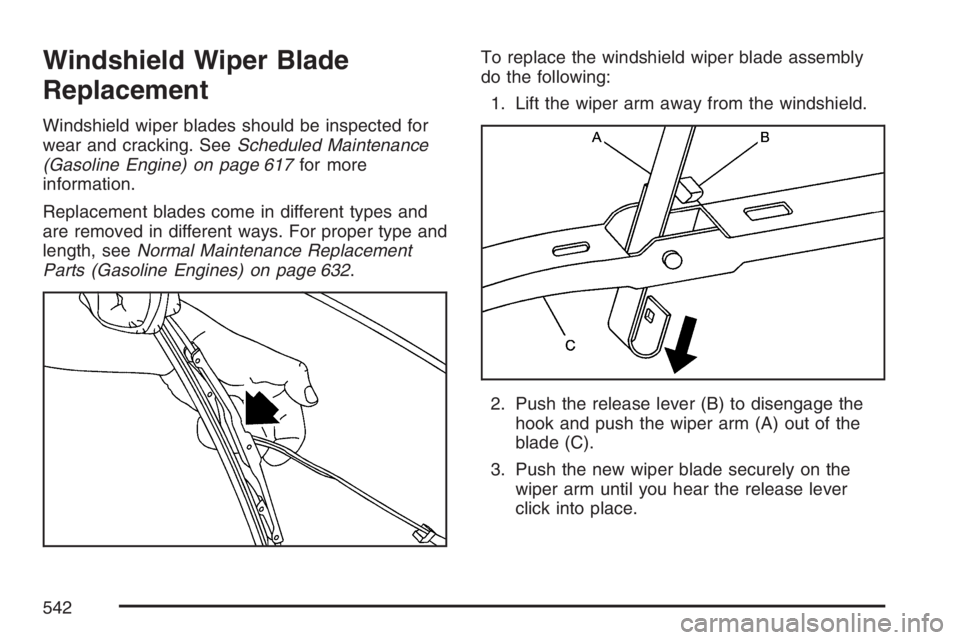
1. Lift the wiper arm away from the windshield.
2. Push the release lever (B) to disengage the
hook and push the wiper arm (A) out of the
blade (C).
3. Push the new wiper blade securely on the
wiper arm until you hear the release lever
click into place.
542
Page 547 of 674
(F) Tire Ply Material:The type of cord and
number of plies in the sidewall and under
the tread.
(G) Single Tire Maximum Load:Maximum load
that can be carried and the maximum pressure
needed to support that load when used as a
single. For information on recommended
tire pressure seeInation - Tire Pressure on
page 551andLoading Your Vehicle on page 409.
Tire Size
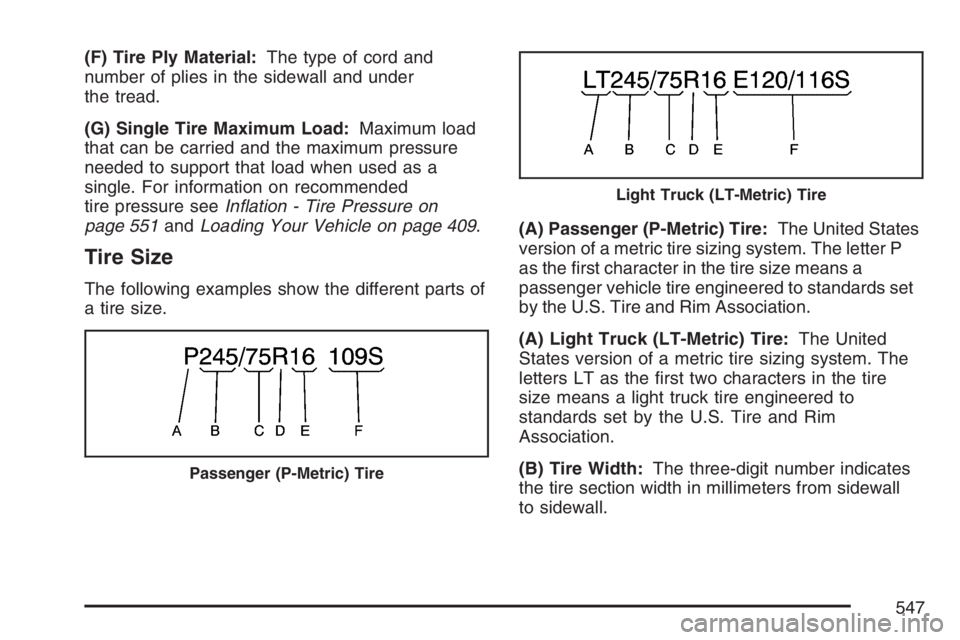
The following examples show the different parts of
a tire size.(A) Passenger (P-Metric) Tire:The United States
version of a metric tire sizing system. The letter P
as the rst character in the tire size means a
passenger vehicle tire engineered to standards set
by the U.S. Tire and Rim Association.
(A) Light Truck (LT-Metric) Tire:The United
States version of a metric tire sizing system. The
letters LT as the rst two characters in the tire
size means a light truck tire engineered to
standards set by the U.S. Tire and Rim
Association.
(B) Tire Width:The three-digit number indicates
the tire section width in millimeters from sidewall
to sidewall.
Passenger (P-Metric) Tire
Light Truck (LT-Metric) Tire
547