automatic transmission GMC SIERRA CLASSIC 2007 User Guide
[x] Cancel search | Manufacturer: GMC, Model Year: 2007, Model line: SIERRA CLASSIC, Model: GMC SIERRA CLASSIC 2007Pages: 674, PDF Size: 3.5 MB
Page 142 of 674
{CAUTION:
If you have four-wheel drive, your vehicle
will be free to roll — even if your shift
lever is in PARK (P) — if your transfer
case is in NEUTRAL. So, be sure the
transfer case is in a drive gear, two-wheel
high (2H) or four-wheel high (4H) or
four-wheel low (4L) — not in NEUTRAL.
SeeShifting Into Park (P) (Automatic
Transmission) on page 170.
REVERSE (R):Use this gear to back up. If your
vehicle has the Allison Transmission
®,theRonthe
shift display, may blink if the shift inhibitor is active.
Notice:Shifting to REVERSE (R) while your
vehicle is moving forward could damage the
transmission. The repairs would not be covered
by your warranty. Shift to REVERSE (R) only
after your vehicle is stopped.
To rock your vehicle back and forth to get out of
snow, ice, or sand without damaging your
transmission, seeIf Your Vehicle is Stuck in Sand,
Mud, Ice, or Snow on page 406.NEUTRAL (N):In this position, your engine does
not connect with the wheels. To restart when
you are already moving, use NEUTRAL (N) only.
Also, use NEUTRAL (N) when your vehicle is
being towed.
{CAUTION:
Shifting into a drive gear while your
engine is running at high speed is
dangerous. Unless your foot is rmly on
the brake pedal, your vehicle could move
very rapidly. You could lose control and
hit people or objects. Do not shift into a
drive gear while your engine is running at
high speed.
Notice:Shifting out of PARK (P) or
NEUTRAL (N) with the engine running at high
speed may damage the transmission. The
repairs would not be covered by your warranty.
Be sure the engine is not running at high
speed when shifting your vehicle.
142
Page 143 of 674
DRIVE (D):This position is for normal driving. It
provides the best fuel economy for your vehicle. If
you need more power for passing, and you are:
Going less than about 35 mph (55 km/h), push
your accelerator pedal about halfway down.
Going about 35 mph (55 km/h) or more, push
the accelerator all the way down.
By doing this, the vehicle shifts down to the
next gear and has more power.
Downshifting the transmission in slippery road
conditions could result in skidding, see “Skidding”
underLoss of Control on page 371
DRIVE (D) can be used when towing a trailer,
carrying a heavy load, driving on steep hills, or for
off-road driving. You may want to shift the
transmission to THIRD (3) or, if necessary, a lower
gear selection if the transmission shifts too often.
If your vehicle has the Allison Transmission
®, it will
shift into rst range when DRIVE (D) is selected.
As vehicle speed increases, the transmission
will upshift automatically through each available
range up to SIXTH (6). As the vehicle slows,
the transmission will downshift automatically.The Allison Transmission
®uses a shift stabilization
feature that adjusts the transmission shifting to
the current driving conditions in order to reduce
rapid upshifts and downshifts. This shift
stabilization feature is designed to determine
before making an upshift if the engine will be able
to maintain vehicle speed by analyzing things
such as throttle position, vehicle load, and
hill grade. If the shift stabilization feature
determines that current vehicle speed cannot be
maintained, the transmission does not upshift
and instead holds the current gear. In some cases,
this may appear to be a delayed shift, however
the transmission is operating normally.
The Allison Transmission
®also uses adaptive shift
controls. Adaptive shift controls continually
compares key shift parameters to pre-programmed
ideal shift conditions. The Allison Transmission
®
constantly makes adjustments to improve vehicle
performance according to the way the vehicle is
being used, such as with a heavy load. During this
adaptive shift controls process, some shifts may
feel different as the transmission determines
optimum settings for a particular shift.
143
Page 144 of 674
MANUAL MODE (M):This position, is available
on vehicles with the Allison Transmission®.It
lets drivers select the range of gears appropriate
for current driving conditions. If your vehicle
has this feature, see Range Select Mode (Allison
Transmission
®) later in this section.
THIRD (3):This position is also used for normal
driving. However, it reduces vehicle speed
more than DRIVE (D) without using your brakes.
You might choose THIRD (3) instead of DRIVE (D)
when driving on hilly, winding roads, when
towing a trailer, so there is less shifting between
gears and when going down a steep hill.
SECOND (2):This position reduces vehicle speed
even more than THIRD (3) without using your
brakes. You can use SECOND (2) on hills. It can
help control your speed as you go down steep
mountain roads, but then you would also want to
use your brakes off and on.
If you manually select SECOND (2) in an
automatic transmission, the transmission will start
in second gear. You can use this feature for
reducing the speed of the rear wheels when you
are trying to start your vehicle from a stop on
slippery road surfaces.For an Allison Transmission
®, see Low Traction
Mode later in this section.
FIRST (1):For an automatic transmission, this
position reduces vehicle speed even more than
SECOND (2) without using your brakes. You can
use it on very steep hills, or in deep snow or mud. If
the shift lever is put in FIRST (1) while the vehicle is
moving forward, the transmission will not shift into
rst gear until the vehicle is going slowly enough.
For an Allison Transmission
®, This position reduces
vehicle speed, without using your brakes. You can
use it for major/sever downgrades and off-road
driving where the vehicle would otherwise
accelerate due to steepness of grade. When you
shift to FIRST (1) it will provide the lowest gear
appropriate to your current road speed and will
continue to downshift as the vehicle slows,
eventually downshifting to FIRST (1) gear.
Notice:Spinning the tires or holding the
vehicle in one place on a hill using only the
accelerator pedal may damage the
transmission. The repair will not be covered by
your warranty. If you are stuck, do not spin
the tires. When stopping on a hill, use the
brakes to hold the vehicle in place.
144
Page 146 of 674
Low Traction Mode
(Allison Transmission®)
If your vehicle has the DURAMAX®diesel engine
and the Allison Transmission®,ithasaLow
Traction Mode that assists in vehicle acceleration
when road conditions are slippery, such as
with ice or snow. While at a stop, selecting the
second gear range using the Range Selection
system, will allow the Allison Transmission
®to limit
torque to the wheels after it detects wheel slip,
preventing the tires from spinning.
Notice:Spinning the tires or holding the
vehicle in one place on a hill using only the
accelerator pedal may damage the
transmission. The repair will not be covered by
your warranty. If you are stuck, do not spin
the tires. When stopping on a hill, use the
brakes to hold the vehicle in place.
Cold Weather Operation
(Allison Transmission®)
On cold days, approximately 32°F (0°C) or colder,
your automatic transmission is designed to shift
differently. The transmission uses a warm-up mode
shift schedule until the engine reaches normal
operating temperature. While the transmission is
in warm-up mode it is normal for transmission
upshifts to be delayed or held longer. This feature
improves heater performance by giving quicker
vehicle warm-ups.
When temperatures are below−13°F (−25°C), the
transmission will prevent certain operations to
protect against damage. When active the DIC will
display the message “Trans in Warm-up”.
SeeDIC Warnings and Messages on page 270for
more information.
146
Page 147 of 674
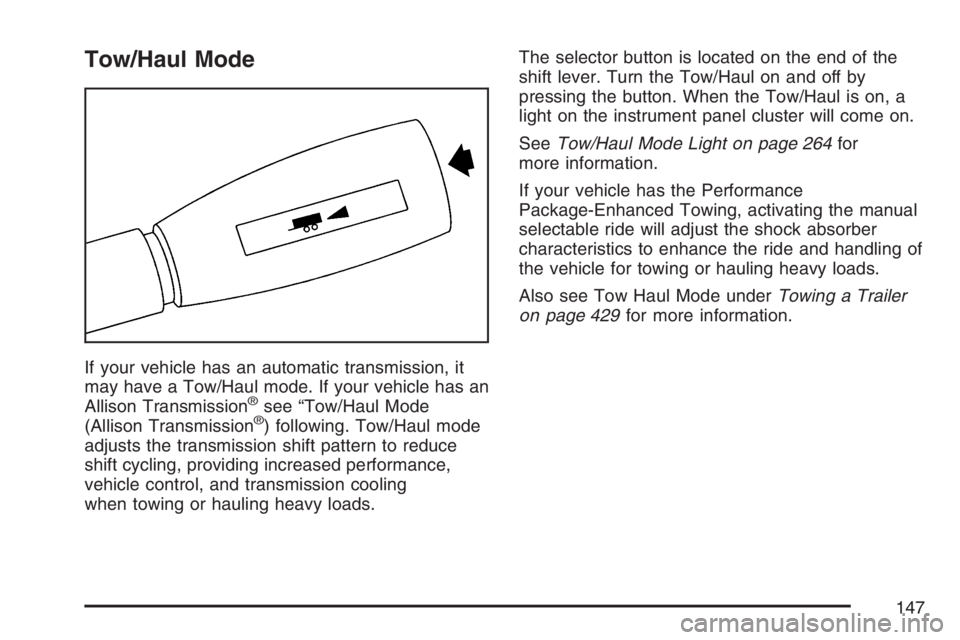
Tow/Haul Mode
If your vehicle has an automatic transmission, it
may have a Tow/Haul mode. If your vehicle has an
Allison Transmission
®see “Tow/Haul Mode
(Allison Transmission®) following. Tow/Haul mode
adjusts the transmission shift pattern to reduce
shift cycling, providing increased performance,
vehicle control, and transmission cooling
when towing or hauling heavy loads.The selector button is located on the end of the
shift lever. Turn the Tow/Haul on and off by
pressing the button. When the Tow/Haul is on, a
light on the instrument panel cluster will come on.
SeeTow/Haul Mode Light on page 264for
more information.
If your vehicle has the Performance
Package-Enhanced Towing, activating the manual
selectable ride will adjust the shock absorber
characteristics to enhance the ride and handling of
the vehicle for towing or hauling heavy loads.
Also see Tow Haul Mode underTowing a Trailer
on page 429for more information.
147
Page 148 of 674
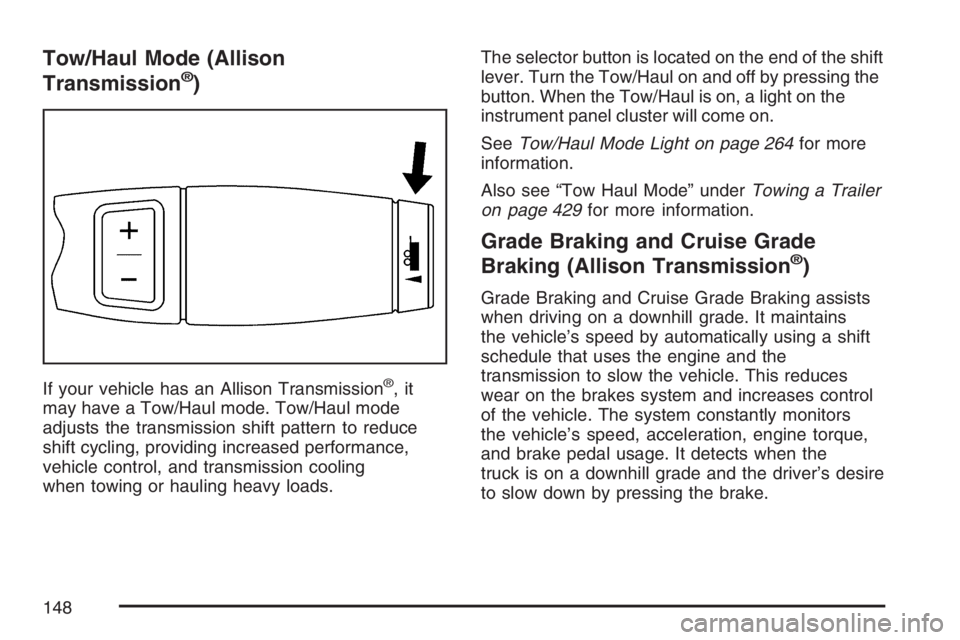
Tow/Haul Mode (Allison
Transmission®)
If your vehicle has an Allison Transmission®,it
may have a Tow/Haul mode. Tow/Haul mode
adjusts the transmission shift pattern to reduce
shift cycling, providing increased performance,
vehicle control, and transmission cooling
when towing or hauling heavy loads.The selector button is located on the end of the shift
lever. Turn the Tow/Haul on and off by pressing the
button. When the Tow/Haul is on, a light on the
instrument panel cluster will come on.
SeeTow/Haul Mode Light on page 264for more
information.
Also see “Tow Haul Mode” underTowing a Trailer
on page 429for more information.
Grade Braking and Cruise Grade
Braking (Allison Transmission®)
Grade Braking and Cruise Grade Braking assists
when driving on a downhill grade. It maintains
the vehicle’s speed by automatically using a shift
schedule that uses the engine and the
transmission to slow the vehicle. This reduces
wear on the brakes system and increases control
of the vehicle. The system constantly monitors
the vehicle’s speed, acceleration, engine torque,
and brake pedal usage. It detects when the
truck is on a downhill grade and the driver’s desire
to slow down by pressing the brake.
148
Page 149 of 674
Cruise Grade Braking is available on the 6.6L
DURAMAX®diesel engine. Cruise Grade Braking
monitors a vehicle’s cruise state, engine torque,
acceleration, vehicle speed, and the cruise set
speed. Using this information, it detects when the
truck is accelerating on a downhill grade and will
automatically downshift to slow the vehicle if it
exceeds the cruise set speed by a certain amount.
SeeCruise Control on page 217for more
information.
The Tow/Haul mode and Grade Braking shift
modes can be activated by pressing the button on
the end of the shift control stalk. If your vehicle
has the DURAMAX
®diesel Engine or the
8.1L VORTEC™ gasoline engine, Grade Braking
is only available while the Tow/Haul Mode is
selected. While in the Range Selection Mode,
Grade Braking is deactivated allowing the driver to
select a desired range of gears.
SeeAutomatic Transmission Operation on
page 140for more information.
Also seeTowing a Trailer on page 429for more
information.
Manual Transmission Operation
Five-Speed
(VORTEC™ 6.0L V8 Engine)
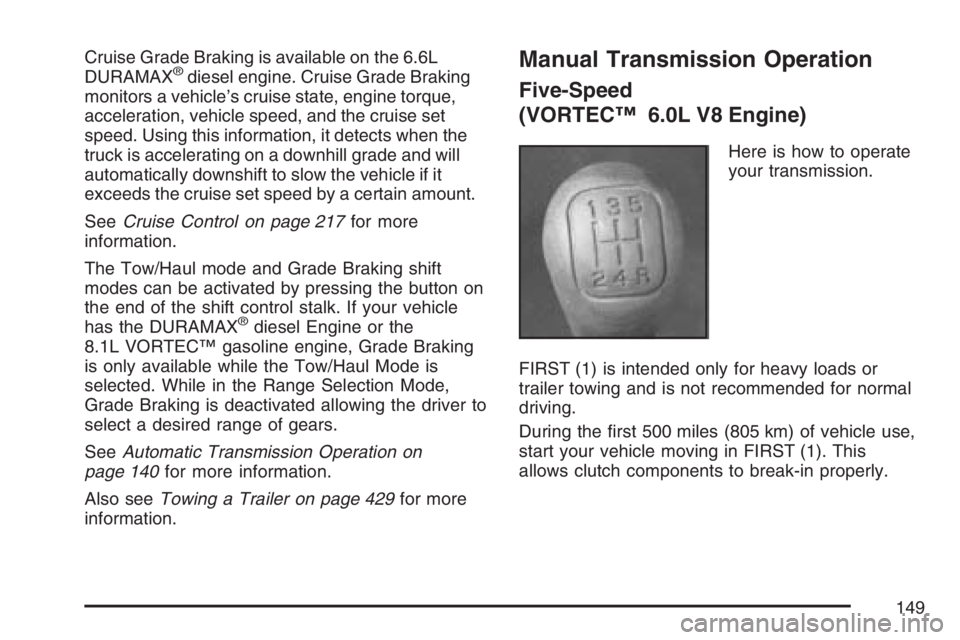
Here is how to operate
your transmission.
FIRST (1) is intended only for heavy loads or
trailer towing and is not recommended for normal
driving.
During the rst 500 miles (805 km) of vehicle use,
start your vehicle moving in FIRST (1). This
allows clutch components to break-in properly.
149
Page 153 of 674
When this light comes on, you can shift to the next
higher gear if weather, road and traffic conditions
allow. For the best fuel economy, accelerate slowly
and shift when the light comes on.
While you accelerate, it is normal for the light to
go on and off if you quickly change the position of
the accelerator.
If your vehicle has four-wheel drive and has a
manual transmission, disregard the shift light when
the transfer case is in Four-Wheel Low.
Ignore the shift light when you downshift.
Four-Wheel Drive
If your vehicle has four-wheel drive, you can send
your engine’s driving power to all four wheels
for extra traction. To get the most satisfaction out
of four-wheel drive, you must be familiar with
its operation. Read the part that follows before
using four-wheel drive. See the appropriate text for
the transfer case in your vehicle.
While driving on clean dry pavement and during
tight turns, you may experience a vibration in
the steering system.
Front Axle Locking Feature
The front axle locks and unlocks automatically
when you shift the transfer case. Some delay for
the axle to lock or unlock is normal.
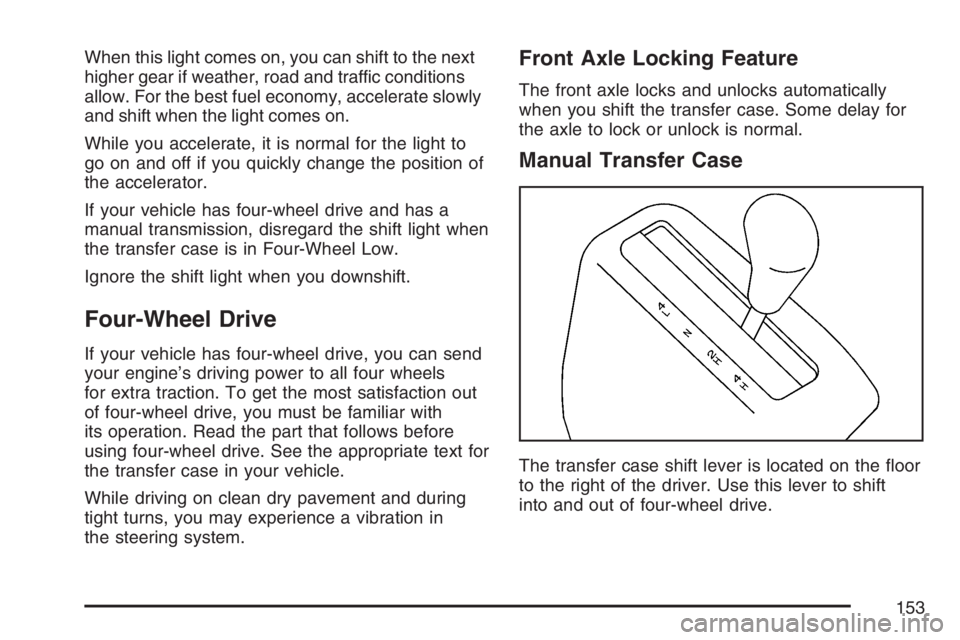
Manual Transfer Case
The transfer case shift lever is located on the oor
to the right of the driver. Use this lever to shift
into and out of four-wheel drive.
153
Page 157 of 674
Shifting In or Out of 4L (Four-Wheel
Drive Low)
Notice:Shifting the transfer case into 4L
while moving at speeds faster than 3 mph
(5 km/h) may cause premature wear to
the transfer case, and may cause the gears to
grind. To avoid causing premature wear,
and grinding the gears, do not shift the transfer
case into 4L while the vehicle is moving
faster than 3 mph (5 km/h).
Shifts into 4L can be made with the vehicle at a
stop, or while slowly rolling about 1 to 3 mph
(2 to 5 km/h).
Shift the automatic transmission into
NEUTRAL (N), or with a manual transmission,
press the clutch pedal, or shift into NEUTRAL.
Shift the transfer case shift lever in one
continuous motion into the 4L position.
When in 4L do not drive faster than 45 mph.
This will reduce wear and extend the life of
the transfer case.
Shifting In or Out of NEUTRAL
1. With the vehicle running and the engine at an
idle set the parking brake and apply the
regular brake.
2. Place the transmission into NEUTRAL (N).
Shift the transfer case in one continuous motion
into or out of the NEUTRAL position.
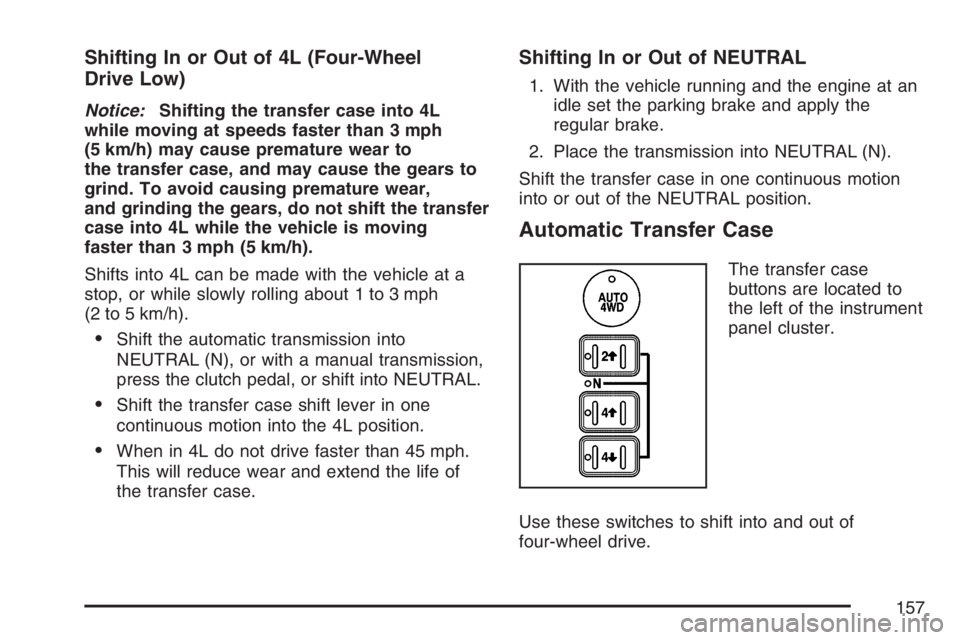
Automatic Transfer Case
The transfer case
buttons are located to
the left of the instrument
panel cluster.
Use these switches to shift into and out of
four-wheel drive.
157
Page 158 of 674
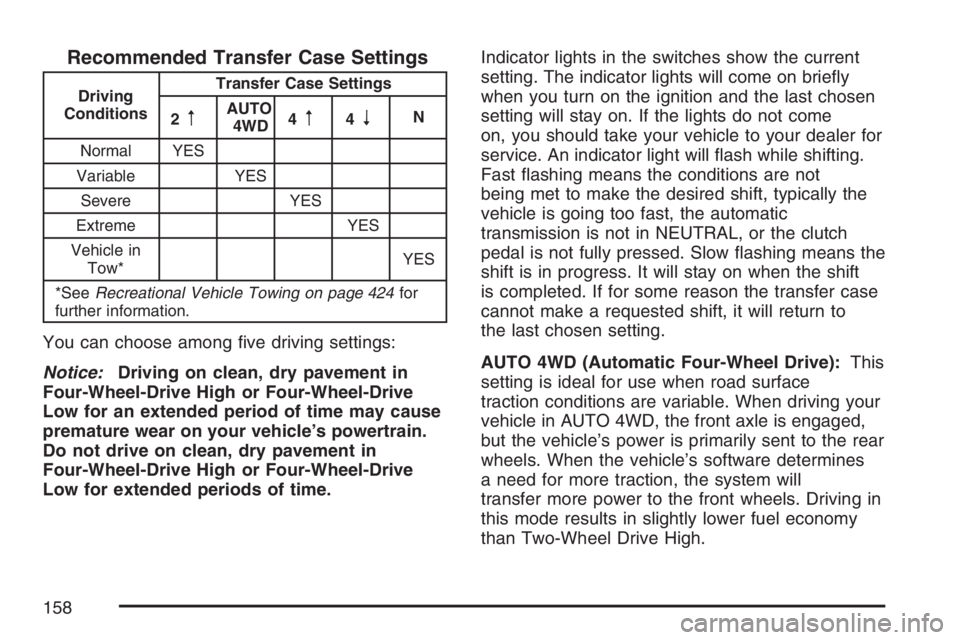
Recommended Transfer Case Settings
Driving
ConditionsTransfer Case Settings
2
mAUTO
4WD4m4nN
Normal YES
Variable YES
Severe YES
Extreme YES
Vehicle in
Tow*YES
*SeeRecreational Vehicle Towing on page 424for
further information.
You can choose among ve driving settings:
Notice:Driving on clean, dry pavement in
Four-Wheel-Drive High or Four-Wheel-Drive
Low for an extended period of time may cause
premature wear on your vehicle’s powertrain.
Do not drive on clean, dry pavement in
Four-Wheel-Drive High or Four-Wheel-Drive
Low for extended periods of time.Indicator lights in the switches show the current
setting. The indicator lights will come on briey
when you turn on the ignition and the last chosen
setting will stay on. If the lights do not come
on, you should take your vehicle to your dealer for
service. An indicator light will ash while shifting.
Fast ashing means the conditions are not
being met to make the desired shift, typically the
vehicle is going too fast, the automatic
transmission is not in NEUTRAL, or the clutch
pedal is not fully pressed. Slow ashing means the
shift is in progress. It will stay on when the shift
is completed. If for some reason the transfer case
cannot make a requested shift, it will return to
the last chosen setting.
AUTO 4WD (Automatic Four-Wheel Drive):This
setting is ideal for use when road surface
traction conditions are variable. When driving your
vehicle in AUTO 4WD, the front axle is engaged,
but the vehicle’s power is primarily sent to the rear
wheels. When the vehicle’s software determines
a need for more traction, the system will
transfer more power to the front wheels. Driving in
this mode results in slightly lower fuel economy
than Two-Wheel Drive High.
158