service indicator GMC SIERRA CLASSIC 2007 User Guide
[x] Cancel search | Manufacturer: GMC, Model Year: 2007, Model line: SIERRA CLASSIC, Model: GMC SIERRA CLASSIC 2007Pages: 674, PDF Size: 3.5 MB
Page 352 of 674
A non-scrubbing action, wet-type cleaner which
uses a cassette with a fabric belt to clean the tape
head can be used. This type of cleaning cassette
will not eject on its own. A non-scrubbing
action cleaner may not clean as thoroughly as the
scrubbing type cleaner. The use of a
non-scrubbing action, dry-type cleaning cassette is
not recommended.
After the player is cleaned, press and hold the
eject button for ve seconds to reset the CLEAN
indicator. The radio will display --- or CLEANED to
show the indicator was reset.
Cassettes are subject to wear and the sound
quality may degrade over time. Always make sure
the cassette tape is in good condition before
the tape player is serviced.Care of Your CDs and DVDs
Handle CDs carefully. Store them in their original
cases or other protective cases and away from
direct sunlight and dust. The CD player scans the
bottom surface of the disc. If the surface of a
CD is damaged, such as cracked, broken,
or scratched, the CD will not play properly or not
at all. If the surface of a CD is soiled, take a
soft, lint free cloth or dampen a clean, soft cloth in
a mild, neutral detergent solution mixed with
water, and clean it. Make sure the wiping process
starts from the center to the edge.
Do not touch the bottom side of a CD while
handling it; this could damage the surface. Pick up
CDs by grasping the outer edges or the edge of
the hole and the outer edge.
Care of the CD and DVD Player
The use of CD lens cleaners for CDs is not
advised, due to the risk of contaminating the lens
of the CD optics with lubricants internal to the
CD mechanism.
352
Page 471 of 674
If your vehicle has the 6.0L V8 engine
(VIN Code N), use premium unleaded gasoline
with a posted octane rating of 91 or higher.
You may also use regular unleaded gasoline rated
at 87 octane or higher, but your vehicle’s
acceleration may be slightly reduced, and you
may notice a slight audible knocking noise,
commonly referred to as spark knock. If the octane
is less than 87, you may notice a heavy knocking
noise when you drive. If this occurs, use a
gasoline rated at 87 octane or higher as soon as
possible. Otherwise, you might damage your
engine. If you are using gasoline rated at
87 octane or higher and you hear heavy knocking,
your engine needs service.
Gasoline Specications
At a minimum, gasoline should meet ASTM
specication D 4814 in the United States or
CAN/CGSB-3.5 in Canada. Some gasolines may
contain an octane-enhancing additive called
methylcyclopentadienyl manganese tricarbonyl
(MMT). General Motors recommends against the
use of gasolines containing MMT. SeeAdditives
on page 472for additional information.
California Fuel
If your vehicle is certied to meet California
Emissions Standards, it is designed to operate on
fuels that meet California specications. See the
underhood emission control label. If this fuel is not
available in states adopting California emissions
standards, your vehicle will operate satisfactorily on
fuels meeting federal specications, but emission
control system performance may be affected. The
malfunction indicator lamp may turn on and your
vehicle may fail a smog-check test. SeeMalfunction
Indicator Lamp on page 258. If this occurs, return to
your authorized GM dealer for diagnosis. If it is
determined that the condition is caused by the type
of fuel used, repairs may not be covered by your
warranty.
471
Page 472 of 674
Additives
To provide cleaner air, all gasolines in the United
States are now required to contain additives
that will help prevent engine and fuel system
deposits from forming, allowing your emission
control system to work properly. In most cases,
you should not have to add anything to your
fuel. However, some gasolines contain only the
minimum amount of additive required to meet U.S.
Environmental Protection Agency regulations.
To help keep fuel injectors and intake valves clean,
or if your vehicle experiences problems due to
dirty injectors or valves, look for gasoline that is
advertised as TOP TIER Detergent Gasoline.
Also, your GM dealer has additives that will help
correct and prevent most deposit-related problems.
Gasolines containing oxygenates, such as
ethers and ethanol, and reformulated gasolines
may be available in your area. General Motors
recommends that you use these gasolines if they
comply with the specications described earlier.
However, E85 (85% ethanol) and other fuels
containing more than 10% ethanol must not be
used in vehicles that were not designed for
those fuels.Notice:Your vehicle was not designed for
fuel that contains methanol. Do not use
fuel containing methanol. It can corrode metal
parts in your fuel system and also damage
the plastic and rubber parts. That damage
would not be covered under your warranty.
Some gasolines that are not reformulated for low
emissions may contain an octane-enhancing
additive called methylcyclopentadienyl manganese
tricarbonyl (MMT); ask the attendant where you
buy gasoline whether the fuel contains MMT.
General Motors recommends against the use of
such gasolines. Fuels containing MMT can reduce
the life of spark plugs and the performance of
the emission control system may be affected. The
malfunction indicator lamp may turn on. If this
occurs, return to your authorized GM dealer
for service.
472
Page 519 of 674
Brake Wear
Your vehicle has front disc brakes and may have
rear drum brakes or rear disc brakes.
Disc brake pads have built-in wear indicators that
make a high-pitched warning sound when the
brake pads are worn and new pads are needed.
The sound may come and go or be heard all
the time your vehicle is moving, except when you
are pushing on the brake pedal rmly.
{CAUTION:
The brake wear warning sound means that
soon your brakes will not work well. That
could lead to an accident. When you hear
the brake wear warning sound, have your
vehicle serviced.
Notice:Continuing to drive with worn-out
brake pads could result in costly brake repair.
Some driving conditions or climates may cause
a brake squeal when the brakes are rst applied or
lightly applied. This does not mean something is
wrong with your brakes.Properly torqued wheel nuts are necessary to help
prevent brake pulsation. When tires are rotated,
inspect brake pads for wear and evenly tighten
wheel nuts in the proper sequence to GM torque
specications.
If you have rear drum brakes, they do not have
wear indicators, but if you ever hear a rear brake
rubbing noise, have the rear brake linings
inspected immediately. Rear brake drums should
be removed and inspected each time the tires
are removed for rotation or changing. Drum brakes
have an inspection hole to inspect lining wear
during scheduled maintenance. When you have
the front brake pads replaced, have the rear
brakes inspected, too.
Brake linings should always be replaced as
complete axle sets.
Brake Pedal Travel
See your dealer if the brake pedal does not return
to normal height, or if there is a rapid increase in
pedal travel. This could be a sign of brake trouble.
Brake Adjustment
Every time you make a brake stop, your brakes
adjust for wear.
519
Page 619 of 674
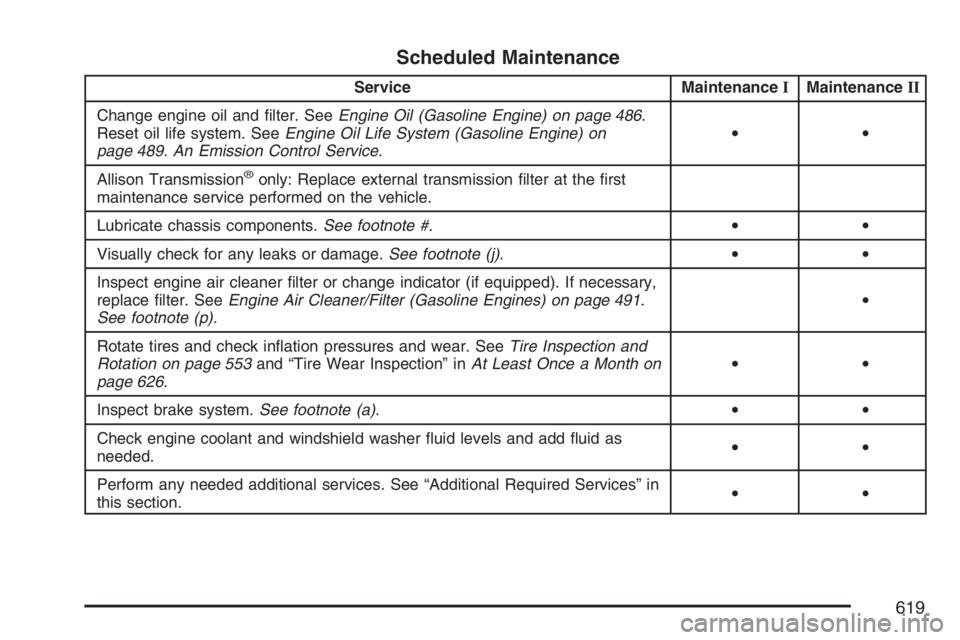
Scheduled Maintenance
Service MaintenanceIMaintenanceII
Change engine oil and lter. SeeEngine Oil (Gasoline Engine) on page 486.
Reset oil life system. SeeEngine Oil Life System (Gasoline Engine) on
page 489.An Emission Control Service.••
Allison Transmission
®only: Replace external transmission lter at the rst
maintenance service performed on the vehicle.
Lubricate chassis components.See footnote #.••
Visually check for any leaks or damage.See footnote (j).••
Inspect engine air cleaner lter or change indicator (if equipped). If necessary,
replace lter. SeeEngine Air Cleaner/Filter (Gasoline Engines) on page 491.
See footnote (p).•
Rotate tires and check ination pressures and wear. SeeTire Inspection and
Rotation on page 553and “Tire Wear Inspection” inAt Least Once a Month on
page 626.••
Inspect brake system.See footnote (a).••
Check engine coolant and windshield washer uid levels and add uid as
needed.••
Perform any needed additional services. See “Additional Required Services” in
this section.••
619
Page 621 of 674
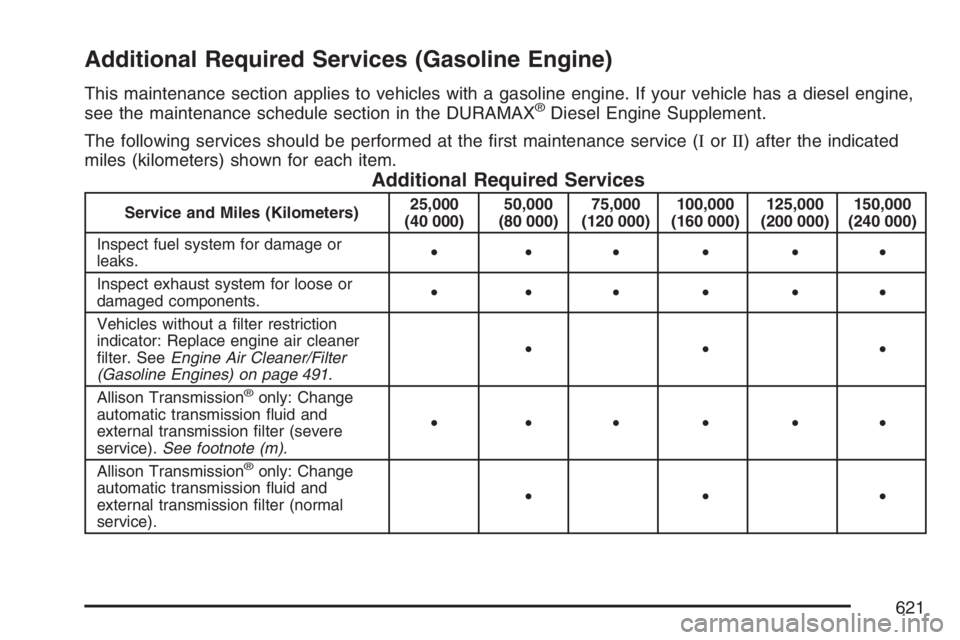
Additional Required Services (Gasoline Engine)
This maintenance section applies to vehicles with a gasoline engine. If your vehicle has a diesel engine,
see the maintenance schedule section in the DURAMAX®Diesel Engine Supplement.
The following services should be performed at the rst maintenance service (IorII) after the indicated
miles (kilometers) shown for each item.
Additional Required Services
Service and Miles (Kilometers)25,000
(40 000)50,000
(80 000)75,000
(120 000)100,000
(160 000)125,000
(200 000)150,000
(240 000)
Inspect fuel system for damage or
leaks.• •••••
Inspect exhaust system for loose or
damaged components.• •••••
Vehicles without a lter restriction
indicator: Replace engine air cleaner
lter. SeeEngine Air Cleaner/Filter
(Gasoline Engines) on page 491.•••
Allison Transmission
®only: Change
automatic transmission uid and
external transmission lter (severe
service).See footnote (m).• •••••
Allison Transmission
®only: Change
automatic transmission uid and
external transmission lter (normal
service).•••
621
Page 625 of 674
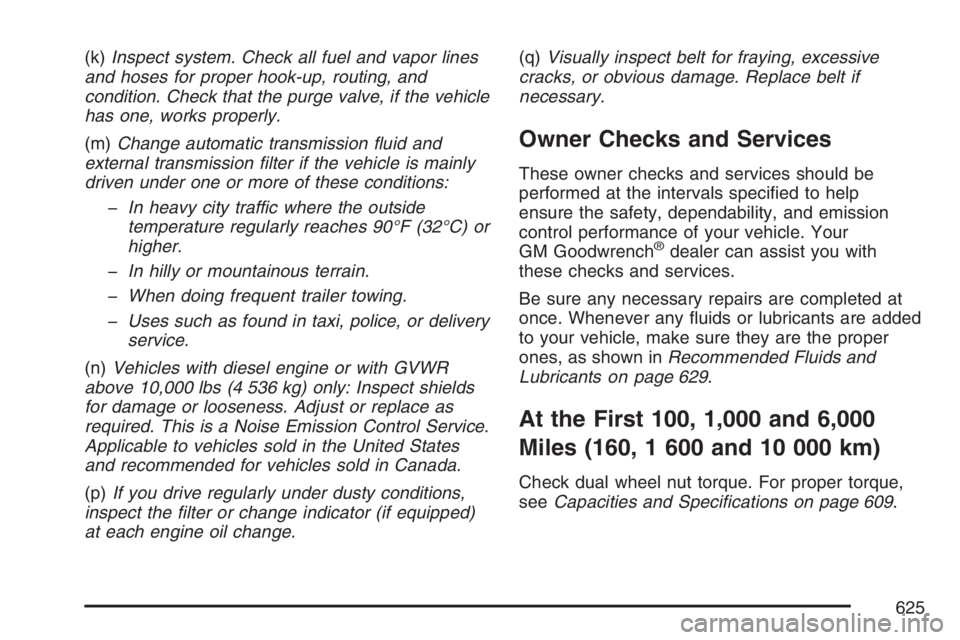
(k)Inspect system. Check all fuel and vapor lines
and hoses for proper hook-up, routing, and
condition. Check that the purge valve, if the vehicle
has one, works properly.
(m)Change automatic transmission uid and
external transmission lter if the vehicle is mainly
driven under one or more of these conditions:
In heavy city traffic where the outside
temperature regularly reaches 90°F (32°C) or
higher.
In hilly or mountainous terrain.
When doing frequent trailer towing.
Uses such as found in taxi, police, or delivery
service.
(n)Vehicles with diesel engine or with GVWR
above 10,000 lbs (4 536 kg) only: Inspect shields
for damage or looseness. Adjust or replace as
required. This is a Noise Emission Control Service.
Applicable to vehicles sold in the United States
and recommended for vehicles sold in Canada.
(p)If you drive regularly under dusty conditions,
inspect the lter or change indicator (if equipped)
at each engine oil change.(q)Visually inspect belt for fraying, excessive
cracks, or obvious damage. Replace belt if
necessary.
Owner Checks and Services
These owner checks and services should be
performed at the intervals specied to help
ensure the safety, dependability, and emission
control performance of your vehicle. Your
GM Goodwrench
®dealer can assist you with
these checks and services.
Be sure any necessary repairs are completed at
once. Whenever any uids or lubricants are added
to your vehicle, make sure they are the proper
ones, as shown inRecommended Fluids and
Lubricants on page 629.
At the First 100, 1,000 and 6,000
Miles (160, 1 600 and 10 000 km)
Check dual wheel nut torque. For proper torque,
seeCapacities and Specications on page 609.
625
Page 667 of 674
Light (cont.)
Passenger Airbag Status Indicator............ 250
Safety Belt Reminder............................... 247
Security................................................... 263
Tow/Haul Mode........................................ 264
Traction Off.............................................. 256
Up-Shift................................................... 254
Lighting
Entry........................................................ 227
Exit.......................................................... 227
Loading Your Vehicle................................... 409
Locking Rear Axle....................................... 366
Lockout Protection....................................... 126
Locks
Delayed Locking...................................... 122
Door........................................................ 120
Lockout Protection................................... 126
Power Door............................................. 121
Programmable Automatic Door Locks....... 123
Rear Door Security Locks........................ 126
Loss of Control........................................... 371
Low Fuel Warning Light............................... 265
Lumbar
Power Controls.......................................... 11M
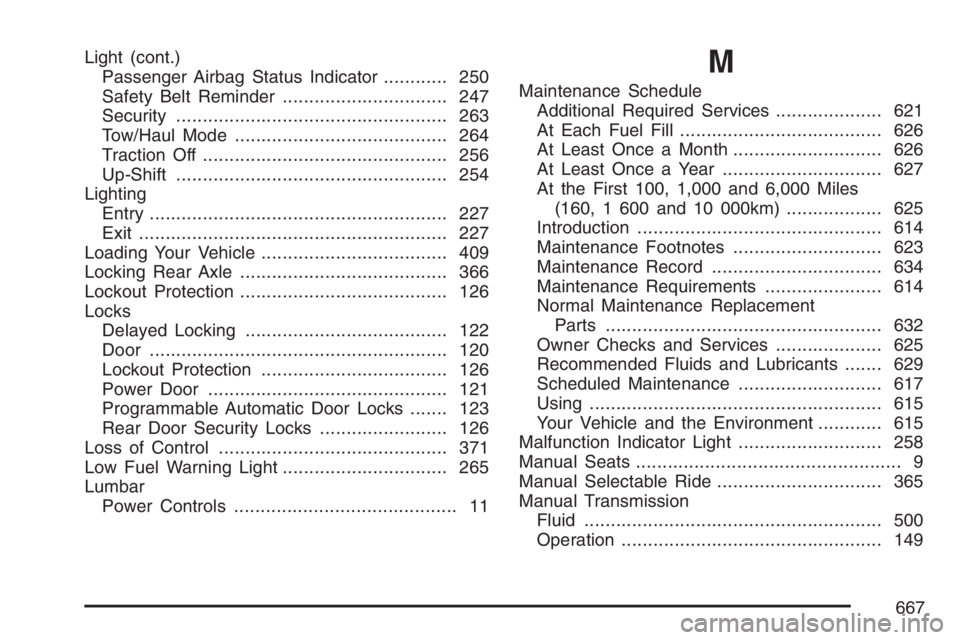
Maintenance Schedule
Additional Required Services.................... 621
At Each Fuel Fill...................................... 626
At Least Once a Month............................ 626
At Least Once a Year .............................. 627
At the First 100, 1,000 and 6,000 Miles
(160, 1 600 and 10 000km).................. 625
Introduction.............................................. 614
Maintenance Footnotes............................ 623
Maintenance Record................................ 634
Maintenance Requirements...................... 614
Normal Maintenance Replacement
Parts.................................................... 632
Owner Checks and Services.................... 625
Recommended Fluids and Lubricants....... 629
Scheduled Maintenance........................... 617
Using....................................................... 615
Your Vehicle and the Environment............ 615
Malfunction Indicator Light........................... 258
Manual Seats.................................................. 9
Manual Selectable Ride............................... 365
Manual Transmission
Fluid........................................................ 500
Operation................................................. 149
667
Page 669 of 674
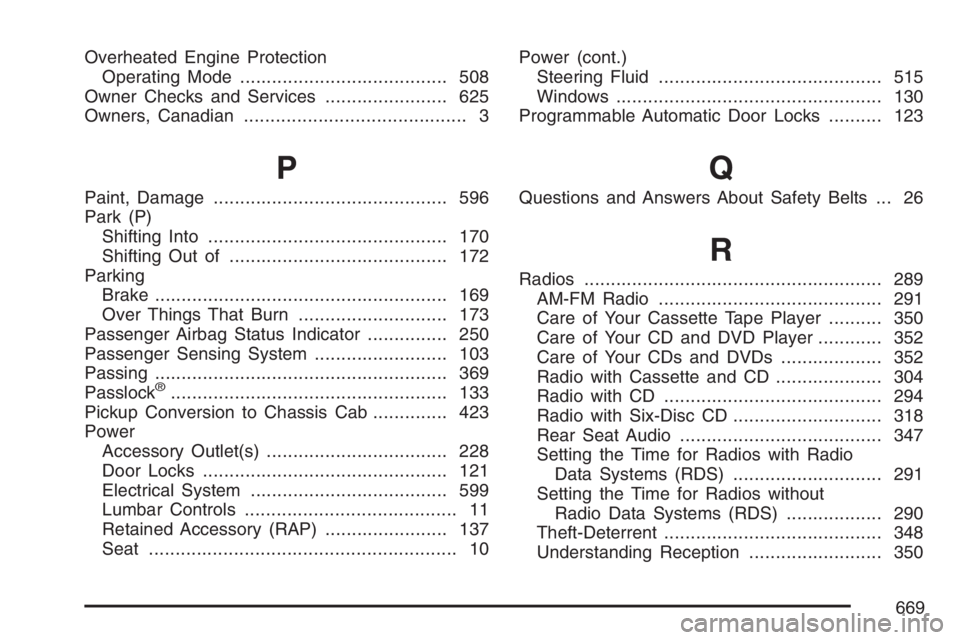
Overheated Engine Protection
Operating Mode....................................... 508
Owner Checks and Services....................... 625
Owners, Canadian.......................................... 3
P
Paint, Damage............................................ 596
Park (P)
Shifting Into............................................. 170
Shifting Out of......................................... 172
Parking
Brake....................................................... 169
Over Things That Burn............................ 173
Passenger Airbag Status Indicator............... 250
Passenger Sensing System......................... 103
Passing....................................................... 369
Passlock
®.................................................... 133
Pickup Conversion to Chassis Cab.............. 423
Power
Accessory Outlet(s).................................. 228
Door Locks.............................................. 121
Electrical System..................................... 599
Lumbar Controls........................................ 11
Retained Accessory (RAP)....................... 137
Seat.......................................................... 10Power (cont.)
Steering Fluid.......................................... 515
Windows.................................................. 130
Programmable Automatic Door Locks.......... 123
Q
Questions and Answers About Safety Belts ... 26
R
Radios........................................................ 289
AM-FM Radio.......................................... 291
Care of Your Cassette Tape Player.......... 350
Care of Your CD and DVD Player............ 352
Care of Your CDs and DVDs................... 352
Radio with Cassette and CD.................... 304
Radio with CD......................................... 294
Radio with Six-Disc CD............................ 318
Rear Seat Audio...................................... 347
Setting the Time for Radios with Radio
Data Systems (RDS)............................ 291
Setting the Time for Radios without
Radio Data Systems (RDS).................. 290
Theft-Deterrent......................................... 348
Understanding Reception......................... 350
669
Page 674 of 674
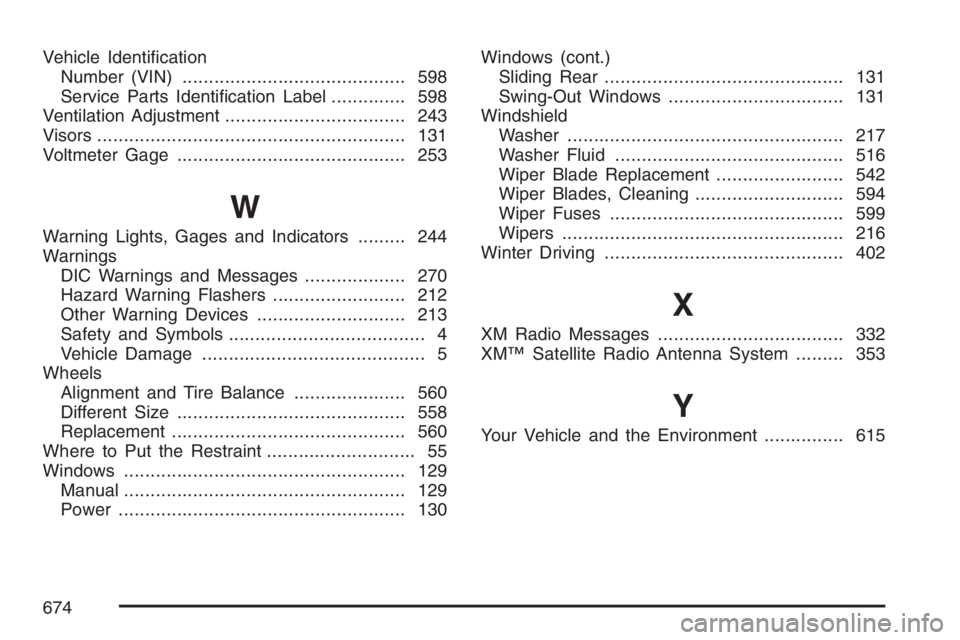
Vehicle Identication
Number (VIN).......................................... 598
Service Parts Identication Label.............. 598
Ventilation Adjustment.................................. 243
Visors.......................................................... 131
Voltmeter Gage........................................... 253
W
Warning Lights, Gages and Indicators......... 244
Warnings
DIC Warnings and Messages................... 270
Hazard Warning Flashers......................... 212
Other Warning Devices............................ 213
Safety and Symbols..................................... 4
Vehicle Damage.......................................... 5
Wheels
Alignment and Tire Balance..................... 560
Different Size........................................... 558
Replacement............................................ 560
Where to Put the Restraint............................ 55
Windows..................................................... 129
Manual..................................................... 129
Power...................................................... 130Windows (cont.)
Sliding Rear............................................. 131
Swing-Out Windows................................. 131
Windshield
Washer.................................................... 217
Washer Fluid........................................... 516
Wiper Blade Replacement........................ 542
Wiper Blades, Cleaning............................ 594
Wiper Fuses............................................ 599
Wipers..................................................... 216
Winter Driving............................................. 402
X
XM Radio Messages................................... 332
XM™ Satellite Radio Antenna System......... 353
Y
Your Vehicle and the Environment............... 615
674